 Скачать презентацию Serving Students with Disabilities in Indiana Office of
eece8a9bfc00baa10afb0d3c9cc6672c.ppt
- Количество слайдов: 21



Serving Students with Disabilities in Indiana Office of Special Education Division of School Improvement
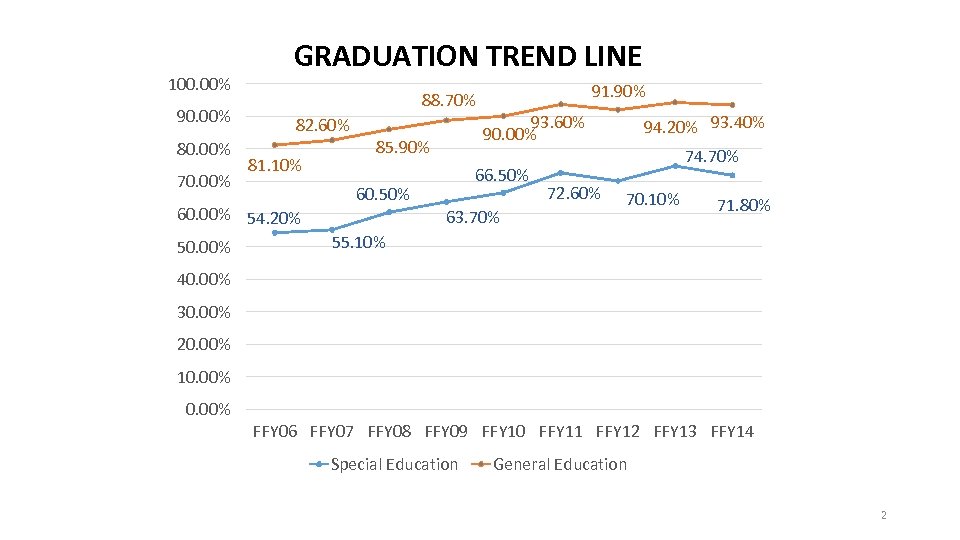
100. 00% 90. 00% 80. 00% 70. 00% GRADUATION TREND LINE 81. 10% 94. 20% 93. 40% 93. 60% 90. 00% 82. 60% 60. 00% 54. 20% 50. 00% 91. 90% 88. 70% 85. 90% 66. 50% 60. 50% 63. 70% 72. 60% 74. 70% 70. 10% 71. 80% 55. 10% 40. 00% 30. 00% 20. 00% 10. 00% FFY 06 FFY 07 FFY 08 FFY 09 FFY 10 FFY 11 FFY 12 FFY 13 FFY 14 Special Education General Education 2
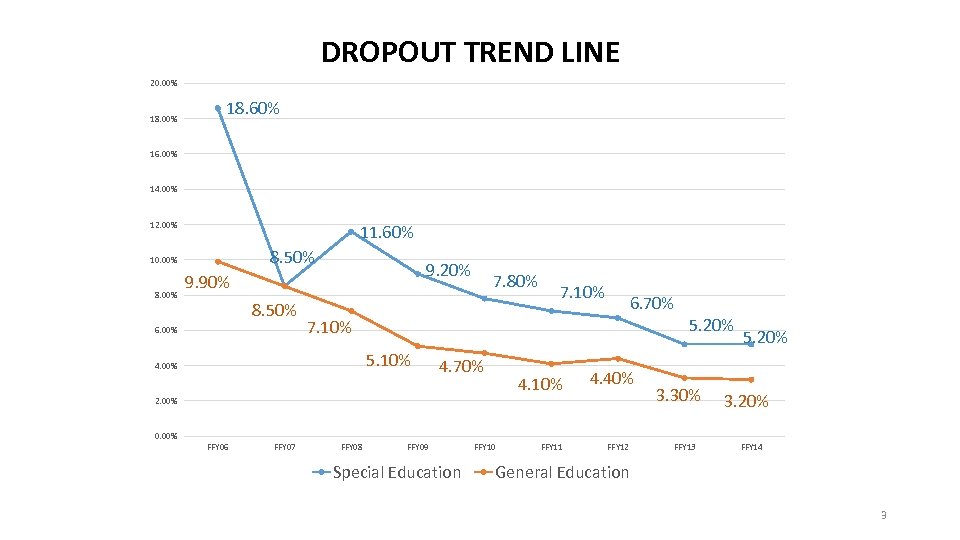
DROPOUT TREND LINE 20. 00% 18. 60% 16. 00% 14. 00% 12. 00% 11. 60% 8. 50% 10. 00% 8. 00% 9. 20% 9. 90% 8. 50% 6. 00% 7. 80% 7. 10% 6. 70% 5. 20% 7. 10% 5. 10% 4. 00% 4. 70% 4. 10% 4. 40% 2. 00% 0. 00% FFY 06 FFY 07 FFY 08 FFY 09 Special Education FFY 10 FFY 11 FFY 12 3. 30% FFY 13 5. 20% 3. 20% FFY 14 General Education 3
Clarifications for Serving Students with Disabilities • Dear Colleague Letter from the Office of Special Education (OSEP), US DOE – November 2015 • Reauthorization of ESEA – December 2015 Now the Every Student Succeeds Act (ESSA)
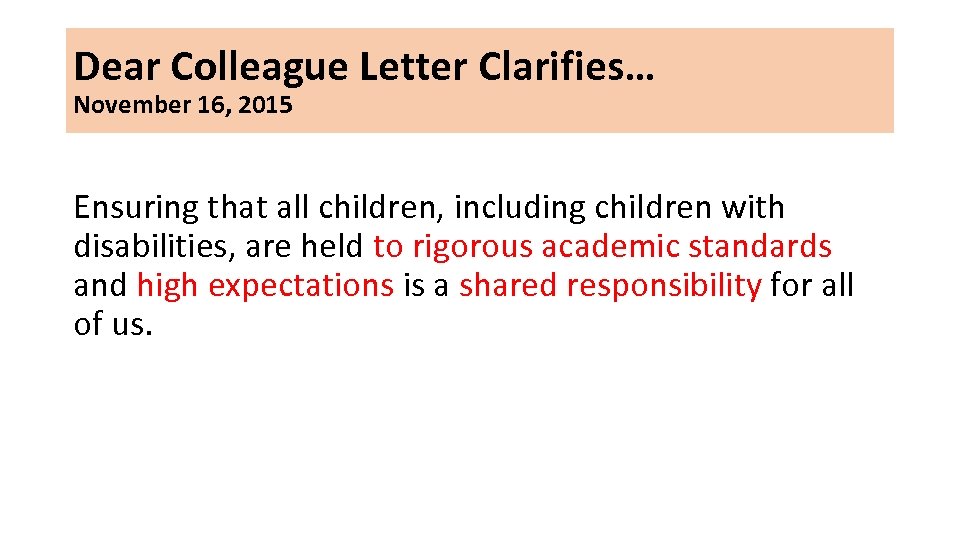
Dear Colleague Letter Clarifies… November 16, 2015 Ensuring that all children, including children with disabilities, are held to rigorous academic standards and high expectations is a shared responsibility for all of us.
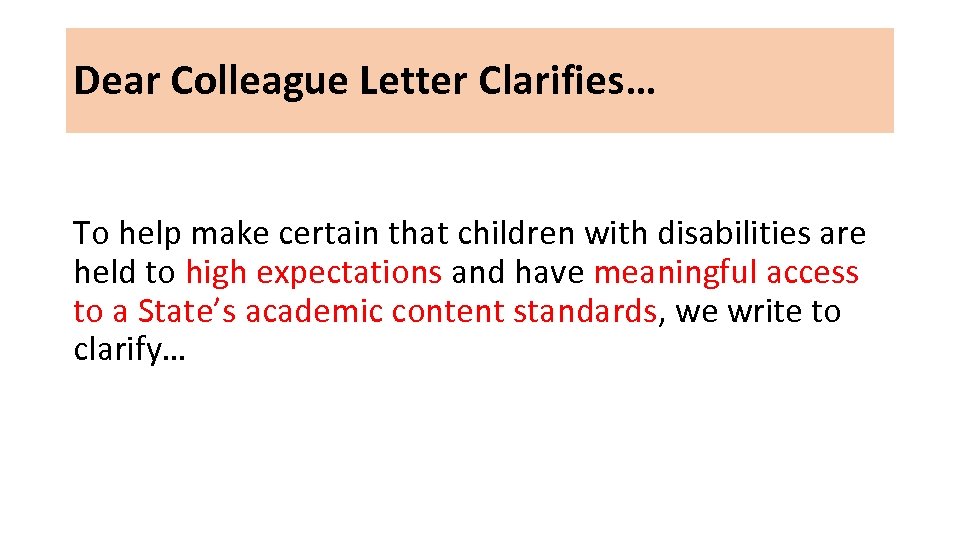
Dear Colleague Letter Clarifies… To help make certain that children with disabilities are held to high expectations and have meaningful access to a State’s academic content standards, we write to clarify…
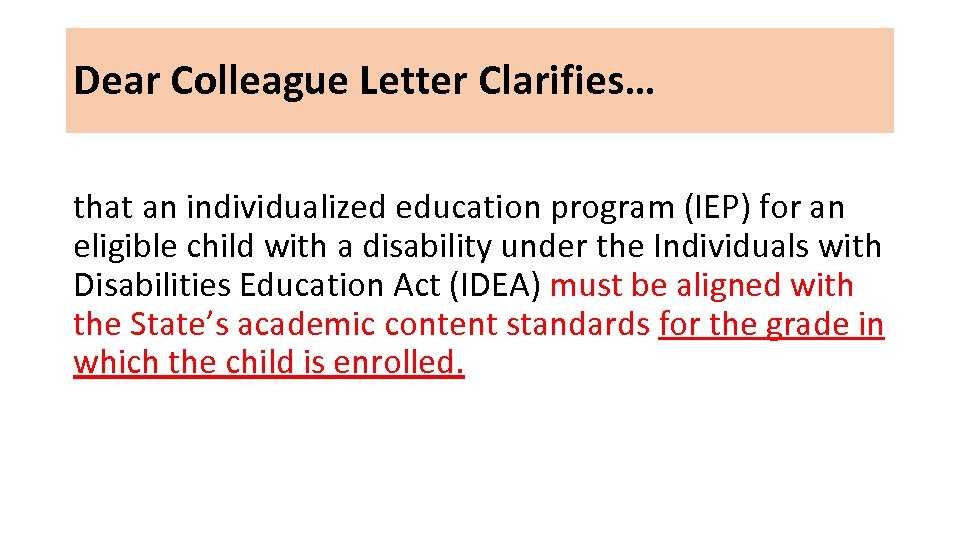
Dear Colleague Letter Clarifies… that an individualized education program (IEP) for an eligible child with a disability under the Individuals with Disabilities Education Act (IDEA) must be aligned with the State’s academic content standards for the grade in which the child is enrolled.
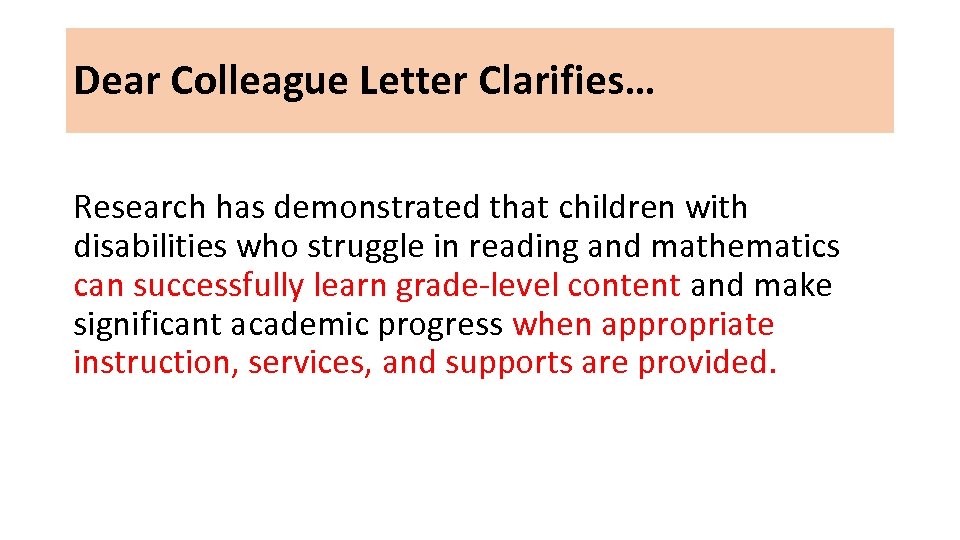
Dear Colleague Letter Clarifies… Research has demonstrated that children with disabilities who struggle in reading and mathematics can successfully learn grade-level content and make significant academic progress when appropriate instruction, services, and supports are provided.
Dear Colleague Letter Clarifies… • Conversely, low expectations can lead to children with disabilities receiving less challenging instruction that reflects below grade-level content standards, and thereby not learning what they need to succeed at the grade in which they are enrolled. • http: //www 2. ed. gov/policy/speced/guid/idea/memosdcltrs/guidance -on-fape-11 -17 -2015. pdf
Dear Colleague Letter Clarifies… Expectations for IEPs • Defines Free Appropriate Public Education (FAPE) as enabling a student to be involved in and make progress in the general education curriculum • Based on the individual needs of the student • Takes into account the impact of the child’s disability on his or her involvement and progress in the general education curriculum. • Goals must be aligned to grade level content standards, must be achievable, must be sufficiently ambitious to close any achievement gaps.
Dear Colleague Letter Clarifies… Interpretation of General Education Curriculum the same curriculum as for nondisabled children based on the State’s academic content standards for the grade in which a child is enrolled, regardless of the severity of the disability.
Dear Colleague Letter Clarifies… Reiterates Definition of Specially Designed Instruction “adapting, as appropriate to the needs of an eligible child, the content, methodology, or delivery of instruction to address the unique needs of the child that result from the child’s disability…so that the child can meet the educational standards…that apply to all children. ” 34 CFR 300. 39(b)(3)
Dear Colleague Letter Clarifies… For those students with significant cognitive disabilities, alternate academic achievement standards • • Must be aligned with grade level standards, May be restricted in scope or complexity or take the form of introductory or pre-requisite skills, CCC team should estimate the student’s growth toward grade level academic standards, Annual IEP goals are sufficiently ambitious to close the gap between the student’s performance and the grade level standards.
Every Student Succeeds Act (ESSA) • Regulations are currently being developed at the federal level, • There are opportunities for stakeholder input and updates • In coming months, IDOE will establish an ESSA Stakeholder Group.
Every Student Succeeds Act (ESSA) • The Act applies to All students and All public schools • Lessens federal requirements and allows states to determine appropriate accountability methods. • Promotes high expectations • Encourages Collaboration and Sharing Responsibility
Key Provisions of ESSA that Impact Students with Disabilities INSTRUCTION • Retains requirements to adopt challenging, academic standards that apply to ALL public schools and their students, including students with disabilities • States may adopt alternate achievement standards
Key Provisions of ESSA that Impact Students with Disabilities ASSESSMENT • States must provide for appropriate accommodations including assistive technology • Must be developed, to the extent practicable, using principles of Universal Design for Learning (UDL). • Parents must be clearly informed if achievement will be measured based on alternate standards.
Key Provisions of ESSA that Impact Students with Disabilities ACCOUNTABILITY • States must set challenging achievement goals for all students and ensure that meaningful progress is made toward those goals. • All students must be measured annually using valid and reliable academic indicators allowing for meaningful differentiation in school performance • States must ensure that for each subject, the total number of students with significant cognitive disabilities assessed using an alternate assessment does not exceed 1 percent of the total number of students in the state who are assessed in that subject.
Key Provisions of ESSA that Impact Students with Disabilities OTHER • States may not preclude a student with the most significant cognitive disabilities who takes an alternate assessment from attempting to complete the requirements for a regular high school. • Prohibits states from counting lesser credentials, such as certificate of completion, certificate of attendance, or GED – as a regular high school diploma.
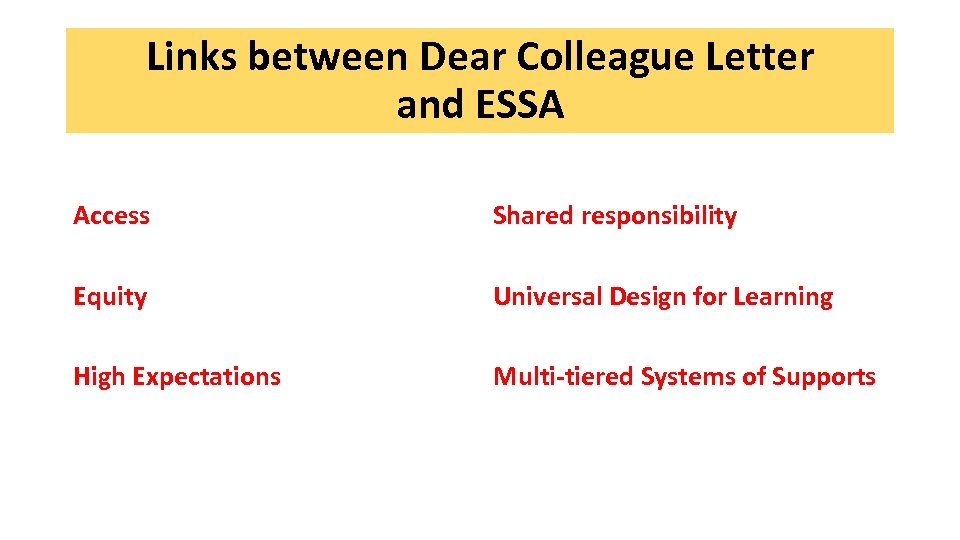
Links between Dear Colleague Letter and ESSA Access Shared responsibility Equity Universal Design for Learning High Expectations Multi-tiered Systems of Supports
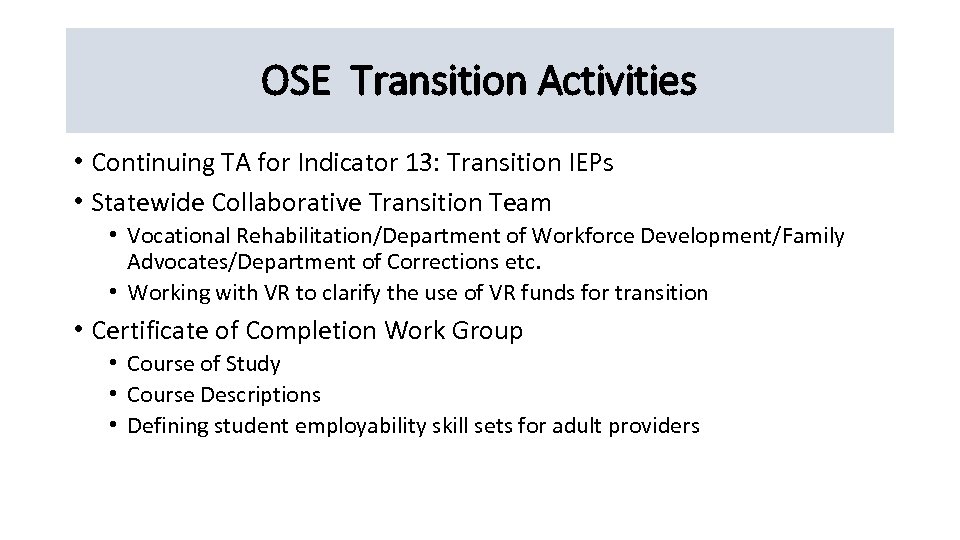
OSE Transition Activities • Continuing TA for Indicator 13: Transition IEPs • Statewide Collaborative Transition Team • Vocational Rehabilitation/Department of Workforce Development/Family Advocates/Department of Corrections etc. • Working with VR to clarify the use of VR funds for transition • Certificate of Completion Work Group • Course of Study • Course Descriptions • Defining student employability skill sets for adult providers
Скачать презентацию Serving Students with Disabilities in Indiana Office of
eece8a9bfc00baa10afb0d3c9cc6672c.ppt