


 Скачать презентацию Training 4 volunteers Sport Volunteering Research Network 18
eca18450f42c54090c82c04ff1971ee0.ppt
- Количество слайдов: 39
 Training 4 volunteers Sport Volunteering Research Network 18 th April 2012
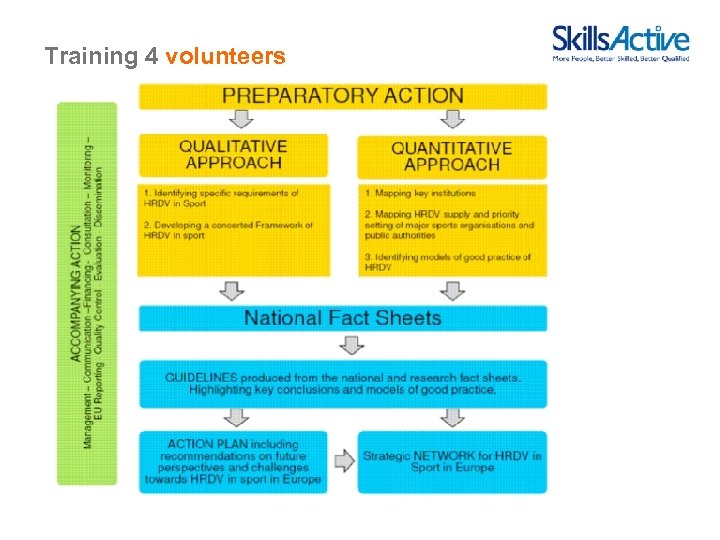
 Training 4 volunteers Background • The Lisbon Treaty created the new EU Competence in the field of sport, and 2011 was been designated the European Year of Volunteering • Call for proposals to implement the 2010 Preparatory Action in the field of sport (EAC/22/2010) • A partnership of 10 partners from 9 different Member States was formed which bid successfully for the project, entitled: • Training 4 Volunteers: Mapping Strategies and Good Practices of Human Resource Development for Volunteers in Sports Organisations in Europe.
 Training 4 volunteers Sport participation • Sport plays an important societal role within Europe • 40 % exercising or participating in sport with some regularity • Overall citizens of the Nordic countries take sport most seriously (up to 72%) • Bulgaria, Greece and Italy having the fewest citizens who play sport regularly at 3%. • Hungary reported just 9% taking part in 2 x 30 minute sessions per week. Source: Special Eurobarometer 334 Sport and Physical Activity
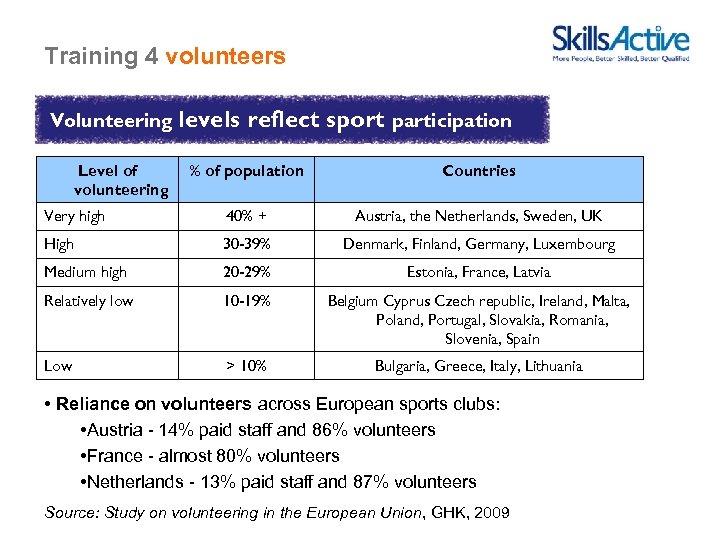 Training 4 volunteers Volunteering Level of volunteering levels reflect sport participation % of population Countries Very high 40% + Austria, the Netherlands, Sweden, UK High 30 -39% Denmark, Finland, Germany, Luxembourg Medium high 20 -29% Estonia, France, Latvia Relatively low 10 -19% Belgium Cyprus Czech republic, Ireland, Malta, Poland, Portugal, Slovakia, Romania, Slovenia, Spain Low > 10% Bulgaria, Greece, Italy, Lithuania • Reliance on volunteers across European sports clubs: • Austria - 14% paid staff and 86% volunteers • France - almost 80% volunteers • Netherlands - 13% paid staff and 87% volunteers Source: Study on volunteering in the European Union, GHK, 2009
 Training 4 volunteers Volunteer characteristics • • Lukka and Ellis argue that “volunteering” is a cultural-centric concept These studies reveal a strong link between higher socio-economic groups / education / earnings and participation and volunteering Men more likely than women to participate* (43% vs 36%) and to volunteer Sport participation decreases with age Younger volunteers were much more likely than older ones to coach*** Older volunteers tended to take on administrative roles*** Our UK experts observed that the “unemployed” do not volunteer – except for young or involuntary retirees Our European experts confirmed the lack of a “culture of volunteering” in parts of Eastern Europe, emerging from a centralised economy Sources: *Special Eurobarometer 334 Sport and Physical Activity / **Study on volunteering in the European Union, GHK, 2009 / ***Sports volunteering in Wales, Sport Wales, 2010
 Training 4 volunteers Project objectives • Set up a comprehensive theoretical framework for the specific human resource development of volunteers (HRDV) • Mapping of strategies and measures of training volunteers in sport organizations across all 27 EU states • Strengths and weaknesses related to education & training of volunteers • Identification of models of good practice Skills. Active’s role: • To review existing desk research on volunteering • To conduct qualitative depth interviews with volunteering “experts” • To fine-tune existing HRDV models • To assess the political and social factors influencing volunteering • To validate the evidence from the literature review • Identify best practice examples of managing volunteers
 Training 4 volunteers
 Training 4 volunteers A Human Resource Development Framework Definitions • • An EU Study on Volunteering carried out in 2009 in the 27 Member States concludes that within voluntary organisations: “Professionalisation of human resource management practices is [. . . ] needed, to improve the recruitment, training and retention of volunteers. (cf pp 19 f), HRDF Definition: • “…comprises all activities associated with human resources planning, recruitment, selection, orientation, training, appraisal, motivation, remuneration, etc. • HRM aims at developing people for and through work in a voluntary sport organization” Volunteer definition: • Volunteers are people who regularly donate their time to sport organisations to carry out activities in a field they are passionate about which out any expectation of financial reward except for possible reimbursement of expenses.
 Training 4 volunteers The project design process • • Skills. Active reviewed key sources of volunteering literature to source models, assess relevance of motivational research and inform the expert ‘topic guide’. Nine experts were interviewed, representing volunteering organisations, sports councils, Skills for the Third Sector, NGBs, and Training providers. Most experts were able to draw on experience from their professional careers AND their own volunteer experiences. An iterative process was adopted allowing new research evidence to be introduced by experts (some unpublished). Interviews included experts from each of the Four Nations in the UK, Germany and Hungary. Additional partner input was received from Lithuania and Bulgaria. Sports represented include Football, Cricket, Lacrosse, Basketball, Ice Hockey, Table Tennis. Thematic analysis conducted to cover all aspects of the design brief and project objectives for the HRDF.
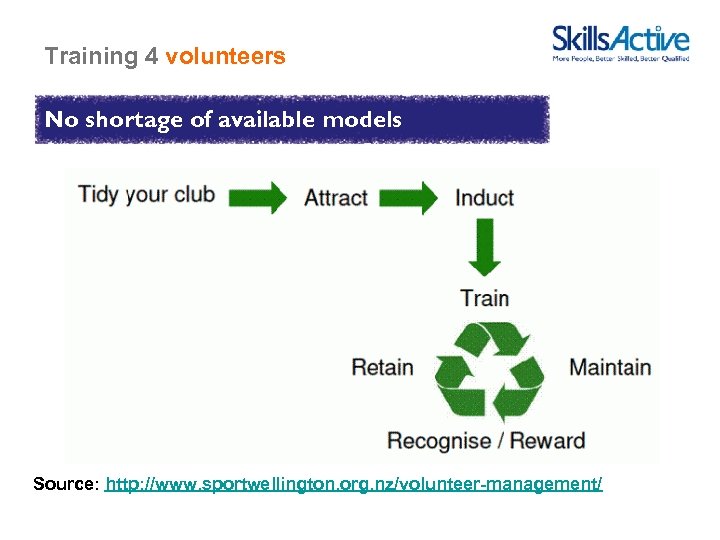 Training 4 volunteers No shortage of available models Source: http: //www. sportwellington. org. nz/volunteer-management/
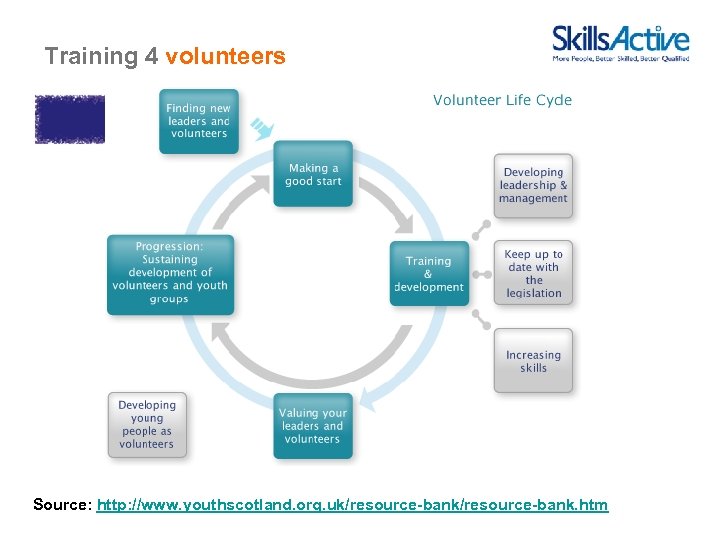 Training 4 volunteers Source: http: //www. youthscotland. org. uk/resource-bank. htm
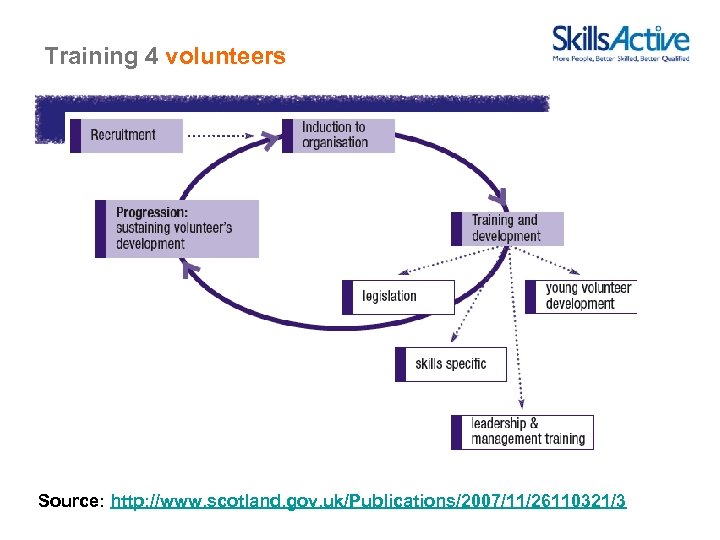 Training 4 volunteers Source: http: //www. scotland. gov. uk/Publications/2007/11/26110321/3
 Training 4 volunteers Five stages of volunteering Haski-Leventhal and Bargal suggest that there are five different stages in volunteering • • • Nominee / new club member Newcomer Emotional involvement Established volunteering Retirement or abandonment Source: The Volunteer Stages and Transitions Model: Organizational Socialization of Volunteers, Haski. Leventhal, D. & Bargal, D. , 2008, Human Relations, 6 (1): 67 -102
 Training 4 volunteers The experts’ view of models • • • Experts questioned the value of a theoretical model… A single model may not suffice to describe multiple routes Individual motivations vary so greatly Expert consensus: different journeys for different volunteers The journey and the motivation may be ‘volunteer defined’*: 1. Students - keen to volunteer in coaching and develop their CV 2. Sport lovers - ex-athletes who are still passionate about their sport 3. Parents - (particularly of children aged 7 -15) take various roles 4. Skilled volunteers - those with the skillset seek administrative roles to give something back to the community e. g. retired bank managers using their skills in sports clubs Source: Sport Wales, Active Adults Survey 2008 -09
 Training 4 volunteers Students • Looking for experience and development opportunities that come with sports volunteering (particularly coaching) • Typically aged between 18 and 25; over half are male • Usually coach rather than taking on other roles • Motivated by a need for experience or to develop a CV • Aspire to a professional sport-related career • Actively seek out opportunities to volunteer
 Training 4 volunteers Sport lovers • As they become older, can no longer compete through injury, or have reached advanced levels of expertise, they become involved in coaching or volunteering • Wide age range, from 20 to 55 • More likely to coach, but older individuals may take on other roles • Motivated by a passion for their sport • May aspire to progress further as a coach • More about creating an opportunity than seeking one
 Training 4 volunteers Parents • Already on the sidelines, they get involved when the club/class expresses a need • Typically aged between 30 and 45 • More likely to coach but take on a variety of roles • Motivated to spend time with, and support, their children • Little desire to progress—involved because they were asked
 Training 4 volunteers Skilled volunteers • Hear about a club’s needs through friends or family, and respond to that need, undertaking tasks such as driving, administration or accounting • Typically aged 45 and above • Tend to take on non-coaching roles • Motivated by a desire to give something back to the community • Tend to be asked through their existing social networks
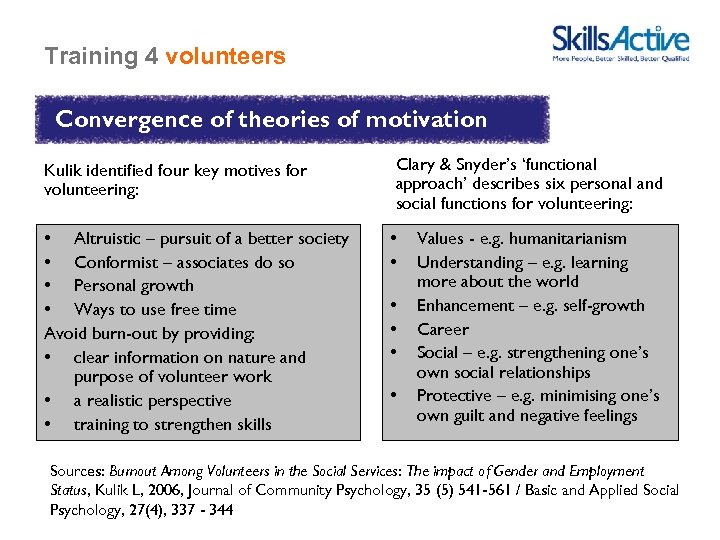 Training 4 volunteers Convergence of theories of motivation Kulik identified four key motives for volunteering: • Altruistic – pursuit of a better society • Conformist – associates do so • Personal growth • Ways to use free time Avoid burn-out by providing: • clear information on nature and purpose of volunteer work • a realistic perspective • training to strengthen skills Clary & Snyder’s ‘functional approach’ describes six personal and social functions for volunteering: • • • Values - e. g. humanitarianism Understanding – e. g. learning more about the world Enhancement – e. g. self-growth Career Social – e. g. strengthening one’s own social relationships Protective – e. g. minimising one’s own guilt and negative feelings Sources: Burnout Among Volunteers in the Social Services: The impact of Gender and Employment Status, Kulik L, 2006, Journal of Community Psychology, 35 (5) 541 -561 / Basic and Applied Social Psychology, 27(4), 337 - 344
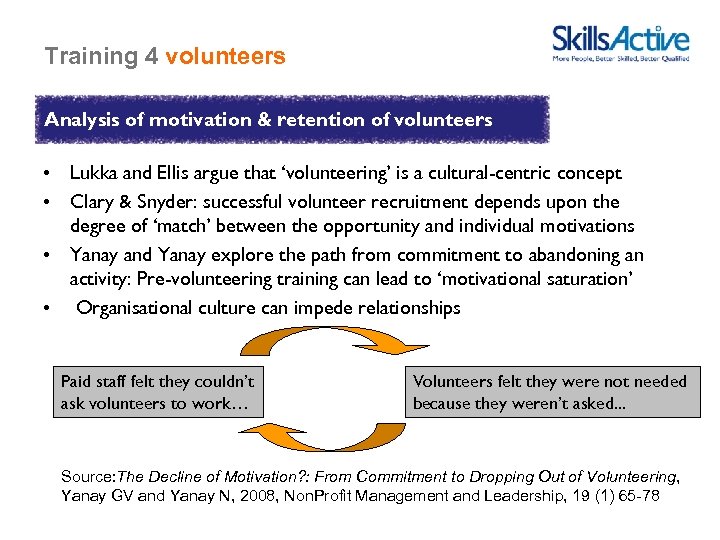 Training 4 volunteers Analysis of motivation & retention of volunteers • Lukka and Ellis argue that ‘volunteering’ is a cultural-centric concept • Clary & Snyder: successful volunteer recruitment depends upon the degree of ‘match’ between the opportunity and individual motivations • Yanay and Yanay explore the path from commitment to abandoning an activity: Pre-volunteering training can lead to ‘motivational saturation’ • Organisational culture can impede relationships Paid staff felt they couldn’t ask volunteers to work… Volunteers felt they were not needed because they weren’t asked. . . Source: The Decline of Motivation? : From Commitment to Dropping Out of Volunteering, Yanay GV and Yanay N, 2008, Non. Profit Management and Leadership, 19 (1) 65 -78
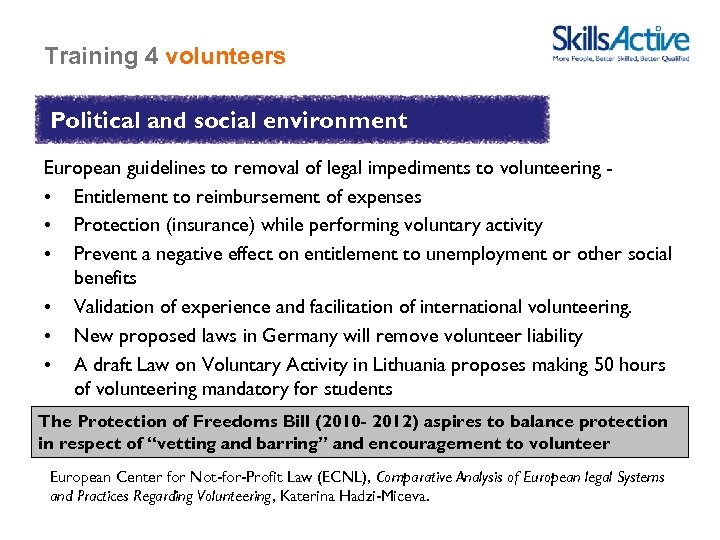 Training 4 volunteers Political and social environment European guidelines to removal of legal impediments to volunteering • Entitlement to reimbursement of expenses • Protection (insurance) while performing voluntary activity • Prevent a negative effect on entitlement to unemployment or other social benefits • Validation of experience and facilitation of international volunteering. • New proposed laws in Germany will remove volunteer liability • A draft Law on Voluntary Activity in Lithuania proposes making 50 hours of volunteering mandatory for students The Protection of Freedoms Bill (2010 - 2012) aspires to balance protection in respect of “vetting and barring” and encouragement to volunteer European Center for Not-for-Profit Law (ECNL), Comparative Analysis of European legal Systems and Practices Regarding Volunteering, Katerina Hadzi-Miceva.
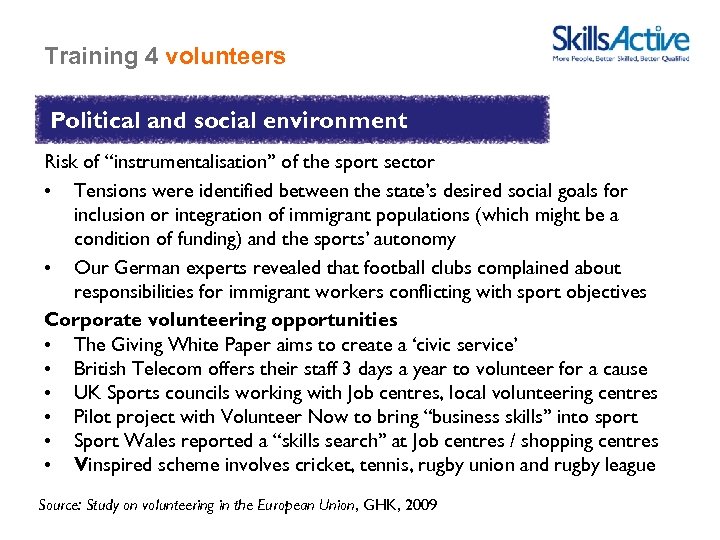 Training 4 volunteers Political and social environment Risk of “instrumentalisation” of the sport sector • Tensions were identified between the state’s desired social goals for inclusion or integration of immigrant populations (which might be a condition of funding) and the sports’ autonomy • Our German experts revealed that football clubs complained about responsibilities for immigrant workers conflicting with sport objectives Corporate volunteering opportunities • The Giving White Paper aims to create a ‘civic service’ • British Telecom offers their staff 3 days a year to volunteer for a cause • UK Sports councils working with Job centres, local volunteering centres • Pilot project with Volunteer Now to bring “business skills” into sport • Sport Wales reported a “skills search” at Job centres / shopping centres • Vinspired scheme involves cricket, tennis, rugby union and rugby league Source: Study on volunteering in the European Union, GHK, 2009
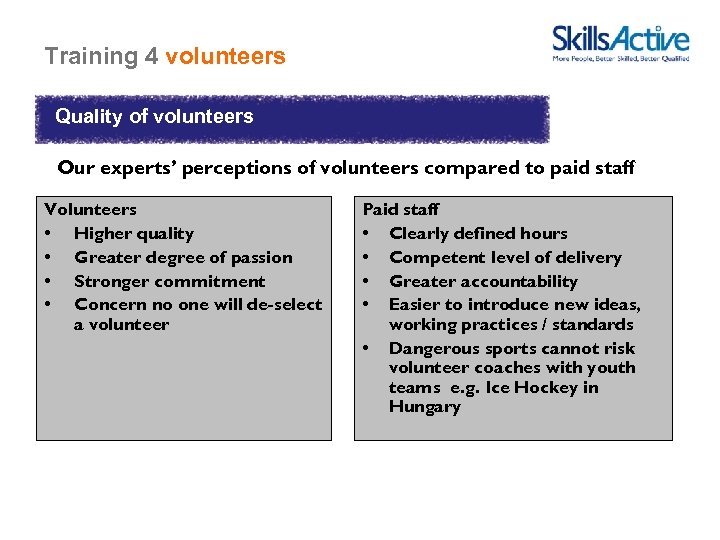 Training 4 volunteers Quality of volunteers Our experts’ perceptions of volunteers compared to paid staff Volunteers • Higher quality • Greater degree of passion • Stronger commitment • Concern no one will de-select a volunteer Paid staff • Clearly defined hours • Competent level of delivery • Greater accountability • Easier to introduce new ideas, working practices / standards • Dangerous sports cannot risk volunteer coaches with youth teams e. g. Ice Hockey in Hungary
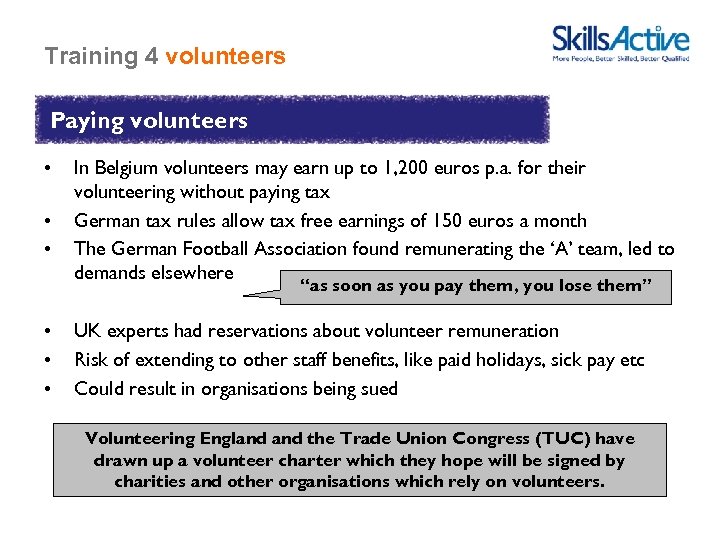 Training 4 volunteers Paying volunteers • • • In Belgium volunteers may earn up to 1, 200 euros p. a. for their volunteering without paying tax German tax rules allow tax free earnings of 150 euros a month The German Football Association found remunerating the ‘A’ team, led to demands elsewhere “as soon as you pay them, you lose them” • • • UK experts had reservations about volunteer remuneration Risk of extending to other staff benefits, like paid holidays, sick pay etc Could result in organisations being sued Volunteering England the Trade Union Congress (TUC) have drawn up a volunteer charter which they hope will be signed by charities and other organisations which rely on volunteers.
 Training 4 volunteers Volunteer strategy Our experts emphasised the importance of having a volunteer strategy: • Develop a strategy for what the club needs and seek the skill-sets • Create a meaningful role description and • Aim to match the right person / motivation to the skills for the task • Keep it flexible so tasks can be shared between volunteers • Ask the volunteer what skills / time they can contribute • Develop a role with the volunteer • Make use of template role descriptions But they cautioned against • Using templates as a “tick-box exercise” • Using templates as a substitute for a high quality discussion • Making it too formal
 Training 4 volunteers Good practice recruitment examples Our experts recommended: • Start a club volunteer task force • Encourage clubs to get to know the “sport family” • Introduce “parent registration” schemes • Identify useful skills amongst parents • Approach anyone on the touchline and give them a task • Allocate 2 -hour slots in events to introduce volunteers • Recruit volunteers for a limited period of time, with an “exit” • Recruit with a “buddy” to reduce the workload - The England & Wales Cricket Board (EWCB) have approached local colleges to offer practical opportunities for construction students to repair clubhouses. - The EWCB report that corporate schemes help to breakdown stereotypical perceptions of cricket.
 Training 4 volunteers Volunteer management Our experts considered that there was a double standard: • Commonly held view that coaches could NOT coach to the correct standard without the appropriate coaching qualification • Contradictory perception that anyone can do volunteer management without training or qualifications. • 42% had not received any training to manage volunteers * • Most of our experts had experienced poor quality volunteer management in their own volunteering. • The role of the Volunteer Co-ordinator seen as pivotal development • Some suggested that sports councils could do more: • Volunteer management should be a Key Performance Indicator • And included in the Clubmark scheme in England Source: Valuing Volunteer Management Skills, Institute of Volunteering Research, 2010
 Training 4 volunteers Volunteers award schemes Our experts thought national AND local recognition were important National schemes: • Coach of the Year Award (scuk) • Scottish Sports Awards • Behind Every Star (Sport Wales) • Volunteers Week (1 -7 June Vol Eng) Oustanding Service to Cricket (OSCA) German Soccer Association Local schemes: • Importance of CLUBS doing simple things well • Encourage children and parents to thank their coaches • Use of the Club Notice Boards • Feature photos, responsibilities and achievements of volunteers • Local publicity
 Training 4 volunteers History of UK Volunteer Management Instruments • The UK has a rich provision of research, case studies, and tips for volunteer managers supplied by Sports Councils, NGBs and Volunteer Development Agencies • Quality standards exist: ‘Investing in Volunteers Standard’ • National Occupational Standards for Volunteer Management at levels 3, 4 and 5 have been developed • Runningsports offers a number of specific courses aimed at the management of sport volunteers (at levels 1, 2 and 3) • Specific courses have been developed in Northern Ireland using funding from DCAL: Involving Volunteers in Sport The expert view • Our UK experts thought that there was more than adequate provision of resource materials for volunteer management • Clear signposting to relevant portals would help
 Training 4 volunteers Expert views on other HRM Instruments • • • Valuing volunteers is important through National Award Schemes Experts emphasised the importance of sports clubs doing simple things well Encourage children and parents to thank their coaches Use local publicity where people are known Use of club notice boards - volunteer photos, responsibilities, achievements Mentoring support is considered to be powerful in improving the quality of coaching and sports performance, and in retaining volunteers. Sports Councils were trying to evaluate the difference this made. German soccer feared mentoring officials would require twice as many to “double up” at weekends Networking was seen as a huge benefit Sports councils felt that networks operated more effectively in coaching Volunteers still face a time barrier
 Training 4 volunteers Conclusions • • An effective match of motivation and reward is vital to make best use of a scarce volunteer resource Aim to equalise propensity to volunteer in sport across Europe Encourage positive attitudes to sport volunteering – Increase the ‘culture of volunteering’ in parts of Eastern Europe Reduce disparity of Member States’ response to sport volunteering The UK leads the way in Quality Standards, NOS and volunteer management qualifications Encourage sports clubs to make best use of HRD Instruments Extend an effective Human Resource Development Framework across Europe to provide high quality support for all sport volunteers
 Training 4 volunteers Sport Volunteering Research Network Reference sources and information 18 th April 2012
 Training 4 volunteers Literature Review Sources – – – Special barometer 344 Sport and Physical Activity VOLUNTEERING IN THE EUROPEAN UNION, GHK, 2010 VOLUNTEERING SPORT MALTA, GHK, (part of the report above) Volunteering in voluntary based sport clubs in Denmark, University of Southern Denmark and Danish Institute for Sport Studies, 2011 Evaluation Of The Scottish Skills Fund Managing Volunteers In Sport Project, Fiona Grossart Consulting, for Skills. Active, 2005 Valuing Volunteer Management Skills, Institute of Volunteer Research, 2010 Voluntary And Community Sector Skills Survey, Northern Ireland, NICVA, 2008 Voluntary Sector Skills Survey, NCVO, 2008 The UK Voluntary Sector Workforce Almanac, NCVO, 2007 State of the Sector IV, NICVA, 2005 Sports Volunteering in England, Sport England, 2002
 Training 4 volunteers Management of Volunteers: Quality Standards • • In 1995 the Wandsworth Volunteer Bureau in South London was concerned that they had no way of knowing whether volunteers they sent to other organisations received a good standard of management. A pilot with 60 organisations 1998 -2002 was successful. Areas of volunteer management covered: – Planning for volunteer involvement – recruiting volunteer – selecting and matching volunteers – supporting and retaining volunteers In 2003 guardianship of the Investing in Volunteers Standard passed to the Volunteer Development Agencies in each nation
 Training 4 volunteers UK Volunteering organisations • • Each nation within the UK has a Volunteer Development organisation which provides Volunteer Management resources on their websites: – Volunteering England – Volunteer Development Scotland – Volunteer Development Agency, Northern Ireland – Wales Council for Voluntary Action Each country has a National Council for Voluntary Organisations Each country has a Sports council Other volunteering organisations: – Institute of Volunteer Research – Volresource. org. uk
 Training 4 volunteers UK Volunteering website resources: • • • Good Practice bank – find and share information about volunteer management Information Service Monthly magazines for members Volunteer management programmes Research Case Studies, quick guides, workbooks Volunteer management training and workshops Top Tips Funding and grants Events Opportunities
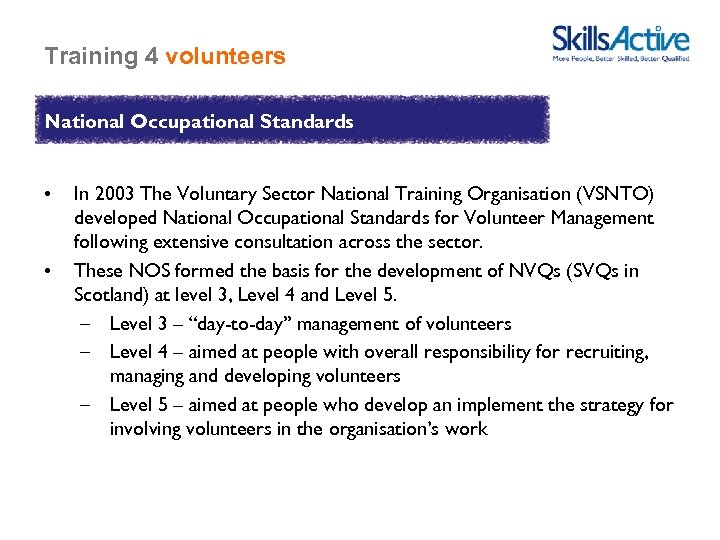 Training 4 volunteers National Occupational Standards • • In 2003 The Voluntary Sector National Training Organisation (VSNTO) developed National Occupational Standards for Volunteer Management following extensive consultation across the sector. These NOS formed the basis for the development of NVQs (SVQs in Scotland) at level 3, Level 4 and Level 5. – Level 3 – “day-to-day” management of volunteers – Level 4 – aimed at people with overall responsibility for recruiting, managing and developing volunteers – Level 5 – aimed at people who develop an implement the strategy for involving volunteers in the organisation’s work
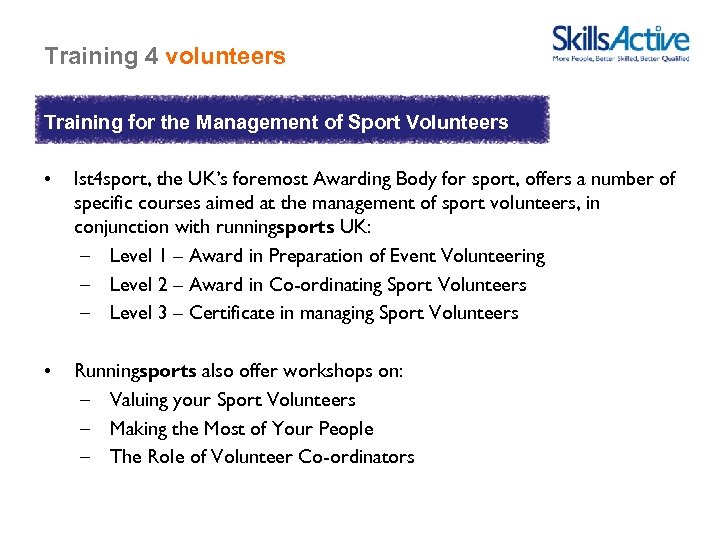 Training 4 volunteers Training for the Management of Sport Volunteers • Ist 4 sport, the UK’s foremost Awarding Body for sport, offers a number of specific courses aimed at the management of sport volunteers, in conjunction with runningsports UK: – Level 1 – Award in Preparation of Event Volunteering – Level 2 – Award in Co-ordinating Sport Volunteers – Level 3 – Certificate in managing Sport Volunteers • Runningsports also offer workshops on: – Valuing your Sport Volunteers – Making the Most of Your People – The Role of Volunteer Co-ordinators
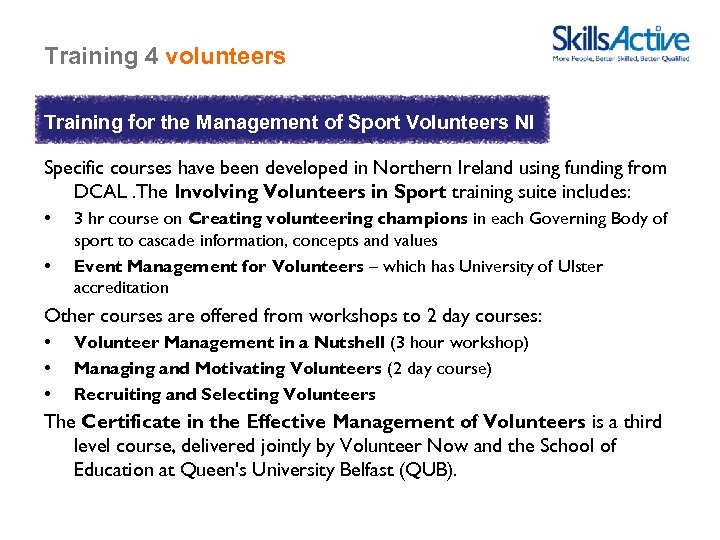 Training 4 volunteers Training for the Management of Sport Volunteers NI Specific courses have been developed in Northern Ireland using funding from DCAL. The Involving Volunteers in Sport training suite includes: • • 3 hr course on Creating volunteering champions in each Governing Body of sport to cascade information, concepts and values Event Management for Volunteers – which has University of Ulster accreditation Other courses are offered from workshops to 2 day courses: • • • Volunteer Management in a Nutshell (3 hour workshop) Managing and Motivating Volunteers (2 day course) Recruiting and Selecting Volunteers The Certificate in the Effective Management of Volunteers is a third level course, delivered jointly by Volunteer Now and the School of Education at Queen's University Belfast (QUB).