 Скачать презентацию Service Transformation Seminar Chair David Walker Editor Public
5df6847385df596fa7d446a1f50defea.ppt
- Количество слайдов: 87



Service Transformation Seminar Chair: David Walker, Editor, Public Magazine David Mills, CRM Vice President, Oracle Siobhan Coughlan, Principal Consultant, Transformation Government, Improvement & Development Agency Stefan Czerniawski, Deputy Director – Business Strategy, Department of Work and Pensions Martin Willis, Director, INLOGOV 1
<Insert Picture Here> Delivering Great Customer Service David Mills Vice-President, UK, Ireland & Israel
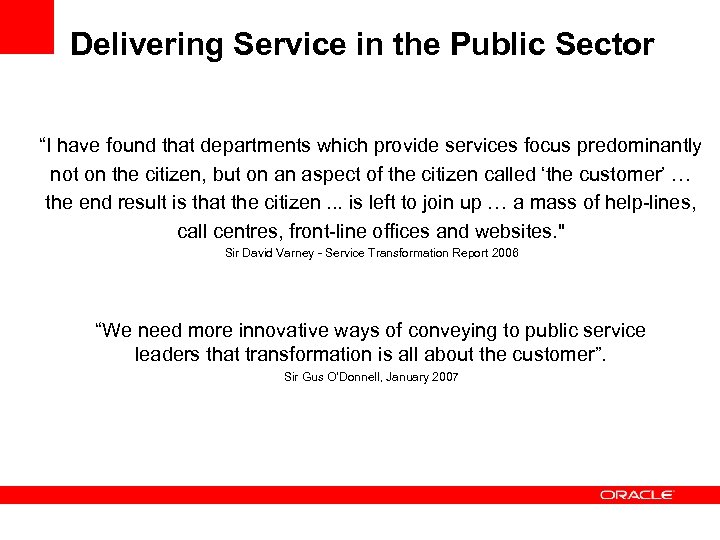
Delivering Service in the Public Sector “I have found that departments which provide services focus predominantly not on the citizen, but on an aspect of the citizen called ‘the customer’ … the end result is that the citizen. . . is left to join up … a mass of help-lines, call centres, front-line offices and websites. " Sir David Varney - Service Transformation Report 2006 “We need more innovative ways of conveying to public service leaders that transformation is all about the customer”. Sir Gus O’Donnell, January 2007
The Public Sector isn’t driven by profit. Excellence in Service Delivery is your key motive for existence. Don’t look to learn from UK Industry, teach them how good you are.
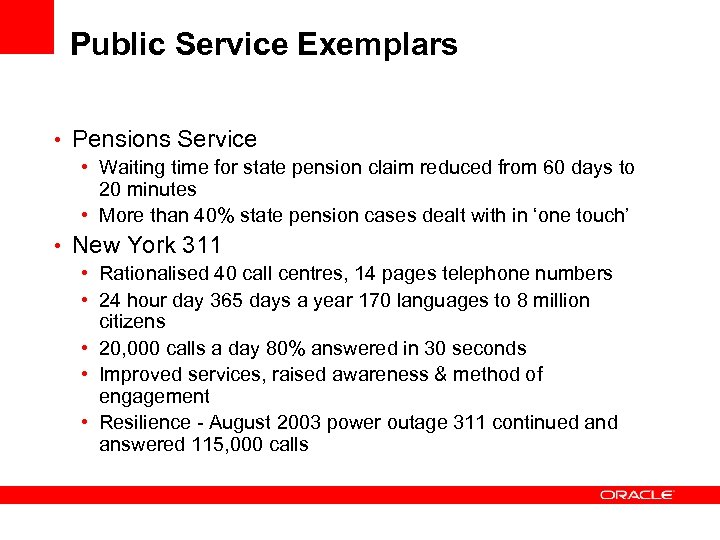
Public Service Exemplars • Pensions Service • Waiting time for state pension claim reduced from 60 days to 20 minutes • More than 40% state pension cases dealt with in ‘one touch’ • New York 311 • Rationalised 40 call centres, 14 pages telephone numbers • 24 hour day 365 days a year 170 languages to 8 million citizens • 20, 000 calls a day 80% answered in 30 seconds • Improved services, raised awareness & method of engagement • Resilience - August 2003 power outage 311 continued answered 115, 000 calls
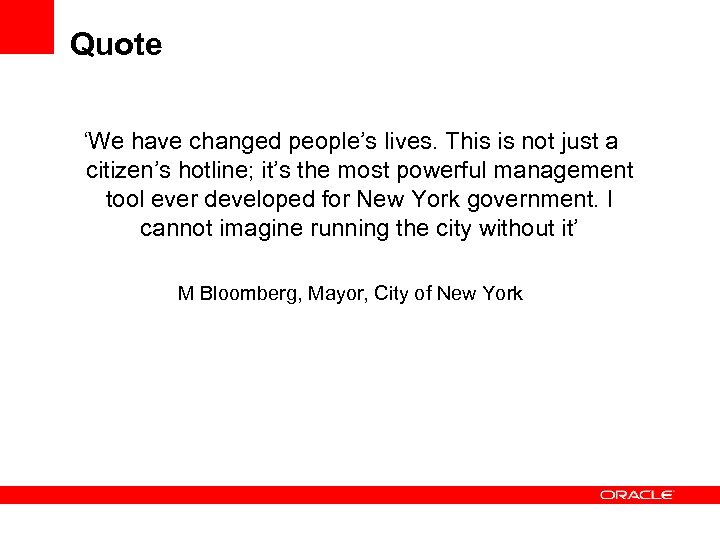
Quote ‘We have changed people’s lives. This is not just a citizen’s hotline; it’s the most powerful management tool ever developed for New York government. I cannot imagine running the city without it’ M Bloomberg, Mayor, City of New York
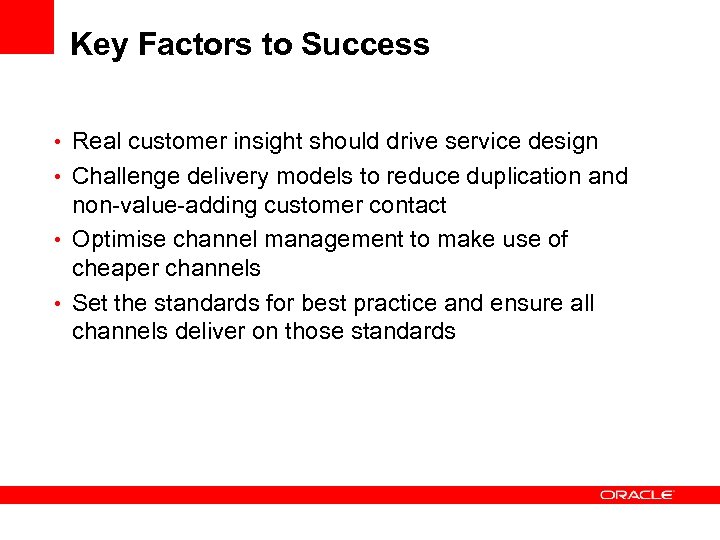
Key Factors to Success • Real customer insight should drive service design • Challenge delivery models to reduce duplication and non-value-adding customer contact • Optimise channel management to make use of cheaper channels • Set the standards for best practice and ensure all channels deliver on those standards
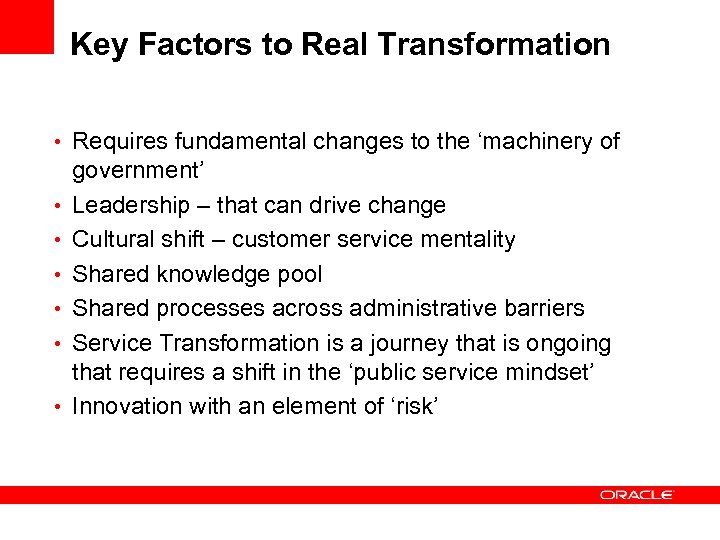
Key Factors to Real Transformation • Requires fundamental changes to the ‘machinery of • • • government’ Leadership – that can drive change Cultural shift – customer service mentality Shared knowledge pool Shared processes across administrative barriers Service Transformation is a journey that is ongoing that requires a shift in the ‘public service mindset’ Innovation with an element of ‘risk’
<Insert Picture Here> You Won't Get a Second Chance – Commerce You Haven’t Got a Choice – Public Service
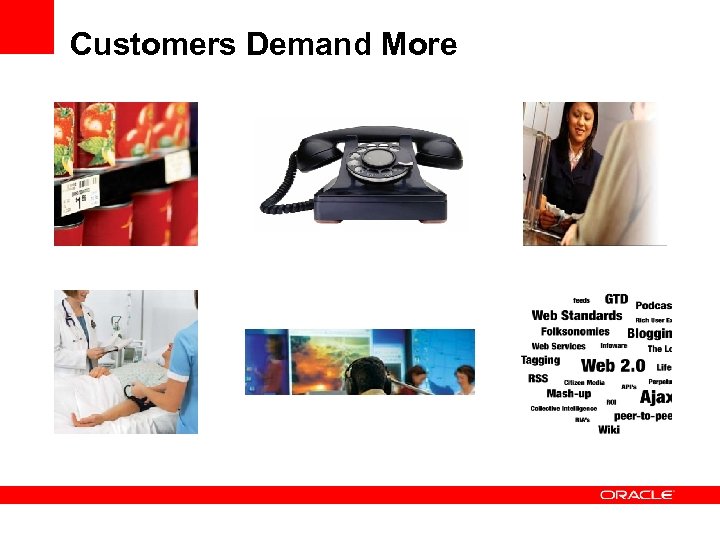
Customers Demand More
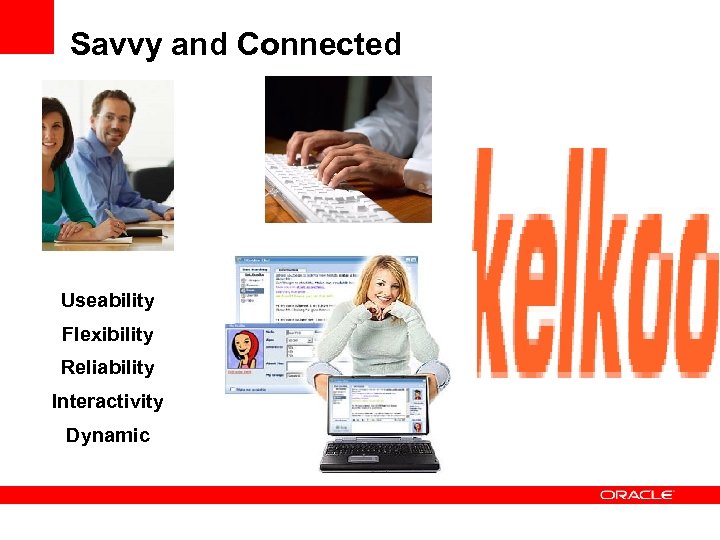
Savvy and Connected Useability Flexibility Reliability Interactivity Dynamic
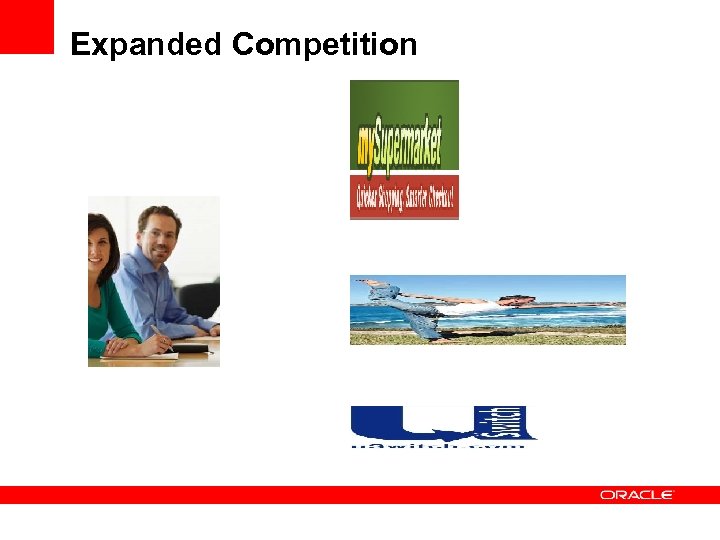
Expanded Competition
<Insert Picture Here> Looking Forward
Build the Right Team
Provide the Right Tools SOA BPEL
Key Factors to Real Transformation • Requires fundamental changes to the ‘machinery of • • • government’ Leadership – that can drive change Cultural shift – customer service mentality Shared knowledge pool Shared processes across administrative barriers Service Transformation is a journey that is ongoing that requires a shift in the ‘public service mindset’ Innovation with an element of ‘risk’
<Insert Picture Here> Delivering Great Customer Service David Mills Vice-President, UK, Ireland & Israel
Service Transformation Seminar Chair: David Walker, Editor, Public Magazine David Mills, CRM Vice President, Oracle Siobhan Coughlan, Principal Consultant, Transformation Government, Improvement & Development Agency Stefan Czerniawski, Deputy Director – Business Strategy, Department of Work and Pensions Martin Willis, Director, INLOGOV 19
The Guardian Public Service transformation – putting the citizen at the centre Siobhan Coughlan 19 February 2008
Transformational government agenda ‘Technology alone does not transform government, but government cannot transform to meet modern citizens’ expectations without it’…. ‘The design of citizen-centric services to ensure effectiveness of delivery to the customer, achieve policy goals, and to release savings by reducing duplication and streamlining processes’ Transformational Government Report 2005 21
The Local authority landscape • 388 LAs in England • Unitary, County and Districts – urban LAs & rural • 21, 000 elected councillors • Post Lyons - Locally determined services for local customers • 2007 CPA – 150 top tier LAs, only two 1 star LAs • Varney Review – LAs as examples of innovation and customer centric service delivery 22
The role of local authorities • Delivers 400 – 600 services locally (different tiers) • The front office for many central government services , e. g. benefits, education, licensing, etc • Joins up services for the local community – local partnership working , LSP, LAA, etc • Commissions services third sector, – private sector, etc, • Representing and answerable to the loca 23
Customer experience of public services • Front line services organised departmentally specific service areas for • Multiple contact points the high street on • Differentoffice opening hours • Different telephony & IT • Different customer data information & management systems • Different training & development opportunities for staff , (different 24
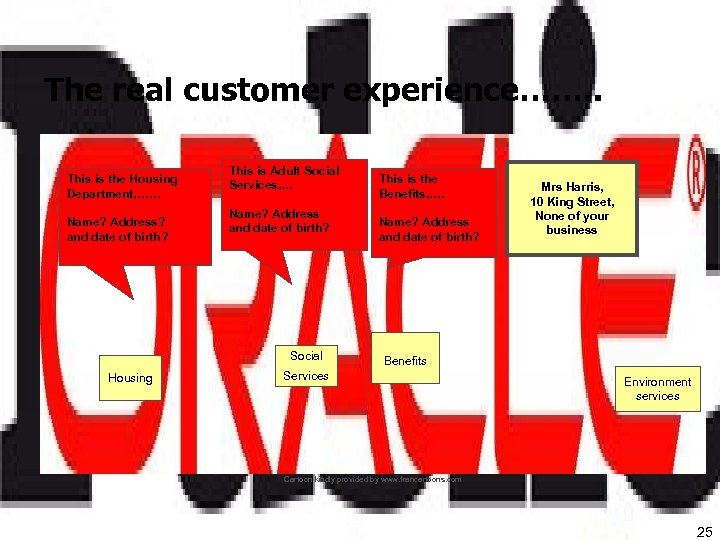
The real customer experience……. . This is the Housing Department, …… Name? Address? and date of birth? This is Adult Social Services, … Name? Address and date of birth? Social Housing This is the Benefits, …. Name? Address and date of birth? Mrs Harris, 10 King Street, None of your business Benefits Services Environment services Cartoon kindly provided by www. francartoons. com 25
Locally delivered services • Local services are changing & improving however, expectations are rising, new ‘duty to involve’ • Local services being delivered within a local framework and existing partnerships, e. g. LSP, LAA & MAA • Local partners are increasingly working together to meet complex needs of customers (e. g. shared service collaborations) • CAA - new performance framework to 26
Drivers for Service Transformation 27
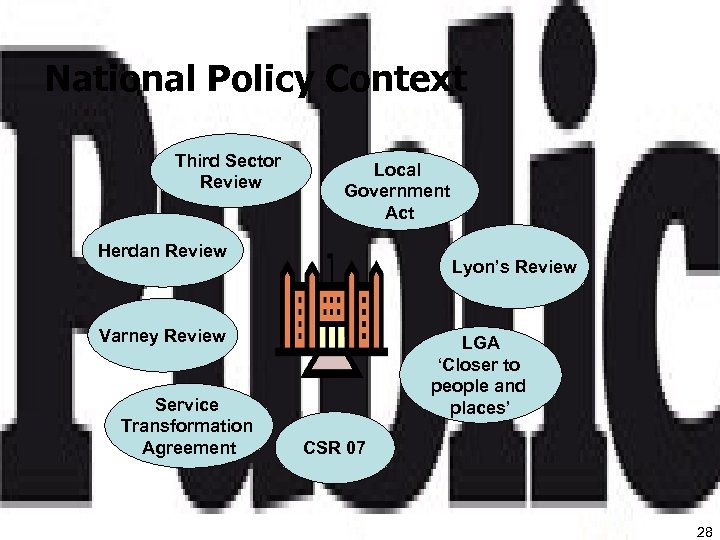
National Policy Context Third Sector Review Local Government Act Herdan Review Lyon’s Review Varney Review Service Transformation Agreement LGA ‘Closer to people and places’ CSR 07 28
Drivers for Service Transformation • Local Government Act– LAA, MAA • LGR and Two Tier Pathfinders – reorganisation of local services • Local Government new performance framework – 198 PIs* and CAA • Performance indicator NI 14 ‘Avoidable contact’ • CRS 07 – efficiency savings 3% p. a. • Service Transformation Agreement – Varney Review • Customer expectations! 29

The Local Government Act 30
The Local Government Act ‘To meet this challenge, all councils must adopt a strategic approach to service delivery. Our proposal to strengthen the strategic commissioning role for councils will ensure that they start from an understanding of the needs and preferences of users, adopt best practice in service design, assess the full range of service delivery options, and implement optimal solutions that balance quality and value for money. ’ Chapter 7, ‘Efficiency - Transforming Local Services’ 31
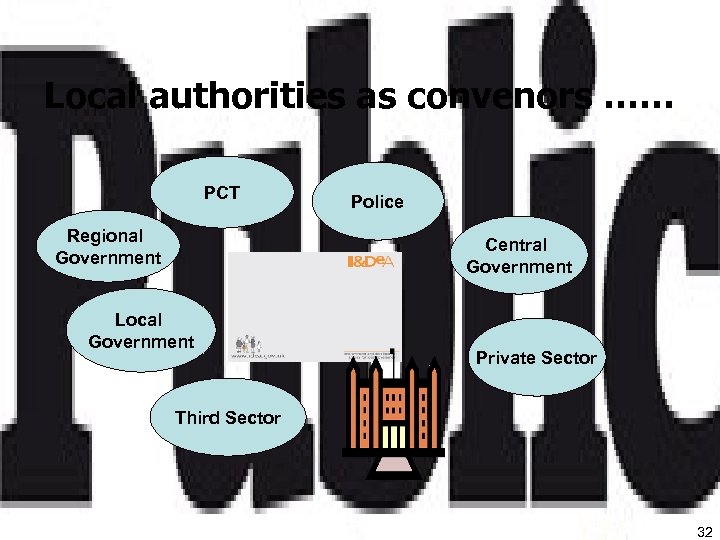
Local authorities as convenors …… PCT Regional Government Police Central Government Local Government Private Sector Third Sector 32
Key challenges • Understanding shared customers using customer insight, to re organise and deliver services • Joining up related services , provided by different organisations, around different customer groups • Leveraging assets through sharing frontline and back offices • Managing and sharing data across the partners to make it easier for the customer to carry out their transaction • Exploiting technology an effective tool as • Removing duplication and wastage to drive out efficiency savings through business process improvement 33

Front Office Shared Services 34
Joining up services - FOSS Programme • CLG, Cabinet Office, LGA IDe. A and research programme • To identify and showcase local government's achievements in transforming local public services • ‘Exemplar’ projectsredesign local public services around the needs and preferences of citizens • Shared ‘front office’ partnership and collaborative arrangements, e. g. one-stop shops, contact centres, web portals and 35
FOSS Projects Main report, 'delivering public sector transformation' and Executive Briefing, ’new designs for public services - delivering better outcomes’ and 16 detailed case studies www. idea. gov. uk/foss • • • Dorset for You a single web portal for the citizens of Dorset – Northumbria 101 single number for a range of non emergency services Staffordshire Moorlands District Council : Councils Connect – series of OSS including self service kiosks London: Report. IT a pan-London service to report street related problems via the 'Your London' web site South Yorkshire: e@sy connects - access to services from a broad range of agencies over the web, digital TV and mobile telephones Kent Gateway multi-agency service in Ashford that delivers public and voluntary services in a retail environment 36
Key factors for success • Clear Leadership political & managerial – • Agreed shared vision across partners – outcomes focused on customers • Understanding needs & engagement the of customers • Engaging staff particularly frontline staff – • Partnership working – governance arrangements • Exploiting technology sharing & 37

Local Government Delivery Council 38
LGDC - Background • Post LGOL programme – a voice for local government • Commissioning of the Varney Review – opportunity for LG to highlight good practice as well as barriers • Front Office Shared Services project – real innovation at a local level • Support and expertise for local government representatives on the Delivery Council 39
Objectives • By local government, for local government • Principal interface between central and local government and the local government family • Provide strategic leadership sector to fulfils its role in to driving local service transformation • Be a collective voice for the sector influence national to policy • Mirror and co-ordinate with Cabinet Office’s Delivery Council on the Transformational Government agenda • Facilitating effective support to councils good e. g. practice; • Highlight opportunities & barriersdrive service to transformation 40
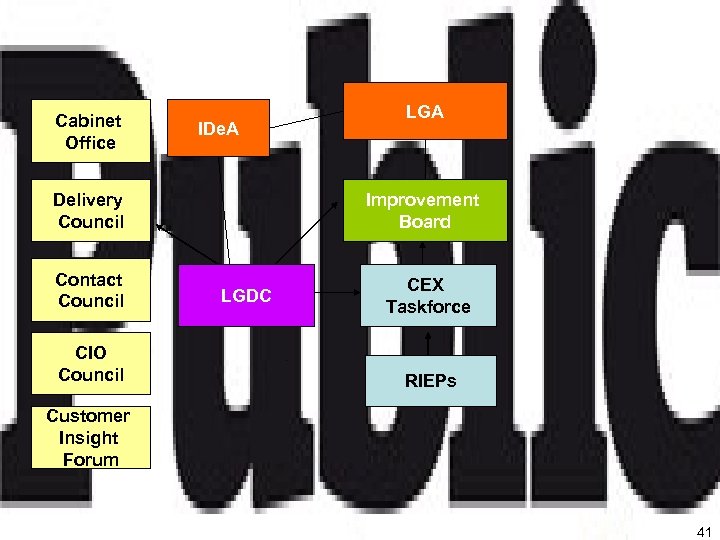
Cabinet Office IDe. A Delivery Council Contact Council CIO Council LGA Improvement Board LGDC CEX Taskforce RIEPs Customer Insight Forum 41
Deliverables • Work with key stakeholders CLG & LGA, Cabinet Office to jointly develop the vision & work programme across CRS 07 • To coordinate activities the principal of local government agencies around service transformation • To highlight and share emerging good practice raise problems, issues and , identify gaps in capacity • To coordinate the links with other key agenciesaround local government transformation, 42
LGDC Representatives • 13 Local authority representatives from all regions, tiers, urban & rural LAs (links with RIEPs & professional bodies) • Chaired by Janet Callender, CEX Tameside MBC and one of the local government representatives on the Delivery Council • Local government stakeholders, LGA, IDe. A, CLG • Central government departments, DWP, DH • Third Sector • National Consumer Council 43
Programme of activities • National Projects Public Sector Asset Review, DWP ‘Tell us Once’, LGR & Two Tier Pathfinders • Best Practice & engagement. FOSS – conference May ’ 08, Beacons, benchmarking, knowledge & Co. Ps, national & regional networks and events • Performance management. CAA, LG PIs, – Contact councils measures • Tools & Enablers data sharing, Gov – Connects, ESD Toolkit, Customer Insight & 44
In summary • Local government leading service transformation of local public services • Lots of innovation & good practice However, • Need to highlight & share learning more systematically • Need to maximise our investments i. e. use the ‘tools’ already have • Need to bring local partners together for 45
Service Transformation Seminar Chair: David Walker, Editor, Public Magazine David Mills, CRM Vice President, Oracle Siobhan Coughlan, Principal Consultant, Transformation Government, Improvement & Development Agency Stefan Czerniawski, Deputy Director – Business Strategy, Department of Work and Pensions Martin Willis, Director, INLOGOV 46

Beyond transformation Stefan Czerniawski

48

49

50
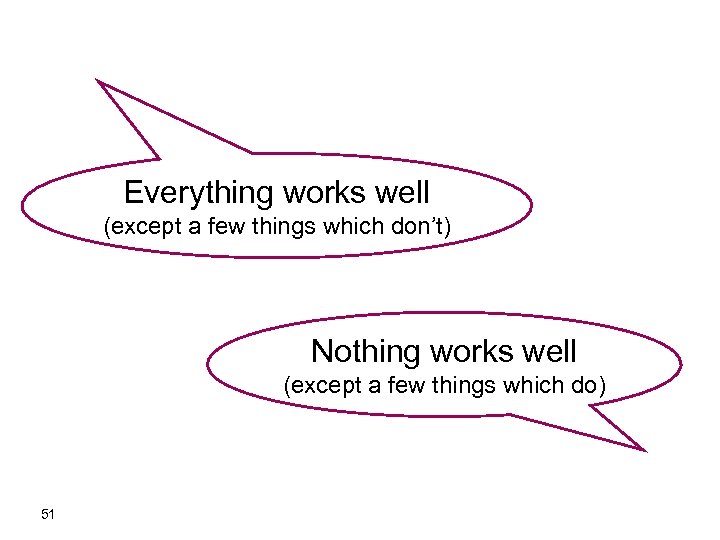
Everything works well (except a few things which don’t) Nothing works well (except a few things which do) 51

52

53
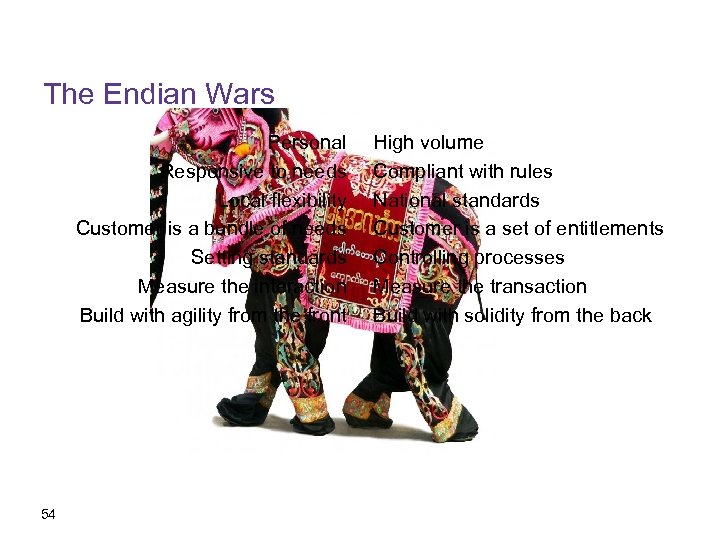
The Endian Wars Personal Responsive to needs Local flexibility Customer is a bundle of needs Setting standards Measure the interaction Build with agility from the front 54 High volume Compliant with rules National standards Customer is a set of entitlements Controlling processes Measure the transaction Build with solidity from the back

55

56
Today, I don’t even bother attempting to communicate directly with most companies; who wants to navigate phone-tree hell? If I have a problem, I poke around on the Web until I find an answer. If I don’t, I’ll post a question on the likeliest Web forum. 57 Scott Rosenberg
58
59

60

61

62

63
Service Transformation Seminar Chair: David Walker, Editor, Public Magazine David Mills, CRM Vice President, Oracle Siobhan Coughlan, Principal Consultant, Transformation Government, Improvement & Development Agency Stefan Czerniawski, Deputy Director – Business Strategy, Department of Work and Pensions Martin Willis, Director, INLOGOV 64
Leadership and Transformational Government Martin Willis, Director Inlogov (Institute of Local Government Studies) Guardian/Oracle Seminar 19 th February 2008

Seeing the Wood and the Trees Martin Willis, Director Inlogov (Institute of Local Government Studies) February 2008
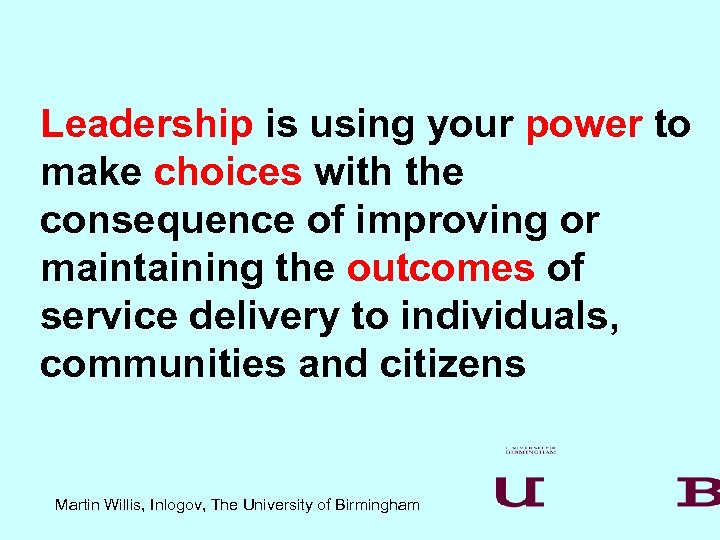
Leadership is using your power to make choices with the consequence of improving or maintaining the outcomes of service delivery to individuals, communities and citizens Martin Willis, Inlogov, The University of Birmingham
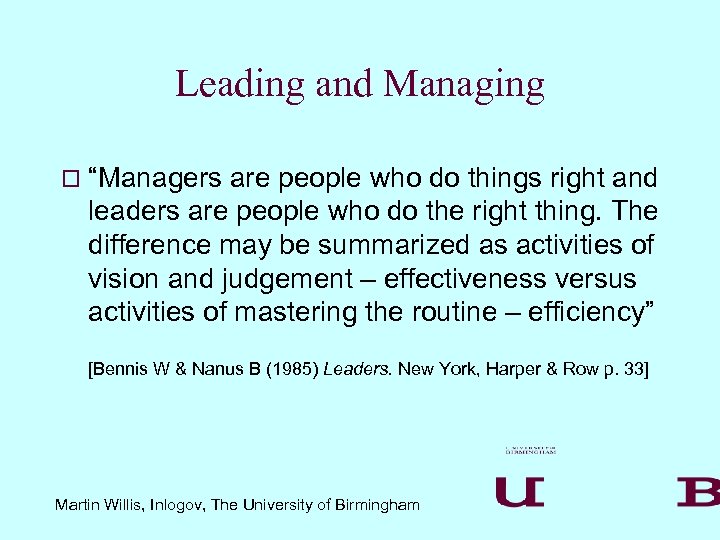
Leading and Managing o “Managers are people who do things right and leaders are people who do the right thing. The difference may be summarized as activities of vision and judgement – effectiveness versus activities of mastering the routine – efficiency” [Bennis W & Nanus B (1985) Leaders. New York, Harper & Row p. 33] Martin Willis, Inlogov, The University of Birmingham
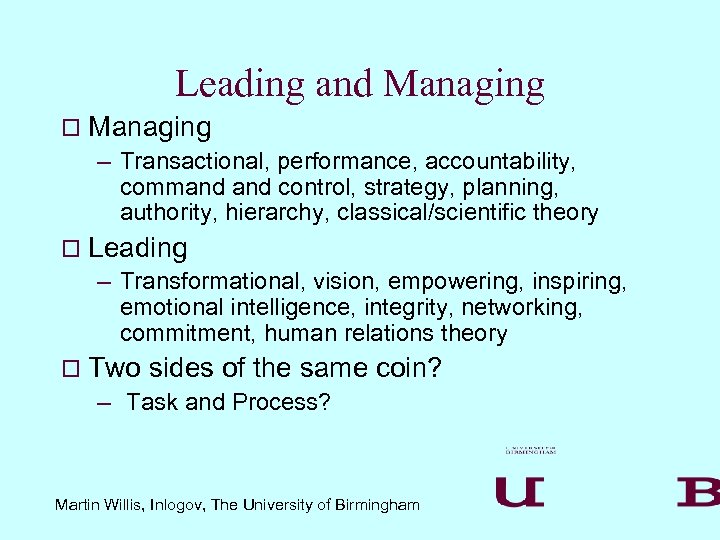
Leading and Managing o Managing – Transactional, performance, accountability, command control, strategy, planning, authority, hierarchy, classical/scientific theory o Leading – Transformational, vision, empowering, inspiring, emotional intelligence, integrity, networking, commitment, human relations theory o Two sides of the same – Task and Process? coin? Martin Willis, Inlogov, The University of Birmingham
Leadership Research o. What does research evidence suggest to us about effective leadership? Martin Willis, Inlogov, The University of Birmingham
The Leaders Role in Quality and Safety Improvement: Research Summary o Research Question: “What do leaders need to do to support health care improvement? ” o Evidence to support the importance of leadership but not conclusive o Some evidence suggests that professional leaders have as much, if not more, influence that top or middle managers o Evidence about which management actions are effective is not strong Martin Willis, Inlogov, The University of Birmingham
The Leaders Role in Quality and Safety Improvement: Research Summary o Combination of conditions are needed for Q&SI changes, some of which managers can influence: low resistance, high readiness, existence of resources and need for change o Subjective desire for change including a sense of urgency and pain may be required o Some studies suggest Q&SI more effective where leaders skilfully adapt a particular quality method or approach rather than inflexibly follow a detailed prescription Martin Willis, Inlogov, The University of Birmingham
The Leaders Role in Quality and Safety Improvement: Research Summary o Specific leader actions which are effective may vary according to the type of leader role, the type of improvement, the organisation, its environment and other factors [Ovretveit J. (2005) The Leaders Role in Quality and Safety Improvement: A Review of research and guidance. Faculty of Medicine, Bergen University, Norway] Martin Willis, Inlogov, The University of Birmingham
How can councils meet the challenges of performance? o Skelcher C et al (2006) Learning from the Experience of Recovery – www. inlogov. bham. ac. uk/research/expofrecovery. htm o Three factors explain the ability of councils to prevent performance decline and to recover from poor performance Martin Willis, Inlogov, The University of Birmingham
o Cognition – Understanding the organisation’s current performance o Capability – Holding a shared vision of how the council will recover and improve and using this to motivate others to take action o Capacity – Having the necessary political and managerial skills to deliver the improvement vision Martin Willis, Inlogov, The University of Birmingham
Capability, Vision and Leadership People Centred Outcomes o Outcomes – the benefits or consequences of a service on the quality of the lives of individuals, communities and citizens Martin Willis, Inlogov, The University of Birmingham
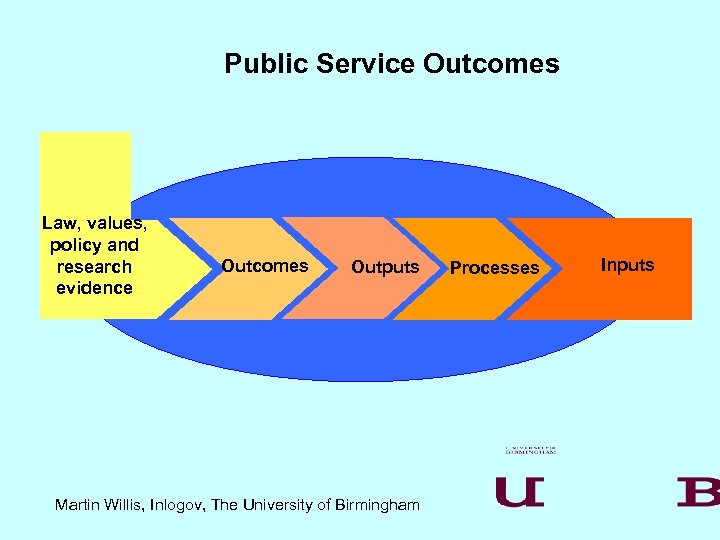
Public Service Outcomes Law, values, policy and research evidence Outcomes Outputs Martin Willis, Inlogov, The University of Birmingham Processes Inputs
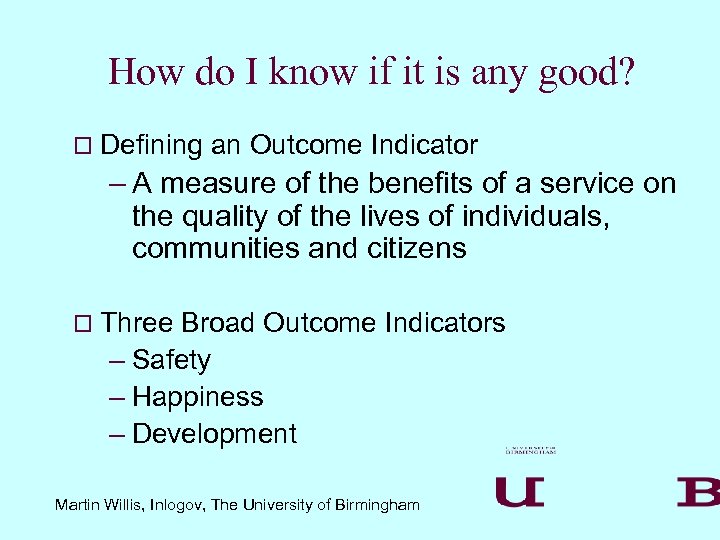
How do I know if it is any good? o Defining an Outcome Indicator – A measure of the benefits of a service on the quality of the lives of individuals, communities and citizens o Three Broad Outcome Indicators – Safety – Happiness – Development Martin Willis, Inlogov, The University of Birmingham
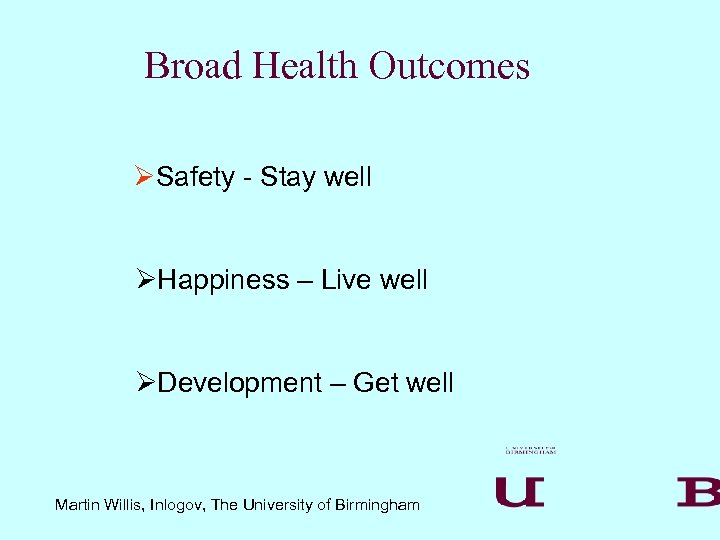
Broad Health Outcomes ØSafety - Stay well ØHappiness – Live well ØDevelopment – Get well Martin Willis, Inlogov, The University of Birmingham
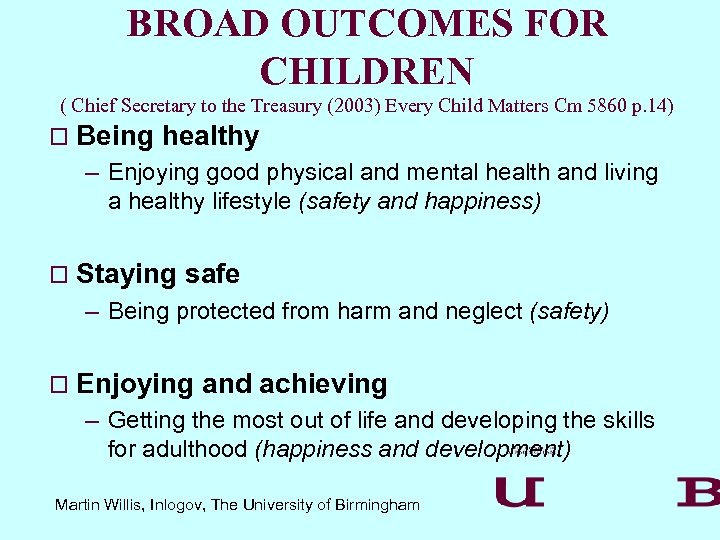
BROAD OUTCOMES FOR CHILDREN ( Chief Secretary to the Treasury (2003) Every Child Matters Cm 5860 p. 14) o Being healthy – Enjoying good physical and mental health and living a healthy lifestyle (safety and happiness) o Staying safe – Being protected from harm and neglect (safety) o Enjoying and achieving – Getting the most out of life and developing the skills for adulthood (happiness and development) Martin Willis, Inlogov, The University of Birmingham
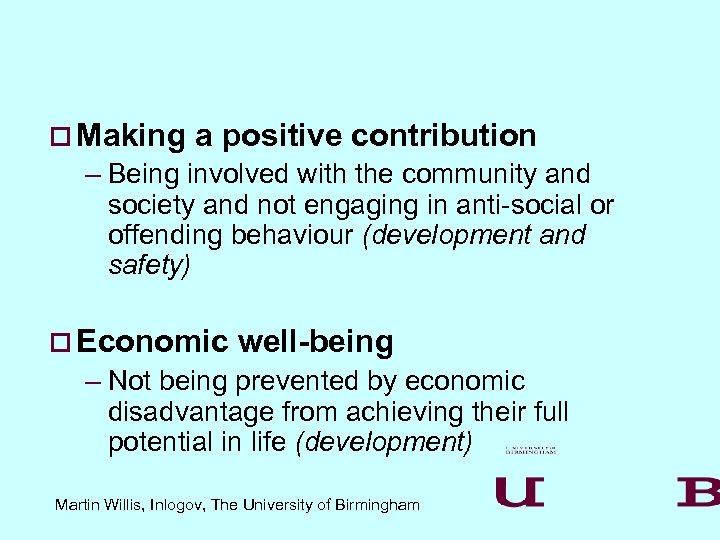
o Making a positive contribution – Being involved with the community and society and not engaging in anti-social or offending behaviour (development and safety) o Economic well-being – Not being prevented by economic disadvantage from achieving their full potential in life (development) Martin Willis, Inlogov, The University of Birmingham
BROAD SOCIAL WELL-BEING OUTCOMES [Murphey D (2005) The Social Well-Being of Vermonters http: //www. ahs. state. vt. us Murphey D (2006) Vermont Well-Being 2006 http: //humanservices. vermont. gov] o% voting-age population voting in General Election o Rate of child abuse and neglect (ages 0 -4) o % Students (grades 9 -12) who did not go to school during past 30 days because they felt unsafe Martin Willis, Inlogov, The University of Birmingham
BROAD SOCIAL WELL-BEING OUTCOMES [Murphey D (2005) The Social Well-Being of Vermonters http: //www. ahs. state. vt. us Murphey D (2006) Vermont Well-Being 2006 http: //humanservices. vermont. gov] o% Adults who are “binge drinkers” o % Adults who are obese o Deaths from lung cancer o % Population in poverty o % People with disabilities employed o Property crimes per 100, 000 population o % Older people (65+) engaged in some leisure-time physical activity Martin Willis, Inlogov, The University of Birmingham
Leadership and Public Service Outcomes o “This inquiry saw too many examples of those in senior positions attempting to justify their work in terms of bureaucratic activity, rather than outcomes for people” [Department of Health (2003) The Victoria Climbié Inquiry. Summary Report. p. 6] Martin Willis, Inlogov, The University of Birmingham
o “Whenever I am feeling overwhelmed by the problems I am facing, I take a detour to a school to fill up my tank with the energy and optimism that I find in the classroom, I am inspired by the glimpses of the journey of learning that teachers are undertaking with their pupils” (Tim Brighouse) Martin Willis, Inlogov, The University of Birmingham
SEEING THE WOOD AND THE TREES o Systems Thinking § “The discipline which unites the others and brings all together in a pattern that can be understandable – systems thinking is seeing the wood and the trees ” [Ref: Senge P. in Pugh D and Hickson D (1996) Writers on Organizations 5 th Edition. Penguin, Harmondsworth pp. 204 -6] Martin Willis, Inlogov, The University of Birmingham

Martin Willis Director Inlogov m. h. willis@bham. ac. uk 0121 414 4961 Martin Willis, Inlogov, The University of Birmingham
Service Transformation Seminar Chair: David Walker, Editor, Public Magazine David Mills, CRM Vice President, Oracle Siobhan Coughlan, Principal Consultant, Transformation Government, Improvement & Development Agency Stefan Czerniawski, Deputy Director – Business Strategy, Department of Work and Pensions Martin Willis, Director, INLOGOV 88
Скачать презентацию Service Transformation Seminar Chair David Walker Editor Public
5df6847385df596fa7d446a1f50defea.ppt