


 Скачать презентацию Service Science Management and Engineering and Design and
dd76ce88c0f8f7221c85fc33fdcc5bc9.ppt
- Количество слайдов: 39
 Service Science, Management, and Engineering (and Design, and Art…) Five Years of Service Science Paul P. Maglio IBM Almaden Research Center Art and Science of Service V Bentley University June 18, 2009 1 © 2009 IBM Corporation © 2005 IBM Corporation
 Agenda § What is service science? § What are its basic ideas? § What has been going on? 2 © 2009 IBM Corporation © 2005 IBM Corporation
 What is Service Science or SSME(D)? Service Science, Management, and Engineering (SSME) is a term introduced by IBM to describe Service Science, an interdisciplinary approach to the study, design, and implementation of services systems – complex systems in which specific arrangements of people and technologies take actions that provide value for others. More precisely, SSME has been defined as the application of science, management, and engineering disciplines to tasks that one organization beneficially performs for and with another. 3 © 2009 IBM Corporation © 2005 IBM Corporation
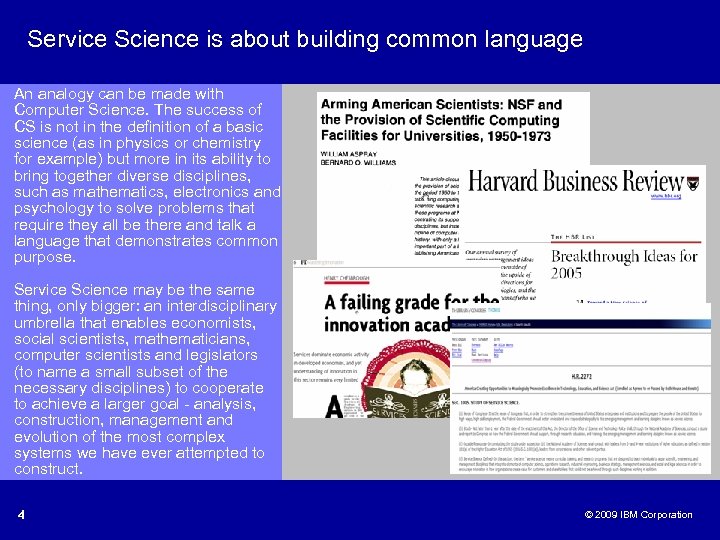 Service Science is about building common language An analogy can be made with Computer Science. The success of CS is not in the definition of a basic science (as in physics or chemistry for example) but more in its ability to bring together diverse disciplines, such as mathematics, electronics and psychology to solve problems that require they all be there and talk a language that demonstrates common purpose. Service Science may be the same thing, only bigger: an interdisciplinary umbrella that enables economists, social scientists, mathematicians, computer scientists and legislators (to name a small subset of the necessary disciplines) to cooperate to achieve a larger goal - analysis, construction, management and evolution of the most complex systems we have ever attempted to construct. 4 © 2009 IBM Corporation © 2005 IBM Corporation
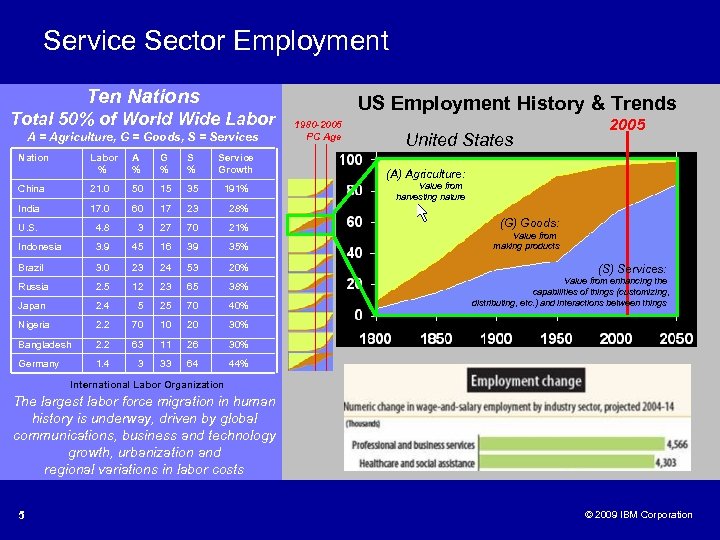 Service Sector Employment Ten Nations Total 50% of World Wide Labor A = Agriculture, G = Goods, S = Services Nation Labor % A % G % Service Growth China 21. 0 50 15 35 191% India 17. 0 60 17 23 4. 8 3 27 70 21% Indonesia 3. 9 45 16 39 35% Brazil 3. 0 23 24 53 20% 1980 -2005 PC Age United States 2005 28% U. S. US Employment History & Trends Russia 2. 5 12 23 65 38% Japan 2. 4 5 25 70 40% Nigeria 2. 2 70 10 20 2. 2 63 11 26 1. 4 3 33 64 (G) Goods: Value from making products (S) Services: Value from enhancing the capabilities of things (customizing, distributing, etc. ) and interactions between things 30% Germany Value from harvesting nature 30% Bangladesh (A) Agriculture: 44% International Labor Organization The largest labor force migration in human history is underway, driven by global communications, business and technology growth, urbanization and regional variations in labor costs 5 © 2009 IBM Corporation © 2005 IBM Corporation
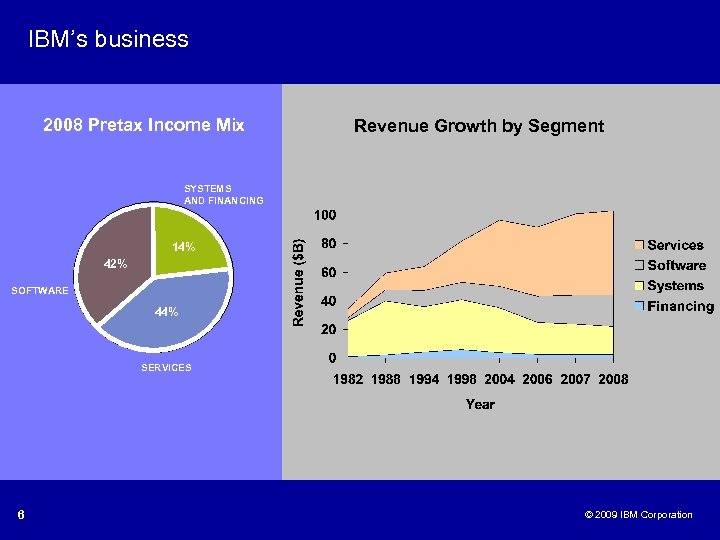 IBM’s business 2008 Pretax Income Mix Revenue Growth by Segment SYSTEMS AND FINANCING 14% 42% SOFTWARE 44% SERVICES 6 © 2009 IBM Corporation © 2005 IBM Corporation
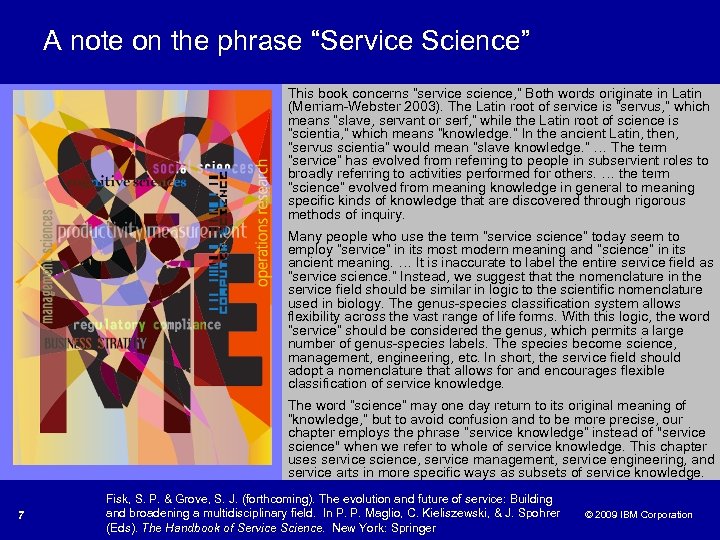 A note on the phrase “Service Science” This book concerns “service science, ” Both words originate in Latin (Merriam-Webster 2003). The Latin root of service is “servus, ” which means “slave, servant or serf, ” while the Latin root of science is “scientia, ” which means “knowledge. ” In the ancient Latin, then, “servus scientia” would mean “slave knowledge. ” … The term “service” has evolved from referring to people in subservient roles to broadly referring to activities performed for others. … the term “science” evolved from meaning knowledge in general to meaning specific kinds of knowledge that are discovered through rigorous methods of inquiry. Many people who use the term “service science” today seem to employ “service” in its most modern meaning and “science” in its ancient meaning. … It is inaccurate to label the entire service field as “service science. ” Instead, we suggest that the nomenclature in the service field should be similar in logic to the scientific nomenclature used in biology. The genus-species classification system allows flexibility across the vast range of life forms. With this logic, the word “service” should be considered the genus, which permits a large number of genus-species labels. The species become science, management, engineering, etc. In short, the service field should adopt a nomenclature that allows for and encourages flexible classification of service knowledge. The word “science” may one day return to its original meaning of “knowledge, ” but to avoid confusion and to be more precise, our chapter employs the phrase “service knowledge” instead of "service science" when we refer to whole of service knowledge. This chapter uses service science, service management, service engineering, and service arts in more specific ways as subsets of service knowledge. 7 Fisk, S. P. & Grove, S. J. (forthcoming). The evolution and future of service: Building and broadening a multidisciplinary field. In P. P. Maglio, C. Kieliszewski, & J. Spohrer (Eds). The Handbook of Service Science. New York: Springer © 2009 IBM Corporation © 2005 IBM Corporation
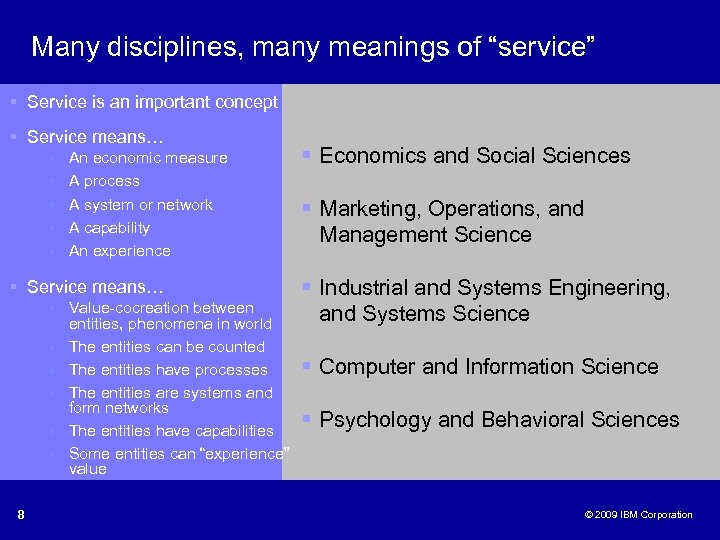 Many disciplines, many meanings of “service” § Service is an important concept § Service means… 4 4 4 An economic measure A process A system or network A capability An experience § Service means… 4 4 4 8 Value-cocreation between entities, phenomena in world The entities can be counted The entities have processes The entities are systems and form networks The entities have capabilities Some entities can “experience” value § Economics and Social Sciences § Marketing, Operations, and Management Science § Industrial and Systems Engineering, and Systems Science § Computer and Information Science § Psychology and Behavioral Sciences © 2009 IBM Corporation © 2005 IBM Corporation
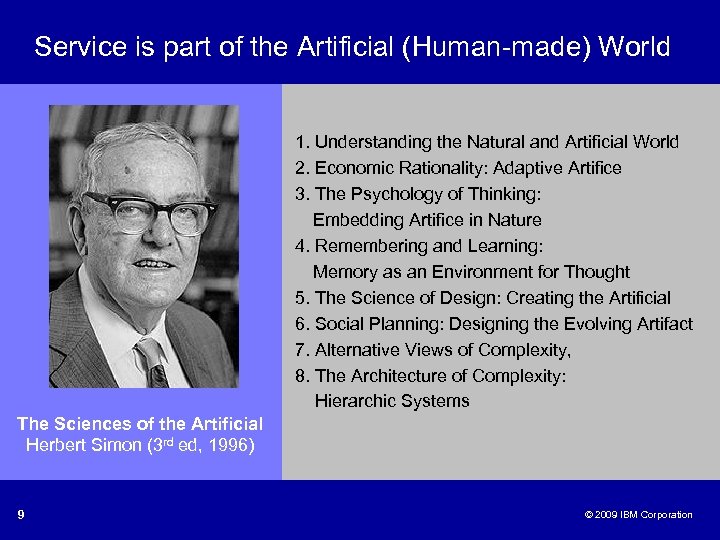 Service is part of the Artificial (Human-made) World 1. Understanding the Natural and Artificial World 2. Economic Rationality: Adaptive Artifice 3. The Psychology of Thinking: Embedding Artifice in Nature 4. Remembering and Learning: Memory as an Environment for Thought 5. The Science of Design: Creating the Artificial 6. Social Planning: Designing the Evolving Artifact 7. Alternative Views of Complexity, 8. The Architecture of Complexity: Hierarchic Systems The Sciences of the Artificial Herbert Simon (3 rd ed, 1996) 9 © 2009 IBM Corporation © 2005 IBM Corporation
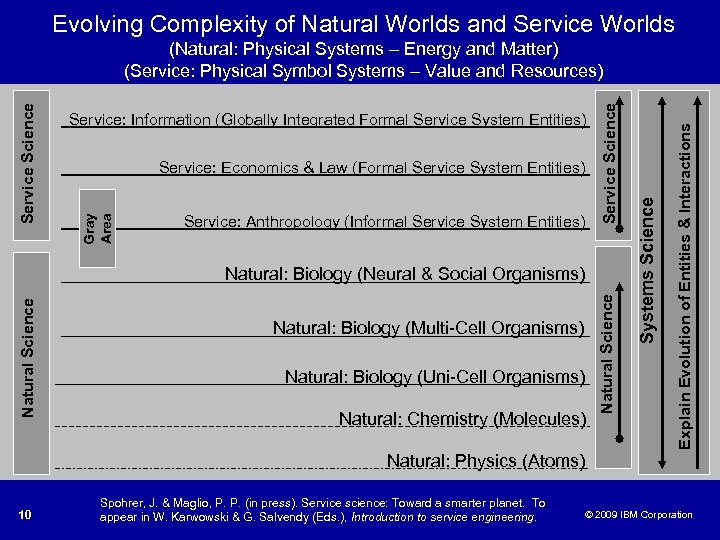 Evolving Complexity of Natural Worlds and Service Worlds Natural: Biology (Multi-Cell Organisms) Natural: Biology (Uni-Cell Organisms) Natural: Chemistry (Molecules) Natural Science Natural: Biology (Neural & Social Organisms) Explain Evolution of Entities & Interactions Service: Anthropology (Informal Service System Entities) Systems Science Service: Economics & Law (Formal Service System Entities) Service Science Service: Information (Globally Integrated Formal Service System Entities) Gray Area Service Science (Natural: Physical Systems – Energy and Matter) (Service: Physical Symbol Systems – Value and Resources) Natural: Physics (Atoms) 10 Spohrer, J. & Maglio, P. P. (in press). Service science: Toward a smarter planet. To appear in W. Karwowski & G. Salvendy (Eds. ), Introduction to service engineering. © 2009 IBM Corporation © 2005 IBM Corporation
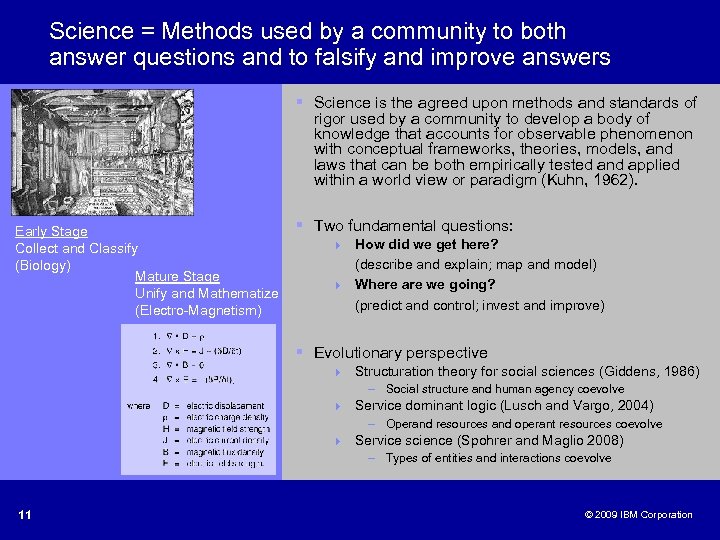 Science = Methods used by a community to both answer questions and to falsify and improve answers § Science is the agreed upon methods and standards of rigor used by a community to develop a body of knowledge that accounts for observable phenomenon with conceptual frameworks, theories, models, and laws that can be both empirically tested and applied within a world view or paradigm (Kuhn, 1962). Early Stage Collect and Classify (Biology) Mature Stage Unify and Mathematize (Electro-Magnetism) § Two fundamental questions: 4 How did we get here? (describe and explain; map and model) 4 Where are we going? (predict and control; invest and improve) § Evolutionary perspective 4 Structuration theory for social sciences (Giddens, 1986) – Social structure and human agency coevolve 4 Service dominant logic (Lusch and Vargo, 2004) – Operand resources and operant resources coevolve 4 Service science (Spohrer and Maglio 2008) – Types of entities and interactions coevolve 11 © 2009 IBM Corporation © 2005 IBM Corporation
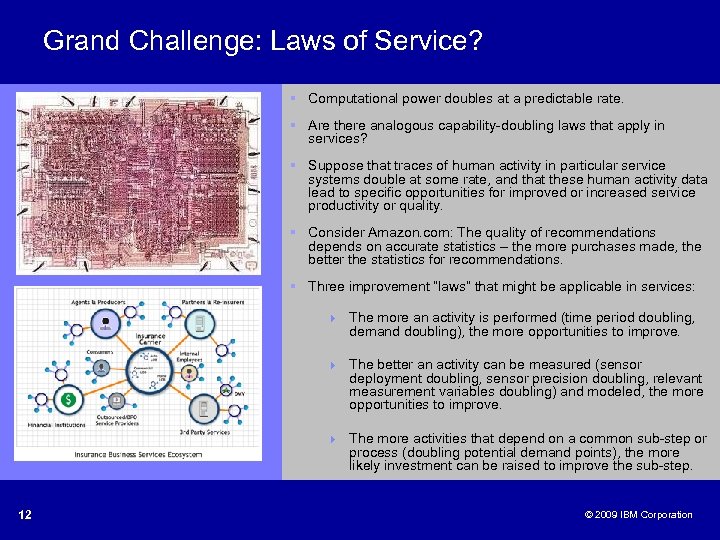 Grand Challenge: Laws of Service? § Computational power doubles at a predictable rate. § Are there analogous capability-doubling laws that apply in services? § Suppose that traces of human activity in particular service systems double at some rate, and that these human activity data lead to specific opportunities for improved or increased service productivity or quality. § Consider Amazon. com: The quality of recommendations depends on accurate statistics – the more purchases made, the better the statistics for recommendations. § Three improvement “laws” that might be applicable in services: 4 The more an activity is performed (time period doubling, demand doubling), the more opportunities to improve. 4 The better an activity can be measured (sensor deployment doubling, sensor precision doubling, relevant measurement variables doubling) and modeled, the more opportunities to improve. 4 The more activities that depend on a common sub-step or process (doubling potential demand points), the more likely investment can be raised to improve the sub-step. 12 © 2009 IBM Corporation © 2005 IBM Corporation
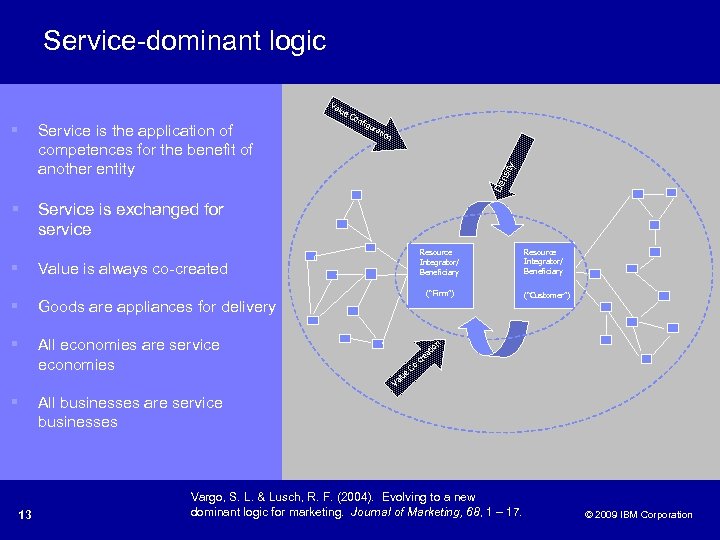 Service-dominant logic Va lue § nfi gu Service is exchanged for service § Resource Integrator/ Beneficiary Goods are appliances for delivery § ion Value is always co-created § rat ty Service is the application of competences for the benefit of another entity De nsi § Co All economies are service economies (“Firm”) 13 (“Customer”) n tio -c e lu Va § Resource Integrator/ Beneficiary Co a re All businesses are service businesses Vargo, S. L. & Lusch, R. F. (2004). Evolving to a new dominant logic for marketing. Journal of Marketing, 68, 1 – 17. © 2009 IBM Corporation © 2005 IBM Corporation
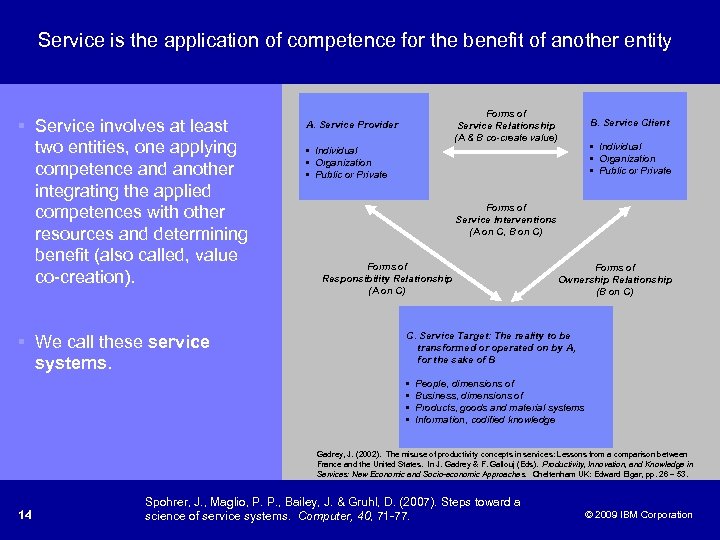 Service is the application of competence for the benefit of another entity § Service involves at least two entities, one applying competence and another integrating the applied competences with other resources and determining benefit (also called, value co-creation). § We call these service systems. Forms of Service Relationship (A & B co-create value) A. Service Provider • Individual • Organization • Public or Private B. Service Client • Individual • Organization • Public or Private Forms of Service Interventions (A on C, B on C) Forms of Responsibility Relationship (A on C) Forms of Ownership Relationship (B on C) C. Service Target: The reality to be transformed or operated on by A, for the sake of B • • People, dimensions of Business, dimensions of Products, goods and material systems Information, codified knowledge Gadrey, J. (2002). The misuse of productivity concepts in services: Lessons from a comparison between France and the United States. In J. Gadrey & F. Gallouj (Eds). Productivity, Innovation, and Knowledge in Services: New Economic and Socio-economic Approaches. Cheltenham UK: Edward Elgar, pp. 26 – 53. 14 Spohrer, J. , Maglio, P. P. , Bailey, J. & Gruhl, D. (2007). Steps toward a science of service systems. Computer, 40, 71 -77. © 2009 IBM Corporation © 2005 IBM Corporation
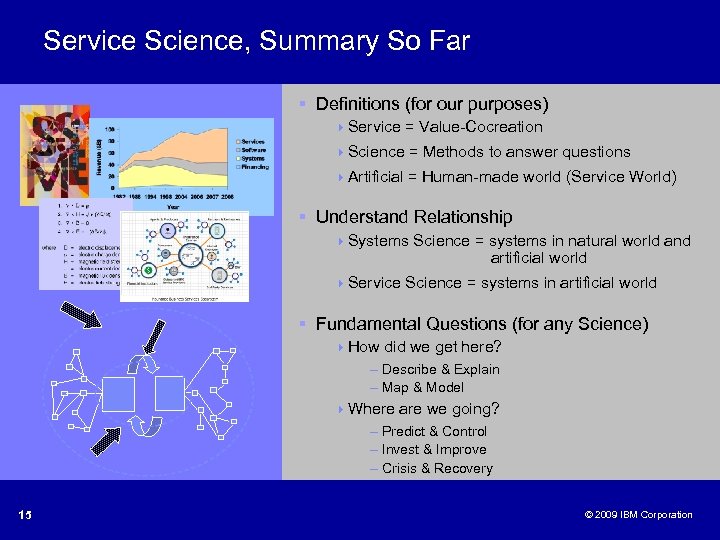 Service Science, Summary So Far § Definitions (for our purposes) 4 Service = Value-Cocreation 4 Science = Methods to answer questions 4 Artificial = Human-made world (Service World) § Understand Relationship 4 Systems 4 Service Science = systems in natural world and artificial world Science = systems in artificial world § Fundamental Questions (for any Science) 4 How did we get here? – Describe & Explain – Map & Model 4 Where are we going? – Predict & Control – Invest & Improve – Crisis & Recovery 15 © 2009 IBM Corporation © 2005 IBM Corporation
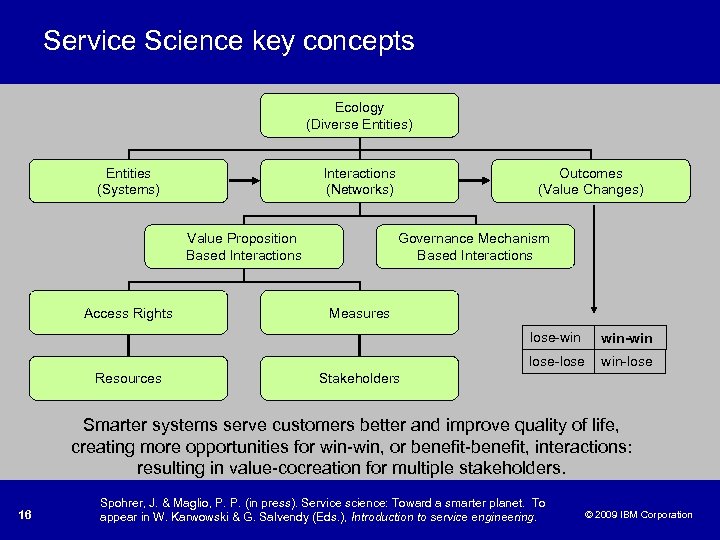 Service Science key concepts Ecology (Diverse Entities) Entities (Systems) Interactions (Networks) Value Proposition Based Interactions Access Rights Outcomes (Value Changes) Governance Mechanism Based Interactions Measures lose-win lose-lose Resources win-win win-lose Stakeholders Smarter systems serve customers better and improve quality of life, creating more opportunities for win-win, or benefit-benefit, interactions: resulting in value-cocreation for multiple stakeholders. 16 Spohrer, J. & Maglio, P. P. (in press). Service science: Toward a smarter planet. To appear in W. Karwowski & G. Salvendy (Eds. ), Introduction to service engineering. © 2009 IBM Corporation © 2005 IBM Corporation
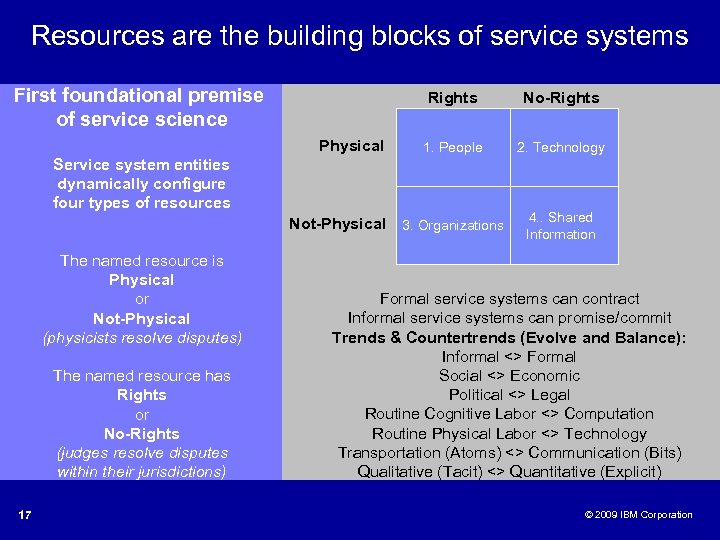 Resources are the building blocks of service systems First foundational premise of service science Rights Physical No-Rights 1. People 2. Technology Service system entities dynamically configure four types of resources Not-Physical 3. Organizations The named resource is Physical or Not-Physical (physicists resolve disputes) The named resource has Rights or No-Rights (judges resolve disputes within their jurisdictions) 17 4. . Shared Information Formal service systems can contract Informal service systems can promise/commit Trends & Countertrends (Evolve and Balance): Informal <> Formal Social <> Economic Political <> Legal Routine Cognitive Labor <> Computation Routine Physical Labor <> Technology Transportation (Atoms) <> Communication (Bits) Qualitative (Tacit) <> Quantitative (Explicit) © 2009 IBM Corporation © 2005 IBM Corporation
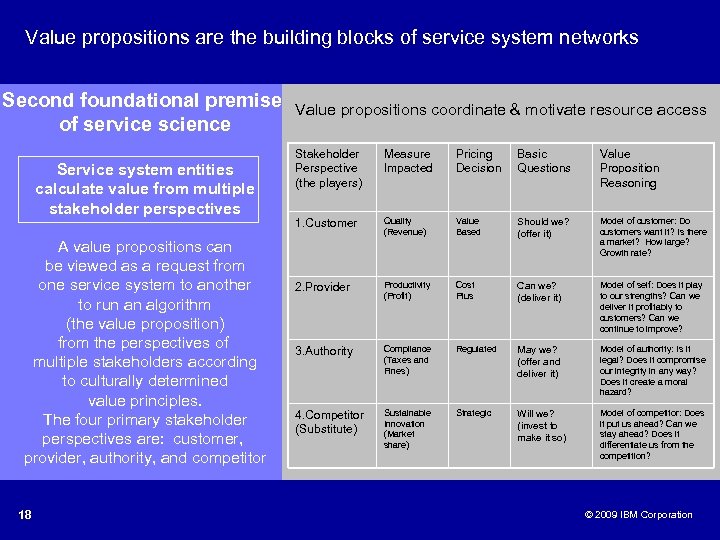 Value propositions are the building blocks of service system networks Second foundational premise of service science Service system entities calculate value from multiple stakeholder perspectives A value propositions can be viewed as a request from one service system to another to run an algorithm (the value proposition) from the perspectives of multiple stakeholders according to culturally determined value principles. The four primary stakeholder perspectives are: customer, provider, authority, and competitor 18 Value propositions coordinate & motivate resource access Stakeholder Perspective (the players) Measure Impacted Pricing Decision Basic Questions Value Proposition Reasoning 1. Customer Quality (Revenue) Value Based Should we? (offer it) Model of customer: Do customers want it? Is there a market? How large? Growth rate? 2. Provider Productivity (Profit) Cost Plus Can we? (deliver it) Model of self: Does it play to our strengths? Can we deliver it profitably to customers? Can we continue to improve? 3. Authority Compliance (Taxes and Fines) Regulated May we? (offer and deliver it) Model of authority: Is it legal? Does it compromise our integrity in any way? Does it create a moral hazard? 4. Competitor (Substitute) Sustainable Innovation (Market share) Strategic Will we? (invest to make it so) Model of competitor: Does it put us ahead? Can we stay ahead? Does it differentiate us from the competition? © 2009 IBM Corporation © 2005 IBM Corporation
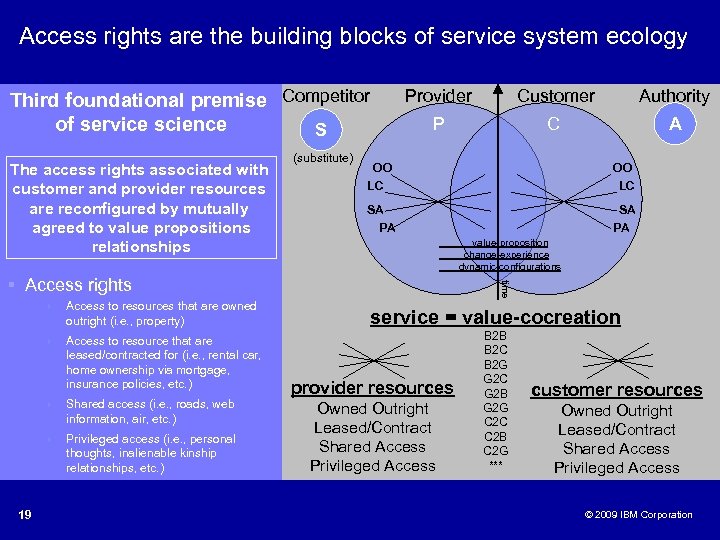 Access rights are the building blocks of service system ecology Third foundational premise Competitor of service science S The access rights associated with customer and provider resources are reconfigured by mutually agreed to value propositions relationships (substitute) Provider Customer Authority P C A OO LC SA PA value-proposition change-experience dynamic-configurations 4 Access to resources that are owned outright (i. e. , property) 4 Access to resource that are leased/contracted for (i. e. , rental car, home ownership via mortgage, insurance policies, etc. ) 4 4 19 Shared access (i. e. , roads, web information, air, etc. ) Privileged access (i. e. , personal thoughts, inalienable kinship relationships, etc. ) time § Access rights service = value-cocreation provider resources Owned Outright Leased/Contract Shared Access Privileged Access B 2 B B 2 C B 2 G G 2 C G 2 B G 2 G C 2 C C 2 B C 2 G *** customer resources Owned Outright Leased/Contract Shared Access Privileged Access © 2009 IBM Corporation © 2005 IBM Corporation
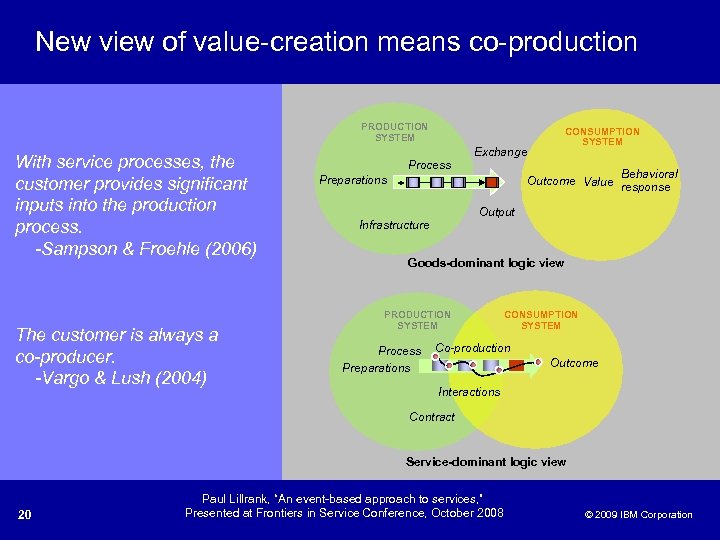 New view of value-creation means co-production PRODUCTION SYSTEM With service processes, the customer provides significant inputs into the production process. -Sampson & Froehle (2006) The customer is always a co-producer. -Vargo & Lush (2004) Process CONSUMPTION SYSTEM Exchange Behavioral Outcome Value response Preparations Output Infrastructure Goods-dominant logic view PRODUCTION SYSTEM Process Preparations CONSUMPTION SYSTEM Co-production Outcome Interactions Contract Service-dominant logic view 20 Paul Lillrank, “An event-based approach to services, ” Presented at Frontiers in Service Conference, October 2008 © 2009 IBM Corporation © 2005 IBM Corporation
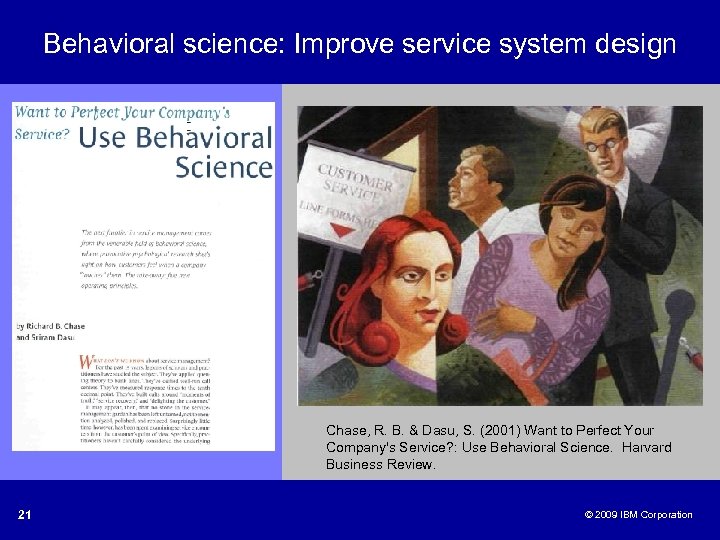 Behavioral science: Improve service system design Chase, R. B. & Dasu, S. (2001) Want to Perfect Your Company's Service? : Use Behavioral Science. Harvard Business Review. 21 © 2009 IBM Corporation © 2005 IBM Corporation
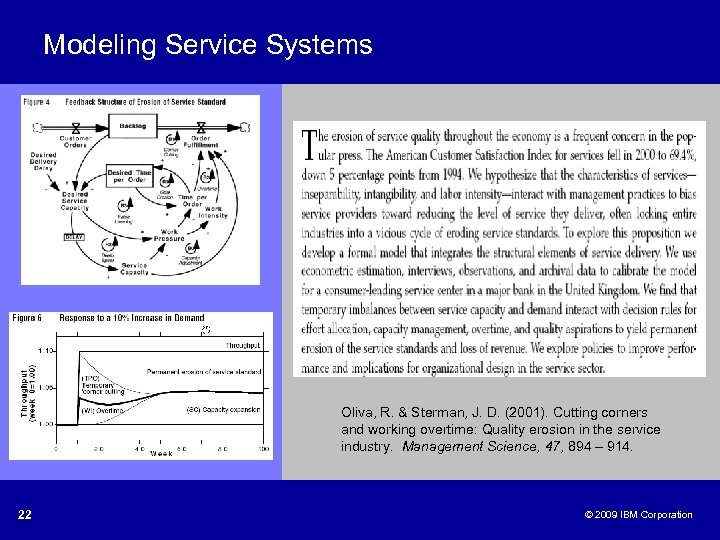 Modeling Service Systems Oliva, R. & Sterman, J. D. (2001). Cutting corners and working overtime: Quality erosion in the service industry. Management Science, 47, 894 – 914. 22 © 2009 IBM Corporation © 2005 IBM Corporation
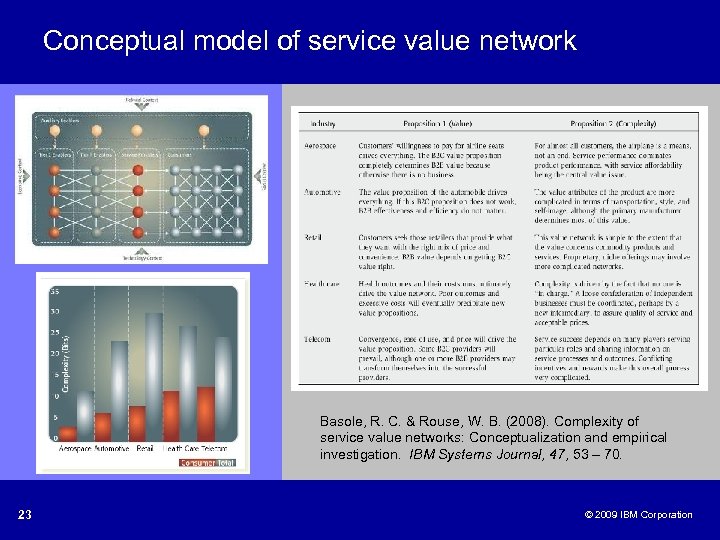 Conceptual model of service value network Basole, R. C. & Rouse, W. B. (2008). Complexity of service value networks: Conceptualization and empirical investigation. IBM Systems Journal, 47, 53 – 70. 23 © 2009 IBM Corporation © 2005 IBM Corporation
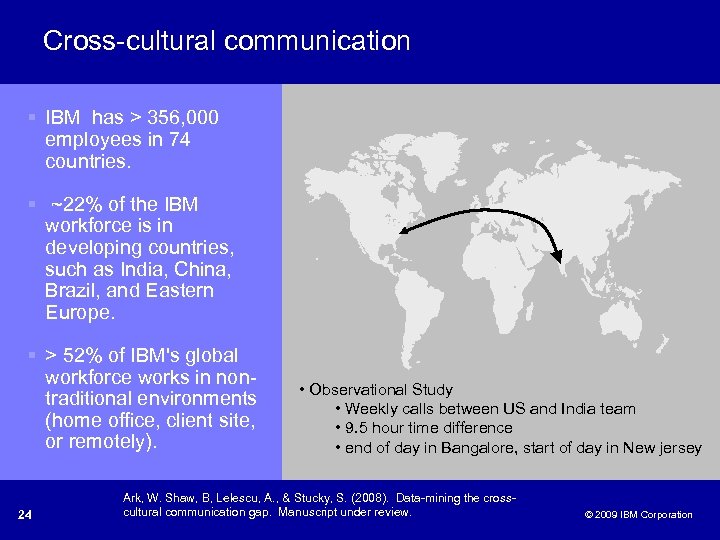 Cross-cultural communication § IBM has > 356, 000 employees in 74 countries. § ~22% of the IBM workforce is in developing countries, such as India, China, Brazil, and Eastern Europe. § > 52% of IBM's global workforce works in nontraditional environments (home office, client site, or remotely). 24 • Observational Study • Weekly calls between US and India team • 9. 5 hour time difference • end of day in Bangalore, start of day in New jersey Ark, W. Shaw, B, Lelescu, A. , & Stucky, S. (2008). Data-mining the crosscultural communication gap. Manuscript under review. © 2009 IBM Corporation © 2005 IBM Corporation
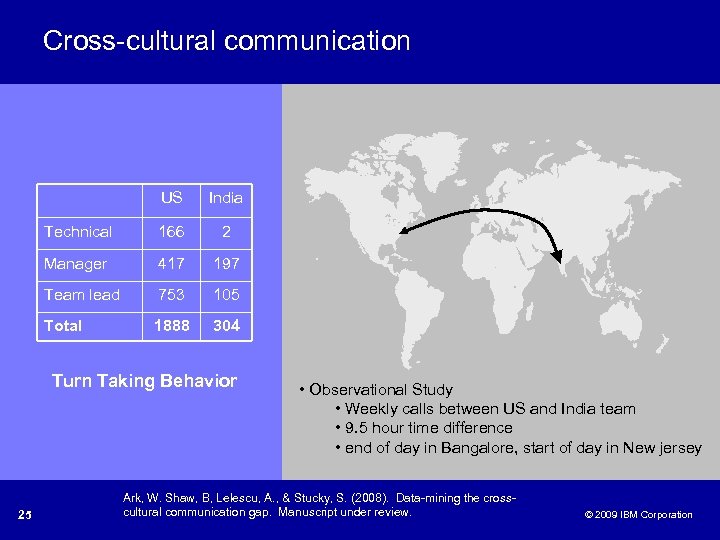 Cross-cultural communication US India Technical 166 2 Manager 417 197 Team lead 753 105 Total 1888 304 Turn Taking Behavior 25 • Observational Study • Weekly calls between US and India team • 9. 5 hour time difference • end of day in Bangalore, start of day in New jersey Ark, W. Shaw, B, Lelescu, A. , & Stucky, S. (2008). Data-mining the crosscultural communication gap. Manuscript under review. © 2009 IBM Corporation © 2005 IBM Corporation
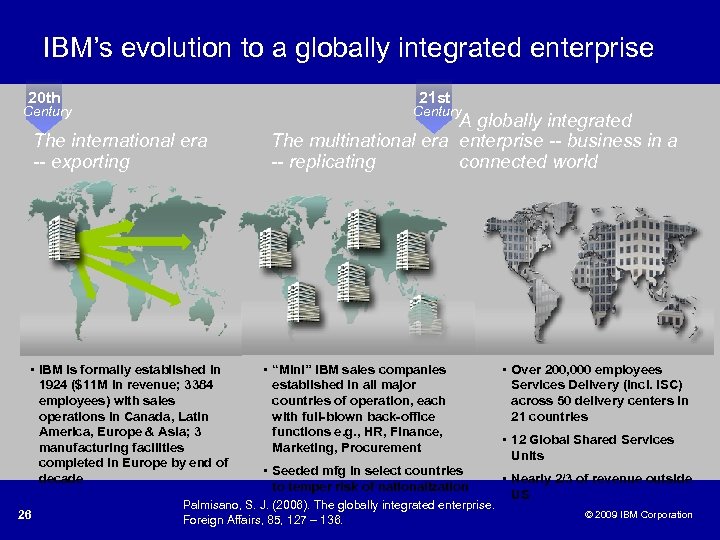 IBM’s evolution to a globally integrated enterprise 20 th 21 st Century The international era -- exporting • IBM is formally established in 1924 ($11 M in revenue; 3384 employees) with sales operations in Canada, Latin America, Europe & Asia; 3 manufacturing facilities completed in Europe by end of decade 26 A globally integrated The multinational era enterprise -- business in a connected world -- replicating • “Mini” IBM sales companies established in all major countries of operation, each with full-blown back-office functions e. g. , HR, Finance, Marketing, Procurement • Seeded mfg in select countries to temper risk of nationalization Palmisano, S. J. (2006). The globally integrated enterprise. Foreign Affairs, 85, 127 – 136. • Over 200, 000 employees Services Delivery (incl. ISC) across 50 delivery centers in 21 countries • 12 Global Shared Services Units • Nearly 2/3 of revenue outside US © 2009 IBM Corporation © 2005 IBM Corporation
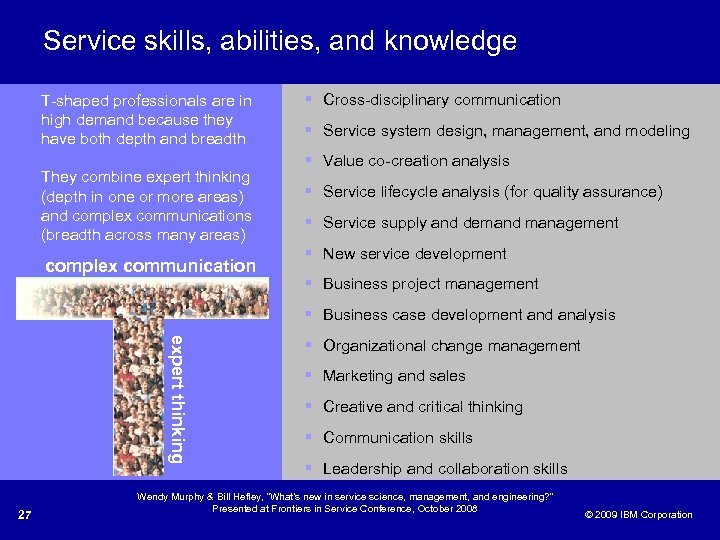 Service skills, abilities, and knowledge T-shaped professionals are in high demand because they have both depth and breadth They combine expert thinking (depth in one or more areas) and complex communications (breadth across many areas) complex communication § Cross-disciplinary communication § Service system design, management, and modeling § Value co-creation analysis § Service lifecycle analysis (for quality assurance) § Service supply and demand management § New service development § Business project management § Business case development and analysis expert thinking 27 § Organizational change management § Marketing and sales § Creative and critical thinking § Communication skills § Leadership and collaboration skills Wendy Murphy & Bill Hefley, “What’s new in service science, management, and engineering? ” Presented at Frontiers in Service Conference, October 2008 © 2009 IBM Corporation © 2005 IBM Corporation
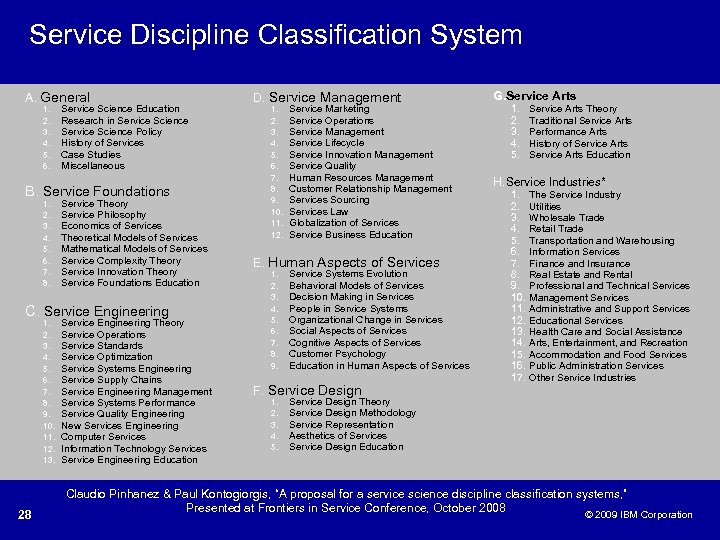 Service Discipline Classification System A. General 1. 2. 3. 4. 5. 6. Service Science Education Research in Service Science Policy History of Services Case Studies Miscellaneous B. Service Foundations 1. 2. 3. 4. 5. 6. 7. 8. Service Theory Service Philosophy Economics of Services Theoretical Models of Services Mathematical Models of Services Service Complexity Theory Service Innovation Theory Service Foundations Education C. Service Engineering 1. 2. 3. 4. 5. 6. 7. 8. 9. 10. 11. 12. 13. 28 Service Engineering Theory Service Operations Service Standards Service Optimization Service Systems Engineering Service Supply Chains Service Engineering Management Service Systems Performance Service Quality Engineering New Services Engineering Computer Services Information Technology Services Service Engineering Education D. Service Management 1. 2. 3. 4. 5. 6. 7. 8. 9. 10. 11. 12. Service Marketing Service Operations Service Management Service Lifecycle Service Innovation Management Service Quality Human Resources Management Customer Relationship Management Services Sourcing Services Law Globalization of Services Service Business Education E. Human Aspects of Services 1. 2. 3. 4. 5. 6. 7. 8. 9. Service Systems Evolution Behavioral Models of Services Decision Making in Services People in Service Systems Organizational Change in Services Social Aspects of Services Cognitive Aspects of Services Customer Psychology Education in Human Aspects of Services F. Service Design 1. 2. 3. 4. 5. G. Service Arts 1. 2. 3. 4. 5. Service Arts Theory Traditional Service Arts Performance Arts History of Service Arts Education H. Service Industries* 1. 2. 3. 4. 5. 6. 7. 8. 9. 10. 11. 12. 13. 14. 15. 16. 17. The Service Industry Utilities Wholesale Trade Retail Trade Transportation and Warehousing Information Services Finance and Insurance Real Estate and Rental Professional and Technical Services Management Services Administrative and Support Services Educational Services Health Care and Social Assistance Arts, Entertainment, and Recreation Accommodation and Food Services Public Administration Services Other Service Industries Service Design Theory Service Design Methodology Service Representation Aesthetics of Services Service Design Education Claudio Pinhanez & Paul Kontogiorgis, “A proposal for a service science discipline classification systems, ” Presented at Frontiers in Service Conference, October 2008 © 2009 IBM Corporation © 2005 IBM Corporation
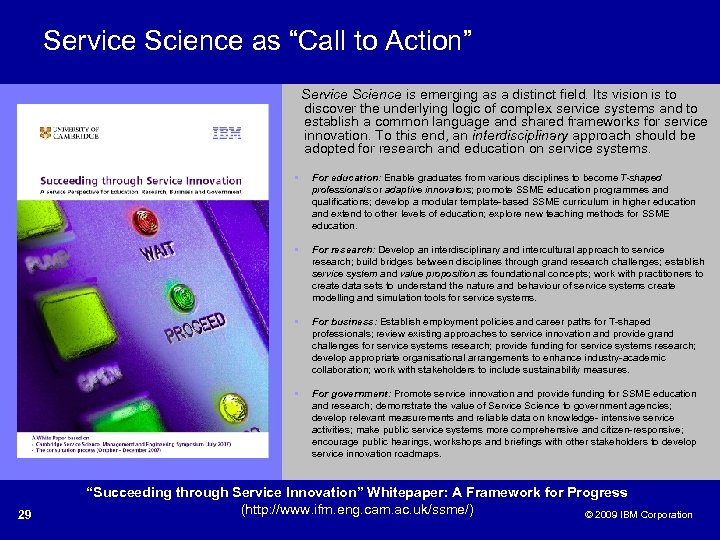 Service Science as “Call to Action” Service Science is emerging as a distinct field. Its vision is to discover the underlying logic of complex service systems and to establish a common language and shared frameworks for service innovation. To this end, an interdisciplinary approach should be adopted for research and education on service systems. § § For research: Develop an interdisciplinary and intercultural approach to service research; build bridges between disciplines through grand research challenges; establish service system and value proposition as foundational concepts; work with practitioners to create data sets to understand the nature and behaviour of service systems create modelling and simulation tools for service systems. § For business: Establish employment policies and career paths for T-shaped professionals; review existing approaches to service innovation and provide grand challenges for service systems research; provide funding for service systems research; develop appropriate organisational arrangements to enhance industry-academic collaboration; work with stakeholders to include sustainability measures. § 29 For education: Enable graduates from various disciplines to become T-shaped professionals or adaptive innovators; promote SSME education programmes and qualifications; develop a modular template-based SSME curriculum in higher education and extend to other levels of education; explore new teaching methods for SSME education. For government: Promote service innovation and provide funding for SSME education and research; demonstrate the value of Service Science to government agencies; develop relevant measurements and reliable data on knowledge- intensive service activities; make public service systems more comprehensive and citizen-responsive; encourage public hearings, workshops and briefings with other stakeholders to develop service innovation roadmaps. “Succeeding through Service Innovation” Whitepaper: A Framework for Progress (http: //www. ifm. eng. cam. ac. uk/ssme/) © 2009 IBM Corporation © 2005 IBM Corporation
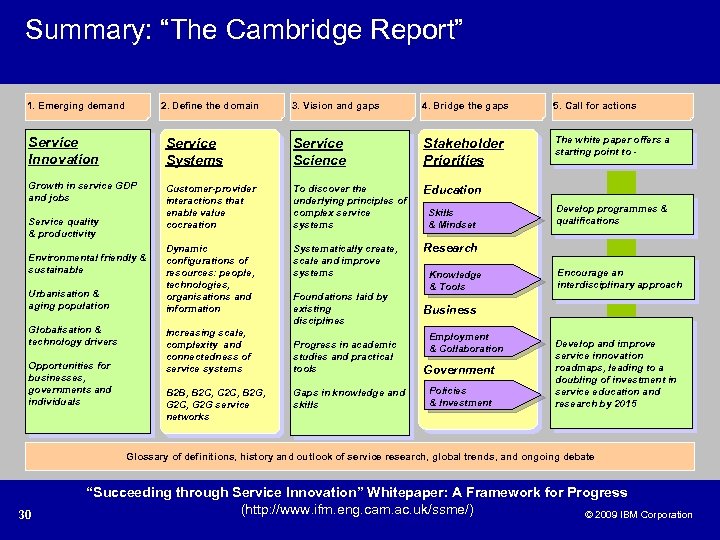 Summary: “The Cambridge Report” 1. Emerging demand 2. Define the domain 3. Vision and gaps 4. Bridge the gaps 5. Call for actions The white paper offers a starting point to - Service Innovation Service Systems Service Science Stakeholder Priorities Growth in service GDP and jobs Customer-provider interactions that enable value cocreation To discover the underlying principles of complex service systems Education Dynamic configurations of resources: people, technologies, organisations and information Systematically create, scale and improve systems Research Service quality & productivity Environmental friendly & sustainable Urbanisation & aging population Globalisation & technology drivers Opportunities for businesses, governments and individuals Increasing scale, complexity and connectedness of service systems B 2 B, B 2 C, C 2 C, B 2 G, G 2 C, G 2 G service networks Foundations laid by existing disciplines Progress in academic studies and practical tools Gaps in knowledge and skills Skills & Mindset Knowledge & Tools Develop programmes & qualifications Encourage an interdisciplinary approach Business Employment & Collaboration Government Policies & Investment Develop and improve service innovation roadmaps, leading to a doubling of investment in service education and research by 2015 Glossary of definitions, history and outlook of service research, global trends, and ongoing debate 30 “Succeeding through Service Innovation” Whitepaper: A Framework for Progress (http: //www. ifm. eng. cam. ac. uk/ssme/) © 2009 IBM Corporation © 2005 IBM Corporation
 Worldwide University Programs and SSME § >250 Universities in >50 nations 4 Courses that combine business and engineering perspectives Various levels: undergrad, masters, and doctoral – 102 degree programs in SSME worldwide – 88 Masters degrees, 14 Bachelors 4 Core area of study remains the focus 4 4 Adds breadth and exposure to many service system examples 4 Preparing graduates to be adaptive innovators in service-led economies § >25 Service Research Institutes established 4 4 Interdisciplinary teams that focus by industries 4 31 Practical experience and industry participation Student competition and award programs © 2009 IBM Corporation © 2005 IBM Corporation
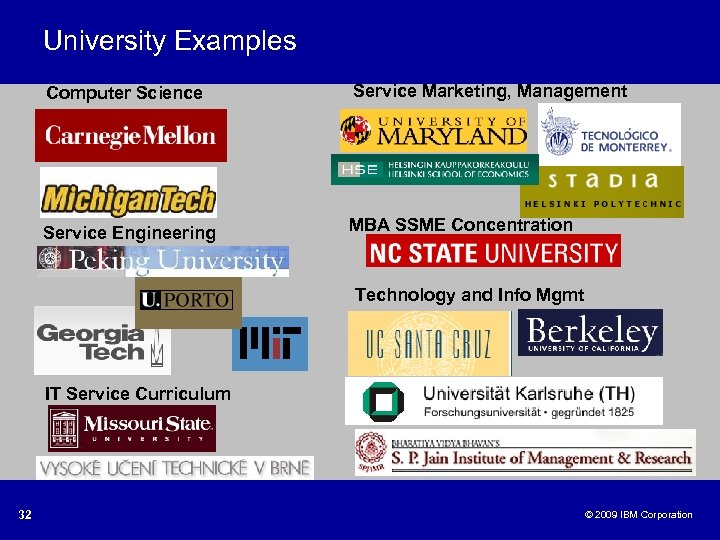 University Examples Computer Science Service Marketing, Management Service Engineering MBA SSME Concentration Technology and Info Mgmt IT Service Curriculum 32 © 2009 IBM Corporation © 2005 IBM Corporation
 Worldwide Service Research Centers (>27 Total) § Bahcesehir and Northeastern (Turkey) Universities • § Innovation University: Helsinki University of Technology (HUT)=Design Factory, Helsinki School of Economics HSE)= Service Factory and Helsinki University of Arts and Design (UAD)=Media § India SP Jain Institute for Management SSME Center § Karlsruhe Service Research Center § Shanghai Research Center (Charles King, Pund-IT) § National Tsinghua Institute for Service Science § University of Amsterdam and the VU University Amsterdam will launch one of the first European university centers for service innovation § University Federal de Rio de Janeiro SSME Research Group 33 © 2009 IBM Corporation © 2005 IBM Corporation
 Worldwide Government Programs § >18 Nations have held events, written papers 4 4 Typically, focus on a few key industries (health care, financial, etc. ) 4 Often tied to growth of entrepreneurship and new e-service offerings 4 A few have made government e-service offerings a priority 4 Identify leading university programs 4 Identify leading industrial research organizations 4 Identify government research and funding programs 4 Identify public-private stakeholder organizations to drive agenda 4 34 Basic statistics on jobs, businesses, GDP, Import/Export, growth Establish recommendations going forward © 2009 IBM Corporation © 2005 IBM Corporation
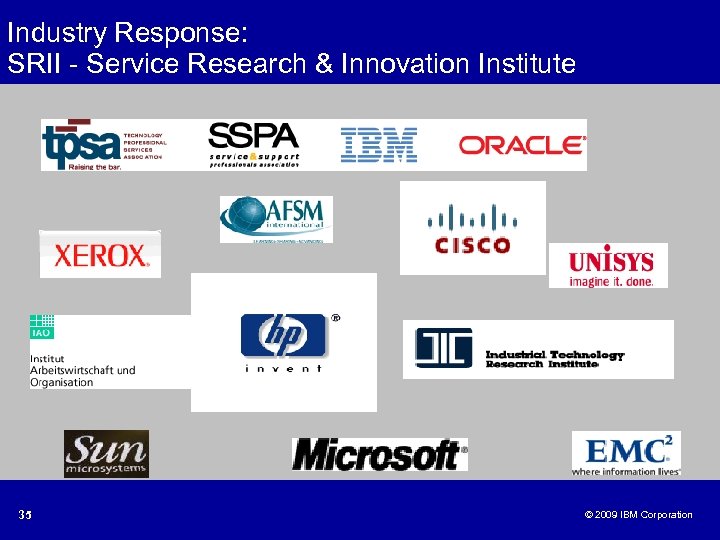 Industry Response: SRII - Service Research & Innovation Institute 35 © 2009 IBM Corporation © 2005 IBM Corporation
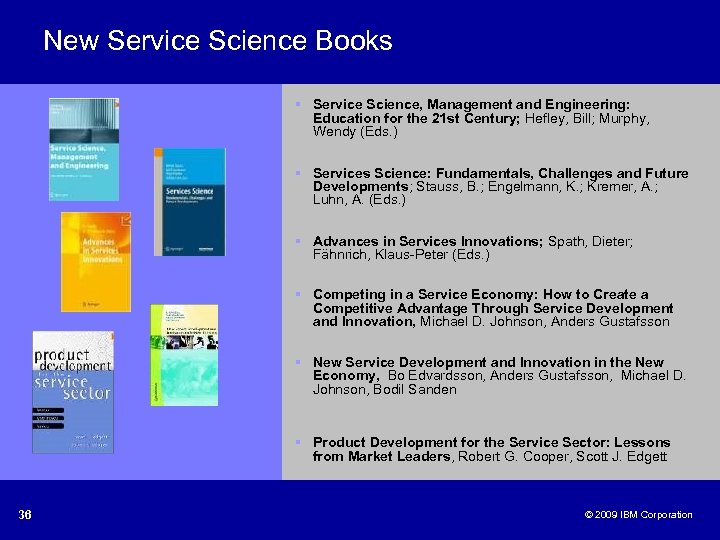 New Service Science Books § Service Science, Management and Engineering: Education for the 21 st Century; Hefley, Bill; Murphy, Wendy (Eds. ) § Services Science: Fundamentals, Challenges and Future Developments; Stauss, B. ; Engelmann, K. ; Kremer, A. ; Luhn, A. (Eds. ) § Advances in Services Innovations; Spath, Dieter; Fähnrich, Klaus-Peter (Eds. ) § Competing in a Service Economy: How to Create a Competitive Advantage Through Service Development and Innovation, Michael D. Johnson, Anders Gustafsson § New Service Development and Innovation in the New Economy, Bo Edvardsson, Anders Gustafsson, Michael D. Johnson, Bodil Sanden § Product Development for the Service Sector: Lessons from Market Leaders, Robert G. Cooper, Scott J. Edgett 36 © 2009 IBM Corporation © 2005 IBM Corporation
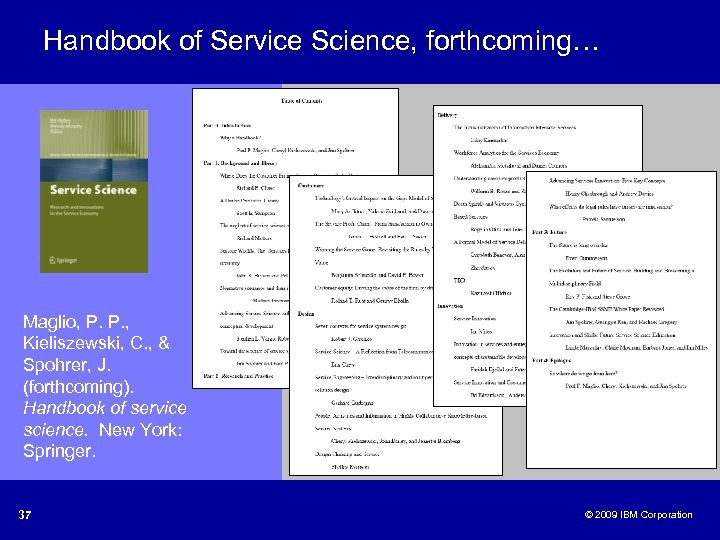 Handbook of Service Science, forthcoming… Maglio, P. P. , Kieliszewski, C. , & Spohrer, J. (forthcoming). Handbook of service science. New York: Springer. 37 © 2009 IBM Corporation © 2005 IBM Corporation
 So what is service science? § Service is value-cocreation, that is, useful changes that result from communication, planning, or other purposeful interactions between distinct entities. § A service system is a collection of entities and interactions that cocreate value, that is, a set of distinct configurations of resources (including people, organizations, shared information, and technology) that are better off working together than working alone. § Service Science aims to create a body of knowledge that describes, explains, predicts, and improves value -cocreation between entities as they interact, that is, relying on methods and standards used by a community to account for observable phenomenon with conceptual frameworks, theories, models, and laws that can be empirically tested. § So the object of study value-cocreation, the basic abstraction is the service system, and the ultimate goal is develop methods and theories that can be used to explain and improve value-cocreation in service systems. 38 © 2009 IBM Corporation © 2005 IBM Corporation
 http: //www. ibm. com/university/ssme 39 © 2009 IBM Corporation © 2005 IBM Corporation