 Скачать презентацию Service Quality in Academic Libraries Case Studies from
ab9457b6180526de5adc14c9fd401a11.ppt
- Количество слайдов: 33



Service Quality in Academic Libraries: Case Studies from Delhi, India Dr. K. Madhavan Sangeeta Narang Neha Chandel 1 ICRL 2018
Overview Introduction – Definition Background – why to measure service quality? Research Gap Objective Methodology – survey settings Pioneering work in the field Institutions & Libraries profile Data analysis and findings Limitations Suggestions Conclusion 2 ICRL 2018
Introduction The expansion of Internet as a mixed cluster of electronic documents affect readers’ learning and research. The educators, researchers and students face problems in retrieving correct information from the web in short period of time at right place. The libraries bring specific, authentic resources to meet the growing demand of the readers, incorporate new technologies and tools and offer excellent reading spaces to the learners. Librarians develop new service paradigms in various areas of library operations whether it is in purchase of resources, access and delivery mechanisms or maintenance of collections. Academic librarians reorient the library services with extreme care to satisfy readers demand. They are adopting Service Quality models similar to Total Quality Management (TQM) of business organizations to stay ahead. 3 ICRL 2018
Definition Service quality is the overall evaluation of a specific service firm that results from comparing that firm’s performance with the customer’s general expectations of how firms in that industry should perform - Parasuraman et al. (1988) An assessment of how well a delivered service conforms to the client's expectations. Service business operators often assess the service quality provided to their customers in order to improve their service, to quickly identify problems, and to better assess client satisfaction (service quality. Business. Dictionary. com. Web. Finance, Inc. http: //www. businessdictionary. com/definition/servicequality. html (accessed: January 29, 2018). 4 ICRL 2018
Background Parasuraman, A. Zeithaml, V. A. and Berry, L. L. (1985) underlined the importance of quality assurance in service deliveries in business organizations Their pioneering studies became a role model for later researchers to advance research They developed an assessment tool called “Servqual” to measure service quality 5 ICRL 2018
Why to measure Library Service Quality? “A measure of library quality based solely on collections has become obsolete. ” Nitecki, 1996 “Within a service-quality assessment model only customers judge quality; all other judgments are essentially irrelevant. ” Zeithaml, Parasuraman, Berry, 1990 To serve as diagnostic and benchmarking tool to improve service quality and increase or maintain customer satisfaction. Courtesy: Beatty, and Ryan (2003). Library Service Quality in Academic Libraries: Assessment and Action. Available at https: //tinyurl. com/yaw 6 zd 35 ICRL 2018
Research Gap Literature on service quality is rich enough in the business sector in India but in LIS this area did not get the needed attention. Service quality research done in LIS domain in the western world is abundant. While Indian libraries are lagging behind in designing exemplary service models. 7 ICRL 2018
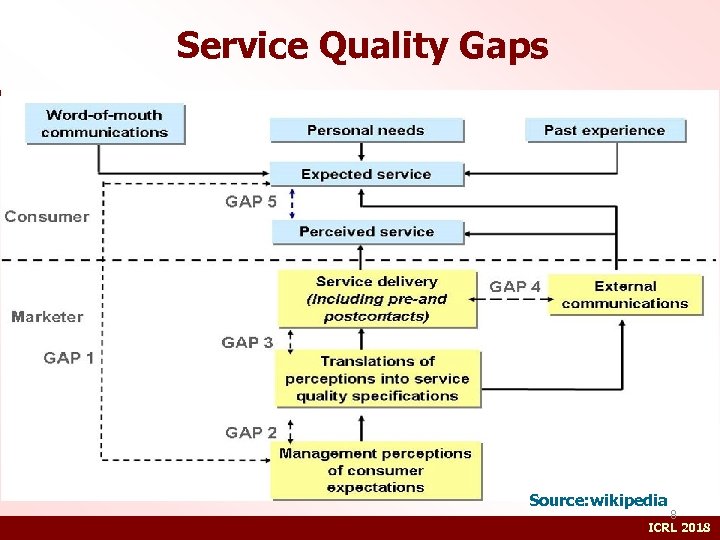
Service Quality Gaps Source: wikipedia 8 ICRL 2018
Objective The objectives of this study are: To investigate the customers’ perception about library services To determine the best areas of service quality To ascertain problems encountered by the users with regard to library service To know patrons expectations from the library To draw suggestions based on patrons response for the areas in which library need improvement 9 ICRL 2018
Methodology A common questionnaire on service quality was developed and distributed to the library patrons at three higher education institutions in first week of December 2017. It consisted of 9 close ended questions and one open ended question. Open ended question was included with an idea to provide a platform to patrons for expressing their view about the library services freely and to draw their expectations from the libraries Readers were prior informed about the purpose of this survey, their participation was voluntary and their identity was hidden The collected data was tabulated in MS Excel for analysis and the findings are presented in the subsequent slides. 10 ICRL 2018
Survey Settings Three academic libraries of Delhi considered for this study include: All India Institute of Medical Sciences (AIIMS), New Delhi Gitarattan International Business School (GIBS) , Fortune Institute of International Business (FIIB) 11 ICRL 2018
Survey instrument In the library settings, it was in the year 2000, the Association of Research Libraries, USA, partnered with Texas A&M University Libraries to develop, test, and refine Lib. QUAL+ instrument for measuring service quality in academic libraries Lib. Qual + measures library users’ minimum, perceived, and desired levels of service quality across three dimensions: effect of service, Information control, library as a place. “Since 2000, more than 1, 300 libraries in 33 countries have participated in Lib. QUAL+, including college and university, community college, health sciences, and academic law libraries”. 12 ICRL 2018
Institutions and Libraries Profile 13 ICRL 2018
All India Institute of Medical Sciences (AIIMS), New Delhi AIIMS was established in 1956, by an Act of Parliament as an institution of national importance to develop patterns and standards of excellence in teaching undergraduate and postgraduate medical education. Teaching and research in the institute is conducted in 70 disciplines. There are over 700 faculty members, 800 undergraduate students and 1500 postgraduate students. AIIMS provide innovative instructional opportunities to an expanding number of health professionals both national and International. It also offers continuing medical education to thousands of physicians and healthcare professionals to help improve skills, increase knowledge and improve performance. 14 ICRL 2018
B. B. Dikshit Library, AIIMS BB Dikshit Library of AIIMS is open round the clock, seven days a week except six National Holidays in a year to serve bonafide members of the institute. It has over 3000 members on library records and about 300 readers visit library every day. The library is well equipped with modern technologies to support medical education and research. It has a collection of over 1. 5 lakh books in diverse disciplines of medicine; more than 1500 periodicals are subscribed by the library. In addition, library subscribes to number of medical science databases viz. Up. To. Date, BMJ case reports, Access medicine and several e-books are available. The subscribed online databases and journals can be browsed within the campus as well as through remote access. All documentation services and library operations are computerized using integrated library management software Lib. Sys. Premia. The library has computer lab consisting of three servers, fifty-four desktops and ten thin-client computers. The library provides printing and reprographic services to the library patrons. 15 ICRL 2018
BBDL (Contd. ) In 2016, the library implemented EBSCO Discovery Service (EDS) as a single search tool to access numerous resources. It also procured i. Thenticate: plagiarism detection software last year. Information about all books and documents viz. thesis, reports received in the library are available online accessible through Intranet service within the campus, more records are updated regularly in the database. Library offers current awareness service, bibliographic service and reference service to its customers. It publishes new arrival books bulletin regularly for the benefit of its readers. 16 ICRL 2018
Gitarattan International Business School (GIBS) GIBS is promoted by Rohini Educational Society, Gitarattan International Business School (GIBS) established in the year 2004. This premier Management institute in North India is affiliated to Guru Gobind Singh Indraprastha University, Delhi(GGSIPU, New Delhi). The main goal of this academic institution is to provide quality education to young minds from India and abroad. (http: //www. gitarattan. edu. in/index. php). GIBS offer graduate and postgraduate courses in Computer Applications, Management, and Law. 17 ICRL 2018
GIBS Library It has a state-of-the-art library, having computer labs and highly talented faculty and library team. The learning resource center is well stocked with more than 20, 000 management books, 5, 000 computer books, 2, 500 law books and other collections. GIBS Library caters to the information needs of over 1, 200 students and 100 teaching faculty. It subscribes to major databases and is in the process of modernization. The Library at GIBS is transitioning in to a modern academic library by adopting latest library technologies such as Radio Frequency Identification (RFID) Library is developing as a knowledge base of e-resources that include e-journals from premier publishers, NPTEL Videos from IIT Chennai, and present open access resources for the benefit of its customers. 18 ICRL 2018
Fortune Institute of International Business (FIIB) FIIB was established in 1995, as a premier Business B-School in Delhi. It has worked towards rediscovering and reinventing MBA education through developing an industry relevant and global curriculum delivered by erudite faculty. Through its commitment to excellence in Management education, the college has been able to touch lives of close to 2000+ students and helped them realize their dreams of becoming Leaders and Managers, not only in India but across the globe. The focus of FIIB has been to bring a transformation in the mindset of its college students by encouraging them to make a difference in whichever field they choose. In 23 years of existence, the college has been lauded for its efforts. Its strong recruiter relationships, ranking among the best B-schools in India and awards by major business school academies are a testimony to its growing popularity 19 ICRL 2018
Library In keeping with the vision and mission of the Institute, the FIIB library has been established “to facilitate knowledge generation and application through its effective dissemination”. Library holds a comprehensive and up-to-date collection of knowledge resources such as print and electronic resources including e-books. FIIB library also provides access to national/international databases like Capitaline, EBSCO and J-Gate and to the National Digital Library, Virtual repository of learning resources. FIIB has established linkages with DELNET, which provides the delivery of individual books as and when required by members and photocopies of articles published in India and abroad through the Inter Library Loan/Document Delivery Services 20 ICRL 2018
DATA ANALYSIS 21 ICRL 2018
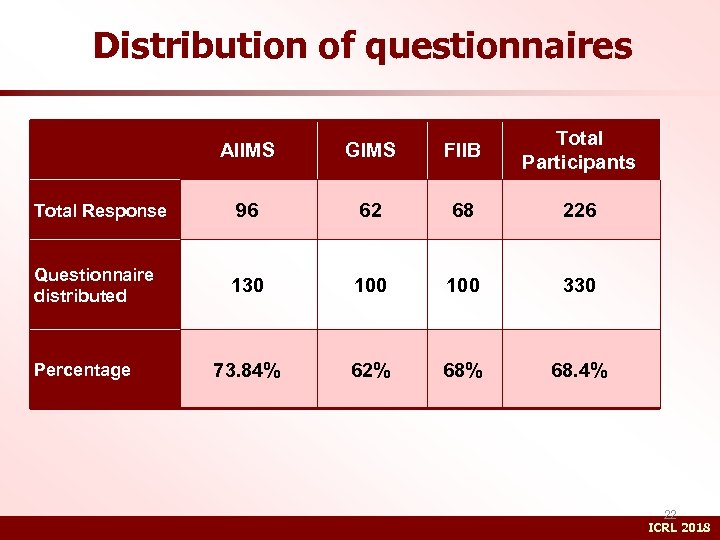
Distribution of questionnaires AIIMS GIMS FIIB Total Participants Total Response 96 62 68 226 Questionnaire distributed 130 100 330 73. 84% 62% 68. 4% Percentage 22 ICRL 2018
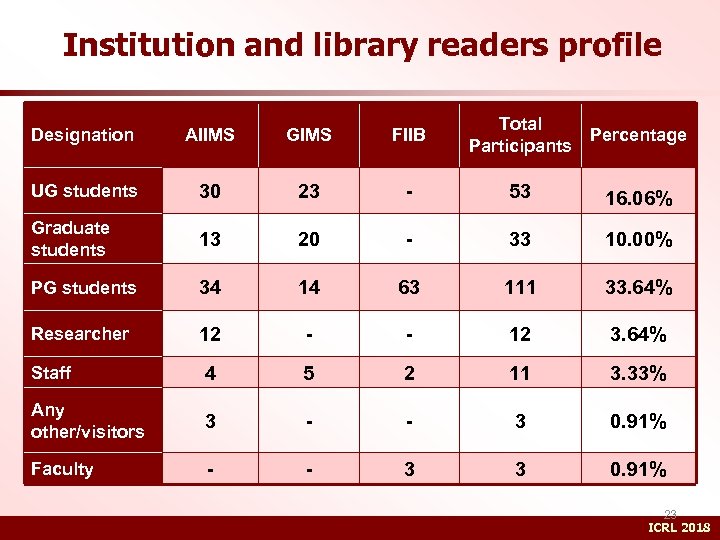
Institution and library readers profile Designation AIIMS GIMS FIIB Total Participants Percentage UG students 30 23 - 53 16. 06% Graduate students 13 20 - 33 10. 00% PG students 34 14 63 111 33. 64% Researcher 12 - - 12 3. 64% Staff 4 5 2 11 3. 33% Any other/visitors 3 - - 3 0. 91% Faculty - - 3 3 0. 91% 23 ICRL 2018
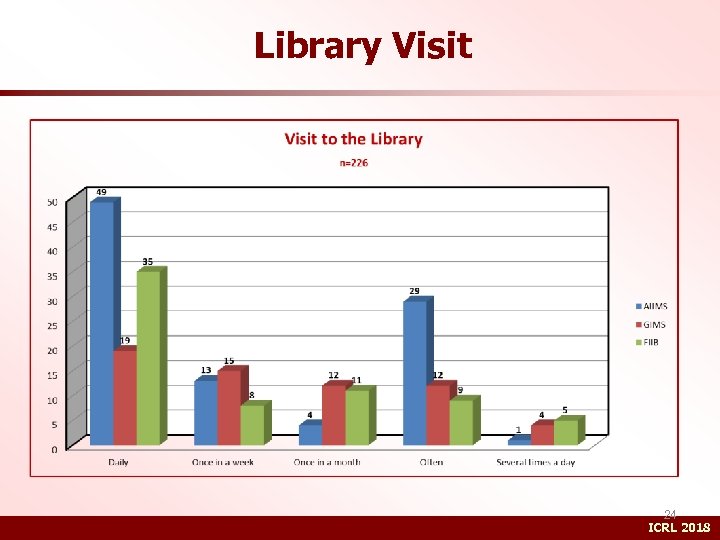
Library Visit 24 ICRL 2018
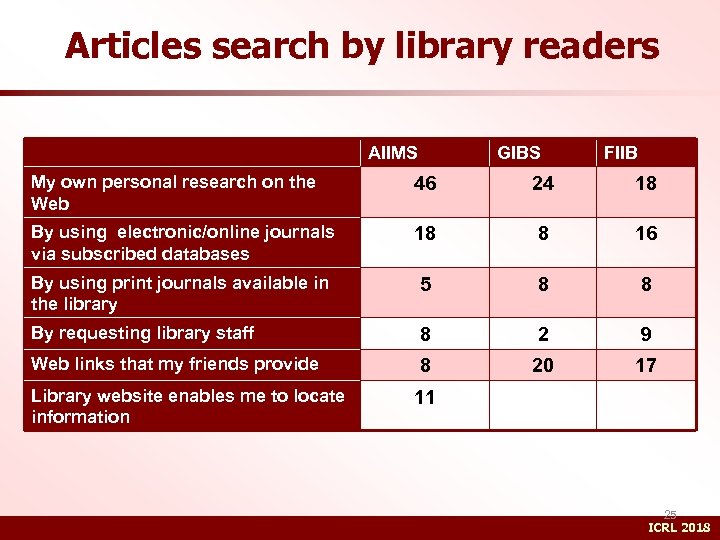
Articles search by library readers AIIMS GIBS FIIB My own personal research on the Web 46 24 18 By using electronic/online journals via subscribed databases 18 8 16 By using print journals available in the library 5 8 8 By requesting library staff 8 2 9 Web links that my friends provide 8 20 17 Library website enables me to locate information 11 25 ICRL 2018
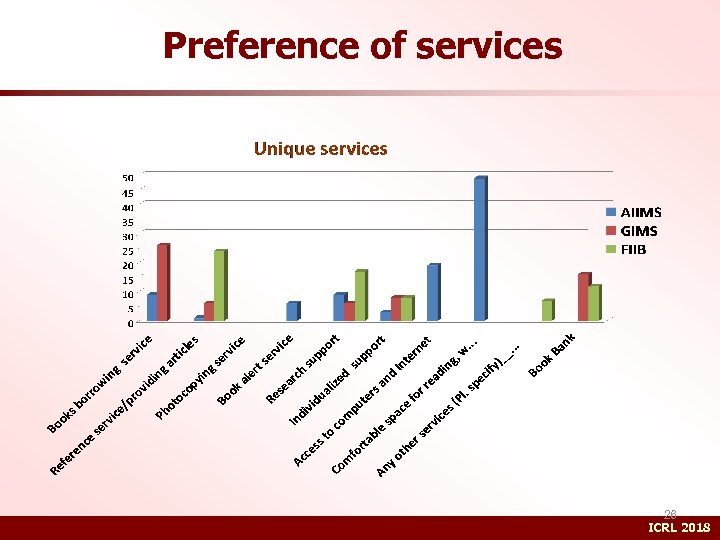
Preference of services 26 ICRL 2018
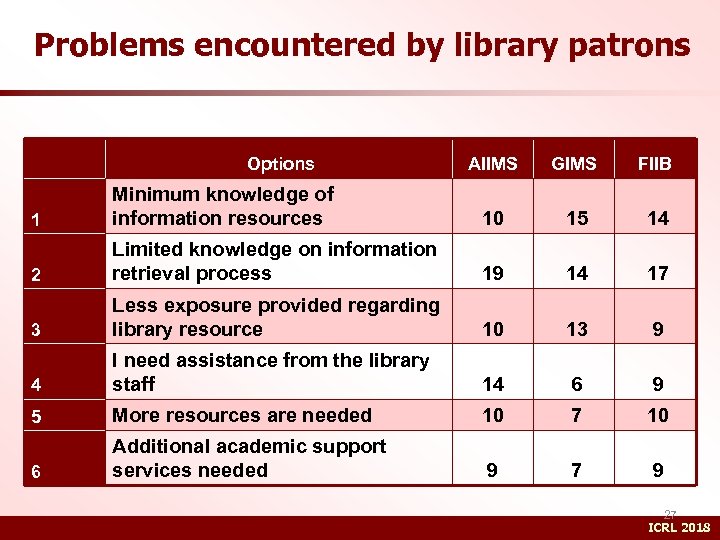
Problems encountered by library patrons Options AIIMS GIMS FIIB 1 Minimum knowledge of information resources 10 15 14 2 Limited knowledge on information retrieval process 19 14 17 3 Less exposure provided regarding library resource 10 13 9 4 I need assistance from the library staff 14 6 9 5 More resources are needed 10 7 10 6 Additional academic support services needed 9 7 9 27 ICRL 2018
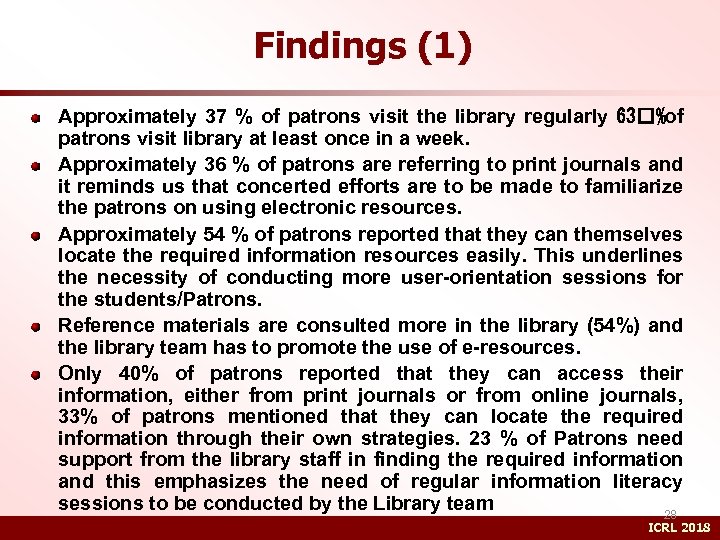
Findings (1) Approximately 37 % of patrons visit the library regularly 63 %of patrons visit library at least once in a week. Approximately 36 % of patrons are referring to print journals and it reminds us that concerted efforts are to be made to familiarize the patrons on using electronic resources. Approximately 54 % of patrons reported that they can themselves locate the required information resources easily. This underlines the necessity of conducting more user-orientation sessions for the students/Patrons. Reference materials are consulted more in the library (54%) and the library team has to promote the use of e-resources. Only 40% of patrons reported that they can access their information, either from print journals or from online journals, 33% of patrons mentioned that they can locate the required information through their own strategies. 23 % of Patrons need support from the library staff in finding the required information and this emphasizes the need of regular information literacy sessions to be conducted by the Library team 28 ICRL 2018
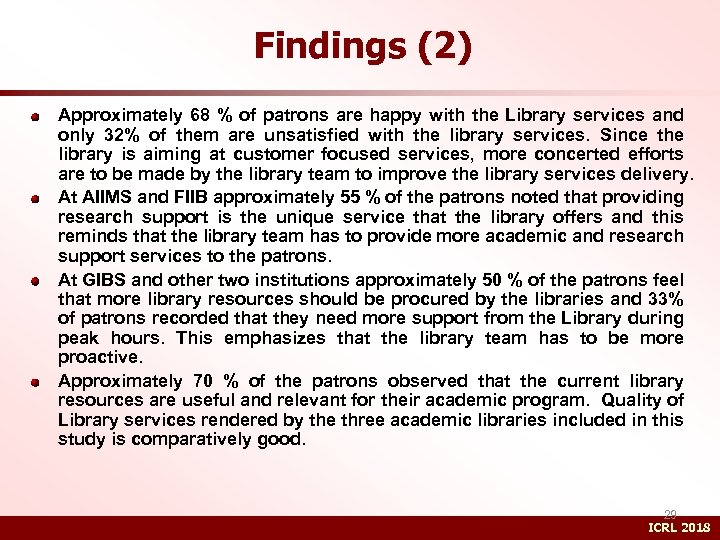
Findings (2) Approximately 68 % of patrons are happy with the Library services and only 32% of them are unsatisfied with the library services. Since the library is aiming at customer focused services, more concerted efforts are to be made by the library team to improve the library services delivery. At AIIMS and FIIB approximately 55 % of the patrons noted that providing research support is the unique service that the library offers and this reminds that the library team has to provide more academic and research support services to the patrons. At GIBS and other two institutions approximately 50 % of the patrons feel that more library resources should be procured by the libraries and 33% of patrons recorded that they need more support from the Library during peak hours. This emphasizes that the library team has to be more proactive. Approximately 70 % of the patrons observed that the current library resources are useful and relevant for their academic program. Quality of Library services rendered by the three academic libraries included in this study is comparatively good. 29 ICRL 2018
Limitations of the Study This research collected data from three higher educational institutions located in Delhi and similar studies conducted in other parts of the country would increase the external validity of the study results. The service quality survey used in this study is not strictly analogous to the LIBQUAL survey instrument. Further studies may investigate the relationship between service quality and customer satisfaction and customer behavior in the education sector. 30 ICRL 2018
Suggestions Libraries should regularly conduct training programmes for library patrons, orientation sessions for students on information literacy and research support services. Libraries should create a user friendly environment where customers feel welcomed and valued. Embed Web 2. 0 technologies on to the library website would help in building networks, facilitate resource sharing and collaboration with other stakeholder. s Engage with other IT professionals and motivate library staff members for their learning and services. Conduct library service assessments regularly at least once in an academic year would enable librarians to understand the patrons expectations from the libraries. 31 ICRL 2018
Conclusion This study has demonstrated that there is difference between the users perception and expectations about the library services and patrons demand customer- focused and innovative services. There is need for librarians to reengineer the infrastructure and service in accordance with the user demands in the academic institutions It is expected that the findings obtained from this investigation will help to improve the quality of service deliveries, will bridge service quality gaps, and stimulate further research in this area. It is also hoped that the results of this exploratory research study would help all stakeholders to redefine the service paradigm , and to reengineer the façade of library services 32 in the digital era. ICRL 2018

33
Скачать презентацию Service Quality in Academic Libraries Case Studies from
ab9457b6180526de5adc14c9fd401a11.ppt