


 Скачать презентацию Service Oriented Architectures for R E networks Google Mashing
f98dcb7c32fb07efa261868eb3551a57.ppt
- Количество слайдов: 33
 Service Oriented Architectures for R&E networks “Google Mashing everything” Bill St. Arnaud CANARIE Inc – www. canarie. ca Bill. st. arnaud@canarie. ca
 Google mashing > Google as developed a web service for Google Maps that allows users to overlay any geographical data > A powerful example of SOA and web services > No more using maps as GIFs or JPEGs, or using proprietary mapping software > Users can also create a workflow of their geographical data overlaid onto Google Maps and offer that as a web service to others
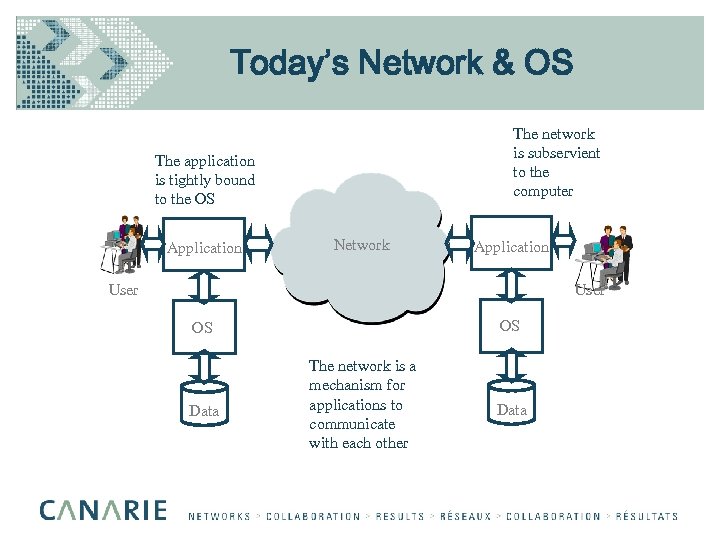 Today’s Network & OS The network is subservient to the computer The application is tightly bound to the OS Application Network Application User OS OS Data The network is a mechanism for applications to communicate with each other Data
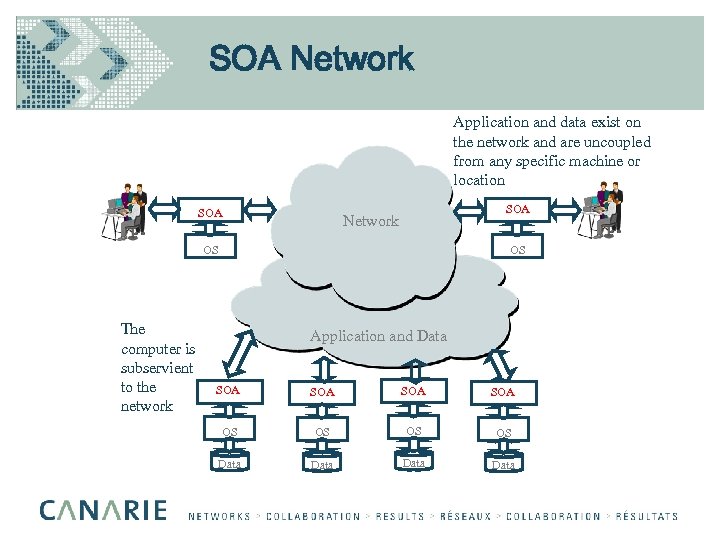 SOA Network Application and data exist on the network and are uncoupled from any specific machine or location SOA Network OS The computer is subservient to the network OS Application and Data SOA SOA OS OS Data
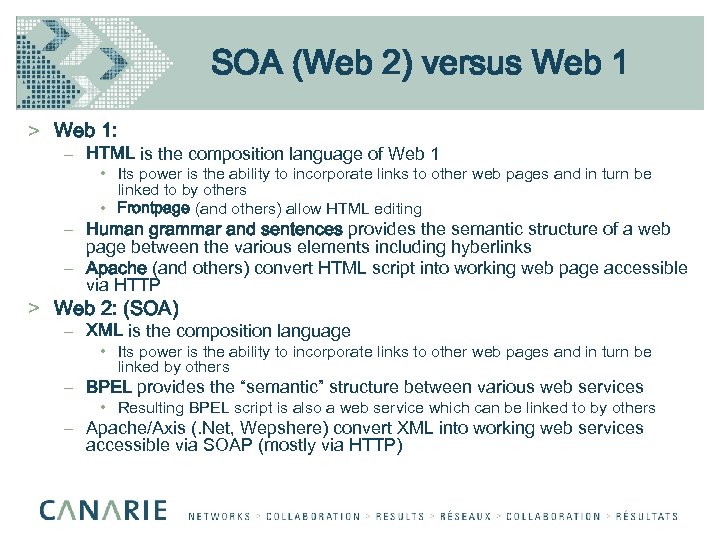 SOA (Web 2) versus Web 1 > Web 1: – HTML is the composition language of Web 1 • Its power is the ability to incorporate links to other web pages and in turn be linked to by others • Frontpage (and others) allow HTML editing – Human grammar and sentences provides the semantic structure of a web page between the various elements including hyberlinks – Apache (and others) convert HTML script into working web page accessible via HTTP > Web 2: (SOA) – XML is the composition language • Its power is the ability to incorporate links to other web pages and in turn be linked by others – BPEL provides the “semantic” structure between various web services • Resulting BPEL script is also a web service which can be linked to by others – Apache/Axis (. Net, Wepshere) convert XML into working web services accessible via SOAP (mostly via HTTP)
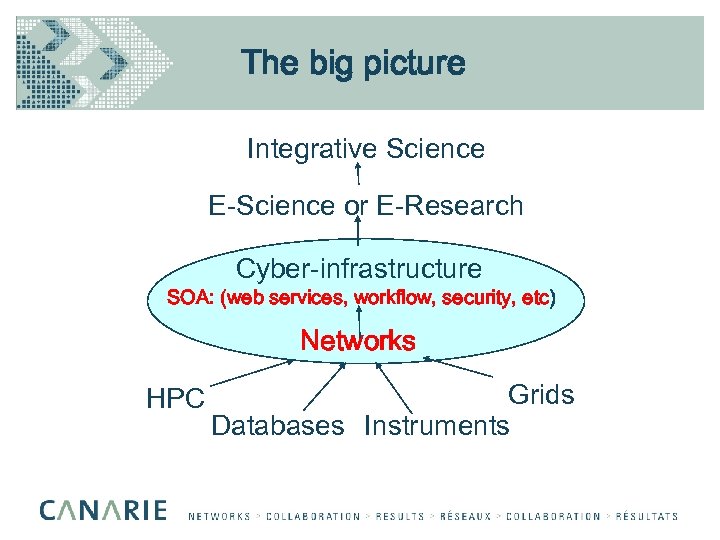 The big picture Integrative Science E-Science or E-Research Cyber-infrastructure SOA: (web services, workflow, security, etc) Networks HPC Grids Databases Instruments
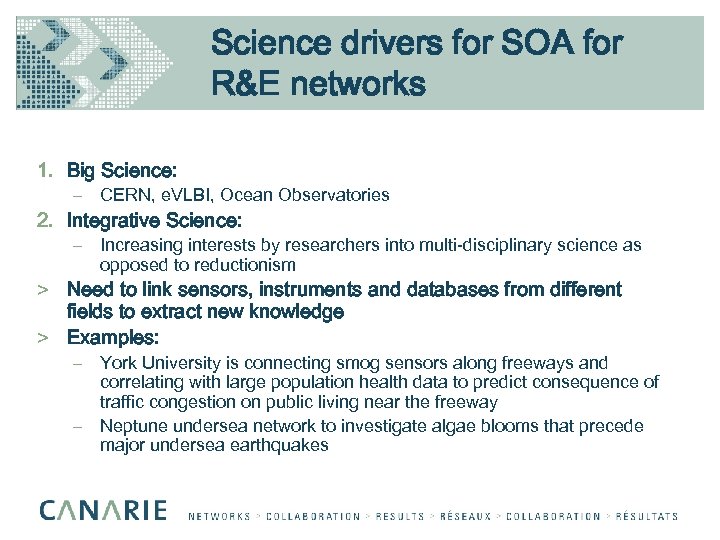 Science drivers for SOA for R&E networks 1. Big Science: – CERN, e. VLBI, Ocean Observatories 2. Integrative Science: – Increasing interests by researchers into multi-disciplinary science as opposed to reductionism > Need to link sensors, instruments and databases from different fields to extract new knowledge > Examples: – York University is connecting smog sensors along freeways and correlating with large population health data to predict consequence of traffic congestion on public living near the freeway – Neptune undersea network to investigate algae blooms that precede major undersea earthquakes
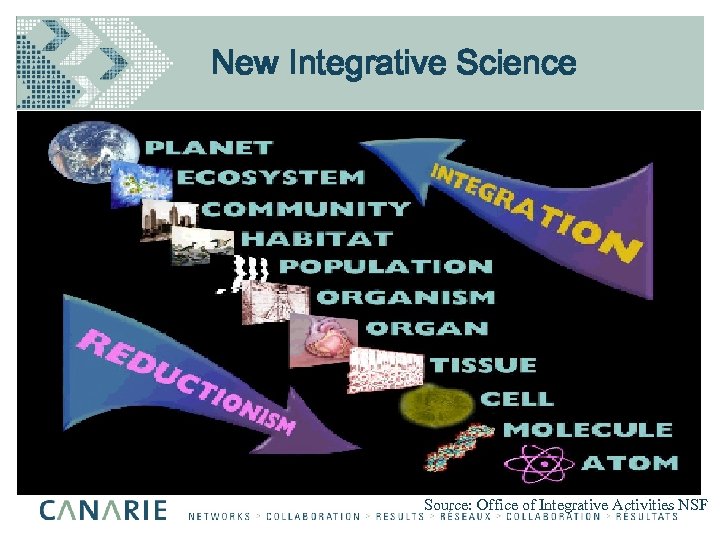 New Integrative Science Source: Office of Integrative Activities NSF
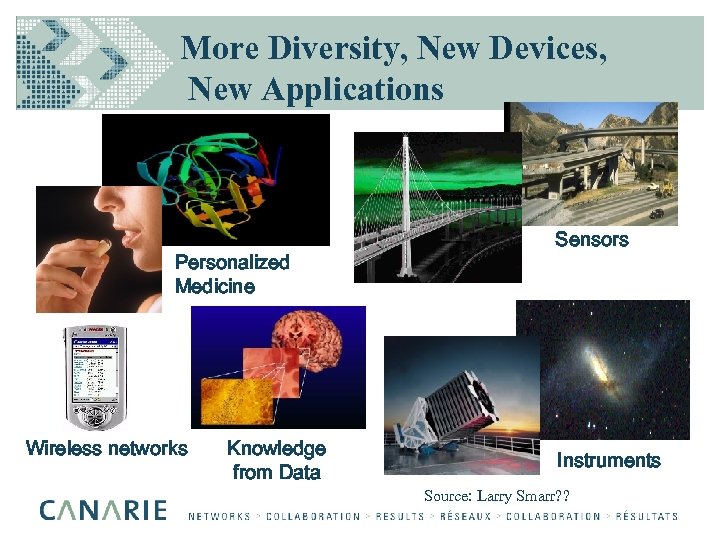 More Diversity, New Devices, New Applications Picture of earthquake and bridge Personalized Medicine Sensors Picture of digital sky Wireless networks Knowledge from Data Instruments Source: Larry Smarr? ?
 SOA and networks
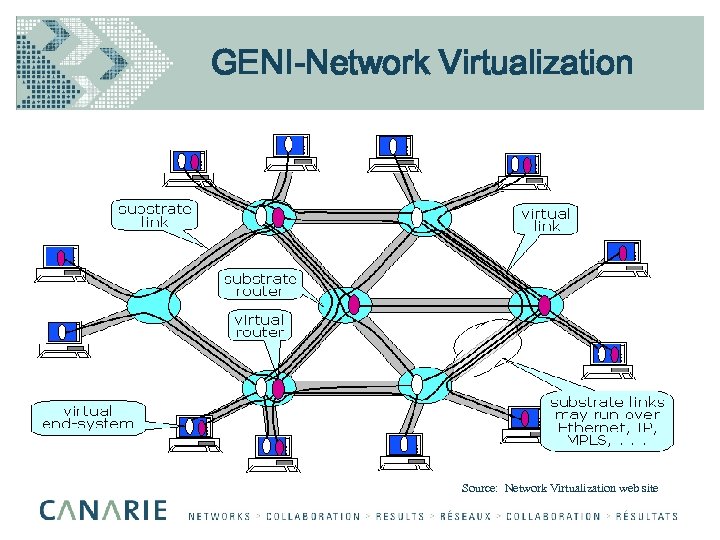 GENI-Network Virtualization Source: Network Virtualization web site
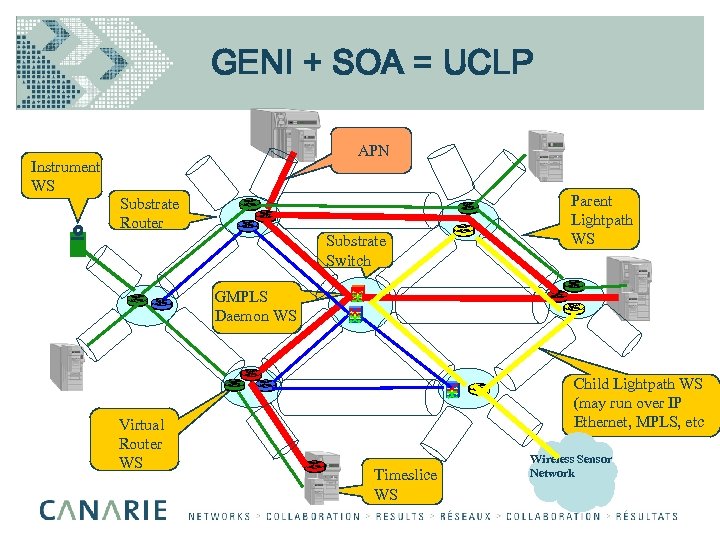 GENI + SOA = UCLP APN Instrument WS Substrate Router Substrate Switch Parent Lightpath WS GMPLS Daemon WS Virtual Router WS Child Lightpath WS (may run over IP Ethernet, MPLS, etc Timeslice WS Wireless Sensor Network
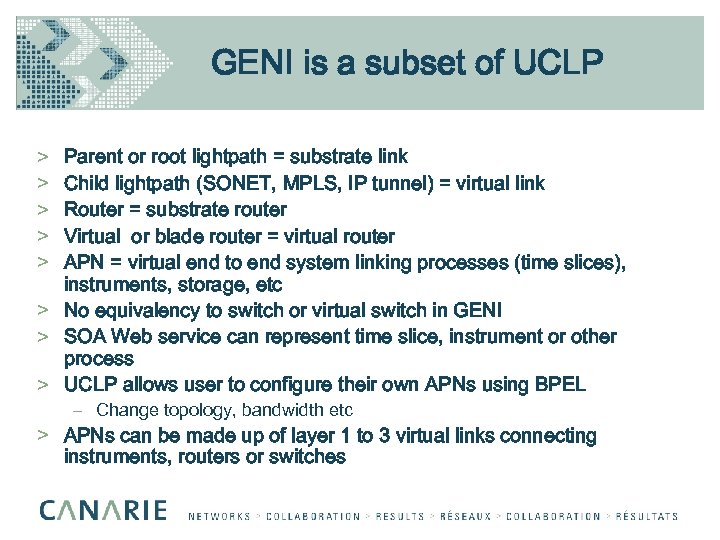 GENI is a subset of UCLP > > > Parent or root lightpath = substrate link Child lightpath (SONET, MPLS, IP tunnel) = virtual link Router = substrate router Virtual or blade router = virtual router APN = virtual end to end system linking processes (time slices), instruments, storage, etc > No equivalency to switch or virtual switch in GENI > SOA Web service can represent time slice, instrument or other process > UCLP allows user to configure their own APNs using BPEL – Change topology, bandwidth etc > APNs can be made up of layer 1 to 3 virtual links connecting instruments, routers or switches
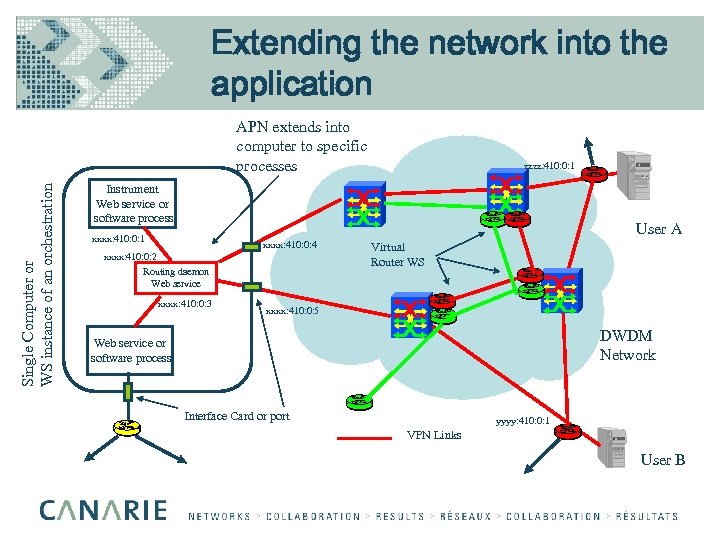 Extending the network into the application Single Computer or WS instance of an orchestration APN extends into computer to specific processes zzzz: 410: 0: 1 Instrument Web service or software process User A xxxx: 410: 0: 1 xxxx: 410: 0: 4 xxxx: 410: 0: 2 Routing daemon Web service xxxx: 410: 0: 3 Virtual Router WS xxxx: 410: 0: 5 DWDM Network Web service or software process Interface Card or port yyyy: 410: 0: 1 VPN Links User B
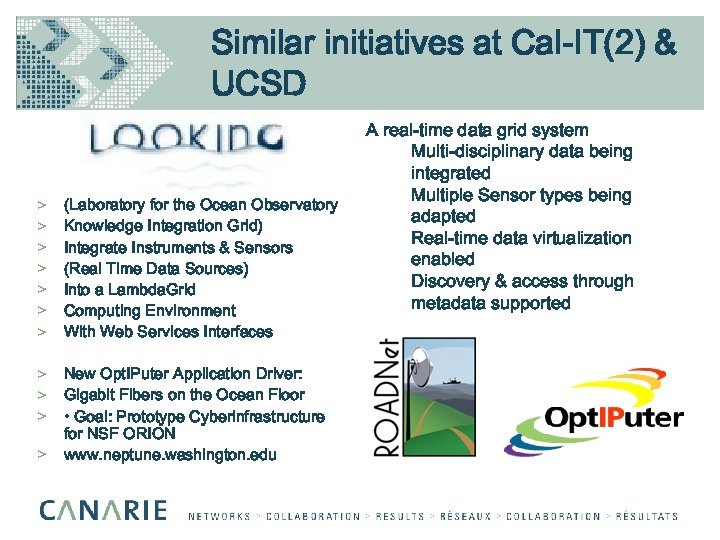 Similar initiatives at Cal-IT(2) & UCSD > > > > (Laboratory for the Ocean Observatory Knowledge Integration Grid) Integrate Instruments & Sensors (Real Time Data Sources) Into a Lambda. Grid Computing Environment With Web Services Interfaces > > > New Opt. IPuter Application Driver: Gigabit Fibers on the Ocean Floor • Goal: Prototype Cyberinfrastructure for NSF ORION www. neptune. washington. edu > A real-time data grid system Multi-disciplinary data being integrated Multiple Sensor types being adapted Real-time data virtualization enabled Discovery & access through metadata supported
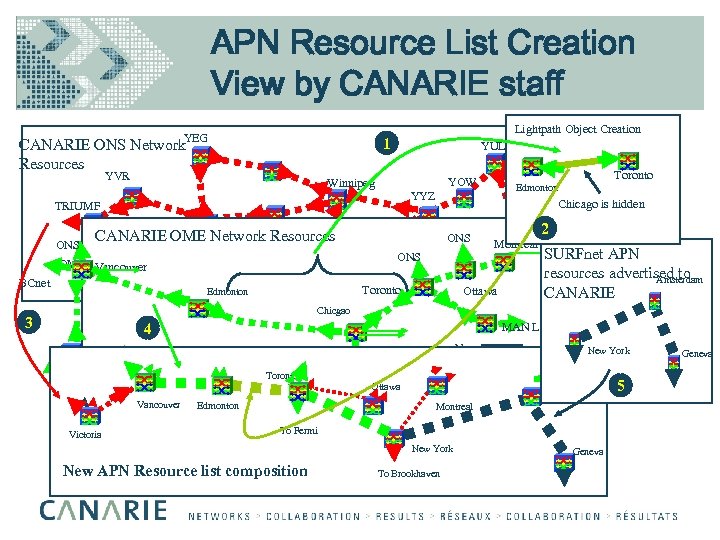 APN Resource List Creation View by CANARIE staff YEG Lightpath Object Creation 1 CANARIE ONS Network Resources YVR YUL ONS OME Vancouver BCnet 3 Chicago is hidden ONS Pwave HDX 4 Seattle Victoria 2 MAN LAN HDX New York Chicago Toronto Vancouver Montreal SURFnet APN Halifax resources advertised to Amsterdam Ottawa CANARIE MAN LAN HDX ONS Toronto STAR LIGHT HDX Chicgao Edmonton YYZ TRIUMF CANARIE OME Network Resources YCG Toronto YOW Winnipeg STAR LIGHT HDX Ottawa Edmonton New York Amsterdam ONS Montreal To Fermi New York New APN Resource list composition To Brookhaven Geneva 5 Geneva
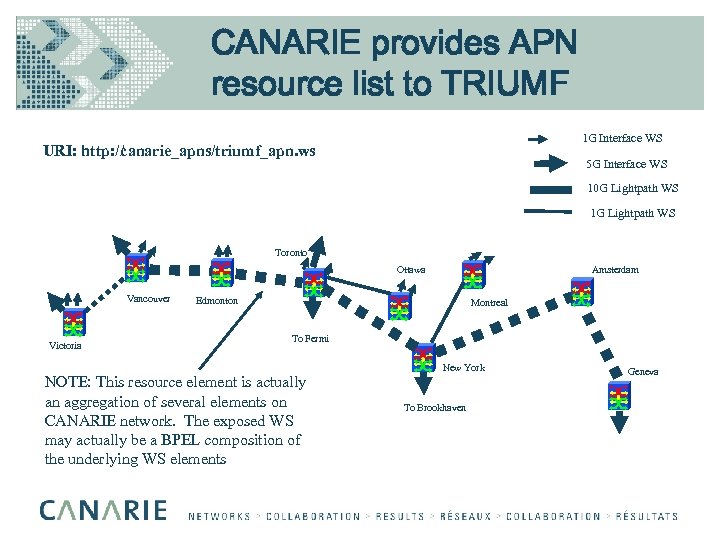 CANARIE provides APN resource list to TRIUMF 1 G Interface WS URI: http: // anarie_apns/triumf_apn. ws c 5 G Interface WS 10 G Lightpath WS 1 G Lightpath WS Toronto Ottawa Vancouver Victoria Amsterdam Edmonton Montreal To Fermi New York NOTE: This resource element is actually an aggregation of several elements on CANARIE network. The exposed WS may actually be a BPEL composition of the underlying WS elements To Brookhaven Geneva
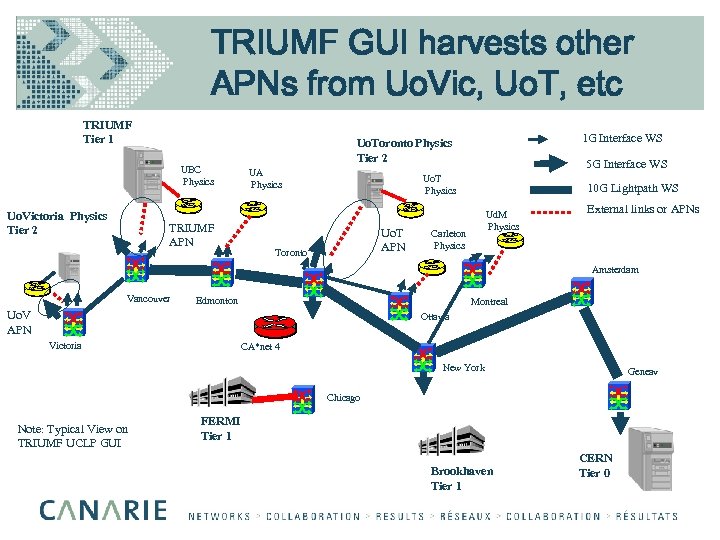 TRIUMF GUI harvests other APNs from Uo. Vic, Uo. T, etc TRIUMF Tier 1 UBC Physics Uo. Victoria Physics Tier 2 TRIUMF APN 1 G Interface WS Uo. Toronto Physics Tier 2 UA Physics 5 G Interface WS Uo. T Physics Uo. T APN Toronto 10 G Lightpath WS Ud. M Physics Carleton Physics External links or APNs Amsterdam Vancouver Edmonton Montreal Uo. V APN Ottawa Victoria CA*net 4 New York Geneav Chicago Note: Typical View on TRIUMF UCLP GUI FERMI Tier 1 Brookhaven Tier 1 CERN Tier 0
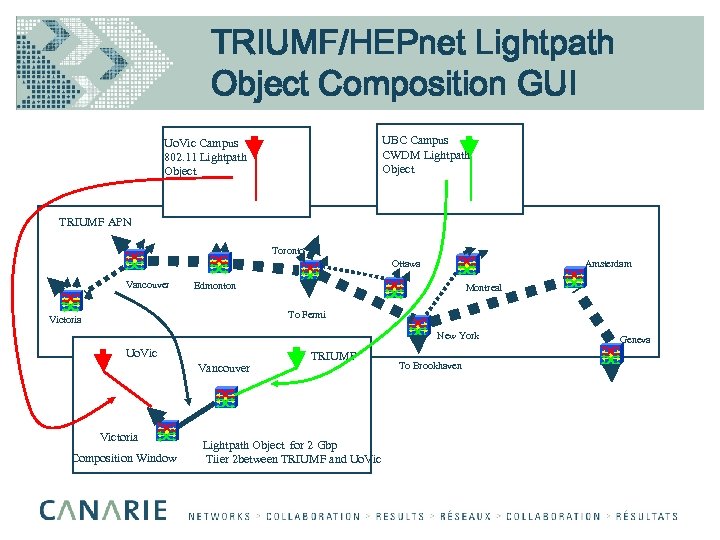 TRIUMF/HEPnet Lightpath Object Composition GUI UBC Campus CWDM Lightpath Object Uo. Vic Campus 802. 11 Lightpath Object TRIUMF APN Toronto Ottawa Vancouver Amsterdam Edmonton Montreal To Fermi Victoria New York Uo. Vic Vancouver Victoria Composition Window TRIUMF Lightpath Object for 2 Gbp Tiier 2 between TRIUMF and Uo. Vic To Brookhaven Geneva
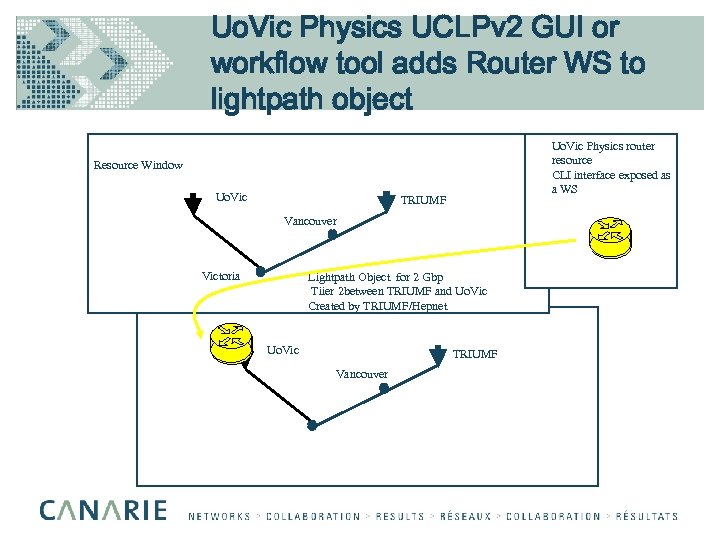 Uo. Vic Physics UCLPv 2 GUI or workflow tool adds Router WS to lightpath object Uo. Vic Physics router resource CLI interface exposed as a WS Resource Window Uo. Vic TRIUMF Vancouver Victoria Lightpath Object for 2 Gbp Tiier 2 between TRIUMF and Uo. Vic Created by TRIUMF/Hepnet Uo. Vic TRIUMF Vancouver
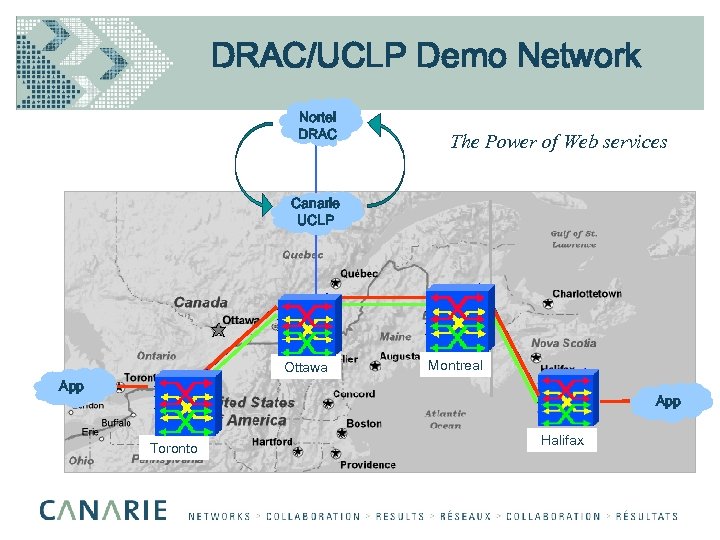 DRAC/UCLP Demo Network Nortel DRAC The Power of Web services Canarie UCLP Ottawa Montreal App Toronto Halifax
 SOA Applications
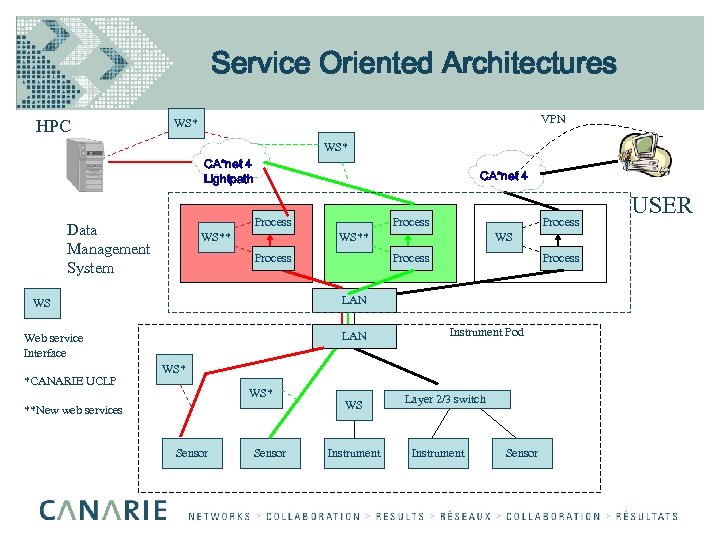
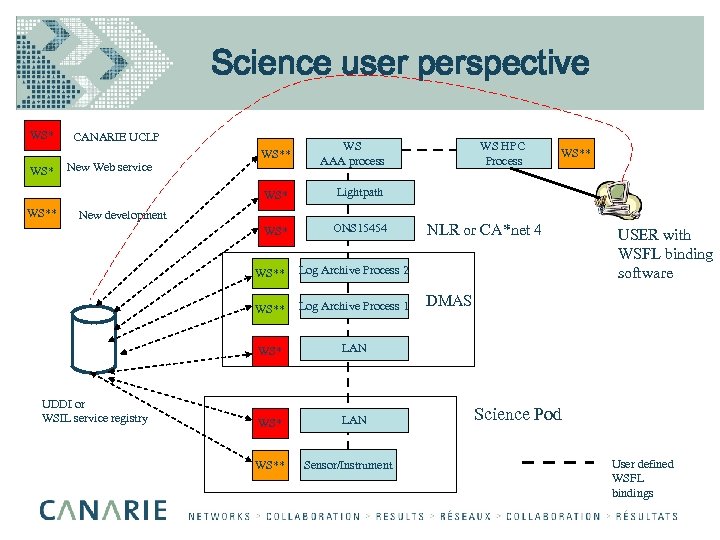
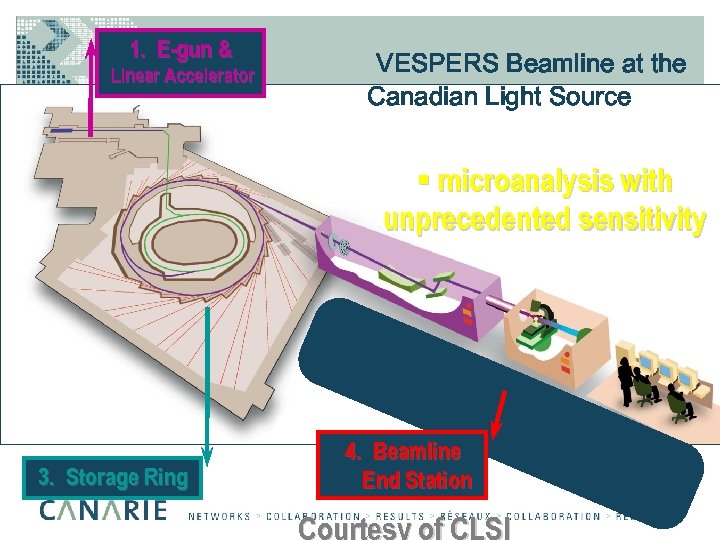
 CANARIE’s i-Infrastructure program > To adapt Service Oriented Architectures (SOA) to process control, instrumentation systems and sensor networks > Applications include manufacturing, oil and gas, power systems, water, building management systems, environmental control systems, etc > Built upon CANARIE’s initial work on User Controlled Light. Paths (UCLP) > Start with large science research facilities such as Neptune, Canada Light Source and then expand into industrial applications > www. canarie. ca/ccip
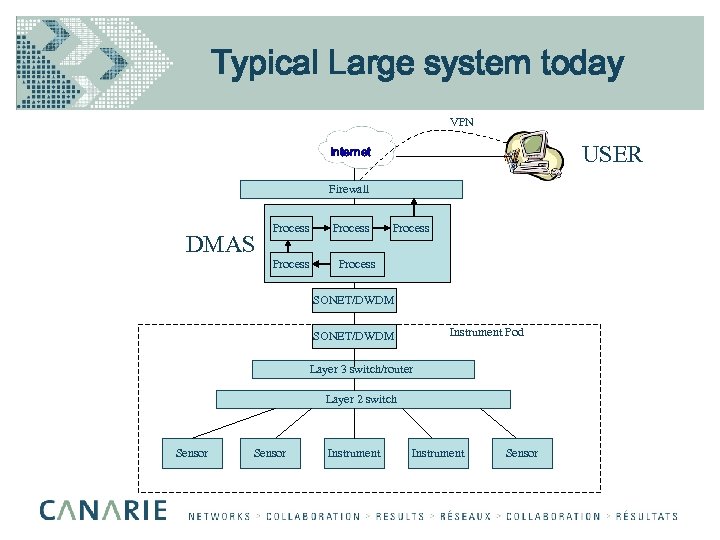 Typical Large system today VPN USER Internet Firewall DMAS Process Process SONET/DWDM Instrument Pod SONET/DWDM Layer 3 switch/router Layer 2 switch Sensor Instrument Sensor
 Service Oriented Architectures HPC VPN WS* CA*net 4 Lightpath CA*net 4 Data Management System WS** Process WS** WS Process LAN WS LAN Web service Interface *CANARIE UCLP Process Instrument Pod WS* **New web services Sensor WS Instrument Layer 2/3 switch Instrument Sensor USER
 Science user perspective WS* CANARIE UCLP WS** WS* New Web service WS AAA process WS* ONS 15454 New development WS** Log Archive Process 1 WS* LAN USER with WSFL binding software LAN WS* NLR or CA*net 4 Log Archive Process 2 WS** UDDI or WSIL service registry WS** Lightpath WS** WS HPC Process WS** Sensor/Instrument DMAS Science Pod User defined WSFL bindings
 1. E-gun & Linear Accelerator VESPERS Beamline at the Canadian Light Source § microanalysis with unprecedented sensitivity 3. Storage Ring 4. Beamline End Station Courtesy of CLSI
 UCLP-Enabled Virtual Design Studio 3 D digital construction of the Salk Institute Michael Jemtrud Konstantin Privalov James Hayes Nicolas Valenzuela Carleton Immersive Media Studio Carleton University , School of Architecture, Ottawa (Canada)
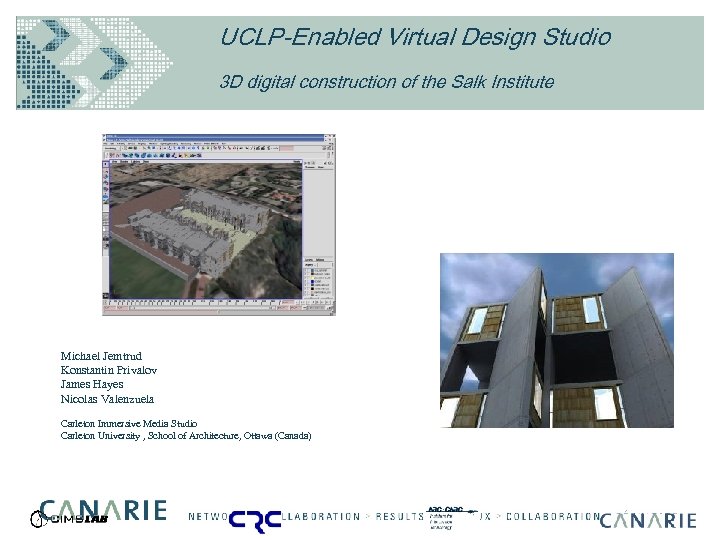
 SOA for Participatory Design Studio – Service provides are • network resources (UCLP) • devices (cameras, displays, rendering computers) • software (MAYA) – Provisioning for a PDS session requires • finding a configuration of network resources, devices and software that meets the user’s needs – SOA will monitor session • Does not transport high definition signal > Demo illustrates how end users can establish UCLP connections without knowing details
 Other SOA Network Projects > Design Service-Oriented Architecture (SOA) and build Web Services for linking research data to scholarly publications > Web services control of undersea HDTV camera – Neptue > SOA for military real time simulation
 Amateurs discover most Supernovas http: //www. nytimes. com/2002/11/07/technology/circu its/07 astr. html? todaysheadlines “Nasa and amateur scientists nightly harvest about 1, 000 images, which are shared with other amateur astronomers over the Internet. Together, they analyze the pictures for previously undiscovered supernovas, the remains of collapsed stars. “ “Over 58 supernovas have been discovered” “While most amateur astronomers use computers to enhance a hobby, the advances in technology are also blurring the distinctions between professionals and sophisticated amateurs. ”
 Sloan Digital Sky. Server > http: //skyserver. sdss. org/en/ > Large database of astronomical data and images > Available to scientists, students and public > XML and Java web services interfaces
 Conclusions > SOA & Cyber-Infrastructure will fundamentally transform science and IT > Better get prepared and learn as much as possible and learn about CI and SOA – – – Web services Resource discovery and consumption Publishing services Workflow and orchestration SOA platforms – OGSA, . NET, . Websphere > Commercialization potentials of integrative science and CI are significantly greater than with traditional science