


 Скачать презентацию Service delivery and health care improvement in Georgia
326319953350d56d296c9f56f4a62deb.ppt
- Количество слайдов: 13
 Service delivery and health care improvement in Georgia Thoughts from a recent case study Dr. Francoise Cluzeau Senior Adviser NICE International
 Quality improvement (QI) at the heart of health care reforms • EBM clinical guidelines and Quality Standards , if appropriately implemented can be effective levers for: – performance management schemes – inform regulatory initiatives at national or regional levels – investment decisions to identify best value interventions in high priority diseases and conditions • To work they need – Clear strategic direction – Engagement from governments, health insurers, providers • Underpinned by – reliable information system – Regular and robust monitoring
 QI in Georgia • Georgian Health Sector Development Project aims at improving the equitable coverage and utilization of quality health care services • Legislation article 16, b/1; • MOLHSA: the National Council on Elaboration, Evaluation and Establishment of the national clinical practice recommendations (guidelines) and disease management standards. – multidisciplinary committee chaired by Deputy Health Minister – has approved over 80 guidelines 40 being developed – guidelines developed by professional associations, based on guidelines from other countries, often funded by donor agencies • Coordinating team based at Mo. LHSA
 Collaboration with NICE International • NICE International provided technical assistance to the MOLHSA to strengthen its existing framework for production and implementation of guidelines in Georgia: – building local technical capacity – adapting an existing NICE CPG in a high priority area, to the Georgian setting – helping develop implementation support tools to increase the uptake of evidence-informed standards in day-to-day policy and practice in Georgia – Developing a Georgian policy document for producing CPG and Quality standards framework based on the experience from the project • Twelve months project funded by the World Bank
 The project • Training – systematic reviewing – Introduction to health economics – Guideline development Pilot adaptation – topic selection (stroke) – setting questions relevant to Georgia, reviewing NICE recommendations, undertaking new reviews, updating evidence, making recommendations – Selecting high priority recommendations for implementation and developing standards – carrying out a cost impact for some recommendations for implementation
 Key features of the project • Guideline adapted by multidisciplinary group (professionals and patients) chaired by stroke expert, peer reviewed by international expert • Mo. LHSA full involvement – Mo. LHSA technical and administrative team to support the guideline group – the Guidelines Council reviewed and approved final products • Involvement of policy makers – Policy workshop in Tbilisi • Health insurance, providers, Mo. LHSA reviewed quality standards
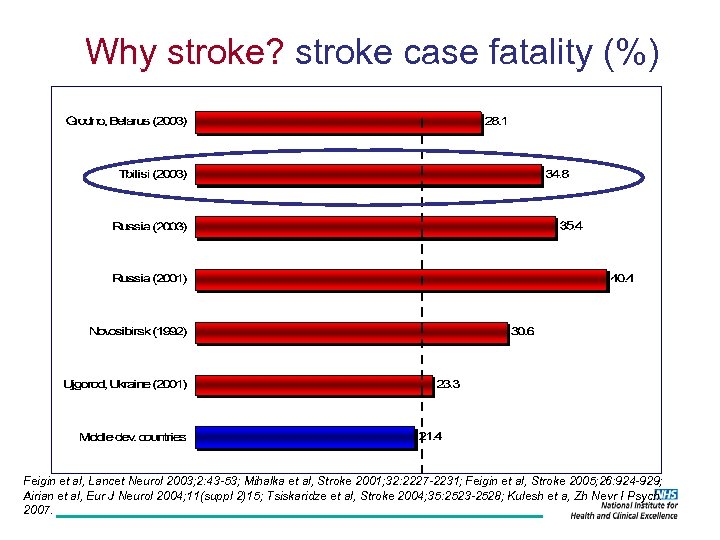 Why stroke? stroke case fatality (%) Feigin et al, Lancet Neurol 2003; 2: 43 -53; Mihalka et al, Stroke 2001; 32: 2227 -2231; Feigin et al, Stroke 2005; 26: 924 -929; Airian et al, Eur J Neurol 2004; 11(suppl 2)15; Tsiskaridze et al, Stroke 2004; 35: 2523 -2528; Kulesh et a, Zh Nevr I Psych. 2007.
 Problems with stroke management in Georgia • Lack of information on stroke signs at population level • Inappropriate pre-hospital management /Delayed hospitalization • No stroke units and stroke teams • Imaging only available daytime • No evidence-based national guideline • Lack of evidence-based interventions – Excessive use of drugs of no proven effectiveness – Inappropriate use of anticoagulants • Unjustified high neurosurgical interventions for intracerebral hemorrhage • Late mobilization and rehabilitation of stroke patients
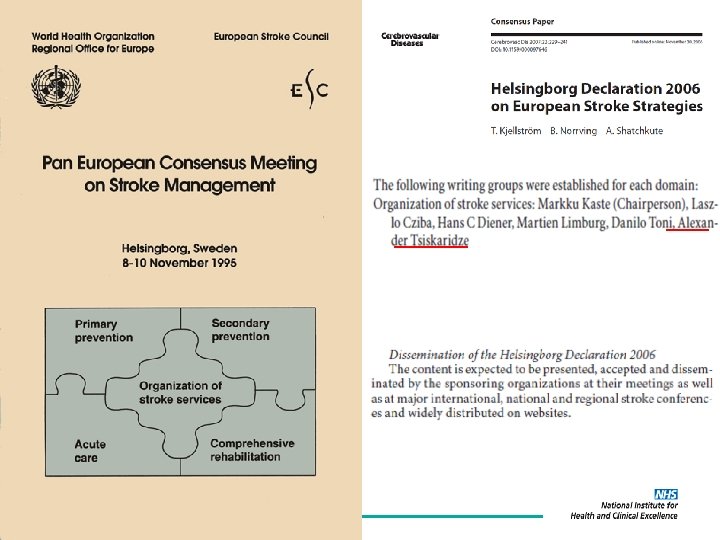
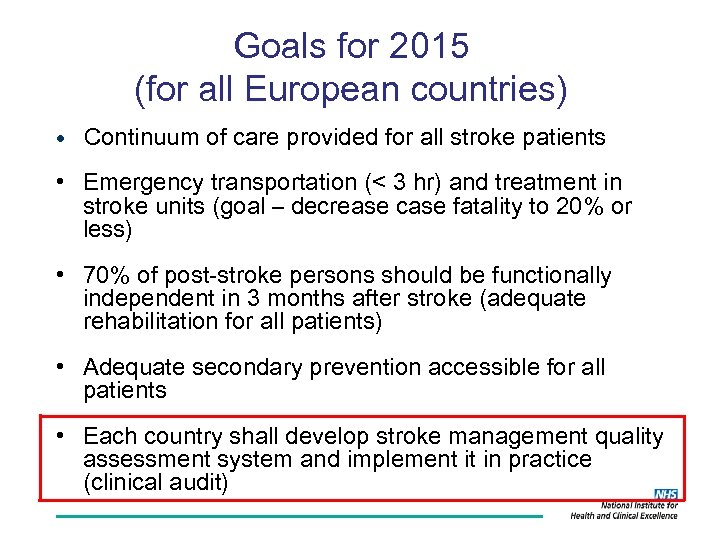 Goals for 2015 (for all European countries) • Continuum of care provided for all stroke patients • Emergency transportation (< 3 hr) and treatment in stroke units (goal – decrease case fatality to 20% or less) • 70% of post-stroke persons should be functionally independent in 3 months after stroke (adequate rehabilitation for all patients) • Adequate secondary prevention accessible for all patients • Each country shall develop stroke management quality assessment system and implement it in practice (clinical audit)
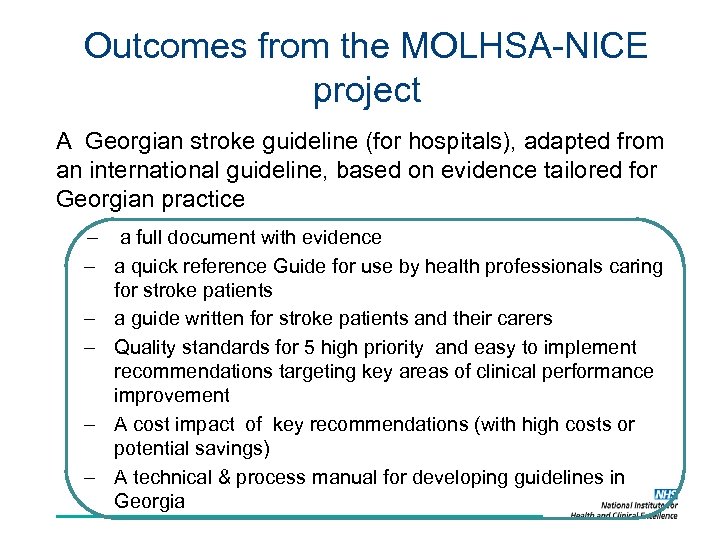 Outcomes from the MOLHSA-NICE project A Georgian stroke guideline (for hospitals), adapted from an international guideline, based on evidence tailored for Georgian practice – a full document with evidence – a quick reference Guide for use by health professionals caring for stroke patients – a guide written for stroke patients and their carers – Quality standards for 5 high priority and easy to implement recommendations targeting key areas of clinical performance improvement – A cost impact of key recommendations (with high costs or potential savings) – A technical & process manual for developing guidelines in Georgia
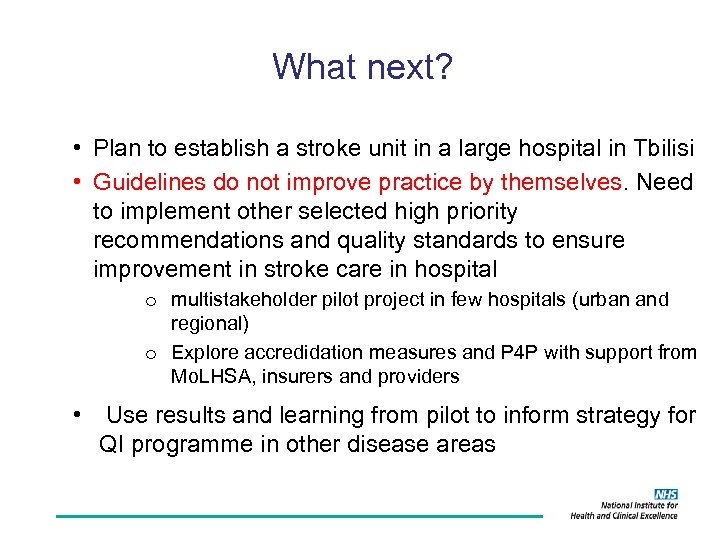 What next? • Plan to establish a stroke unit in a large hospital in Tbilisi • Guidelines do not improve practice by themselves. Need to implement other selected high priority recommendations and quality standards to ensure improvement in stroke care in hospital o multistakeholder pilot project in few hospitals (urban and regional) o Explore accredidation measures and P 4 P with support from Mo. LHSA, insurers and providers • Use results and learning from pilot to inform strategy for QI programme in other disease areas
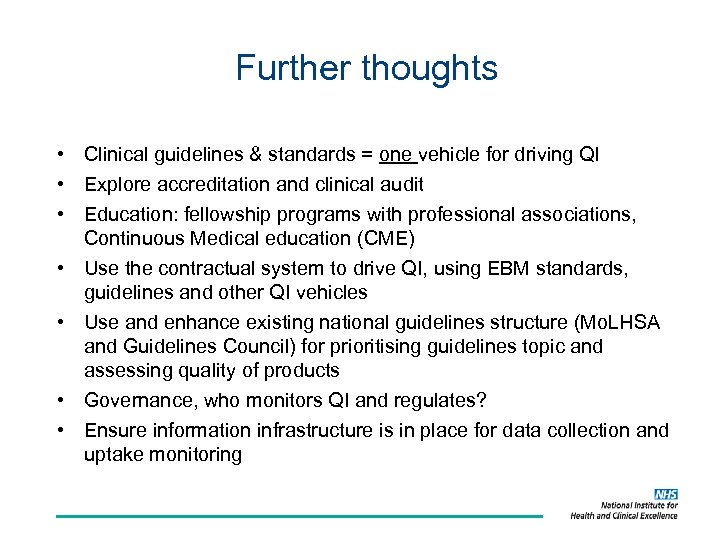 Further thoughts • Clinical guidelines & standards = one vehicle for driving QI • Explore accreditation and clinical audit • Education: fellowship programs with professional associations, Continuous Medical education (CME) • Use the contractual system to drive QI, using EBM standards, guidelines and other QI vehicles • Use and enhance existing national guidelines structure (Mo. LHSA and Guidelines Council) for prioritising guidelines topic and assessing quality of products • Governance, who monitors QI and regulates? • Ensure information infrastructure is in place for data collection and uptake monitoring