


 Скачать презентацию Server-side Technologies Technologies that exist at the
a5921fe820a2d790d8873206b623d402.ppt
- Количество слайдов: 38
 Server-side Technologies • Technologies that exist at the server side • Where the real work occurs
 Server-side Technologies • Looking at …. – Client-side scripting v Server-side scripting – Factors in selecting a technology – Older and New technologies • CGI, Fast CGI, Mod Perl, Active Server Pages (ASP), Cold Fusion – Overview of Servlets – Introduction to Java Server Pages (JSP) 2
 Client-side scripting v Serverside scripting • Client-side scripting – Validates user input – Accesses the browser – Enhances Web pages with Active. X® controls, applets, etc. – Manipulates browser documents • Client-side validation – Reduces number of requests that need to be passed to server • Client-side scripting limitations – Browser dependency – Viewable to users through View Source command • Java. Script most popular client-side script 3
 Client-side scripting v Serverside scripting • Server-side scripts – Provides programmers greater flexibility – Generates custom responses for clients – Contains greater programmatic capabilities than client-side equivalents – Has access to server-side software that extend server functionality 4
 Server-side options • • Common Gateway Interface (CGI) Fast CGI Mod Perl Active Server Pages (ASP) Personal Home Pages (PHP) Cold Fusion Java Servlets Java Server Page (JSP) 5
 Common Features • All server-side frameworks share a common set of features – Read data submitted by the user – Generate HTML dynamically based on user input – Determine information about the client browser – Access database systems – Exploit the HTTP protocol 6
 Decision Points • When evaluating which server-side technology to use, you need to consider a number of critical factors – Ease of development • How easily can you build new applications – Performance • How fast can the technology respond to queries – Scalability • Can the technology scale to thousands, even millions of users? – Security • Are there any inherent security vulnerabilities? 7
 Common Gateway Interface (CGI) • CGI represents one of the earliest, practical methods for generating web content • Primarily written in the Perl programming language • Unfortunately, some CGI programs suffer from scalability and performance problems – Let us see why this happens 8
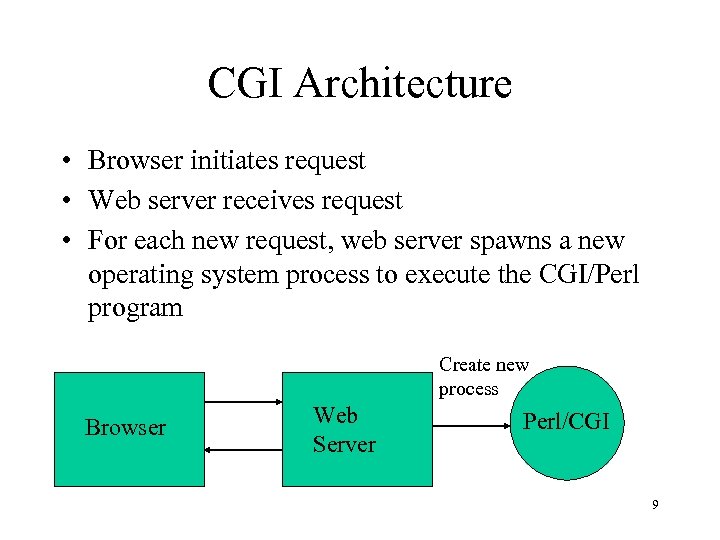 CGI Architecture • Browser initiates request • Web server receives request • For each new request, web server spawns a new operating system process to execute the CGI/Perl program Create new process Browser Web Server Perl/CGI 9
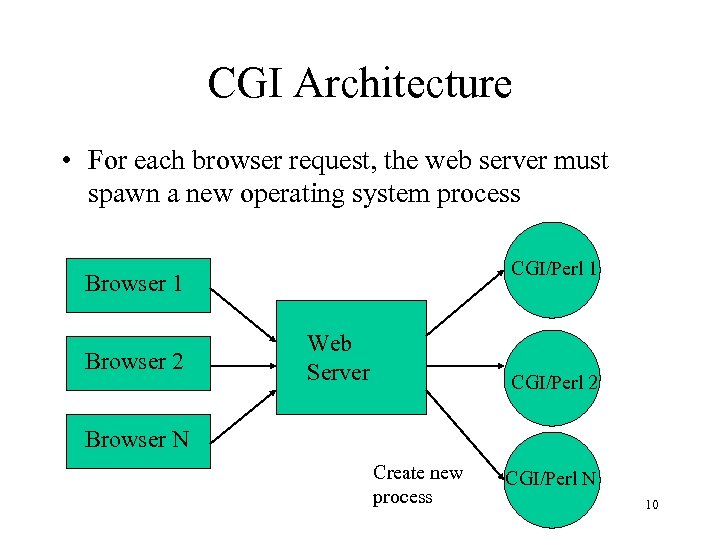 CGI Architecture • For each browser request, the web server must spawn a new operating system process CGI/Perl 1 Browser 2 Web Server CGI/Perl 2 Browser N Create new process CGI/Perl N 10
 CGI Architecture • Spawning a new operating system process for each request takes time and memory • Hence, CGI programs have inherent scalability and performance problems • Almost all other server architectures address these problems 11
 Fast CGI • Developed by Open Market as an option for developing faster, more scalable CGI programs • Works by creating a pool of processes for handling CGI requests • When a server receives a CGI request, Fast CGI picks up one of the processes from the pool and assigns it to the task • Without the overhead of creating new processes each time, Fast CGI is much quicker than traditional CGI 12
 Mod Perl • A module of the Apache Web server • Embeds the Perl interpreter directly within the web server • Perl programs are therefore precompiled • Since Perl is embedded within the server, Mod Perl does not need to create a new process for each request • Like Fast CGI, Mod Perl is much faster than traditional CGI 13
 Server Extensions • Several web servers provide extension APIs (Application Programming Interfaces) – Netscape provides (NSAPI) – Microsoft provides (ISAPA) • Similar to Mod Perl, these programs run directly within the web server • Hence, Server Extensions are much faster than traditional CGI • Usually written in C/C++, they are not portable across web servers – E. g. if you develop using Netscape NSAPI, you cannot 14 run it on Microsoft ISAPA
 ASP (Active Server Pages) • Developed by Microsoft • Runs on Microsoft’s web server: IIS (Internet Information Server) • Developers add ASP code directly to their HTML pages • When a client requests a page, the web server takes the HTML page, runs the ASP code within the page, and returns the result in another HTML page • Faster than traditional CGI but only works 15 with Microsoft’s IIS
 Cold Fusion • Developed by Allaire Corporation • Provides excellent database access and tools • Very good technology for Rapid Prototyping and Rapid development 16
 PHP (Personal Home Pages) • An open source project developed by volunteers • Provides simple and powerful database access and tools • Good for Rapid Application Development 17
 Servlet • Java’s answer to the CGI script • Do not confuse a servlet with an applet – Applet: a java program that runs within a browser – Servlet: a java program that runs within a web server • Rapidly becoming most popular technology for developing web based applications 18
 Servlet Overview • Servlets are a significant development in client/server computing for the web • Java Servlet API – standard extension to Java • Provides a Java class that can be loaded dynamically to expand the functionality of a Java-enabled server • Does not require Java support on the client side 19
 Servlet Overview • Provides a generic mechanism for extending the functionality of any kind of server (not just web servers) – e. g. could be used to extend the functionality of a Java-based ftp server, or a mail server to scan for viruses attached to email • Makes it easier for applets to communicate with the server • Created to solve one basic need recognised: Generating dynamic web content 20
 History of Servlets • In late 1996, the use of Java on the server side was developing • Allows getting away from the use of sockets on the server side – Software vendors were each developing their own approach – Problem: each technology was tied to a particular vendor server program 21
 History of Servlets • Better to have a generic technology so that server programs could have the “write-once, run-anywhere” approach • Early 1997, Java. Soft (Sun Microsystems) released the Servlet API • Designed to work on Java and non-Java based servers • Most web servers support Servlets 22
 General mechanism • Execute within the server’s process space • Each servlet handled by a separate thread within the server process, not as separate processes (as in CGI). • Servlets are portable across different web servers and different operating systems • Fast, powerful and portable replacements to CGI scripts 23
 General mechanism • Persist between invocations (CGI scripts reloaded), resulting in significant performance benefits over CGI programs • Servlets have full access to the Java APIs and also to third party component classes (e. g. database connections, etc. ) 24
 Places where Servlets can be used • Accessed by name to generate a HTML page • Embedded inside a HTML page as a server side include – These are useful when a web page is mostly static info but contains small sections of dynamically-generated info • Embedded inside a HTML page using Java Server Pages (JSP) – see these later 25
 3 types of servlet engine • Standalone – Server that contains built in support for Servlets (e. g. Tomcat) • Does not exist for many web servers – Disadvantage: have to wait for a new server release to get latest servlet support • Add-on – A plug-in for an existing web server – Many have been written for servers (e. g. Apache) • Embedded – Lightweight servlet platform that can be embedded 26 in another application
 Advantages of Servlets • Servlets have 6 main advantages – Efficient – Convenient – Powerful – Portable – Secure – Inexpensive • Let us see why 27
 Advantages of Servlets • Efficient – For each browser request, the servlet spawns a light weight thread – This is faster and more efficient than spawning a new operating system process – Hence, servlets have better performance and scalability than traditional CGI 28
 Advantages of Servlets • Convenient – Servlets include built-in functionality for: • • Reading HTML from data Handling cookies Tracking user sessions Setting HTTP headers – Java is an object-oriented language which arguably can make development easier 29
 Advantages of Servlets • Powerful – Servlets can talk directly to web servers – Multiple servlets can share data • Particularly important for maintaining database connections – Includes powerful techniques for tracking user sessions 30
 Advantages of Servlets • Portable – One of the advantages of Java is its portability across different operating systems – Servlets have the same advantages (they are written in Java) • Can be written on a Windows platform and run on a UNIX operating system – Servlets can be run on any Java-enabled web server with no code changes 31
 Advantages of Servlets • Secure – Traditional CGI programs have a number of known security vulnerabilities – Hence, a separate CGI/Perl script is usually required to provide the extra security required – Java itself has a number of built-in security features – Therefore, Servlets are regarded to be more secure than CGI programs 32
 Advantages of Servlets • Inexpensive – You can download free servlet kits for development – As many servlets that are required can be developed for free and run on many free Javaenabled web servers 33
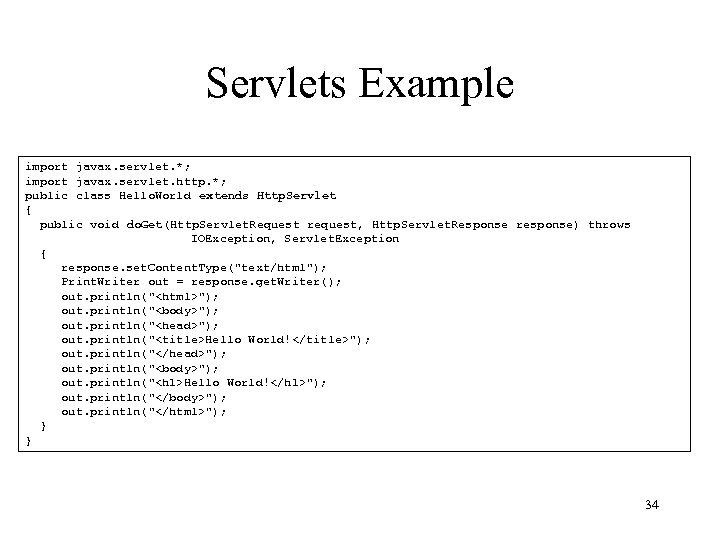 Servlets Example import javax. servlet. *; import javax. servlet. http. *; public class Hello. World extends Http. Servlet { public void do. Get(Http. Servlet. Request request, Http. Servlet. Response response) throws IOException, Servlet. Exception { response. set. Content. Type("text/html"); Print. Writer out = response. get. Writer(); out. println(""); out. println("
 Server Pages • Microsoft IIS + ASP (Active Server Pages) • Sun followed suit + JSP (Java. Server Pages) 35
 Java Server Pages • Related to Java servlets – An extension of the Java servlet API • Can be used alone or in conjunction with servlets • Another method for developing server side applications • We will look at these in more detail in next lecture 36
 References • Check out – Fast CGI • http: //www. fastcgi. com – Mod Perl • http: //perl. apache. org – Active Server Pages (ASP) • http: //www. microsoft. com – Cold Fusion • http: //www. allaire. com – PHP • http: //www. php. net – Servlet and Java Server Page (JSP) • http: //java. sun. com 37
 Summary • We have looked at: – Client-side scripting v Server-side scripting – Factors in selecting a technology – Older and New technologies • CGI, Fast CGI, Mod Perl, Active Server Pages (ASP), Cold Fusion – Overview of Servlets – Introduction to Java Server Pages (JSP) 38