 Скачать презентацию Sermons From Science — Feb 2013 科学布道— 2013年
6c82c24d737b1a5dd6dfef232f9e949a.ppt
- Количество слайдов: 121




Sermons From Science -- Feb 2013 科学布道-- 2013年 2月 Sermons from Science is now published in both You. Tube under the name “Pastor Chui” and also in Power. Point slides in the website http: //Christ. Center. Gospel. org. The contents of this presentation were taken from Dave Coppedge’s website http: //crev. info. May God have all the glory. Pastor Chui http: //Christ. Center. Gospel. org ckchui 1@yahoo. com

Happy New Biomimetics Year 新年快乐仿生学年 The variety of design applications coming from the imitation of natural n n solutions continues to be astonishing. Hope for sensitive teeth: When is it time to see the dentist? At 2: 30 (tooth hurty). If you have sensitive teeth like 3 out of 4 people, there may be a biomimetic solution coming. Sensitivity occurs when dentin at the gum line erodes, leaving nerves exposed to hot, cold, sweet or sour signals. Phys. Org and Science Daily, echoing a press release from the American Chemical Society, announced a way to rebuild enamel and dentin, taking a clue from mussels. Mussels build a waterproof adhesive to secure themselves to the rocks. “Taking inspiration from nature, ” a team “reasoned that it could help keep minerals in contact with dentin long enough for the rebuilding process to occur. ” They have invented a “gooey substance” that allows the dentin and enamel to grow together (see picture on Phys. Org). This solution would be far better than the current band-aid treatment of brushing with special toothpaste that deadens the nerves. Instead, the adhesive could allow the teeth to be reconstructed for good.
Happy New Biomimetics Year 新年快乐仿生学年 n Pearl of great price: The beauty of pearl and mother-ofpearl (nacre) goes beyond its attractiveness in jewelry. The material is also desirable for its durability against cracks. Biomimetics engineers would like to imitate the construction of similar materials, but understanding how the mollusk does it is a prerequisite. It looks like imitation will be a way off; in a PNAS paper, researchers described how they “identified 80 shell matrix proteins, among which 66 are entirely unique. ” Although they believed that shell-making was key to the “evolutionary success” of mollusks, they didn’t describe how these unique proteins arose, each one being a highly improbable outcome for a blind evolutionary process (see online book). The French team said,
Happy New Biomimetics Year 新年快乐仿生学年 n This is the only description of the whole “biomineralization toolkit” of the matrices that, at least in part, is thought to regulate the formation of the prismatic and nacreous shell layers in the pearl oysters. We unambiguously demonstrate that prisms and nacre assembled from very different protein repertoires. This suggests that these layers do not derive from each other.
Happy New Biomimetics Year 新年快乐仿生学年 Imitating rapid steroid synthesis: Researchers at n Scripps Institute are achieving “a feat … that only nature could make on a large scale” – the synthesis of polyhydroxylated steroids. ““These compounds. used in heart-failure medications and other drugs, have been notoriously problematic to synthesize in the laboratory, ” Phys. Org reported. The work “points the way to a scalable formation and modification of a variety of useful compounds that had been obtainable in significant quantities only from plants or animals. ” They reduced the number of steps from 41 to 21, making nature’s feat still look superior.
Happy New Biomimetics Year 新年快乐仿生学年 Bioinspired catalysts: Nature makes it look so n easy. “Naturally occurring metalloenzymes have long been recognized as attractive catalysts for aerobic oxidations because they can operate under mild conditions with complete chemoselectivity, ” Science Magazine said. “Simulation of the function of these enzymes has led to the discovery of many biomimetic oxidation catalysts. ” Martine Largeron and Maurice-Bernard Fleury described progress in this dynamic research field. Researchers aren’t yet close to catching up with what living cells do every day:
Happy New Biomimetics Year 新年快乐仿生学年 n Many challenges remain, including the development of biomimetic catalytic systems that operate effectively at room temperature with ambient air rather than pure molecular oxygen. The development of recyclable heterogeneous nanocluster catalysts that contain biocompatible rather than rare and precious metals would also be welcome. From a more general viewpoint, mimicking the function of amine oxidase enzymes would provide environmentally friendly organic synthesis because air is the cheaper and less polluting stoichiometric oxidant.
Happy New Biomimetics Year 新年快乐仿生学年 Mitochondria-inspired fuel cells: Inspired by how n cellular organelles like mitochondria and chloroplasts harvest sunlight so efficiently, researchers at the University of Reading have built nanowire networks with vastly increased surface area that can reside on plastic substrates, promising fuel cells and other products that are more efficient, cheaper, lightweight, and environmentally friendly. Phys. Org headlined this, “Nanomaterial inspired by nature paves way for greenergy. ” If you don’t mind the goofy music, a video clip shows the manufacturing process.

Happy New Biomimetics Year 新年快乐仿生学年 Living buildings: Imagine buildings of the future hosting lichens n and mosses that can absorb excess C 02. That’s becoming an option, reported Science Daily, with a drawing of a building with a “vegetated facade” making the most of the sunlight. The new material, designed at a university in Barcelona, Spain, “offers environmental, thermal and aesthetic advantages over other similar construction solutions. ” It also improves thermal comfort of people inside. “The innovative feature of this new (vertical multilayer) concrete is that it acts as a natural biological support for the growth and development of certain biological organisms, to be specific, certain families of microalgae, fungi, lichens and mosses. ” The layered structure captures rainwater for use by the organisms, and as they grow, the buildings will change in color over time. The researchers see their patented concrete being used for renovating buildings, creating “vertical gardens” and designing architectures that blend into the landscape.

Happy New Biomimetics Year 新年快乐仿生学年 n Everyone can love biomimetics. Many of the above are unique stories, not mentioned here before. Faster, better, cheaper – nature shows us the way. Darwin-talk drops out of the discussion when the focus is on natural design we can use to improve our lives.

Gloria Deo 愿荣耀归上帝 n

Sermons From Science -- Feb 2013 科学布道-- 2013年 2月 Sermons from Science is now published in both You. Tube under the name “Pastor Chui” and also in Power. Point slides in the website http: //Christ. Center. Gospel. org. The contents of this presentation were taken from Dave Coppedge’s website http: //crev. info. May God have all the glory. Pastor Chui http: //Christ. Center. Gospel. org ckchui 1@yahoo. com
Faint Young Sun Paradox Solution Criticized 批评年轻太阳悖论解决方案 A proposed solution for keeping the Earth warm n n when the sun was 25% cooler leaves other evolutionists doubtful. The “faint young sun paradox” has been a worry for decades. Theoretically, stars like our sun would have been 20– 30% cooler in their early years – about the time when the Earth was preparing for life in evolutionary scenarios. How did the Earth’s surface avoid becoming frozen solid, from which an escape to springtime was impossible? Besides, records of the “oldest” crustal rocks show signs that oceans were liquid 3 – 4 billion years ago in the evolutionary timeline.

Faint Young Sun Paradox Solution Criticized 批评年轻太阳悖论解决方案 A new solution was proposed in the 4 Jan issue n of Science Magazine by Robin Wordsworth and Raymond Pierrehumbert of the University of Chicago. They propose that higher levels of nitrogen combined with 10% hydrogen would have increased collisional and rotational states in these gases. That would produce global warming enough to keep the surface from freezing. This new proposal adds to earlier hypotheses about other greenhouse gases that might have been present, such as methane or more carbon dioxide.

Faint Young Sun Paradox Solution Criticized 批评年轻太阳悖论解决方案 But in the same issue of Science, James Kasting of Penn State n threw cold water on the new proposal. Hydrogen gas was unlikely to have existed once life evolved, because methanogens would have eaten it out of the atmosphere in short order. In addition, Sara Reardon in New Scientist noted that fossil raindrop imprints, which are large and show free fall through a thin atmosphere, contradict the idea that nitrogen and hydrogen were abundant. She also pointed out that volcanoes do not typically exude the amount of hydrogen needed in the new model. And on Space. com, Charles Q. Choi said that “Past research had suggested that the early Earth was not rich in hydrogen. ” Even Wordsworth admitted, “Hydrogen is such a rare gas in Earth’s atmosphere today that at first glance, it seems crazy that it could ever have played a role in warming the climate. ”

Faint Young Sun Paradox Solution Criticized 批评年轻太阳悖论解决方案 n While not overthrowing the new proposal, Kasting, Reardon and Choi suggested that the paradox will require further work to resolve. Woodworth agreed: “There’s been lots of previous work on the faint young sun paradox, and we’re sure our study won’t be the last word on the matter, ” Wordsworth added. “It’s of course quite possible that the early Earth was kept warm by a combination of effects. ”
Faint Young Sun Paradox Solution Criticized 批评年轻太阳悖论解决方案 n Nevertheless, the headlines in the popular media put the proposal in a positive light. Because Titan’s atmosphere has more hydrogen than Earth’s, New Scientist titled its entry, “Titan holds clue to faint young sun paradox. ” This is misleading because the hydrogen does not contribute significantly to warming on Titan due to the low temperature, according to Kasting. And Space. com promised but did not deliver on its headline, “How Early Earth Kept Warm Despite Faint Sun. ”

Faint Young Sun Paradox Solution Criticized 批评年轻太阳悖论解决方案 This is a classic case of special pleading. Planetary n evolutionists need a warm Earth to fit their old-age ideas of the sun and the planet, but the Earth has to maintain a stable temperature as the sun gets warmer and life evolves. So they invent scenarios to walk that tightrope. The Earth could have stayed warm if hydrogen made up 10% of the atmosphere and nitrogen was 2– 3 times as dense as it is today. This implausible ad hoc scenario could conceivably have increased surface temperatures by as much as 10° to 15°C. But then the hydrogen had to leak out, and the nitrogen become less dense, to match the increasing temperature of the sun over time.
Faint Young Sun Paradox Solution Criticized 批评年轻太阳悖论解决方案 n Building on the house of cards, Kasting says it “could have been caused by pressure broadening of CO 2 and H 2 O lines” with the higher nitrogen levels. Climbing higher on the house of cards, he says “the realization that H 2 can warm terrestrial planet climates could be important for the prebiotic Earth, early Mars, and young Earth-like exoplanets. ” Wow —we got from one implausible hypothesis to life all over the place! Isn’t evolution wonderful. It explains everything. (So does unbounded imagination. )

Faint Young Sun Paradox Solution Criticized 批评年轻太阳悖论解决方案 n The faint young sun paradox is a selfcontradiction within evolutionary theory. It does not exist for creationists. They know that God created Earth to be inhabited from the start, not that long ago.

Gloria Deo 愿荣耀归上帝 n

Sermons From Science -- Feb 2013 科学布道-- 2013年 2月 Sermons from Science is now published in both You. Tube under the name “Pastor Chui” and also in Power. Point slides in the website http: //Christ. Center. Gospel. org. The contents of this presentation were taken from Dave Coppedge’s website http: //crev. info. May God have all the glory. Pastor Chui http: //Christ. Center. Gospel. org ckchui 1@yahoo. com

A Brain Wouldn’t Survive Star Travel 大脑将无法生存星旅游 n Don’t take a star trek unless you want to arrive n demented. According to Science Daily, prolonged exposure to cosmic radiation accelerates the development of dementia, including Alzheimer’s Disease. The headline says it: “Space Travel May Be Harmful to the Brain, Study Suggests; Prolonged Cosmic Radiation Exposure Could Hasten Alzheimer’s. ” The press release at the University of Rochester put it this way: “Houston, We Have Another Problem. ”

A Brain Wouldn’t Survive Star Travel 大脑将无法生存星旅游 n A study published in PLo. S ONE (open access) found that mice at Brookhaven National Lab exposed to radiation levels similar to those in space had accelerated levels of dementia. This damage adds to the well-known cancer risks and potential for muscle atrophy for long trips in weightlessness. The new study shows that galactic cosmic rays not only have cardiovascular and musculoskeletal impacts – they slowly destroy the brain.

A Brain Wouldn’t Survive Star Travel 大脑将无法生存星旅游 Why is galactic cosmic radiation so damaging? n n Can’t NASA guard against it? The press release explains, While space is full of radiation, the earth’s magnetic field generally protects the planet and people in low earth orbit from these particles. However, once astronauts leave orbit, they are exposed to constant shower of various radioactive particles. With appropriate warning, astronauts can be shielded from dangerous radiation associated with solar flares. But there also other forms of cosmic radiation that, for all intents and purposes, cannot be effectively blocked.

A Brain Wouldn’t Survive Star Travel That’s because cosmic rays are so energetic; shielding 大脑将无法生存星旅游 n n cannot stop them, or else it creates a shower of lowerenergy particles that are also damaging. Heavy ion particles sent out from galaxies would be impossible to deflect: “One would have to essentially wrap a spacecraft in a six-foot block of lead or concrete, ” coauthor M. Kerry O’Banion said. Try launching that out of Earth gravity. There aren’t as many cosmic particles as those in the solar wind, but the damage they cause accumulates. “Because this radiation exists in low levels, the longer an astronaut is in deep space, the greater the exposure. ” At this rate, forget star travel; the effects may be too harsh for astronauts on NASA’s drawing-board proposals for a 3 year mission to Mars.

A Brain Wouldn’t Survive Star Travel 大脑将无法生存星旅游 n Update 1/07/13: Science NOW reported on results from the Mars 500 mission simulation, during which six practice crewmen lived in the confinement of a space capsule for 520 days – the length of time for a Mars round trip. In short, they became couch potatoes: lethargic, bored, and unenthusiastic. This is another reality that mission planners will have to take into account.

A Brain Wouldn’t Survive Star Travel 大脑将无法生存星旅游 This updates an entry from 9/23/2006, showing n that the problem has not gone away with six more years of research. The take-home lesson should be gratitude for the safety bubble we inhabit in the cosmic shooting gallery, allowing us to live, love, and enjoy the beauty of creation. Safe within our bubble, Hollywood screenwriters can envision epic space voyages (acted out by actors in Earth-bound studios), and astronomers can search out the most distant galaxies and strive to understand the entire universe from a protected platform – our Privileged Planet.

Gloria Deo 愿荣耀归上帝 n

Sermons From Science -- Feb 2013 科学布道-- 2013年 2月 Sermons from Science is now published in both You. Tube under the name “Pastor Chui” and also in Power. Point slides in the website http: //Christ. Center. Gospel. org. The contents of this presentation were taken from Dave Coppedge’s website http: //crev. info. May God have all the glory. Pastor Chui http: //Christ. Center. Gospel. org ckchui 1@yahoo. com
Stampeding Dinosaur Tracks Made in Water 惊跑恐龙的水足迹 n n What were these dinosaurs running from? Science Daily reported that dinosaur trackways in Australia, formerly presumed to have been made by a stampeding herd on land, were actually formed in water. “Queensland paleontologists have discovered that the world’s only recorded dinosaur stampede is largely made up of the tracks of swimming rather than running animals, ” the article began.

Stampeding Dinosaur Tracks Made in Water 惊跑恐龙的水足迹 n n Some of the tracks look like vertical impressions of toes; others are long grooves. These would fit impressions made as the dinosaurs – at least the smaller individuals – were partially buoyed up by water. Larger individuals left flat footprints as if wading up to their legs. The tracks are identified as ornithopod, ranging in size from chickens to ostriches. The tracks are found in sandstone and siltstone near Queensland Lark Quarry. The new interpretation changes the scenario from a stampede to a river crossing, the article said.
Stampeding Dinosaur Tracks Made in Water 惊跑恐龙的水足迹 n The question they are not asking is, How did footprints in water get preserved? Wouldn’t such vulnerable impressions get washed out quickly if made in a shallow river? Wouldn’t dinosaur tracks like this be ubiquitous around the world, if made the way these evolutionary paleontologists assume, in shallow rivers over millions of years? There should have been numerous rivers in the paths of numerous dinosaurs like this.
Stampeding Dinosaur Tracks Made in Water 惊跑恐龙的水足迹 n The dinosaurs probably knew something the scientist’s don’t: flood waters were coming, and a huge wall of sand– and silt-filled water was aimed right at them. They were running for their lives. This was a rare, catastrophic occurrence, the last thing they would have seen.

Gloria Deo 愿荣耀归上帝

Sermons From Science -- Feb 2013 科学布道-- 2013年 2月 Sermons from Science is now published in both You. Tube under the name “Pastor Chui” and also in Power. Point slides in the website http: //Christ. Center. Gospel. org. The contents of this presentation were taken from Dave Coppedge’s website http: //crev. info. May God have all the glory. Pastor Chui http: //Christ. Center. Gospel. org ckchui 1@yahoo. com
Human Genome in Meltdown 人类基因组消融 Most of the deleterious mutations in the human population arose in the last 5, 000 to 10, 000 years, a survey claims. n According to a study published Jan. 10 in Nature by geneticists from 4 universities including Harvard, “Analysis of 6, 515 exomes reveals the recent origin of most human protein-coding variants. ” By recent they mean really recent on evolutionary timescales: n
Human Genome in Meltdown 人类基因组消融 n We estimate that approximately 73% of all protein-coding SNVs [singlenucleotide variants] and approximately 86% of SNVs predicted to be deleterious arose in the past 5, 000– 10, 000 years. The average of deleterious SNVs varied significantly across molecular pathways, and disease genes contained a significantly higher proportion of recently arisen deleterious SNVs than other genes.

Human Genome in Meltdown 人类基因组消融 n The authors explained this in evolutionary terms as the result of “explosive population growth” and that “selection has not had sufficient time to purge them from the population. ” They claimed Europeans had more variants “consistent with weaker purifying selection due to the Out-of-Africa dispersal. ” The last paragraph assesses the impact of their findings:

Human Genome in Meltdown 人类基因组消融 n More generally, the recent dramatic increase in human population size, resulting in a deluge of rare functionally important variation, has important implications for understanding and predicting current and future patterns of human disease and evolution. For example, the increased mutational capacity of recent human populations has led to a larger burden of Mendelian disorders, increased the allelic and genetic heterogeneity of traits, and may have created a new repository of recently arisen advantageous alleles that adaptive evolution will act upon in subsequent generations.
Human Genome in Meltdown 人类基因组消融 n As for advantageous mutations, they provided NO examples. That’s merely an assumption, based on neo. Darwinian theory, that evolution would need beneficial mutations as raw material for “adaptive evolution” in the future. What they observed, by contrast, was a “larger burden of Mendelian disorders” afflicting mankind.
Human Genome in Meltdown 人类基因组消融 n n The findings depend on models and assumptions, but appear to support thesis of John Sanford’s book Genetic Entropy and the Mystery of the Genome, which argues that the genetic load increases so rapidly that mankind could not have survived for tens of thousands of years, to say nothing of millions (see recent You. Tube interview part 1 and part 2). How can such rapid rate of degradation be sustained over evolutionary time? The authors seemed a bit baffled by their findings. The following paragraph gives a hint of that (compare “expected” vs observed):
Human Genome in Meltdown 人类基因组消融 n The site frequency spectrum (SFS) of protein-coding SNVs revealed an enormous excess of rare variants (Fig. 1 a). Indeed, we observed an SNV approximately once every 52 base pairs (bp) and 57 bp in European Americans and African Americans, respectively, whereas in a population without recent explosive growth we would expect the SNVs to occur once every 257 bp and 152 bp in European Americans and African Americans, respectively (Supplementary Information). Thus, the European American and African American samples contain approximately fivefold and threefold increases in SNVs, respectively, attributable to explosive population growth, resulting in a large burden of rare SNVs predicted to have arisen very recently (Fig. 1 b).
Human Genome in Meltdown 人类基因组消融 n For example, the expected age of derived singletons, which comprise 55. 1% of all SNVs, is 1, 244 and 2, 107 years for the European American and African American samples, respectively. Overall, 73. 2% of SNVs (81. 4% and 58. 7% in European Americans and African Americans, respectively) are predicted to have arisen in the past 5, 000 years. SNVs that arose more than 50, 000 years ago were observed more frequently in the African American samples (Fig. 1 b), which probably reflects stronger genetic drift in European Americans associated with the Out-of. Africa dispersal.
Human Genome in Meltdown 人类基因组消融 n n But how can they claim Europeans “probably” had stronger genetic drift at the same time Africans did not? Genetic drift is not racist. It appears they are fudging assumptions. To the degree they have empirical support, their findings seem to fly in the face of long ages but support a human population that has only been in existence for 10, 000 years or less, as indicated in the Genesis record.

Gloria Deo 愿荣耀归上帝 n

Sermons From Science -- Feb 2013 科学布道-- 2013年 2月 Sermons from Science is now published in both You. Tube under the name “Pastor Chui” and also in Power. Point slides in the website http: //Christ. Center. Gospel. org. The contents of this presentation were taken from Dave Coppedge’s website http: //crev. info. May God have all the glory. Pastor Chui http: //Christ. Center. Gospel. org ckchui 1@yahoo. com
Cosmology’s Lumpiness Problem “Defies Theory” 宇宙学的凹凸不平问题“违抗理论” n n n A record-breaking structure in the universe “defies theory, ” the news said, ignoring that theory has been defied for decades since smaller large structures were found (the lumpiness problem). Phys. Org’s article begins with an image of it. It’s 4 billion light-years across, Science Daily’s headline reads. And National Geographic led off with: “Biggest Thing in Universe Found—Defies Scientific Theory. ” What is it? a huge Large Quasar Group (LQG), found in data from the Sloan Digital Sky Survey. Talk about a whopper—astronomers have discovered a structure in the universe so large that modern cosmological theory says it should not exist, a new study says.
Cosmology’s Lumpiness Problem “Defies Theory” 宇宙学的凹凸不平问题“违抗理论” n n Well, then, will they junk theory and start over? Roger Clowes confessed, “It could mean that our mathematical description of the universe has been oversimplified—and that would represent a serious difficulty and a serious increase in complexity. ” Nobody seems ready, however, to jump ship, even with the confessions: “This structure is bigger than we expect based on the shockwaves formed in the universe after the big bang, ” said [Gerard] Williger.
Cosmology’s Lumpiness Problem “Defies Theory” 宇宙学的凹凸不平问题“违抗理论” n “This discovery was very much a surprise, since it n n does break the cosmological record as the largest structure in the known universe, ” said study leader Roger Clowes, an astronomer at University of Central Lancashire in England. “So this represents a challenge to our current understanding and now creates a mystery— rather than solves one, ” Clowes said. One theory holds that this type of colossal collection of quasars may be precursors to galaxy superclusters in the modern universe—but the exact nature of their connection is still a mystery.
Cosmology’s Lumpiness Problem “Defies Theory” 宇宙学的凹凸不平问题“违抗理论” n n n Theory will survive because they need it to solve other problems. National Geographic speculates, . …the massive structure could possibly shed light on the evolution of galaxies like our own Milky Way. Quasars, which pump out powerful jets of energy, are among the brightest and most energetic objects from when the universe was still young. They represent an early, but brief, stage in the evolution of most galaxies. —not that anyone has seen that happen, but it fits with theory.

Cosmology’s Lumpiness Problem “Defies Theory” 宇宙学的凹凸不平问题“违抗理论” n The Lumpiness Problem in cosmology is old. * Phys. Org writes, “Since 1982 it has been known that quasars tend to group together in clumps or ‘structures’ of surprisingly large sizes, forming large quasar groups or LQGs. ” Geller and Huchra threw down the first challenge in 1989 with their discovery of a “Great Wall” of galaxies. This LQG is so big, though, that big bang theory cannot deal with it. It spans 1/20 the observable universe. That’s 500 Mpc (megaparsecs), far exceeding the limit of theory: “Based on the Cosmological Principle and the modern theory of cosmology, calculations suggest that astrophysicists should not be able to find a structure larger than 370 Mpc. ” Well, now they do.
Cosmology’s Lumpiness Problem “Defies Theory” 宇宙学的凹凸不平问题“违抗理论” n The team, led by Dr. Roger Clowes from UCLan’s Jeremiah Horrocks Institute, has identified the LQG which is so significant in size it also challenges the Cosmological Principle: the assumption that the universe, when viewed at a sufficiently large scale, looks the same no matter where you are observing it from.
Cosmology’s Lumpiness Problem “Defies Theory” 宇宙学的凹凸不平问题“违抗理论” n n n New Scientist says the trend to find larger and larger structures has been ongoing: “As time went on, people did more and more surveys, ” says Clowes. “Each time they found structures the size of the new survey, and you began to wonder when it would all stop. ” Previous calculations gave a value of one billion light years as the maximum possible size of a cluster. The 1991 LQG is at this supposed limit, but Huge-LQG smashes right through it. The researchers say this could undermine the cosmological principle, although it may simply mean that we need to revise upwards the size limit on large structures.

Cosmology’s Lumpiness Problem “Defies Theory” 宇宙学的凹凸不平问题“违抗理论” n Aha—that suggests that theory can be rescued with a revision, something like raising the national debt ceiling. But the Huge-LQG is not the only crisis: a controversial stream of galaxies all moving in the same direction, called the “dark flow, ” also flies in the face of theory.
Cosmology’s Lumpiness Problem “Defies Theory” 宇宙学的凹凸不平问题“违抗理论” n Getting from a smooth beginning to a universe of structure has long proved a challenge to modern cosmology. Now, at the other end of the problem, according to another article on Science Daily, spacetime is “a smoother brew than we knew. ” It’s not foamy like beer, but smooth like whiskey, the reporter quipped. So how does one get from a smooth spacetime, and a cloud of expanding gas, to dense clusters of dense matter in long chains of quasars? If it was hard to imagine in 1982, it’s much worse now.
Cosmology’s Lumpiness Problem “Defies Theory” 宇宙学的凹凸不平问题“违抗理论” n The responses of some cosmologists are instructive. n n Reporter Jacob Aron at New Scientist ends with these: The search for such large structures is key to furthering our understanding of the universe and creating new and improved cosmological models, says Subir Sarkar of the University of Oxford. “All of this suggests there is structure on scales at which the universe is supposed to be boring, ” he says. But the cosmological principle is so ingrained that it is hard for researchers to shake. “People are maybe understandably reluctant to give up the thing, because it will make cosmology too bloody complicated, ” says Sarkar.
Cosmology’s Lumpiness Problem “Defies Theory” 宇宙学的凹凸不平问题“违抗理论” n In the NG article, Gerard Williger opined about n what it would take to replace current theory: “There is very likely some mechanism [that] is turning on quasars over a large scale like this— and in a short time—which could relate to some condition in the early universe. ” With that, the cosmologists, briefly awakened from their dogmatic slumbers, rolled over and went back to sleep. *For previous entries on the Lumpiness Problem, see 11/10/2000, 6/05/2001, 8/22/2001, 10/24/2003, 1/02/2004, 6/12/2008, or search on “lumpiness” in the Search Bar.

Cosmology’s Lumpiness Problem “Defies Theory” 宇宙学的凹凸不平问题“违抗理论” n Try that kind of language in government to explain to a Congressional committee an unexpected expense doubling the limit of funding. “There is very likely some mechanism that could relate to some condition in the early accounting. ”

Cosmology’s Lumpiness Problem “Defies Theory” 宇宙学的凹凸不平问题“违抗理论” n So is the big bang falsified? The Huge-LQG “broke through” the limit set by theory. That should account for falsification. Can we move on now to design theories? The universe isn’t boring any more. It’s downright exciting. It’s far more complex than the secular consensus had “oversimplified. ” Let the evidence speak, and get to work.

Gloria Deo 愿荣耀归上帝 n

Sermons From Science -- Feb 2013 科学布道-- 2013年 2月 Sermons from Science is now published in both You. Tube under the name “Pastor Chui” and also in Power. Point slides in the website http: //Christ. Center. Gospel. org. The contents of this presentation were taken from Dave Coppedge’s website http: //crev. info. May God have all the glory. Pastor Chui http: //Christ. Center. Gospel. org ckchui 1@yahoo. com
Another Phylum Found in Cambrian Explosion 寒武纪大爆发中发现另一个界门 n n Fossils of members of phylum entoprocta, known from the Jurassic, are now found in Cambrian strata in abundance. The oldest certain fossils from phylum entoprocta are in Jurassic strata, claimed by evolutionists to be 145 million years old. In 1977, A fossil from the Burgess Shale (Cambrian) was claimed by Simon Conway Morris to be an entoproct, but others denied it (see Wikipedia). Now, according to Live Science, hundreds of clearly-identifiable entoprocts have been found in Cambrian strata in China, dated in the evolutionary scale at 520 million years old – three and a half times older than previously assumed.
Another Phylum Found in Cambrian Explosion 寒武纪大爆发中发现另一个界门 n The fossils show tulip-shaped animals that were attached to the seafloor by a stalk. The tulip part contains a Ushaped digestive tract, with mouth and anus side by side. Tentacles allowed the animals to filter feed as they swayed in the current.
Another Phylum Found in Cambrian Explosion n 寒武纪大爆发中发现另一个界门 According to reporter Stephanie Pappas, the fossil animals have a body plan that is “almost identical” to living species – except that the fossils were up to 8 times larger – as much as 56 mm. Also, “Unlike what is found in living entoprocts, the stem and flowerlike feeding cup of the ancient creature were covered by tiny hardened protuberances called sclerites, which may have formed a sort of hard exoskeleton for the creatures. ”
Another Phylum Found in Cambrian Explosion 寒武纪大爆发中发现另一个界门 n OK, evolutionists: it’s time to face up to the fossil evidence. Here is another example of an animal phylum appearing suddenly in the oldest layers containing multicellular animals. It bursts onto the scene, fully formed, and doesn’t change its basic body plan for 520 million years! This is true of virtually all the animal phyla now. How does that fit with Darwin’s theory?
Another Phylum Found in Cambrian Explosion 寒武纪大爆发中发现另一个界门 n Stephanie Pappas tried to protect Darwin by claiming the creature was “likely an ancestor of a group known as the entoprocta. ” Come on. Don’t put us on. How can this be an ancestor, when it was larger and more complex than the modern counterparts? That would put Darwin’s tree upside down. and where’s the evolution? Its body plan is virtually identical to the living ones – no evolution in 520 million years in your mythical timeline.
Another Phylum Found in Cambrian Explosion 寒武纪大爆发中发现另一个界门 n Let’s stop playing games and protecting Charlie in a phony King’s X zone. His theory has been falsified (see the documentary Darwin’s Dilemma for more proof of that). He himself considered the sudden appearance of animals as the greatest challenge to his theory. He hoped new fossils would fill in the gaps, but 150 years of global research has only made the problem worse. His time is up; he’s struck out. Take him out of the science books, and put him in the history books. His tale should be told as a sad case of The Biggest Loser who misled the world for a century and a half.

Gloria Deo 愿荣耀归上帝 n

Sermons From Science -- Feb 2013 科学布道-- 2013年 2月 Sermons from Science is now published in both You. Tube under the name “Pastor Chui” and also in Power. Point slides in the website http: //Christ. Center. Gospel. org. The contents of this presentation were taken from Dave Coppedge’s website http: //crev. info. May God have all the glory. Pastor Chui http: //Christ. Center. Gospel. org ckchui 1@yahoo. com
Titan and Mercury: Challenges to Billions of Years n n n 土卫六和水星:数十亿年龄的挑战 News from Titan and Mercury continue to challenge current theories that they formed billions of years ago. Mercury Science Magazine highlighted new results from the MESSENGER spacecraft, now orbiting the inner planet, about deep ice found in shadowed craters in its polar regions. For ice to be stable, it would have to be at a very low temperature to avoid loss by sublimation, requiring it remain permanently blocked from the heat of the nearby sun, and blanketed with an insulating layer of dust. Theoretically, such temperatures can be achieved in shadowed craters, but can such deep deposits of water ice and organics be expected to survive for billions of years?
Titan and Mercury: Challenges to Billions of Years 土卫六和水星:数十亿年龄的挑战 n 1. Planetary scientists are never at a loss to rescue the old ages with various “scenarios” of how the ice stays there. Neumann et al. published evidence for bright and dark deposits at the poles. The dark areas may have a protective blanket over the ice, but light areas appear to be “deposits of nearly pure water ice up to several meters thick. ” To account for these, they had to invoke comets as delivery vehicles to replenish the ice over geologic time:
Titan and Mercury: Challenges to Billions of Years n 土卫六和水星:数十亿年龄的挑战 Detailed thermal models suggest that surface temperatures in the majority of the high-latitude craters with RB [radar-bright] deposits that MLA [Mercury laser altimeter] has observed to date are too warm to support persistent water ice at the surface, but the temperatures in their shadowed areas are compatible with the presence of surface dark organic material. Modeled subsurface temperatures in these dark regions are permissive of stable water ice beneath a ~10 -cm-thick layer of thermally insulating material. In contrast, thermal modeling of the bright areas is supportive of surface water ice. This interpretation of the surface reflectance at 1064 nm is fully consistent with the radar results as well as with neutron spectroscopic measurements of Mercury’s polar regions. The bright and dark areas can be ascribed collectively to the deposition of water and organic volatiles derived from the impacts of comets or volatile-rich asteroids on Mercury’s surface and migrated to polar cold traps via thermally stimulated random walk.
Titan and Mercury: Challenges to Billions of Years 土卫六和水星:数十亿年龄的挑战 n n 2. In another paper in the same issue of Science, Lawrence et al. agree with the comet hypothesis. There’s a lot of water up there: Combined neutron and radar data are best matched if the buried layer consists of nearly pure water ice. The upper layer contains less than 25 weight % water-equivalent hydrogen. The total mass of water at Mercury’s poles is inferred to be 2 × 10¹⁶ to 1018 grams and is consistent with delivery by comets or volatile-rich asteroids.
Titan and Mercury: Challenges to Billions of Years 土卫六和水星:数十亿年龄的挑战 n Even so, depletion of the ice by sublimation is rapid enough that they said, “The average thickness of the upper layer inferred from neutron spectrometry therefore suggests that Mercury’s polar water ice was emplaced sometime in the last 18 to 70 My” [million years], a tiny fraction of the assumed 4. 5 billion years Mercury has supposedly been orbiting the sun.
Titan and Mercury: Challenges to Billions of Years 土卫六和水星:数十亿年龄的挑战 n n 3. Paige et al. took on the task of modeling how long water ice could survive for billions of years. Yes, sublimation can be very slow (1 mm per billion years) if the conditions are right. A lot depends on the assumptions and the temperature: …the temperature at which a water ice deposit can be considered thermally stable depends on the time scale under consideration. At a temperature of 102 K, for instance, a meter-thick layer of pure water ice would sublimate to space in 1 billion years, whereas at a temperature of 210 K, a meter-thick layer of pure water ice would sublimate in 35 days.
Titan and Mercury: Challenges to Billions of Years 土卫六和水星:数十亿年龄的挑战 n n But under certain measured conditions, a one-meter depth of ice would sublimate in just 1000 years, they said: Today, thick deposits of ground ice are found near 75°N in areas with biannual maximum surface temperatures in excess of 150 K. At these temperatures, pure exposed water ice deposited by a cometary impact would sublimate at a rate of 1 m per 1000 years. The ice deposit would disappear on time scales of tens of thousands of years if not thermally protected by a ~10 -cm-thick layer of overlying ice-free material, but this geometry is problematic because the time scales for burial to these depths by impact-gardened soil from adjacent regions is estimated to be on the order of tens of millions of years.
Titan and Mercury: Challenges to Billions of Years 土卫六和水星:数十亿年龄的挑战 n In short, they decided that the dark deposits require replenishment. “Because metastable ice deposits must accumulate on time scales that are shorter than those at which they sublimate, the formation of the MLA-dark deposits by sublimation lag is compatible with episodic deposition of water and other volatiles by asteroids and comets. ”
Titan and Mercury: Challenges to Billions of Years 土卫六和水星:数十亿年龄的挑战 n 4. In a review of these three papers in the same issue, Paul G. Lucey described a “wet and volatile Mercury” that requires ongoing dynamical processing to last very long. His description of what is required sounds like a stretch, a composite explanation of maybe this, maybe that:
Titan and Mercury: Challenges to Billions of Years n 土卫六和水星:数十亿年龄的挑战 Mercury’s polar cold traps appear to have been filled by one or more comet impacts that introduced massive quantities of water and other volatile vapors in the tenuous atmosphere that promptly migrated to the polar cold traps. Ices began to immediately sublimate, and to acquire organic lag deposits, probably from radiation-induced chemical synthesis. The colder parts of the poles now exhibiting radar anomalies retained water ice below the lag deposit, while in warmer portions the ice entirely sublimed away, leaving the lowreflectance organic residue. Not depicted are the rare veryhigh-reflectance spots that are confined to the coldest portions of the pole. These may indicate a slow continuous production of water from small wet meteorites, solar wind proton interactions with oxygen in Mercury’s surface, or inhibition by the very low temperatures of the organic synthesis occurring elsewhere.
Titan and Mercury: Challenges to Billions of Years 土卫六和水星:数十亿年龄的挑战 n n He says “the new data reveal a dynamic history of these deposits, ” meaning that theory requires a dynamic history, not that the data actually reveal it. The water ice won’t last long. It requires continual resupply: The results also show that the charging of the cold traps can temporarily overcome thermal instability and can be used to derive a high lower limit on the amount of water vapor that can be at least transiently retained in a transient atmosphere of Mercury in a comet impact to account for the distribution of the dark deposits.
Titan and Mercury: Challenges to Billions of Years 土卫六和水星:数十亿年龄的挑战 n n Titan Far out in the cold at Saturn, Titan presents other long age problems. After 8 and 1/2 years in orbit, the Cassini spacecraft has radar-mapped about 50% of the surface. A study of Titan’s 30 or so craters discovered so far, compared with those on the comparably sized moon Ganymede at Jupiter, shows Titan’s craters generally shallower, suggesting infilling of some sort. Some suggest the sand from the ubiquitous dunes that belt the equatorial regions. A NASA press release echoed on Science Daily describes the head-scratching required between finding sources of methane (rapidly depleted by the solar wind) and crater-filling mechanisms, as revealed by the number of “However” clauses:
Titan and Mercury: Challenges to Billions of Years 土卫六和水星:数十亿年龄的挑战 n “Since the sand appears to be produced from the atmospheric methane, Titan must have had methane in its atmosphere for at least several hundred million years in order to fill craters to the levels we are seeing, ” says Neish. However, researchers estimate Titan’s current supply of methane should be broken down by sunlight within tens of millions of years, so Titan either had a lot more methane in the past, or it is being replenished somehow.
Titan and Mercury: Challenges to Billions of Years 土卫六和水星:数十亿年龄的挑战 n Team members say it’s possible that other processes could be filling the craters on Titan: erosion from the flow of liquid methane and ethane for example. However, this type of weathering tends to fill a crater quickly at first, then more slowly as the crater rim gets worn down and less steep. If liquid erosion were primarily responsible for the infill, then the team would expect to see a lot of partially filled craters on Titan. “However, this is not the case, ” says Neish. “Instead we see craters at all stages; some just beginning to be filled in, some halfway, and some that are almost completely full. This suggests a process like windblown sand, which fills craters and other features at a steady rate. ”
Titan and Mercury: Challenges to Billions of Years 土卫六和水星:数十亿年龄的挑战 n For those who want to relive the exciting landing of the Huygens Probe on Titan 8 years ago this month, Astrobiology Magazine posted the European Space Agency’s latest animation re-creating its bouncy, skidding landing from various angles. Viewers will notice the cloud of dry dust cast up into the atmosphere, reemphasizing the contrast between the predicted global ocean and the reality of a mostly dry world.
Titan and Mercury: Challenges to Billions of Years 土卫六和水星:数十亿年龄的挑战 n One measure of the strength of a scientific hypothesis is the number of auxiliary hypotheses required. A recent creation of these worlds requires very few additional assumptions. But when secular astronomers have to bring in boatloads of comets and “wet asteroids” to keep Mercury’s poles icy, or an unknown mechanism for keeping Titan’s methane “replenished somehow” (see the hands wave), the burden is on them.

Gloria Deo 愿荣耀归上帝 n

Sermons From Science -- Feb 2013 科学布道-- 2013年 2月 Sermons from Science is now published in both You. Tube under the name “Pastor Chui” and also in Power. Point slides in the website http: //Christ. Center. Gospel. org. The contents of this presentation were taken from Dave Coppedge’s website http: //crev. info. May God have all the glory. Pastor Chui http: //Christ. Center. Gospel. org ckchui 1@yahoo. com
Ferrari-Like Gears Move Your Muscles 法拉利齿轮等移动你的肌肉 n n A creative science reporter compares the “gears” of molecular motors in your muscle cells to those of high-performance cars. A short but potent article in Phys. Org, “A nanogear in a nano-motor inside you, ” describes dynein—a molecular motor that transports cargo in cells and helps muscles work. In so doing, the reporter shows how nature outsmarted scientists who thought the motor was slow and inefficient. First, the build-up sets the stage in hunting terms:

Ferrari-Like Gears Move Your Muscles 法拉利齿轮等移动你的肌肉 n To live is to move. You strike to swat that irritable mosquito, which skillfully evades the hand of death. How did that happen? Who moved your hand, and what saved the mosquito? Enter the Molecular Motors, nanoscale protein-machines in the muscles of your hand wings of the mosquito. You need these motors to swat mosquitoes, blink your eyes, walk, eat, drink… just name it. Millions of motors tug as a team within your muscles, and you swat the mosquito. This is teamwork at its exquisite best.
Ferrari-Like Gears Move Your Muscles 法拉利齿轮等移动你的肌肉 n Zooming into the cell, the article describes how a scientists used to wonder why “nature” made a “counter-intuitive choice” to use dynein, a rather sluggish motor, instead of the more powerful kinesin. By measuring the forces on dynein, a team at Tata Institute of Fundamental Research (TIFR), led by Dr. Roop Mallik, found the answer: dynein has gears. Mallik explained,
Ferrari-Like Gears Move Your Muscles 法拉利齿轮等移动你的肌肉 n “Each dynein showed a special ability to shift gears, just like you shift gears in your car to go uphill. Therefore, each dynein in a team could speed up or slow down, depending how hard it was pulled back. This allowed the dyneins to bunch close together as they were pulling. The bunching helped dyneins to share their load equitably, and therefore work efficiently to generate large forces. Remarkably, motor-teams made up of another motor (called kinesin) which is much stronger than dynein, could not generate comparable forces. The reason? Well … you guessed it right. Kinesin does not have a gear!!”
Ferrari-Like Gears Move Your Muscles 法拉利齿轮等移动你的肌肉 n The double exclamation points put the delight in finding the answer. “Because of this, dynein’s do much better at teamwork than other stronger motors that cannot change gears, ” the article explained. And even though dynein gears are orders of magnitude smaller than those on a performance car, the principle is the same:
Ferrari-Like Gears Move Your Muscles 法拉利齿轮等移动你的肌肉 n n Taken together, these new studies show that Nature may have learnt how to use the gear in a motor much before we made our Ferrari’s and Lamborghini’s. But, what boggles the mind is that dynein’s gear works on a size scale that is ten-million times smaller than the Ferrari’s gear. This led to a bit of debate in the comments about evolution vs. intelligent design, even though the article didn’t mention evolution.
Ferrari-Like Gears Move Your Muscles 法拉利齿轮等移动你的肌肉 Evolutionists try to explain this by saying that natural selection n uses whatever works, even if the design is inelegant. But surely the key question is how did a molecular motor arise in the first place. It would seem a diversity of motors for different purposes is a good design. And if the reporter here thought of Ferrari’s and Lamborghini’s by comparison, how can the Darwinist invoke blind natural selection? From uniform experience, the only cause sufficient to arrange parts for gear-driven function is intelligence. Animals as diverse as flies and mammals share the same motors in their respective muscles. On the face of it, these considerations falsify neo-Darwinism, but Darwinians are clever. They say that the common ancestor invented the motors, then they stayed the same for millions of years along different evolutionary branches. They say, “Nature evolves to the point of ‘good enough’. ” Such insufferable ingrates. Say that to a Ferrari designer.

Ferrari-Like Gears Move Your Muscles 法拉利齿轮等移动你的肌肉 n Gimme that old time selection, n Gimme that old time selection; n Gimme that old blind selection; n It’s good enough for me. n It was good enough for Darwin, n It was goody for Dobzhansky, n It was good enough for Dawkins; n It’s good enough for me.

Gloria Deo 愿荣耀归上帝 n

Sermons From Science -- Feb 2013 科学布道-- 2013年 2月 Sermons from Science is now published in both You. Tube under the name “Pastor Chui” and also in Power. Point slides in the website http: //Christ. Center. Gospel. org. The contents of this presentation were taken from Dave Coppedge’s website http: //crev. info. May God have all the glory. Pastor Chui http: //Christ. Center. Gospel. org ckchui 1@yahoo. com
Make Like a Firefly 像萤火虫制造 n n n Biomimetics puts a new meaning into “Make like a tree. ” Yes, make things like trees, snails, fireflies, and a thousand other creatures do, and life can be inspiring. See what the following organisms have to offer: Fireflies: A new LED inspired by fireflies is 55% more efficient, reported Phys. Org. The team lead said, “will continue to explore the great diversity of the natural world, searching for new sources of knowledge and inspiration. ”

Make Like a Firefly 像萤火虫制造 n Skin: Who would have thought your skin would inspire design of a generator? Scientists at MIT and Harvard did. In Science, they wrote about their “Bio-Inspired Polymer Composite Actuator and Generator Driven by Water Gradients. ” They’ve designed a wateractuated polymer film that “can generate contractile stress up to 27 megapascals, lift objects 380 times heavier than itself, and transport cargo 10 times heavier than itself. ” They were “Inspired by the network structure of animal dermis, in which rigid collagen fibers reinforce an elastic network of elastin microfibrils to form a sturdy and flexible material, ” they said.
Make Like a Firefly 像萤火虫制造 n Tissue: Human tissues inspired the creation of 3 -D scaffolds for tissue repair, according to Science Daily. A team of researchers from international hospitals designed a stretchable polymer that will allow stem cells to be positioned where needed. The abstract of the paper in Tissue Engineering, entitled “Biomimetic Three. Dimensional Anisotropic Geometries by Uniaxial Stretch of Poly(ɛ-Caprolactone) Films for Mesenchymal Stem Cell Proliferation, Alignment, and Myogenic Differentiation, ” states, “Here, we present a novel simple, solvent-free, and reproducible method via uniaxial stretching for incorporating anisotropic topographies on bioresorbable films with ambitions to realize stem cell alignment control. ”
Make Like a Firefly 像萤火虫制造 DNA: Science Magazine reported a new record for DNA storage n of digitized information: 2. 2 petabytes per gram (a petabyte is a thousand terabytes or a million gigabytes). “At the storage density achieved, a single gram of DNA would hold 2. 2 million gigabits of information, or about what you can store in 468, 000 DVDs, ” the article said. Calling DNA a perfect storage medium, the Nick Goldman and team stored photographs, sound and text, including all of Shakespeare’s sonnets. The team believes it will remain stable for thousands of years, even without electricity or constant maintenance. The team also retrieved the stored information with 100% accuracy. See also the BBC News, Nature News and Phys. Org. For all the celebration, observers will note that nature had it first, using a stable aperiodic molecule that can store up to an exabit (1018 bits, a thousand petabits) of information per cubic millimeter, according to Dr. Dean Kenyon in the Q&A section of the film Unlocking the Mystery of Life.
Make Like a Firefly 像萤火虫制造 Snails: Snails have teeth? Yes, marine snails called chitons do, and n upcoming solar panels might thank them for it. Science Daily shows a large chiton’s teeth, and promises “less costly and more efficient nanoscale materials to improve solar cells and lithium-ion batteries” by the skin of their teeth. How can that be? Well, these marine snails that feed on algae on rocks have a rasping tool called a radula, with “a conveyer belt-like structure in the mouth that contains 70 to 80 parallel rows of teeth. ” It allows them to replace the front teeth continuously at the same rate they are shed with materials containing magnetite, one of the hardest minerals known. Cool, said David Kisailus from UC Riverside, who “uses nature as inspiration to design next generation engineering products and materials, ” the article said. He’s amazed at how the chiton uses available materials at room temperature to build these highly-effective tools. His paper analyzing the process includes visions of how the same principles could allow engineers to construct tools from nanocrystals “at significantly lower temperatures, which means significantly lower production costs. ”
Make Like a Firefly 像萤火虫制造 n n Catalysts: Cells are filled with molecular machines called enzymes that catalyze slow chemical reactions to fantastically rapid rates. A paper in Science 18 January discussed “Re-engineering nature’s catalysts” that demonstrates “biomimicry paradigm in reverse” – that is, “altering the function of one of nature’s most versatile biocatalysts is directed to a transformation originally conceived and implemented by synthetic chemists. ” Actually, it’s straightforward biomimicry, too: you have an idea, and you look how nature solved it. The authors of this paper claimed, “Directed evolution is one of the most successful approaches toward achieving these goals. This method is a laboratory-based, accelerated version of natural evolution. ”
Make Like a Firefly 像萤火虫制造 n n Exercise: Before we tell you, try to identify the fallacy in that last sentence. The wonderful world of biomimetics proceeds apace. It’s kind of surprising that the Biomimicry Revolution is happening now, after Darwin’s Century portrayed a world of happenstance, bloodshed, and survival in a natural world personified as a blind watchmaker, whose invisible hand tinkers with whatever parts are around, cobbling together slapdash solutions to immediate threats to survival. Look at all these exquisite designs in life! They are so good, the world’s greatest minds can’t get enough of them. The new view of nature inspires awe. Whole new biomimicry institutes have sprung up, with new journals to share the latest findings.
Make Like a Firefly 像萤火虫制造 Scientists are astonished that plants can fix nitrogen at room n temperature, that geckos can employ atomic forces to climb glass, and that dragonflies can process optic flow better than high-speed computers. Those are things engineer struggle to do. This is the Information Century, where intelligence is king. Darwinism is a ball and chain holding back this new era. Claiming that lab-based, accelerated selection is like natural evolution is wholly wrong. It’s the opposite! It’s intelligent design. The researchers have a goal in their minds; then they select out of random trials the results they want. Natural evolution is short-sighted, blind, careless – it doesn’t even care about survival, because it doesn’t care about anything. “Directed evolution” is, therefore, a colossal oxymoron. If they really care about making the world a better place with sustainable technology, it will do secular scientists no harm to silently shed their photos of Papa Darwin and get on board with the new show in town that’s able to do it.

Gloria Deo 愿荣耀归上帝 n

Sermons From Science -- Feb 2013 科学布道-- 2013年 2月 Sermons from Science is now published in both You. Tube under the name “Pastor Chui” and also in Power. Point slides in the website http: //Christ. Center. Gospel. org. The contents of this presentation were taken from Dave Coppedge’s website http: //crev. info. May God have all the glory. Pastor Chui http: //Christ. Center. Gospel. org ckchui 1@yahoo. com

Reporter Lies About Academic Freedom Bills, Calls Them “Anti. Science” n n 学术自由法案,记者说谎为“反科学” Right out of NCSE talking points, lies flowed from the pen of a reporter intent on stopping academic freedom bills for public schools. On Discovery News (no connection with the Discovery Institute), reprinted on Live Science, Larry O’Hanlon set the tone of his report from the very first word: “Anti-Science Bills Weighed in Four States. ” The bills being considered in Colorado, Oklahoma, Missouri and Montana actually protect science and science teachers. Here is the text of the Colorado bill, posted on Evolution News & Views:

Reporter Lies About Academic Freedom Bills, Calls Them “Anti. Science” 学术自由法案,记者说谎为“反科学” n Public school authorities and administrators must permit teachers to help students understand, analyze, critique, and review in an objective manner the scientific strengths and scientific weaknesses of existing scientific theories covered in a given course.

Reporter Lies About Academic Freedom Bills, Calls Them “Anti. Science” n n 学术自由法案,记者说谎为“反科学” Any fair-minded reader sees immediately that this bill says nothing about evolution, creation, Genesis, or “climate change” (formerly global warming), but conspiracy theorists are dead sure that creationists in the legislatures are pushing an agenda of some kind. O’Hanlon writes, Anti-science bills are popping up like daisies after a spring shower. Five bills in four states have been introduced with the opening of state legislatures across the United States. All of the bills are aimed at undermining the teaching of biology and physical science — specifically, evolution and climate change — in public schools.
Reporter Lies About Academic Freedom Bills, Calls Them “Anti. Science” 学术自由法案,记者说谎为“反科学” n Here, O’Hanlon has combined fear- n mongering with glittering generalities to protect the association of “evolution” and “climate change” with the word “science. ” This is also misleading because he didn’t define his terms. As it stands, “evolution” could mean anything from an albino monkey to molecules-to -man universal common descent by a blind Darwinian process. “Climate change” could mean anything from the changing seasons to cap-and-trade. But that’s not the worst of it. O’Hanlon ruthlessly and recklessly lied about the Discovery Institute:

Reporter Lies About Academic Freedom Bills, Calls Them “Anti. Science” n 学术自由法案,记者说谎为“反科学” “It is almost identical language in all of the bills, ” said Rosenau. “It’s a package of bills that we’ve been tracking since the 2004 ‘Academic Freedom’ bill. ” That bill, which was passed into law, was based on language generated by the Discovery Institute, which has long pushed for the inclusion of biblical creationism and pseudo-scientific “intelligent design” into science classes in public schools.

Reporter Lies About Academic Freedom Bills, Calls Them “Anti. Science” n 学术自由法案,记者说谎为“反科学” The Discovery Institute does not write bills, for instance, but advises legislators (when asked) on how to avoid legal challenges. More importantly, the Institute specifically and categorically denies advocating “biblical creationism” be taught in public schools. Its official position is not to promote teaching even intelligent design, but to allow teachers (who desire to) to present Darwinian evolution honestly (its strengths and weaknesses) without fear of incrimination. The Institute frequently and clearly distinguishes intelligent design – a scientific theory used in multiple sciences every day – from biblical creation or any other religious-based belief. Yet O’Hanlon called it “pseudo-scientific” with utter disregard for the facts. O’Hanlon even engaged in pseudo-scientific mindreading, pretending to know the secret motivations of his targets of hate.

Reporter Lies About Academic Freedom Bills, Calls Them “Anti. Science” 学术自由法案,记者说谎为“反科学” n It’s no wonder, when his sole source was the NCSE, an organization whose sole purpose is to protect whitewashed Darwinism (flawed “evidences” and all) in the public schools. O’Hanlon used the voice of NCSE’s Josh Rosenau to lie again, saying “No one has been expelled” by critiquing Darwinian evolution. Cases of many victims have been documented in the movie by that name and in Jerry Bergman’s book, Slaughter of the Dissidents. Despite this, O’Hanlon and Rosenau called the bills “a solution in search of a problem, ” adding ignorance to to injury by posting a large graphic of the discredited “ape-to-man” icon—a picture of the outworn orthogenesis view of evolution that even evolutionary paleoanthropologists dismiss as simplistic and misleading.
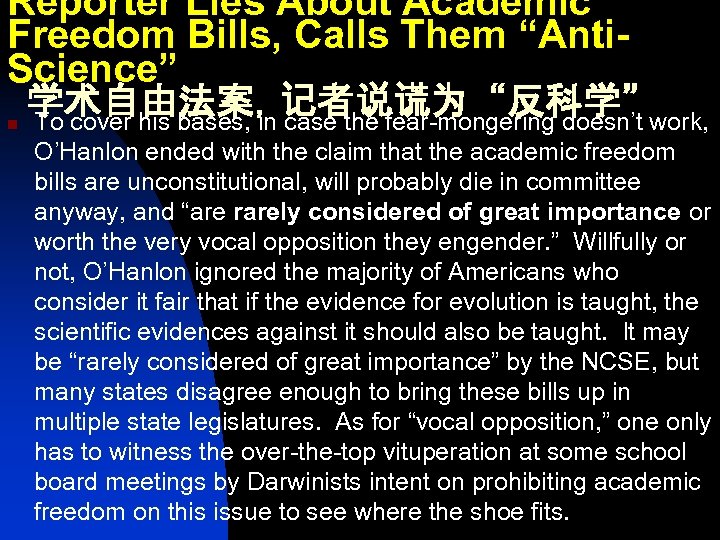
Reporter Lies About Academic Freedom Bills, Calls Them “Anti. Science” 学术自由法案,记者说谎为“反科学” n To cover his bases, in case the fear-mongering doesn’t work, O’Hanlon ended with the claim that the academic freedom bills are unconstitutional, will probably die in committee anyway, and “are rarely considered of great importance or worth the very vocal opposition they engender. ” Willfully or not, O’Hanlon ignored the majority of Americans who consider it fair that if the evidence for evolution is taught, the scientific evidences against it should also be taught. It may be “rarely considered of great importance” by the NCSE, but many states disagree enough to bring these bills up in multiple state legislatures. As for “vocal opposition, ” one only has to witness the over-the-top vituperation at some school board meetings by Darwinists intent on prohibiting academic freedom on this issue to see where the shoe fits.

Reporter Lies About Academic Freedom Bills, Calls Them “Anti. Science” 学术自由法案,记者说谎为“反科学” n O’Hanlon’s lying is not just misinformation; it’s disinformation: intentional propaganda aimed, not at rational discourse, but at destroying a targeted group with utter disregard for the facts. It should be self-evident that any media source repeating these lies becomes an accomplice to them.

Reporter Lies About Academic Freedom Bills, Calls Them “Anti. Science” n 学术自由法案,记者说谎为“反科学” You see once again the kind of people you deal with when trying to give teachers and students the honest truth about evolution. An entrenched power structure that cannot tolerate honest inquiry will stop at nothing to propagandize, even using the Stalin-like Big Lie tactic to protect Charlie. We’ve been showing this willful, lying pattern of angry resistance by the Darwinistas for over a decade. Lie Science is just one of the repeat offenders. It’s time you stopped pretending this is merely a disagreement about a side issue. It’s time you got involved.

Reporter Lies About Academic Freedom Bills, Calls Them “Anti. Science” 学术自由法案,记者说谎为“反科学” n If you do get involved, make sure (and we cannot stress this enough) that you know the pitfalls and booby-traps the Darwinistas will use against you. Know the facts, know the law, and know the hills worth defending in this intellectual battleground, lest you make matters worse. Know their talking points cold, and the responses. Most of all, do not stoop to the lying tactics they use. Overcome lies with the truth.

Reporter Lies About Academic Freedom Bills, Calls Them “Anti. Science” 学术自由法案,记者说谎为“反科学” n Suggestion: Quote to them the words of Charles Darwin himself from the introduction of his Origin of Species: “A fair result can only be obtained by fully stating and balancing the facts and arguments on both sides of each question” (see. Academic. Freedom. Day. com and Academic. Freedom. Petition. com).

Gloria Deo 愿荣耀归上帝 n
Скачать презентацию Sermons From Science — Feb 2013 科学布道— 2013年
6c82c24d737b1a5dd6dfef232f9e949a.ppt