


 Скачать презентацию Series Tests of High Gradient Singlecell Superconducting Cavity
d0826c53c90b6e7c0c2100b392eaebf5.ppt
- Количество слайдов: 24
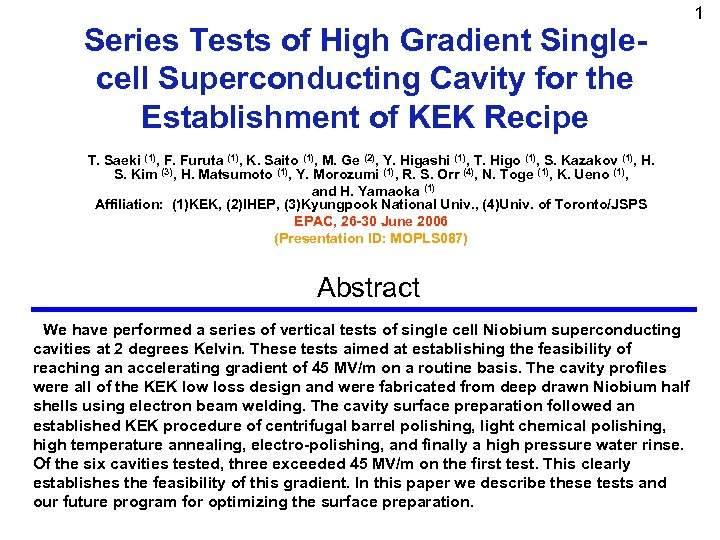 Series Tests of High Gradient Singlecell Superconducting Cavity for the Establishment of KEK Recipe T. Saeki (1), F. Furuta (1), K. Saito (1), M. Ge (2), Y. Higashi (1), T. Higo (1), S. Kazakov (1), H. S. Kim (3), H. Matsumoto (1), Y. Morozumi (1), R. S. Orr (4), N. Toge (1), K. Ueno (1), and H. Yamaoka (1) Affiliation: (1)KEK, (2)IHEP, (3)Kyungpook National Univ. , (4)Univ. of Toronto/JSPS EPAC, 26 -30 June 2006 (Presentation ID: MOPLS 087) Abstract We have performed a series of vertical tests of single cell Niobium superconducting cavities at 2 degrees Kelvin. These tests aimed at establishing the feasibility of reaching an accelerating gradient of 45 MV/m on a routine basis. The cavity profiles were all of the KEK low loss design and were fabricated from deep drawn Niobium half shells using electron beam welding. The cavity surface preparation followed an established KEK procedure of centrifugal barrel polishing, light chemical polishing, high temperature annealing, electro-polishing, and finally a high pressure water rinse. Of the six cavities tested, three exceeded 45 MV/m on the first test. This clearly establishes the feasibility of this gradient. In this paper we describe these tests and our future program for optimizing the surface preparation. 1
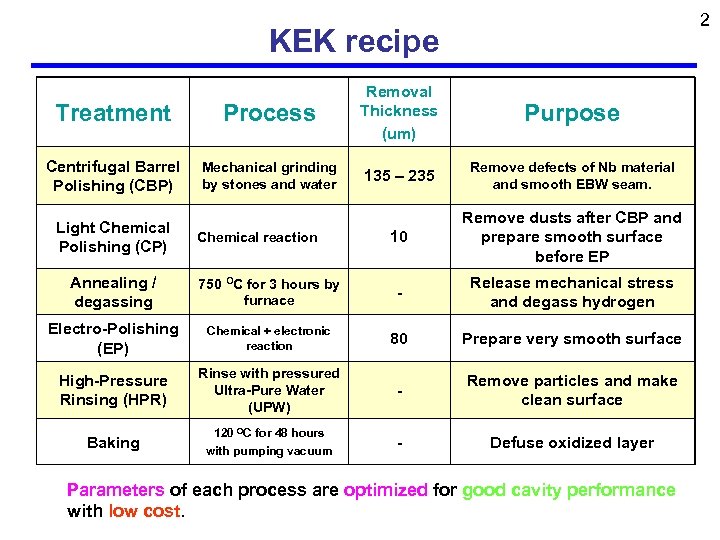 2 KEK recipe Treatment Process Removal Thickness (um) Centrifugal Barrel Polishing (CBP) Mechanical grinding by stones and water 135 – 235 Remove defects of Nb material and smooth EBW seam. 10 Remove dusts after CBP and prepare smooth surface before EP Light Chemical Polishing (CP) Chemical reaction Purpose Annealing / degassing 750 OC for 3 hours by furnace - Release mechanical stress and degass hydrogen Electro-Polishing (EP) Chemical + electronic reaction 80 Prepare very smooth surface High-Pressure Rinsing (HPR) Rinse with pressured Ultra-Pure Water (UPW) - Remove particles and make clean surface Baking 120 OC for 48 hours with pumping vacuum - Defuse oxidized layer Parameters of each process are optimized for good cavity performance with low cost.
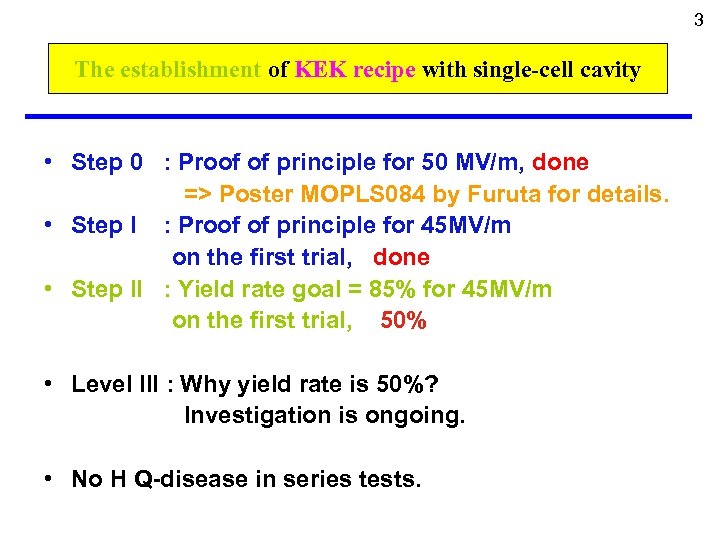 3 The establishment of KEK recipe with single-cell cavity • Step 0 : Proof of principle for 50 MV/m, done => Poster MOPLS 084 by Furuta for details. • Step I : Proof of principle for 45 MV/m on the first trial, done • Step II : Yield rate goal = 85% for 45 MV/m on the first trial, 50% • Level III : Why yield rate is 50%? Investigation is ongoing. • No H Q-disease in series tests.
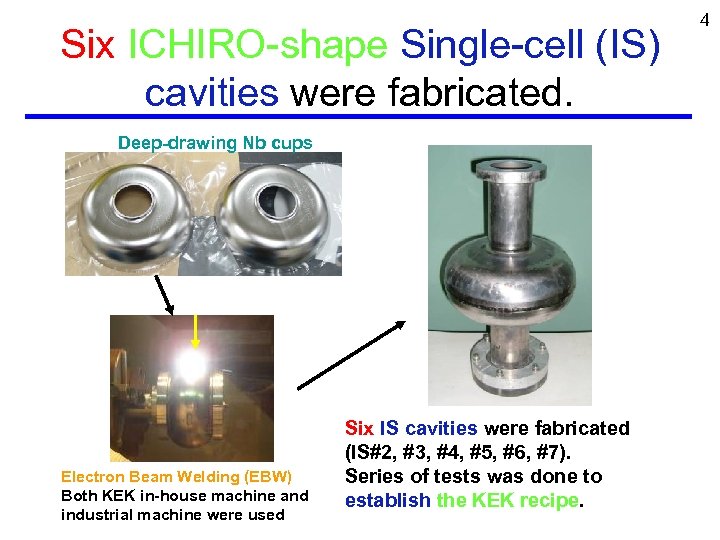 Six ICHIRO-shape Single-cell (IS) cavities were fabricated. Deep-drawing Nb cups Electron Beam Welding (EBW) Both KEK in-house machine and industrial machine were used Six IS cavities were fabricated (IS#2, #3, #4, #5, #6, #7). Series of tests was done to establish the KEK recipe. 4
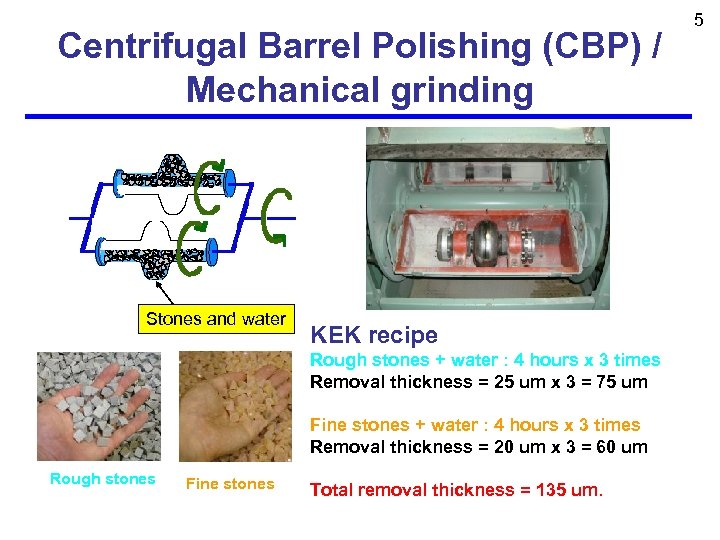 Centrifugal Barrel Polishing (CBP) / Mechanical grinding Stones and water KEK recipe Rough stones + water : 4 hours x 3 times Removal thickness = 25 um x 3 = 75 um Fine stones + water : 4 hours x 3 times Removal thickness = 20 um x 3 = 60 um Rough stones Fine stones Total removal thickness = 135 um. 5
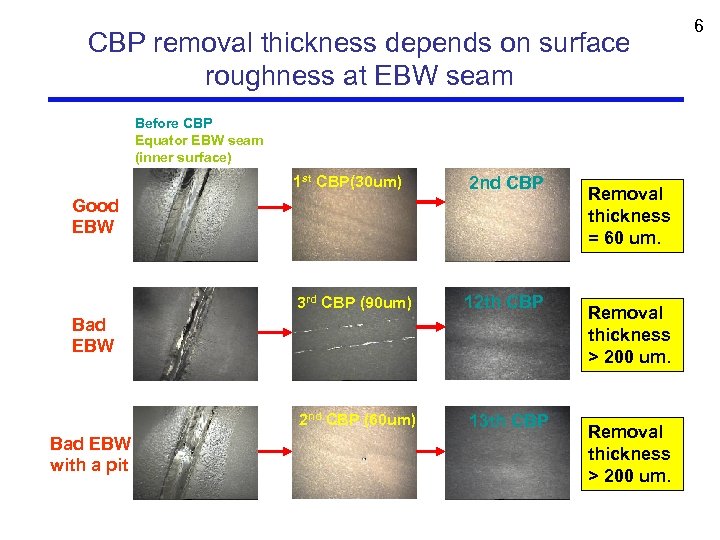 CBP removal thickness depends on surface roughness at EBW seam Before CBP Equator EBW seam (inner surface) 1 st CBP(30 um) 2 nd CBP Good EBW 3 rd CBP (90 um) 12 th CBP Bad EBW 2 nd CBP (60 um) Bad EBW with a pit 13 th CBP Removal thickness = 60 um. Removal thickness > 200 um. 6
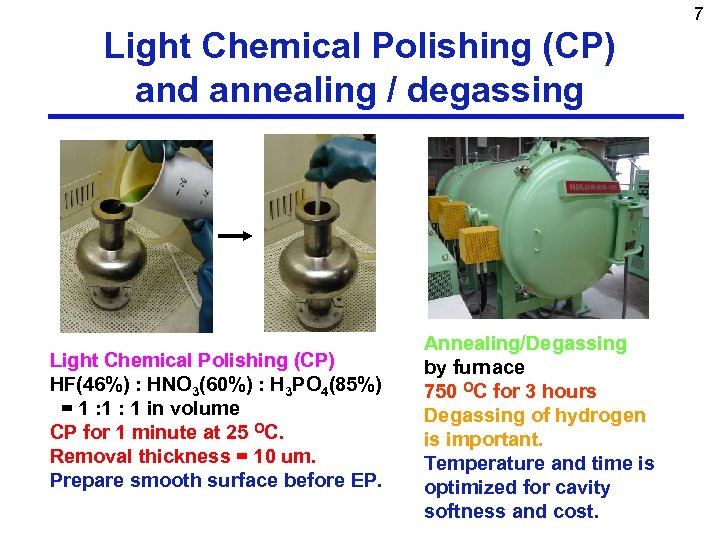 7 Light Chemical Polishing (CP) and annealing / degassing Light Chemical Polishing (CP) HF(46%) : HNO 3(60%) : H 3 PO 4(85%) = 1 : 1 in volume CP for 1 minute at 25 OC. Removal thickness = 10 um. Prepare smooth surface before EP. Annealing/Degassing by furnace 750 OC for 3 hours Degassing of hydrogen is important. Temperature and time is optimized for cavity softness and cost.
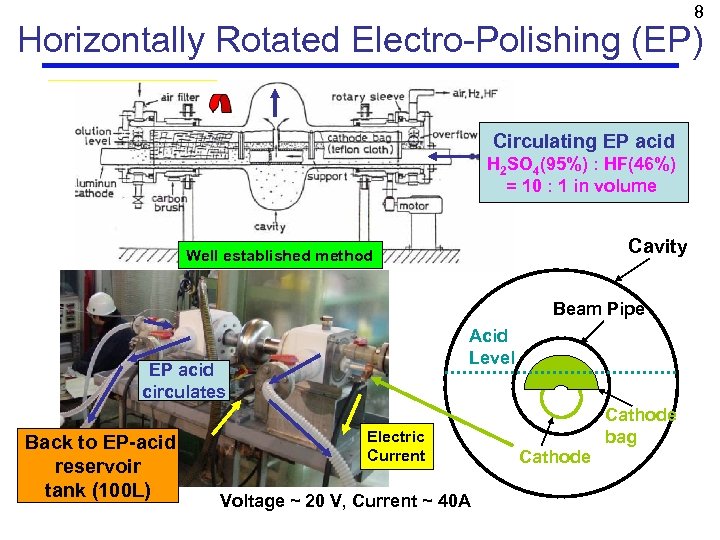 8 Horizontally Rotated Electro-Polishing (EP) Circulating EP acid H 2 SO 4(95%) : HF(46%) = 10 : 1 in volume Cavity Well established method Beam Pipe Acid Level EP acid circulates Back to EP-acid reservoir tank (100 L) Electric Current Voltage ~ 20 V, Current ~ 40 A Cathode bag
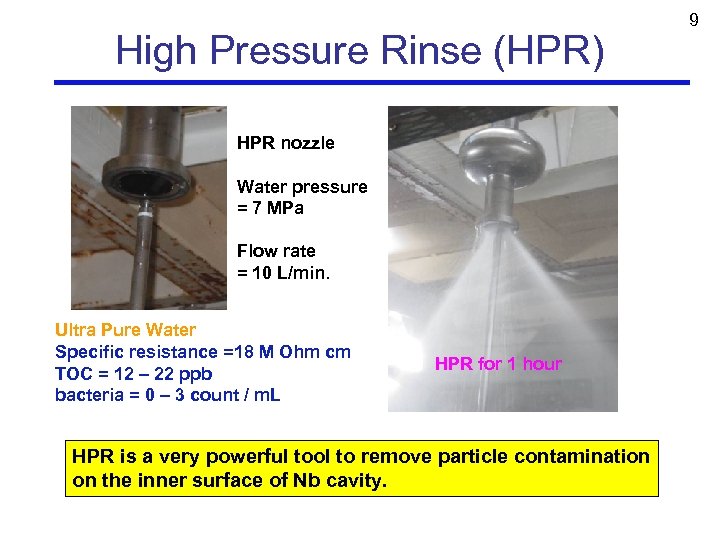 High Pressure Rinse (HPR) HPR nozzle Water pressure = 7 MPa Flow rate = 10 L/min. Ultra Pure Water Specific resistance =18 M Ohm cm TOC = 12 – 22 ppb bacteria = 0 – 3 count / m. L HPR for 1 hour HPR is a very powerful tool to remove particle contamination on the inner surface of Nb cavity. 9
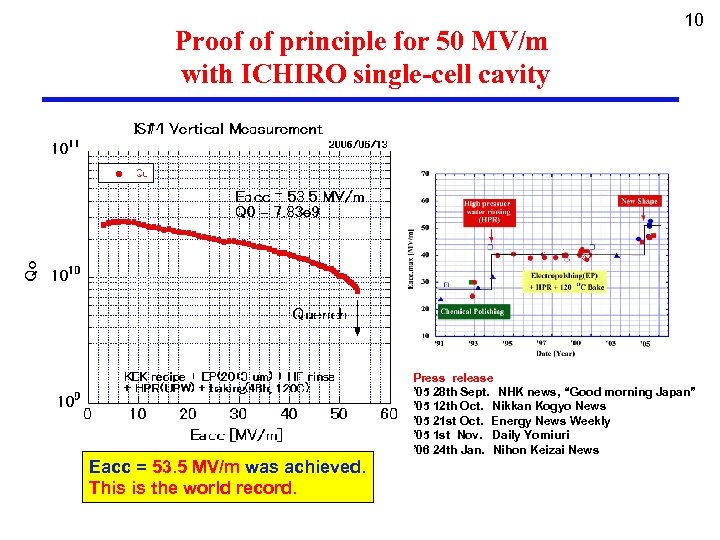 Proof of principle for 50 MV/m with ICHIRO single-cell cavity 10 Press release ’ 05 28 th Sept. NHK news, “Good morning Japan” ’ 05 12 th Oct. Nikkan Kogyo News ’ 05 21 st Oct. Energy News Weekly ’ 05 1 st Nov. Daily Yomiuri ’ 06 24 th Jan. Nihon Keizai News Eacc = 53. 5 MV/m was achieved. This is the world record.
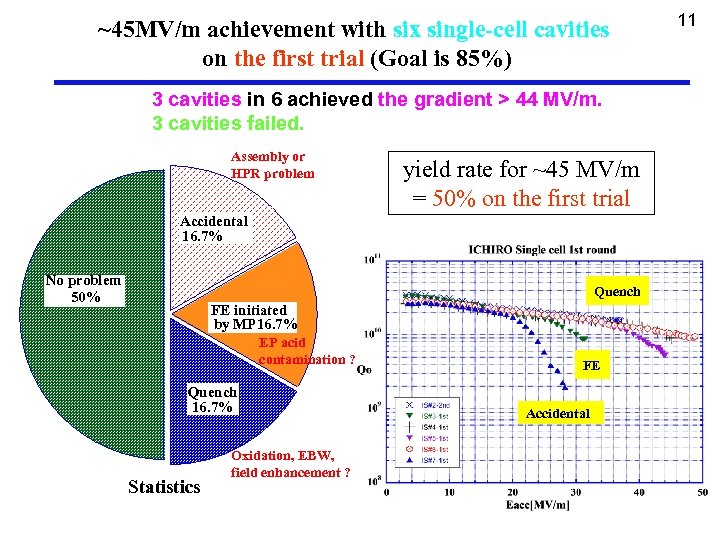 ~45 MV/m achievement with six single-cell cavities on the first trial (Goal is 85%) 3 cavities in 6 achieved the gradient > 44 MV/m. 3 cavities failed. Assembly or HPR problem yield rate for ~45 MV/m = 50% on the first trial Accidental 16. 7% No problem 50% Quench FE initiated by MP 16. 7% EP acid contamination ? Quench 16. 7% Statistics Oxidation, EBW, field enhancement ? FE Accidental 11
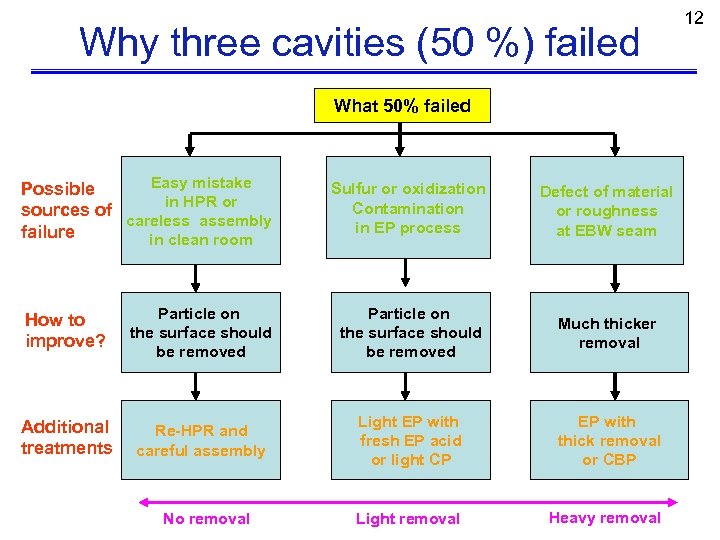 Why three cavities (50 %) failed What 50% failed Easy mistake Possible in HPR or sources of careless assembly failure in clean room Sulfur or oxidization Contamination in EP process Defect of material or roughness at EBW seam How to improve? Particle on the surface should be removed Much thicker removal Additional treatments Re-HPR and careful assembly Light EP with fresh EP acid or light CP EP with thick removal or CBP Light removal Heavy removal No removal 12
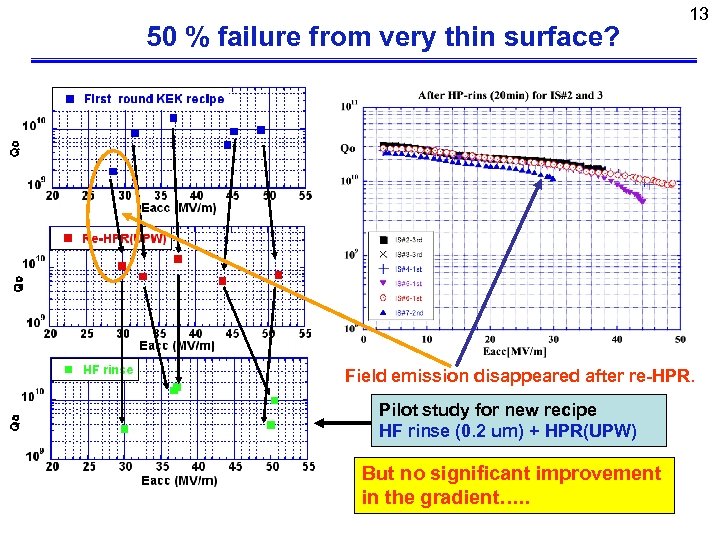 50 % failure from very thin surface? 13 Field emission disappeared after re-HPR. Pilot study for new recipe HF rinse (0. 2 um) + HPR(UPW) But no significant improvement in the gradient…. .
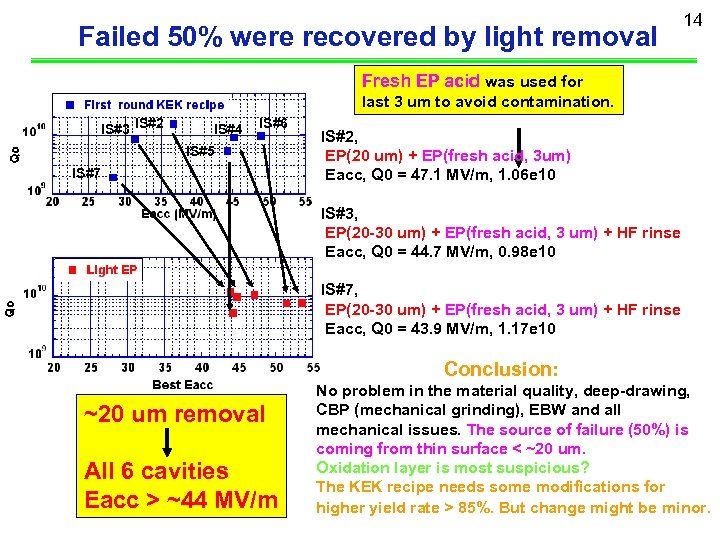 Failed 50% were recovered by light removal 14 Fresh EP acid was used for last 3 um to avoid contamination. IS#3 IS#2 IS#4 IS#6 IS#5 IS#7 IS#2, EP(20 um) + EP(fresh acid, 3 um) Eacc, Q 0 = 47. 1 MV/m, 1. 06 e 10 IS#3, EP(20 -30 um) + EP(fresh acid, 3 um) + HF rinse Eacc, Q 0 = 44. 7 MV/m, 0. 98 e 10 IS#7, EP(20 -30 um) + EP(fresh acid, 3 um) + HF rinse Eacc, Q 0 = 43. 9 MV/m, 1. 17 e 10 Conclusion: ~20 um removal All 6 cavities Eacc > ~44 MV/m No problem in the material quality, deep-drawing, CBP (mechanical grinding), EBW and all mechanical issues. The source of failure (50%) is coming from thin surface < ~20 um. Oxidation layer is most suspicious? The KEK recipe needs some modifications for higher yield rate > 85%. But change might be minor.
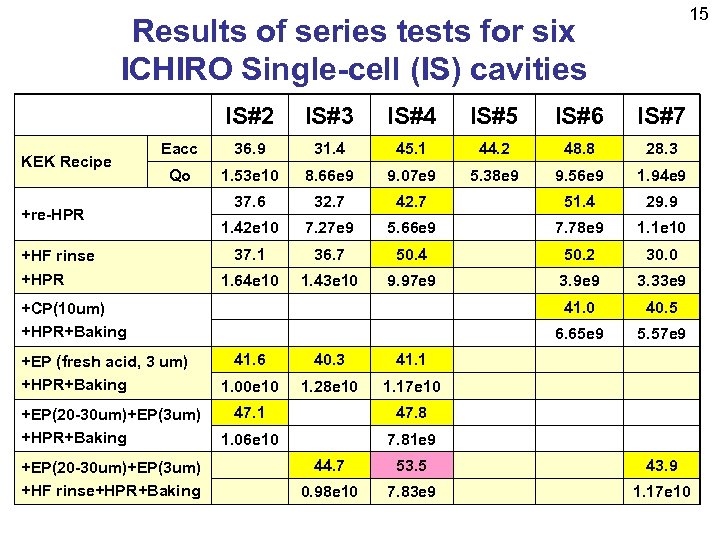 15 Results of series tests for six ICHIRO Single-cell (IS) cavities IS#2 KEK Recipe IS#3 IS#4 IS#5 IS#6 IS#7 Eacc 36. 9 31. 4 45. 1 44. 2 48. 8 28. 3 Qo 1. 53 e 10 8. 66 e 9 9. 07 e 9 5. 38 e 9 9. 56 e 9 1. 94 e 9 37. 6 32. 7 42. 7 51. 4 29. 9 1. 42 e 10 7. 27 e 9 5. 66 e 9 7. 78 e 9 1. 1 e 10 37. 1 36. 7 50. 4 50. 2 30. 0 1. 64 e 10 1. 43 e 10 9. 97 e 9 3. 9 e 9 3. 33 e 9 41. 0 40. 5 6. 65 e 9 5. 57 e 9 +re-HPR +HF rinse +HPR +CP(10 um) +HPR+Baking +EP (fresh acid, 3 um) +HPR+Baking +EP(20 -30 um)+EP(3 um) +HF rinse+HPR+Baking 41. 6 40. 3 41. 1 1. 00 e 10 1. 28 e 10 1. 17 e 10 47. 1 47. 8 1. 06 e 10 7. 81 e 9 44. 7 53. 5 43. 9 0. 98 e 10 7. 83 e 9 1. 17 e 10
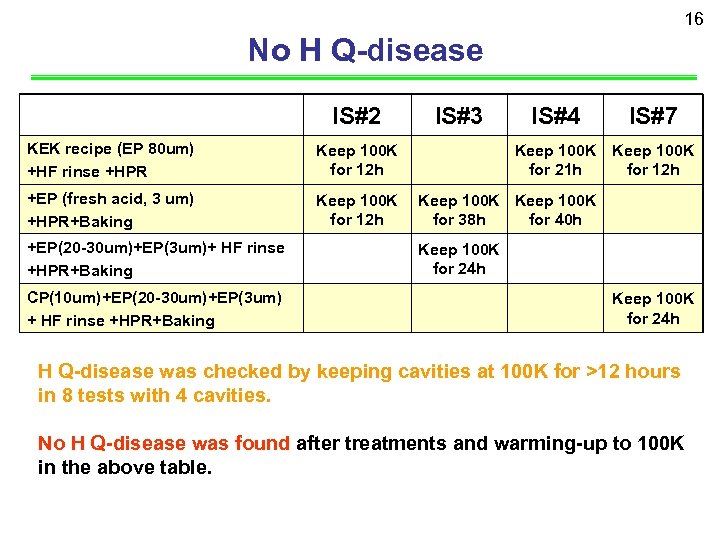 16 No H Q-disease IS#2 KEK recipe (EP 80 um) +HF rinse +HPR Keep 100 K for 12 h +EP (fresh acid, 3 um) +HPR+Baking Keep 100 K for 12 h IS#3 +EP(20 -30 um)+EP(3 um)+ HF rinse +HPR+Baking CP(10 um)+EP(20 -30 um)+EP(3 um) + HF rinse +HPR+Baking IS#4 IS#7 Keep 100 K for 21 h for 12 h Keep 100 K for 38 h for 40 h Keep 100 K for 24 h H Q-disease was checked by keeping cavities at 100 K for >12 hours in 8 tests with 4 cavities. No H Q-disease was found after treatments and warming-up to 100 K in the above table.
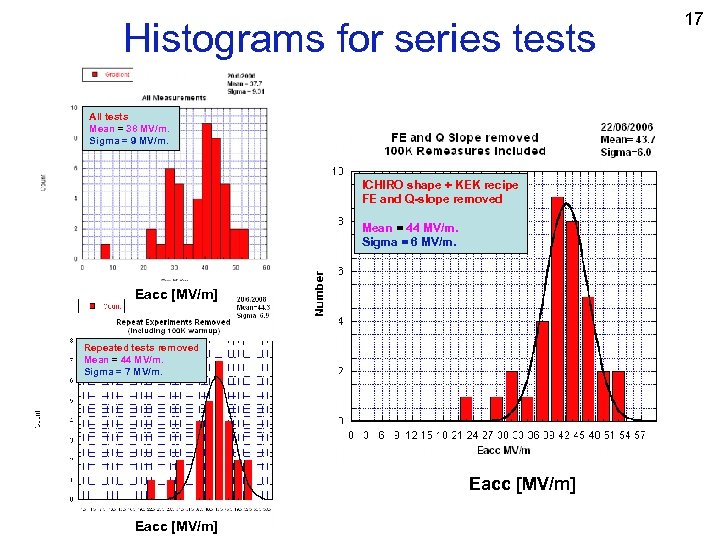 Histograms for series tests All tests Mean = 38 MV/m. Sigma = 9 MV/m. ICHIRO shape + KEK recipe FE and Q-slope removed Mean = 44 MV/m. Sigma = 6 MV/m. Eacc [MV/m] Repeated tests removed Mean = 44 MV/m. Sigma = 7 MV/m. Eacc [MV/m] 17
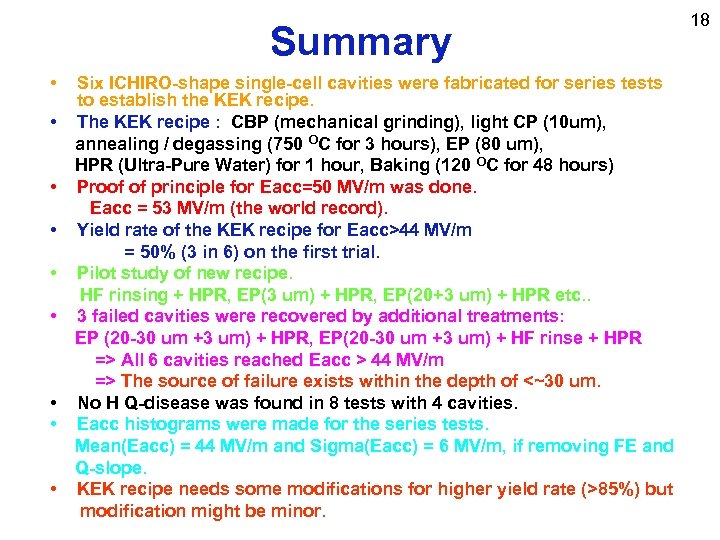 Summary • • • Six ICHIRO-shape single-cell cavities were fabricated for series tests to establish the KEK recipe. The KEK recipe : CBP (mechanical grinding), light CP (10 um), annealing / degassing (750 OC for 3 hours), EP (80 um), HPR (Ultra-Pure Water) for 1 hour, Baking (120 OC for 48 hours) Proof of principle for Eacc=50 MV/m was done. Eacc = 53 MV/m (the world record). Yield rate of the KEK recipe for Eacc>44 MV/m = 50% (3 in 6) on the first trial. Pilot study of new recipe. HF rinsing + HPR, EP(3 um) + HPR, EP(20+3 um) + HPR etc. . 3 failed cavities were recovered by additional treatments: EP (20 -30 um +3 um) + HPR, EP(20 -30 um +3 um) + HF rinse + HPR => All 6 cavities reached Eacc > 44 MV/m => The source of failure exists within the depth of <~30 um. No H Q-disease was found in 8 tests with 4 cavities. Eacc histograms were made for the series tests. Mean(Eacc) = 44 MV/m and Sigma(Eacc) = 6 MV/m, if removing FE and Q-slope. KEK recipe needs some modifications for higher yield rate (>85%) but modification might be minor. 18
 OPTIONAL POSTERS
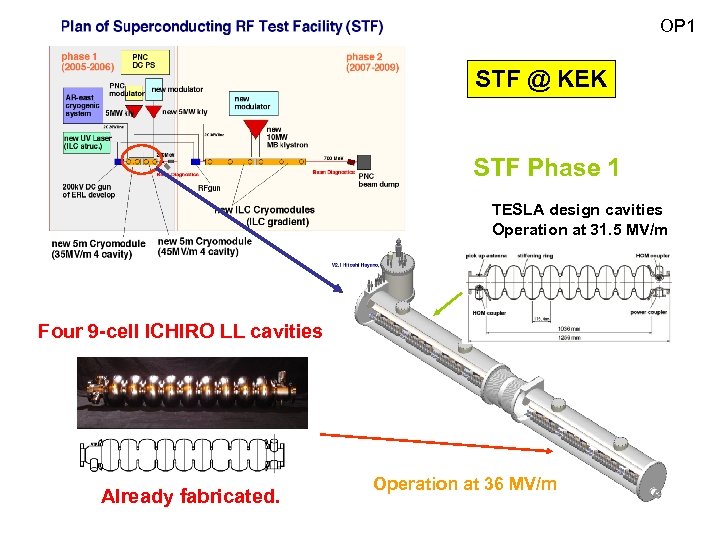 OP 1 STF @ KEK STF Phase 1 TESLA design cavities Operation at 31. 5 MV/m Four 9 -cell ICHIRO LL cavities Already fabricated. Operation at 36 MV/m
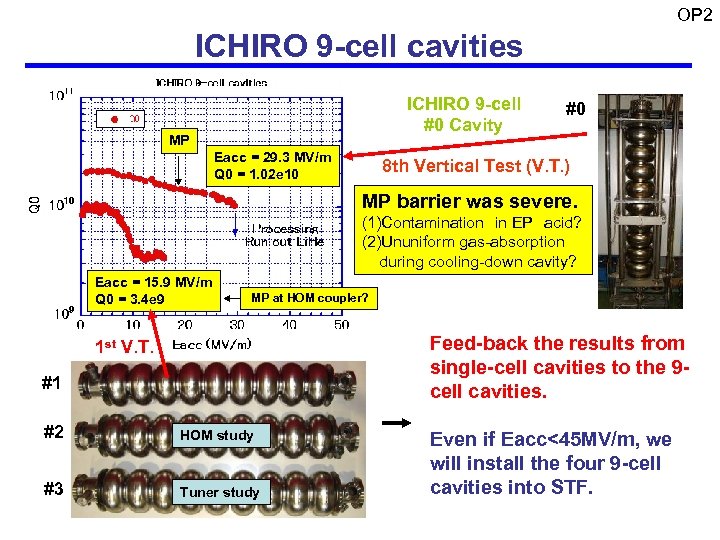 OP 2 ICHIRO 9 -cell cavities ICHIRO 9 -cell #0 Cavity MP Eacc = 29. 3 MV/m Q 0 = 1. 02 e 10 #0 8 th Vertical Test (V. T. ) MP barrier was severe. (1)Contamination in EP acid? (2)Ununiform gas-absorption during cooling-down cavity? Eacc = 15. 9 MV/m Q 0 = 3. 4 e 9 MP at HOM coupler? Feed-back the results from single-cell cavities to the 9 cell cavities. 1 st V. T. #1 #2 HOM study #3 Tuner study Even if Eacc<45 MV/m, we will install the four 9 -cell cavities into STF.
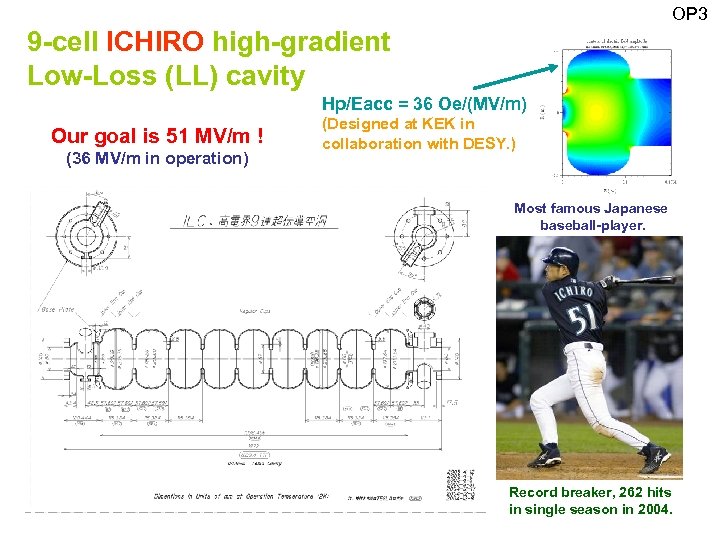 OP 3 9 -cell ICHIRO high-gradient Low-Loss (LL) cavity Hp/Eacc = 36 Oe/(MV/m) Our goal is 51 MV/m ! (36 MV/m in operation) (Designed at KEK in collaboration with DESY. ) Most famous Japanese baseball-player. Record breaker, 262 hits in single season in 2004.
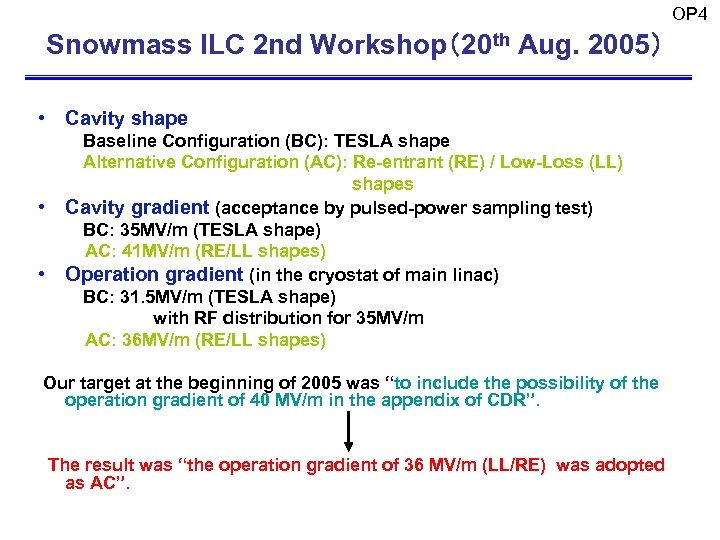 OP 4 Snowmass ILC 2 nd Workshop(20 th Aug. 2005) • Cavity shape Baseline Configuration (BC): TESLA shape Alternative Configuration (AC): Re-entrant (RE) / Low-Loss (LL) shapes • Cavity gradient (acceptance by pulsed-power sampling test) BC: 35 MV/m (TESLA shape) AC: 41 MV/m (RE/LL shapes) • Operation gradient (in the cryostat of main linac) BC: 31. 5 MV/m (TESLA shape) with RF distribution for 35 MV/m AC: 36 MV/m (RE/LL shapes) Our target at the beginning of 2005 was “to include the possibility of the operation gradient of 40 MV/m in the appendix of CDR”. The result was “the operation gradient of 36 MV/m (LL/RE) was adopted as AC”.
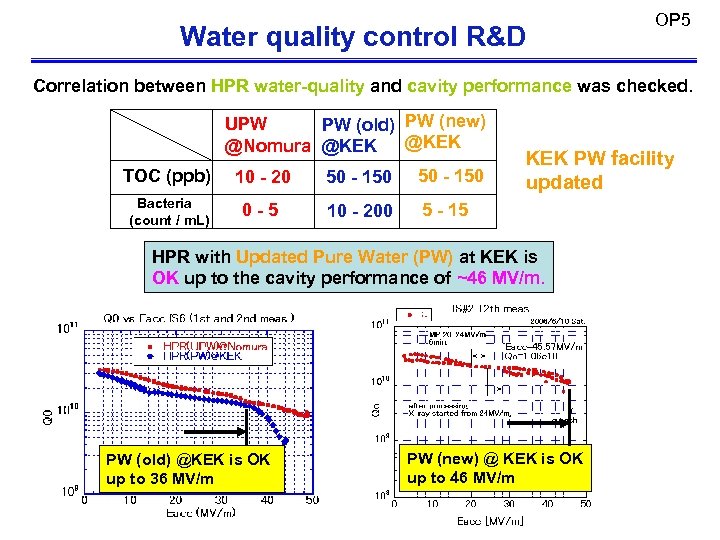 Water quality control R&D OP 5 Correlation between HPR water-quality and cavity performance was checked. UPW PW (old) PW (new) @KEK @Nomura @KEK TOC (ppb) 10 - 20 50 - 150 Bacteria (count / m. L) 0 -5 10 - 200 KEK PW facility updated 5 - 15 HPR with Updated Pure Water (PW) at KEK is OK up to the cavity performance of ~46 MV/m. PW (old) @KEK is OK up to 36 MV/m PW (new) @ KEK is OK up to 46 MV/m