


 Скачать презентацию Serial Powering of Silicon Strip Detectors at SLHC
295302bb29148bf6577c402076b3a4a6.ppt
- Количество слайдов: 41
 Serial Powering of Silicon Strip Detectors at SLHC Marc Weber, Giulio Villani, M. Tyndel (RAL) with Anu Tuonnonnen and Robert Apsimon 1
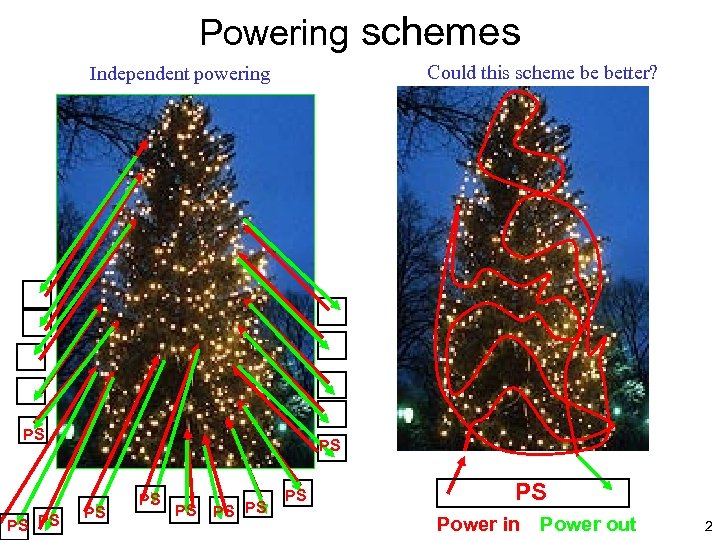 Powering schemes Could this scheme be better? Independent powering PS PS PS Power in Power out 2
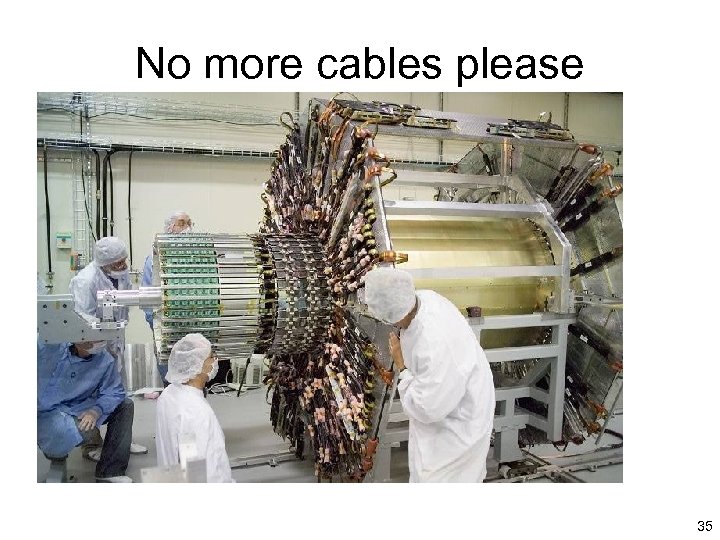
 How to power a SLHC tracker ? Many unknowns, but power will be a major challenge and affects cooling, material budget, packaging and more Focus of this talk is on silicon strip sensors. There is earlier powering stuff for ATLAS pixels by Bonn university group Known SCT: up to 160 m long cables, cable resistance up to ~ 3. 5 Ω SCT: power efficiency 50%, 25 k. W module power; 50 k. W total Estimate (assuming lower voltages, similar current and cable resistance) SLHC: power efficiency 20%, if 50 k. W modules power 200 k. W total This is a power station not a tracker ! 3
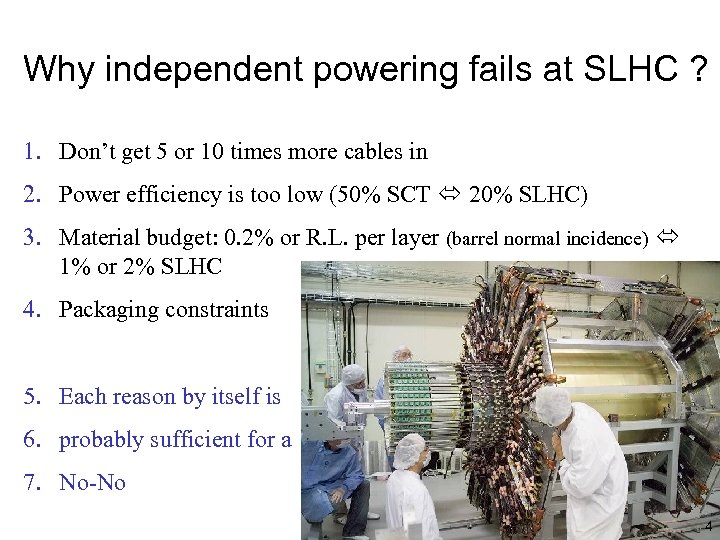 Why independent powering fails at SLHC ? 1. Don’t get 5 or 10 times more cables in 2. Power efficiency is too low (50% SCT 20% SLHC) 3. Material budget: 0. 2% or R. L. per layer (barrel normal incidence) 1% or 2% SLHC 4. Packaging constraints 5. Each reason by itself is 6. probably sufficient for a 7. No-No 4
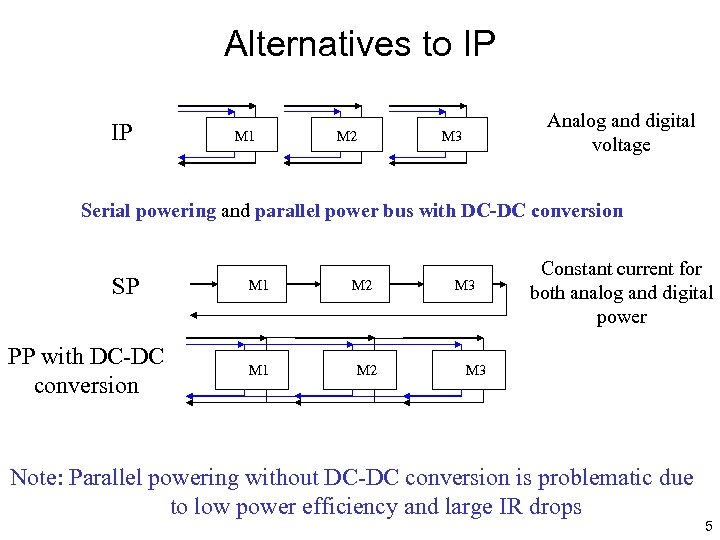 Alternatives to IP IP M 1 M 2 Analog and digital voltage M 3 Serial powering and parallel power bus with DC-DC conversion SP PP with DC-DC conversion M 1 M 2 M 3 Constant current for both analog and digital power M 3 Note: Parallel powering without DC-DC conversion is problematic due to low power efficiency and large IR drops 5
 How does SP work? Four elements § Current source § Shunt regulator and power device (digital power) § Linear regulator (analog power) § AC or opto-coupling of signals 6
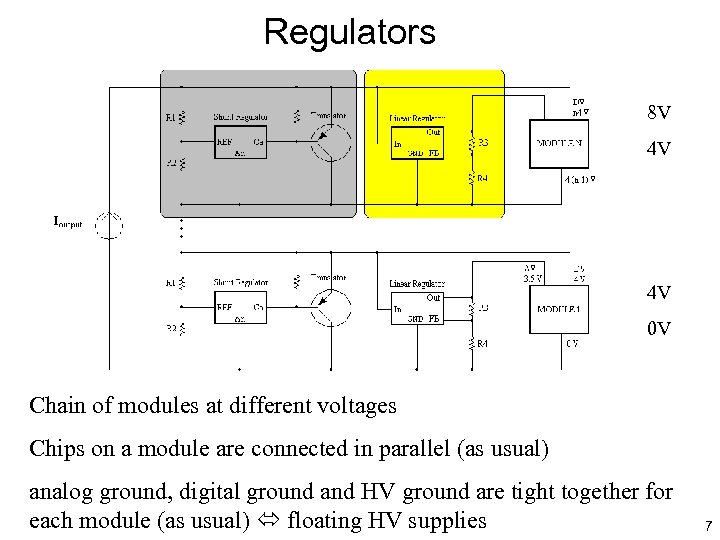 Regulators 8 V 4 V 4 V 0 V Chain of modules at different voltages Chips on a module are connected in parallel (as usual) analog ground, digital ground and HV ground are tight together for each module (as usual) floating HV supplies 7
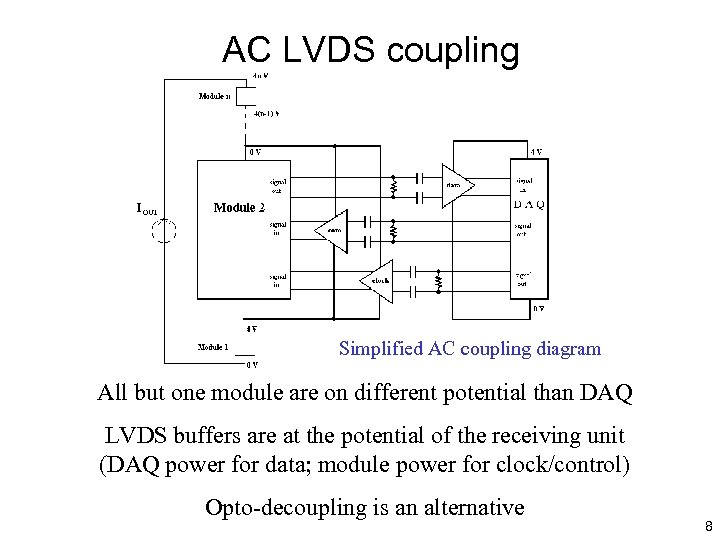 AC LVDS coupling Simplified AC coupling diagram All but one module are on different potential than DAQ LVDS buffers are at the potential of the receiving unit (DAQ power for data; module power for clock/control) Opto-decoupling is an alternative 8
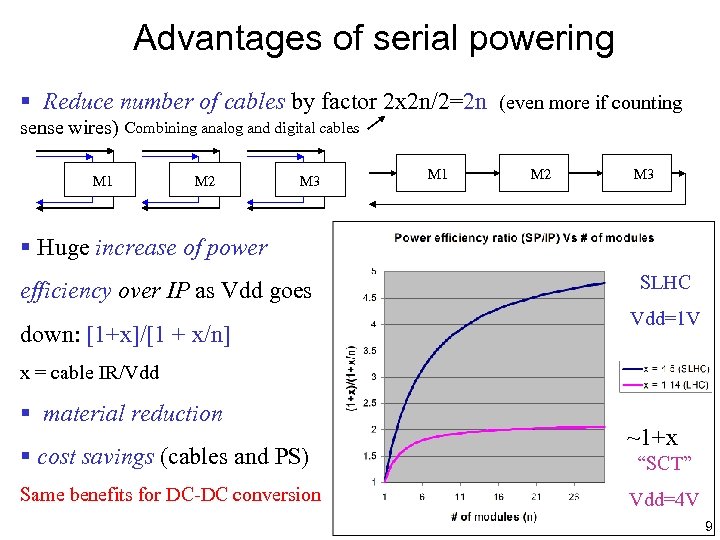 Advantages of serial powering § Reduce number of cables by factor 2 x 2 n/2=2 n (even more if counting sense wires) Combining analog and digital cables M 1 M 2 M 3 § Huge increase of power efficiency over IP as Vdd goes down: [1+x]/[1 + x/n] SLHC Vdd=1 V x = cable IR/Vdd § material reduction § cost savings (cables and PS) Same benefits for DC-DC conversion ~1+x “SCT” Vdd=4 V 9
 Perceived disadvantages of SP “ Only a physicist can be crazy enough to try this!” § Noisy; oscillations; interference between modules probably not main difficulty § Risky; can lose all modules due to single-point failure Much less risky than one might think § Loss of control over individual modules important constraint that can be addressed to some extent § Grounding and shielding of densely packaged extended system is part of stave R&D 10
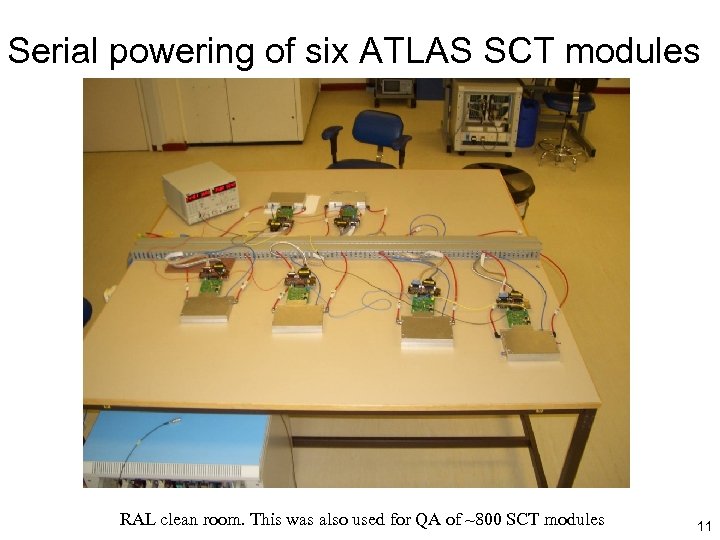 Serial powering of six ATLAS SCT modules RAL clean room. This was also used for QA of ~800 SCT modules 11
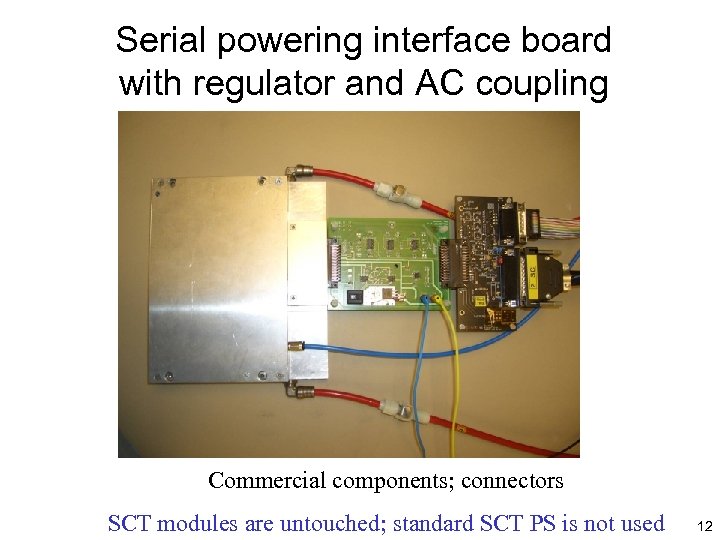 Serial powering interface board with regulator and AC coupling Commercial components; connectors SCT modules are untouched; standard SCT PS is not used 12
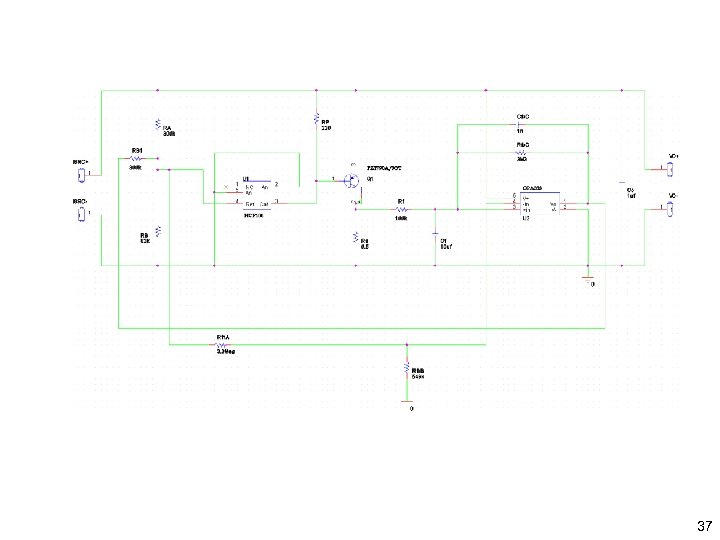
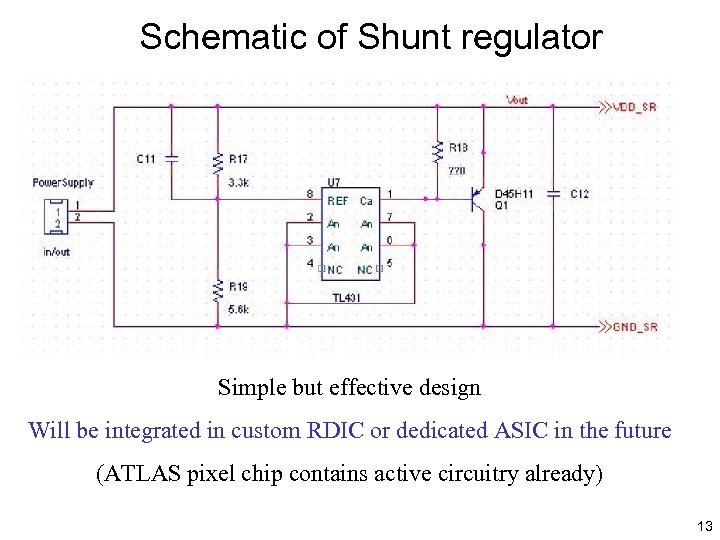 Schematic of Shunt regulator Simple but effective design Will be integrated in custom RDIC or dedicated ASIC in the future (ATLAS pixel chip contains active circuitry already) 13
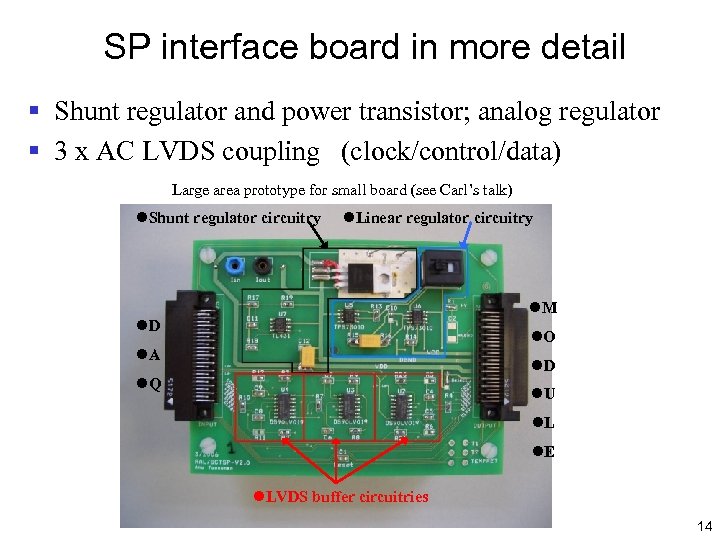 SP interface board in more detail § Shunt regulator and power transistor; analog regulator § 3 x AC LVDS coupling (clock/control/data) Large area prototype for small board (see Carl’s talk) l. Shunt regulator circuitry l. Linear regulator circuitry l. M l. D l. O l. A l. D l. Q l. U l. L l. E l. LVDS buffer circuitries 14
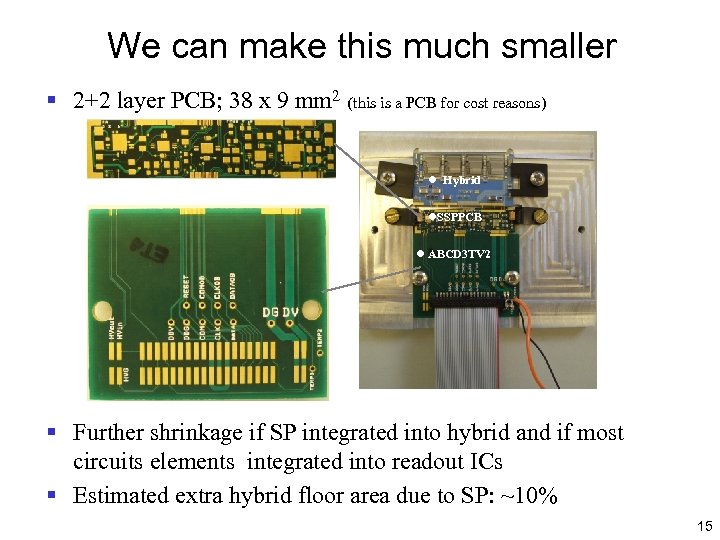 We can make this much smaller § 2+2 layer PCB; 38 x 9 mm 2 (this is a PCB for cost reasons) l Hybrid l. SSPPCB l ABCD 3 TV 2 § Further shrinkage if SP integrated into hybrid and if most circuits elements integrated into readout ICs § Estimated extra hybrid floor area due to SP: ~10% 15
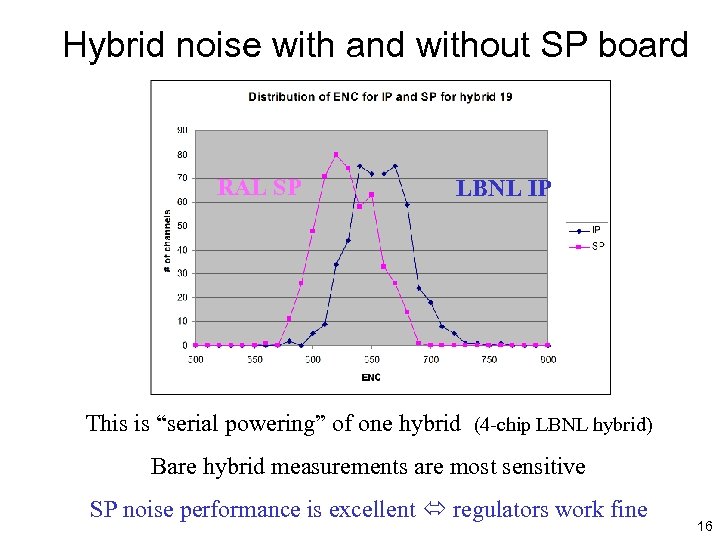 Hybrid noise with and without SP board RAL SP LBNL IP This is “serial powering” of one hybrid (4 -chip LBNL hybrid) Bare hybrid measurements are most sensitive SP noise performance is excellent regulators work fine 16
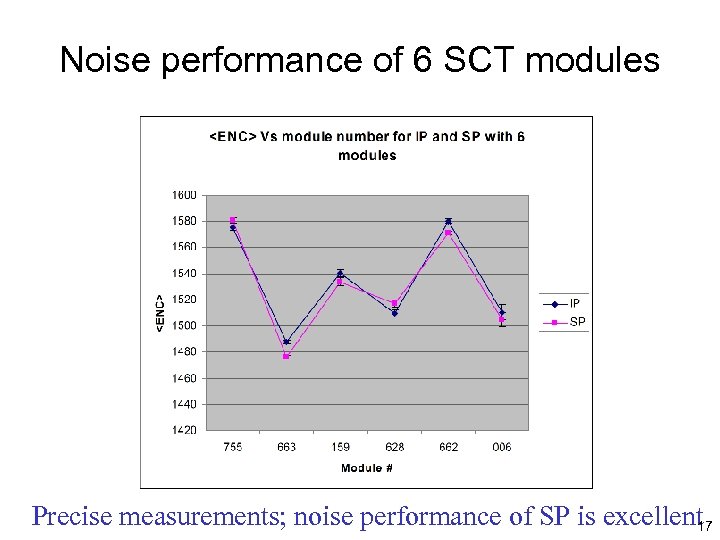 Noise performance of 6 SCT modules Precise measurements; noise performance of SP is excellent 17
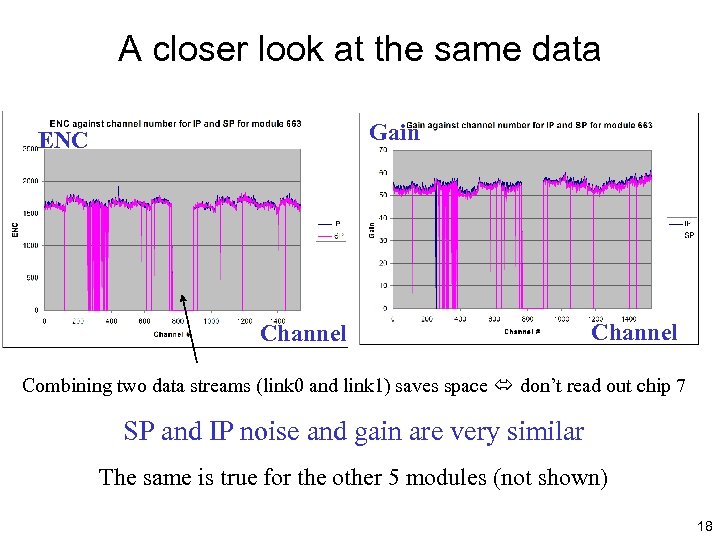 A closer look at the same data Gain ENC Channel Combining two data streams (link 0 and link 1) saves space don’t read out chip 7 SP and IP noise and gain are very similar The same is true for the other 5 modules (not shown) 18
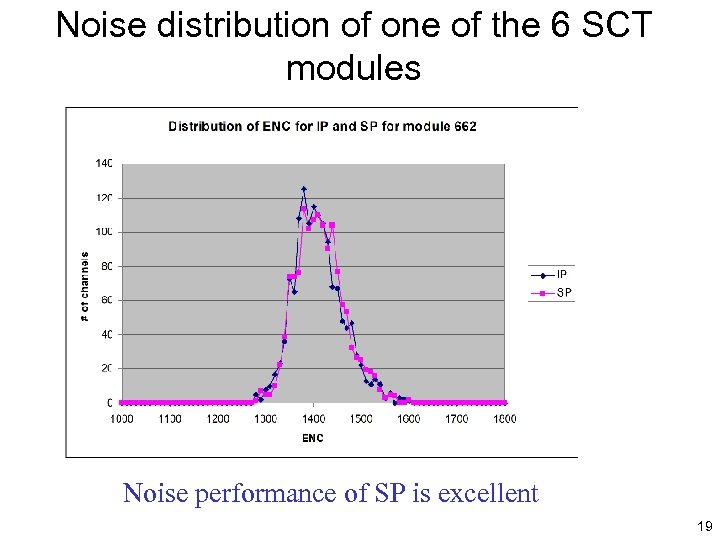 Noise distribution of one of the 6 SCT modules Noise performance of SP is excellent 19
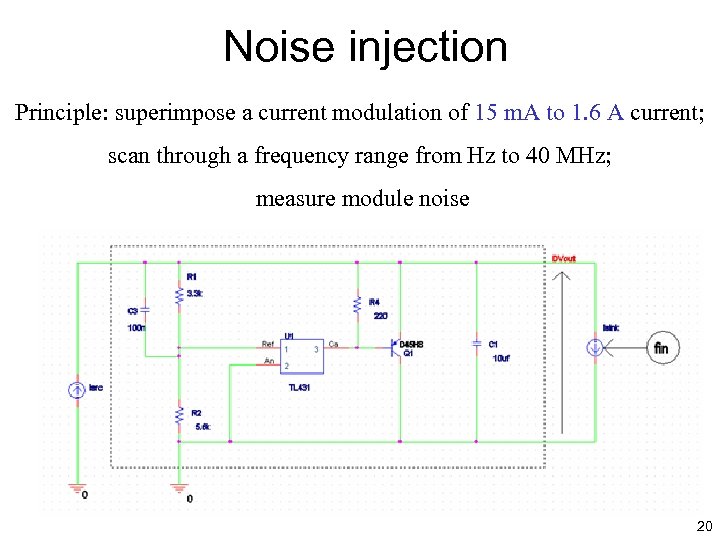 Noise injection Principle: superimpose a current modulation of 15 m. A to 1. 6 A current; scan through a frequency range from Hz to 40 MHz; measure module noise 20
![Noise injection: SP with 6 SCT modules <ENC> Frequency [Hz] No significant increase in](https://present5.com/presentation/295302bb29148bf6577c402076b3a4a6/image-21.jpg "Noise injection: SP with 6 SCT modules <ENC> Frequency [Hz] No significant increase in") Noise injection: SP with 6 SCT modules
Noise injection: SP with 6 SCT modules
 Is serial powering to risky? Risk = (# of power connections) x (probability of a failure) x (# of modules lost per failure) I am sure there are other ways to define risk, but this is plausible and instructive § Risk of module loss due to single-point failures for IP and SP § Over current protection through shunt regulator design § Protection by operating SR in parallel 22
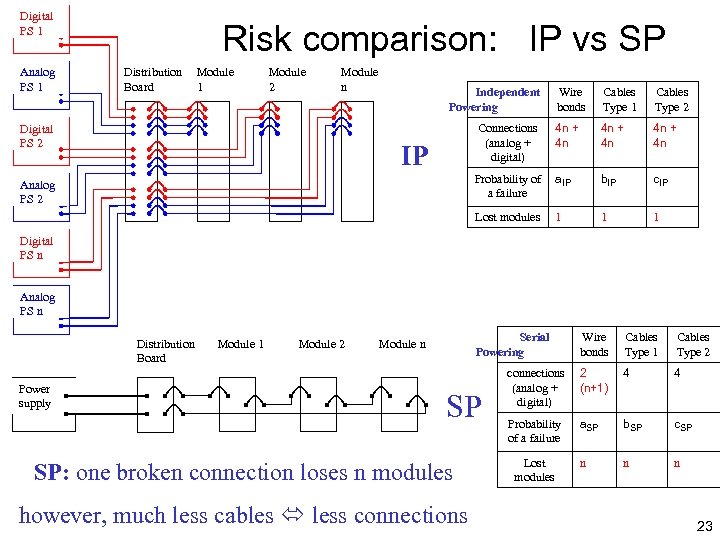 Digital PS 1 Analog PS 1 Risk comparison: IP vs SP Distribution Board Module 1 Module 2 Module n Cables Type 2 4 n + 4 n a. IP b. IP c. IP Lost modules Analog PS 2 Cables Type 1 Connections (analog + digital) IP Wire bonds Probability of a failure Digital PS 2 Independent Powering 1 1 1 Wire bonds Cables Type 1 Cables Type 2 connections (analog + digital) 2 (n+1) 4 4 Probability of a failure a. SP b. SP c. SP n n n Digital PS n Analog PS n Distribution Board Power supply Module 1 Module 2 Serial Powering Module n SP SP: one broken connection loses n modules however, much less cables less connections Lost modules 23
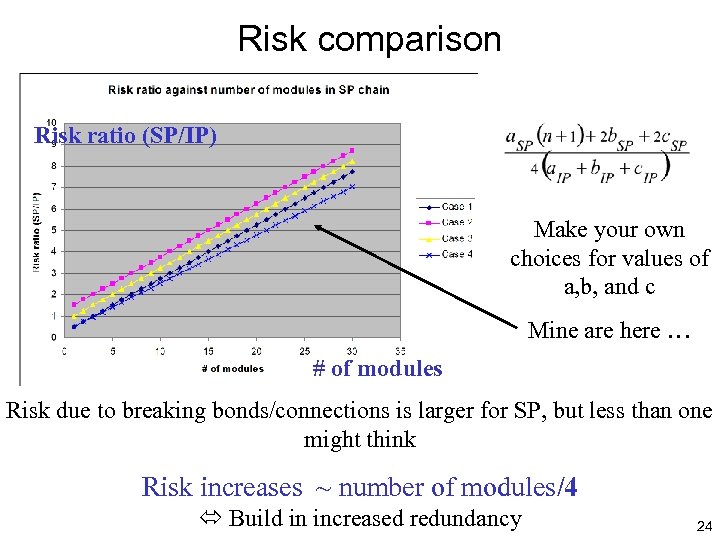 Risk comparison Risk ratio (SP/IP) Make your own choices for values of a, b, and c Mine are here … # of modules Risk due to breaking bonds/connections is larger for SP, but less than one might think Risk increases ~ number of modules/4 Build in increased redundancy 24
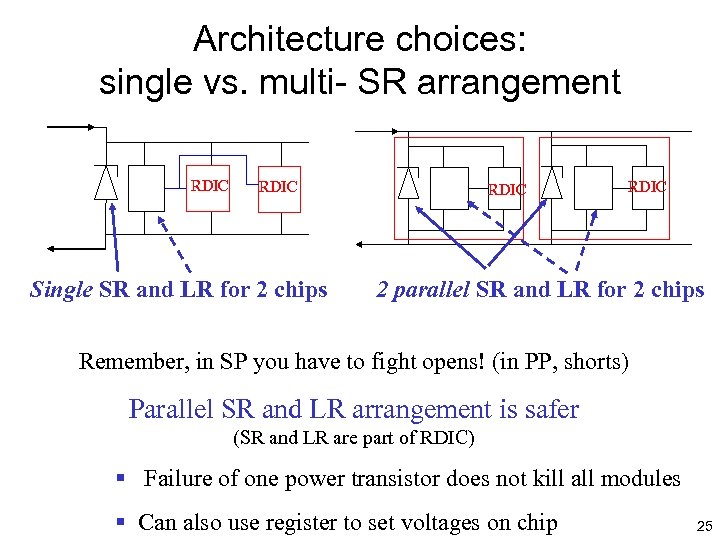 Architecture choices: single vs. multi- SR arrangement RDIC Single SR and LR for 2 chips RDIC 2 parallel SR and LR for 2 chips Remember, in SP you have to fight opens! (in PP, shorts) Parallel SR and LR arrangement is safer (SR and LR are part of RDIC) § Failure of one power transistor does not kill all modules § Can also use register to set voltages on chip 25
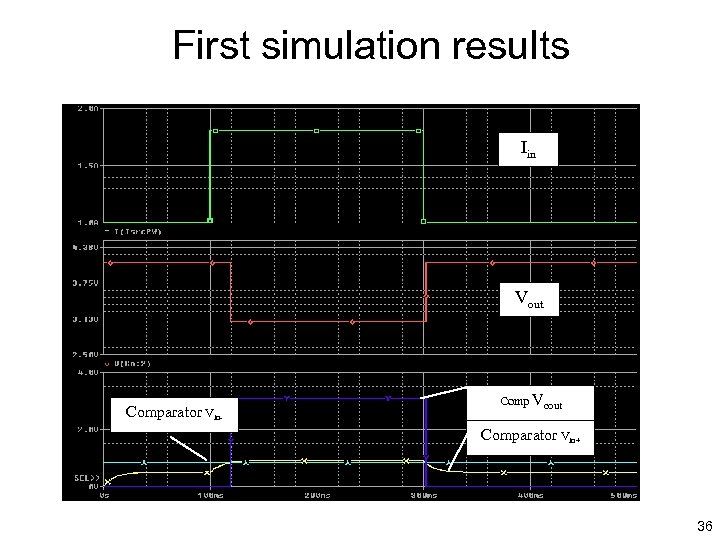
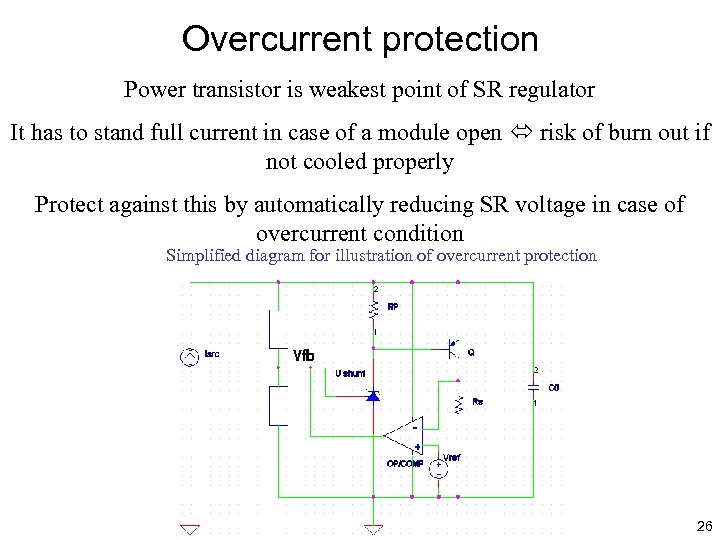 Overcurrent protection Power transistor is weakest point of SR regulator It has to stand full current in case of a module open risk of burn out if not cooled properly Protect against this by automatically reducing SR voltage in case of overcurrent condition Simplified diagram for illustration of overcurrent protection 26
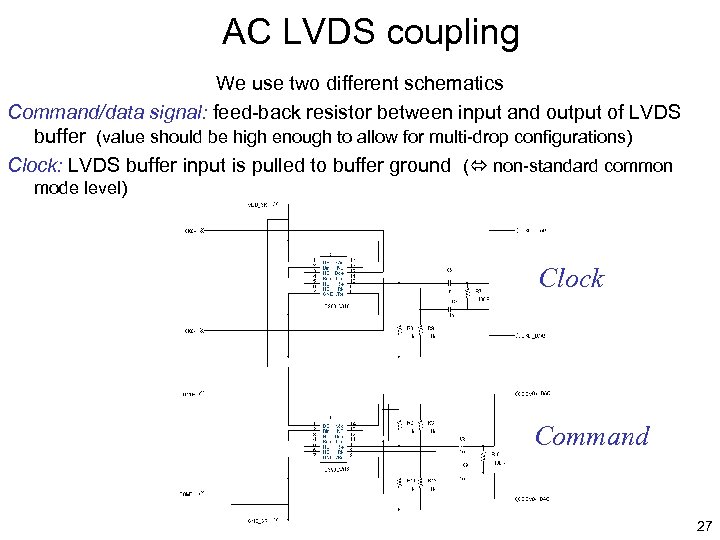 AC LVDS coupling We use two different schematics Command/data signal: feed-back resistor between input and output of LVDS buffer (value should be high enough to allow for multi-drop configurations) Clock: LVDS buffer input is pulled to buffer ground ( non-standard common mode level) Clock Command 27
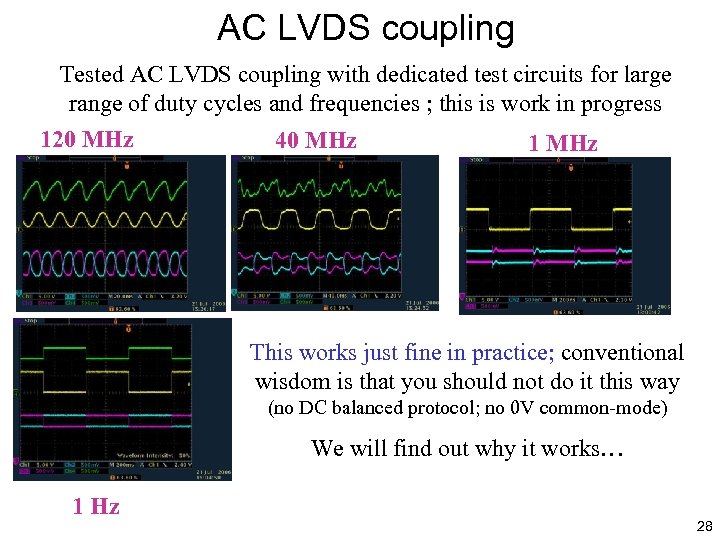 AC LVDS coupling Tested AC LVDS coupling with dedicated test circuits for large range of duty cycles and frequencies ; this is work in progress 120 MHz 40 MHz 1 MHz This works just fine in practice; conventional wisdom is that you should not do it this way (no DC balanced protocol; no 0 V common-mode) We will find out why it works… 1 Hz 28
 Future R&D program on powering schemes Goal: be ready for implementation of advanced SP and DC-DC conversion PP systems in a realistic module assembly in ~ 3 years Can distinguish three phases: Generic studies (as presented here and in Carl’s talk) to identify crucial features and challenges “easy”, affordable, “fun” Develop radiation-hard custom electronics (ABC_Next chip); build and test systems with large number of modules significant effort, serious engineering Implementation of power distribution schemes on advanced supermodule prototypes “service”, crucial to establish supermodule electrical performance 29
 What we have learnt so far § Noise performance is excellent; expect SP systems to be less noisy than alternatives; IR drops don’t matter for one § Risk of failure is bigger than for IP but much smaller than naively expected; SP/IP risk ~ n/4; can use fraction of space gains to buy robustness; protect power transistor § Power efficiency is hugely improved over IP (depending on x=IR/V); 20% (IP) -> 80% (SP) can save >100 k. W of cable losses; power consumption of SP circuitry is small, dominated by excess current in power transistor § Need to emphasize voltage adjustment and feed-back from individual modules (slow control) 30
 Outlook It unusual to gain such significant factors in a technology as mature as silicon detectors SP is challenging but I believe we can make it work If you are sceptical about these concepts, remember that we need to innovate. Without new powering schemes, we will simply not get any SLHC tracking detectors Last, but not least: this not only of interest for SLHC. ILC tracker or non-silicon detectors might benefit as well 31
 Appendix 32
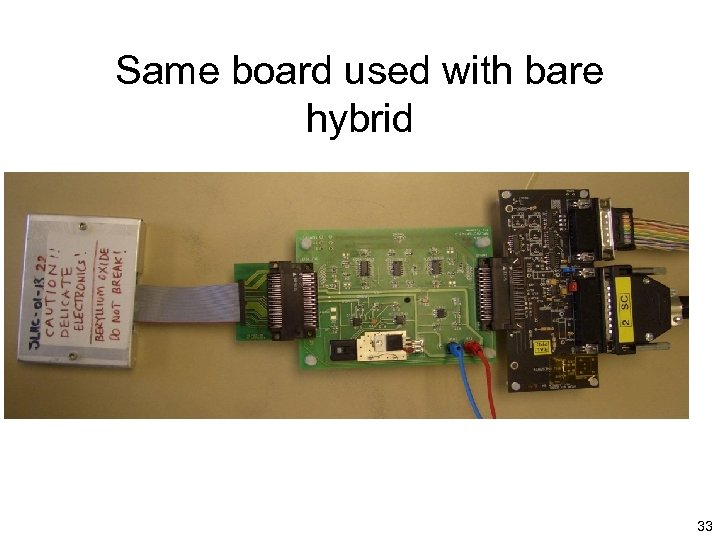 Same board used with bare hybrid Hybrid SPPCB DAQ support card 33
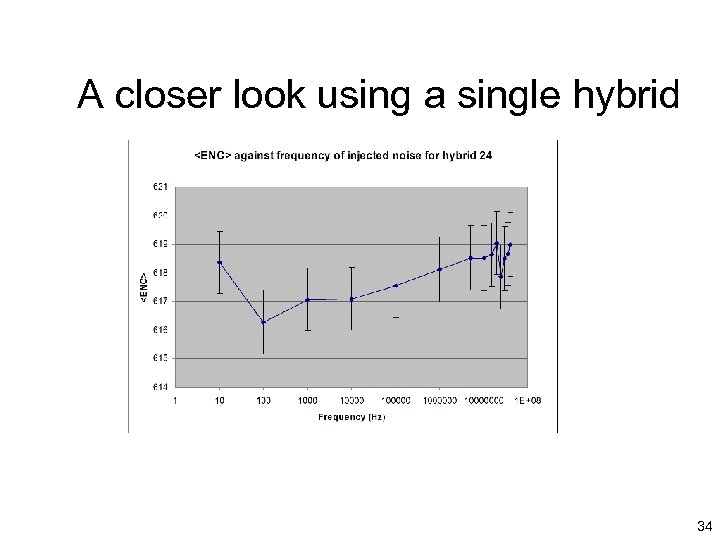 A closer look using a single hybrid 34
 No more cables please 35
 First simulation results Iin Vout Comparator Vin- Comp Vcout Comparator Vin+ 36
 37
37
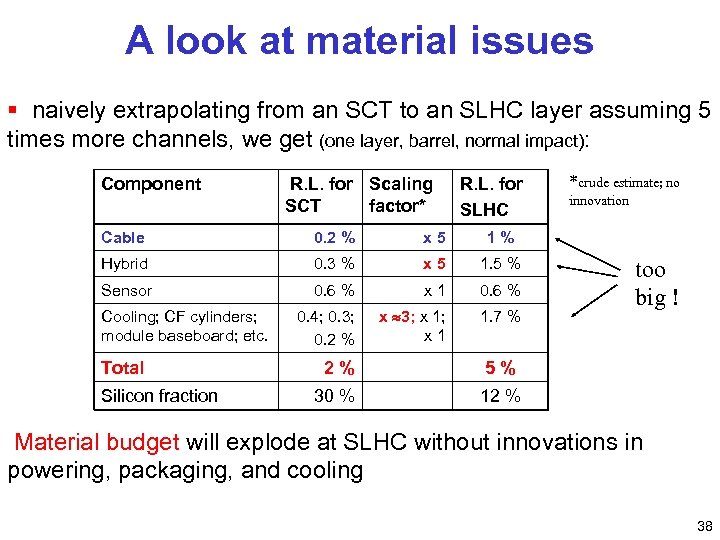 A look at material issues § naively extrapolating from an SCT to an SLHC layer assuming 5 times more channels, we get (one layer, barrel, normal impact): Component R. L. for Scaling SCT factor* R. L. for SLHC Cable 0. 2 % x 5 0. 3 % x 5 1. 5 % Sensor 0. 6 % x 1 0. 6 % 0. 4; 0. 3; 0. 2 % x 3; x 1 1. 7 % innovation 1% Hybrid *crude estimate; no Cooling; CF cylinders; module baseboard; etc. Total Silicon fraction 2% 5% 30 % too big ! 12 % Material budget will explode at SLHC without innovations in powering, packaging, and cooling 38
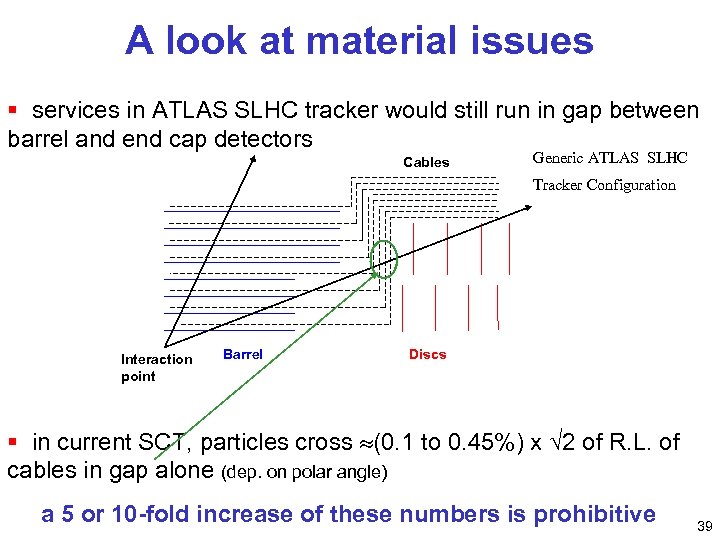 A look at material issues § services in ATLAS SLHC tracker would still run in gap between barrel and end cap detectors Cables Generic ATLAS SLHC Tracker Configuration Interaction point Barrel Discs § in current SCT, particles cross (0. 1 to 0. 45%) x √ 2 of R. L. of cables in gap alone (dep. on polar angle) a 5 or 10 -fold increase of these numbers is prohibitive 39
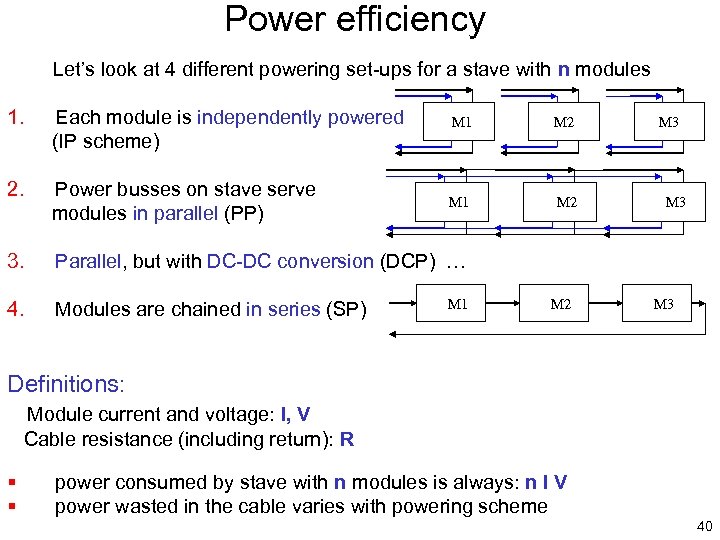 Power efficiency Let’s look at 4 different powering set-ups for a stave with n modules 1. Each module is independently powered (IP scheme) M 1 M 2 2. Power busses on stave serve modules in parallel (PP) M 1 M 2 3. Parallel, but with DC-DC conversion (DCP) … 4. Modules are chained in series (SP) M 1 M 2 M 3 M 3 Definitions: Module current and voltage: I, V Cable resistance (including return): R § § power consumed by stave with n modules is always: n I V power wasted in the cable varies with powering scheme 40
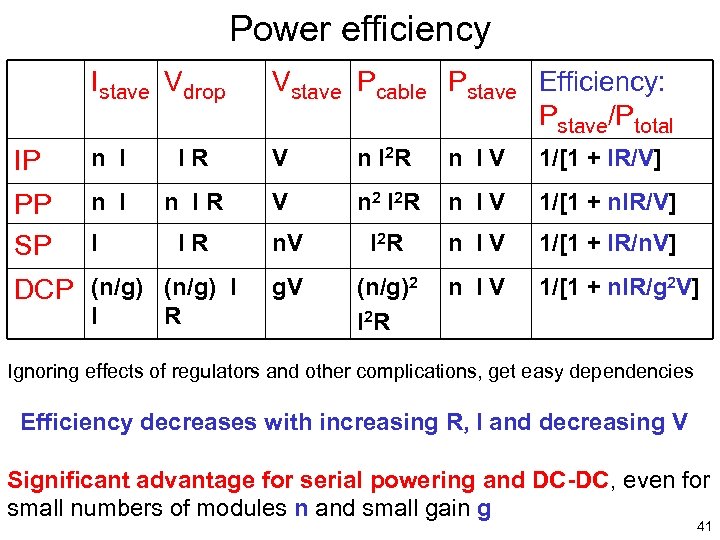 Power efficiency Istave Vdrop Vstave Pcable Pstave Efficiency: Pstave/Ptotal IP n I IR V n I 2 R n IV 1/[1 + IR/V] PP SP n IR V n 2 I 2 R n IV 1/[1 + n. IR/V] n. V I 2 R n IV 1/[1 + IR/n. V] g. V (n/g)2 I 2 R n IV 1/[1 + n. IR/g 2 V] I IR DCP (n/g) I I R Ignoring effects of regulators and other complications, get easy dependencies Efficiency decreases with increasing R, I and decreasing V Significant advantage for serial powering and DC-DC, even for small numbers of modules n and small gain g 41