


 Скачать презентацию Sergei Hariton FC-45 The price paid
2c5b36429321c50725b1a0abd8b0899b.ppt
- Количество слайдов: 18
 * Sergei Hariton FC-45
 *The price paid for the use of money *Many different interest rates *Speak as if only one interest rate *Determined by the money supply and money demand *
 *Why hold money? *Transactions demand, Dt *Determined by nominal GDP *Independent of the interest rate *Asset demand, Da *Money as a store of value * *Varies inversely with the interest rate *Total money demand, Dm
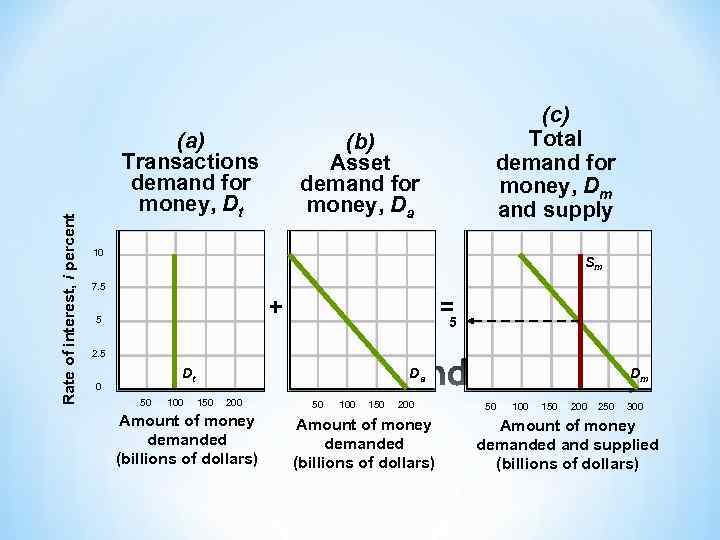 Rate of interest, i percent (a) Transactions demand for money, Dt (c) Total demand for money, Dm and supply (b) Asset demand for money, Da 10 Sm 7. 5 = 5 + 5 * 2. 5 Dt 0 50 100 150 200 Amount of money demanded (billions of dollars) 50 Da 100 150 200 Amount of money demanded (billions of dollars) Dm 50 100 150 200 250 300 Amount of money demanded and supplied (billions of dollars)
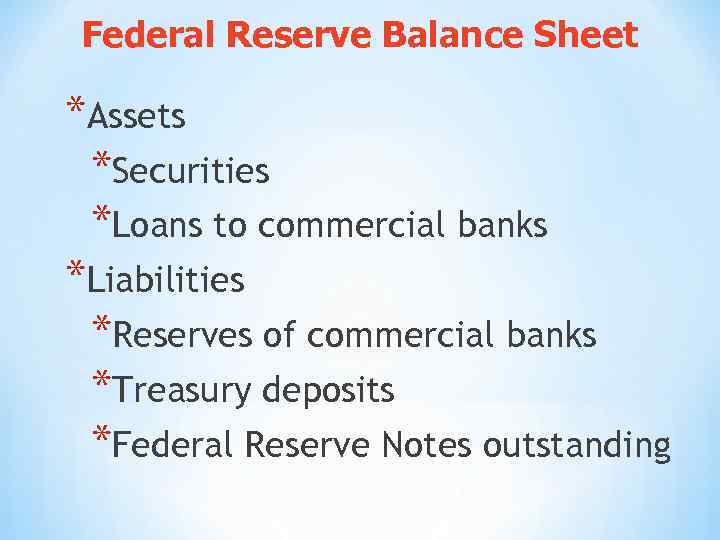 Federal Reserve Balance Sheet *Assets *Securities *Loans to commercial banks *Liabilities *Reserves of commercial banks *Treasury deposits *Federal Reserve Notes outstanding
 *Open market operations *Buying and selling of government securities (or bonds) *Commercial banks and the general public *Used to influence the money supply * *When the Fed sells securities, commercial bank reserves are reduced
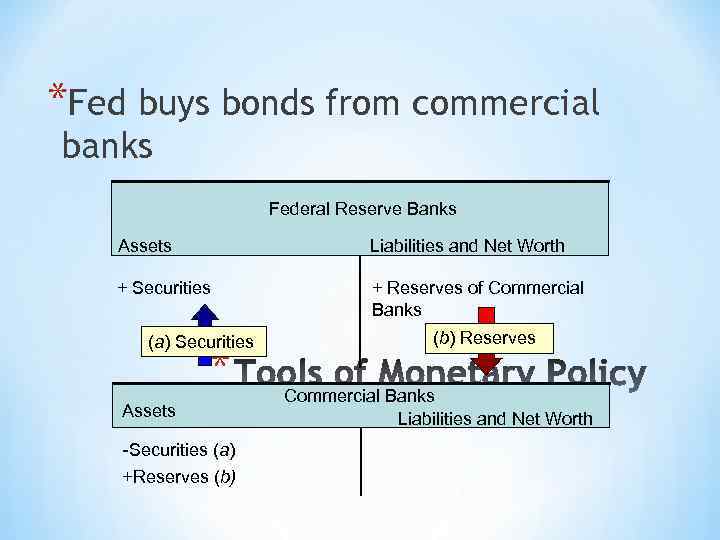 *Fed buys bonds from commercial banks Federal Reserve Banks Assets Liabilities and Net Worth + Securities + Reserves of Commercial Banks (a) Securities * Assets -Securities (a) +Reserves (b) Reserves Commercial Banks Liabilities and Net Worth
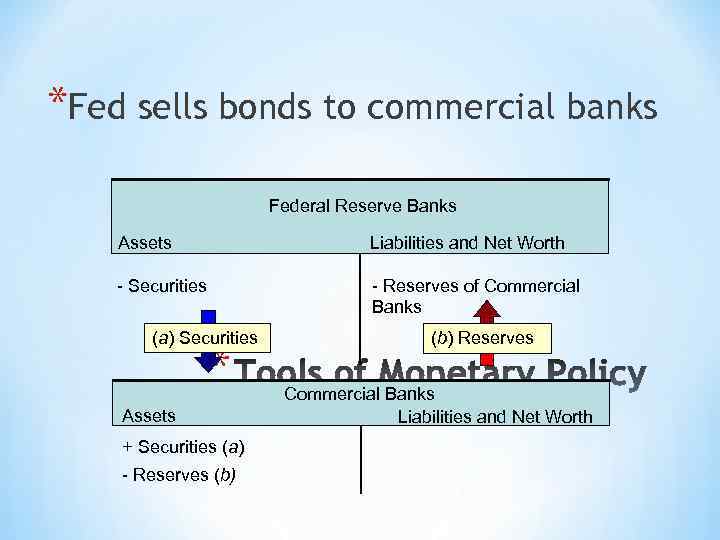 *Fed sells bonds to commercial banks Federal Reserve Banks Assets Liabilities and Net Worth - Securities - Reserves of Commercial Banks (a) Securities * Assets + Securities (a) - Reserves (b) Reserves Commercial Banks Liabilities and Net Worth
 *The reserve ratio *Changes the money multiplier *The discount rate *The Fed as lender of last resort *Short term loans *Term auction facility * *Introduced December 2007 *Banks bid for the right to borrow reserves
 *Open market operations are the most important *Reserve ratio last changed in 1992 *Discount rate was a passive tool *Term auction facility is new *Guaranteed amount lent by the Fed *Anonymous *
 *Rate charged by banks on overnight loans *Targeted by the Federal Reserve *FOMC conducts open market operations to achieve the target *Demand curve for Federal funds *Supply curve for Federal funds *
 *Expansionary monetary policy *Economy faces a recession *Lower target for Federal funds rate *Fed buys securities *Expanded money supply *Downward pressure on other interest rates *
 *Restrictive monetary policy *Periods of rising inflation *Increases Federal funds rate *Increases money supply *Increases other interest rates *
 *Rule of thumb for tracking actual monetary policy *Fed has 2% target inflation rate *If real GDP = potential GDP and inflation is 2%, then targeted Federal funds rate is 4% *Target varies as inflation and real GDP vary *
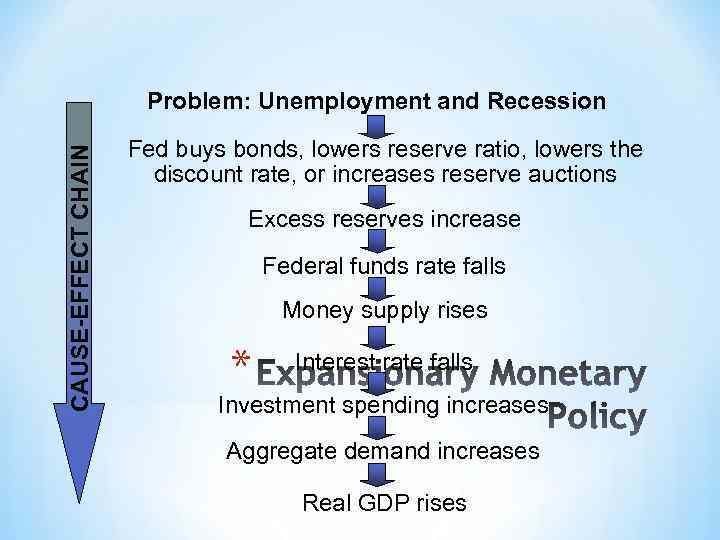 CAUSE-EFFECT CHAIN Problem: Unemployment and Recession Fed buys bonds, lowers reserve ratio, lowers the discount rate, or increases reserve auctions Excess reserves increase Federal funds rate falls Money supply rises * Interest rate falls Investment spending increases Aggregate demand increases Real GDP rises
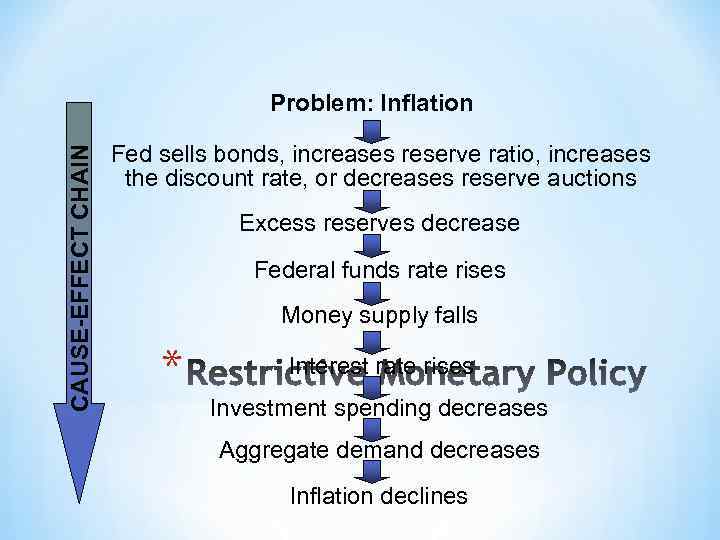 CAUSE-EFFECT CHAIN Problem: Inflation Fed sells bonds, increases reserve ratio, increases the discount rate, or decreases reserve auctions Excess reserves decrease Federal funds rate rises Money supply falls * Interest rate rises Investment spending decreases Aggregate demand decreases Inflation declines
 *Advantages over fiscal policy *Speed and flexibility *Isolation from political pressure *Monetary policy is more subtle than fiscal policy *
 *Lags *Recognition and operational *Cyclical asymmetry *Liquidity trap *