 Скачать презентацию SERENATE End-user workshop IBM MONTPELLIER 17 -19
f5319cb7f3dfed93ea8616a4e933f6b6.ppt
- Количество слайдов: 18



SERENATE End-user workshop @ IBM MONTPELLIER 17 -19 January 2003
European Commission Centre of Excellence Inter. Disciplinary Research & Applications Based on Nuclear and Atomic Physics http: //idranap. nipne. ro/ cex@ifin. nipne. ro From NATIONAL INSTITUTE OF PHYSICS & NUCLEAR ENGNG. (IFIN-HH), Bucharest, ROMANIA http: //www. nipne. ro
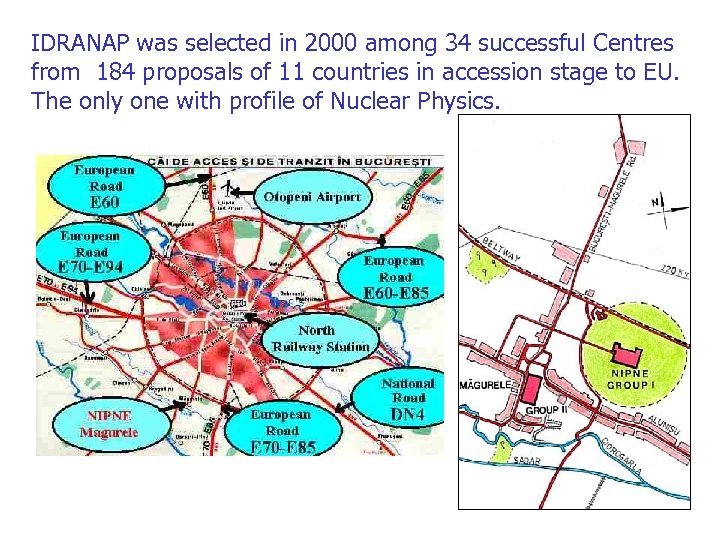
IDRANAP was selected in 2000 among 34 successful Centres from 184 proposals of 11 countries in accession stage to EU. The only one with profile of Nuclear Physics.
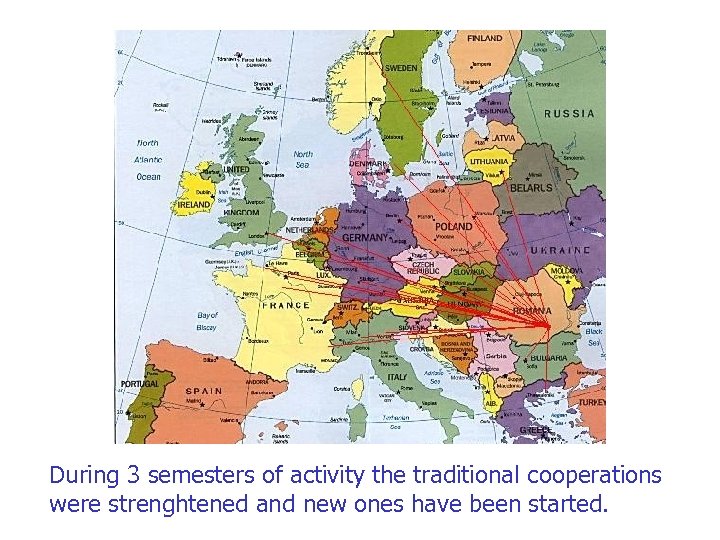
During 3 semesters of activity the traditional cooperations were strenghtened and new ones have been started.
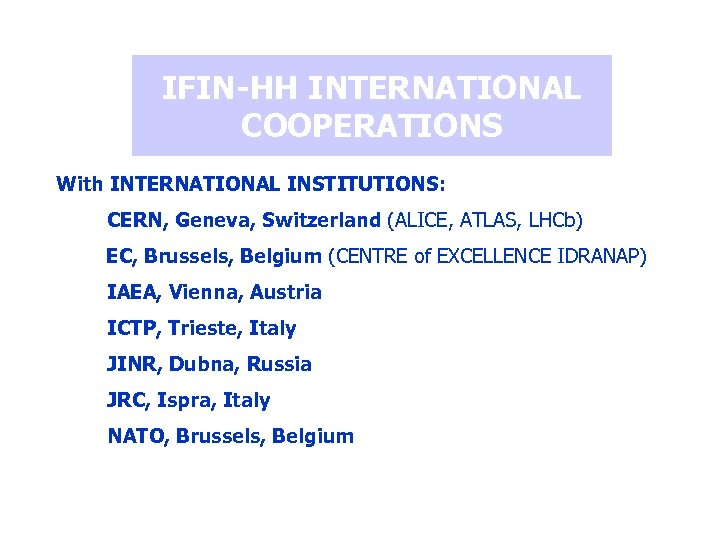
IFIN-HH INTERNATIONAL COOPERATIONS With INTERNATIONAL INSTITUTIONS: CERN, Geneva, Switzerland (ALICE, ATLAS, LHCb) EC, Brussels, Belgium (CENTRE of EXCELLENCE IDRANAP) IAEA, Vienna, Austria ICTP, Trieste, Italy JINR, Dubna, Russia JRC, Ispra, Italy NATO, Brussels, Belgium
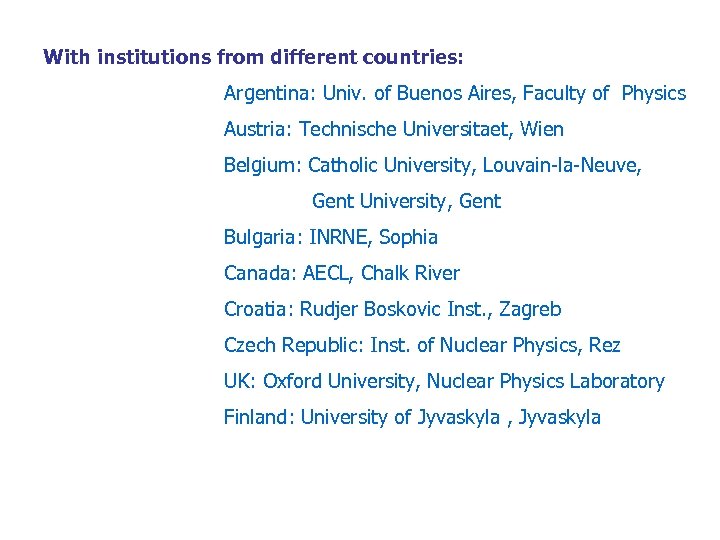
With institutions from different countries: Argentina: Univ. of Buenos Aires, Faculty of Physics Austria: Technische Universitaet, Wien Belgium: Catholic University, Louvain-la-Neuve, Gent University, Gent Bulgaria: INRNE, Sophia Canada: AECL, Chalk River Croatia: Rudjer Boskovic Inst. , Zagreb Czech Republic: Inst. of Nuclear Physics, Rez UK: Oxford University, Nuclear Physics Laboratory Finland: University of Jyvaskyla , Jyvaskyla
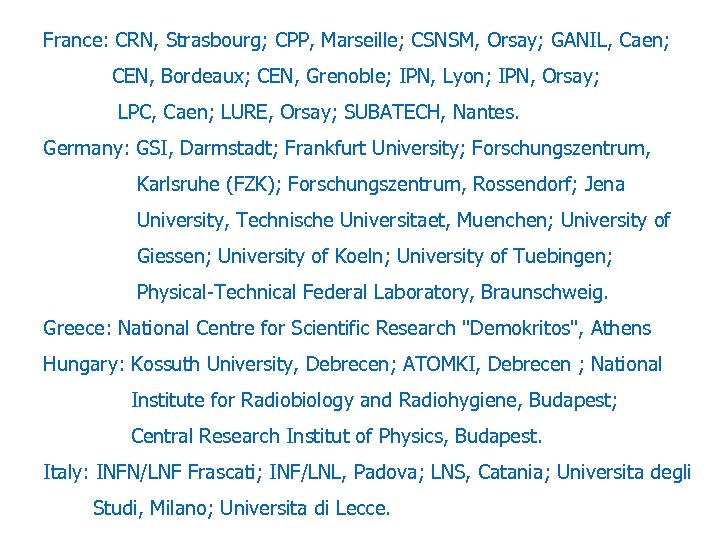
France: CRN, Strasbourg; CPP, Marseille; CSNSM, Orsay; GANIL, Caen; CEN, Bordeaux; CEN, Grenoble; IPN, Lyon; IPN, Orsay; LPC, Caen; LURE, Orsay; SUBATECH, Nantes. Germany: GSI, Darmstadt; Frankfurt University; Forschungszentrum, Karlsruhe (FZK); Forschungszentrum, Rossendorf; Jena University, Technische Universitaet, Muenchen; University of Giessen; University of Koeln; University of Tuebingen; Physical-Technical Federal Laboratory, Braunschweig. Greece: National Centre for Scientific Research "Demokritos", Athens Hungary: Kossuth University, Debrecen; ATOMKI, Debrecen ; National Institute for Radiobiology and Radiohygiene, Budapest; Central Research Institut of Physics, Budapest. Italy: INFN/LNF Frascati; INF/LNL, Padova; LNS, Catania; Universita degli Studi, Milano; Universita di Lecce.
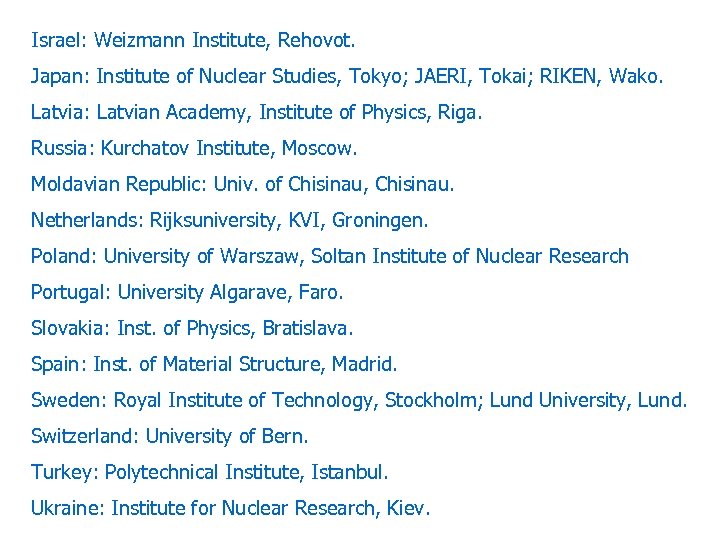
Israel: Weizmann Institute, Rehovot. Japan: Institute of Nuclear Studies, Tokyo; JAERI, Tokai; RIKEN, Wako. Latvia: Latvian Academy, Institute of Physics, Riga. Russia: Kurchatov Institute, Moscow. Moldavian Republic: Univ. of Chisinau, Chisinau. Netherlands: Rijksuniversity, KVI, Groningen. Poland: University of Warszaw, Soltan Institute of Nuclear Research Portugal: University Algarave, Faro. Slovakia: Inst. of Physics, Bratislava. Spain: Inst. of Material Structure, Madrid. Sweden: Royal Institute of Technology, Stockholm; Lund University, Lund. Switzerland: University of Bern. Turkey: Polytechnical Institute, Istanbul. Ukraine: Institute for Nuclear Research, Kiev.
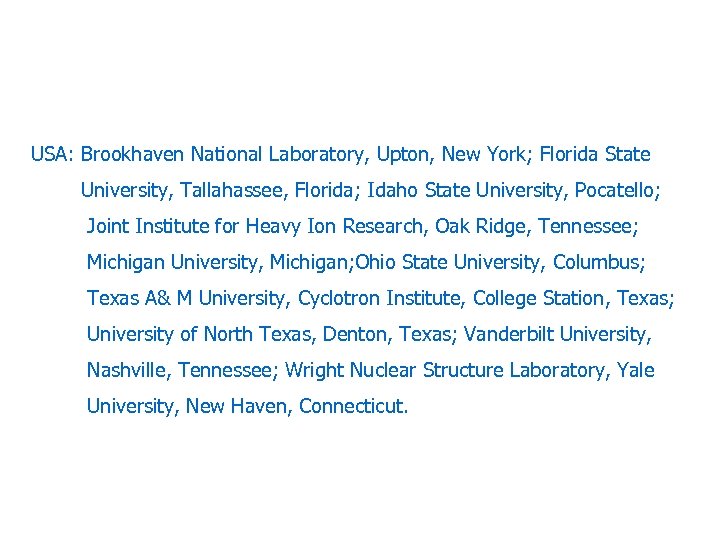
USA: Brookhaven National Laboratory, Upton, New York; Florida State University, Tallahassee, Florida; Idaho State University, Pocatello; Joint Institute for Heavy Ion Research, Oak Ridge, Tennessee; Michigan University, Michigan; Ohio State University, Columbus; Texas A& M University, Cyclotron Institute, College Station, Texas; University of North Texas, Denton, Texas; Vanderbilt University, Nashville, Tennessee; Wright Nuclear Structure Laboratory, Yale University, New Haven, Connecticut.
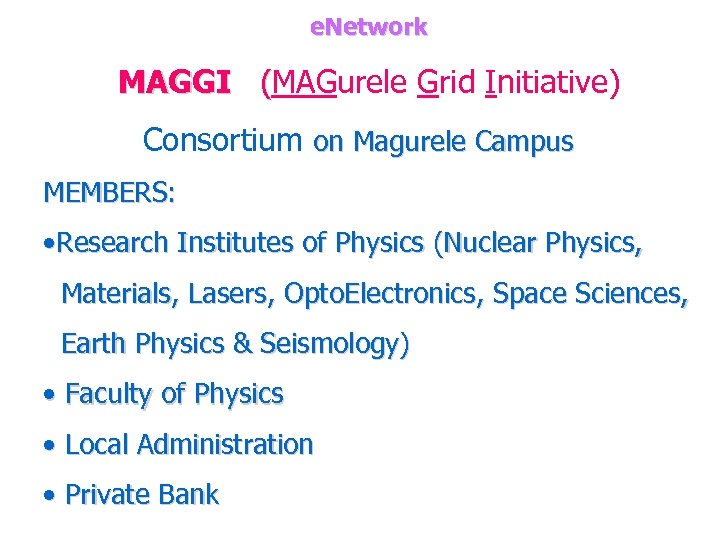
e. Network MAGGI (MAGurele Grid Initiative) Consortium on Magurele Campus MEMBERS: • Research Institutes of Physics (Nuclear Physics, Materials, Lasers, Opto. Electronics, Space Sciences, Earth Physics & Seismology) • Faculty of Physics • Local Administration • Private Bank
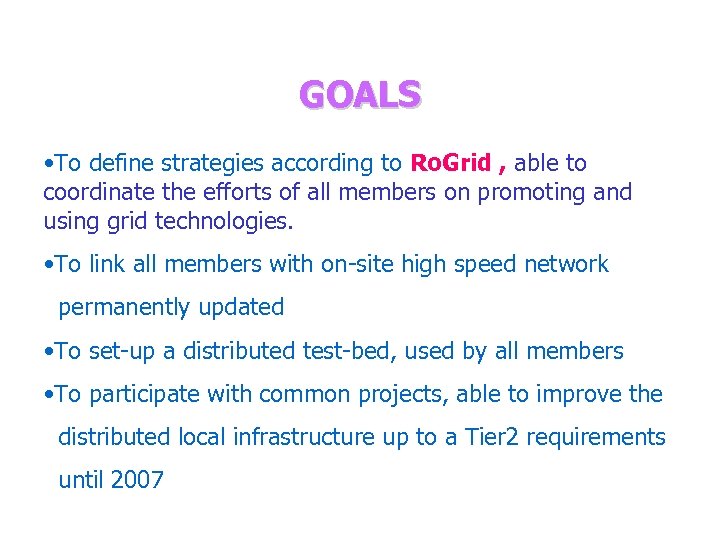
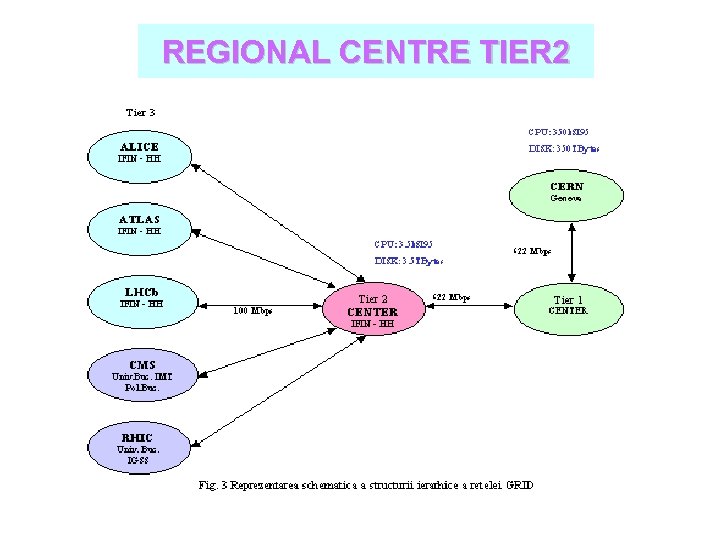
GOALS • To define strategies according to Ro. Grid , able to coordinate the efforts of all members on promoting and using grid technologies. • To link all members with on-site high speed network permanently updated • To set-up a distributed test-bed, used by all members • To participate with common projects, able to improve the distributed local infrastructure up to a Tier 2 requirements until 2007
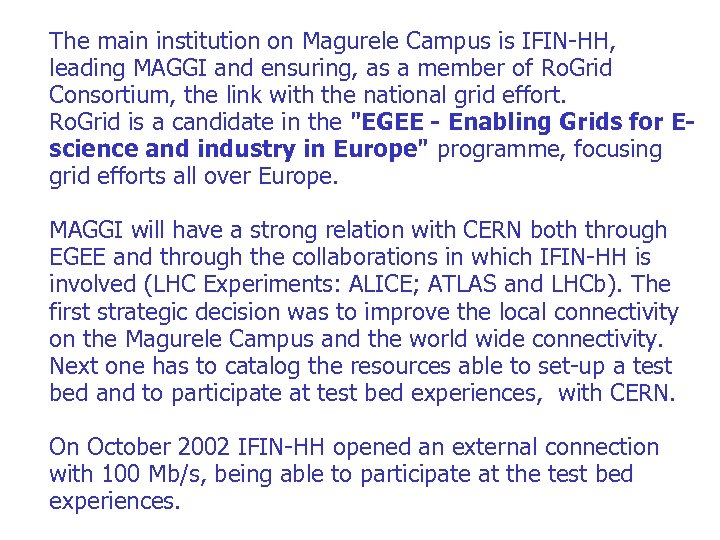
The main institution on Magurele Campus is IFIN-HH, leading MAGGI and ensuring, as a member of Ro. Grid Consortium, the link with the national grid effort. Ro. Grid is a candidate in the "EGEE - Enabling Grids for Escience and industry in Europe" programme, focusing grid efforts all over Europe. MAGGI will have a strong relation with CERN both through EGEE and through the collaborations in which IFIN-HH is involved (LHC Experiments: ALICE; ATLAS and LHCb). The first strategic decision was to improve the local connectivity on the Magurele Campus and the world wide connectivity. Next one has to catalog the resources able to set-up a test bed and to participate at test bed experiences, with CERN. On October 2002 IFIN-HH opened an external connection with 100 Mb/s, being able to participate at the test bed experiences.
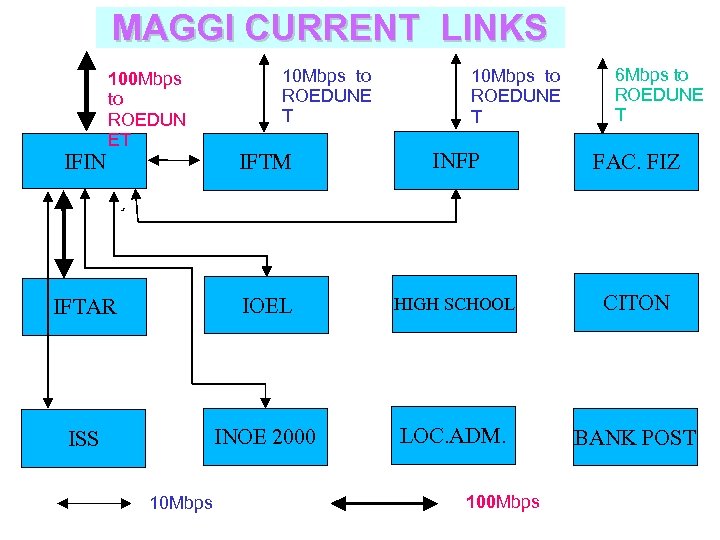
MAGGI CURRENT LINKS 100 Mbps to ROEDUN ET 10 Mbps to ROEDUNE T 6 Mbps to ROEDUNE T IFTM INFP FAC. FIZ IFTAR IOEL HIGH SCHOOL CITON ISS INOE 2000 LOC. ADM. BANK POST IFIN 10 Mbps 100 Mbps
REGIONAL CENTRE TIER 2
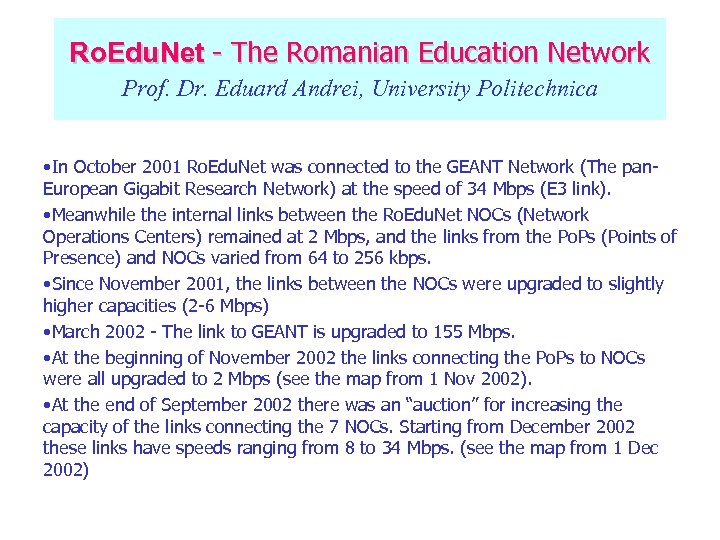
Ro. Edu. Net - The Romanian Education Network Prof. Dr. Eduard Andrei, University Politechnica • In October 2001 Ro. Edu. Net was connected to the GEANT Network (The pan. European Gigabit Research Network) at the speed of 34 Mbps (E 3 link). • Meanwhile the internal links between the Ro. Edu. Net NOCs (Network Operations Centers) remained at 2 Mbps, and the links from the Po. Ps (Points of Presence) and NOCs varied from 64 to 256 kbps. • Since November 2001, the links between the NOCs were upgraded to slightly higher capacities (2 -6 Mbps) • March 2002 - The link to GEANT is upgraded to 155 Mbps. • At the beginning of November 2002 the links connecting the Po. Ps to NOCs were all upgraded to 2 Mbps (see the map from 1 Nov 2002). • At the end of September 2002 there was an “auction” for increasing the capacity of the links connecting the 7 NOCs. Starting from December 2002 these links have speeds ranging from 8 to 34 Mbps. (see the map from 1 Dec 2002)
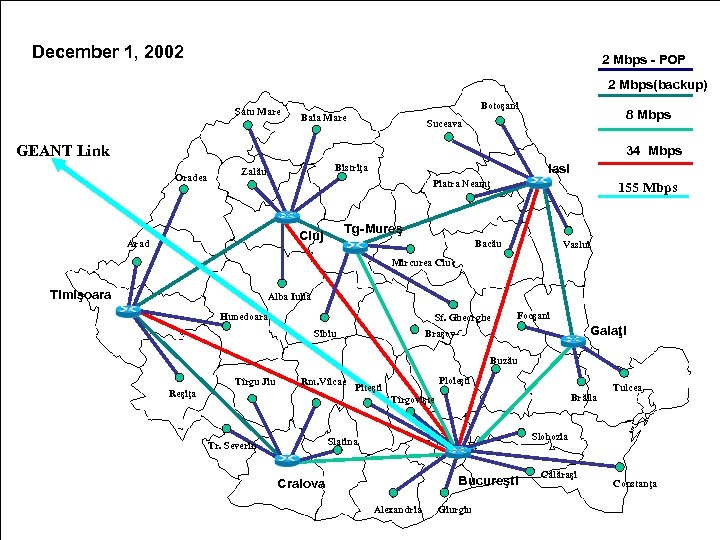
December 1, 2002 2 Mbps - POP 2 Mbps(backup) Satu Mare Botoşani Baia Mare 8 Mbps Suceava GEANT Link 34 Mbps Oradea Iasi Bistriţa Zalău Piatra Neamţ Tg-Mureş Cluj Arad 155 Mbps Bacău Vaslui Mircurea Ciuc Timişoara Alba Iulia Hunedoara Sf. Gheorghe Sibiu Focşani Galaţi Braşov Buzău Tîrgu Jiu Rm. Vîlcae Reşiţa Ploieşti Piteşti Brăila Tîrgovişte Slobozia Slatina Tr. Severin Tulcea Bucureşti Craiova Alexandria Giurgiu Călăraşi Constanţa
Ro. Edu. Net - 2003 • In 2003 one plans to increase the capacity of the link to GEANT to 622 Mbps and also to further increase the internal links capacity (between the NOCs). • This fast and continuous increase of link capacities was imposed by the increasing number of users connected to the Ro. Edu. Net network, and also by their increase for bandwidth demands due to new applications. Now, over 450 universities, schools, research centers and other non-profit and governmental institutions are connected to the Ro. Edu. Network. • Due to the Ministry of Education’s programme to put Internet connected computer networks in as many schools as possible, as well as the increase in the number of applications working over the Ro. Edu. Network, there will be a need for a continuing increase in size of the network.
SUMMARY and OUTLOOK -In IFIN-HH from Dec. 2002: 100 Mb/s. Ro. Edu. Net output operates with 135 Mb/s. -Present OPTICAL FIBER connection to Ro. Edu will allow in the future 2. 5 Gb/s. -Ro. Edu. Net just now extends the metropolitan network (Optical Fiber 2. 5 Mb/s) and covers the regional centres of Romania. By the end of this year the speed will increase to 622 Mb/s. -Search for partners to FP 6 -Research Infrastructure -Development of GRID on Magurele Campus
Скачать презентацию SERENATE End-user workshop IBM MONTPELLIER 17 -19
f5319cb7f3dfed93ea8616a4e933f6b6.ppt