 Скачать презентацию Septic Tank Biological Additives The Good The Bad
487431e3dbc7f085d14d693c8b6deabe.ppt
- Количество слайдов: 47



Septic Tank Biological Additives: The Good, The Bad and The Ugly Sushama Pradhan, Ph. D. , Soils and On -Site Technology Researcher Michael T. Hoover, Ph. D. , Professor and Extension Soils Specialist NC STATE Sept 11, 2008 DEPARTMENT of SOIL
Outline • • • Introduction Objectives Materials and methods Results and discussion Recommendations Conclusions
Septic tank additives • Wide spread production and use of septic system additives across the U. S. • Over 1, 200 septic system additives are available on the market (National Small Flows Clearing House). • Basic categories of septic tank additives: chemical, physical and biological.
Septic tank biological additives • Add billions of bacteria and numerous enzymes • Enhance breakdown of large molecular • • • compounds - proteins, starches, carbohydrates, cellulose, Break down fats, oils and greases that normally accumulate in the septic tank, Digest household waste and reduce the septic tank pumpout frequencies by cleansing the systems, Keep septic systems trouble free, Re-inoculate the septic tank after pumping, or when systems are new or highly stressed, and/or Reduce clogging of the soil below the septic system drainfield, thus increasing wastewater infiltration rates.
Wastewater digestion in septic tank • Biological anaerobic digester • Process of waste digestion 1. Hydrolysis 2. Fermentation 3. Methanogenesis
Problems Very little peer-reviewed and published field research exists regarding efficacy of bacterial septic tank additives. Additive effectiveness assessments have, up until now, typically relied on bench top studies, literature and process assessments, oftentimes by product manufacturers, that have not been substantiated in the field via independent, third party, replicated experiments.
Research objectives To measure the efficacies of selected bacterial additives upon • Total microbial populations in septic tanks • Sludge and scum buildup and breakdown in septic tanks • BOD 5 and TSS concentrations in effluent leaving septic tanks
Materials and Methods • 48 full-scale, functioning septic tanks • 2 to 15 years old • No additives were used prior to study • Liquid biological additives were added to ¾ of tanks during the study period
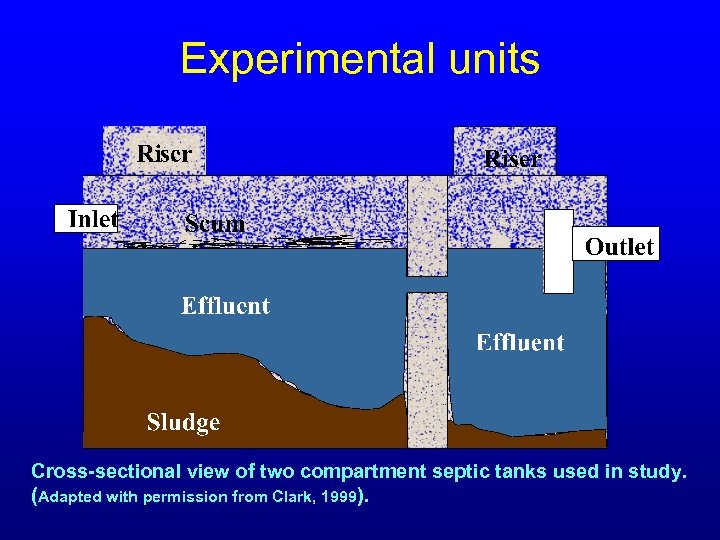
Experimental units Cross-sectional view of two compartment septic tanks used in study. (Adapted with permission from Clark, 1999).
Research sites • Chatham County, NC. • Orange County, NC. • Over 80 septic systems were screened • 48 septic systems were used
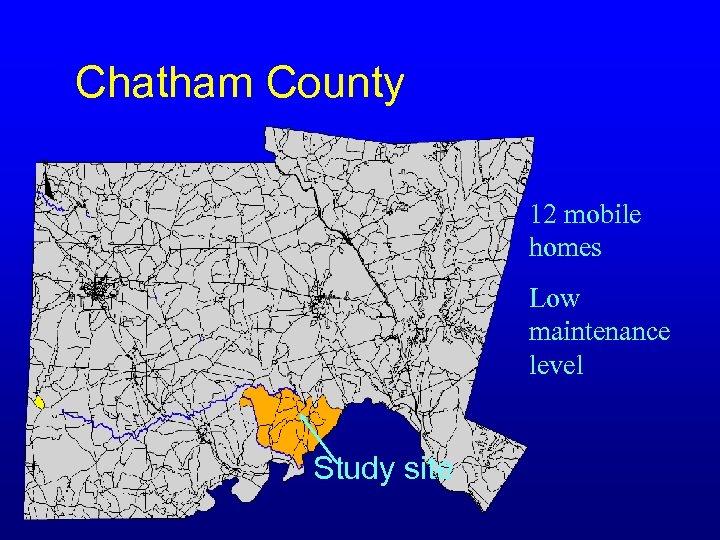
Chatham County 12 mobile homes Low maintenance level Study site
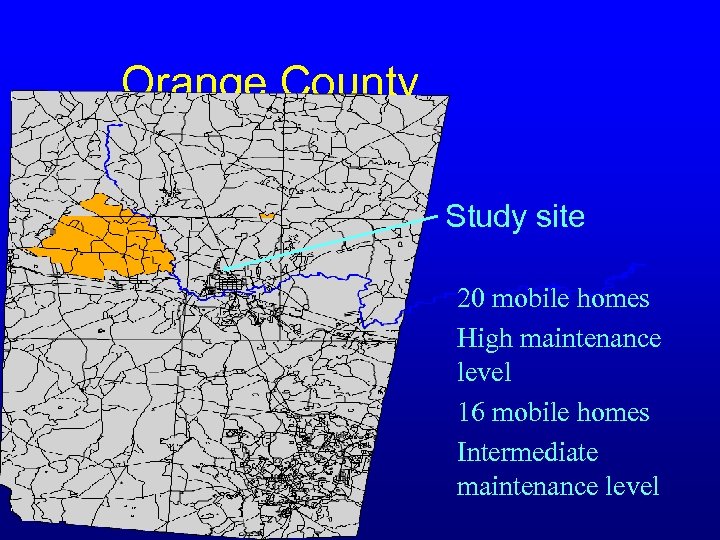
Orange County Study site 20 mobile homes High maintenance level 16 mobile homes Intermediate maintenance level
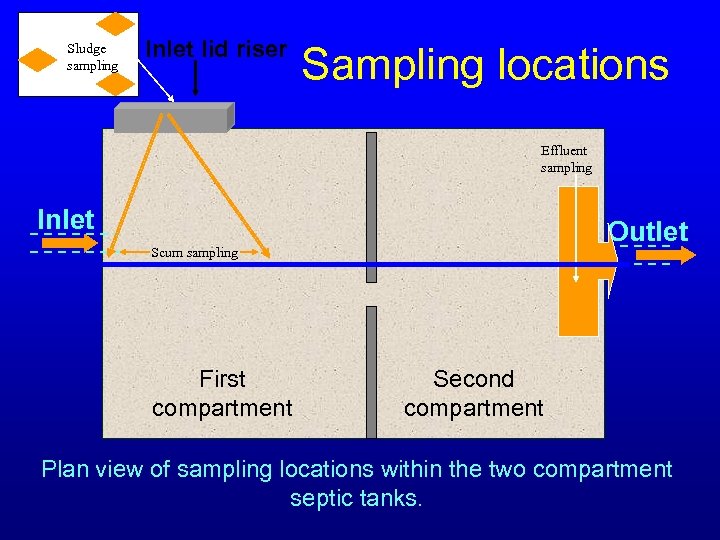
First compartment Sludge sampling Inlet lid riser Sampling locations Effluent sampling Inlet Outlet Scum sampling First compartment Second compartment Plan view of sampling locations within the two compartment septic tanks.
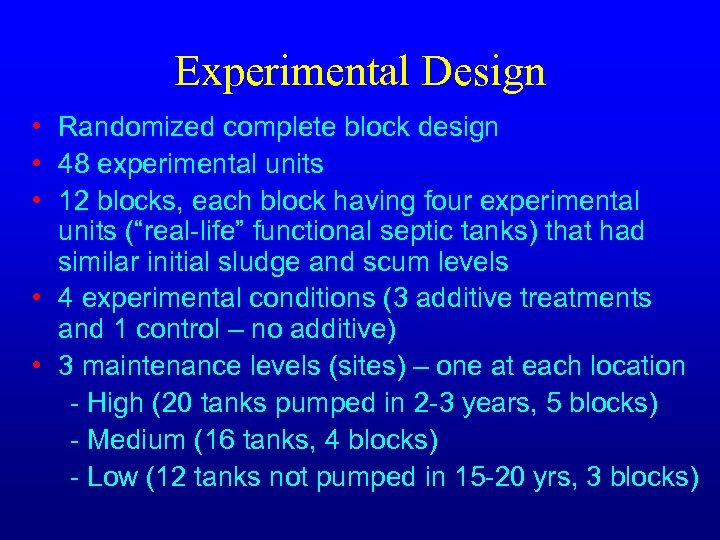
Experimental Design • Randomized complete block design • 48 experimental units • 12 blocks, each block having four experimental units (“real-life” functional septic tanks) that had similar initial sludge and scum levels • 4 experimental conditions (3 additive treatments and 1 control – no additive) • 3 maintenance levels (sites) – one at each location - High (20 tanks pumped in 2 -3 years, 5 blocks) - Medium (16 tanks, 4 blocks) - Low (12 tanks not pumped in 15 -20 yrs, 3 blocks)
Biological additives evaluated • Drano septic tank additive (Additive 1), • Liquid-Plumr septic tank additive (Additive 2) and • Rid-X septic tank additive (Additive 3).
Additive distribution, sampling and analyses • Distribution of the additive application treatments followed a double blind approach • Secondary researchers randomly assigned the three additives and control to the four experimental units within each block • The primary researchers made field measurements, collected samples and analyzed the data, but had no information regarding which treatments (or control) were assigned to the experimental units
Data collection • • • Data were collected by Greg Clark (Dr. Hoover’s former graduate student). Microbial population (cfu) in 48 tanks were measured quarterly. Sludge depth and scum thickness data were collected monthly from 48 septic tanks. BOD 5 and TSS concentrations in septic tank effluent were measured monthly from 20 highly maintained septic tanks.
Microbial population measurement • Biological organism viability in the additive containers was evaluated monthly prior to their field application • A 5 ml sample collected from each additive container was diluted and plated onto Tryptic Soy Agar using a Spiral Plater (Wollum, 1982) • CFU counts in the septic tanks were performed quarterly. The first count was not performed until the twelfth week of the study.
Sludge depth measurement Sludge depth was measured at three locations on the inlet side of the each septic tank using a PINPOINTER TM. 1. Length = 7’ 2. Inside diameter = 2. 2 cm.
Scum thickness measurement Scum thickness was measured using a scum judge at the same time, in as many locations throughout the inlet locations as required to obtained an average thickness.
BOD 5 and TSS measurement • Effluent grab samples were collected, every 4 weeks from within the outlet sanitary tee using a weighted sampling head and a hand held vacuum pump. • The opening of the sampling head had a diameter of 7 millimeters. The sampling head was held approximately 5. 7 centimeter below the surface of the effluent within the outlet sanitary tee as the sample was obtained. • Samples were stored in a cooler upon collection and immediately transported to the lab. • Five-day biochemical oxygen demand was analyzed as soon as possible to keep holding time to minimum
Results and discussions The repeated measures data, i. e. multiple responses, for total microbial population (cfu), sludge depth, scum thickness, BOD 5 and TSS taken in sequence over time on the same experimental units were statistically analyzed using the linear mixed model implemented with the MIXED procedure in the SAS System.
Microbial population • • • Monthly analysis of the products revealed that all additive containers had substantial number of viable microbes a the time of enumeration. CFU concn in Additive 1 = 0. 66 X 108/ml, Additive 2 = 1. 21 X 10 8/ml, Additive 3 = 1. 26 X 10 8/ml. Total bacterial population (CFU/ml) was measured quarterly in all 48 tanks. CFU in the tanks ranges from 6. 81 X 105/ml to 9. 60 X 105/ml. Consistently large quantities of CFU were present in the tank throughout the study period
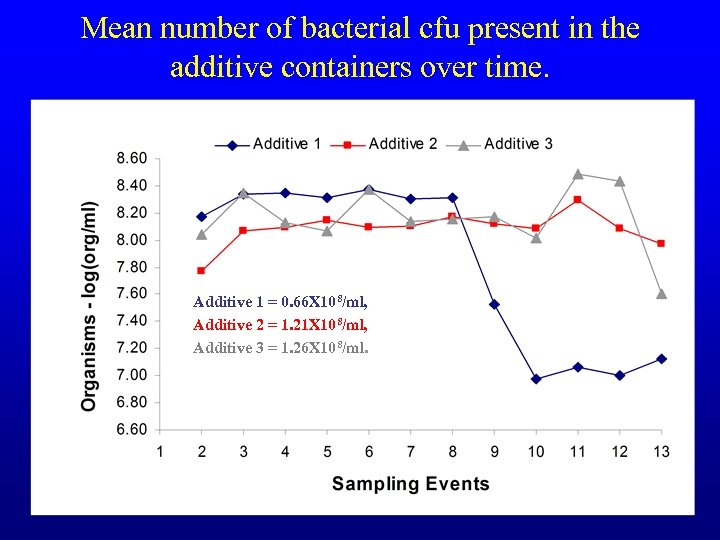
Mean number of bacterial cfu present in the additive containers over time. Additive 1 = 0. 66 X 108/ml, Additive 2 = 1. 21 X 108/ml, Additive 3 = 1. 26 X 108/ml.
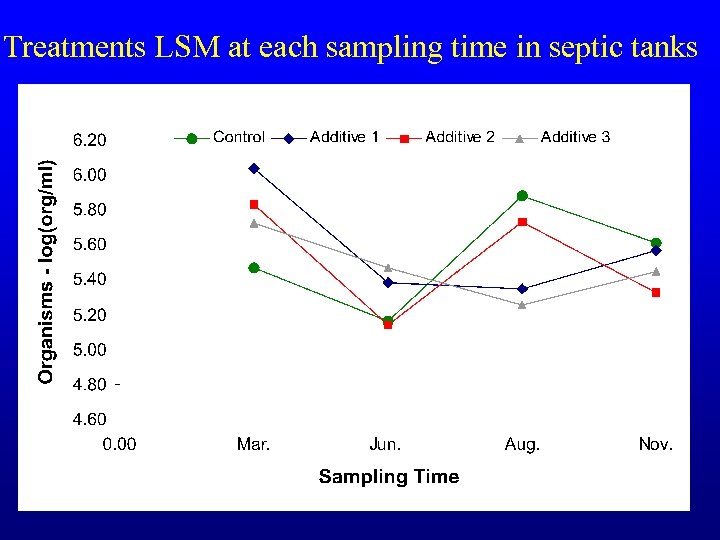
Treatments LSM at each sampling time in septic tanks
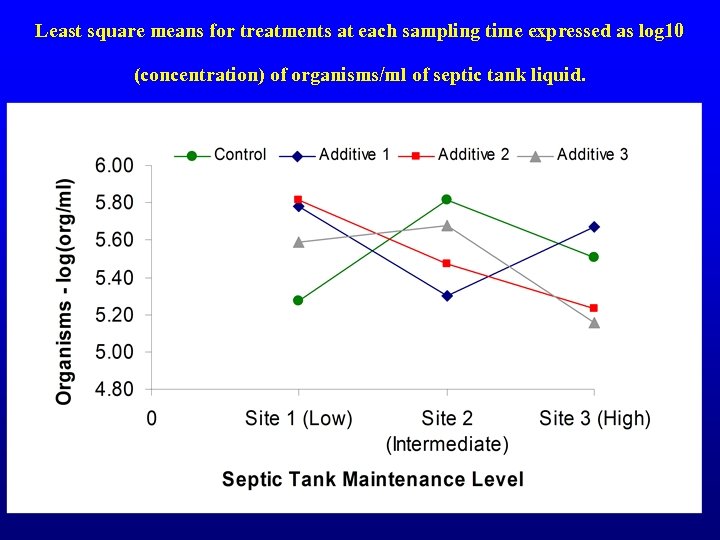
Least square means for treatments at each sampling time expressed as log 10 (concentration) of organisms/ml of septic tank liquid.
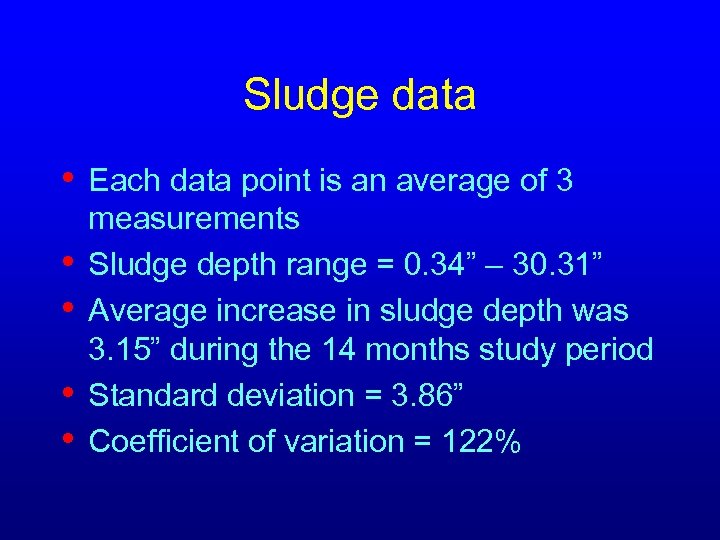
Sludge data • Each data point is an average of 3 • • measurements Sludge depth range = 0. 34” – 30. 31” Average increase in sludge depth was 3. 15” during the 14 months study period Standard deviation = 3. 86” Coefficient of variation = 122%
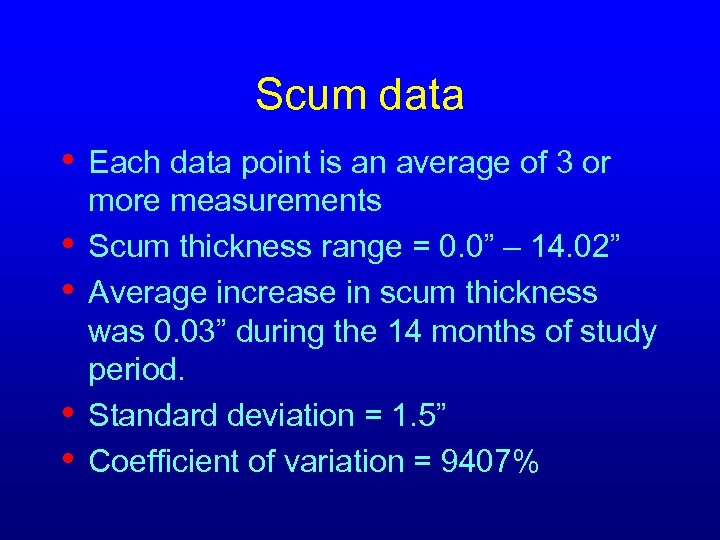
Scum data • Each data point is an average of 3 or • • more measurements Scum thickness range = 0. 0” – 14. 02” Average increase in scum thickness was 0. 03” during the 14 months of study period. Standard deviation = 1. 5” Coefficient of variation = 9407%
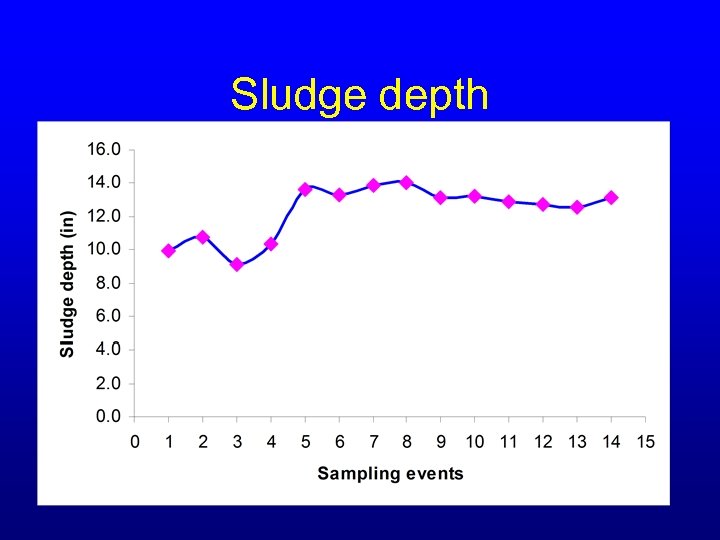
Sludge depth
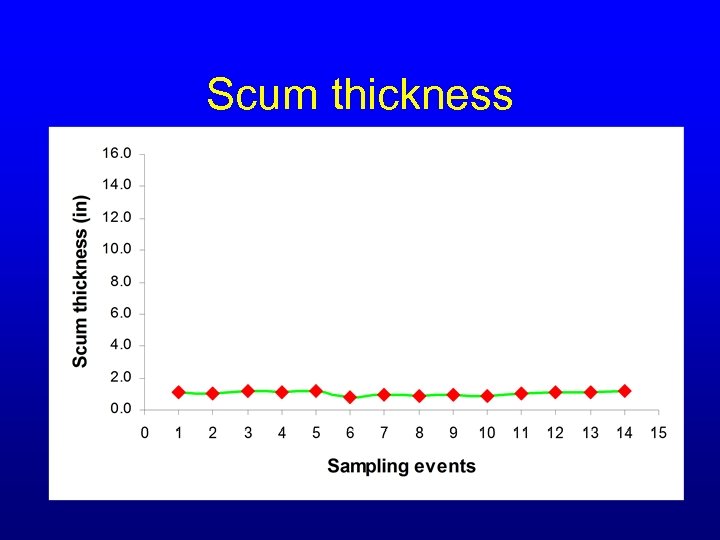
Scum thickness
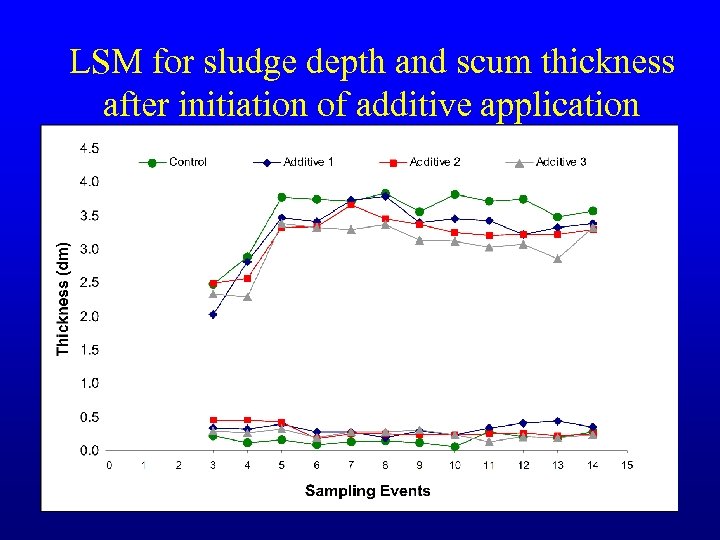
LSM for sludge depth and scum thickness after initiation of additive application
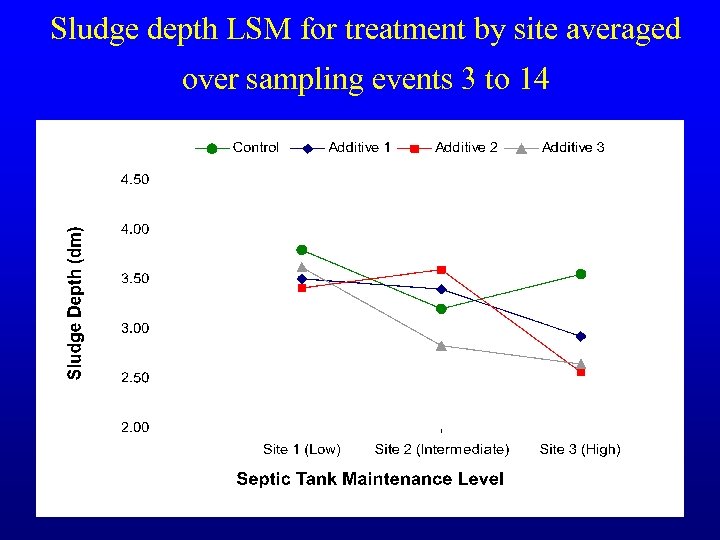
Sludge depth LSM for treatment by site averaged over sampling events 3 to 14
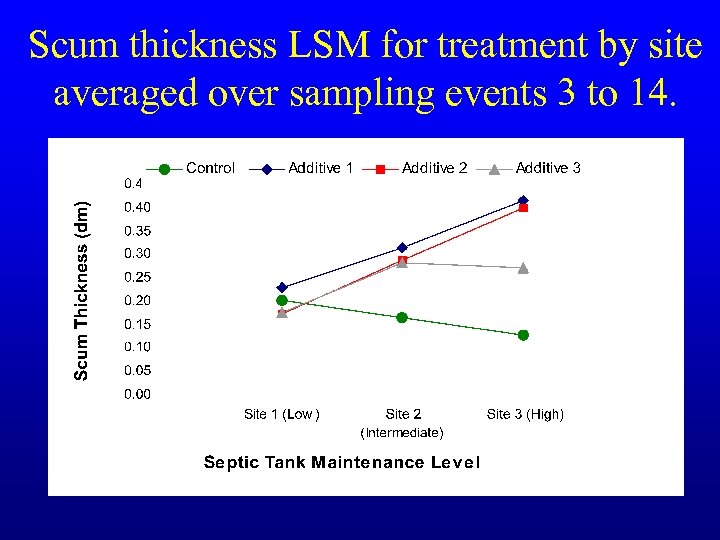
Scum thickness LSM for treatment by site averaged over sampling events 3 to 14.
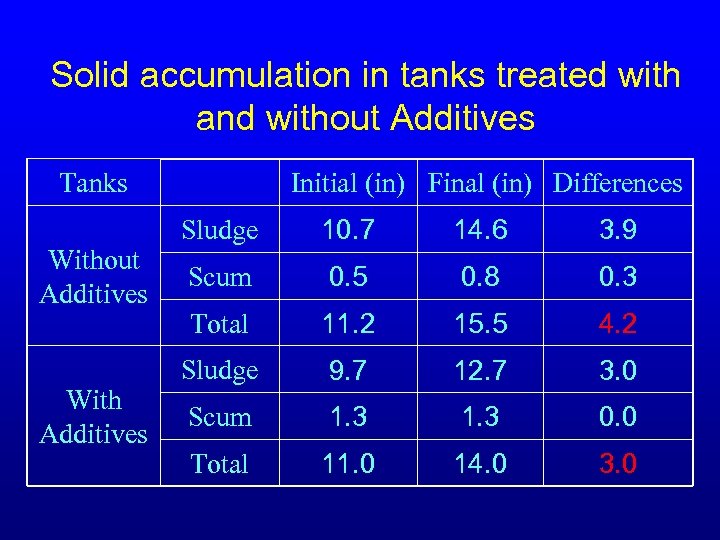
Solid accumulation in tanks treated with and without Additives Tanks Without Additives With Additives Initial (in) Final (in) Differences Sludge 10. 7 14. 6 3. 9 Scum 0. 5 0. 8 0. 3 Total 11. 2 15. 5 4. 2 Sludge 9. 7 12. 7 3. 0 Scum 1. 3 0. 0 Total 11. 0 14. 0 3. 0
Effluent leaving septic tank
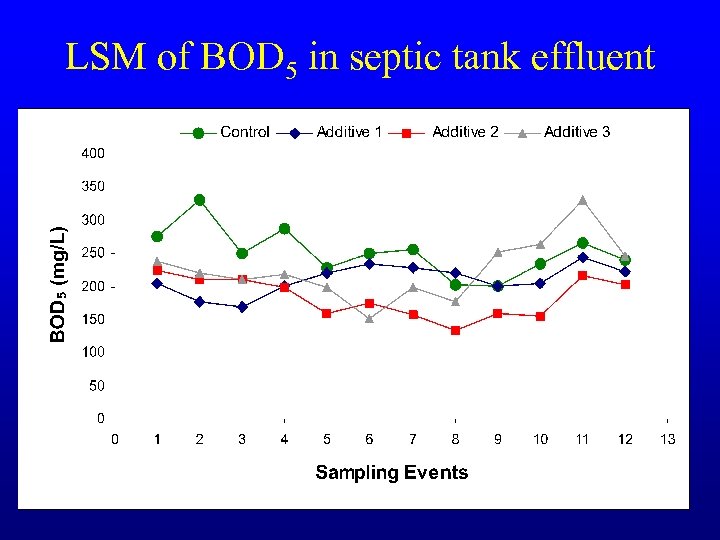
LSM of BOD 5 in septic tank effluent
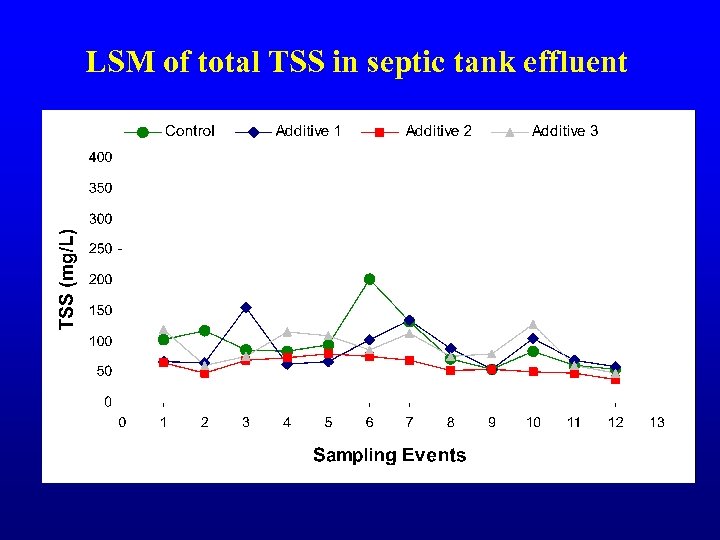
LSM of total TSS in septic tank effluent
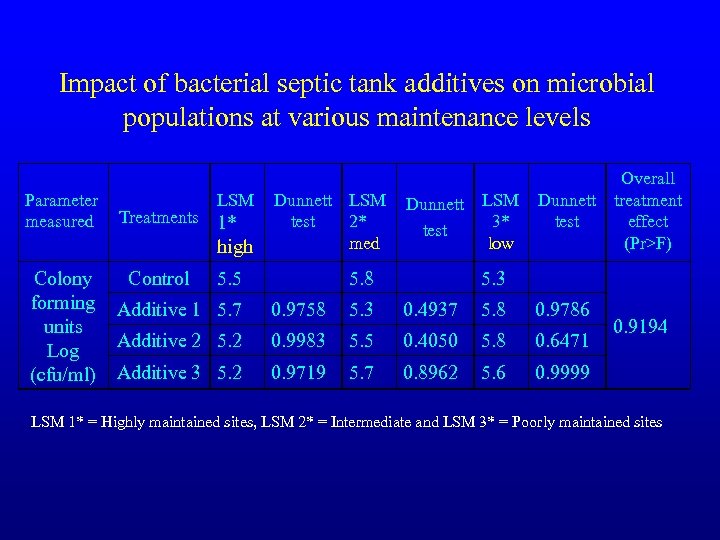
Impact of bacterial septic tank additives on microbial populations at various maintenance levels Parameter measured LSM Treatments 1* high Colony forming units Log (cfu/ml) Control Dunnett LSM test 2* med 5. 5 Dunnett test 5. 8 LSM 3* low Dunnett test Overall treatment effect (Pr>F) 5. 3 Additive 1 5. 7 0. 9758 5. 3 0. 4937 5. 8 0. 9786 Additive 2 5. 2 0. 9983 5. 5 0. 4050 5. 8 0. 6471 Additive 3 5. 2 0. 9719 5. 7 0. 8962 5. 6 0. 9999 0. 9194 LSM 1* = Highly maintained sites, LSM 2* = Intermediate and LSM 3* = Poorly maintained sites
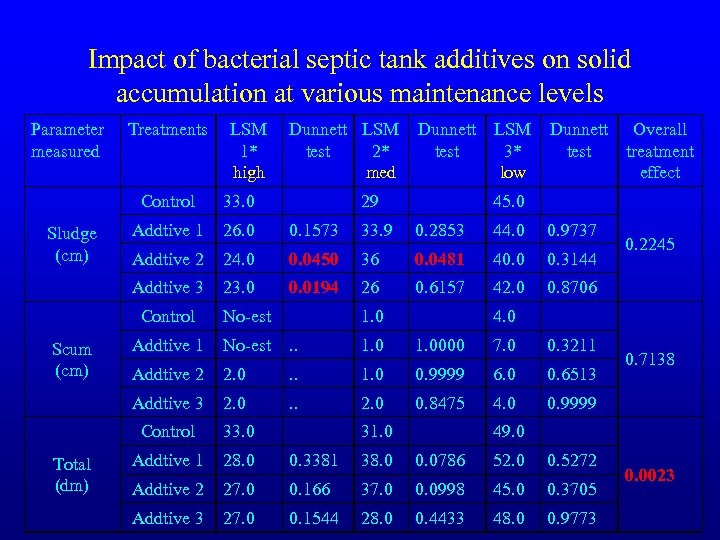
Impact of bacterial septic tank additives on solid accumulation at various maintenance levels Parameter measured Treatments LSM 1* high Dunnett LSM test 2* med Dunnett test Control 33. 0 Addtive 1 26. 0 0. 1573 33. 9 0. 2853 44. 0 0. 9737 Addtive 2 24. 0 0. 0450 36 0. 0481 40. 0 0. 3144 Addtive 3 Sludge (cm) 29 LSM 3* low 23. 0 0. 0194 26 0. 6157 42. 0 45. 0 0. 8706 Control Addtive 1 No-est . . 1. 0000 7. 0 0. 3211 Addtive 2 2. 0 . . 1. 0 0. 9999 6. 0 0. 6513 2. 0 . . 2. 0 0. 8475 4. 0 1. 0 33. 0 Addtive 1 28. 0 0. 3381 38. 0 0. 0786 52. 0 0. 5272 Addtive 2 27. 0 0. 166 37. 0 0. 0998 45. 0 0. 3705 Addtive 3 27. 0 0. 1544 28. 0 0. 4433 48. 0 0. 9773 0. 2245 0. 9999 Control Total (dm) No-est Addtive 3 Scum (cm) Overall treatment effect 4. 0 31. 0 0. 7138 49. 0 0. 0023
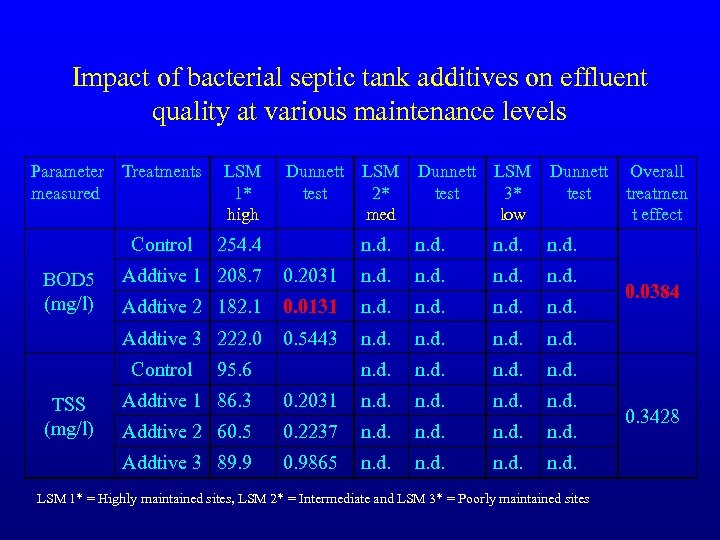
Impact of bacterial septic tank additives on effluent quality at various maintenance levels Parameter Treatments measured Control LSM 1* high Dunnett test LSM 3* low Dunnett Overall test treatmen t effect n. d. 254. 4 LSM 2* med n. d. Addtive 1 208. 7 0. 2031 n. d. Addtive 2 182. 1 0. 0131 n. d. Addtive 3 222. 0 BOD 5 (mg/l) 0. 5443 n. d. Control 95. 6 Addtive 1 86. 3 0. 2031 n. d. Addtive 2 60. 5 0. 2237 n. d. Addtive 3 89. 9 TSS (mg/l) 0. 9865 n. d. LSM 1* = Highly maintained sites, LSM 2* = Intermediate and LSM 3* = Poorly maintained sites 0. 0384 0. 3428
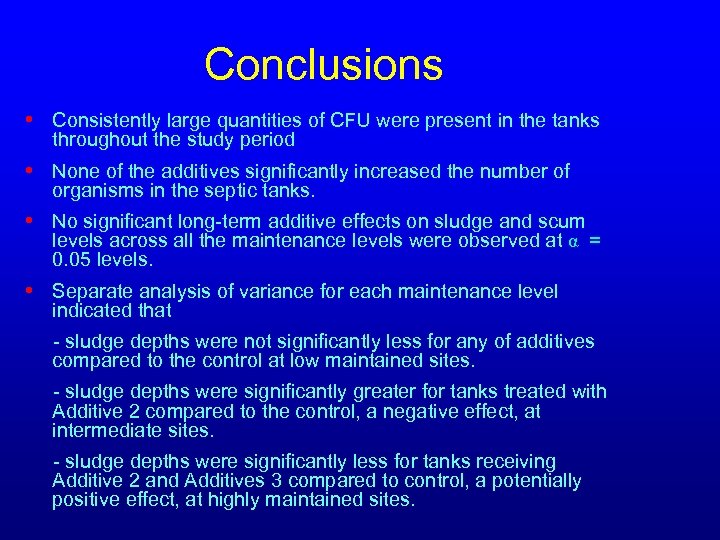
Conclusions • Consistently large quantities of CFU were present in the tanks throughout the study period • None of the additives significantly increased the number of organisms in the septic tanks. • No significant long-term additive effects on sludge and scum levels across all the maintenance levels were observed at α = 0. 05 levels. • Separate analysis of variance for each maintenance level indicated that - sludge depths were not significantly less for any of additives compared to the control at low maintained sites. - sludge depths were significantly greater for tanks treated with Additive 2 compared to the control, a negative effect, at intermediate sites. - sludge depths were significantly less for tanks receiving Additive 2 and Additives 3 compared to control, a potentially positive effect, at highly maintained sites.
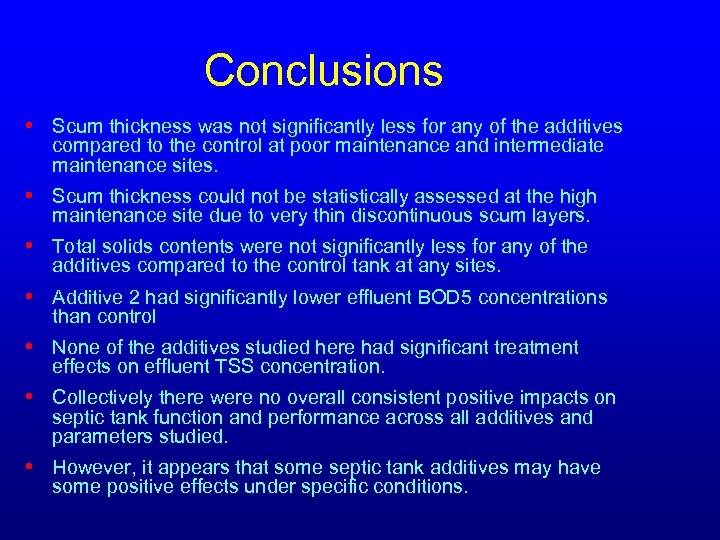
Conclusions • Scum thickness was not significantly less for any of the additives compared to the control at poor maintenance and intermediate maintenance sites. • Scum thickness could not be statistically assessed at the high maintenance site due to very thin discontinuous scum layers. • Total solids contents were not significantly less for any of the additives compared to the control tank at any sites. • Additive 2 had significantly lower effluent BOD 5 concentrations than control • None of the additives studied here had significant treatment effects on effluent TSS concentration. • Collectively there were no overall consistent positive impacts on septic tank function and performance across all additives and parameters studied. • However, it appears that some septic tank additives may have some positive effects under specific conditions.
Recommendation • Only three of the 1, 200+ septic tank additives on the market were studied here. • The results found here may vary with environmental and experimental conditions or for other additives. • More replicated, controlled, full-scale field research is warranted to verify these findings about application of biological bacterial additives.
Recommendation • The potentially positive effects of selected additives at the high maintenance site (all tanks recently pumped) indicates that two out of the three selected additives studied when applied after recent tank pumpout seems to benefit digestion within septic tanks; however, these results need to be vetted via publication in a research journal outlet. • Additives that had a potentially positive effect on sludge accumulation rates and that had either a positive effect (or no effect) on effluent BOD and TSS levels, could be viewed as having a net positive impact on digestion within septic tanks.
Recommendation • Once/if vetted via peer-reviewed research journal publication, then these results would indicate a possible need for establishment of an NSF/ANSI national additive standard.
Acknowledgement • Tom Konsler and Greg Grimes (Orange Co. HD) • Jimmy Collins’ (Chatham Co. HD) • Walter, Joanna, Anthony Bright, Wayland Mc. Farland Lee Lambert for assessing with locating and obtaining access to the study sites.

Questions? ? ?
Скачать презентацию Septic Tank Biological Additives The Good The Bad
487431e3dbc7f085d14d693c8b6deabe.ppt