 Скачать презентацию September 2004 doc IEEE 802 11 -04 0953
879478183f5811fb22ab51f1d537cf3d.ppt
- Количество слайдов: 68



September 2004 doc. : IEEE 802. 11 -04/0953 r 4 Flexible Coding for 802. 11 n MIMO Systems Keith Chugg and Paul Gray Trellis. Ware Technologies Bob Ward Sci. Com Inc. kchugg@trellisware. com (with support provided by UCLA’s Un. Wi. Re. D Lab. ) Submission 1 Keith Chugg, et al, Trellis. Ware Technologies
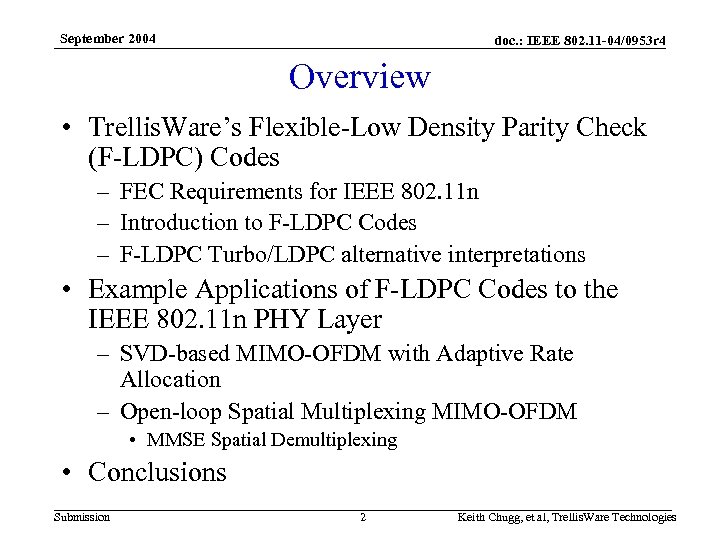
September 2004 doc. : IEEE 802. 11 -04/0953 r 4 Overview • Trellis. Ware’s Flexible-Low Density Parity Check (F-LDPC) Codes – FEC Requirements for IEEE 802. 11 n – Introduction to F-LDPC Codes – F-LDPC Turbo/LDPC alternative interpretations • Example Applications of F-LDPC Codes to the IEEE 802. 11 n PHY Layer – SVD-based MIMO-OFDM with Adaptive Rate Allocation – Open-loop Spatial Multiplexing MIMO-OFDM • MMSE Spatial Demultiplexing • Conclusions Submission 2 Keith Chugg, et al, Trellis. Ware Technologies
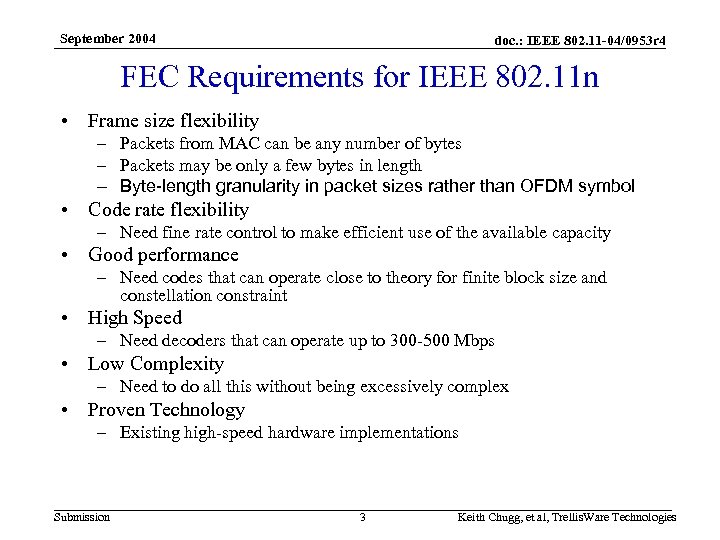
September 2004 doc. : IEEE 802. 11 -04/0953 r 4 FEC Requirements for IEEE 802. 11 n • Frame size flexibility – Packets from MAC can be any number of bytes – Packets may be only a few bytes in length – Byte-length granularity in packet sizes rather than OFDM symbol • Code rate flexibility – Need fine rate control to make efficient use of the available capacity • Good performance – Need codes that can operate close to theory for finite block size and constellation constraint • High Speed – Need decoders that can operate up to 300 -500 Mbps • Low Complexity – Need to do all this without being excessively complex • Proven Technology – Existing high-speed hardware implementations Submission 3 Keith Chugg, et al, Trellis. Ware Technologies
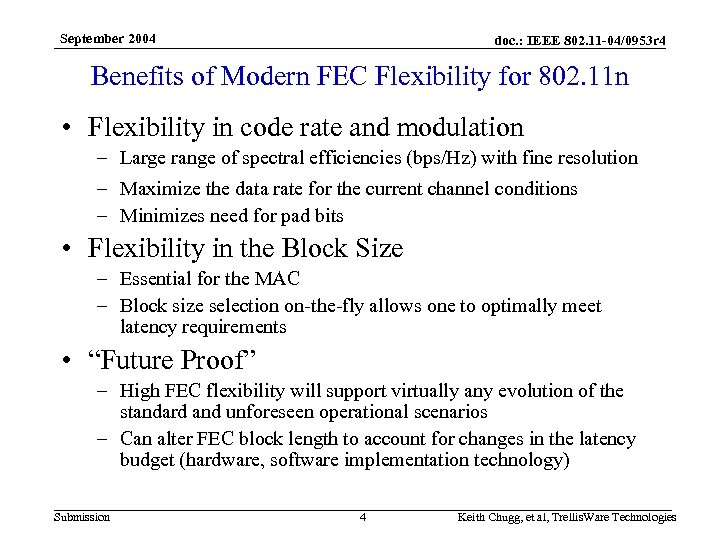
September 2004 doc. : IEEE 802. 11 -04/0953 r 4 Benefits of Modern FEC Flexibility for 802. 11 n • Flexibility in code rate and modulation – Large range of spectral efficiencies (bps/Hz) with fine resolution – Maximize the data rate for the current channel conditions – Minimizes need for pad bits • Flexibility in the Block Size – Essential for the MAC – Block size selection on-the-fly allows one to optimally meet latency requirements • “Future Proof” – High FEC flexibility will support virtually any evolution of the standard and unforeseen operational scenarios – Can alter FEC block length to account for changes in the latency budget (hardware, software implementation technology) Submission 4 Keith Chugg, et al, Trellis. Ware Technologies
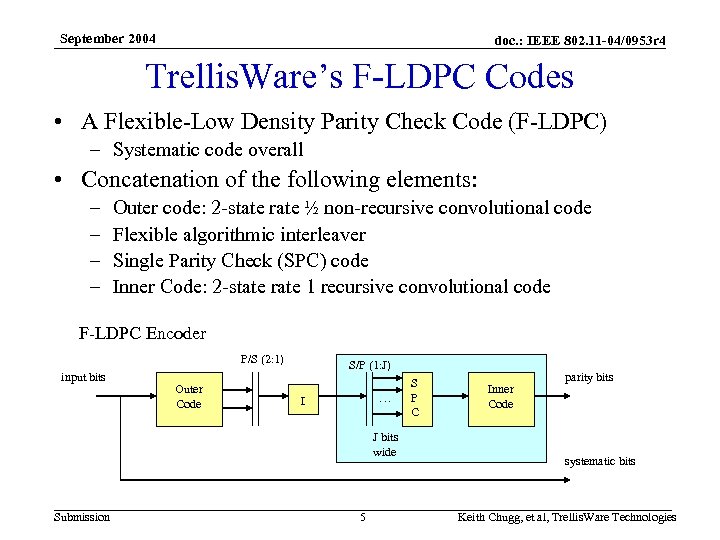
September 2004 doc. : IEEE 802. 11 -04/0953 r 4 Trellis. Ware’s F-LDPC Codes • A Flexible-Low Density Parity Check Code (F-LDPC) – Systematic code overall • Concatenation of the following elements: – – Outer code: 2 -state rate ½ non-recursive convolutional code Flexible algorithmic interleaver Single Parity Check (SPC) code Inner Code: 2 -state rate 1 recursive convolutional code F-LDPC Encoder P/S (2: 1) input bits Outer Code S/P (1: J) … I J bits wide Submission 5 S P C Inner Code parity bits systematic bits Keith Chugg, et al, Trellis. Ware Technologies
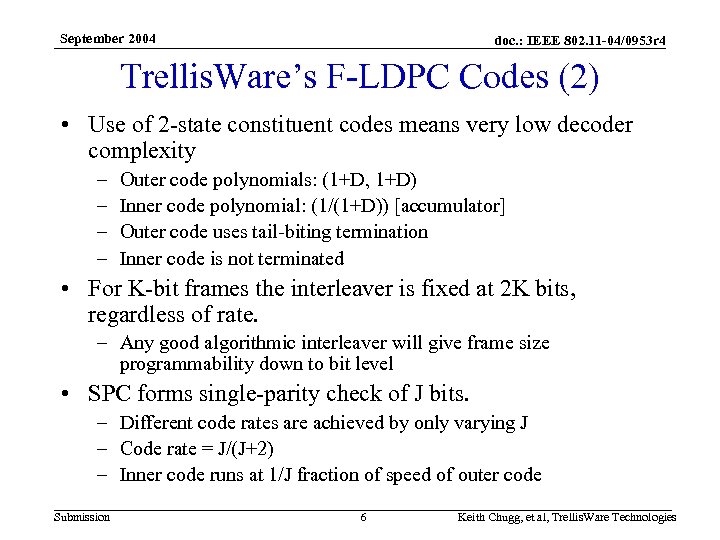
September 2004 doc. : IEEE 802. 11 -04/0953 r 4 Trellis. Ware’s F-LDPC Codes (2) • Use of 2 -state constituent codes means very low decoder complexity – – Outer code polynomials: (1+D, 1+D) Inner code polynomial: (1/(1+D)) [accumulator] Outer code uses tail-biting termination Inner code is not terminated • For K-bit frames the interleaver is fixed at 2 K bits, regardless of rate. – Any good algorithmic interleaver will give frame size programmability down to bit level • SPC forms single-parity check of J bits. – Different code rates are achieved by only varying J – Code rate = J/(J+2) – Inner code runs at 1/J fraction of speed of outer code Submission 6 Keith Chugg, et al, Trellis. Ware Technologies
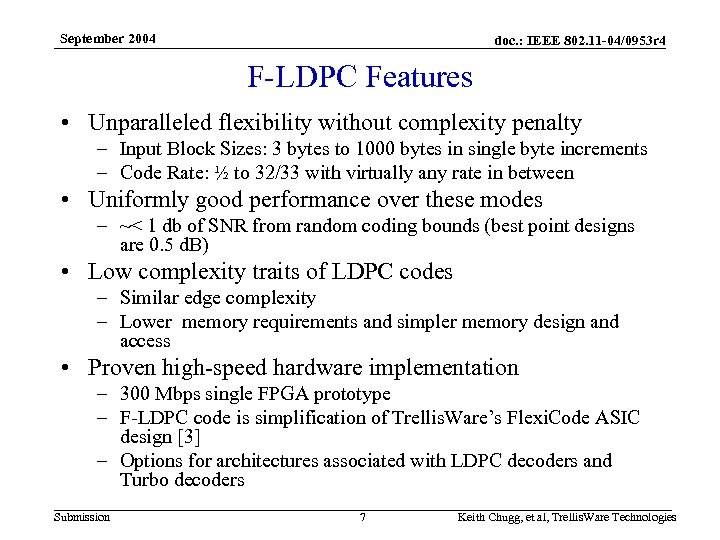
September 2004 doc. : IEEE 802. 11 -04/0953 r 4 F-LDPC Features • Unparalleled flexibility without complexity penalty – Input Block Sizes: 3 bytes to 1000 bytes in single byte increments – Code Rate: ½ to 32/33 with virtually any rate in between • Uniformly good performance over these modes – ~< 1 db of SNR from random coding bounds (best point designs are 0. 5 d. B) • Low complexity traits of LDPC codes – Similar edge complexity – Lower memory requirements and simpler memory design and access • Proven high-speed hardware implementation – 300 Mbps single FPGA prototype – F-LDPC code is simplification of Trellis. Ware’s Flexi. Code ASIC design [3] – Options for architectures associated with LDPC decoders and Turbo decoders Submission 7 Keith Chugg, et al, Trellis. Ware Technologies
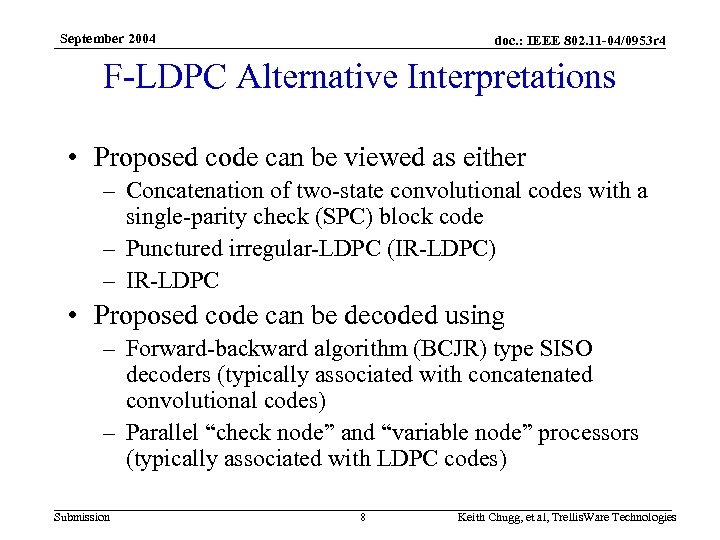
September 2004 doc. : IEEE 802. 11 -04/0953 r 4 F-LDPC Alternative Interpretations • Proposed code can be viewed as either – Concatenation of two-state convolutional codes with a single-parity check (SPC) block code – Punctured irregular-LDPC (IR-LDPC) – IR-LDPC • Proposed code can be decoded using – Forward-backward algorithm (BCJR) type SISO decoders (typically associated with concatenated convolutional codes) – Parallel “check node” and “variable node” processors (typically associated with LDPC codes) Submission 8 Keith Chugg, et al, Trellis. Ware Technologies
September 2004 doc. : IEEE 802. 11 -04/0953 r 4 F-LDPC Alternative Interpretations (2) • Performance is comparable to good IR-LDPC codes – Near best performance of best known codes over wide range of block sizes and code rates • Decoding complexity (measured by operation counts) is very low – Similar to that of the IR-LDPC used in DVB-S 2 – Significantly less than that of an 8 -state PCCC (e. g. , 3 GPP) • Both LDPC and “turbo” architectures can be used – Third parties with good solutions for concatenated convolutional codes and LDPC codes can apply their technology – Yields high degree of freedom for trade-off between parallelism, memory architectures, etc. Submission 9 Keith Chugg, et al, Trellis. Ware Technologies
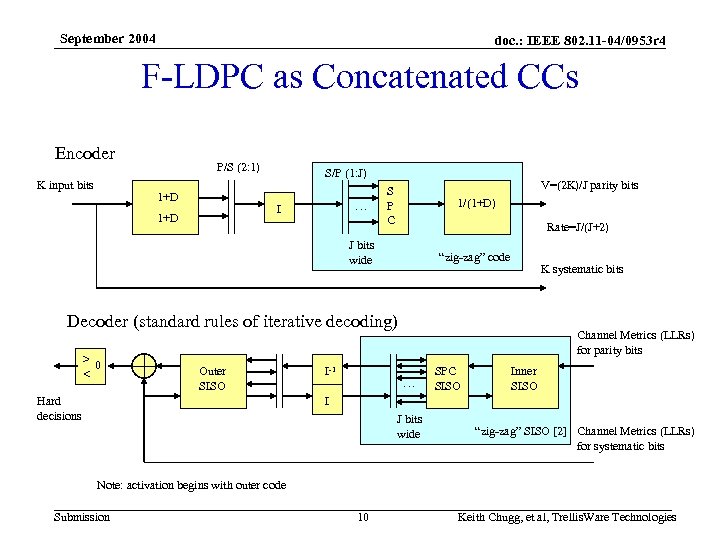
September 2004 doc. : IEEE 802. 11 -04/0953 r 4 F-LDPC as Concatenated CCs Encoder K input bits P/S (2: 1) 1+D S/P (1: J) … I 1+D V=(2 K)/J parity bits S P C 1/(1+D) Rate=J/(J+2) J bits wide “zig-zag” code K systematic bits Decoder (standard rules of iterative decoding) > 0 < Outer SISO Hard decisions I-1 Channel Metrics (LLRs) for parity bits … SPC SISO Inner SISO I J bits wide “zig-zag” SISO [2] Channel Metrics (LLRs) for systematic bits Note: activation begins with outer code Submission 10 Keith Chugg, et al, Trellis. Ware Technologies
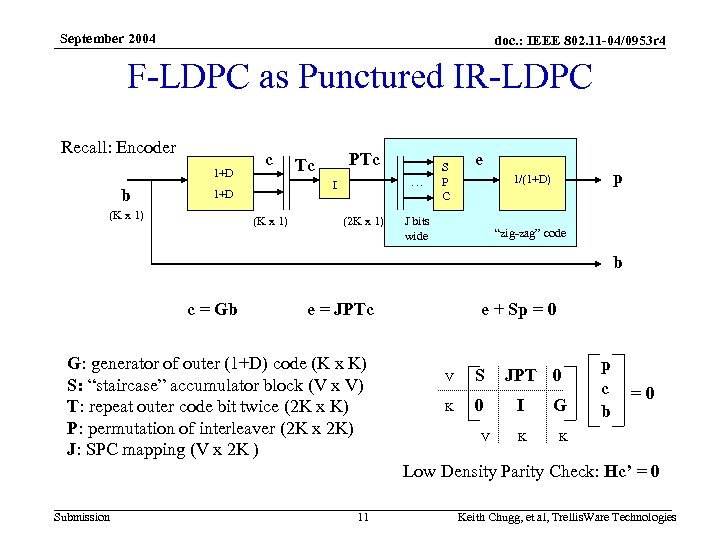
September 2004 doc. : IEEE 802. 11 -04/0953 r 4 F-LDPC as Punctured IR-LDPC Recall: Encoder 1+D b c … I 1+D (K x 1) PTc Tc (K x 1) (2 K x 1) S P C e p 1/(1+D) J bits wide “zig-zag” code b c = Gb e = JPTc G: generator of outer (1+D) code (K x K) S: “staircase” accumulator block (V x V) T: repeat outer code bit twice (2 K x K) P: permutation of interleaver (2 K x 2 K) J: SPC mapping (V x 2 K ) e + Sp = 0 V S K 0 V JPT 0 I G K p c b =0 K Low Density Parity Check: Hc’ = 0 Submission 11 Keith Chugg, et al, Trellis. Ware Technologies
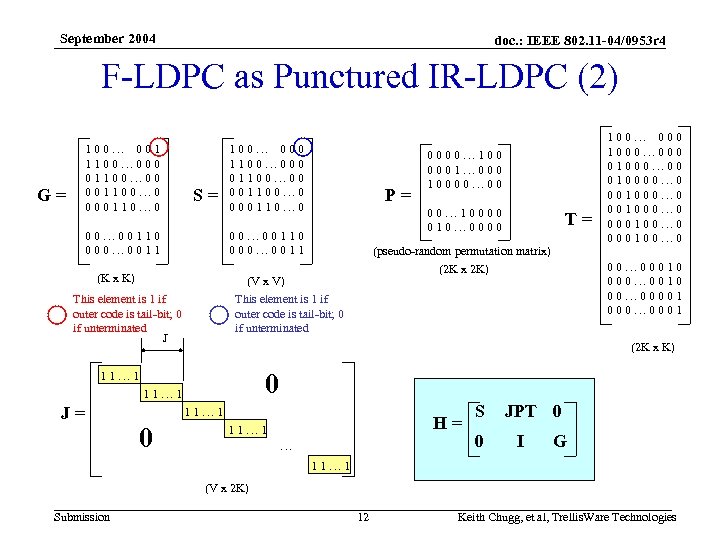
September 2004 doc. : IEEE 802. 11 -04/0953 r 4 F-LDPC as Punctured IR-LDPC (2) 100… 001 1100… 000 01100… 00 001100… 0 000110… 0 G= S= 00… 00110 000… 0011 100… 000 1100… 000 01100… 00 001100… 0 000110… 0 00… 10000 010… 0000 00… 00110 000… 0011 (K x K) 00… 00010 000… 0010 00… 00001 000… 0001 (2 K x 2 K) (2 K x K) 0 11… 1 0 T= (pseudo-random permutation matrix) (V x V) This element is 1 if outer code is tail-bit; 0 if unterminated J J= P= 0000… 100 0001… 000 10000… 00 100… 000 1000… 000 01000… 00 010000… 0 001000… 0 000100… 0 H= 11… 1 … S 0 JPT 0 I G 11… 1 (V x 2 K) Submission 12 Keith Chugg, et al, Trellis. Ware Technologies
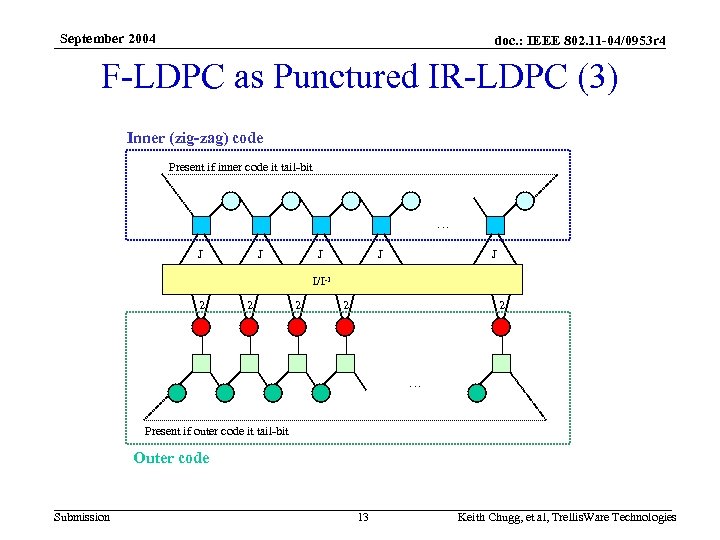
September 2004 doc. : IEEE 802. 11 -04/0953 r 4 F-LDPC as Punctured IR-LDPC (3) Inner (zig-zag) code Present if inner code it tail-bit … J J J I/I-1 2 2 2 … Present if outer code it tail-bit Outer code Submission 13 Keith Chugg, et al, Trellis. Ware Technologies
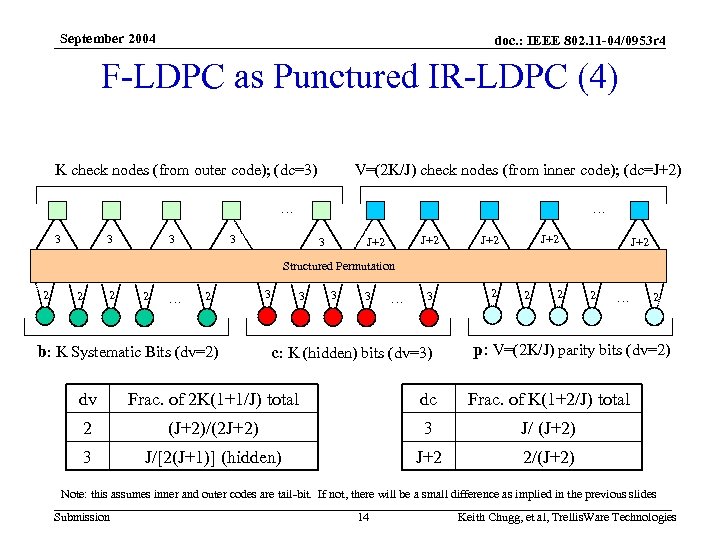
September 2004 doc. : IEEE 802. 11 -04/0953 r 4 F-LDPC as Punctured IR-LDPC (4) K check nodes (from outer code); (dc=3) V=(2 K/J) check nodes (from inner code); (dc=J+2) … … 3 3 3 J+2 J+2 J+2 Structured Permutation 2 2 … 2 b: K Systematic Bits (dv=2) 3 3 … 3 c: K (hidden) bits (dv=3) 2 2 … 2 p: V=(2 K/J) parity bits (dv=2) dv Frac. of 2 K(1+1/J) total dc Frac. of K(1+2/J) total 2 (J+2)/(2 J+2) 3 J/ (J+2) 3 J/[2(J+1)] (hidden) J+2 2/(J+2) Note: this assumes inner and outer codes are tail-bit. If not, there will be a small difference as implied in the previous slides Submission 14 Keith Chugg, et al, Trellis. Ware Technologies
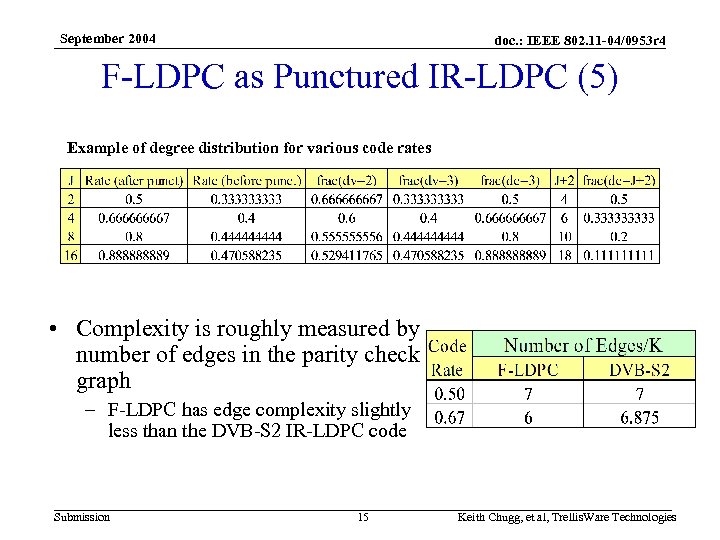
September 2004 doc. : IEEE 802. 11 -04/0953 r 4 F-LDPC as Punctured IR-LDPC (5) Example of degree distribution for various code rates • Complexity is roughly measured by number of edges in the parity check graph – F-LDPC has edge complexity slightly less than the DVB-S 2 IR-LDPC code Submission 15 Keith Chugg, et al, Trellis. Ware Technologies
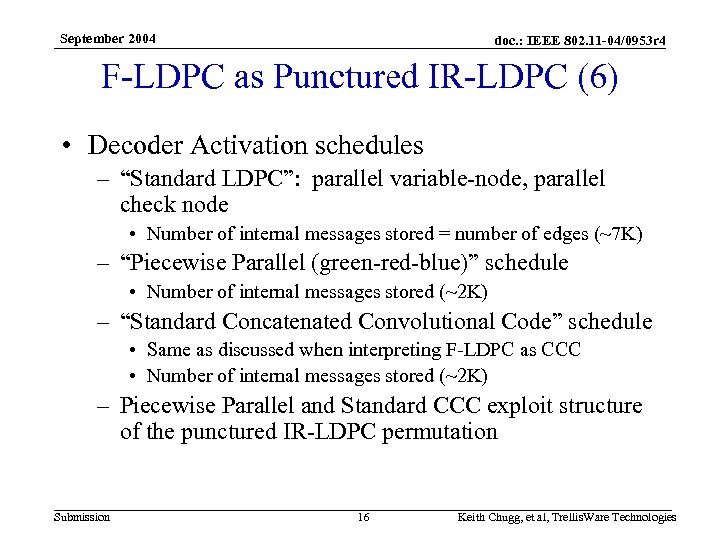
September 2004 doc. : IEEE 802. 11 -04/0953 r 4 F-LDPC as Punctured IR-LDPC (6) • Decoder Activation schedules – “Standard LDPC”: parallel variable-node, parallel check node • Number of internal messages stored = number of edges (~7 K) – “Piecewise Parallel (green-red-blue)” schedule • Number of internal messages stored (~2 K) – “Standard Concatenated Convolutional Code” schedule • Same as discussed when interpreting F-LDPC as CCC • Number of internal messages stored (~2 K) – Piecewise Parallel and Standard CCC exploit structure of the punctured IR-LDPC permutation Submission 16 Keith Chugg, et al, Trellis. Ware Technologies
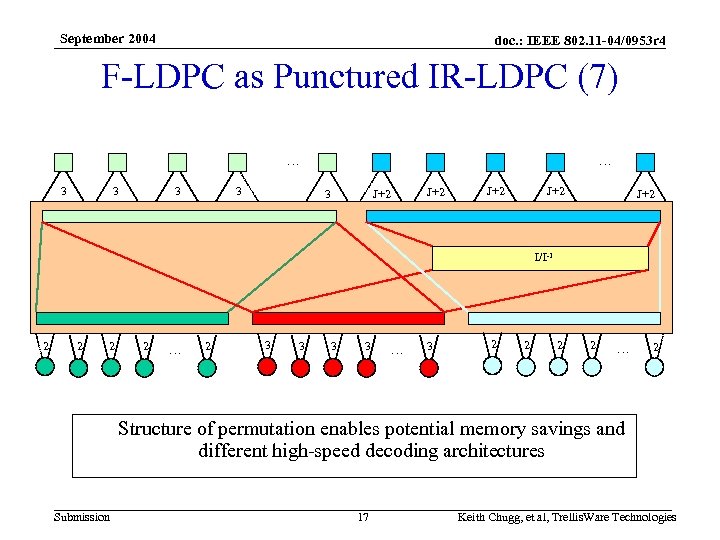
September 2004 doc. : IEEE 802. 11 -04/0953 r 4 F-LDPC as Punctured IR-LDPC (7) … … 3 3 3 J+2 J+2 J+2 I/I-1 2 2 … 2 3 3 … 3 2 2 … 2 Structure of permutation enables potential memory savings and different high-speed decoding architectures Submission 17 Keith Chugg, et al, Trellis. Ware Technologies
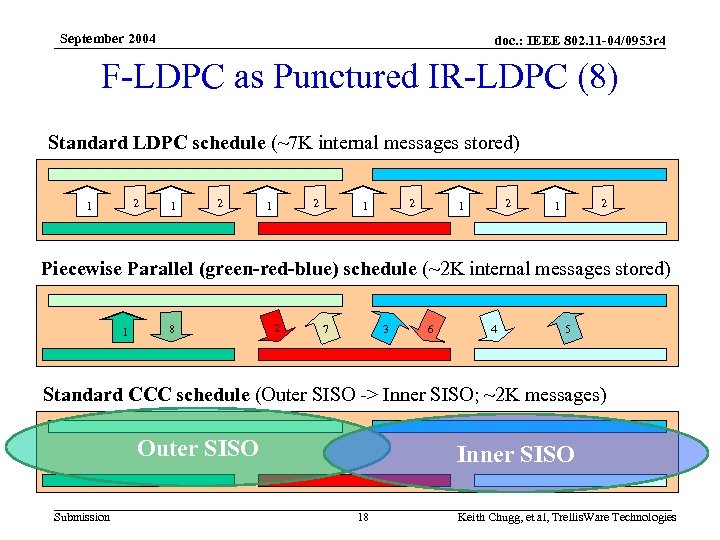
September 2004 doc. : IEEE 802. 11 -04/0953 r 4 F-LDPC as Punctured IR-LDPC (8) Standard LDPC schedule (~7 K internal messages stored) 2 1 1 2 2 1 2 1 Piecewise Parallel (green-red-blue) schedule (~2 K internal messages stored) 1 8 2 7 3 6 4 5 Standard CCC schedule (Outer SISO -> Inner SISO; ~2 K messages) Outer SISO Submission Inner SISO 18 Keith Chugg, et al, Trellis. Ware Technologies
September 2004 doc. : IEEE 802. 11 -04/0953 r 4 F-LDPC as Punctured IR-LDPC (9) • Schedule properties – All are examples of the same standard iterative message-passing decoding rules with different activation schedules – Each have similar computational complexity per iteration – Iteration convergence, degree of parallelism, memory needs, etc. vary with schedule Submission 19 Keith Chugg, et al, Trellis. Ware Technologies
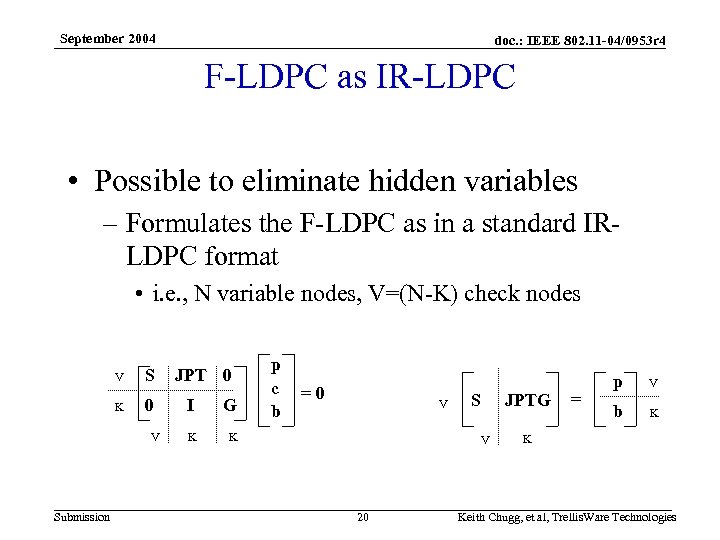
September 2004 doc. : IEEE 802. 11 -04/0953 r 4 F-LDPC as IR-LDPC • Possible to eliminate hidden variables – Formulates the F-LDPC as in a standard IRLDPC format • i. e. , N variable nodes, V=(N-K) check nodes V S K 0 V Submission JPT 0 I G K p c b =0 K V S JPTG V 20 = p V b K K Keith Chugg, et al, Trellis. Ware Technologies
September 2004 doc. : IEEE 802. 11 -04/0953 r 4 F-LDPC as IR-LDPC (2) • Degree distribution – For high-spread interleaver and K>>J • V variable nodes with dv=2 • K variable nodes with dv=4 • All checks have dc=2 J+2 – Example: r=1/2: 50% dv=2, 50% dv=4, dc=6 • This form has many four-cycles – Modified schedule or H-matrix transformations likely required for good performance based on this graphical model Submission 21 Keith Chugg, et al, Trellis. Ware Technologies
September 2004 doc. : IEEE 802. 11 -04/0953 r 4 Example Applications of F-LDPC Codes to the IEEE 802. 11 n PHY Layer Submission 22 Keith Chugg, et al, Trellis. Ware Technologies
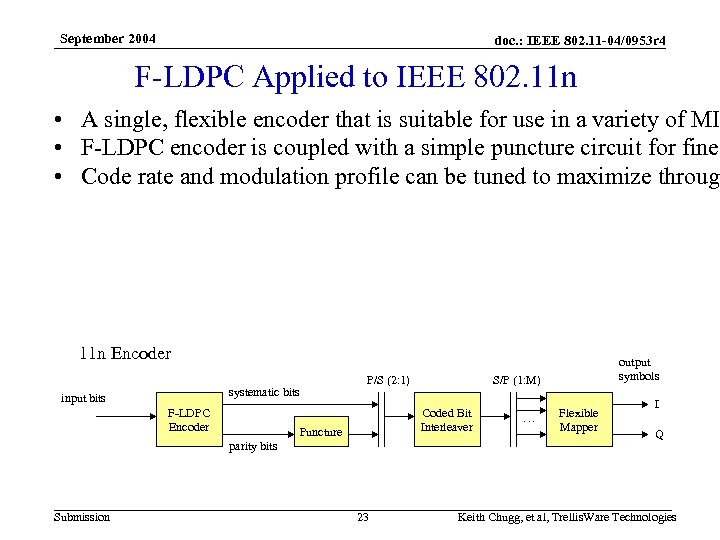
September 2004 doc. : IEEE 802. 11 -04/0953 r 4 F-LDPC Applied to IEEE 802. 11 n • A single, flexible encoder that is suitable for use in a variety of MI • F-LDPC encoder is coupled with a simple puncture circuit for fine • Code rate and modulation profile can be tuned to maximize throug 11 n Encoder systematic bits input bits F-LDPC Encoder P/S (2: 1) parity bits Submission S/P (1: M) Coded Bit Interleaver Puncture 23 output symbols … Flexible Mapper I Q Keith Chugg, et al, Trellis. Ware Technologies
September 2004 doc. : IEEE 802. 11 -04/0953 r 4 F-LDPC Applied to IEEE 802. 11 n (2) • F-LDPC Encoder – 3 -1024 input bytes, in single byte increments (negligible performance gains above 1 Kbytes) – Block size is programmable on the fly and can be used to meet latency requirements – 5 Coarse rates of r = 1/2, 2/3, 4/5, 8/9, and 16/17 • Fine rate control with a simple algorithm – – – • Provides fine resolution – especially for code rates between ½ and 2/3 9 Fine rates of p = 16/16, 15/16, …. , 8/16 Overall rate of r/(r+p(1 -r)), with r=J/(J+2) 45 code rates from 1/2 to 32/33 Fine rate control means that pad bits can be minimized Coded Bit Interleaver – Bit interleaving of a single code word – A simple relative prime interleaver is used here (the size of this interleaver must be very flexible) • Flexible Mapper – 5 modulations of BPSK, QPSK, 16 QAM, 64 QAM, and 256 QAM (more possible) – Gray mapping – Bit-loading is easily supported Submission 24 Keith Chugg, et al, Trellis. Ware Technologies
September 2004 doc. : IEEE 802. 11 -04/0953 r 4 Uniformly Good Performance • PER vs. SNR curves are shown for a range of code rates and modulation orders – Min-sum decoding (“log-max-APP”) – 1% PER can be achieved from -2 d. B to 27 d. B SNR in approximately 0. 25 steps • Bandwidth efficiency is shown against SNR required to achieve a PER of 1% – Full range of code rate, modulation types, and frame sizes (from 128 to 8000 information bits) • Performance is compared with finite block size bound and capacity – Generally within 1 d. B of finite block size bound – Higher order modulation performance could be improved by iterating the soft-demapper (more complex though) – Demonstrates the fine code rate granularity possible Submission 25 Keith Chugg, et al, Trellis. Ware Technologies
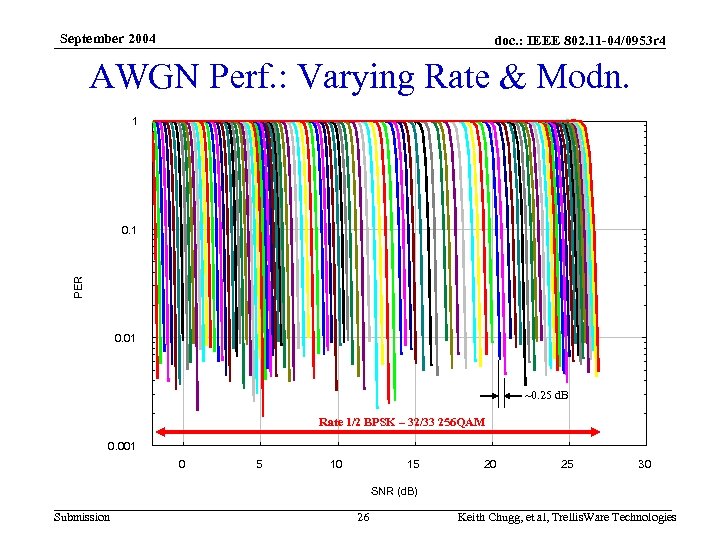
September 2004 doc. : IEEE 802. 11 -04/0953 r 4 AWGN Perf. : Varying Rate & Modn. 1 PER 0. 1 0. 01 ~0. 25 d. B Rate 1/2 BPSK – 32/33 256 QAM 0. 001 0 5 10 15 20 25 30 SNR (d. B) Submission 26 Keith Chugg, et al, Trellis. Ware Technologies
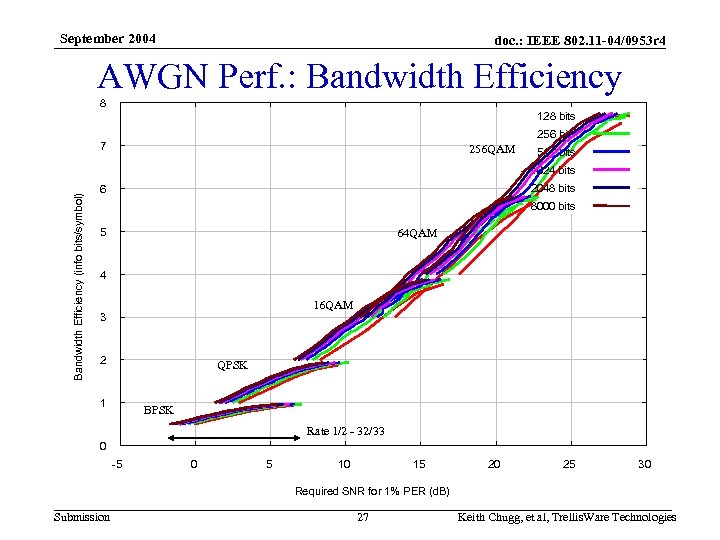
September 2004 doc. : IEEE 802. 11 -04/0953 r 4 AWGN Perf. : Bandwidth Efficiency 8 128 bits 256 bits 7 256 QAM 512 bits Bandwidth Efficiency (info bits/symbol) 1024 bits 2048 bits 6 8000 bits 5 64 QAM 4 16 QAM 3 2 QPSK 1 BPSK Rate 1/2 - 32/33 0 -5 0 5 10 15 20 25 30 Required SNR for 1% PER (d. B) Submission 27 Keith Chugg, et al, Trellis. Ware Technologies
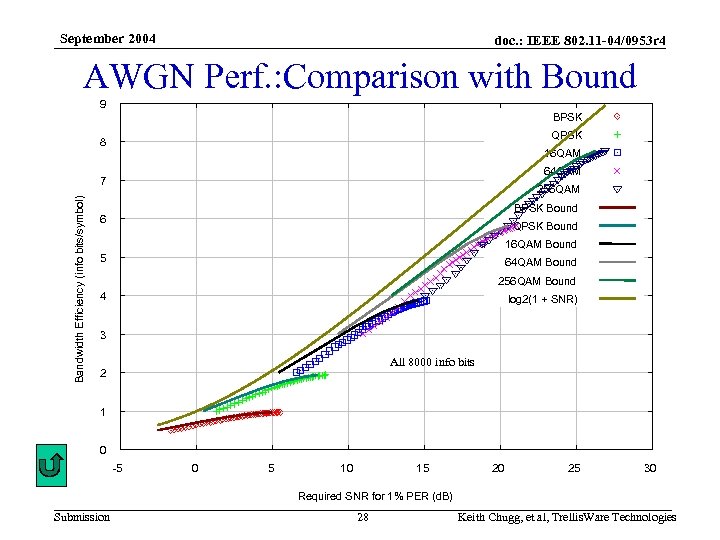
September 2004 doc. : IEEE 802. 11 -04/0953 r 4 AWGN Perf. : Comparison with Bound 9 BPSK QPSK 8 16 QAM 64 QAM Bandwidth Efficiency (info bits/symbol) 7 256 QAM BPSK Bound 6 QPSK Bound 16 QAM Bound 5 64 QAM Bound 256 QAM Bound 4 log 2(1 + SNR) 3 All 8000 info bits 2 1 0 -5 0 5 10 15 20 25 30 Required SNR for 1% PER (d. B) Submission 28 Keith Chugg, et al, Trellis. Ware Technologies
September 2004 doc. : IEEE 802. 11 -04/0953 r 4 Frame Size Flexibility • Coding and modulation is fixed at rate 4/5 16 QAM • PER vs. SNR curves are shown for a range of frame sizes from 8 to 1000 bytes • SNR required to achieve a PER of 1% is shown against frame size – Both automated search and hand tuned interleaver parameters are shown. It is expected that performance matching that of the hand tuned parameters can achieved everywhere – The finite block size performance bound is also plotted, showing that the automated search parameters are within 1 d. B of this bound, and the hand tuned parameters are with 0. 75 d. B Submission 29 Keith Chugg, et al, Trellis. Ware Technologies
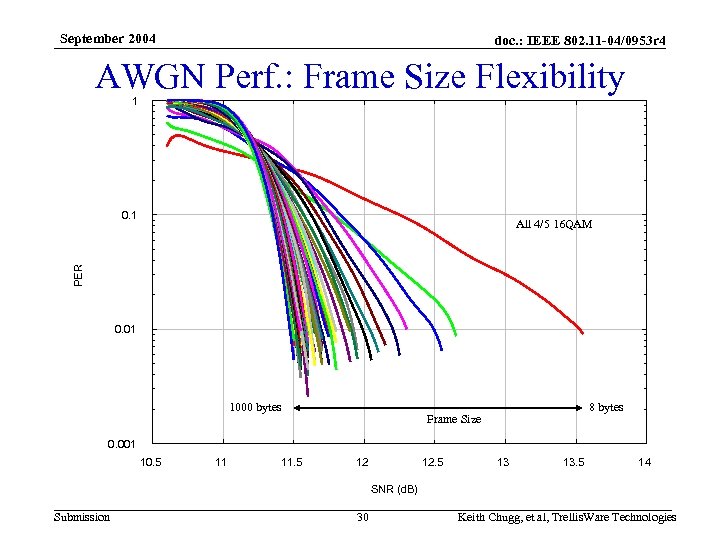
September 2004 doc. : IEEE 802. 11 -04/0953 r 4 AWGN Perf. : Frame Size Flexibility 1 0. 1 PER All 4/5 16 QAM 0. 01 1000 bytes 8 bytes Frame Size 0. 001 10. 5 11 11. 5 12 12. 5 13 13. 5 14 SNR (d. B) Submission 30 Keith Chugg, et al, Trellis. Ware Technologies
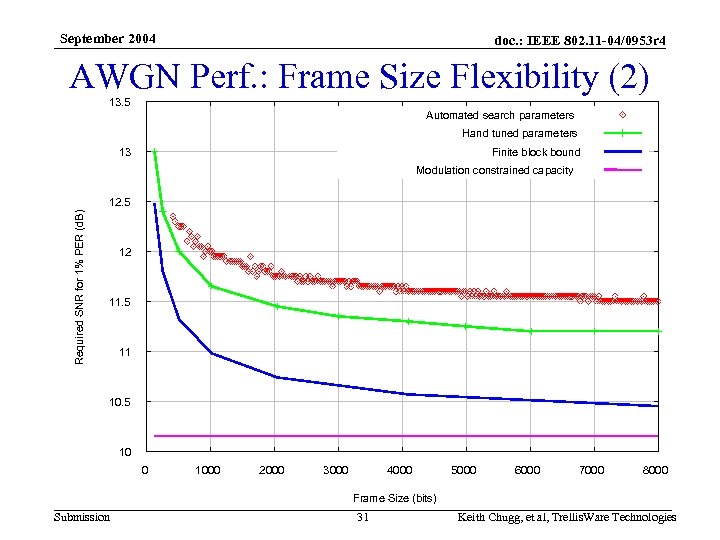
September 2004 doc. : IEEE 802. 11 -04/0953 r 4 AWGN Perf. : Frame Size Flexibility (2) 13. 5 Automated search parameters Hand tuned parameters Finite block bound 13 Modulation constrained capacity Required SNR for 1% PER (d. B) 12. 5 12 11. 5 11 10. 5 10 0 1000 2000 3000 4000 5000 6000 7000 8000 Frame Size (bits) Submission 31 Keith Chugg, et al, Trellis. Ware Technologies
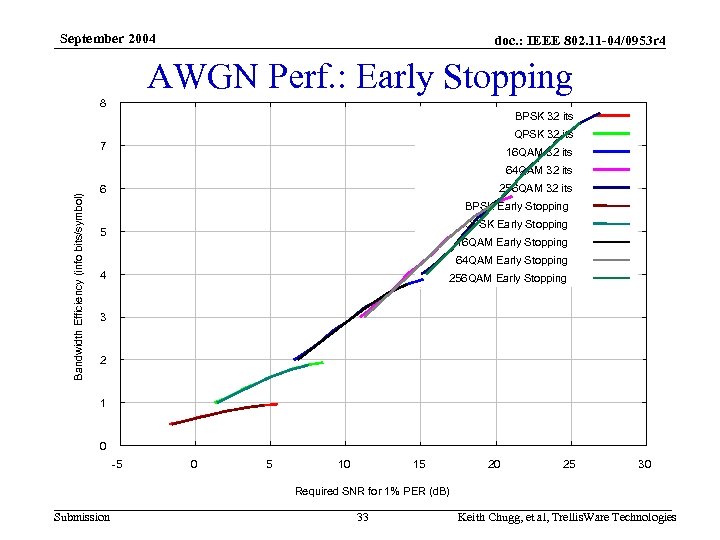
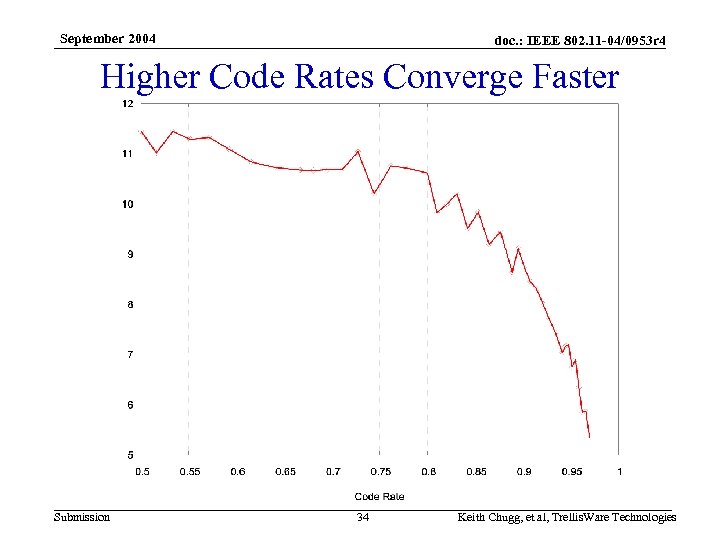
September 2004 doc. : IEEE 802. 11 -04/0953 r 4 Early Stopping • F-LDPC codes can use early-stopping to reduce the average number of iterations and decreasing complexity for a given data throughput • Performance with early stopping is almost as good as that with 32 iterations – Flow control algorithm active with early stopping results – 50% larger input buffer is assumed • Average iterations as a function of required SNR for a 1% PER – With early stopping the average number of iterations is < 12 – Average number of iterations reduces as the code rate increases • 32 iteration performance with an average of less than 12 iterations • Early stopping can also save power Submission 32 Keith Chugg, et al, Trellis. Ware Technologies
September 2004 doc. : IEEE 802. 11 -04/0953 r 4 AWGN Perf. : Early Stopping 8 BPSK 32 its QPSK 32 its 7 16 QAM 32 its Bandwidth Efficiency (info bits/symbol) 64 QAM 32 its 256 QAM 32 its 6 BPSK Early Stopping QPSK Early Stopping 5 16 QAM Early Stopping 64 QAM Early Stopping 4 256 QAM Early Stopping 3 2 1 0 -5 0 5 10 15 20 25 30 Required SNR for 1% PER (d. B) Submission 33 Keith Chugg, et al, Trellis. Ware Technologies
September 2004 doc. : IEEE 802. 11 -04/0953 r 4 Higher Code Rates Converge Faster Submission 34 Keith Chugg, et al, Trellis. Ware Technologies
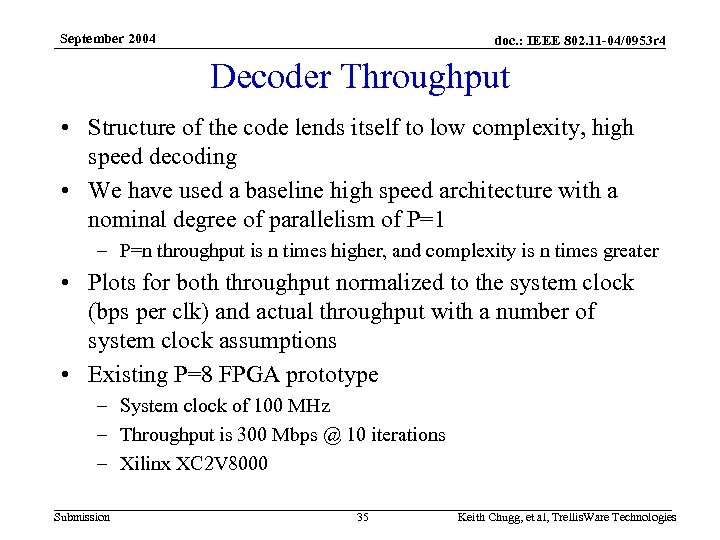
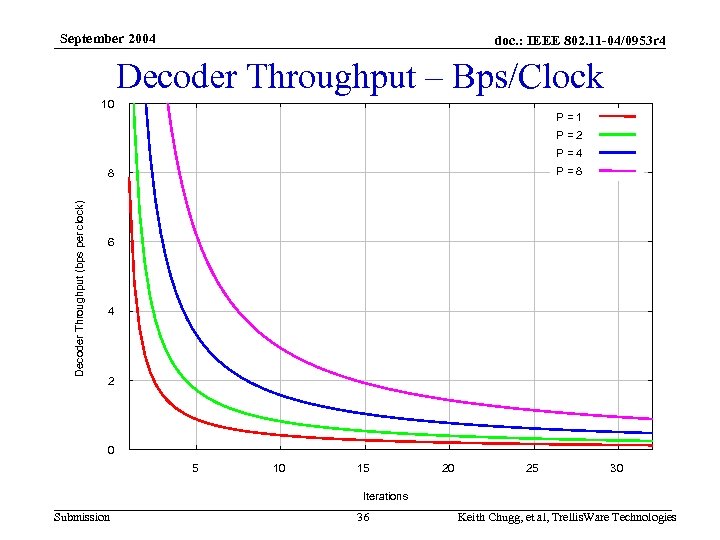
September 2004 doc. : IEEE 802. 11 -04/0953 r 4 Decoder Throughput • Structure of the code lends itself to low complexity, high speed decoding • We have used a baseline high speed architecture with a nominal degree of parallelism of P=1 – P=n throughput is n times higher, and complexity is n times greater • Plots for both throughput normalized to the system clock (bps per clk) and actual throughput with a number of system clock assumptions • Existing P=8 FPGA prototype – System clock of 100 MHz – Throughput is 300 Mbps @ 10 iterations – Xilinx XC 2 V 8000 Submission 35 Keith Chugg, et al, Trellis. Ware Technologies
September 2004 doc. : IEEE 802. 11 -04/0953 r 4 Decoder Throughput – Bps/Clock 10 P=1 P=2 P=4 P=8 Decoder Throughput (bps per clock) 8 6 4 2 0 5 10 15 20 25 30 Iterations Submission 36 Keith Chugg, et al, Trellis. Ware Technologies
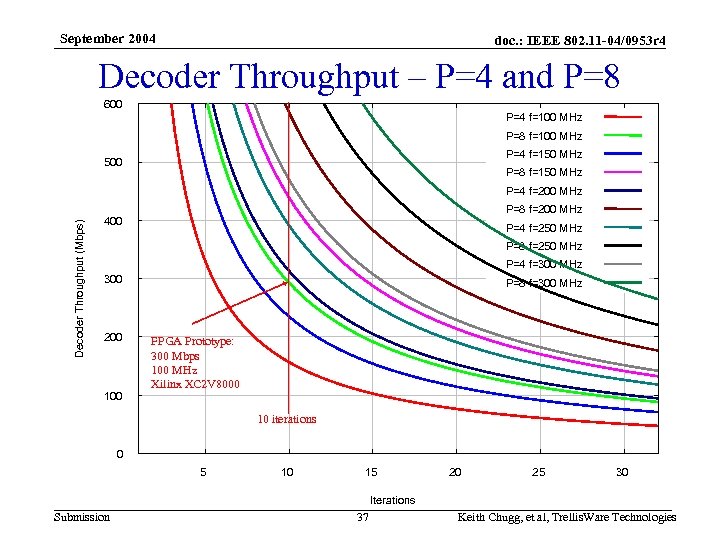
September 2004 doc. : IEEE 802. 11 -04/0953 r 4 Decoder Throughput – P=4 and P=8 600 P=4 f=100 MHz P=8 f=100 MHz P=4 f=150 MHz 500 P=8 f=150 MHz Decoder Throughput (Mbps) P=4 f=200 MHz P=8 f=200 MHz 400 P=4 f=250 MHz P=8 f=250 MHz P=4 f=300 MHz 300 200 100 P=8 f=300 MHz FPGA Prototype: 300 Mbps 100 MHz Xilinx XC 2 V 8000 10 iterations 0 5 10 15 20 25 30 Iterations Submission 37 Keith Chugg, et al, Trellis. Ware Technologies
September 2004 doc. : IEEE 802. 11 -04/0953 r 4 Decoder Latency • Example: Decoder latency needs to be < ~6 μs – Last bit in to first bit out • This can be achieved by a P=8 decoder with a 200 MHz clock – 12 iterations – < ~2048 bit code words • With large MAC packets just ensure that final code word of packet is <2048 bits • As technology improves (higher clock or larger P) this minimum code word size can be increased Submission 38 Keith Chugg, et al, Trellis. Ware Technologies
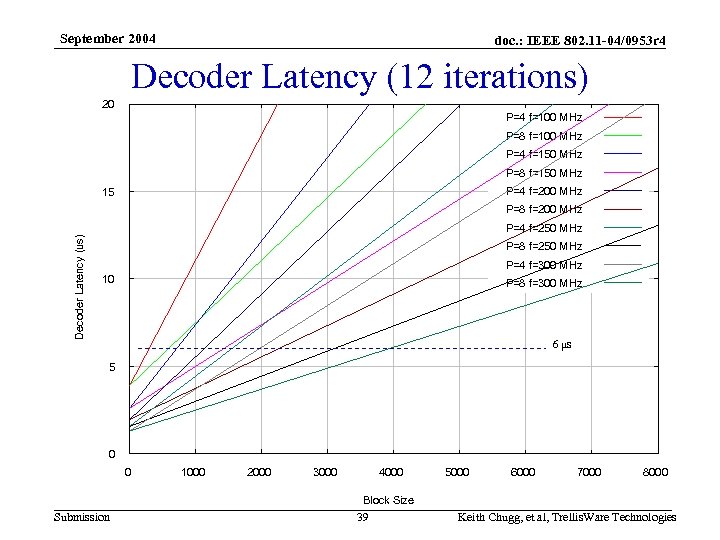
September 2004 doc. : IEEE 802. 11 -04/0953 r 4 Decoder Latency (12 iterations) 20 P=4 f=100 MHz P=8 f=100 MHz P=4 f=150 MHz P=8 f=150 MHz P=4 f=200 MHz 15 P=8 f=200 MHz Decoder Latency (us) P=4 f=250 MHz P=8 f=250 MHz P=4 f=300 MHz 10 P=8 f=300 MHz 6 μs 5 0 0 1000 2000 3000 4000 5000 6000 7000 8000 Block Size Submission 39 Keith Chugg, et al, Trellis. Ware Technologies
September 2004 doc. : IEEE 802. 11 -04/0953 r 4 F-LDPC High Speed Implementation • Proven Technology • FPGA implementations of F-LDPC – 300 Mbps @ 10 iterations with 100 MHz clock – Xilinx XC 2 V 8000 • ASIC implementation of Flexi. Code – – – Submission A version of the F-LPDC with 4 -state codes More complex than F-LDPC with more features BER of 10 -10 in all modes 196 Mbps @ 10 iterations with 125 MHz clock 0. 18 μm standard cell process 40 Keith Chugg, et al, Trellis. Ware Technologies
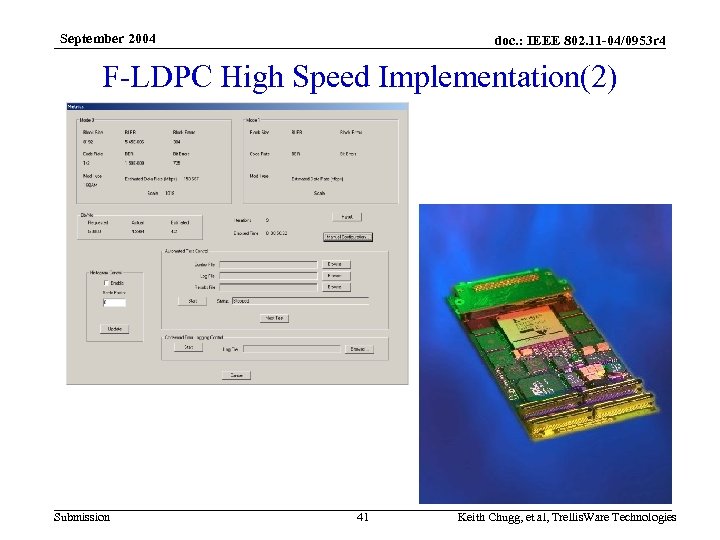
September 2004 doc. : IEEE 802. 11 -04/0953 r 4 F-LDPC High Speed Implementation(2) Submission 41 Keith Chugg, et al, Trellis. Ware Technologies
September 2004 doc. : IEEE 802. 11 -04/0953 r 4 F-LDPC Examples for IEEE 802. 11 n 1. SVD-based MIMO-OFDM Example – – – Assume perfect CSI at the Tx and Rx Adaptive power and rate allocation via a simple codedriven algorithm Greater than 300 Mbps demonstrated 2. ST-MUX Example – – Submission No Tx-CSI MMSE interference suppression Independent application of TW’s F-LDPC code DLL by UCLA’s Un. Wi. Re. D Lab. (Prof. Mike Fitz) Desired Packet error rates demonstrated 42 Keith Chugg, et al, Trellis. Ware Technologies
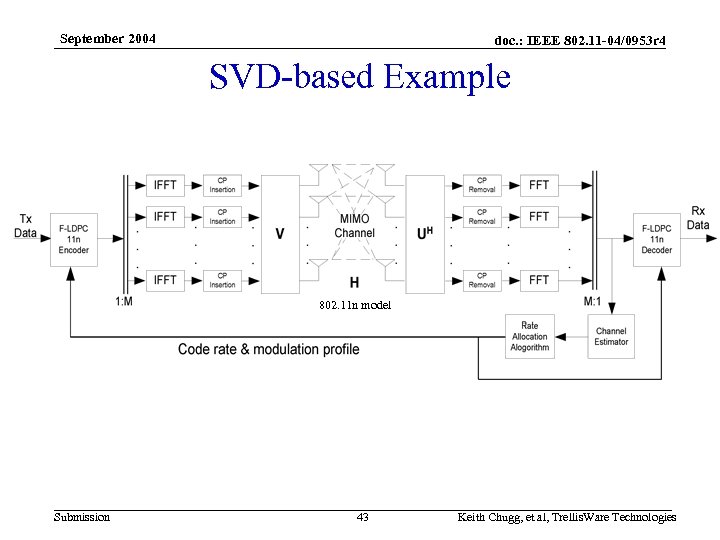
September 2004 doc. : IEEE 802. 11 -04/0953 r 4 SVD-based Example 802. 11 n model Submission 43 Keith Chugg, et al, Trellis. Ware Technologies
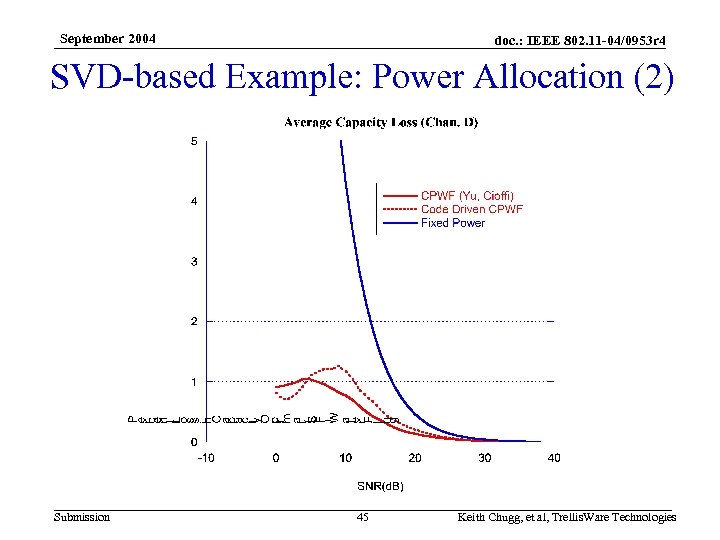
September 2004 doc. : IEEE 802. 11 -04/0953 r 4 SVD-based Example: Power Allocation • Approaches Considered – Space-Frequency Water-Filling (SFWF) – “Constant Power Water-Filling (CPWF)” in Space and Frequency [4] • Select a subset of subchannels to use and allocate power equally among these active subchannels – “Code Driven CPWF” in Space and Frequency • Compute the subchannel SNR assuming a constant power allocation across all subchannels • If this is less than the minimum SNR supported by the FEC, do not use this subchannel (e. g. , -2 d. B for 8000 bit input blocks). • Allocate power equally across subchannels used Submission 44 Keith Chugg, et al, Trellis. Ware Technologies
September 2004 doc. : IEEE 802. 11 -04/0953 r 4 SVD-based Example: Power Allocation (2) Submission 45 Keith Chugg, et al, Trellis. Ware Technologies
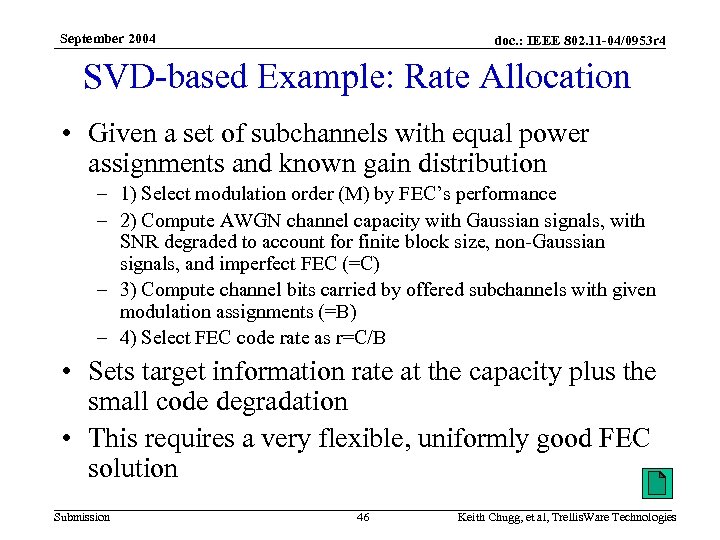
September 2004 doc. : IEEE 802. 11 -04/0953 r 4 SVD-based Example: Rate Allocation • Given a set of subchannels with equal power assignments and known gain distribution – 1) Select modulation order (M) by FEC’s performance – 2) Compute AWGN channel capacity with Gaussian signals, with SNR degraded to account for finite block size, non-Gaussian signals, and imperfect FEC (=C) – 3) Compute channel bits carried by offered subchannels with given modulation assignments (=B) – 4) Select FEC code rate as r=C/B • Sets target information rate at the capacity plus the small code degradation • This requires a very flexible, uniformly good FEC solution Submission 46 Keith Chugg, et al, Trellis. Ware Technologies
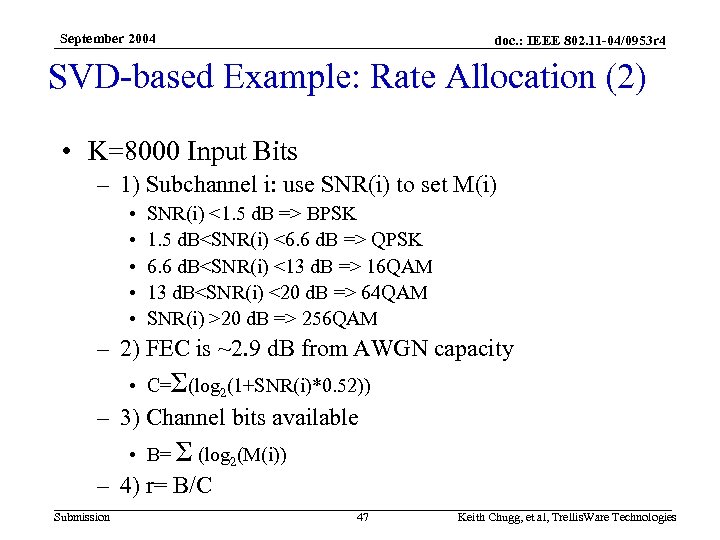
September 2004 doc. : IEEE 802. 11 -04/0953 r 4 SVD-based Example: Rate Allocation (2) • K=8000 Input Bits – 1) Subchannel i: use SNR(i) to set M(i) • • • SNR(i) <1. 5 d. B => BPSK 1. 5 d. B<SNR(i) <6. 6 d. B => QPSK 6. 6 d. B<SNR(i) <13 d. B => 16 QAM 13 d. B<SNR(i) <20 d. B => 64 QAM SNR(i) >20 d. B => 256 QAM – 2) FEC is ~2. 9 d. B from AWGN capacity • C=Σ(log 2(1+SNR(i)*0. 52)) – 3) Channel bits available • B= Σ (log 2(M(i)) – 4) r= B/C Submission 47 Keith Chugg, et al, Trellis. Ware Technologies
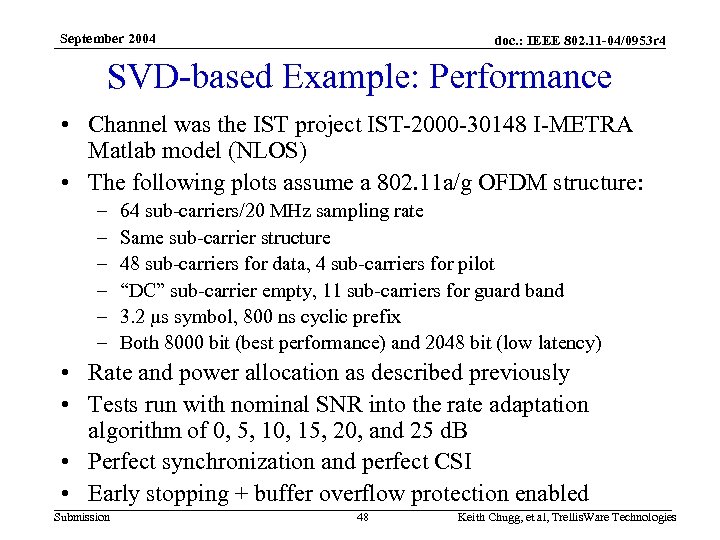
September 2004 doc. : IEEE 802. 11 -04/0953 r 4 SVD-based Example: Performance • Channel was the IST project IST-2000 -30148 I-METRA Matlab model (NLOS) • The following plots assume a 802. 11 a/g OFDM structure: – – – 64 sub-carriers/20 MHz sampling rate Same sub-carrier structure 48 sub-carriers for data, 4 sub-carriers for pilot “DC” sub-carrier empty, 11 sub-carriers for guard band 3. 2 µs symbol, 800 ns cyclic prefix Both 8000 bit (best performance) and 2048 bit (low latency) • Rate and power allocation as described previously • Tests run with nominal SNR into the rate adaptation algorithm of 0, 5, 10, 15, 20, and 25 d. B • Perfect synchronization and perfect CSI • Early stopping + buffer overflow protection enabled Submission 48 Keith Chugg, et al, Trellis. Ware Technologies
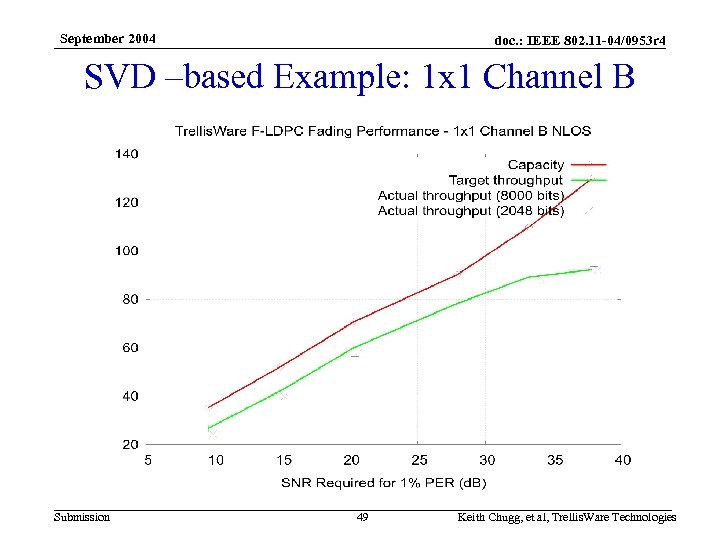
September 2004 doc. : IEEE 802. 11 -04/0953 r 4 SVD –based Example: 1 x 1 Channel B Submission 49 Keith Chugg, et al, Trellis. Ware Technologies
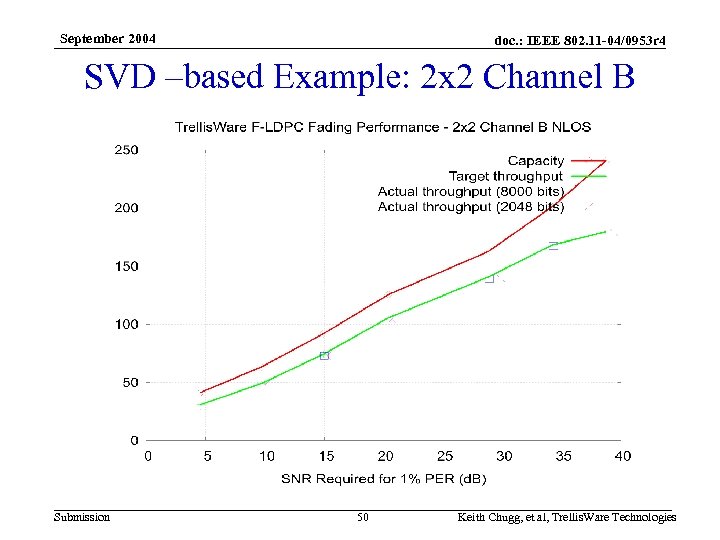
September 2004 doc. : IEEE 802. 11 -04/0953 r 4 SVD –based Example: 2 x 2 Channel B Submission 50 Keith Chugg, et al, Trellis. Ware Technologies
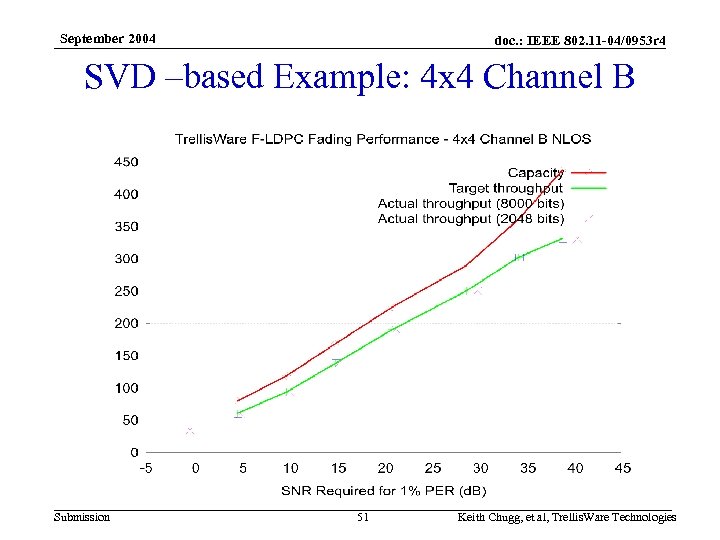
September 2004 doc. : IEEE 802. 11 -04/0953 r 4 SVD –based Example: 4 x 4 Channel B Submission 51 Keith Chugg, et al, Trellis. Ware Technologies
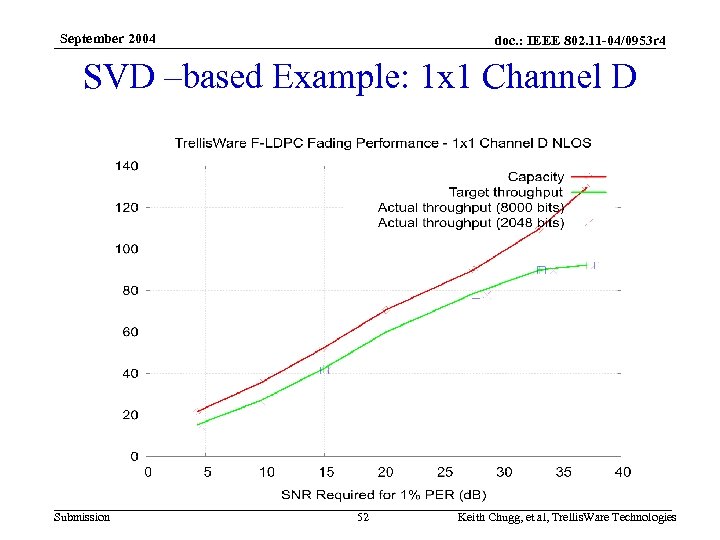
September 2004 doc. : IEEE 802. 11 -04/0953 r 4 SVD –based Example: 1 x 1 Channel D Submission 52 Keith Chugg, et al, Trellis. Ware Technologies
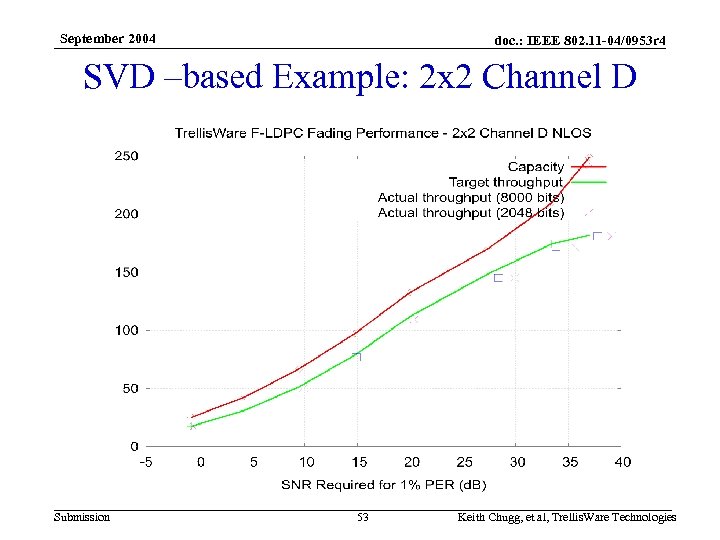
September 2004 doc. : IEEE 802. 11 -04/0953 r 4 SVD –based Example: 2 x 2 Channel D Submission 53 Keith Chugg, et al, Trellis. Ware Technologies
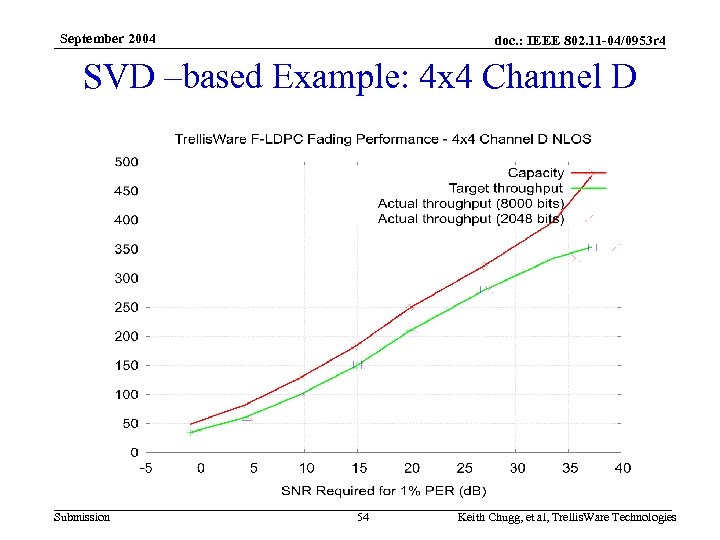
September 2004 doc. : IEEE 802. 11 -04/0953 r 4 SVD –based Example: 4 x 4 Channel D Submission 54 Keith Chugg, et al, Trellis. Ware Technologies
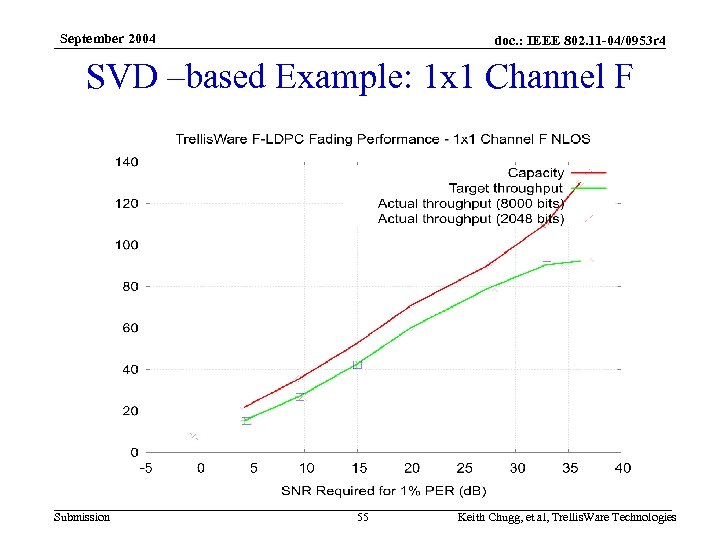
September 2004 doc. : IEEE 802. 11 -04/0953 r 4 SVD –based Example: 1 x 1 Channel F Submission 55 Keith Chugg, et al, Trellis. Ware Technologies
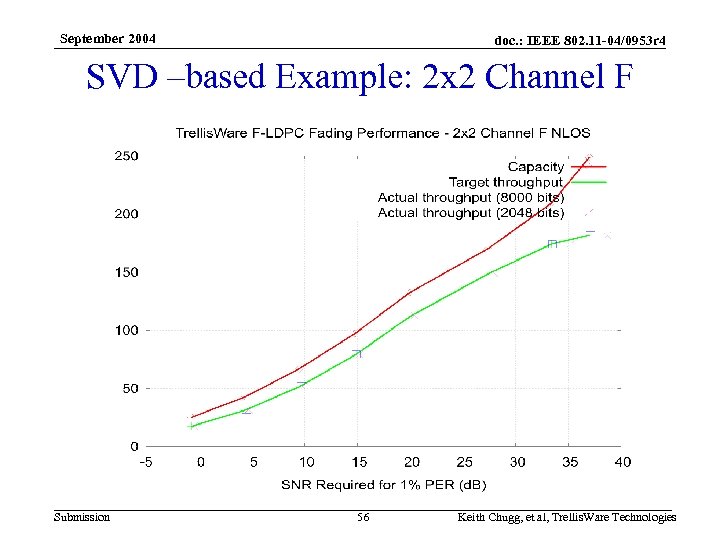
September 2004 doc. : IEEE 802. 11 -04/0953 r 4 SVD –based Example: 2 x 2 Channel F Submission 56 Keith Chugg, et al, Trellis. Ware Technologies
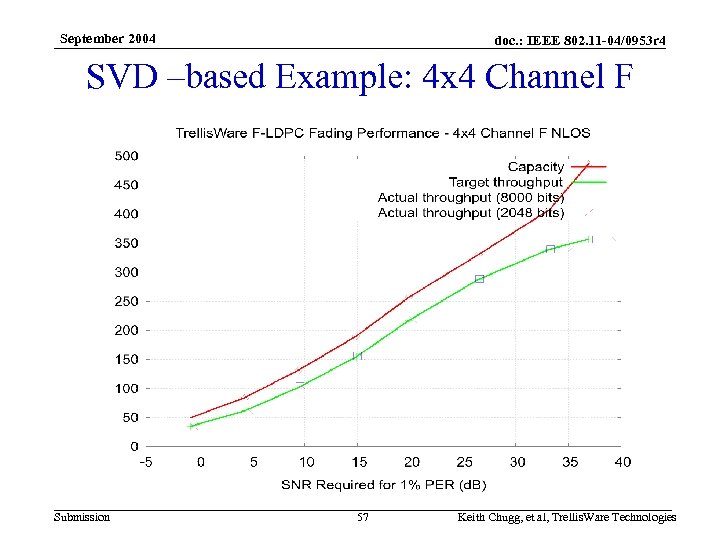
September 2004 doc. : IEEE 802. 11 -04/0953 r 4 SVD –based Example: 4 x 4 Channel F Submission 57 Keith Chugg, et al, Trellis. Ware Technologies
September 2004 doc. : IEEE 802. 11 -04/0953 r 4 ST-MUX Example • The entire MIMO OFDM chain is implemented in ANSI C/C++ • Use 802. 11 a PLCP for initial sync. & freq. Tracking • Perfect channel state information used • MMSE front detection and iterations on FLDPC Decoder for PCSI • Tests run on the UCLA Un. Wi. Re. D Lab test bed [5] Submission 58 Keith Chugg, et al, Trellis. Ware Technologies
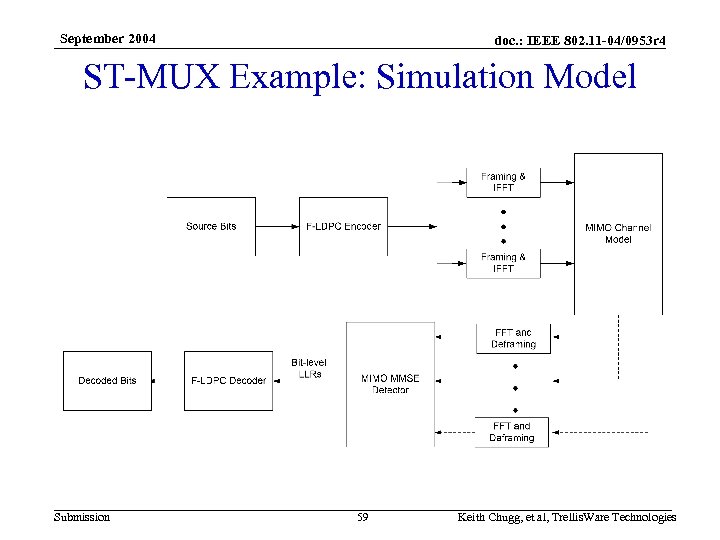
September 2004 doc. : IEEE 802. 11 -04/0953 r 4 ST-MUX Example: Simulation Model Submission 59 Keith Chugg, et al, Trellis. Ware Technologies
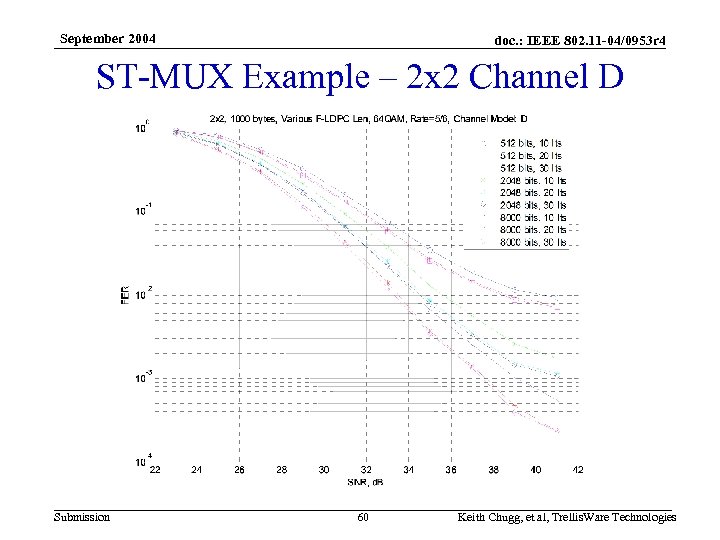
September 2004 doc. : IEEE 802. 11 -04/0953 r 4 ST-MUX Example – 2 x 2 Channel D Submission 60 Keith Chugg, et al, Trellis. Ware Technologies
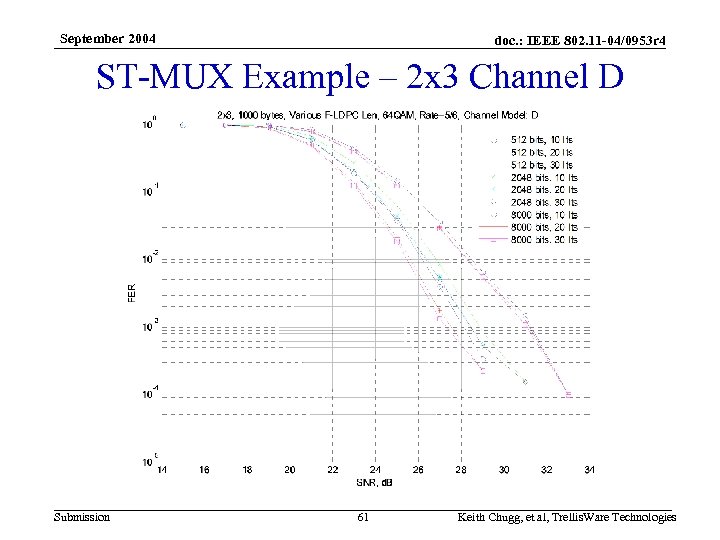
September 2004 doc. : IEEE 802. 11 -04/0953 r 4 ST-MUX Example – 2 x 3 Channel D Submission 61 Keith Chugg, et al, Trellis. Ware Technologies
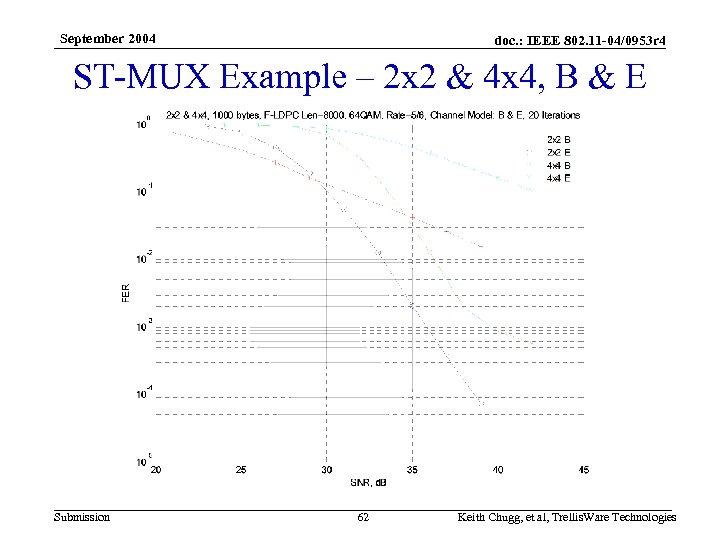
September 2004 doc. : IEEE 802. 11 -04/0953 r 4 ST-MUX Example – 2 x 2 & 4 x 4, B & E Submission 62 Keith Chugg, et al, Trellis. Ware Technologies
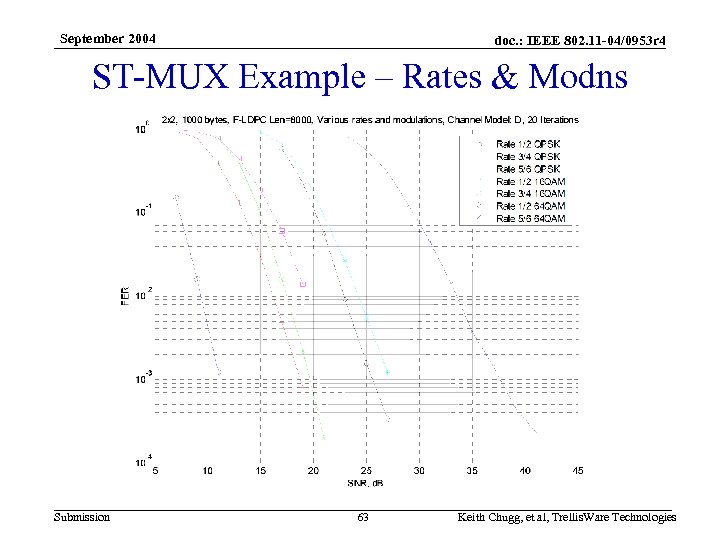
September 2004 doc. : IEEE 802. 11 -04/0953 r 4 ST-MUX Example – Rates & Modns Submission 63 Keith Chugg, et al, Trellis. Ware Technologies
September 2004 doc. : IEEE 802. 11 -04/0953 r 4 Conclusions: IEEE 802. 11 n FEC requirements well met by the F-LDPC • Frame size flexibility – 3 bytes – 1000 bytes in single byte increments – Simplifies MAC interface & allows latency requirements to be met • Code rate flexibility – ½ - 32/33 in 45 steps (~0. 25 d. B SNR steps) – Maximizes throughput and minimizes pad bits • Good performance – Operates within 1 d. B of theory across entire range • High Speed – Decoders can be easily built to operate 500+ Mbps • Proven Technology/Low Complexity – 300 Mbps FPGA-based decoders already built Submission 64 Keith Chugg, et al, Trellis. Ware Technologies
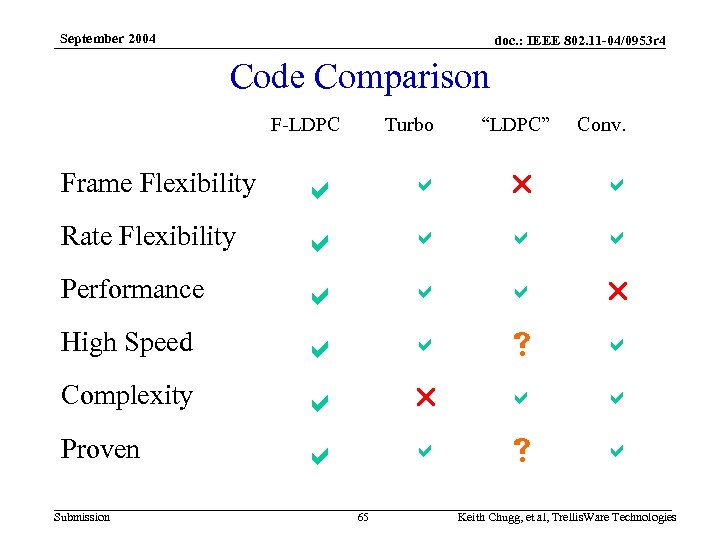
September 2004 doc. : IEEE 802. 11 -04/0953 r 4 Code Comparison F-LDPC Frame Flexibility Rate Flexibility Performance High Speed Complexity Proven Submission Turbo a a a a r a a a a 65 “LDPC” Conv. Keith Chugg, et al, Trellis. Ware Technologies
September 2004 doc. : IEEE 802. 11 -04/0953 r 4 Appendix Submission 66 Keith Chugg, et al, Trellis. Ware Technologies
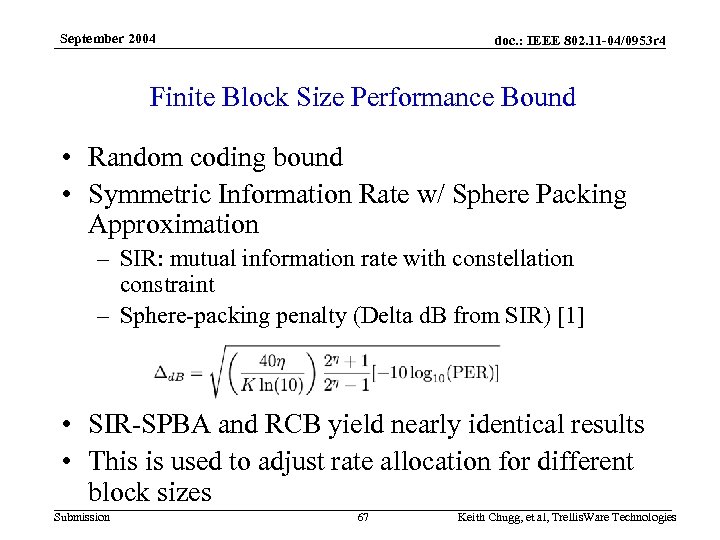
September 2004 doc. : IEEE 802. 11 -04/0953 r 4 Finite Block Size Performance Bound • Random coding bound • Symmetric Information Rate w/ Sphere Packing Approximation – SIR: mutual information rate with constellation constraint – Sphere-packing penalty (Delta d. B from SIR) [1] • SIR-SPBA and RCB yield nearly identical results • This is used to adjust rate allocation for different block sizes Submission 67 Keith Chugg, et al, Trellis. Ware Technologies
![September 2004 doc. : IEEE 802. 11 -04/0953 r 4 References • [1] S.](https://present5.com/presentation/879478183f5811fb22ab51f1d537cf3d/image-68.jpg "September 2004 doc. : IEEE 802. 11 -04/0953 r 4 References • [1] S.")
September 2004 doc. : IEEE 802. 11 -04/0953 r 4 References • [1] S. Dolinar, D. Divsalar, and F. Pollara, "Code Performance as a function of Block Size, " JPL, TMO Progress Report 42 -133. • [2] L. Ping, X. Huang, and N. Phamdo, “Zigzag codes and concatenated zigzag codes, ” IEEE Trans. Information Theory, vol. 47, pp. 800 -807, Feb. 2001 • [3] K. M. Chugg, “A New Class of Turbo-Like Codes with Desirable Practical Properties, ” IEEE Communication Theory Workshop, Capri Island, Italy, May 2004. • [4] Wei Yu, John Cioffi, “On Constant-Power Waterfilling, ” IEEE International Conference on Communications, (ICC), 2001 • [5] http: //www. unwired. ee. ucla. edu/ Submission 68 Keith Chugg, et al, Trellis. Ware Technologies
Скачать презентацию September 2004 doc IEEE 802 11 -04 0953
879478183f5811fb22ab51f1d537cf3d.ppt