 Скачать презентацию September 2003 doc IEEE 802 19 -03 029
797e186bc725d33ca0e31d2ee877cc30.ppt
- Количество слайдов: 12



September 2003 doc. : IEEE 802. 19 -03/029 r 2 Project: IEEE P 802. 19 Coexistence TAG Submission Title: [Common Signaling for UWBCoexistence] Date Submitted: [17 September, 2003] Source: [John Santhoff] Company [Pulse~LINK] Address [9155 Brown Deer Rd. Suite 8, San Diego, CA 92121] Voice: [(858) 587 -9001], FAX: [(858) 587 -8799], E-Mail: [jsanthoff@pulselink. net] Re: [General contribution, tutorial to IEEE 802. 19] Abstract: [At least one task group has chosen a UWB PHY, and a study group in P 802. 15 is considering UWB PHY that will operate in common spectrum. This presentation focuses on potential coexistence issues of multiple UWB PHY layers in a common frequency band. ] Purpose: [Focus and attention need to be directed to P 802. 15, and soon P 802. 11, and discussions started on issues effecting coexistence of multiple UWB PHY layers using common spectrum. It is early enough in the standards draft process to consider preemptive measures to ensure coexistence. ] Notice: This document has been prepared to assist the IEEE P 802. 19. It is offered as a basis for discussion and is not binding on the contributing individual(s) or organization(s). The material in this document is subject to change in form and content after further study. The contributor(s) reserve(s) the right to add, amend or withdraw material contained herein. Release: The contributor acknowledges and accepts that this contribution becomes the property of IEEE and may be made publicly available by P 802. 19. Submission 1 John Santhoff, Pulse~LINK
September 2003 doc. : IEEE 802. 19 -03/029 r 2 Coexistence of Multiple UWB Physical Layers Allowing Many Flavors of UWB Signaling to Coexist Submission 2 John Santhoff, Pulse~LINK
September 2003 doc. : IEEE 802. 19 -03/029 r 2 Outline • • • Why address UWB Coexistence? Coexistence picture today How do we address UWB Coexistence? A Common Signaling Protocol Why is it important to address these issues now? Submission 3 John Santhoff, Pulse~LINK
September 2003 doc. : IEEE 802. 19 -03/029 r 2 Why? • Lets face it: – The FCC R&O defines rules for access to 7, 500 MHz of unlicensed spectrum – We will begin to see a proliferation of devices operating under these rules – Other regulatory bodies are not far behind Submission 4 John Santhoff, Pulse~LINK
September 2003 doc. : IEEE 802. 19 -03/029 r 2 Coexistence Picture Today • Currently: only one UWB standard in draft: P 802. 15. 3 a • Today concern is UWB transmitter to Narrow-Band receiver. • Coexistence, however, is: “the ability of one system to perform a task in a given shared environment where other systems that may or may not be using the same set of rules”. [IEEE 802. 15. 2 definition of coexistence, http: //grouper. ieee. org/groups/802/15/pub/2000/ Sep 00/99134 r 2 P 802 -15_TG 2 -Coexistence. Interoperabilityand. Other. Terms. ppt] • In the works: – P 802. 15. 4 SG 4 a might consider a UWB soluition – P 802. 11 are looking for solutions which might involve UWB • We need a pre-emptive action to ensure the orderly introduction of various UWB PHYs Submission 5 John Santhoff, Pulse~LINK
September 2003 doc. : IEEE 802. 19 -03/029 r 2 How do we Solve the Problem? • We need an “Etiquette” to manage peaceful coexistence of different UWB PHY layers • Today’s action set the path for UWB evolution for decades. – Lets not have market force rush us into compromises or positions we will regret later • A framework is needed that addresses guidelines on “what spectrum” is accessed “when” • A common signaling protocol can act as such an arbitrator Submission 6 John Santhoff, Pulse~LINK
September 2003 doc. : IEEE 802. 19 -03/029 r 2 Why a Common Signaling Protocol? • We have a Once-in-a Lifetime opportunity to define an emerging wireless standard on a potentially global scale – Let’s use this opportunity to address interoperability and coexistence as a part of the standard instead of as an after thought • Example of the recent past: – the unlicensed ISM bands have experienced explosive growth with multiple PHY layer interfaces defined – In the ISM 2. 4 GHz band, there are no less than five different PHY standards competing for coexistence in the same spectrum. (802. 11 b, 802. 15. 3, 802. 15. 4, Bluetooth and Cordless Phones) • UWB is gaining momentum: – It is likely that multiple UWB based PHY layers will emerge – Already in 802. 15. 3 a; potential in 802. 15. 4 SG 4 a; 802. 11 looking Submission 7 John Santhoff, Pulse~LINK
September 2003 doc. : IEEE 802. 19 -03/029 r 2 What is a Common Signaling Protocol? • “Lowest common denominator” UWB operational mode understandable to all UWB air interfaces • Methodology for allowing multiple different UWB PHY layers to coexist in – the same spectrum bands – same coverage areas • Uses cooperative management of allocated PHY resources of time and frequency Submission 8 John Santhoff, Pulse~LINK
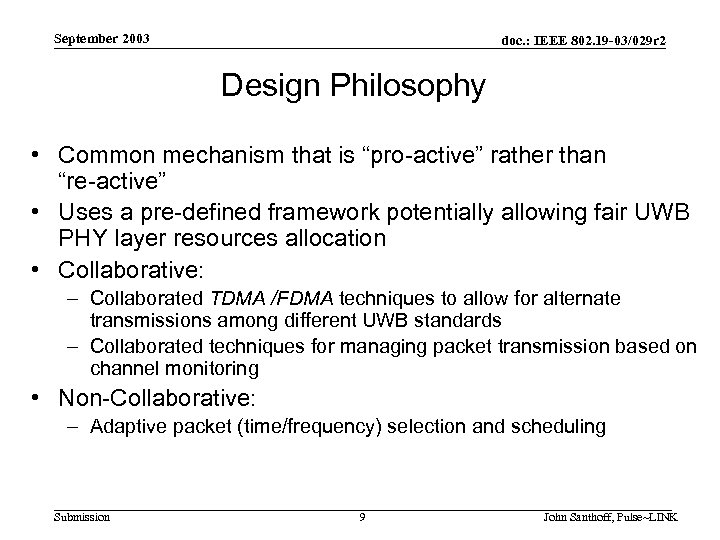
September 2003 doc. : IEEE 802. 19 -03/029 r 2 Design Philosophy • Common mechanism that is “pro-active” rather than “re-active” • Uses a pre-defined framework potentially allowing fair UWB PHY layer resources allocation • Collaborative: – Collaborated TDMA /FDMA techniques to allow for alternate transmissions among different UWB standards – Collaborated techniques for managing packet transmission based on channel monitoring • Non-Collaborative: – Adaptive packet (time/frequency) selection and scheduling Submission 9 John Santhoff, Pulse~LINK
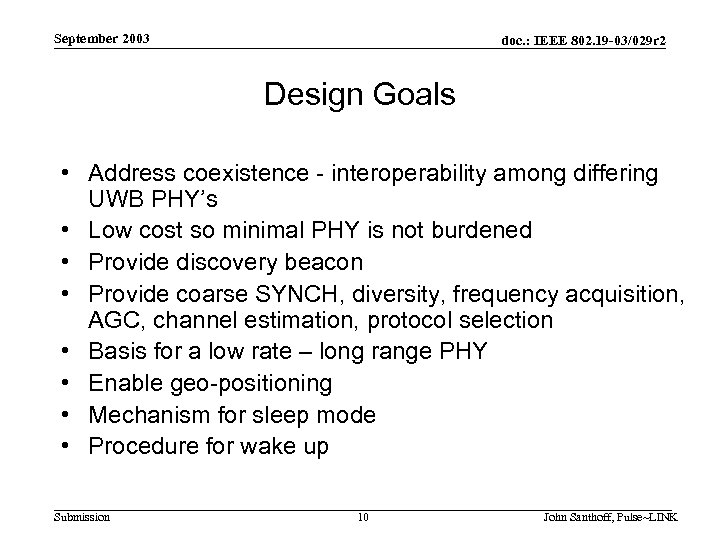
September 2003 doc. : IEEE 802. 19 -03/029 r 2 Design Goals • Address coexistence - interoperability among differing UWB PHY’s • Low cost so minimal PHY is not burdened • Provide discovery beacon • Provide coarse SYNCH, diversity, frequency acquisition, AGC, channel estimation, protocol selection • Basis for a low rate – long range PHY • Enable geo-positioning • Mechanism for sleep mode • Procedure for wake up Submission 10 John Santhoff, Pulse~LINK
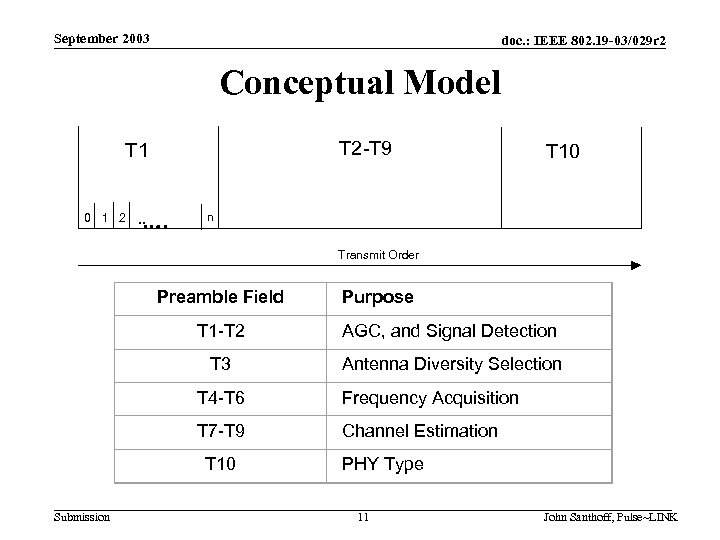
September 2003 doc. : IEEE 802. 19 -03/029 r 2 Conceptual Model T 2 -T 9 T 1 0 1 2 . . . . T 10 n Transmit Order Preamble Field Purpose T 1 -T 2 AGC, and Signal Detection T 3 Antenna Diversity Selection T 4 -T 6 Frequency Acquisition T 7 -T 9 Channel Estimation T 10 Submission PHY Type 11 John Santhoff, Pulse~LINK
September 2003 doc. : IEEE 802. 19 -03/029 r 2 Next Steps? Questions? Comments? Suggestions? Submission 12 John Santhoff, Pulse~LINK
Скачать презентацию September 2003 doc IEEE 802 19 -03 029
797e186bc725d33ca0e31d2ee877cc30.ppt