


 Скачать презентацию SEPG Action items on CMMI findings Nov 10
0940926361b8e55bc1a538e583808d85.ppt
- Количество слайдов: 32
 SEPG Action items on CMMI findings Nov 10 Internal 1
 Agenda l CMMI Appraisal l l Internal Causal Analysis Action Plan 2
 Background l CMMi assessment done by KPMG in Sep 2010 l l Appraisal result is up on the SEI site (http: //sas. sei. cmu. edu/pars. aspx) Scope - Software Solutions Business Locations assessed - Delhi, Kolkata, Bangalore, Mumbai Coverage – All development, maintenance and testing projects of SSB Internal 3
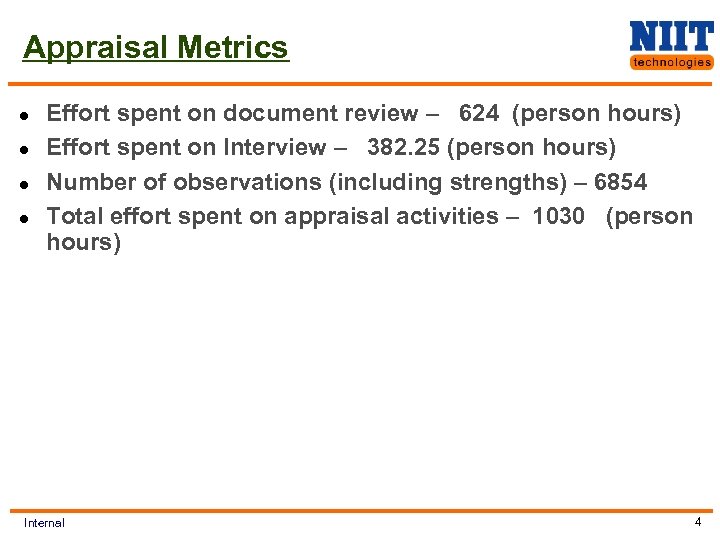 Appraisal Metrics l l Effort spent on document review – 624 (person hours) Effort spent on Interview – 382. 25 (person hours) Number of observations (including strengths) – 6854 Total effort spent on appraisal activities – 1030 (person hours) Internal 4
 Improvement Opportunities l l l Global Process area wise Non-CMMI Findings “ What People Shared “ Internal 5
 Global Notes l Improvement Opportunity : l l l Internal Need to develop and strengthen additional locations from business execution perspective Continued strengthening of sustenance plan with periodic health checks Further Nurturing of High Maturity Practices Sustenance of PCMM drive across organization Usage of models / frameworks such as CMMI SVC, Six Sigma and Lean for holistic improvements Better integration beyond ODCs 6
 Global Notes l SEPG Recommendation : Ë Ë Ë Internal Involvement of KPMG in yearly internal assessment for CMMI (MRM) Sustenance plan for PCMM (MRM) Continued focus on High maturity practices of CMMI, the status can be checked in Internal audits, SMR and through p. H. 7
 RM l Improvement Opportunity : l l l Requirements Management tools can be considered for institutionalization for improving the effectiveness of requirements traceability and change request management Requirements traceability process in support and maintenance projects could be strengthened SEPG Recommendation : Ë Ë Ë Internal Use of requirement traceability metrics template to be strengthened in the projects, to be reviewed and checked by IA and QAM (DH/PM/QAM/IA) Usage of horizontal traceability metrics during impact analysis to be checked by QAM and IA (DH/PM/QAM/IA) In case of unavailability of tool, requirement traceability metrics to be tailored and used in the S&M projects (DH/PM/QAM/IA) 8
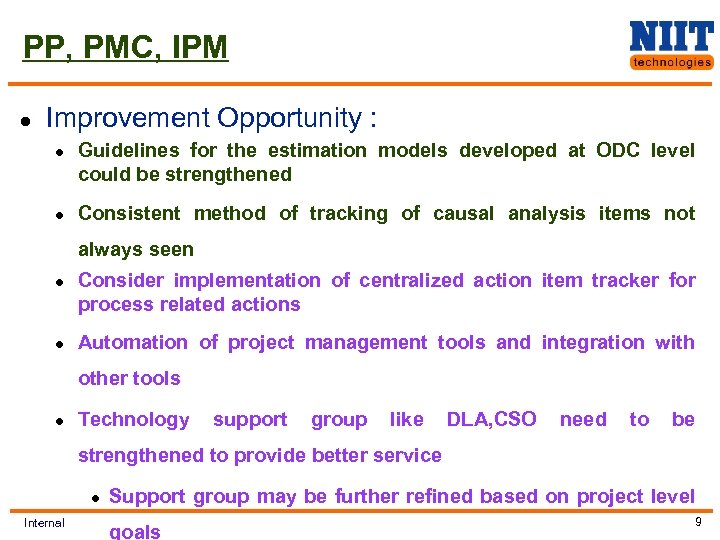 PP, PMC, IPM l Improvement Opportunity : l l Guidelines for the estimation models developed at ODC level could be strengthened Consistent method of tracking of causal analysis items not always seen l l Consider implementation of centralized action item tracker for process related actions Automation of project management tools and integration with other tools l Technology support group like DLA, CSO need to be strengthened to provide better service l Internal Support group may be further refined based on project level goals 9
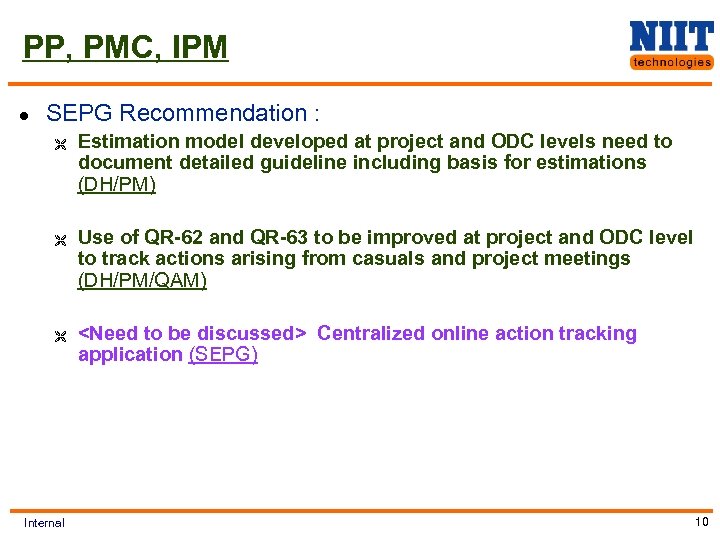 PP, PMC, IPM l SEPG Recommendation : Ë Ë Ë Internal Estimation model developed at project and ODC levels need to document detailed guideline including basis for estimations (DH/PM) Use of QR-62 and QR-63 to be improved at project and ODC level to track actions arising from casuals and project meetings (DH/PM/QAM)
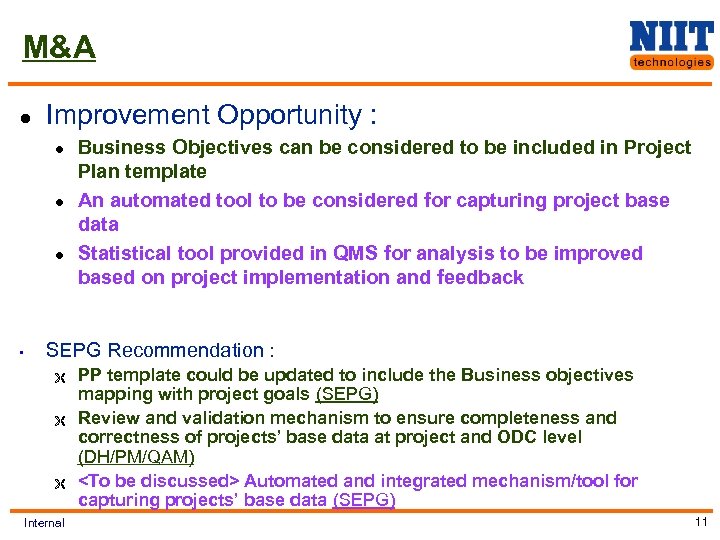 M&A l Improvement Opportunity : l l l • Business Objectives can be considered to be included in Project Plan template An automated tool to be considered for capturing project base data Statistical tool provided in QMS for analysis to be improved based on project implementation and feedback SEPG Recommendation : Ë Ë Ë Internal PP template could be updated to include the Business objectives mapping with project goals (SEPG) Review and validation mechanism to ensure completeness and correctness of projects’ base data at project and ODC level (DH/PM/QAM)
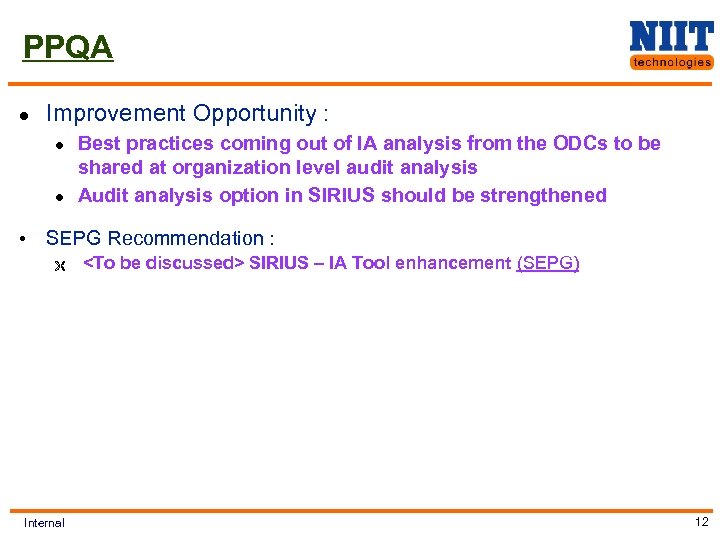 PPQA l Improvement Opportunity : l l • Best practices coming out of IA analysis from the ODCs to be shared at organization level audit analysis Audit analysis option in SIRIUS should be strengthened SEPG Recommendation : Ë Internal
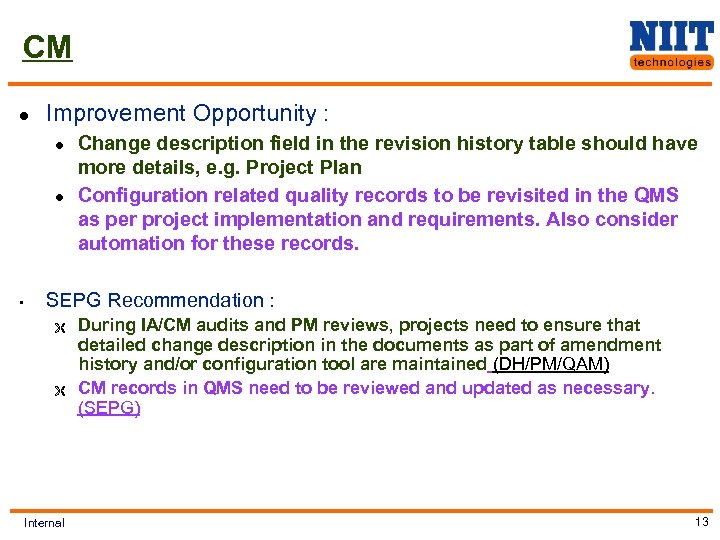 CM l Improvement Opportunity : l l • Change description field in the revision history table should have more details, e. g. Project Plan Configuration related quality records to be revisited in the QMS as per project implementation and requirements. Also consider automation for these records. SEPG Recommendation : Ë Ë Internal During IA/CM audits and PM reviews, projects need to ensure that detailed change description in the documents as part of amendment history and/or configuration tool are maintained (DH/PM/QAM) CM records in QMS need to be reviewed and updated as necessary. (SEPG) 13
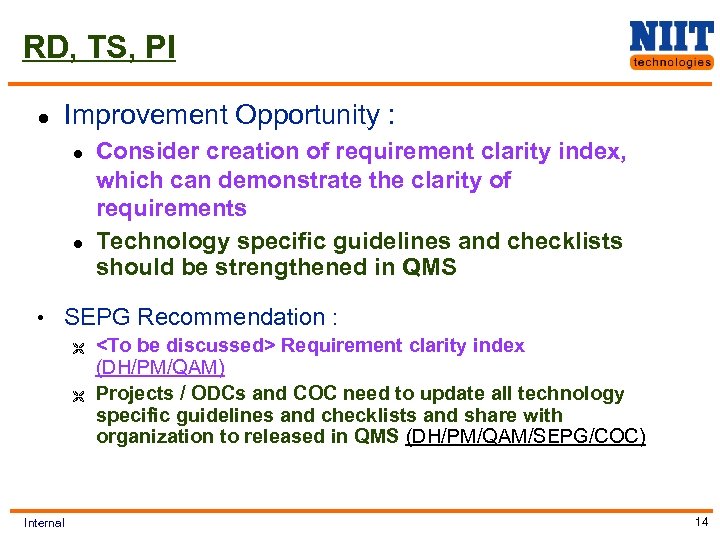 RD, TS, PI l Improvement Opportunity : l l Consider creation of requirement clarity index, which can demonstrate the clarity of requirements Technology specific guidelines and checklists should be strengthened in QMS • SEPG Recommendation : Ë Ë Internal
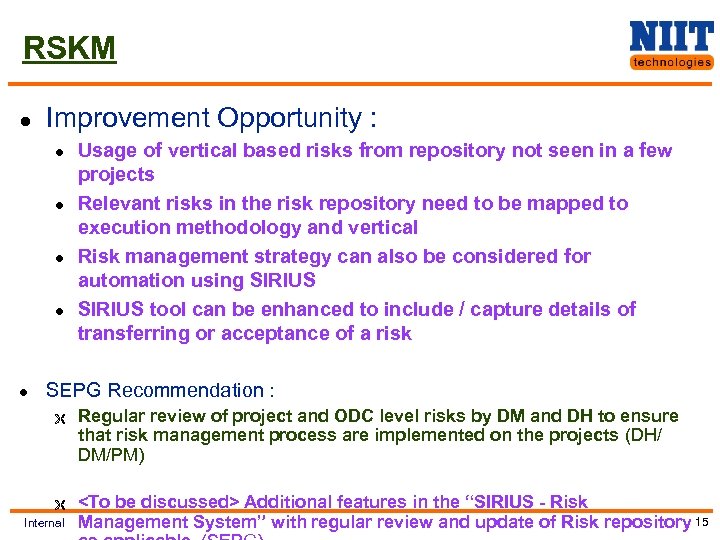 RSKM l Improvement Opportunity : l l l Usage of vertical based risks from repository not seen in a few projects Relevant risks in the risk repository need to be mapped to execution methodology and vertical Risk management strategy can also be considered for automation using SIRIUS tool can be enhanced to include / capture details of transferring or acceptance of a risk SEPG Recommendation : Ë Ë Internal Regular review of project and ODC level risks by DM and DH to ensure that risk management process are implemented on the projects (DH/ DM/PM)
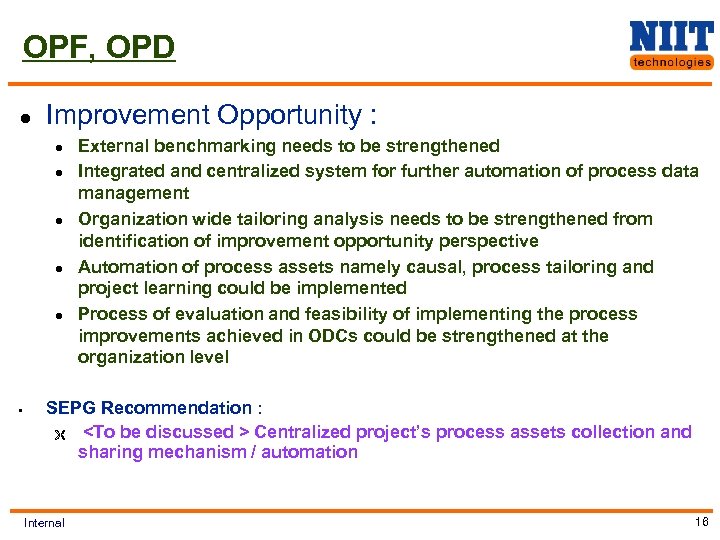 OPF, OPD l Improvement Opportunity : l l l • External benchmarking needs to be strengthened Integrated and centralized system for further automation of process data management Organization wide tailoring analysis needs to be strengthened from identification of improvement opportunity perspective Automation of process assets namely causal, process tailoring and project learning could be implemented Process of evaluation and feasibility of implementing the process improvements achieved in ODCs could be strengthened at the organization level SEPG Recommendation : Ë
 OT l Improvement Opportunity : • • • Online availability of training data to relevant stakeholders for further actions Post training effectiveness need to be captured analysed SEPG Recommendation : Ë
 VER, VAL l Improvement Opportunity : l l • Institutionalization of the code quality dashboard Tools for automation of unit test cases can be further strengthened Evaluation and selection of relevant review techniques need to be Strengthened Automation of defect collection and analysis can be considered SEPG Recommendation : Ë Mandatory use of dashboard view during internal projects reviews for all types of projects (DH/DM) Ë
 DAR l Improvement Opportunity : l • Repository of DAR’s to be maintained at the Organization level SEPG Recommendation : Ë Ë Internal Wherever possible DAR evaluation should be a planned activity and tracked to closure (DH/PM/QAM)
 Organizational Process Performance l Strengths: l Quality and Process performance objectives are identified at organization level and decomposition of the same is evident at the business units level and ODCs level l Macro and micro level baselines based on methods/techniques are established l Process performance models are established at organization level for development projects, at ODCs level for support & maintenance and testing lifecycle projects l ANOVA and regression are used while building the process performance models Internal 20
 Organizational Process Performance l Improvement Opportunity : l l l Usage of micro baselines for process composition not seen in a few projects Micro-Level baselines could include more number of methods or techniques, along with greater projects data PPM equations could include more number of planning parameters of the repeatable activities which are controllable within the sub-process • SEPG Recommendation : Ë Ë Internal Brainstorming to identify actions for improving projects’ base data collection and data quality to establish more number of micro-level baselines for project use. (SEPG, DH) Look for creating more relevant PPM at ODC/project level. Revision of existing PPM by considering more data points and parameters. (SEPG/QAM) 21
 Quantitative Project Management l Strengths: l PPMs and PPBs have also been established and maintained at ODC and Project level l PPMs are used in selected projects on periodic basis by project managers to predict project end objectives and take preventive/corrective actions on sub processes if necessary Internal 22
 Quantitative Project Management l Improvement Opportunity : l l l Automation of metrics collection process More simulation techniques can be considered for predicting the probability of achieving project objectives Training module on quantitative project management needs to be strengthened including various statistical and simulation techniques and this should be part of the project management training • SEPG Recommendation : Ë Ë Ë Internal Brainstorming to identify feasibility and extent of data collection and consolidation automation – (SEPG, DH/QAM) Identify other simulation techniques used in the industry and brainstorming for feasibility – (SEPG) Review and updating of PM and QMS training material and training approach - (SEPG) 23
 Organizational Innovation and Deployment l Strengths : l l l Internal Organizational technology initiatives selected, rolled out, deployed and measured effectively. Centers of competence driving the innovation across projects. Improvement initiatives are identified either based on business objectives or from root cause analysis Hypothesis testing is used at organization level to understand the significance of improvement made through the improvement initiative 24
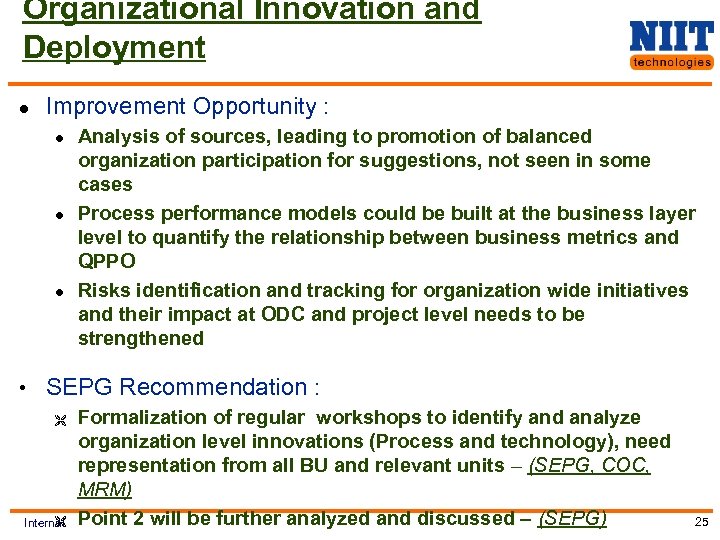 Organizational Innovation and Deployment l Improvement Opportunity : l l l Analysis of sources, leading to promotion of balanced organization participation for suggestions, not seen in some cases Process performance models could be built at the business layer level to quantify the relationship between business metrics and QPPO Risks identification and tracking for organization wide initiatives and their impact at ODC and project level needs to be strengthened • SEPG Recommendation : Ë Ë Internal Formalization of regular workshops to identify and analyze organization level innovations (Process and technology), need representation from all BU and relevant units – (SEPG, COC, MRM) Point 2 will be further analyzed and discussed – (SEPG) 25
 Causal Analysis and Resolution l Strengths: l Internal Customer feedback at Project level is analyzed and actions implemented & monitored. 26
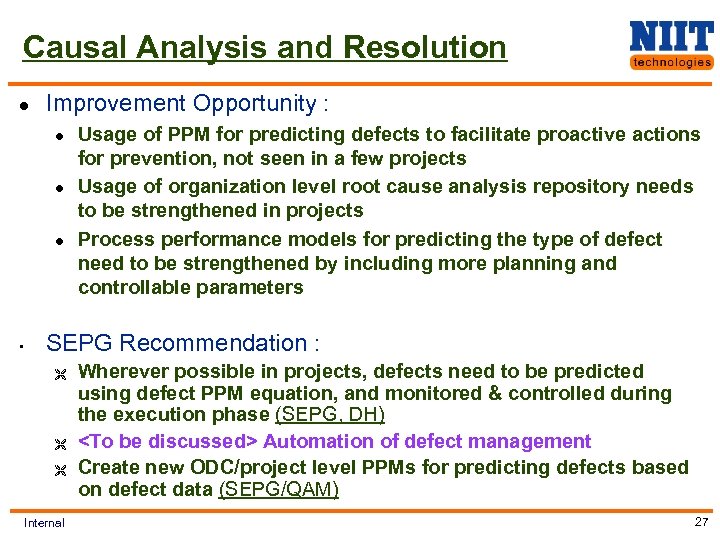 Causal Analysis and Resolution l Improvement Opportunity : l l l • Usage of PPM for predicting defects to facilitate proactive actions for prevention, not seen in a few projects Usage of organization level root cause analysis repository needs to be strengthened in projects Process performance models for predicting the type of defect need to be strengthened by including more planning and controllable parameters SEPG Recommendation : Ë Ë Ë Internal Wherever possible in projects, defects need to be predicted using defect PPM equation, and monitored & controlled during the execution phase (SEPG, DH)
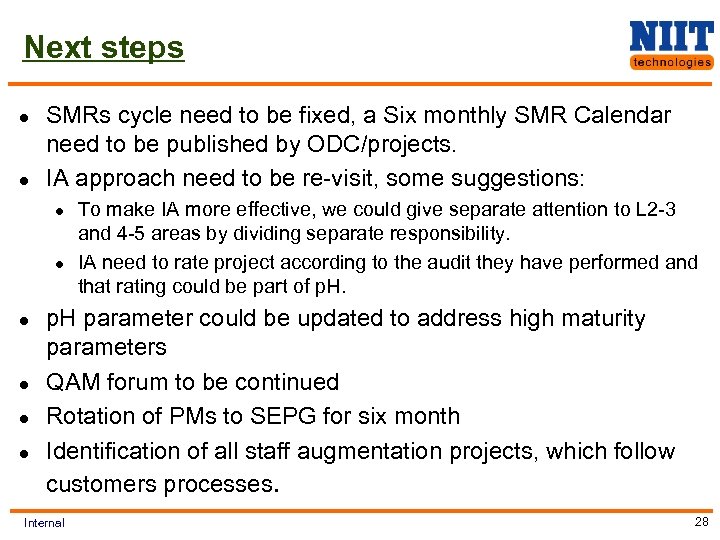 Next steps l l SMRs cycle need to be fixed, a Six monthly SMR Calendar need to be published by ODC/projects. IA approach need to be re-visit, some suggestions: l l l To make IA more effective, we could give separate attention to L 2 -3 and 4 -5 areas by dividing separate responsibility. IA need to rate project according to the audit they have performed and that rating could be part of p. H parameter could be updated to address high maturity parameters QAM forum to be continued Rotation of PMs to SEPG for six month Identification of all staff augmentation projects, which follow customers processes. Internal 28
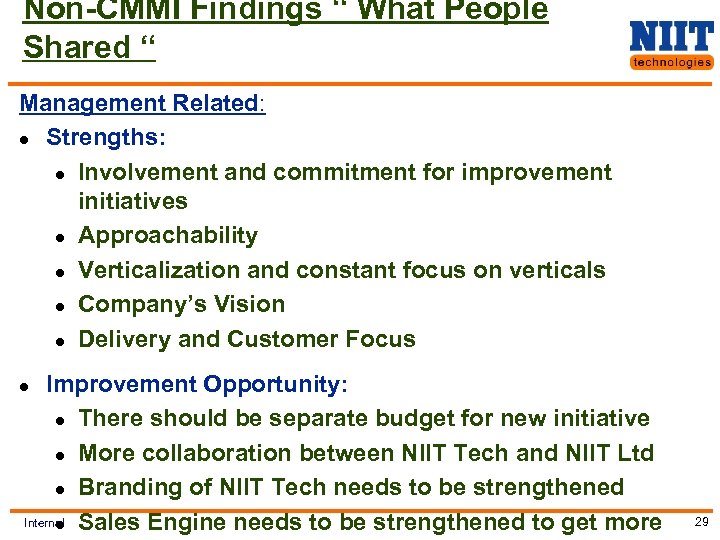 Non-CMMI Findings “ What People Shared “ Management Related: l Strengths: l Involvement and commitment for improvement initiatives l Approachability l Verticalization and constant focus on verticals l Company’s Vision l Delivery and Customer Focus Improvement Opportunity: l There should be separate budget for new initiative l More collaboration between NIIT Tech and NIIT Ltd l Branding of NIIT Tech needs to be strengthened Internal Sales Engine needs to be strengthened to get more l l 29
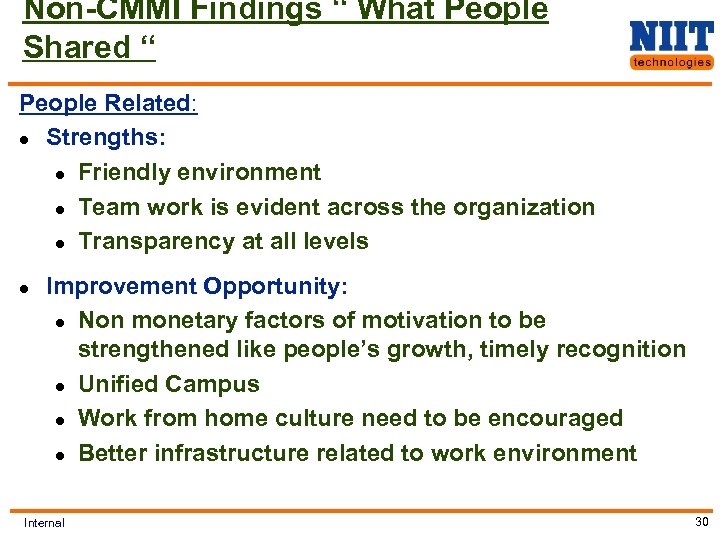 Non-CMMI Findings “ What People Shared “ People Related: l Strengths: l Friendly environment l Team work is evident across the organization l Transparency at all levels l Improvement Opportunity: l Non monetary factors of motivation to be strengthened like people’s growth, timely recognition l Unified Campus l Work from home culture need to be encouraged l Better infrastructure related to work environment Internal 30
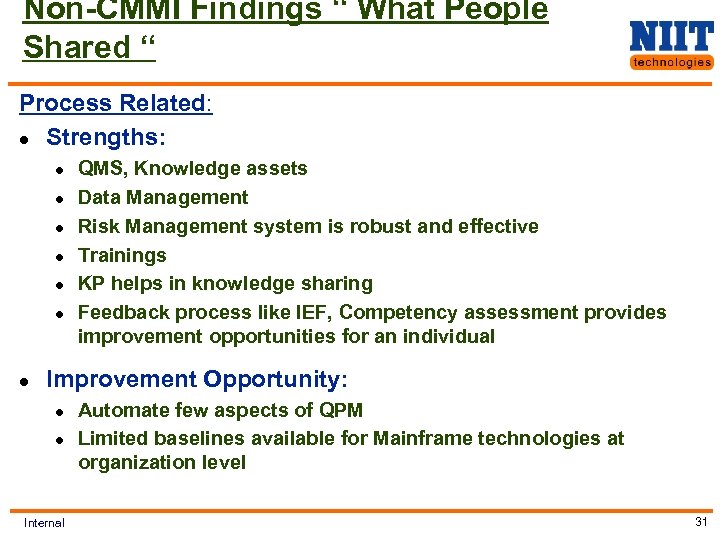 Non-CMMI Findings “ What People Shared “ Process Related: l Strengths: l l l l QMS, Knowledge assets Data Management Risk Management system is robust and effective Trainings KP helps in knowledge sharing Feedback process like IEF, Competency assessment provides improvement opportunities for an individual Improvement Opportunity: l l Internal Automate few aspects of QPM Limited baselines available for Mainframe technologies at organization level 31
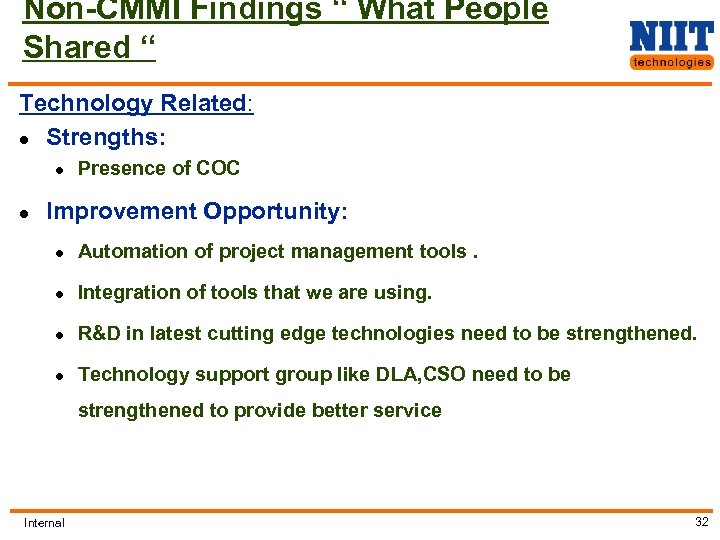 Non-CMMI Findings “ What People Shared “ Technology Related: l Strengths: l l Presence of COC Improvement Opportunity: l Automation of project management tools. l Integration of tools that we are using. l R&D in latest cutting edge technologies need to be strengthened. l Technology support group like DLA, CSO need to be strengthened to provide better service Internal 32