 Скачать презентацию Separation of powers Brazil State political device
Separation of powers Brazil.pptx
- Количество слайдов: 9



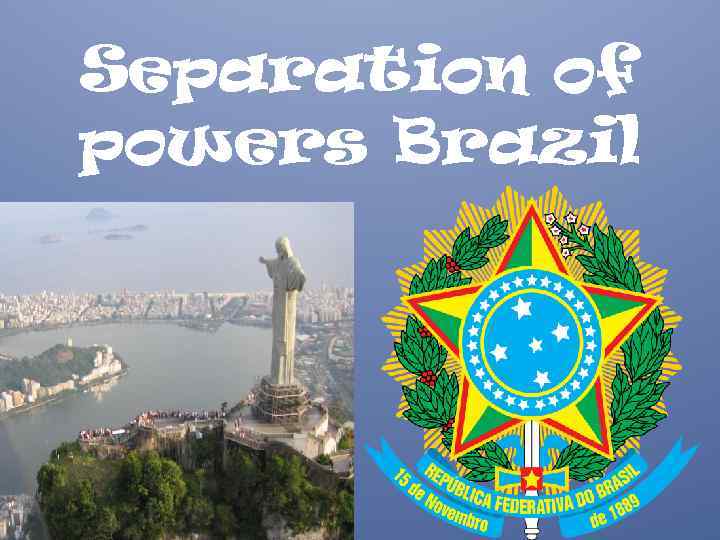
Separation of powers Brazil
State political device • The form of Brazil is a presidential republic, the chief executive is the president, who is elected for four years and are eligible for re-election. • The supreme legislative body is the National Congress, consisting of two chambers: the Federal Senate (81 seats) and the Chamber of Deputies (513 seats). • Supreme judicial power is vested in the Federal Supreme Court, which is responsible for the correctness of the interpretation and application of the Brazilian Constitution.
The Brazilian Constitution • In Brazil's history in the country were seven constitutions. The current Constitution of Brazil, adopted on 5 October 1988. The work on it participated specially convened the Constituent Assembly, as well as a significant portion of the population. [21] • The Brazilian Constitution comprises 250 articles, preamble and transitional provisions. As of May 2011 it made 67 amendments.
Brazil is… federal republic administratively divided into 26 states and the Federal District. State government has a similar structure with the federal government and have the same powers (embodied in their own constitutions), except those that relate to the competence of the federal government or included in the functions of municipal councils. State's chief executive is a governor elected by popular vote for a term of 4 years.
Voting The President and Vice-President of the Republic shall be elected by direct universal suffrage for a term of 4 years. The last presidential elections were held on 31 October 2010. Incumbent President - Dilma Rousseff.
Parliament Brazil • Bicameral National Congress consists of the Federal Senate ( 81 seats : 3 members from each state and the District ) and the Chamber of Deputies ( 513 seats), who are elected for four - year terms. • October 3, 2010 , the regular parliamentary election. President of the Chamber of Deputies from 2010 Marco Maia, of the Workers' Party , was elected from the state of Rio Grande do Sul. Party factions in the Chamber of Deputies : • • • • Workers' Party ( PT ) - Left ( Party Lula da Silva ) - 88 Brazilian Democratic Movement Party ( centrist ) - 79 Brazilian Social Democratic Party ( center-left ) - 53 Democrats ( centrist ) - 43 Progressivist Party ( centrist ) - 41 Republic Party ( centrist ) - 41 The Socialist Party (left ) - 34 Democratic Labor Party (left ) - 28 Labor Party (left ) - 21 Social Christian Party ( levotsentristkaya ) - 17 Green Party ( centrist ) - 15 Communist Party ( far left ) - 15 seats People's Socialist Party ( center-left ) - 12 Republican Party ( centrist ) - 8 In the Chamber of Deputies has presented several parties - 18 deputies. • President of the Federal Senate from 2009 - Jose Sarney.
Domestic policy In some places there are separatist sentiments. In ethno-cultural specificity of having the Southern region were attempts proclamation republic of Pampa Gaucho (Republic of Gaucho Pampas) in the state of Rio Grande do Sul (historically been former breakaway republic) and the Movement "South this is my country" Federal Republic of Pampa (Federal Republic of Pampas) throughout the region. In the most economically developed state of Sao Paulo this idea put forward Motion Republic of Sao Paulo and the Independence Movement of Sao Paulo.
Foreign policy • Traditionally , Brazil has been a leader in the Latin American community and played an important role in the system of collective security and economic cooperation in the Western Hemisphere. Now she is a member of the Inter-American Treaty of Reciprocal Assistance , and a member of the Organization of American States. Recently, Brazil has become to give high priority to relations with its South American neighbors and became a part of the Amazon Pact , Latin American Integration Association and Mercosur. Together with Argentina , Chile and the United States , Brazil one of the guarantors of the Peruvian -Ecuadorian peace process. She sent soldiers in the UN troops to keep the peace in the Belgian Congo , Cyprus , Mozambique , Angola , East Timor and Haiti. In 2004 -2005, Brazil was part of the UN Security Council for the ninth time. • Open-ended questions Brazilian foreign policy include several outstanding sections of the border with Uruguay , Brazil unrecognized zone of interest in Antarctica , overlapping with the British and Argentine areas, efforts to expand marine economic zone along the Brazilian coast , and attempts together with Germany, Japan and India to become permanent members of the Security Council UN.

Thank you for your attention
Скачать презентацию Separation of powers Brazil State political device
Separation of powers Brazil.pptx