


 Скачать презентацию SEP Crustal Research Group Passive Seismic Imaging Return to
a7f8561e96eeea38fea8c21ea20cdbc4.ppt
- Количество слайдов: 45
 SEP/Crustal Research Group Passive Seismic Imaging Return to Passive Imaging Brad Artman June, 6 2002 Ph. D. Proposal brad@sep. stanford. edu 1
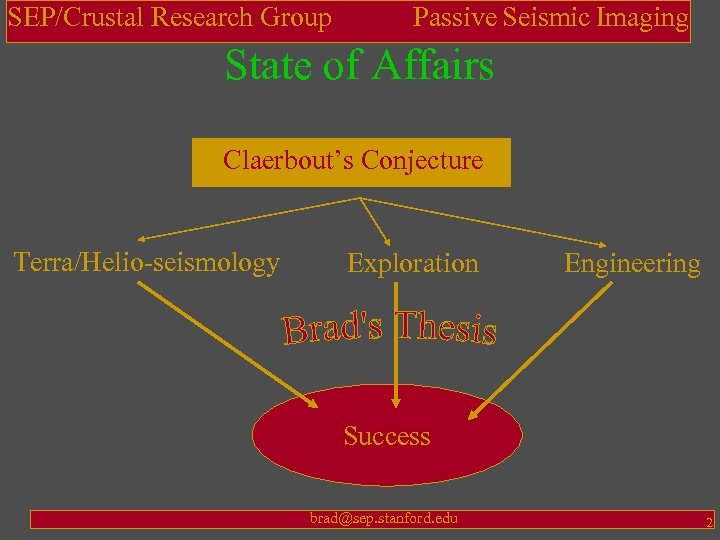 SEP/Crustal Research Group Passive Seismic Imaging State of Affairs Claerbout’s Conjecture Terra/Helio-seismology Exploration Engineering Success brad@sep. stanford. edu 2
 SEP/Crustal Research Group • • • Passive Seismic Imaging The nutshell Why it works As it stands Toward the goal How to finish When will all this be ready? brad@sep. stanford. edu 3
 SEP/Crustal Research Group Passive Seismic Imaging • The nutshell – Problem – Importance – Proposal • • • Why it works As it stands Toward the goal How to finish When will all this be ready? brad@sep. stanford. edu 4
 SEP/Crustal Research Group Passive Seismic Imaging Problem • Who knows if passive seismic imaging works? – Why (not)? brad@sep. stanford. edu 5
 SEP/Crustal Research Group Passive Seismic Imaging Importance • Lots of people care about the subsurface. • No source required opens opportunities for: – Monitoring – Reconnaissance – Restricted access sites – Old long data sets – New long data sets brad@sep. stanford. edu 6
 SEP/Crustal Research Group Passive Seismic Imaging Proposal I propose to answer whether or not the passive seismic experiment can be used as a practicable methodology for subsurface imaging and/or monitoring. + or - I’ll tell you why. brad@sep. stanford. edu 7
 SEP/Crustal Research Group Passive Seismic Imaging • The nutshell • Why it works – Intuitive explanation – Rigorous explanation • • As it stands Toward the goal How to finish When will all this be ready? brad@sep. stanford. edu 8
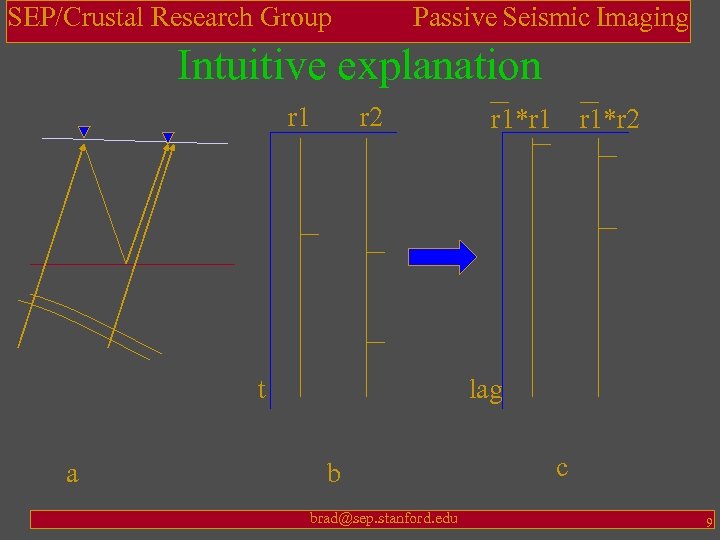 SEP/Crustal Research Group Passive Seismic Imaging Intuitive explanation r 1 r 2 t a r 1*r 1 r 1*r 2 lag b brad@sep. stanford. edu c 9
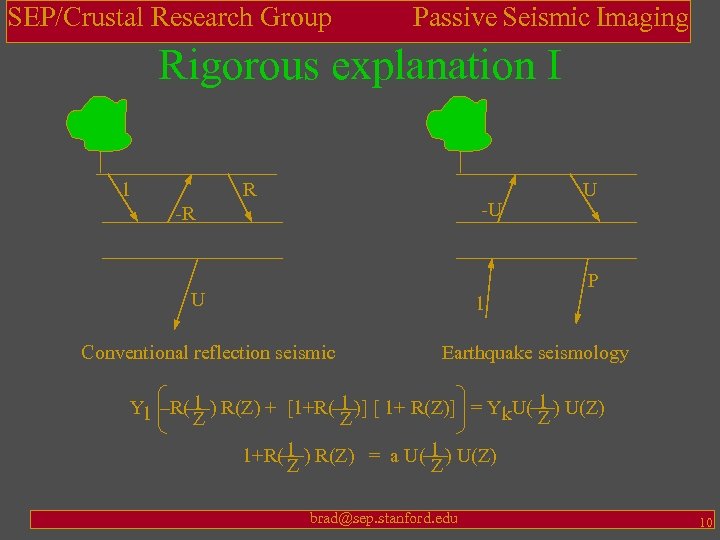 SEP/Crustal Research Group Passive Seismic Imaging Rigorous explanation I 1 R -U -R U P U 1 Conventional reflection seismic Earthquake seismology Y 1 –R( 1 ) R(Z) + [1+R( 1 )] [ 1+ R(Z)] = Yk. U( 1 ) U(Z) Z Z Z 1+R( 1 ) R(Z) = a U( 1 ) U(Z) Z Z brad@sep. stanford. edu 10
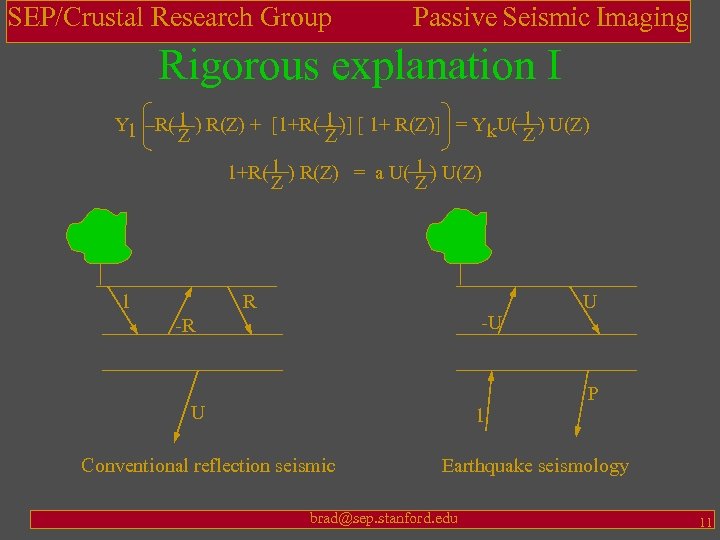 SEP/Crustal Research Group Passive Seismic Imaging Rigorous explanation I Y 1 –R( 1 ) R(Z) + [1+R( 1 )] [ 1+ R(Z)] = Yk. U( 1 ) U(Z) Z Z Z 1+R( 1 ) R(Z) = a U( 1 ) U(Z) Z Z 1 R -U -R U P U 1 Conventional reflection seismic Earthquake seismology brad@sep. stanford. edu 11
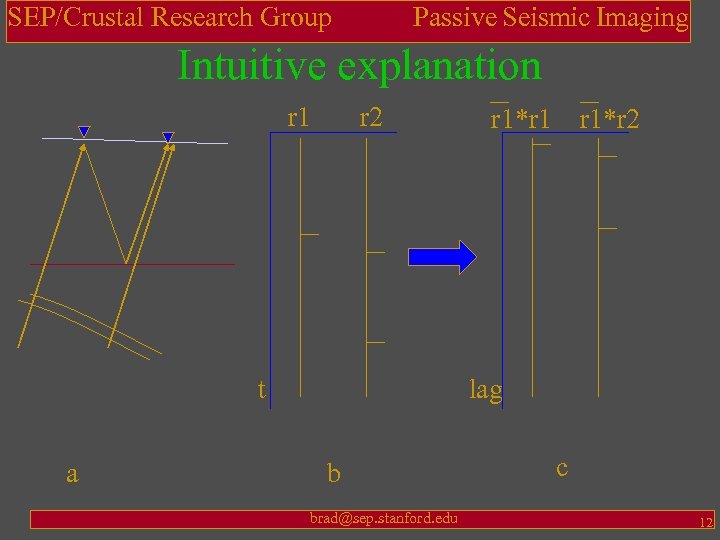 SEP/Crustal Research Group Passive Seismic Imaging Intuitive explanation r 1 r 2 t a r 1*r 1 r 1*r 2 lag b brad@sep. stanford. edu c 12
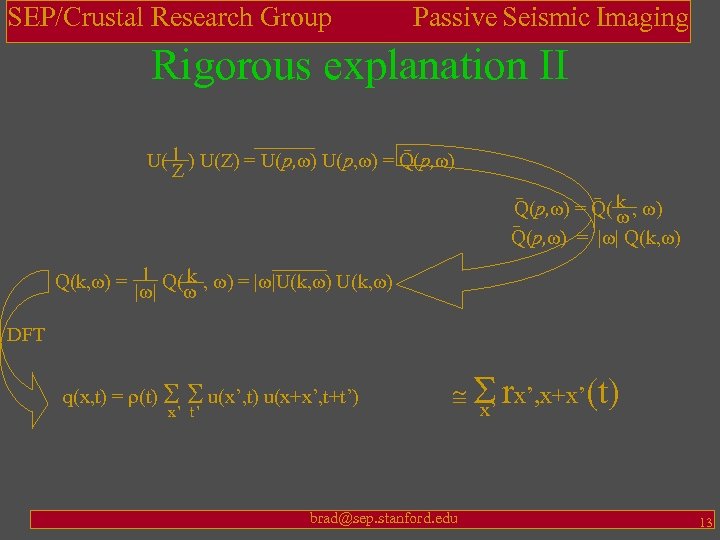 SEP/Crustal Research Group Passive Seismic Imaging Rigorous explanation II U( 1 ) U(Z) = U(p, ω) = Q(p, ω) Z k Q(p, ω) = Q( ω , ω) Q(p, ω) = |ω| Q(k, ω) 1 k Q(k, ω) = |ω| Q(ω , ω) = |ω|U(k, ω) DFT q(x, t) = r(t) S S u(x’, t) u(x+x’, t+t’) x’ t’ @ brad@sep. stanford. edu S rx’, x+x’(t) x’ 13
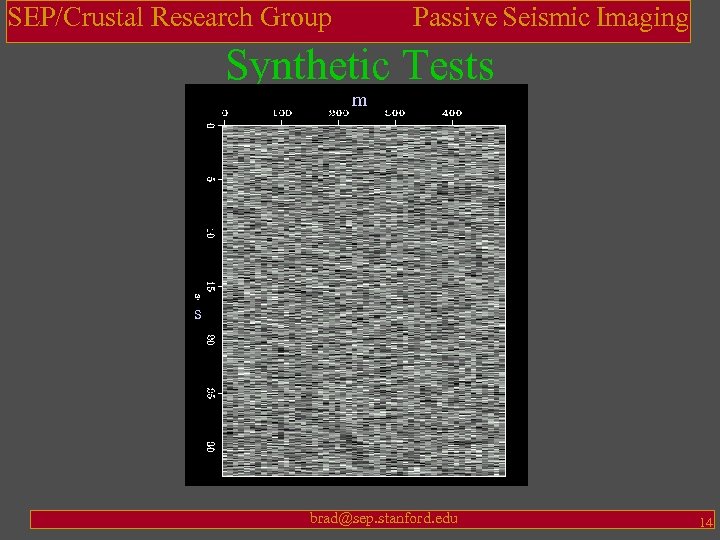 SEP/Crustal Research Group Passive Seismic Imaging Synthetic Tests m s brad@sep. stanford. edu 14
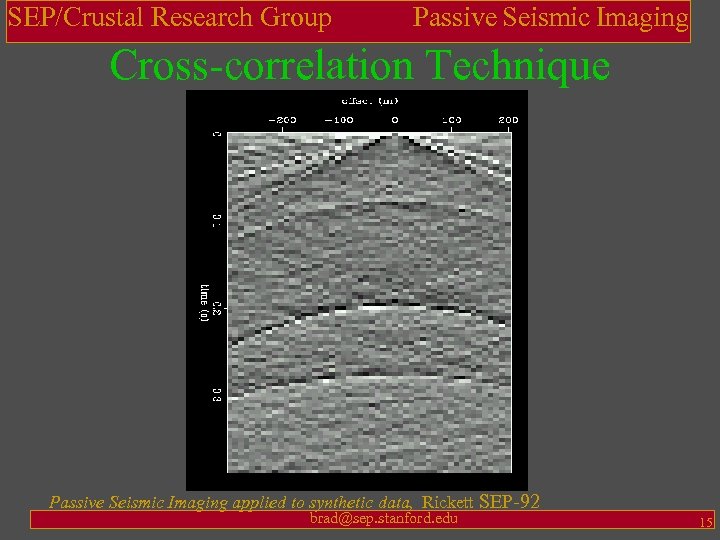 SEP/Crustal Research Group Passive Seismic Imaging Cross-correlation Technique Passive Seismic Imaging applied to synthetic data, Rickett SEP-92 brad@sep. stanford. edu 15
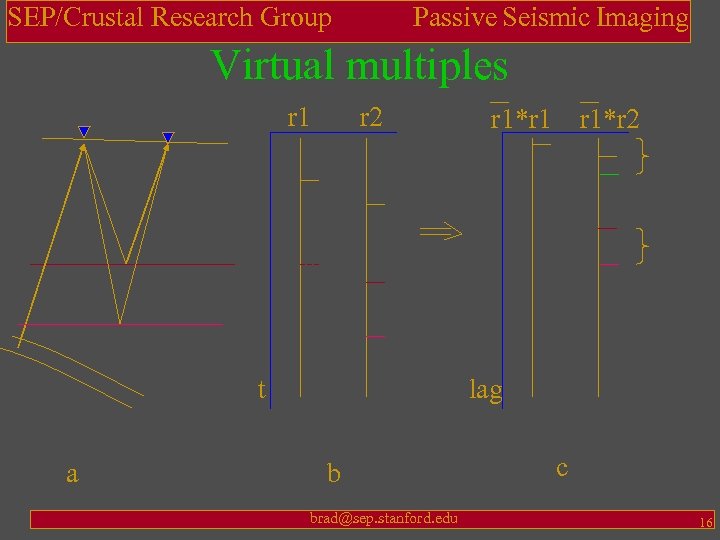 SEP/Crustal Research Group Passive Seismic Imaging Virtual multiples r 1 r 2 t a r 1*r 1 r 1*r 2 lag b brad@sep. stanford. edu c 16
 SEP/Crustal Research Group Passive Seismic Imaging • The nutshell • Why it works • As it stands – It works! – On the shoulders of giants – The race • Toward the goal • How to finish • When will all this be ready? brad@sep. stanford. edu 17
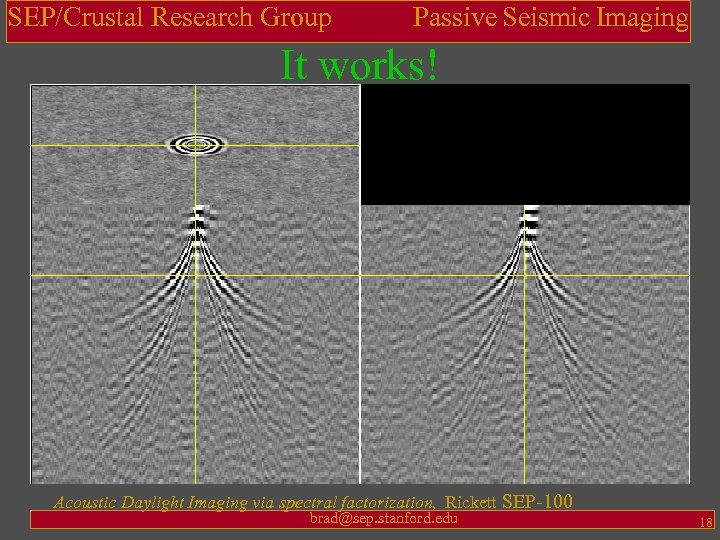 SEP/Crustal Research Group Passive Seismic Imaging It works! Acoustic Daylight Imaging via spectral factorization, Rickett SEP-100 brad@sep. stanford. edu 18
 SEP/Crustal Research Group Passive Seismic Imaging On the shoulders of giants • SEP reports 60 – 86, 100 – SEP’s Franciscan effort and analysis • Schuster – Correlation migration – Drill bit source • Bostock – Earthquake array seismograms • Louie – Engineering characterization brad@sep. stanford. edu 19
 SEP/Crustal Research Group Passive Seismic Imaging The Race • • Undisclosed submission Company interest Livermore? ? ? The earth from satellite? brad@sep. stanford. edu 20
 SEP/Crustal Research Group • • Passive Seismic Imaging The nutshell Why it works As it stands Toward the goal – Is 2 D possible? – Reformulation as migration – Motivation to invert – Sampling the noise-field – Shape of the noise-field – Artman Geo. Services • How to finish • When will all this be ready? brad@sep. stanford. edu 21
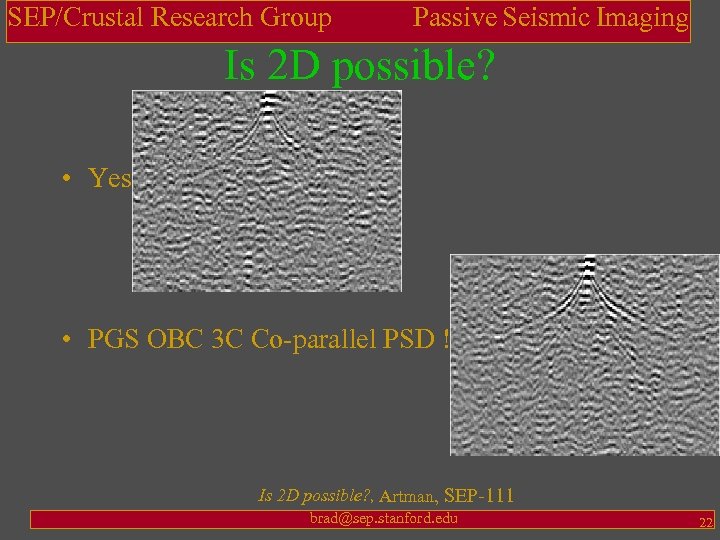 SEP/Crustal Research Group Passive Seismic Imaging Is 2 D possible? • Yes • PGS OBC 3 C Co-parallel PSD ! Is 2 D possible? , Artman, SEP-111 brad@sep. stanford. edu 22
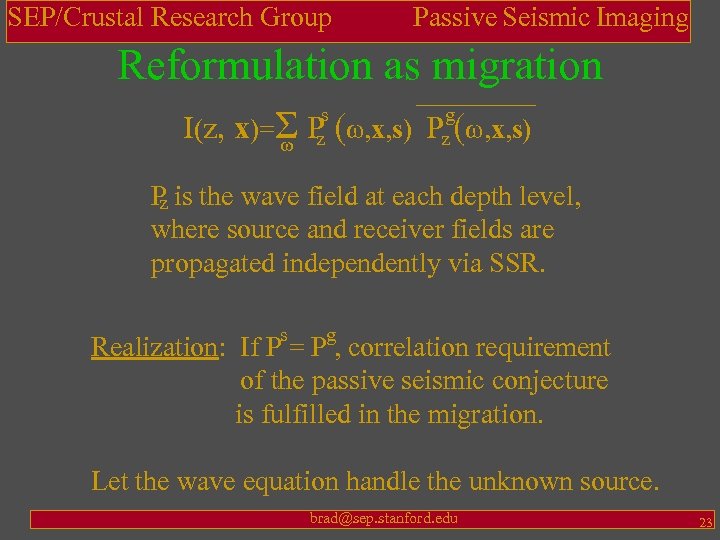 SEP/Crustal Research Group Passive Seismic Imaging Reformulation as migration I(z, x)=Σ P (ω, x, s) ω s z g z P is the wave field at each depth level, z where source and receiver fields are propagated independently via SSR. s g Realization: If P = P , correlation requirement of the passive seismic conjecture is fulfilled in the migration. Let the wave equation handle the unknown source. brad@sep. stanford. edu 23
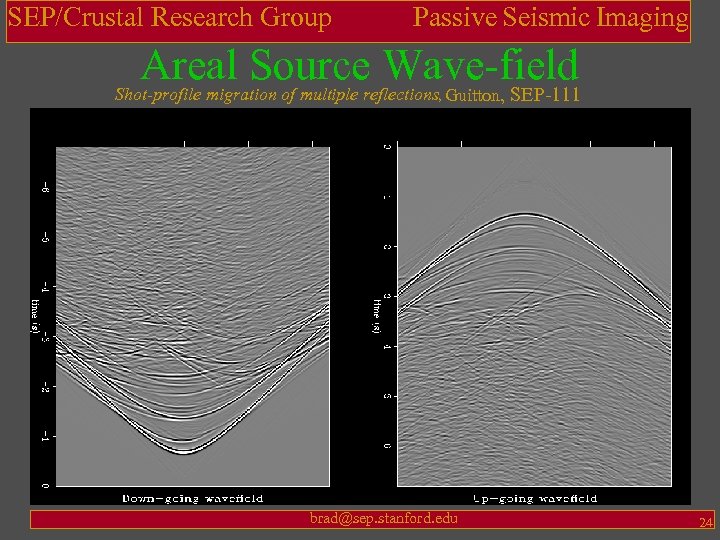 SEP/Crustal Research Group Passive Seismic Imaging Areal Sourcereflections, Guitton, SEP-111 Wave-field Shot-profile migration of multiple brad@sep. stanford. edu 24
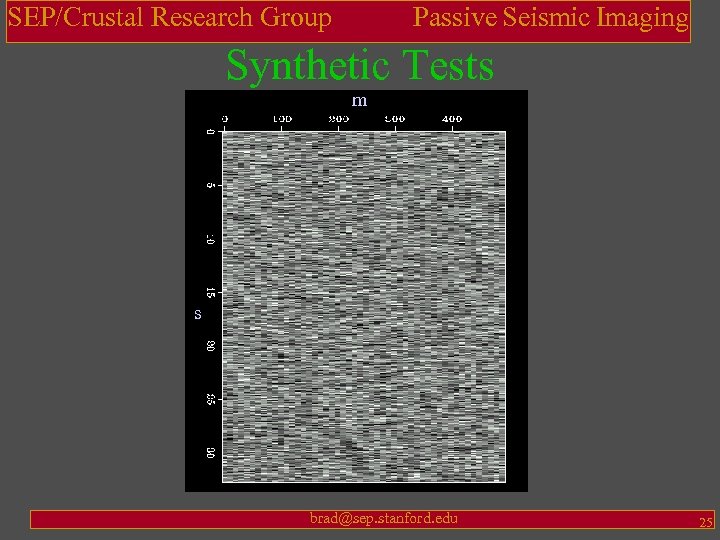 SEP/Crustal Research Group Passive Seismic Imaging Synthetic Tests m s brad@sep. stanford. edu 25
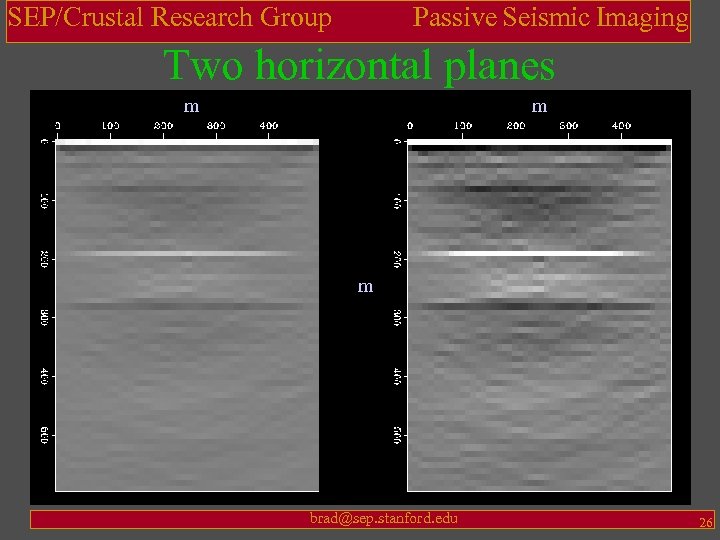 SEP/Crustal Research Group Passive Seismic Imaging Two horizontal planes m m m brad@sep. stanford. edu 26
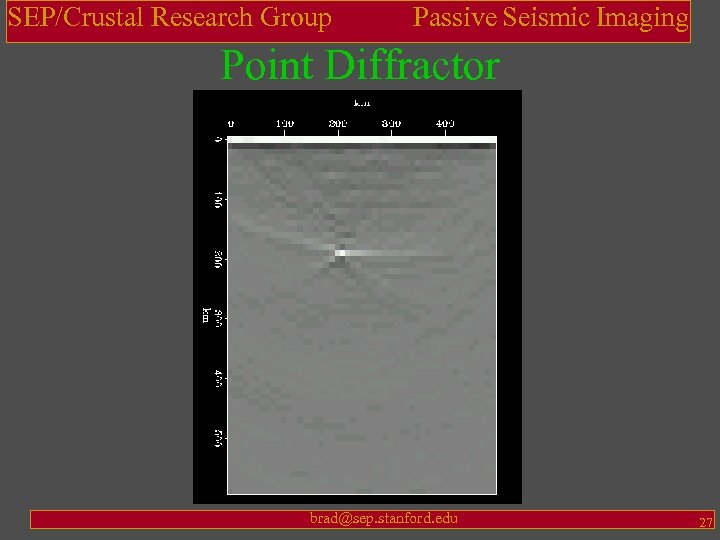 SEP/Crustal Research Group Passive Seismic Imaging Point Diffractor brad@sep. stanford. edu 27
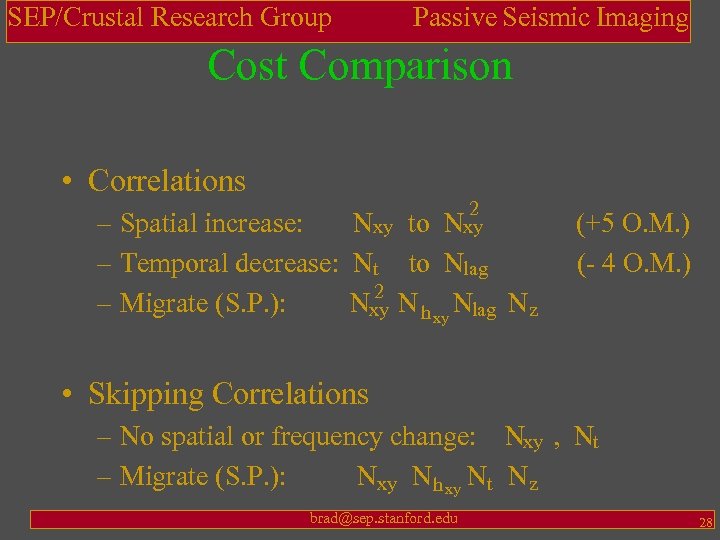 SEP/Crustal Research Group Passive Seismic Imaging Cost Comparison • Correlations 2 Nxy – Spatial increase: Nxy to – Temporal decrease: Nt to Nlag 2 – Migrate (S. P. ): Nxy N h xy Nlag Nz (+5 O. M. ) (- 4 O. M. ) • Skipping Correlations – No spatial or frequency change: Nxy , Nt – Migrate (S. P. ): Nxy N h xy Nt Nz brad@sep. stanford. edu 28
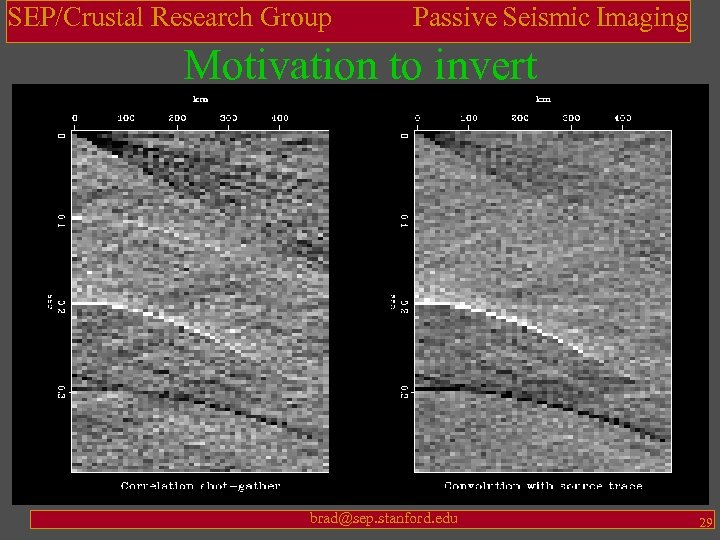 SEP/Crustal Research Group Passive Seismic Imaging Motivation to invert brad@sep. stanford. edu 29
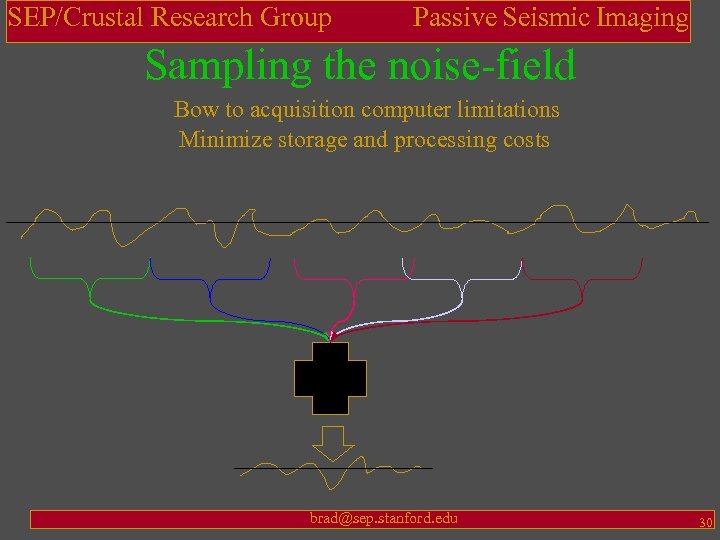 SEP/Crustal Research Group Passive Seismic Imaging Sampling the noise-field Bow to acquisition computer limitations Minimize storage and processing costs brad@sep. stanford. edu 30
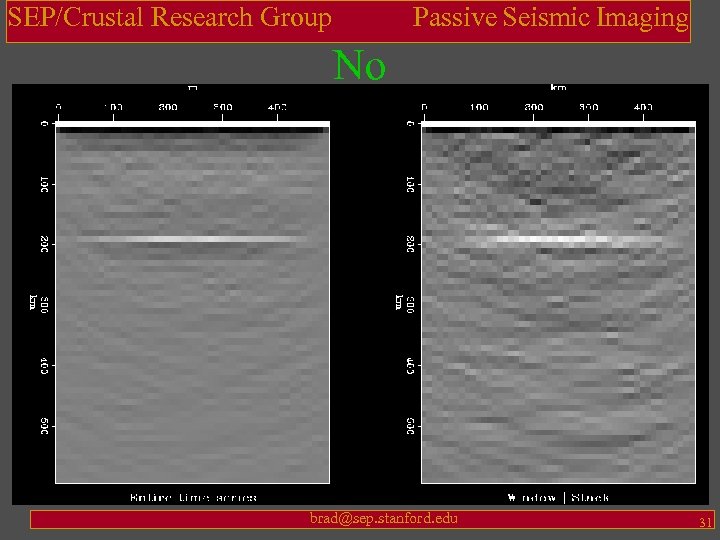 SEP/Crustal Research Group Passive Seismic Imaging No brad@sep. stanford. edu 31
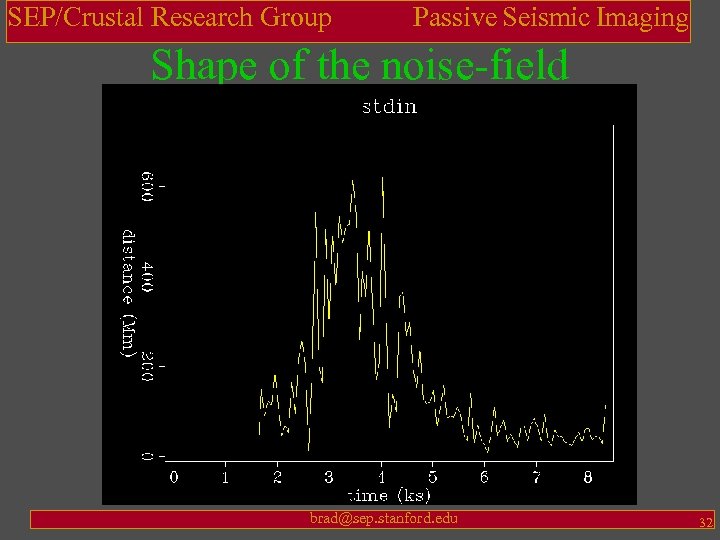 SEP/Crustal Research Group Passive Seismic Imaging Shape of the noise-field brad@sep. stanford. edu 32
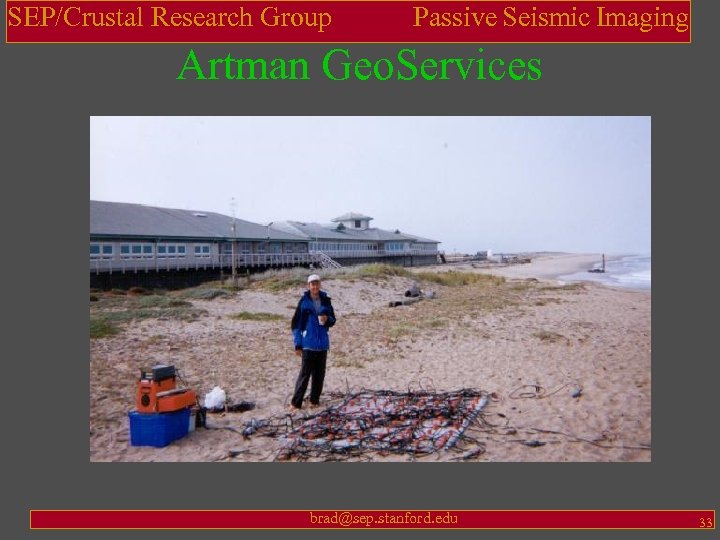 SEP/Crustal Research Group Passive Seismic Imaging Artman Geo. Services brad@sep. stanford. edu 33
 SEP/Crustal Research Group • • • Passive Seismic Imaging The nutshell Why it works As it stands Toward the goal How to finish – Brad, the sun, and your coffee table – Santa Clara Valley Seismic Experiment – Recast as deconvolution – Wave-field separation • When will all this be ready? brad@sep. stanford. edu 34
 SEP/Crustal Research Group Passive Seismic Imaging Solar imaging • Flare structure, density layering • Tools: – Absorbing boundary layer modeling – Up-down extrapolator • James Rickett brad@sep. stanford. edu 35
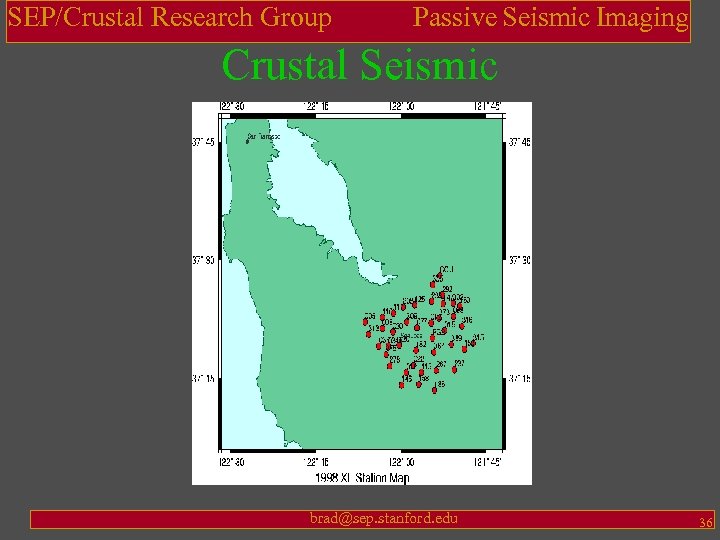 SEP/Crustal Research Group Passive Seismic Imaging Crustal Seismic brad@sep. stanford. edu 36
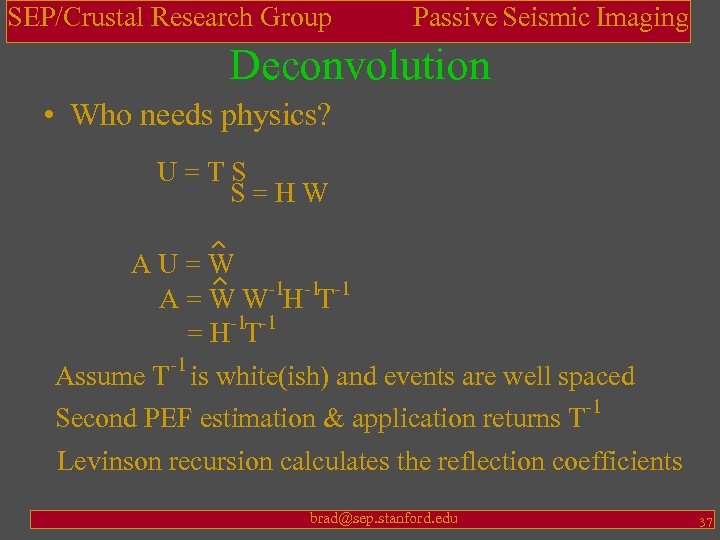 SEP/Crustal Research Group Passive Seismic Imaging Deconvolution • Who needs physics? U=TS S=HW AU=W A = W W-1 H -1 T-1 = H-1 T-1 -1 Assume T is white(ish) and events are well spaced Second PEF estimation & application returns T-1 Levinson recursion calculates the reflection coefficients brad@sep. stanford. edu 37
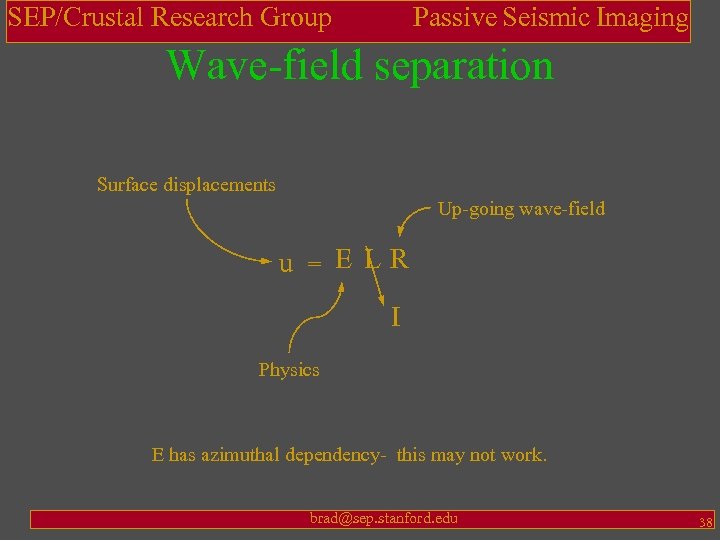 SEP/Crustal Research Group Passive Seismic Imaging Wave-field separation Surface displacements Up-going wave-field u = E LR I Physics E has azimuthal dependency- this may not work. brad@sep. stanford. edu 38
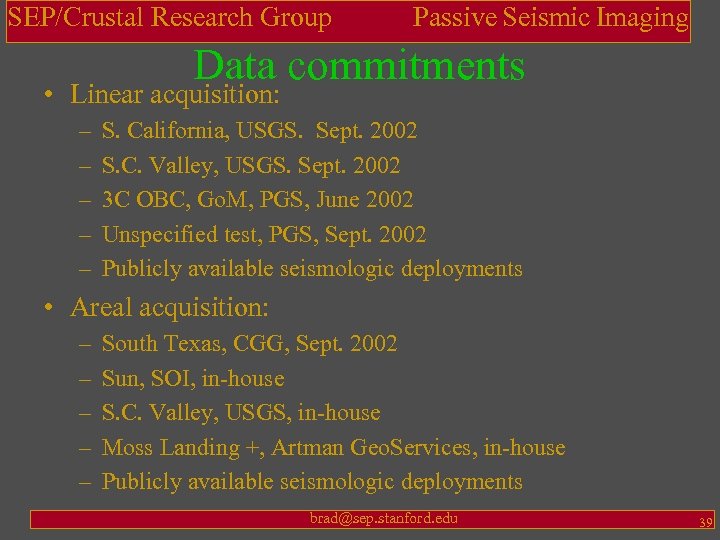 SEP/Crustal Research Group Passive Seismic Imaging Data commitments • Linear acquisition: – – – S. California, USGS. Sept. 2002 S. C. Valley, USGS. Sept. 2002 3 C OBC, Go. M, PGS, June 2002 Unspecified test, PGS, Sept. 2002 Publicly available seismologic deployments • Areal acquisition: – – – South Texas, CGG, Sept. 2002 Sun, SOI, in-house S. C. Valley, USGS, in-house Moss Landing +, Artman Geo. Services, in-house Publicly available seismologic deployments brad@sep. stanford. edu 39
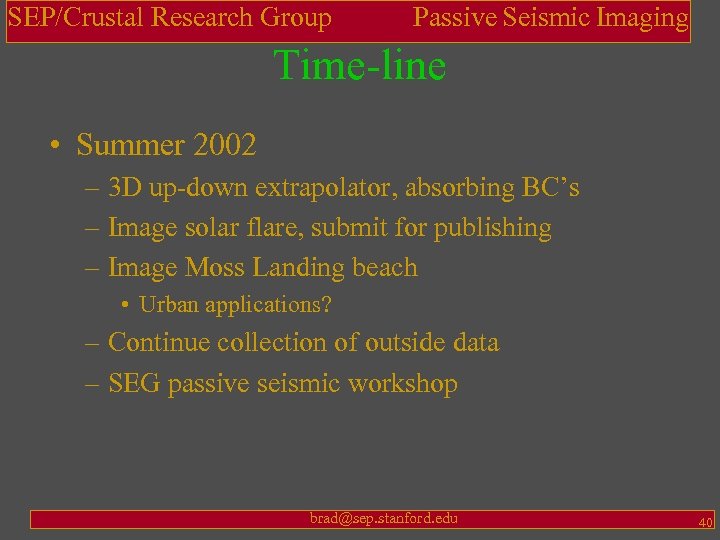 SEP/Crustal Research Group Passive Seismic Imaging Time-line • Summer 2002 – 3 D up-down extrapolator, absorbing BC’s – Image solar flare, submit for publishing – Image Moss Landing beach • Urban applications? – Continue collection of outside data – SEG passive seismic workshop brad@sep. stanford. edu 40
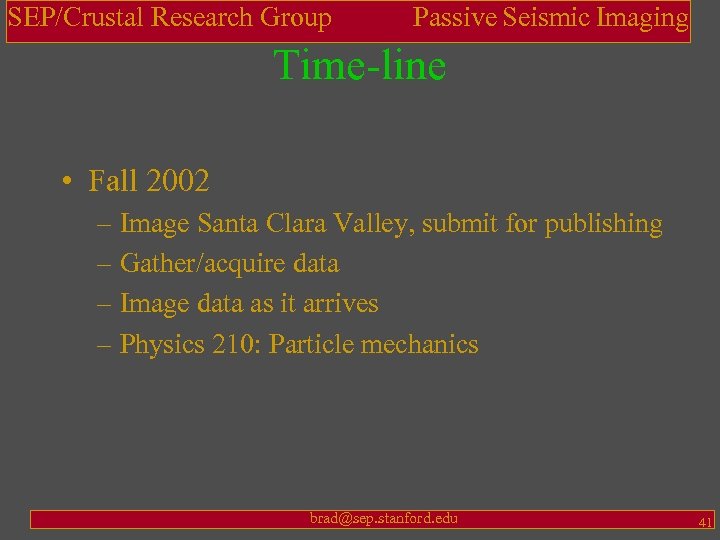 SEP/Crustal Research Group Passive Seismic Imaging Time-line • Fall 2002 – Image Santa Clara Valley, submit for publishing – Gather/acquire data – Image data as it arrives – Physics 210: Particle mechanics brad@sep. stanford. edu 41
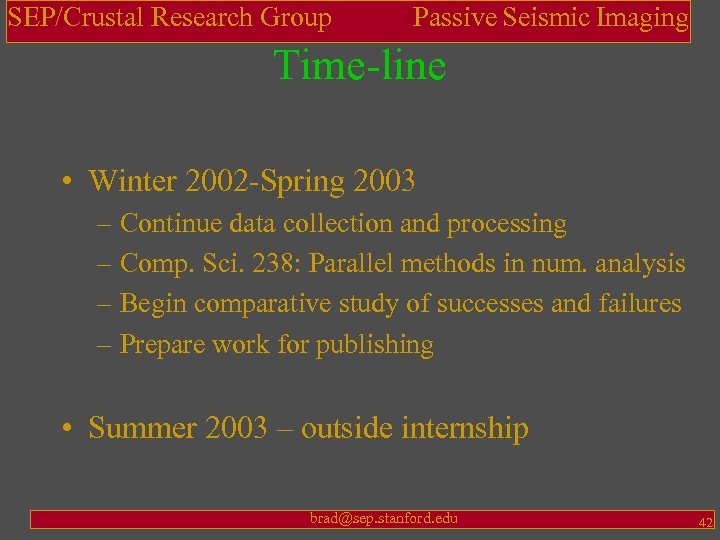 SEP/Crustal Research Group Passive Seismic Imaging Time-line • Winter 2002 -Spring 2003 – Continue data collection and processing – Comp. Sci. 238: Parallel methods in num. analysis – Begin comparative study of successes and failures – Prepare work for publishing • Summer 2003 – outside internship brad@sep. stanford. edu 42
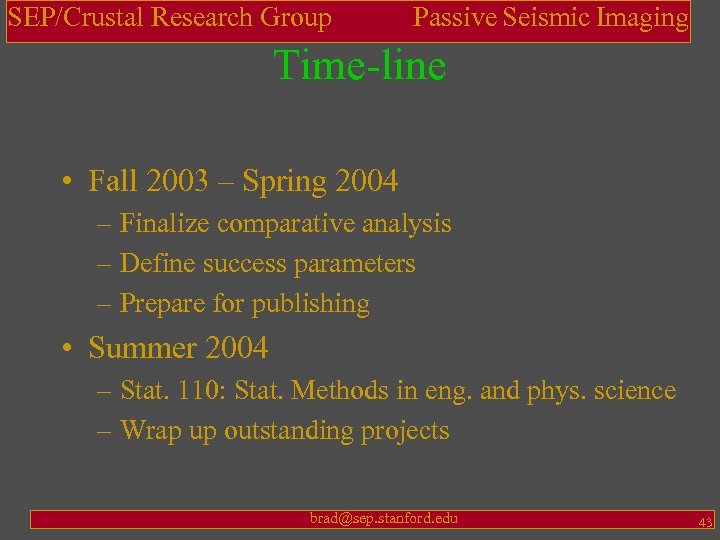 SEP/Crustal Research Group Passive Seismic Imaging Time-line • Fall 2003 – Spring 2004 – Finalize comparative analysis – Define success parameters – Prepare for publishing • Summer 2004 – Stat. 110: Stat. Methods in eng. and phys. science – Wrap up outstanding projects brad@sep. stanford. edu 43
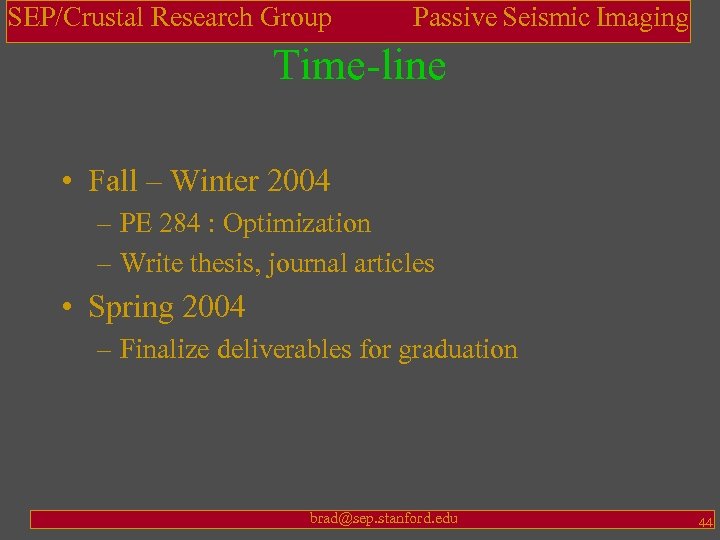 SEP/Crustal Research Group Passive Seismic Imaging Time-line • Fall – Winter 2004 – PE 284 : Optimization – Write thesis, journal articles • Spring 2004 – Finalize deliverables for graduation brad@sep. stanford. edu 44
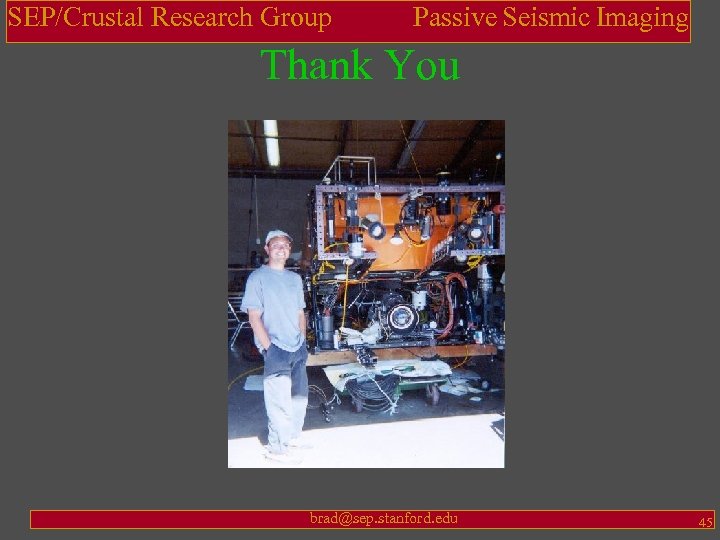 SEP/Crustal Research Group Passive Seismic Imaging Thank You brad@sep. stanford. edu 45