 Скачать презентацию Sentire A Framework for Building Middleware for Sensor
7e24a7a729746b0042b6780cc97a3db8.ppt
- Количество слайдов: 15




Sentire: A Framework for Building Middleware for Sensor and Actuator Networks IEEE Per. Com 2005 – Per. Se. NS Workshop Kauai Island, Hawaii March 8 -12, 2005 Joel W. Branch Rensselaer Polytechnic Institute – Troy, NY John Davis, Daby Sow, and Chatschik Bisdikian IBM T. J. Watson Research Center – Hawthorne, NY
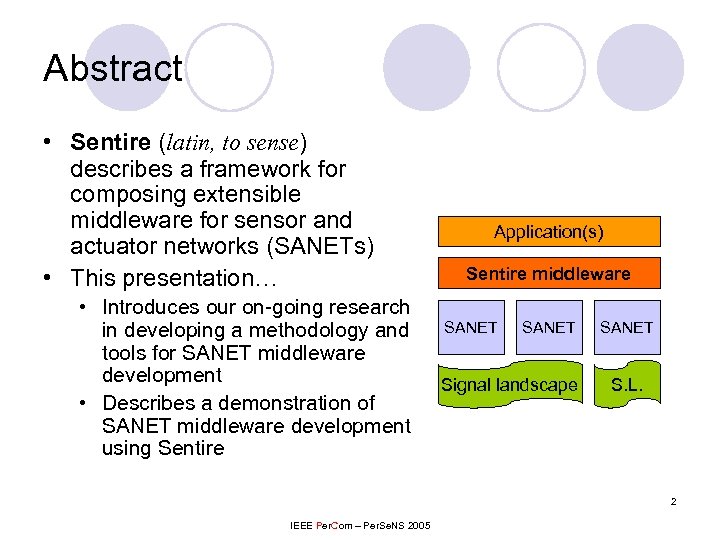
Abstract • Sentire (latin, to sense) describes a framework for composing extensible middleware for sensor and actuator networks (SANETs) • This presentation… • Introduces our on-going research in developing a methodology and tools for SANET middleware development • Describes a demonstration of SANET middleware development using Sentire Application(s) Sentire middleware SANET Signal landscape SANET S. L. 2 IEEE Per. Com – Per. Se. NS 2005

Introduction ? Control distribution Centralized Decentralized Scaling up SANET-related systems Plant process control Automated factories Habitat monitoring Tomorrow Instrumented farm Today Autos Security systems 1 -1000 Networked cities Smart buildings 1000 -10 M Number of embedded devices Adaptive traffic control Asset tracking >10 M Trend points to increasing number of devices and decentralization 3 * Figure reproduced from [Zhao 2004] IEEE Per. Com – Per. Se. NS 2005

Introduction “Reaching tomorrow” – Research motivation SANET application development - Shield application developers from writing complex and custom code for multiple platforms SANET middleware development standard - Supports large scale development - Supports extensibility, reusability, and interoperability SANET requirements - Resource management - Network management - Data management - Supports SANET integration 4 IEEE Per. Com – Per. Se. NS 2005
The Sentire approach Overview Objectives 1. Introduce software development framework for extensible SANET middleware development – Different from middleware instantiations [Yu 2004, Heinzelman 2004] 2. Partition middleware development into logically related sub-tasks 3. Facilitate applications’ use of integrated, heterogeneous sensor and actuator-enabled systems 5 IEEE Per. Com – Per. Se. NS 2005
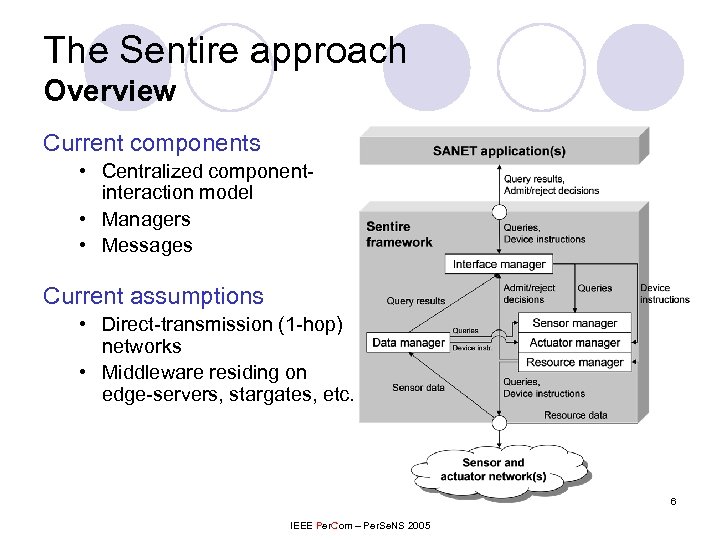
The Sentire approach Overview Current components • Centralized componentinteraction model • Managers • Messages Current assumptions • Direct-transmission (1 -hop) networks • Middleware residing on edge-servers, stargates, etc. 6 IEEE Per. Com – Per. Se. NS 2005
The Sentire approach Framework Managers • Interface manager – Funnels application queries and instructions to appropriate managers – Provides initial layer of query/instruction filtering via developer-defined admit/reject policies • Sensor and actuator managers – Controls sensor and actuator device behavior • Influences both the quality of sensed information and adjustments to the environment • Adjusts resource usage 7 IEEE Per. Com – Per. Se. NS 2005
The Sentire approach Framework Managers (cont. ) • Resource manager – Implements service registration of SANETs – Tracks SANET resource usage (e. g. , energy, bandwidth) – Supports other managers in their policy-based decisions • Data manager – Embodies develop-defined data processing routines (e. g. , event detection, data cleaning, etc. ) 8 IEEE Per. Com – Per. Se. NS 2005
The Sentire approach Framework Messages “Publish-subscribe” used for inter-manager communication • Application and Sentire query headers – Priority – Data type – Query type (e. g. , single query, subscription, event notification) • Data source response headers – Corresponding query ID – Data type • Customizable XML payload structures – Promotes flexible message attributes and data payloads 9 IEEE Per. Com – Per. Se. NS 2005
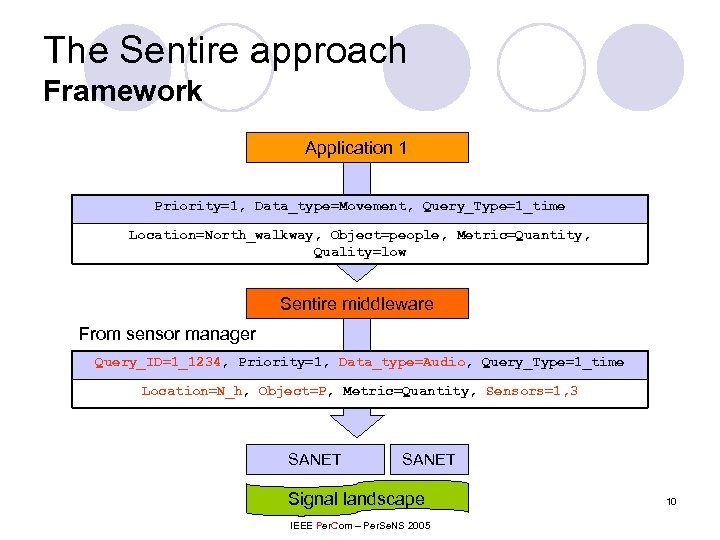
The Sentire approach Framework Application 1 Priority=1, Data_type=Movement, Query_Type=1_time Location=North_walkway, Object=people, Metric=Quantity, Quality=low Sentire middleware From sensor manager Query_ID=1_1234, Priority=1, Data_type=Audio, Query_Type=1_time Location=N_h, Object=P, Metric=Quantity, Sensors=1, 3 SANET Signal landscape IEEE Per. Com – Per. Se. NS 2005 10
![Sentire demonstration Collaborative sensing Implemented using Sentire and LEGO® Mindstorms. TM hardware [LEGO] 1.](https://present5.com/presentation/7e24a7a729746b0042b6780cc97a3db8/image-11.jpg "Sentire demonstration Collaborative sensing Implemented using Sentire and LEGO® Mindstorms. TM hardware [LEGO] 1.")
Sentire demonstration Collaborative sensing Implemented using Sentire and LEGO® Mindstorms. TM hardware [LEGO] 1. The motion detector monitors for vehicle movement in 2 zones 2. Upon detected movement in a zone, re-bind to the zone’s respective light sensor 3. If light is detected, the zone’s respective LED powers on. 11 IEEE Per. Com – Per. Se. NS 2005

Sentire demonstration Collaborative sensing Sentire operation details 1. Interface manager requests event notification from sensor manager 2. Sensor manager decomposes request to utilize available sensors • Checks resource manager for permission 3. Data manager verifies the event and triggers actuation manager to activate appropriate LED 12 IEEE Per. Com – Per. Se. NS 2005

Conclusion Research progress Current progress • Middleware methodology for facilitating applications’ interaction with integrated sense-and-respond system Future work • Extend methodology for “closed-loop” sensoractuator interaction • Distribute Sentire functionality – Coordinate multiple edge-servers, etc. – Distribute framework to the device level Per. Se. NS 2005 Research timeline IEEE Per. Com – Per. Se. NS 2005 13

Conclusion References W. B. Heinzelman, A. L. Murphy, H. S. Carvalho, and M. A. Perillo. “Middleware to support sensor network applications, ” IEEE Network Magazine, Jan 2004. LEGO. com Mindstorms Home, http: //www. legomindstorms. com Y. Yu, B. Krishnamachari, and V. K. Prasanna. “Issues of designing middleware for wireless sensor networks, ” IEEE Network Magazine, Jan 2004. F. Zhao and L. Guibas. Wireless Sensor Networks: An Information Processing Approach, Elsevier, 2004. 14 IEEE Per. Com – Per. Se. NS 2005

Conclusion Thank you “Your questions please” Acknowledgements Ron Ambrosio, Paul Castro, Norman Cohen, Maria Ebling, Archan Misra, Mark Yao 15 IEEE Per. Com – Per. Se. NS 2005
Скачать презентацию Sentire A Framework for Building Middleware for Sensor
7e24a7a729746b0042b6780cc97a3db8.ppt