 Скачать презентацию SENTINEL LYMPH NODE BIOPSY THE NAVIGATOR GPS SYSTEM
SENTINEL Lymph node biopsy.ppt
- Количество слайдов: 13



SENTINEL LYMPH NODE BIOPSY THE NAVIGATOR GPS SYSTEM

A lymph node is part of the body’s lymphatic system. In the lymphatic system, a network of lymph vessels carries clear fluid called lymph. Lymph vessels lead to lymph nodes, which are small round organs that trap cancer cells, bacteria and other harmful substances that may be in the lymph. Groups of lymph nodes are found in the neck, underarms chest abdomen and groin.
CLINICAL BACKGROUND A sentinel Lymph node is the FIRST lymph node to which cancer is likely to spread from the primary tumour. Cancer cells may appear in the sentinel node before spreading to the other lymph nodes. In some cases, there can be more than one sentinel lymph node.

It is often said that every truly successful experiment leads to 10 new questions to be studied. Thus, we face the obligation to look just over the horizon, to consider important new concepts at their earliest stages of intellectual development
A sentinel node biopsy is a procedure developed as a test to determine if breast cancer has spread to the lymph ducts or lymph nodes in the axilla without having to do a traditional axillary node dissection The sentinel lymph node is removed and examined under a microscope to determine whether cancer cells are present. SLN biopsy is based on the idea that the cancer cells metastisize in an orderly way from the primary tumor to the sentinel lymph nodes then to the other nearby lymph nodes.
A negative SLN biopsy result suggests that cancer has not spread to the lymph nodes. A positive result indicates that cancer is present in the SLN and may be present in other lymph nodes in the same area ( regional lymph nodes). This information may help the doctor determine the stage of cancer. This information is essential in developing the appropriate treatment plan
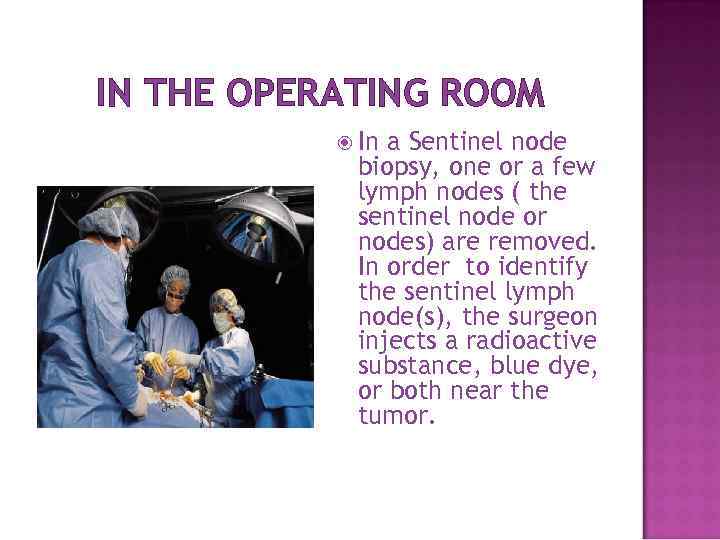
IN THE OPERATING ROOM In a Sentinel node biopsy, one or a few lymph nodes ( the sentinel node or nodes) are removed. In order to identify the sentinel lymph node(s), the surgeon injects a radioactive substance, blue dye, or both near the tumor.
The surgeon then uses the probe to find the sentinel lymph node(s) containing the radioactive substance or looks for the lymph node(s) stained with dye. Once the sentinel node is located, the surgeon makes a small incision ( about ½ inch) in the skin overlying the sentinel lymph node and removes the node(s). The sentinel node(s) is/are checked for the presence of cancer cells by a pathologist
On the morning of surgery, or the day prior, the patient will arrive in nuclear medicine to be injected with 0. 8 -1. 0 -m. Cl of Tc 99 m unfiltered sulfur colloid. The breast will be injected at the 12, 3, 6, and 9 o’clock positions around the palpable tumor, the biopsy site if there has been a previous incision, or around the primary tumor at the time of the mammographic needle localization or ultrasound- guided BB location.
IMPORTANT After injections from nuclear medicine the patient MUST be allotted 2 -3 hours (infiltration time) before arriving in the operating room for the sentinel node biopsy.
ENSURE the battery for the navigator GPS system is fully charged. The surgeon will inject the dye (patient blue) into the breast before you prep and they scrub. Lymphazurin blue dye should be injected 3 -5 minutes before the start of surgery. It is useful to prepare a small table with items required for this pre-injection. (listed on sentinel node binder)
INTRA-OP CONTINUED Prior to patient prep, the surgeon may wish to externally localize the SLN with the probe, checking his/her findings against the markings by nuclear medicine. The probe should be draped with a sterile glove and camera cover during the procedure. All counts must be recorded in the sentinel node log book located in the box with navigator system.
When the surgeon asks for a 10 second count, push the metal button that is labelled “count”. 1 st count is usually skin count of the breast 2 nd count is usually skin count of the axilla “in-vivo” count is when the sentinel node is dissected out and placed onto the end of the probe for a count. Once excised, nodes should be place in formalin and labelled as SLN #1, #2, #3 etc. Confirmation with surgeon during debriefing is part of the surgical safety checklist.
Скачать презентацию SENTINEL LYMPH NODE BIOPSY THE NAVIGATOR GPS SYSTEM
SENTINEL Lymph node biopsy.ppt