


 Скачать презентацию Sensory Science 101 Part II Sensory Evaluation Methods
d485f8df0d48e8a11a07a499cc46a463.ppt
- Количество слайдов: 21
 Sensory Science 101 Part II: Sensory Evaluation Methods Speaker Name Speaker Title Date (optional) © 2007 Institute of Food Technologists
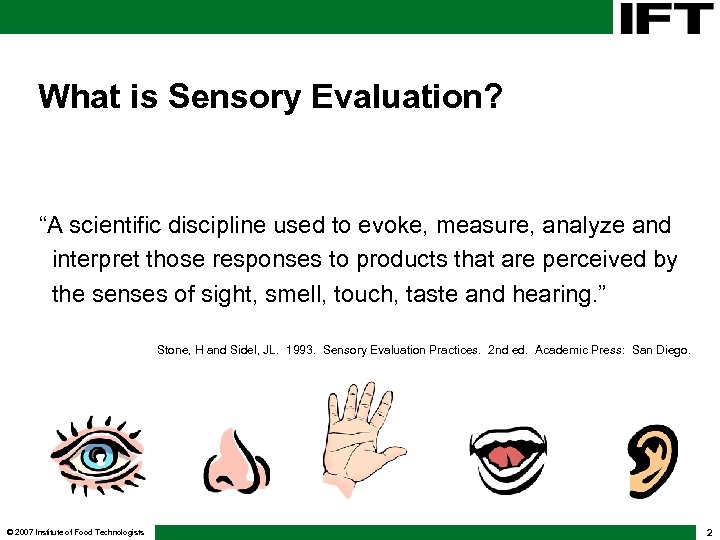 What is Sensory Evaluation? “A scientific discipline used to evoke, measure, analyze and interpret those responses to products that are perceived by the senses of sight, smell, touch, taste and hearing. ” Stone, H and Sidel, JL. 1993. Sensory Evaluation Practices. 2 nd ed. Academic Press: San Diego. © 2007 Institute of Food Technologists 2
 How is Sensory Evaluation Used? • In a food company, sensory scientists work closely with product developer’s to understand: - What consumers like and why - If consumers can tell a difference when they change a product (e. g. substitute an ingredient) • In academia, sensory scientists: - Try to understand how our senses work and how our senses respond to stimuli (both from food and chemicals) - Improve testing methodology © 2007 Institute of Food Technologists 3
 Why Is Sensory Evaluation Used? • It reduces uncertainty and risks in decision making • It ensures a cost-efficient delivery of new products with high consumer acceptability • Human observers are good measuring instruments - People can sometimes detect odorants at levels lower than what can be detected by an instrument - Instruments can not measure liking (although they can be used to determine what characteristics of a food correlate with liking - e. g. with many beverages – up to a point - as sweetness increases so does liking) © 2007 Institute of Food Technologists 4
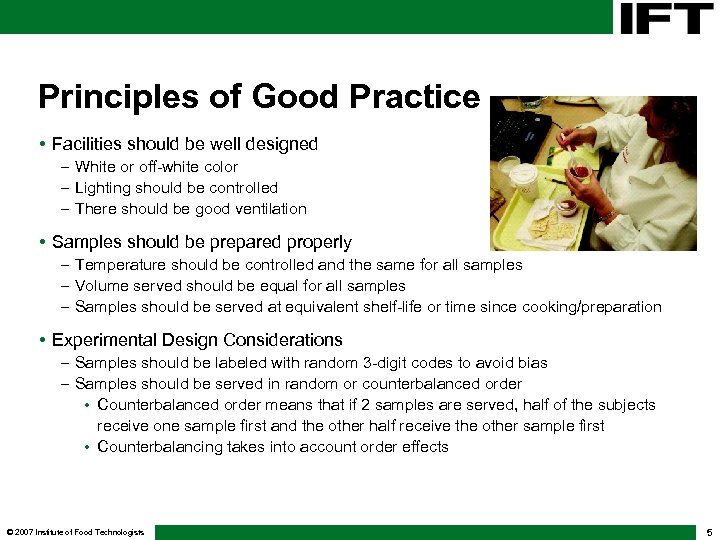 Principles of Good Practice • Facilities should be well designed - White or off-white color - Lighting should be controlled - There should be good ventilation • Samples should be prepared properly - Temperature should be controlled and the same for all samples - Volume served should be equal for all samples - Samples should be served at equivalent shelf-life or time since cooking/preparation • Experimental Design Considerations - Samples should be labeled with random 3 -digit codes to avoid bias - Samples should be served in random or counterbalanced order • Counterbalanced order means that if 2 samples are served, half of the subjects receive one sample first and the other half receive the other sample first • Counterbalancing takes into account order effects © 2007 Institute of Food Technologists 5
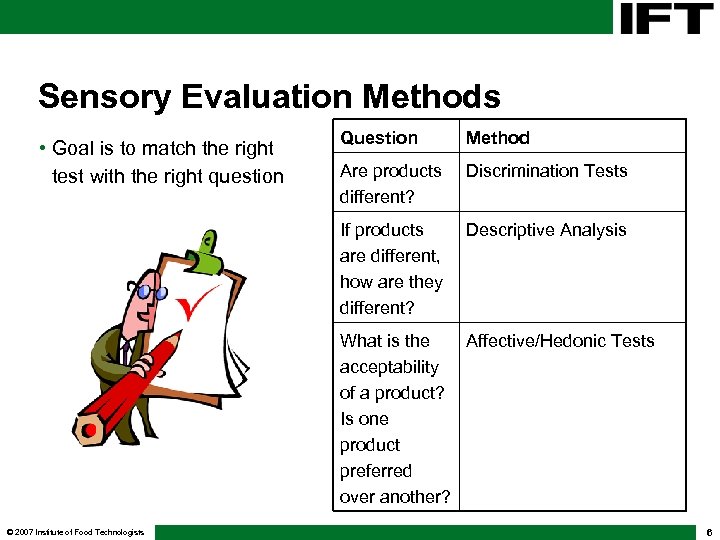 Sensory Evaluation Methods • Goal is to match the right test with the right question Question Method Are products different? Discrimination Tests If products Descriptive Analysis are different, how are they different? What is the Affective/Hedonic Tests acceptability of a product? Is one product preferred over another? © 2007 Institute of Food Technologists 6
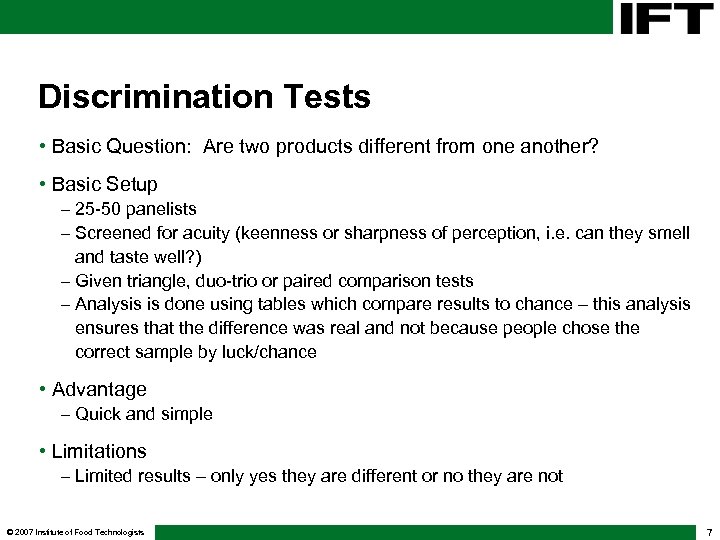 Discrimination Tests • Basic Question: Are two products different from one another? • Basic Setup - 25 -50 panelists - Screened for acuity (keenness or sharpness of perception, i. e. can they smell and taste well? ) - Given triangle, duo-trio or paired comparison tests - Analysis is done using tables which compare results to chance – this analysis ensures that the difference was real and not because people chose the correct sample by luck/chance • Advantage - Quick and simple • Limitations - Limited results – only yes they are different or no they are not © 2007 Institute of Food Technologists 7
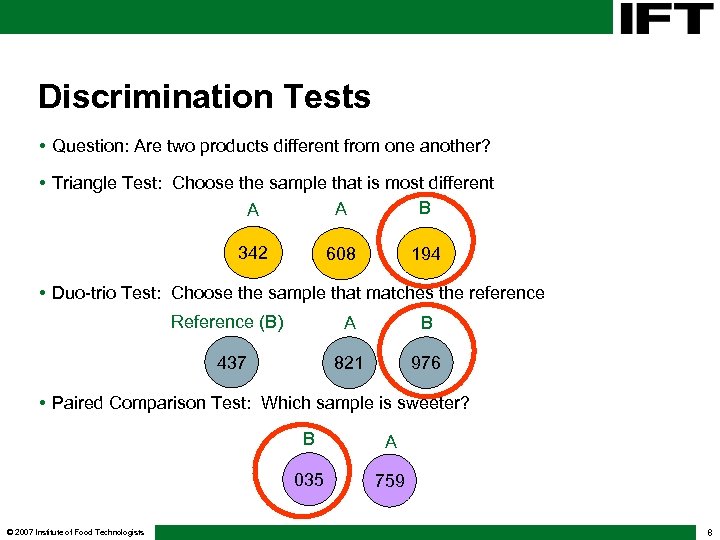 Discrimination Tests • Question: Are two products different from one another? • Triangle Test: Choose the sample that is most different B A A 342 194 608 • Duo-trio Test: Choose the sample that matches the reference Reference (B) A B 437 821 976 • Paired Comparison Test: Which sample is sweeter? B 035 © 2007 Institute of Food Technologists A 759 8
 Descriptive Tests • Basic Question: How do products differ in all sensory attributes? • Basic Setup - 8 -12 panelists - Screened for acuity - Trained - Asked to rate intensity for all sensory attributes - Analysis is done using a t-test to determine if means are statistically different • Advantages - Detailed quantitative information • Limitations - Time consuming © 2007 Institute of Food Technologists 9
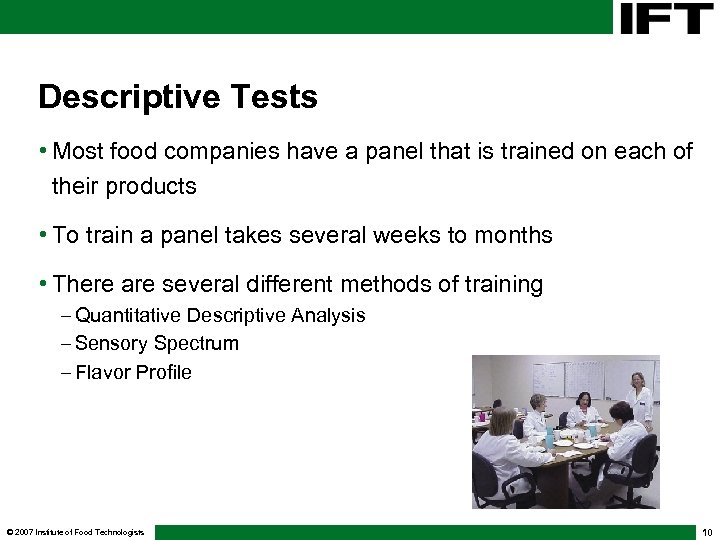 Descriptive Tests • Most food companies have a panel that is trained on each of their products • To train a panel takes several weeks to months • There are several different methods of training - Quantitative Descriptive Analysis - Sensory Spectrum - Flavor Profile © 2007 Institute of Food Technologists 10
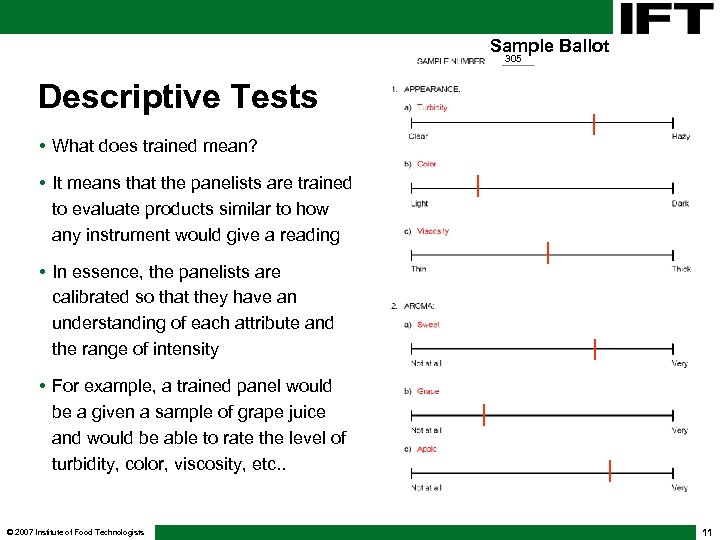 Sample Ballot 305 Descriptive Tests • What does trained mean? • It means that the panelists are trained to evaluate products similar to how any instrument would give a reading • In essence, the panelists are calibrated so that they have an understanding of each attribute and the range of intensity • For example, a trained panel would be a given a sample of grape juice and would be able to rate the level of turbidity, color, viscosity, etc. . © 2007 Institute of Food Technologists 11
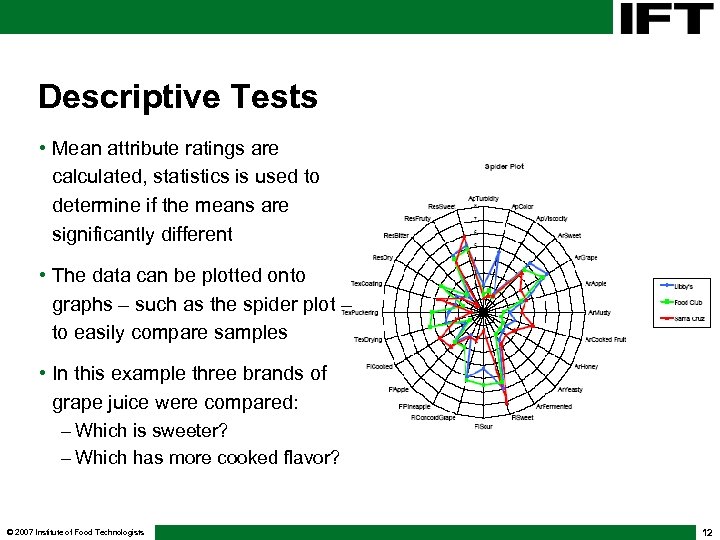 Descriptive Tests • Mean attribute ratings are calculated, statistics is used to determine if the means are significantly different • The data can be plotted onto graphs – such as the spider plot – to easily compare samples • In this example three brands of grape juice were compared: - Which is sweeter? - Which has more cooked flavor? © 2007 Institute of Food Technologists 12
 Consumer Acceptance Tests • Basic Question: Are the products liked? • Basic Setup - 75 -150 consumers per test - Screened for product use (Do they buy the product? And how often? ) - Asked degree of liking (how much do they like it) and/or preference questions • Advantages - Provides essential information – Do they like it or not? • Disadvantages - May be difficult to get a representative sample of consumers © 2007 Institute of Food Technologists 13
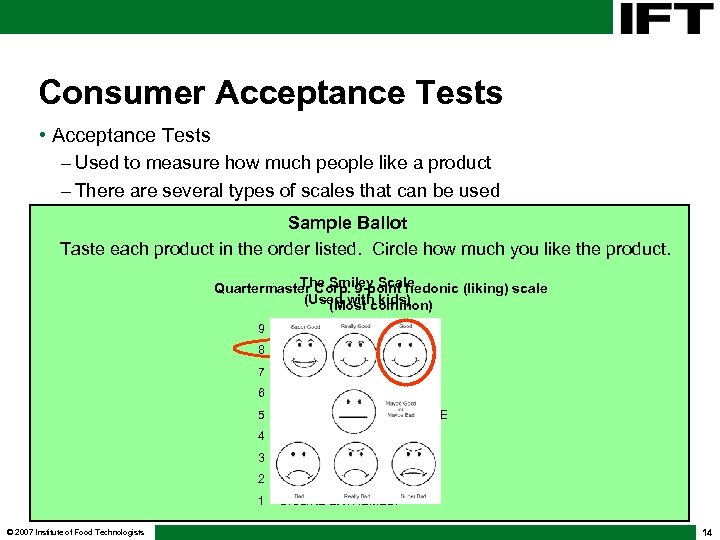 Consumer Acceptance Tests • Acceptance Tests - Used to measure how much people like a product - There are several types of scales that can be used Sample Ballot Taste each product in the order listed. Circle how much you like the product. The Smiley Scale Quartermaster Corp. 9 -point hedonic (liking) scale (Used with kids) (Most common) 9 LIKE EXTREMELY 8 LIKE VERY MUCH 7 LIKE MODERATELY 6 LIKE SLIGHTLY 5 NEITHTER LIKE NOR DISLIKE 4 DISLIKE SLIGHTLY 3 DISLIKE MODERATELY 2 DISLIKE VERY MUCH 1 DISLIKE EXTREMELY © 2007 Institute of Food Technologists 14
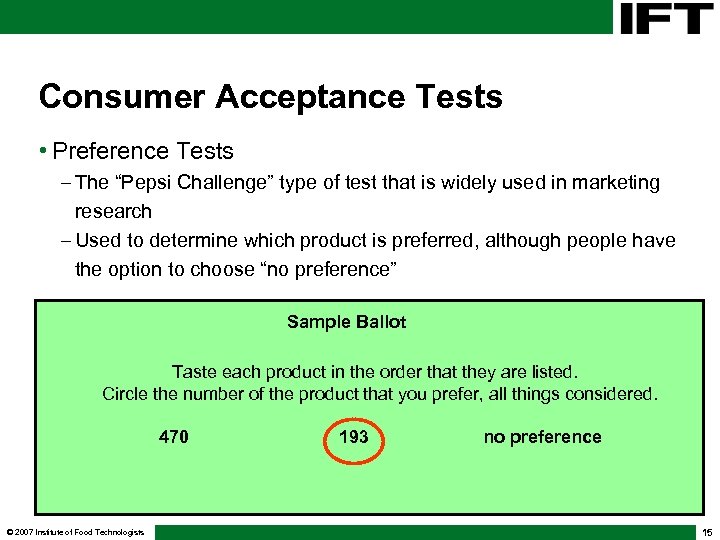 Consumer Acceptance Tests • Preference Tests - The “Pepsi Challenge” type of test that is widely used in marketing research - Used to determine which product is preferred, although people have the option to choose “no preference” Sample Ballot Taste each product in the order that they are listed. Circle the number of the product that you prefer, all things considered. 470 © 2007 Institute of Food Technologists 193 no preference 15
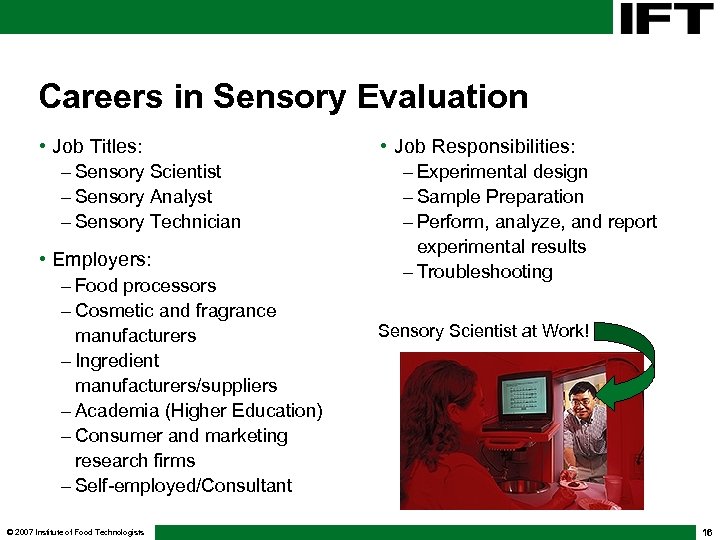 Careers in Sensory Evaluation • Job Titles: - Sensory Scientist - Sensory Analyst - Sensory Technician • Employers: - Food processors - Cosmetic and fragrance manufacturers - Ingredient manufacturers/suppliers - Academia (Higher Education) - Consumer and marketing research firms - Self-employed/Consultant © 2007 Institute of Food Technologists • Job Responsibilities: - Experimental design - Sample Preparation - Perform, analyze, and report experimental results - Troubleshooting Sensory Scientist at Work! 16
 Want to learn more? • Visit: - http: //www. ift. org - http: //school. discovery. com/foodscience/ • Find a Food Scientist: - A database of IFT members who are willing to provide more information about the field of food science to you - http: //members. ift. org/IFT/Education/Teacher. Resources/findafoodscientist. htm © 2007 Institute of Food Technologists 17
 Questions? © 2007 Institute of Food Technologists 18
 Activity • Triangle Sensory Test with Oreo Cookies © 2007 Institute of Food Technologists 19
 References Lawless, HT and Heymann, H. 1998. Sensory Evaluation of Food: Principles and Practices. New York: Chapman & Hall. © 2007 Institute of Food Technologists 20
 Headquarters 525 W. Van Buren Street Suite 1000 Chicago, IL 60607 312. 782. 8424 ift. org © 2007 Institute of Food Technologists Washington, D. C. Office 1025 Connecticut Avenue, NW Suite 503 Washington, D. C. 20036 202. 466. 5980