



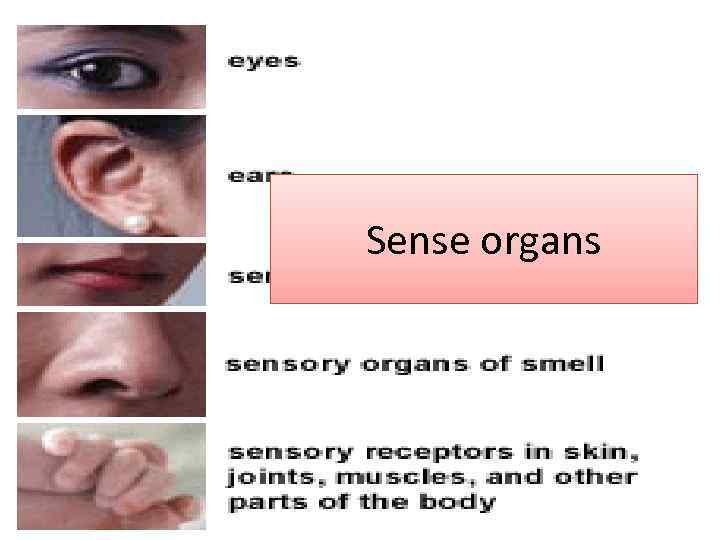
 Sense organs
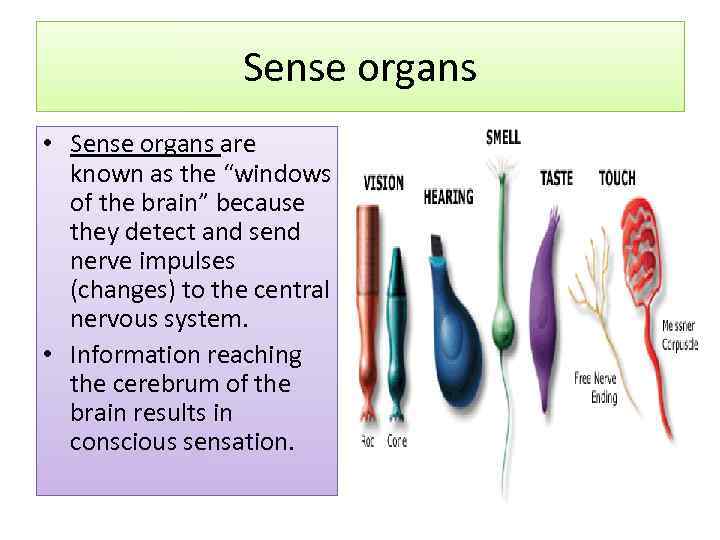 Sense organs • Sense organs are known as the “windows of the brain” because they detect and send nerve impulses (changes) to the central nervous system. • Information reaching the cerebrum of the brain results in conscious sensation.
 Receptors • Receptors are structures specialized to receive certain enviromental stimuli and change them into nerve impulses. • Types of receptors: • Photoreceptors detect light (Eyes). • Pain receptors sensitive to chemicals released by damaged tissues or excess stimuli of pressure or heat. • Proprioceptors sense the degree of muscle contraction. • Thermoreceptors sense temperature (Hypothalamus and skin). • Chemoreceptors are responsible for taste and smell (tongue and nose). • Mechanoreceptors sense pressure, touching and hearing (Skin and ears).
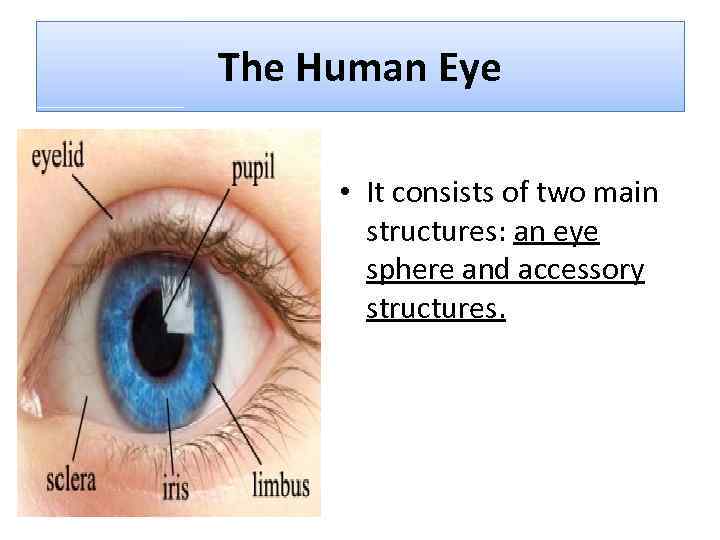 The Human Eye • It consists of two main structures: an eye sphere and accessory structures.
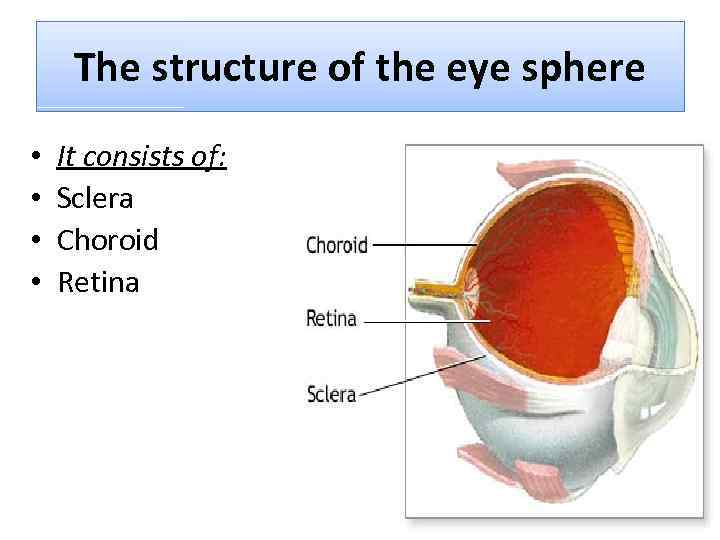 The structure of the eye sphere • • It consists of: Sclera Choroid Retina
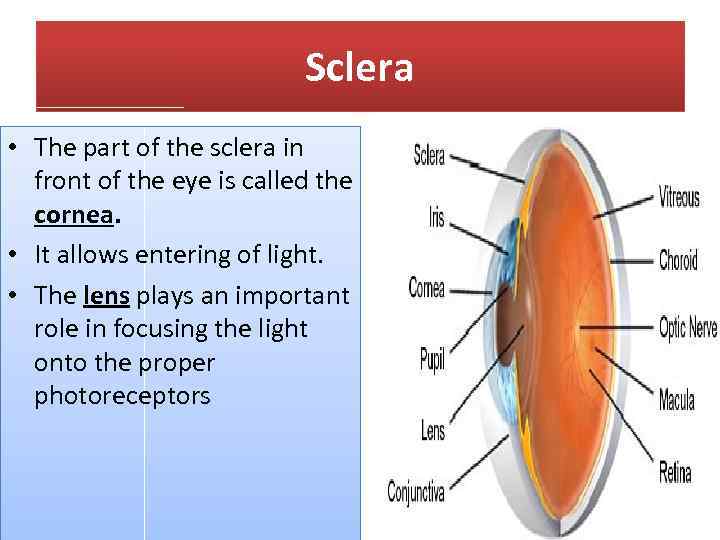 Sclera • The part of the sclera in front of the eye is called the cornea. • It allows entering of light. • The lens plays an important role in focusing the light onto the proper photoreceptors
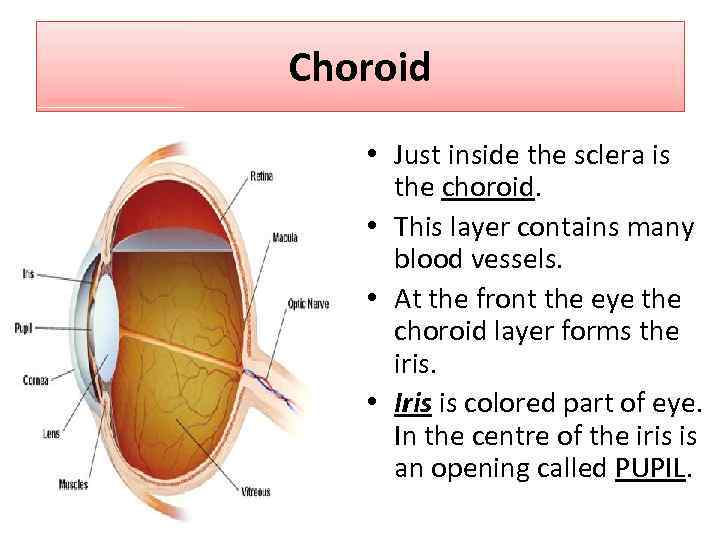 Choroid • Just inside the sclera is the choroid. • This layer contains many blood vessels. • At the front the eye the choroid layer forms the iris. • Iris is colored part of eye. In the centre of the iris is an opening called PUPIL.
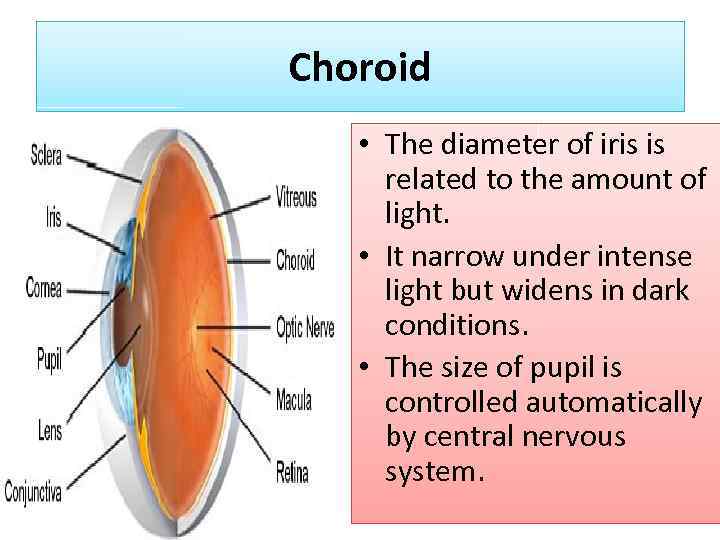 Choroid • The diameter of iris is related to the amount of light. • It narrow under intense light but widens in dark conditions. • The size of pupil is controlled automatically by central nervous system.
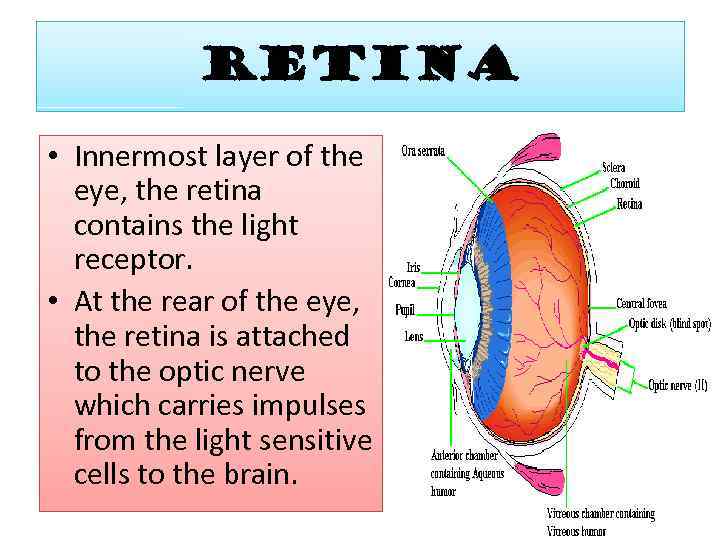 RETINA • Innermost layer of the eye, the retina contains the light receptor. • At the rear of the eye, the retina is attached to the optic nerve which carries impulses from the light sensitive cells to the brain.
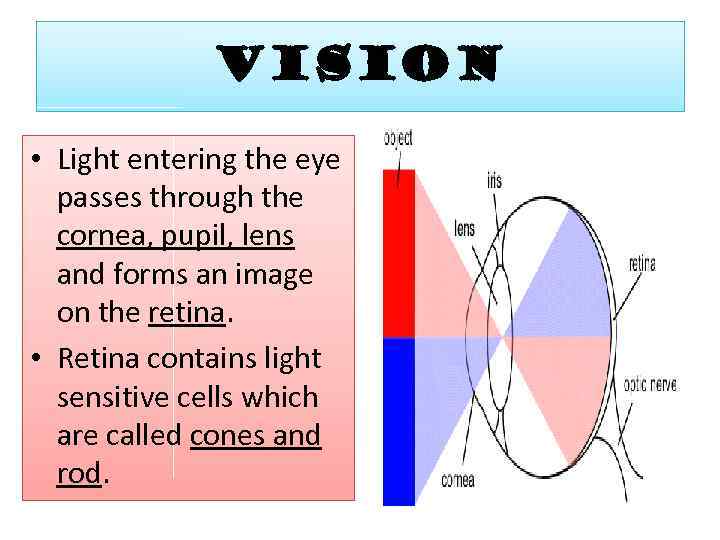 VISION • Light entering the eye passes through the cornea, pupil, lens and forms an image on the retina. • Retina contains light sensitive cells which are called cones and rod.
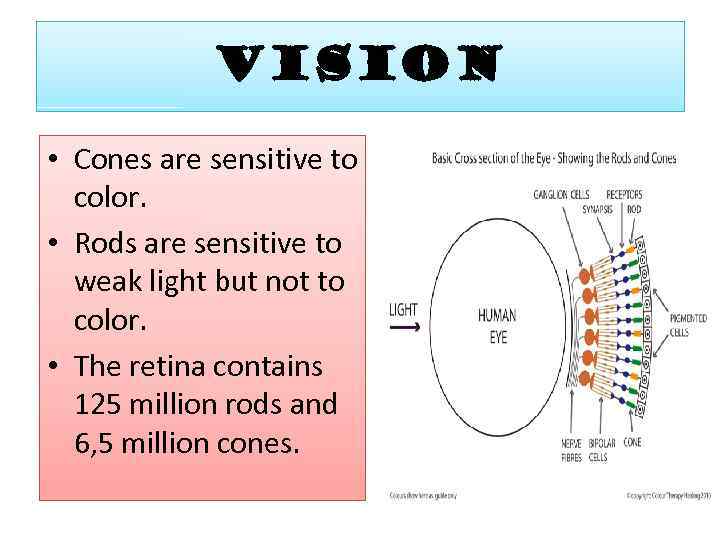 VISION • Cones are sensitive to color. • Rods are sensitive to weak light but not to color. • The retina contains 125 million rods and 6, 5 million cones.

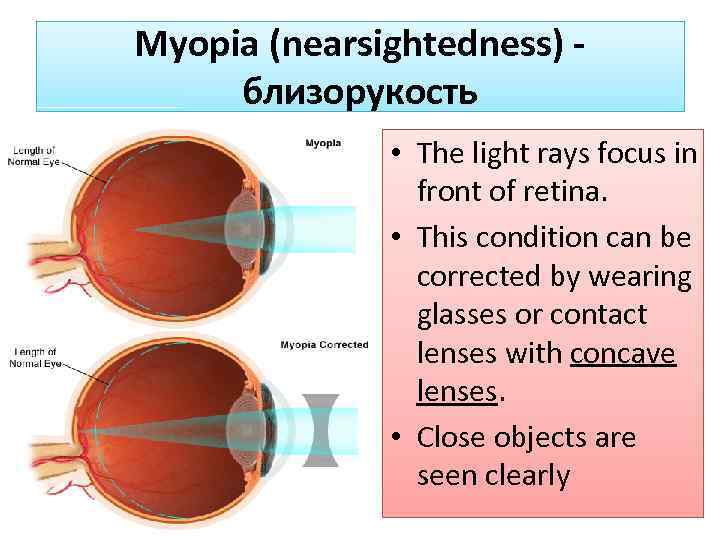 Myopia (nearsightedness) близорукость • The light rays focus in front of retina. • This condition can be corrected by wearing glasses or contact lenses with concave lenses. • Close objects are seen clearly
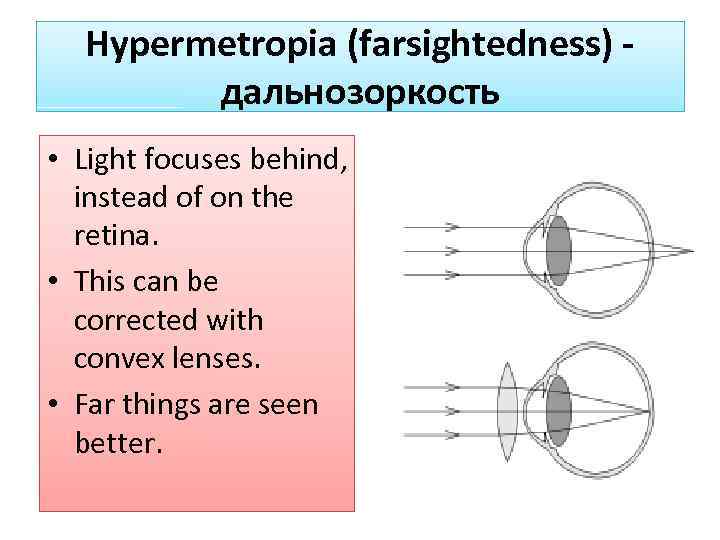 Hypermetropia (farsightedness) дальнозоркость • Light focuses behind, instead of on the retina. • This can be corrected with convex lenses. • Far things are seen better.