


 Скачать презентацию Sensation Psychology 1106 Introduction To talk
c168a44e8d1567d42b4799a349f8726a.ppt
- Количество слайдов: 28
 Sensation Psychology 1106
 Introduction ► To talk to someone we have to hear what they say ► To catch a ball, we have to see it coming ► How does the external get internalized § That in essence, is what sensation is ► Bottom up vs. Top down processing § Sensation is bottom up § Perception is top down
 Basic Principles ► Thresholds § We sense some things and not others § Faintest stimuli ►Absolute threshold § Difference thresholds or jnds ►Proportion ►Stimuli must differ by a constant proportion to be seen as different § Weber’s Law
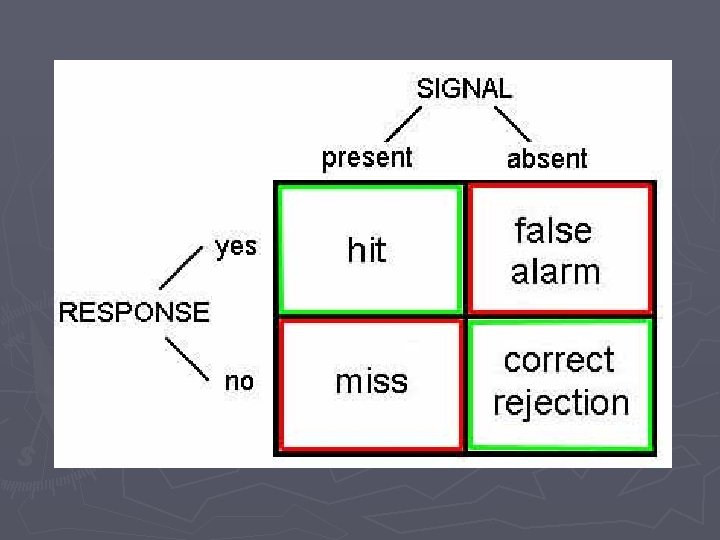
 Signal Detection Theory ► When will we detect stimuli? ► Have to filter out the background noise § Can be internal or external ► Hits vs. misses ► False alarms vs. rejections
 What about subliminal messages? ► “listen to these tapes, they are only 499. 95’ ► We don’t know what the stimulus is, and, it can affect our behaviour for a brief period ► Does it make us buy coke? § NO NO NO ► CBC Experiment ► WTWO experiment ► http: //www. snopes. com/business/hidden/popcorn. asp § What about backward masking… ► Umm, no
 Sensory adaptation ► Getting used to something ► If you stop your eyes from moving, everything would go grey! ► Same thing if you give them constant stimulation, the ping pong ball trick ► Ever notice how everybody else’s house smells funny and yours has no smell at all?
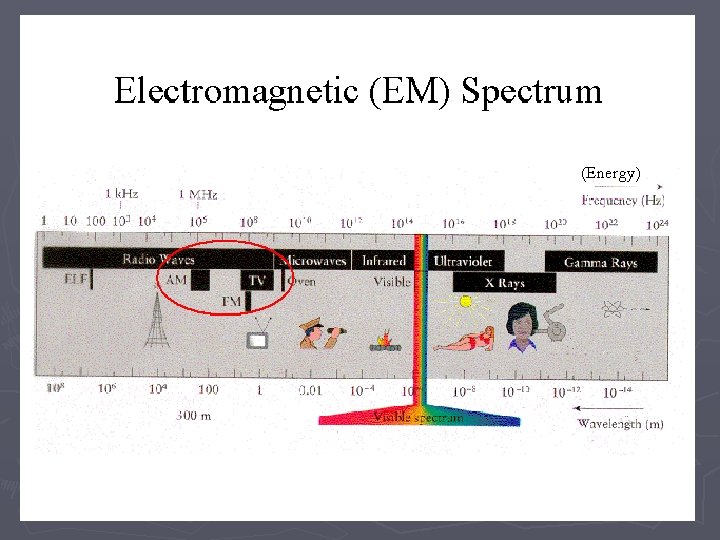
 Vision ► Like any sensory process, vision converts some energy to neural messages ► In this case, light ► Light is just a form of electromagnetic radiation ► So are x rays, micro waves, infra red, UV cosmic rays etc
 I wish to hell I could see better…. ► Wavelength of light determines hue ► Intensity determines brightness ► Light enters the eye through the cornea and the pupil ► Pupil size regulated by iris ► Behind pupil, lens, which accomodates ► Light hits the retina ► Oh ya, it is upside down….
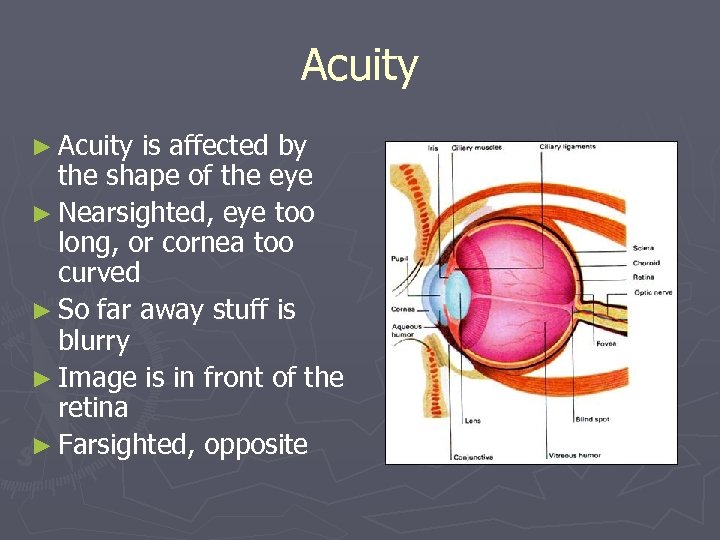 Acuity ► Acuity is affected by the shape of the eye ► Nearsighted, eye too long, or cornea too curved ► So far away stuff is blurry ► Image is in front of the retina ► Farsighted, opposite
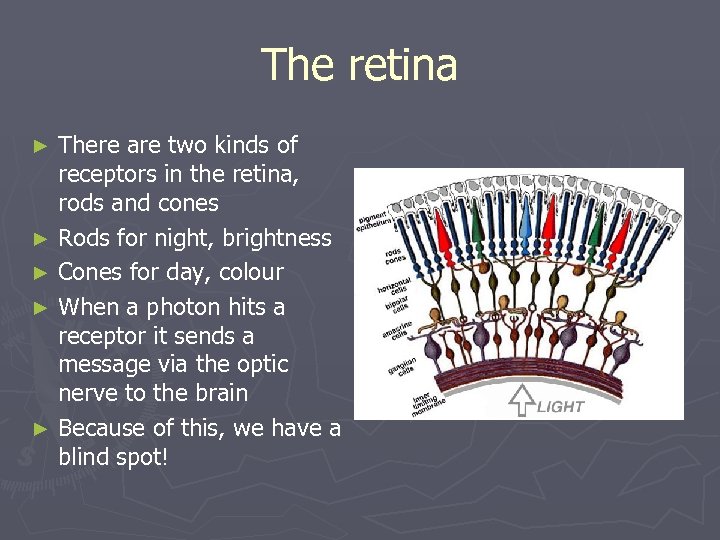 The retina There are two kinds of receptors in the retina, rods and cones ► Rods for night, brightness ► Cones for day, colour ► When a photon hits a receptor it sends a message via the optic nerve to the brain ► Because of this, we have a blind spot! ►
 Gotta love the retina ► Cones are for fine detail and colour ► Cones only really work in the light ► Concentrated in the fovea ► Rods are more evenly distributed ► Many rods to one bipolar cell, so you can see in dim light, but only in black and white ► One rod, one bipolar cell ► About 130 000 receptors per retina
 Its all about me…. ► There are disorders that can lead to problems for the retina ► Albinism ► Pigment guides growth of visual system ► I have no fovea ► My eyes are wired ipsilaterally
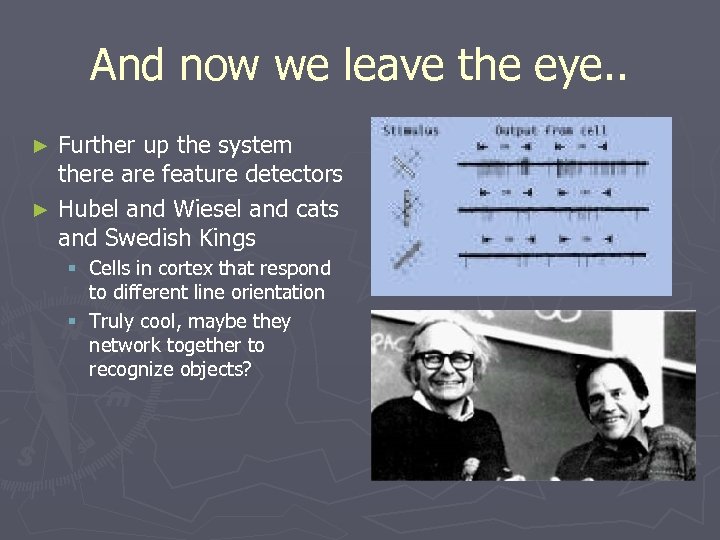 And now we leave the eye. . Further up the system there are feature detectors ► Hubel and Wiesel and cats and Swedish Kings ► § Cells in cortex that respond to different line orientation § Truly cool, maybe they network together to recognize objects?
 More Feature Detectors Dave Perrett’s work on face recognition in monkeys ► Monkeys have cells in their cortex that respond only to a specific monkey! ► Sort of like one of those ‘Grandmother’ cells. ► § Probably a hierarchical network § Hughlings-Jackson Principle
 ► Processing has to be parallel ► Imagine doing it serially! ► 130 000 receptors, one after the other ► You probably wouldn’t live long enough to recognize a triangle ► The ability to process in this fashion could be blown out by a stroke
 Colour vision ► Trichromatic theory ► Opponent process theory ► Three types of cones § Red-green § Blue-yellow § Black-white ► Explains afterimages
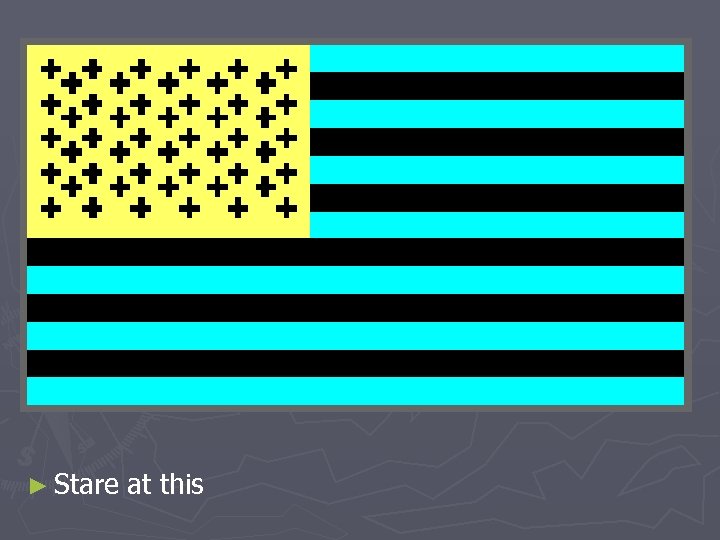 ► Stare at this

 Colour constancy ► Weird thing is that we see things as having the same colour even if they move in to different light conditions ► So a gold coin, reflecting blue light, still looks gold ► More of a perceptual thing than anything else
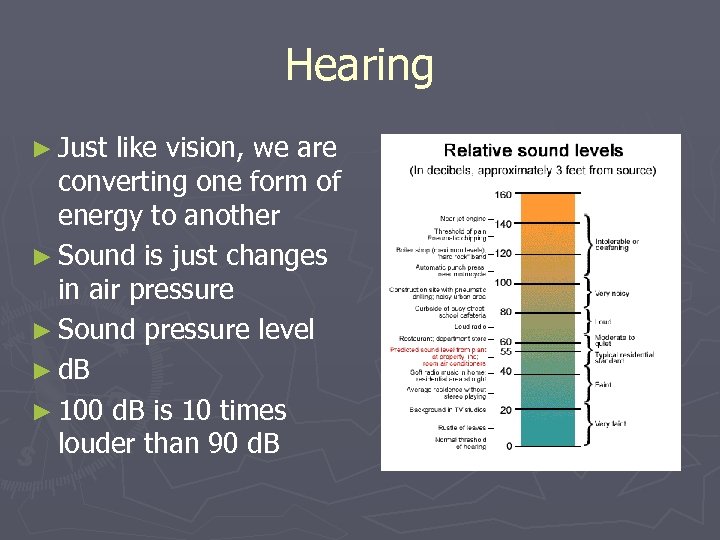 Hearing ► Just like vision, we are converting one form of energy to another ► Sound is just changes in air pressure ► Sound pressure level ► d. B ► 100 d. B is 10 times louder than 90 d. B
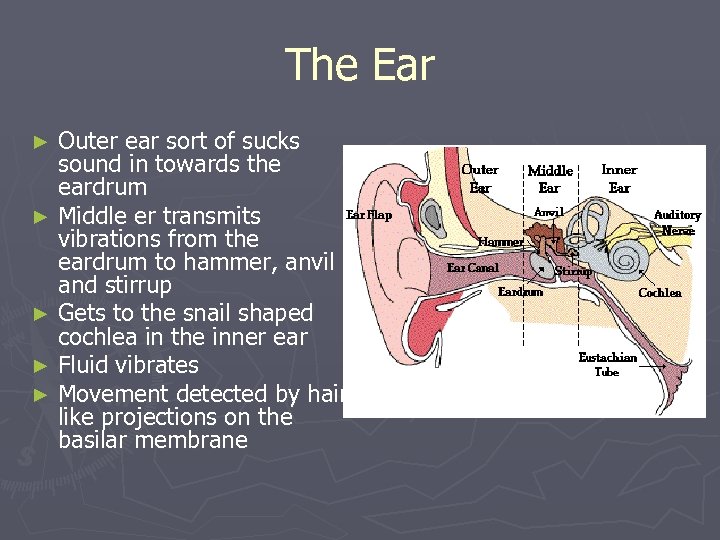 The Ear Outer ear sort of sucks sound in towards the eardrum ► Middle er transmits vibrations from the eardrum to hammer, anvil and stirrup ► Gets to the snail shaped cochlea in the inner ear ► Fluid vibrates ► Movement detected by hair like projections on the basilar membrane ►
 Pitch ► Frequency of sound ► Place theory § Different frequencies make different parts of the membrane vibrate § High frequencies, start of cochlea § Hmm, low frequencies are less localized ► Frequency theory § Frequency of vibrations? § But how do we hear over 1000 Hz? ► Probably both
 Sound Localization ► Sounds hit ears at different times, with different volumes ► So left right distinction is really pretty easy ► Up down is VERY hard, if not impossible ► We usually do up down in concert with other senses
 Other senses ► Touch § Pressure § Warmth § Cold § Pain ► Pressure is easy to understand, 1 to 1 relationship ► There are more receptors some places than other places
 Come on come on and touch me baby ► Pain § Probably a gate that selectively blocks pain § Stimulation § Cognitive effects ► Strangely enough there are different receptors for cold and warmth
 Taste ► Sweet ► Sour ► Bitter ► Salty ► Unami ► Carbohydrate? ► Makes lots of evolutionary sense ► Need the interaction with smell and vision