 Скачать презентацию Sens IT Integration and Experimentation Update BBN Technologies
14001676667d8cd3cb54fffab4df8196.ppt
- Количество слайдов: 24



Sens. IT Integration and Experimentation Update BBN Technologies Prakash Manghwani, Jeff Mazurek, Gail Mitchell, Ken Theriault Sens. IT
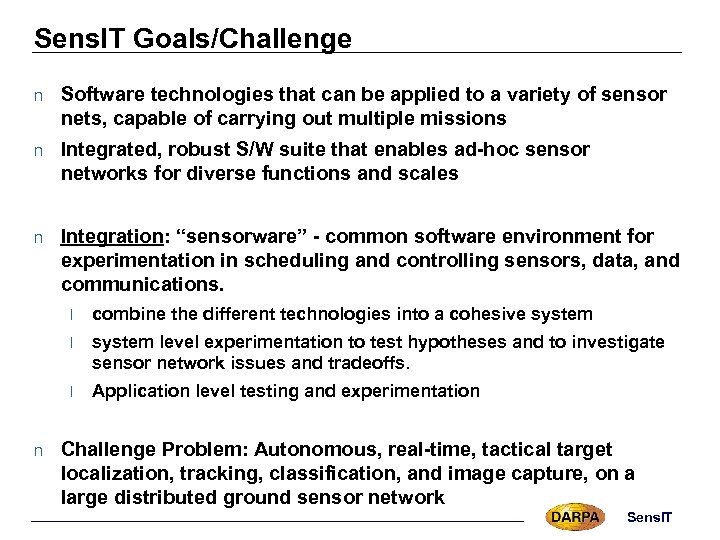
Sens. IT Goals/Challenge n Software technologies that can be applied to a variety of sensor nets, capable of carrying out multiple missions n Integrated, robust S/W suite that enables ad-hoc sensor networks for diverse functions and scales n Integration: “sensorware” - common software environment for experimentation in scheduling and controlling sensors, data, and communications. l l system level experimentation to test hypotheses and to investigate sensor network issues and tradeoffs. l n combine the different technologies into a cohesive system Application level testing and experimentation Challenge Problem: Autonomous, real-time, tactical target localization, tracking, classification, and image capture, on a large distributed ground sensor network Sens. IT
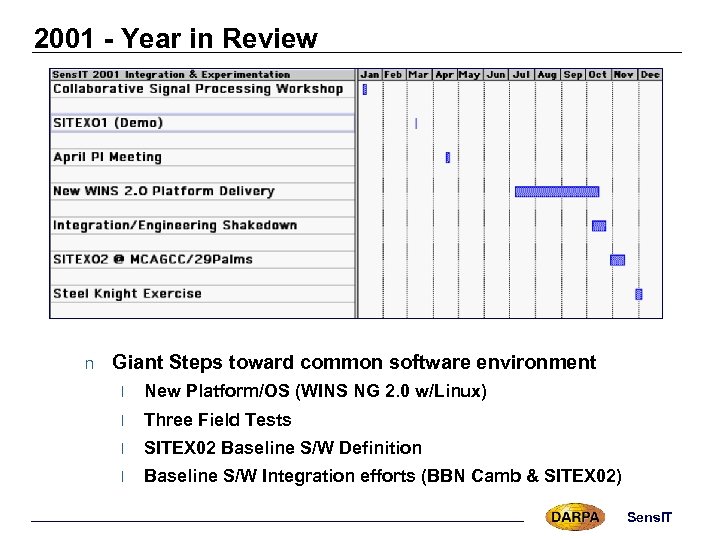
2001 - Year in Review n Giant Steps toward common software environment l New Platform/OS (WINS NG 2. 0 w/Linux) l Three Field Tests l SITEX 02 Baseline S/W Definition l Baseline S/W Integration efforts (BBN Camb & SITEX 02) Sens. IT
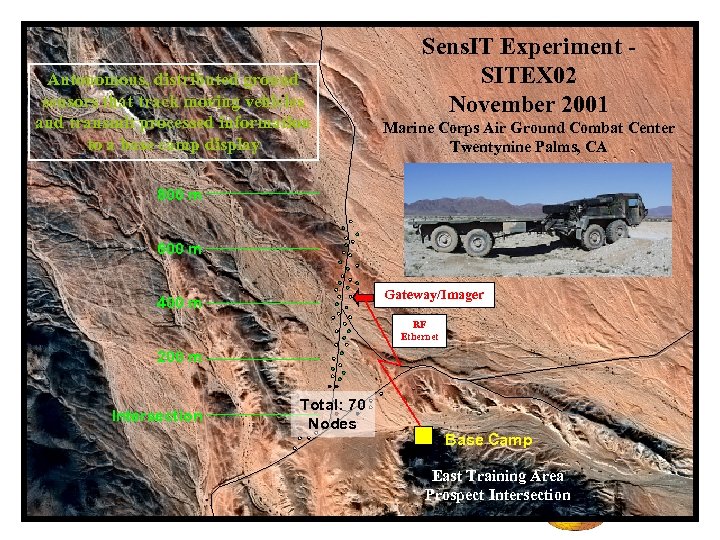
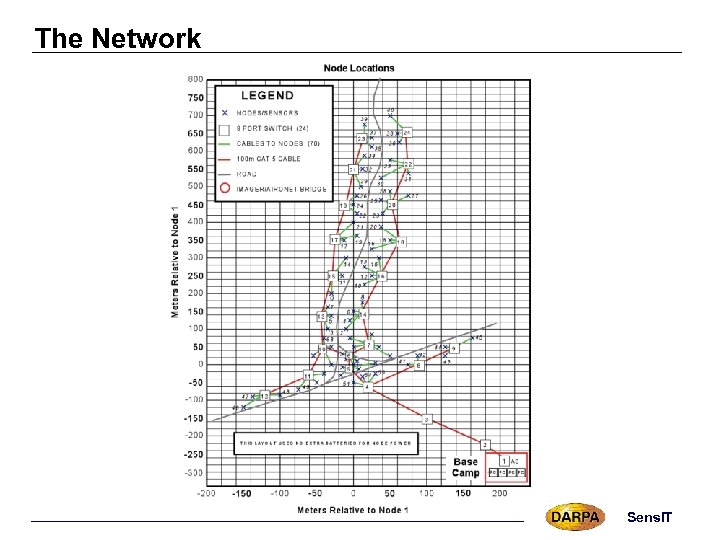
Autonomous, distributed ground sensors that track moving vehicles and transmit processed information to a base camp display Sens. IT Experiment SITEX 02 November 2001 Marine Corps Air Ground Combat Center Twentynine Palms, CA 800 m 600 m Gateway/Imager 400 m RF Ethernet 200 m Intersection Total: 70 Nodes Base Camp East Training Area Prospect Intersection Sens. IT
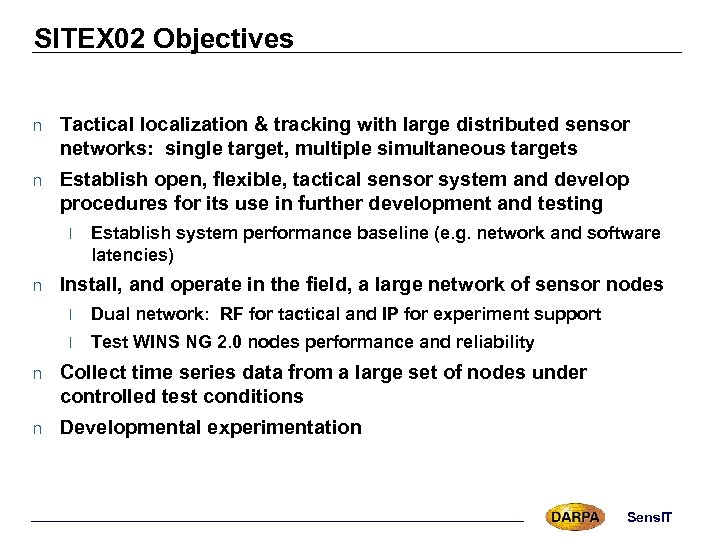
SITEX 02 Objectives n Tactical localization & tracking with large distributed sensor networks: single target, multiple simultaneous targets n Establish open, flexible, tactical sensor system and develop procedures for its use in further development and testing l n Establish system performance baseline (e. g. network and software latencies) Install, and operate in the field, a large network of sensor nodes l Dual network: RF for tactical and IP for experiment support l Test WINS NG 2. 0 nodes performance and reliability n Collect time series data from a large set of nodes under controlled test conditions n Developmental experimentation Sens. IT
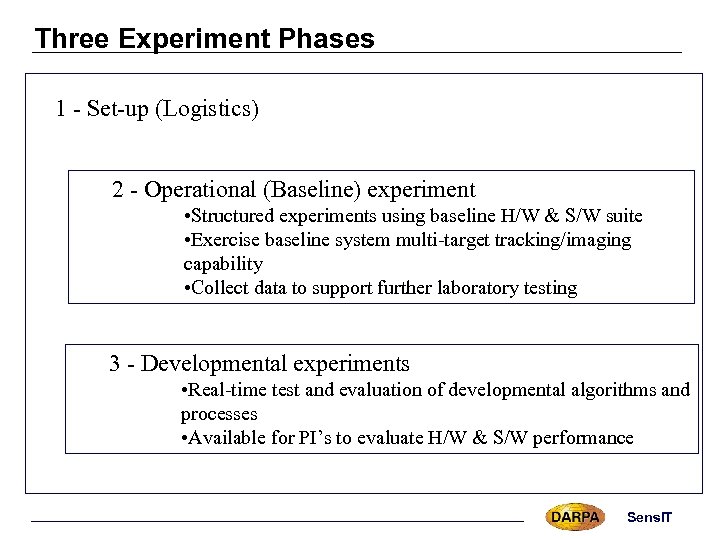
Three Experiment Phases 1 - Set-up (Logistics) 2 - Operational (Baseline) experiment • Structured experiments using baseline H/W & S/W suite • Exercise baseline system multi-target tracking/imaging capability • Collect data to support further laboratory testing 3 - Developmental experiments • Real-time test and evaluation of developmental algorithms and processes • Available for PI’s to evaluate H/W & S/W performance Sens. IT
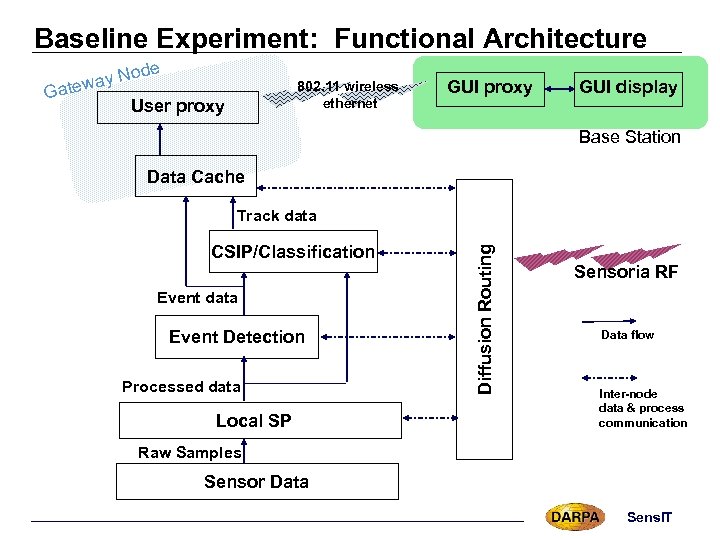
Baseline Experiment: Functional Architecture de ay No Gatew User proxy 802. 11 wireless ethernet GUI proxy GUI display Base Station Data Cache CSIP/Classification Event data Event Detection Processed data Local SP Diffusion Routing Track data Sensoria RF Data flow Inter-node data & process communication Raw Samples Sensor Data Sens. IT
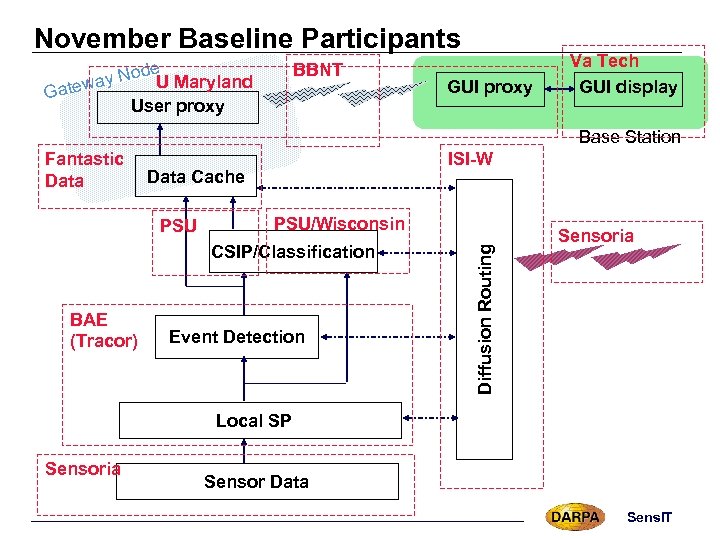
November Baseline Participants de ay No U Maryland Gatew User proxy BBNT GUI proxy Va Tech GUI display Base Station ISI-W Data Cache PSU/Wisconsin CSIP/Classification BAE (Tracor) Event Detection Diffusion Routing Fantastic Data Sensoria Local SP Sensoria Sensor Data Sens. IT
The Network Sens. IT
Baseline Experiment: Accomplishments n Installed and operated in the field 70 dual-networked sensor nodes. l n One of the largest wireless distributed sensor networks ever Collected 30 GB time series and event data l l n significant expansion to Sens. IT's database of signature data (including HMMWV, 5 -ton Truck, Dragonwagon, AAV, LAV, M 1 A 1 Tank, and Soviet BMP-2) provides data for further testing (and for playback) Established and tested procedures for l l n bringing node network up and down initializing and operating an integrated set of processes on the Sensoria nodes Automatically triggered an imager node using track projections calculated from BAE event detections l Detections and trigger commands transmitted via diffusion Sens. IT
Sens. IT
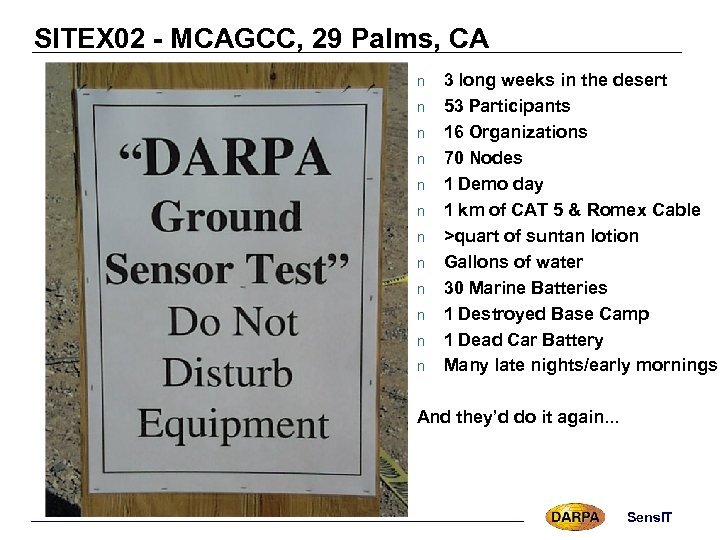
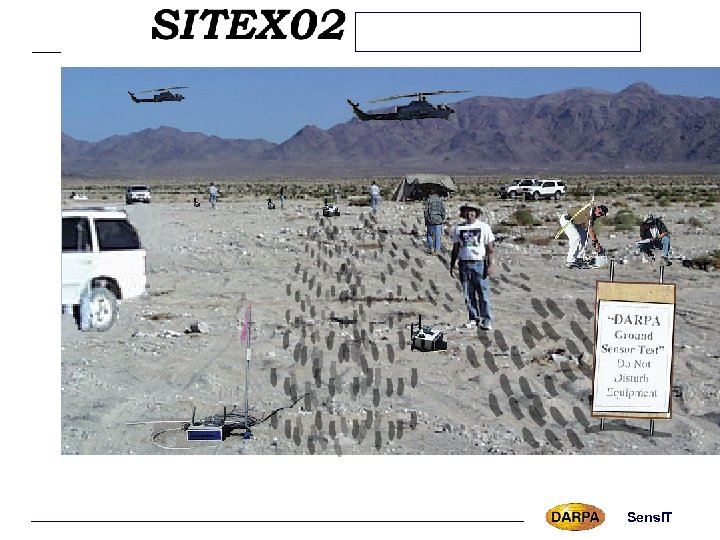
SITEX 02 - MCAGCC, 29 Palms, CA n n n 3 long weeks in the desert 53 Participants 16 Organizations 70 Nodes 1 Demo day 1 km of CAT 5 & Romex Cable >quart of suntan lotion Gallons of water 30 Marine Batteries 1 Destroyed Base Camp 1 Dead Car Battery Many late nights/early mornings And they’d do it again. . . Sens. IT
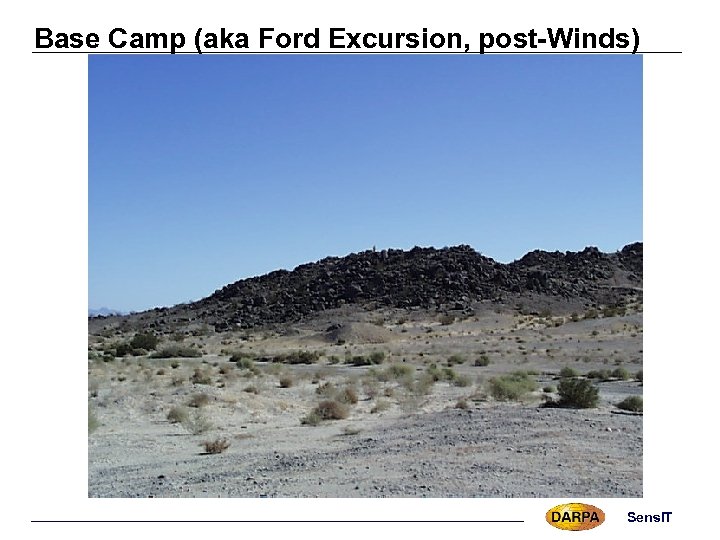
Base Camp (aka Ford Excursion, post-Winds) Sens. IT
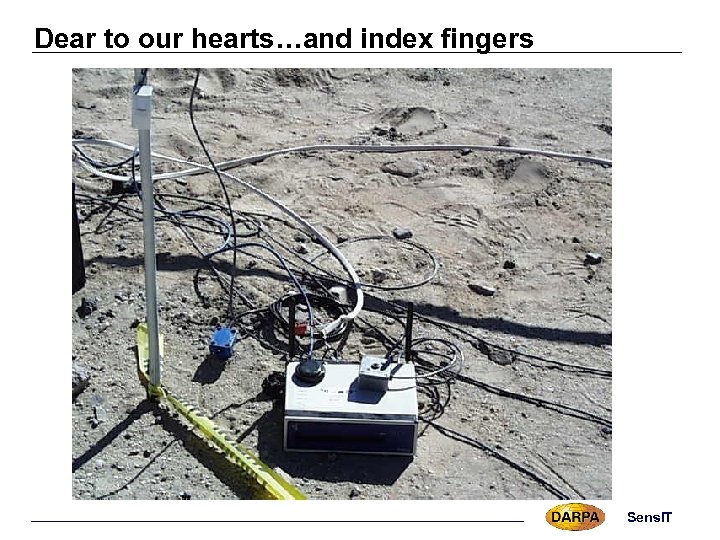
Dear to our hearts…and index fingers Sens. IT
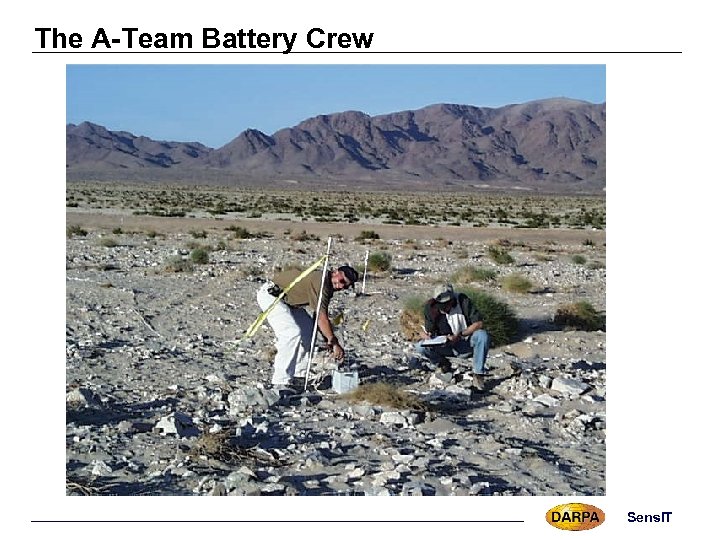
The A-Team Battery Crew Sens. IT
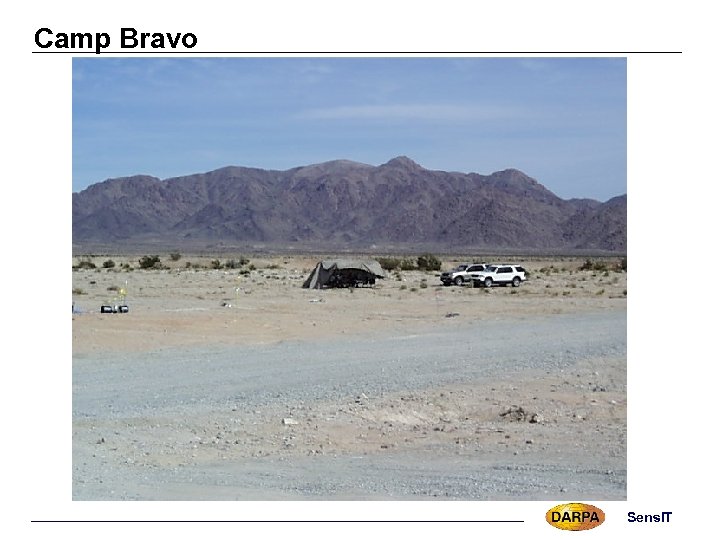
Camp Bravo Sens. IT
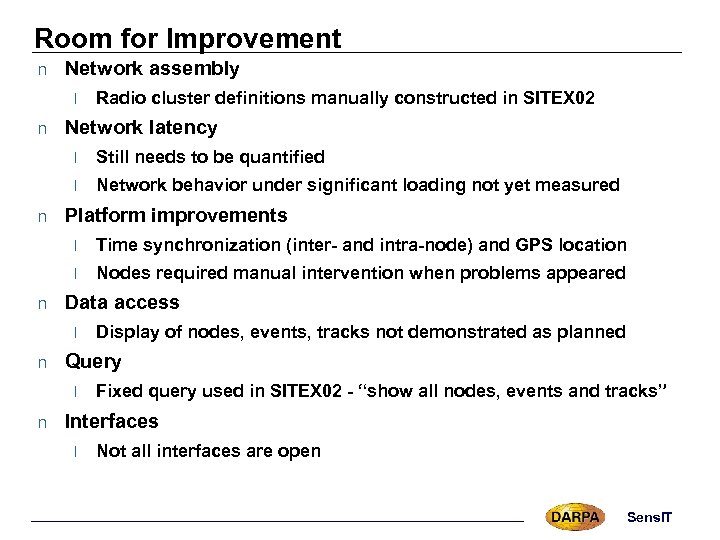
Room for Improvement n Network assembly l n Radio cluster definitions manually constructed in SITEX 02 Network latency l l n Still needs to be quantified Network behavior under significant loading not yet measured Platform improvements l l n Time synchronization (inter- and intra-node) and GPS location Nodes required manual intervention when problems appeared Data access l n Query l n Display of nodes, events, tracks not demonstrated as planned Fixed query used in SITEX 02 - “show all nodes, events and tracks” Interfaces l Not all interfaces are open Sens. IT
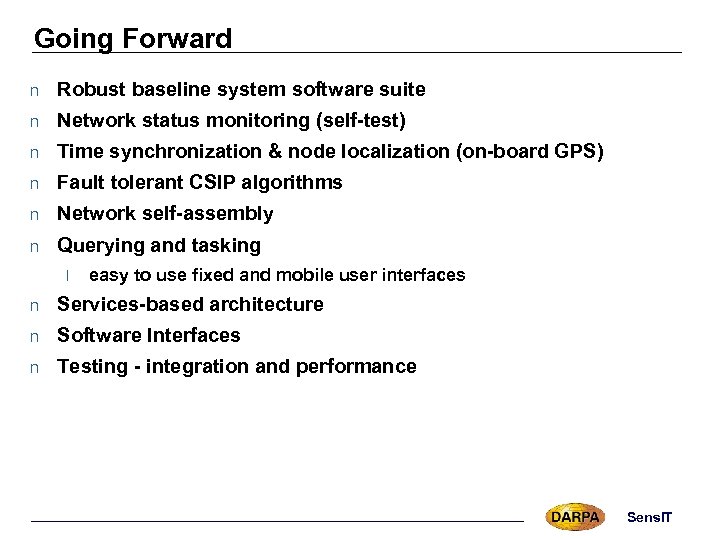
Going Forward n Robust baseline system software suite n Network status monitoring (self-test) n Time synchronization & node localization (on-board GPS) n Fault tolerant CSIP algorithms n Network self-assembly n Querying and tasking l easy to use fixed and mobile user interfaces n Services-based architecture n Software Interfaces n Testing - integration and performance Sens. IT
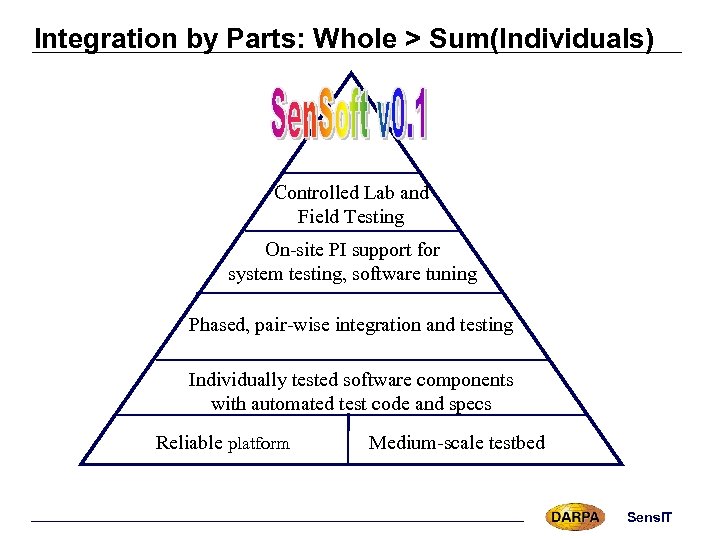
Integration by Parts: Whole > Sum(Individuals) Controlled Lab and Field Testing On-site PI support for system testing, software tuning Phased, pair-wise integration and testing Individually tested software components with automated test code and specs Reliable platform Medium-scale testbed Sens. IT
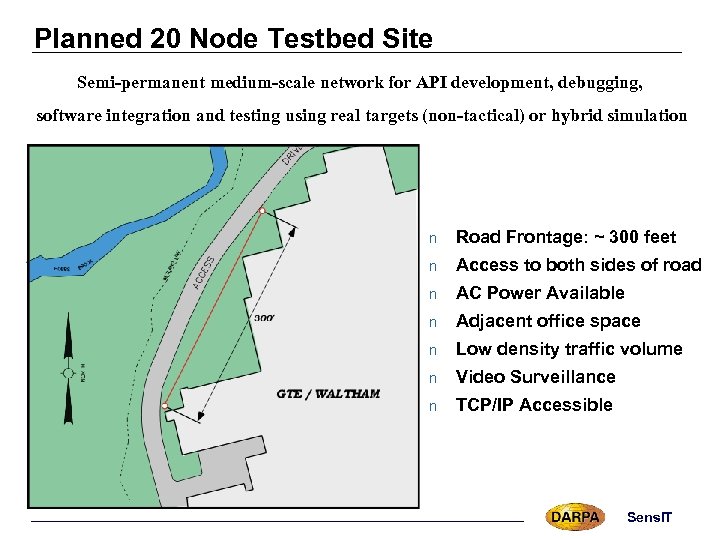
Planned 20 Node Testbed Site Semi-permanent medium-scale network for API development, debugging, software integration and testing using real targets (non-tactical) or hybrid simulation n Road Frontage: ~ 300 feet n Access to both sides of road n AC Power Available n Adjacent office space n Low density traffic volume n Video Surveillance n TCP/IP Accessible Sens. IT
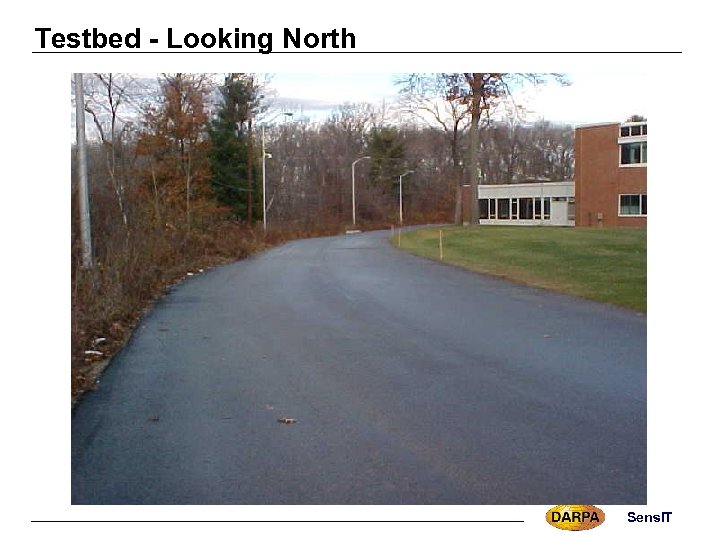
Testbed - Looking North Sens. IT
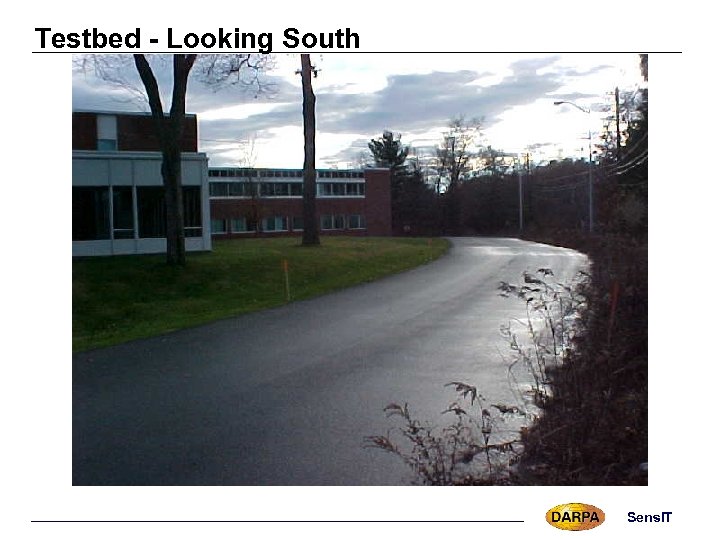
Testbed - Looking South Sens. IT
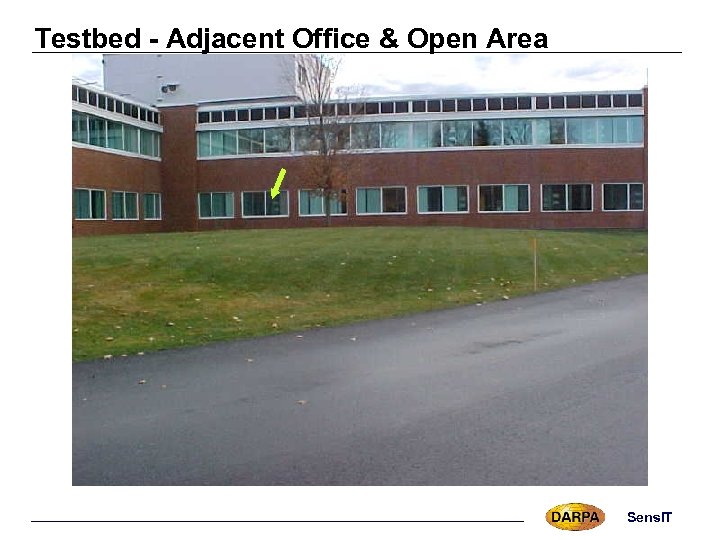
Testbed - Adjacent Office & Open Area Sens. IT
SITEX 02 Lessons Learned n There’s no substitute for being there! n A large-scale network is essential for testing Sens. IT concepts , but imposes a significant logistical burden (manual reboot, battery replacement, etc. ). n Well-defined, open interfaces between functionalities are faster and easier to debug. n Diagnostic tools can ease the test process: status checks, tracing, debugging, . . . l n Reliable hardware is required for software testing. Similarly, debugged software is required before software integration l n Self-diagnostic nodes and radios, and nodes that can reboot without manual intervention would ease the logistical burden how to test? how to improve? Record everything! Sens. IT
Скачать презентацию Sens IT Integration and Experimentation Update BBN Technologies
14001676667d8cd3cb54fffab4df8196.ppt