 Скачать презентацию SENIORS Tell your Tribond how you feel about
87b4ca5d75cb1673750b210bb3cbee09.ppt
- Количество слайдов: 69




SENIORS… Tell your Tribond how you feel about the Bible you own? Is it trustworthy?

SENIORS… Tuesday start-up Two pray Tuesday. In your Tribond have one person pray for the school and another pray for the country
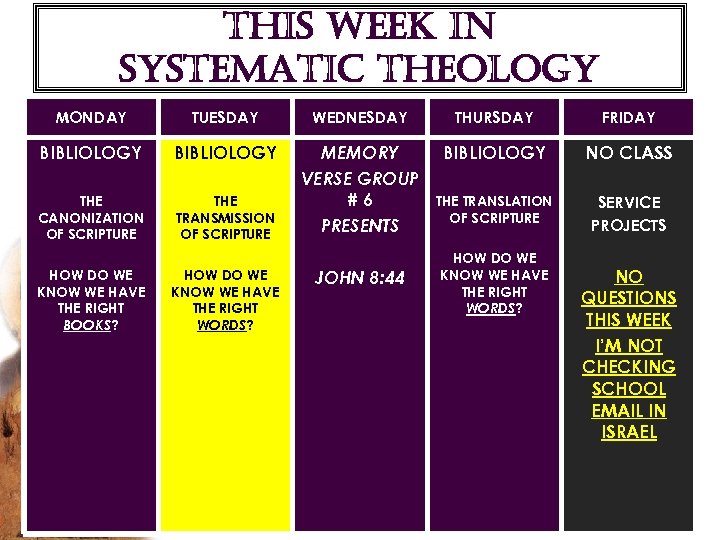
THIS WEEK IN SYSTEMATIC THEOLOGY MONDAY TUESDAY WEDNESDAY THURSDAY FRIDAY BIBLIOLOGY NO CLASS THE CANONIZATION OF SCRIPTURE THE TRANSMISSION OF SCRIPTURE MEMORY VERSE GROUP #6 PRESENTS THE TRANSLATION OF SCRIPTURE SERVICE PROJECTS HOW DO WE KNOW WE HAVE THE RIGHT BOOKS? HOW DO WE KNOW WE HAVE THE RIGHT WORDS? JOHN 8: 44 HOW DO WE KNOW WE HAVE THE RIGHT WORDS? NO QUESTIONS THIS WEEK I’M NOT CHECKING SCHOOL EMAIL IN ISRAEL
TRANSMISSION OF SCRIPTURE HOW DO WE KNOW WE HAVE THE RIGHT WORDS?
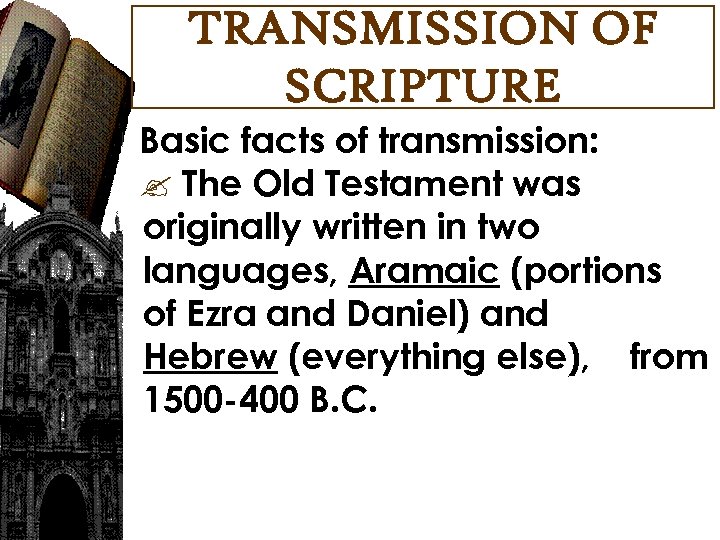
TRANSMISSION OF SCRIPTURE Basic facts of transmission: The Old Testament was originally written in two languages, Aramaic (portions of Ezra and Daniel) and Hebrew (everything else), from 1500 -400 B. C.
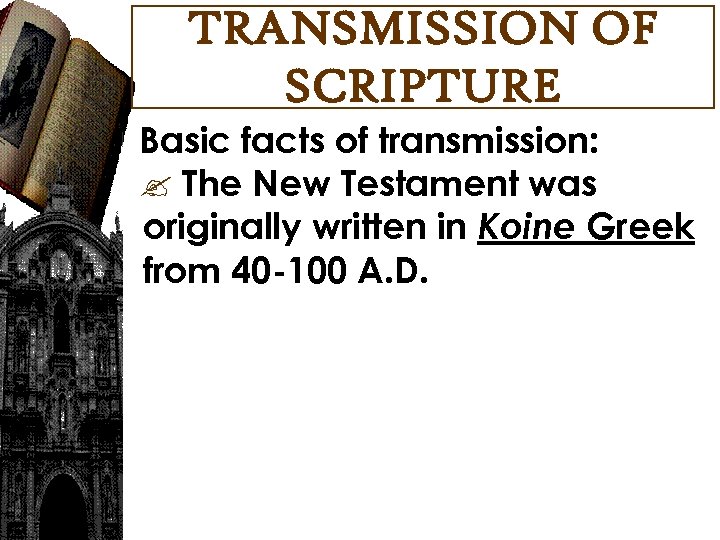
TRANSMISSION OF SCRIPTURE Basic facts of transmission: The New Testament was originally written in Koine Greek from 40 -100 A. D.
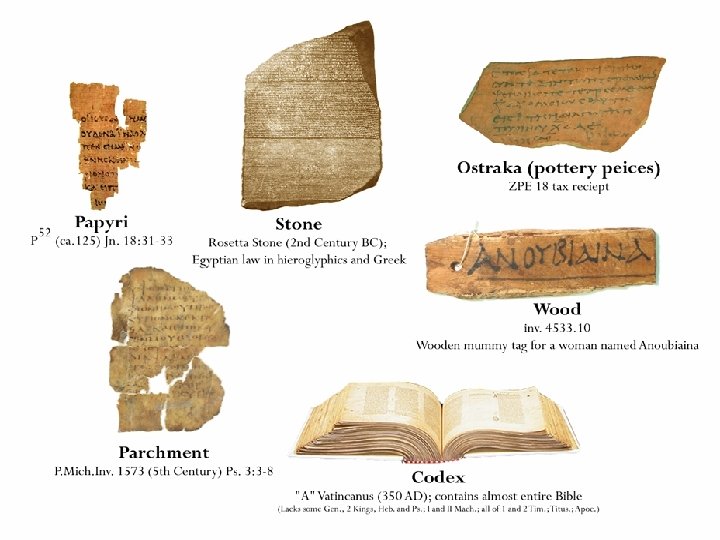
TRANSMISSION OF SCRIPTURE Basic facts of transmission: The most readily available writing materials were stone, papyri, and parchment (vellum) until the codex was developed in the 2 nd century B. C.
TRANSMISSION OF SCRIPTURE Basic facts of transmission: All transmissions of the Bible were handwritten until the invention of the printing press in the 15 th century by Johann Gutenberg
TRANSMISSION OF SCRIPTURE Basic facts of transmission: At times errors were made by the scribes who copied the Scriptures- each different reading among the “extant” or existing manuscripts is called a variant
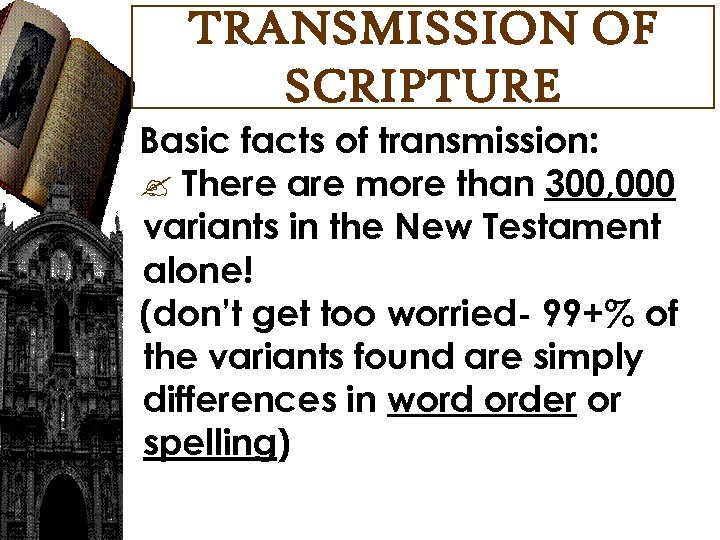
TRANSMISSION OF SCRIPTURE Basic facts of transmission: There are more than 300, 000 variants in the New Testament alone! (don’t get too worried- 99+% of the variants found are simply differences in word order or spelling)
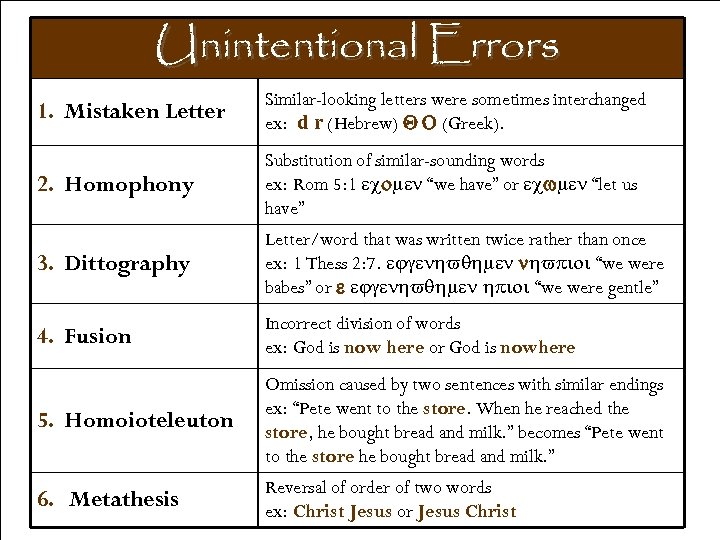
Unintentional Errors 1. Mistaken Letter Similar-looking letters were sometimes interchanged ex: d r (Hebrew) Q O (Greek). 2. Homophony Substitution of similar-sounding words ex: Rom 5: 1 ecomen “we have” or ecwmen “let us have” 3. Dittography Letter/word that was written twice rather than once ex: 1 Thess 2: 7. ejgenhvqhmen nhvpioi “we were babes” or e ejgenhvqhmen hpioi “we were gentle” 4. Fusion Incorrect division of words ex: God is now here or God is nowhere 5. Homoioteleuton Omission caused by two sentences with similar endings ex: “Pete went to the store. When he reached the store, he bought bread and milk. ” becomes “Pete went to the store he bought bread and milk. ” 6. Metathesis Reversal of order of two words ex: Christ Jesus or Jesus Christ
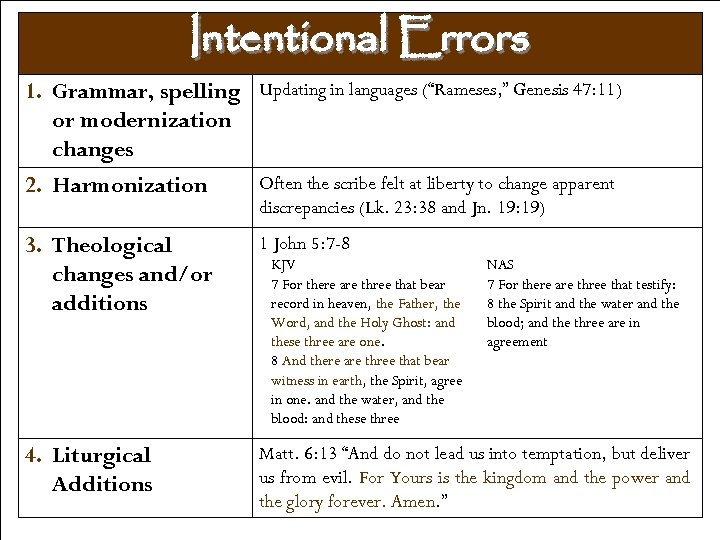
Intentional Errors 1. Grammar, spelling Updating in languages (“Rameses, ” Genesis 47: 11) or modernization changes Often the scribe felt at liberty to change apparent 2. Harmonization discrepancies (Lk. 23: 38 and Jn. 19: 19) 3. Theological changes and/or additions 1 John 5: 7 -8 4. Liturgical Additions Matt. 6: 13 “And do not lead us into temptation, but deliver us from evil. For Yours is the kingdom and the power and the glory forever. Amen. ” KJV 7 For there are three that bear record in heaven, the Father, the Word, and the Holy Ghost: and these three are one. 8 And there are three that bear witness in earth, the Spirit, agree in one. and the water, and the blood: and these three NAS 7 For there are three that testify: 8 the Spirit and the water and the blood; and the three are in agreement
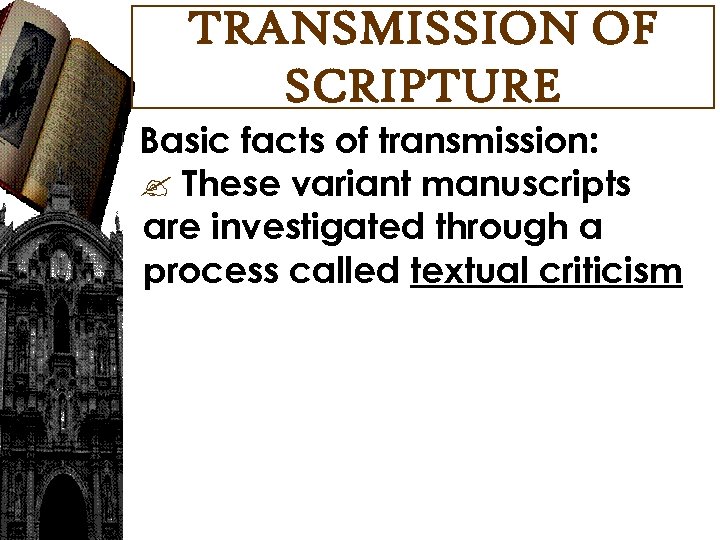
TRANSMISSION OF SCRIPTURE Basic facts of transmission: These variant manuscripts are investigated through a process called textual criticism
TRANSMISSION OF SCRIPTURE Textual Criticism: Science of reconstructing the original text of the Scriptures based upon the available manuscript evidence
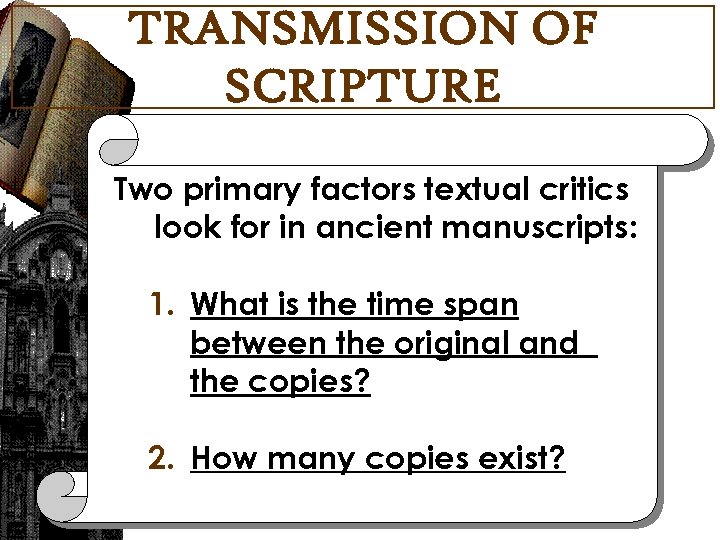
TRANSMISSION OF SCRIPTURE Two primary factors textual critics look for in ancient manuscripts: 1. What is the time span between the original and the copies? 2. How many copies exist?
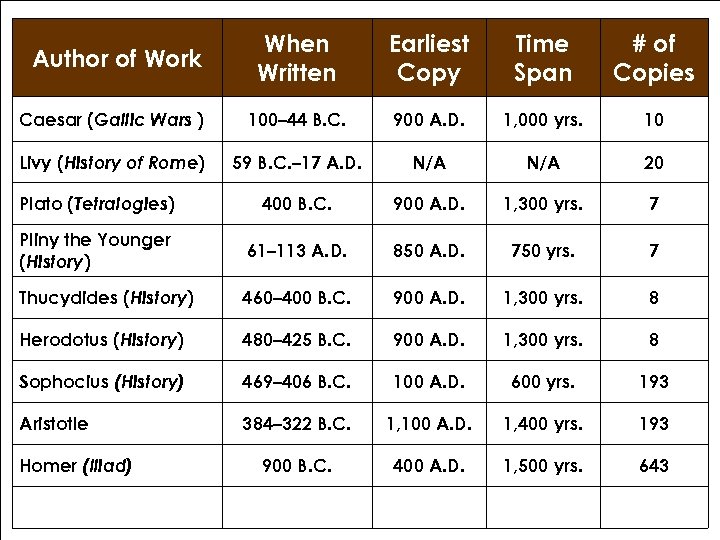
Author of Work When Written Earliest Copy Time Span # of Copies Caesar (Gallic Wars ) 100– 44 B. C. 900 A. D. 1, 000 yrs. 10 Livy (History of Rome) 59 B. C. – 17 A. D. N/A 20 Plato (Tetralogies) 400 B. C. 900 A. D. 1, 300 yrs. 7 Pliny the Younger (History) 61– 113 A. D. 850 A. D. 750 yrs. 7 Thucydides (History) 460– 400 B. C. 900 A. D. 1, 300 yrs. 8 Herodotus (History) 480– 425 B. C. 900 A. D. 1, 300 yrs. 8 Sophocius (History) 469– 406 B. C. 100 A. D. 600 yrs. 193 Aristotle 384– 322 B. C. 1, 100 A. D. 1, 400 yrs. 193 900 B. C. 400 A. D. 1, 500 yrs. 643 Homer (Iliad)
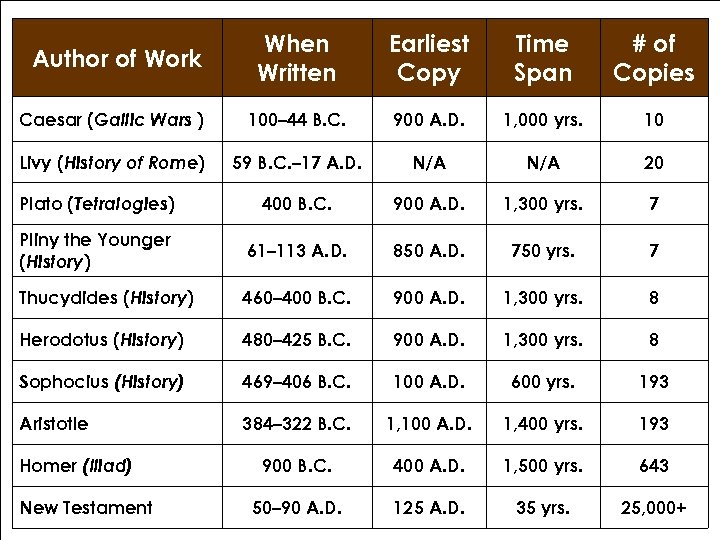
Author of Work When Written Earliest Copy Time Span # of Copies Caesar (Gallic Wars ) 100– 44 B. C. 900 A. D. 1, 000 yrs. 10 Livy (History of Rome) 59 B. C. – 17 A. D. N/A 20 Plato (Tetralogies) 400 B. C. 900 A. D. 1, 300 yrs. 7 Pliny the Younger (History) 61– 113 A. D. 850 A. D. 750 yrs. 7 Thucydides (History) 460– 400 B. C. 900 A. D. 1, 300 yrs. 8 Herodotus (History) 480– 425 B. C. 900 A. D. 1, 300 yrs. 8 Sophocius (History) 469– 406 B. C. 100 A. D. 600 yrs. 193 Aristotle 384– 322 B. C. 1, 100 A. D. 1, 400 yrs. 193 900 B. C. 400 A. D. 1, 500 yrs. 643 50– 90 A. D. 125 A. D. 35 yrs. 25, 000+ Homer (Iliad) New Testament
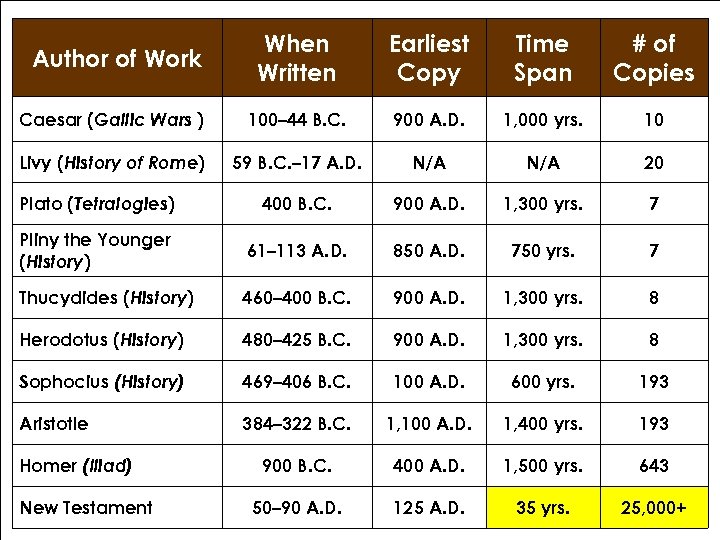
Author of Work When Written Earliest Copy Time Span # of Copies Caesar (Gallic Wars ) 100– 44 B. C. 900 A. D. 1, 000 yrs. 10 Livy (History of Rome) 59 B. C. – 17 A. D. N/A 20 Plato (Tetralogies) 400 B. C. 900 A. D. 1, 300 yrs. 7 Pliny the Younger (History) 61– 113 A. D. 850 A. D. 750 yrs. 7 Thucydides (History) 460– 400 B. C. 900 A. D. 1, 300 yrs. 8 Herodotus (History) 480– 425 B. C. 900 A. D. 1, 300 yrs. 8 Sophocius (History) 469– 406 B. C. 100 A. D. 600 yrs. 193 Aristotle 384– 322 B. C. 1, 100 A. D. 1, 400 yrs. 193 900 B. C. 400 A. D. 1, 500 yrs. 643 50– 90 A. D. 125 A. D. 35 yrs. 25, 000+ Homer (Iliad) New Testament
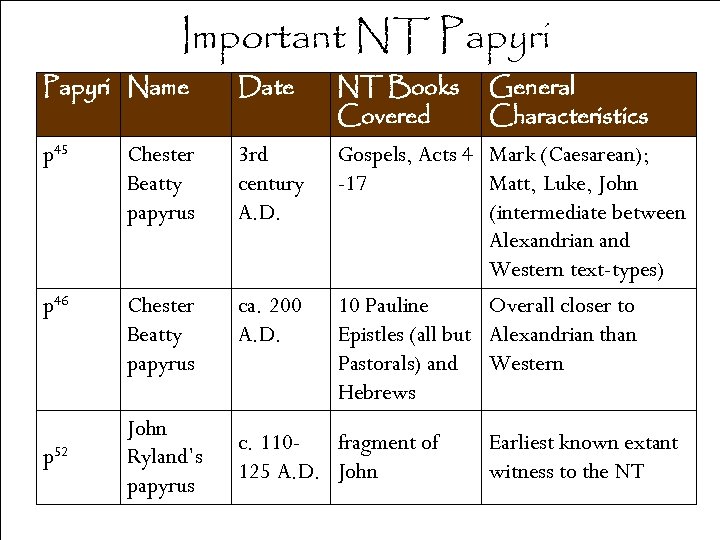
Important NT Papyri Name Date NT Books Covered p 45 Chester Beatty papyrus 3 rd century A. D. Gospels, Acts 4 Mark (Caesarean); -17 Matt, Luke, John (intermediate between Alexandrian and Western text-types) p 46 Chester Beatty papyrus ca. 200 A. D. 10 Pauline Overall closer to Epistles (all but Alexandrian than Pastorals) and Western Hebrews p 52 John Ryland’s papyrus c. 110 fragment of 125 A. D. John General Characteristics Earliest known extant witness to the NT
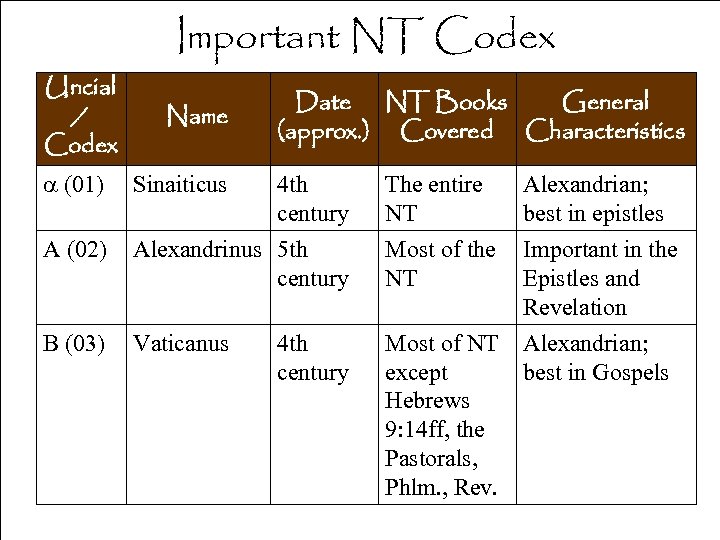
Important NT Codex Uncial / Codex Name a (01) Sinaiticus A (02) B (03) Date NT Books General (approx. ) Covered Characteristics 4 th century The entire NT Alexandrian; best in epistles Alexandrinus 5 th century Most of the NT Important in the Epistles and Revelation Vaticanus Most of NT except Hebrews 9: 14 ff, the Pastorals, Phlm. , Rev. Alexandrian; best in Gospels 4 th century
TRANSMISSION OF SCRIPTURE 1. Leningrad Codex (Codex P): written in A. D. 916
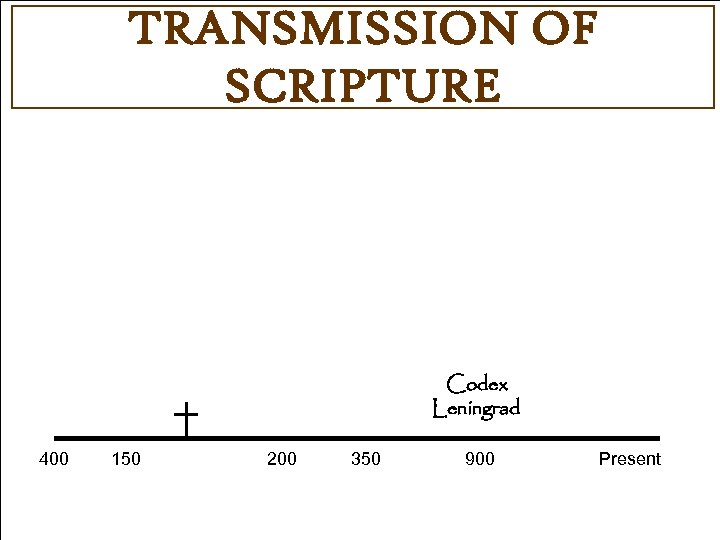
TRANSMISSION OF SCRIPTURE Codex Leningrad 400 150 200 350 900 Present
TRANSMISSION OF SCRIPTURE 2. Septuagint (LXX): Greek translation of the Old Testament translated around 300– 150 B. C. Earliest copy A. D. 400 (a, A, B)
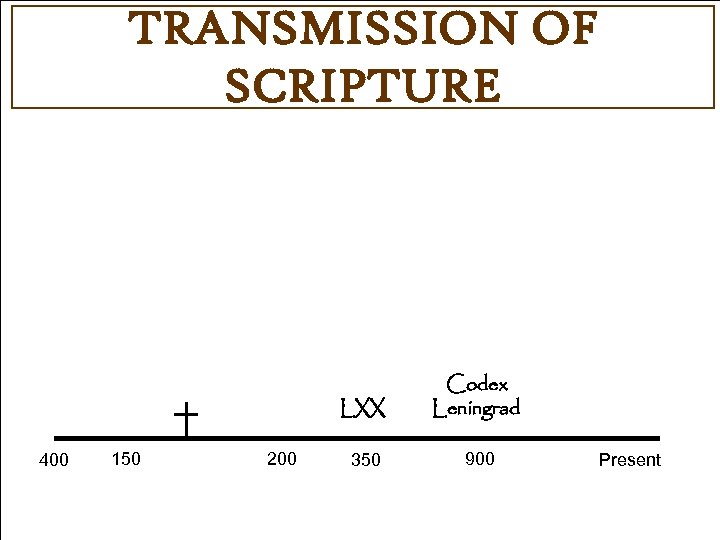
TRANSMISSION OF SCRIPTURE LXX 400 150 200 Codex Leningrad 350 900 Present
TRANSMISSION OF SCRIPTURE 3. Targums: Aramaic paraphrases of the Old Testament after A. D. 200
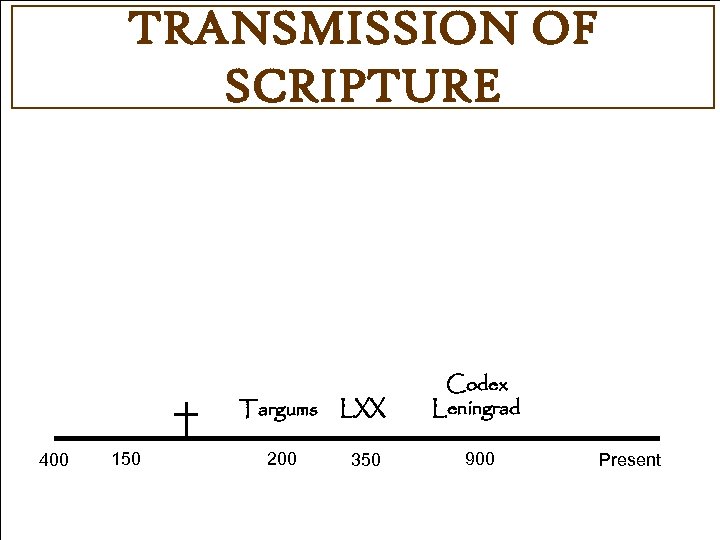
TRANSMISSION OF SCRIPTURE Targums 400 150 LXX Codex Leningrad 200 350 900 Present
TRANSMISSION OF SCRIPTURE 4. Dead Sea Scrolls: Found in 1948, contained copies or portions of every book in the Old Testament except Esther (there is a full copy of Isaiah dating back to 200135 B. C. )
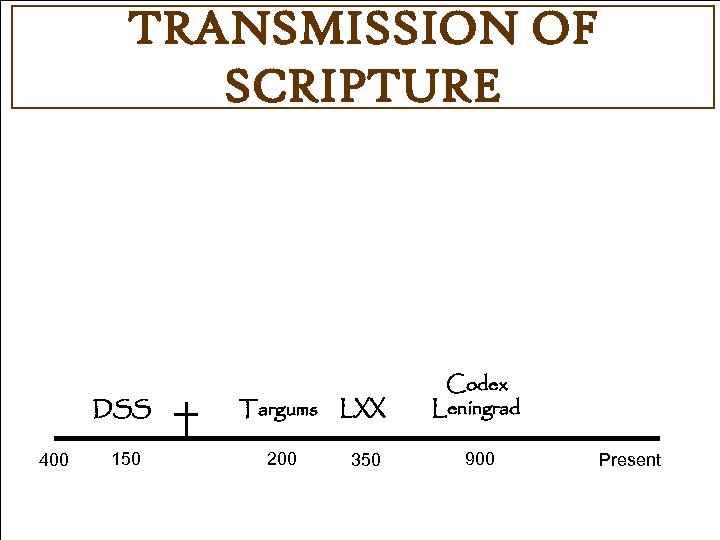
TRANSMISSION OF SCRIPTURE DSS 400 Targums LXX Codex Leningrad 150 200 350 900 Present
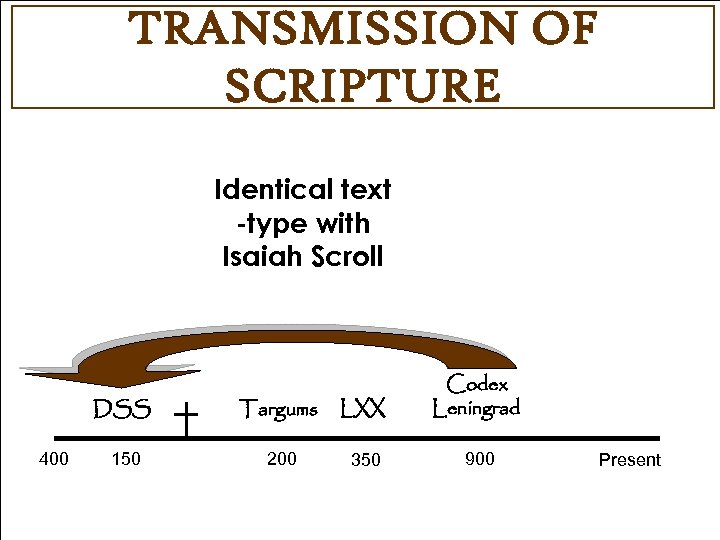
TRANSMISSION OF SCRIPTURE Identical text -type with Isaiah Scroll DSS 400 Targums LXX Codex Leningrad 150 200 350 900 Present
TRANSMISSION OF SCRIPTURE Rules followed by the Masorites: 1. Only parchments from clean animals could be used 2. Each column of the scroll was to have no fewer than 48 and no more than 60 lines whose breadth must consist of 30 letters
TRANSMISSION OF SCRIPTURE Rules followed by the Masorites: 3. The ink was to be black, prepared according to a specific recipe 4. No word or letter was to be written from memory 5. There was to be a space of a hair between each consonant and the space of a consonant between each word
TRANSMISSION OF SCRIPTURE Rules followed by the Masorites: 6. The scribe must wash himself entirely and be in full Jewish dress before beginning to copy the scroll 7. He could not write the name YHWH with a newly dipped brush, nor take notice of anyone, even a king, while writing the sacred name
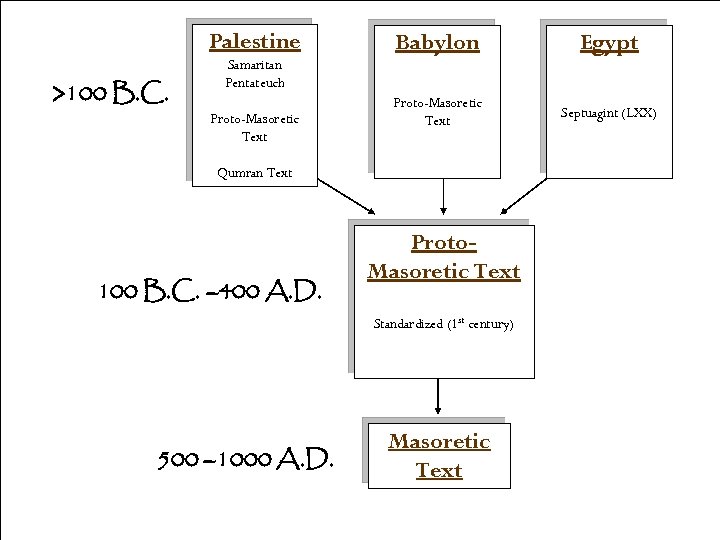
Palestine >100 B. C. Samaritan Pentateuch Proto-Masoretic Text Babylon Egypt Proto-Masoretic Text Septuagint (LXX) Qumran Text 100 B. C. – 400 A. D. Proto. Masoretic Text Standardized (1 st century) 500 – 1000 A. D. Masoretic Text
TRANSMISSION OF SCRIPTURE Questions: 1. How do we know that the Bible we have today is the same as when it was first written? 2. Did the scribes ever make mistakes when copying the Bible? If so, how significant were the mistakes?
SENIORS… Group number 6 prepare to present next weeks memory verse. Everyone else please read John 8: 44
SENIORS… Wednesday start-up Please pray Mr. E and Mr. La. Barbera’s safety as they tour Israel and the surrounding areas.
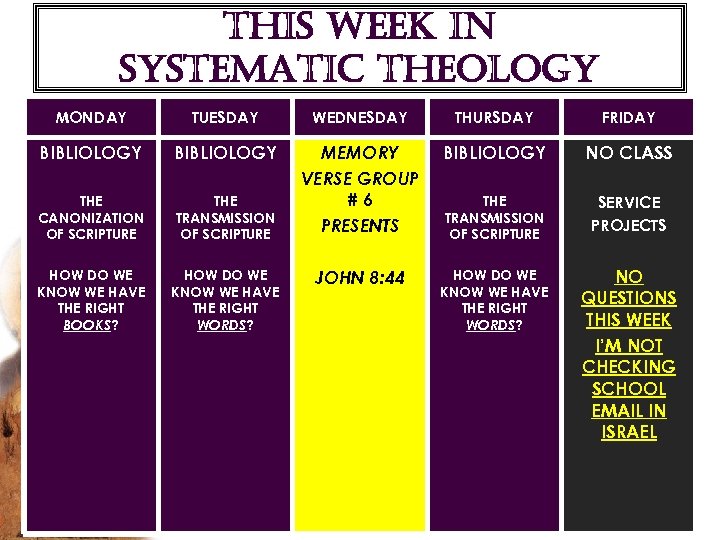
THIS WEEK IN SYSTEMATIC THEOLOGY MONDAY TUESDAY WEDNESDAY THURSDAY FRIDAY BIBLIOLOGY NO CLASS THE CANONIZATION OF SCRIPTURE THE TRANSMISSION OF SCRIPTURE MEMORY VERSE GROUP #6 PRESENTS THE TRANSMISSION OF SCRIPTURE SERVICE PROJECTS HOW DO WE KNOW WE HAVE THE RIGHT BOOKS? HOW DO WE KNOW WE HAVE THE RIGHT WORDS? JOHN 8: 44 HOW DO WE KNOW WE HAVE THE RIGHT WORDS? NO QUESTIONS THIS WEEK I’M NOT CHECKING SCHOOL EMAIL IN ISRAEL

SENIORS… After all your have learned about transmission of the Bible, which translation in English to you think is the most accurate?

SENIORS… Thursday start-up In your Tribond pray over theme in your life. “Fall into His story. ”
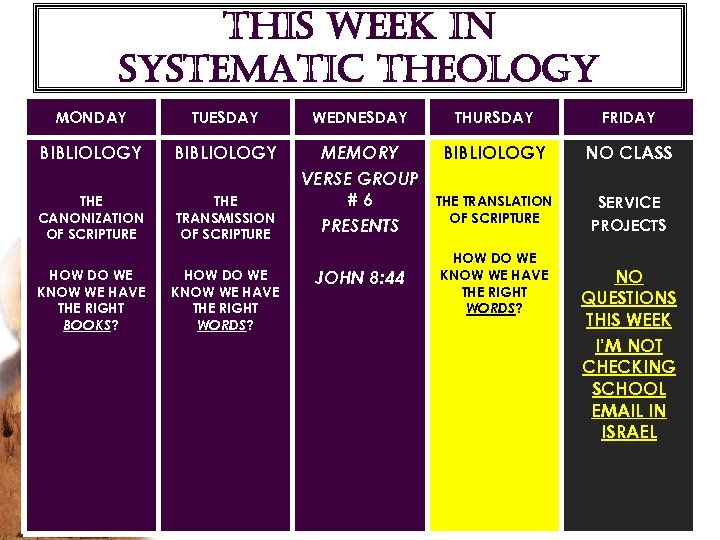
THIS WEEK IN SYSTEMATIC THEOLOGY MONDAY TUESDAY WEDNESDAY THURSDAY FRIDAY BIBLIOLOGY NO CLASS THE CANONIZATION OF SCRIPTURE THE TRANSMISSION OF SCRIPTURE MEMORY VERSE GROUP #6 PRESENTS THE TRANSLATION OF SCRIPTURE SERVICE PROJECTS HOW DO WE KNOW WE HAVE THE RIGHT BOOKS? HOW DO WE KNOW WE HAVE THE RIGHT WORDS? JOHN 8: 44 HOW DO WE KNOW WE HAVE THE RIGHT WORDS? NO QUESTIONS THIS WEEK I’M NOT CHECKING SCHOOL EMAIL IN ISRAEL
TRANSLATION OF SCRIPTURE How did we get the ESV, NAS, and KJV? What manuscripts or codex were used in translating to English? Were they originals?
TRANSLATION OF SCRIPTURE The Greek and Hebrew manuscripts used to create English translations of the Bible were not originals. Jesus taught from copies, not originals and treated them as authoritative.
TRANSLATION OF SCRIPTURE The thorough transmission process makes for trustworthiness. To not accept the copies of the NT is to throw out Homer, Plato, and Aristotle from your bookstore shelves.
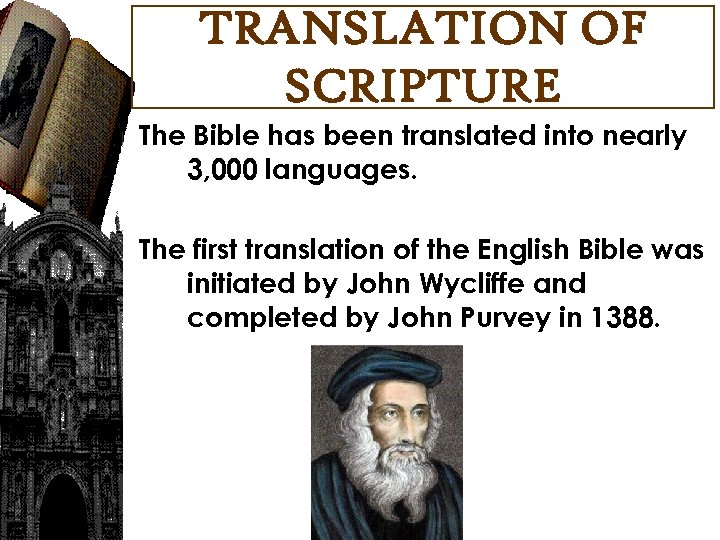
TRANSLATION OF SCRIPTURE The Bible has been translated into nearly 3, 000 languages. The first translation of the English Bible was initiated by John Wycliffe and completed by John Purvey in 1388.
TRANSLATION OF SCRIPTURE Unfamiliar with Hebrew and Greek Wycliffe translated from Latin into English. - - Wycliffe used the Latin Vulgate as his source. The Latin Vulgate was translated from Greek by Jerome. He used the Greek Septuagint for the OT Then later revised from Hebrew OT He revised Latin NT rather than translate from Greek. (This work was already done).
TRANSLATION OF SCRIPTURE Until Wycliffe’s English Bible the Bible was not privately owned and read but controlled by the church (Latin) Wycliffe’s English Bible revealed the church’s rituals, ceremonies, and doctrines were not from the Bible. Wycliffe pronounced that we are saved by divine grace!
TRANSLATION OF SCRIPTURE Wycliffe decided the best way to fight the corrupt church was to give everyone a Bible. His English translation is released in 1380 but not printed. 1384 Wycliffe died, the church had his body dug up and burned and his ashes thrown into the Swift River. 1388 John Purvey continued Wycliffe’s work.
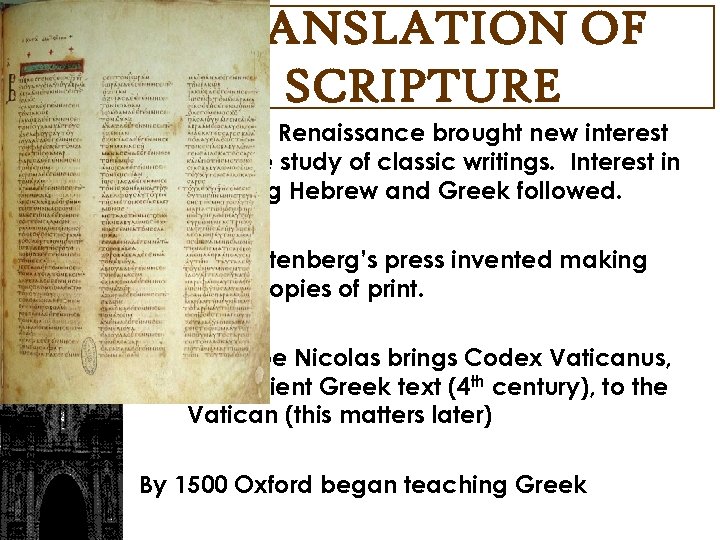
TRANSLATION OF SCRIPTURE By 1425 the Renaissance brought new interest into the study of classic writings. Interest in learning Hebrew and Greek followed. By 1450 Gutenberg’s press invented making mass copies of print. In 1448 Pope Nicolas brings Codex Vaticanus, an ancient Greek text (4 th century), to the Vatican (this matters later) By 1500 Oxford began teaching Greek
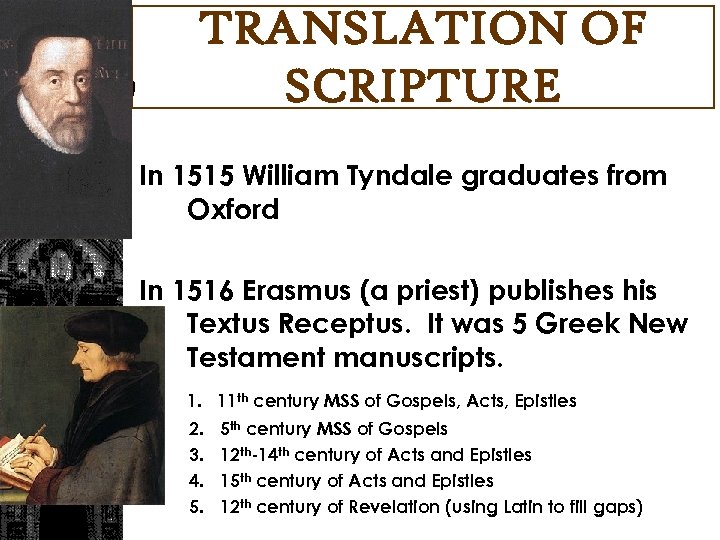
TRANSLATION OF SCRIPTURE In 1515 William Tyndale graduates from Oxford In 1516 Erasmus (a priest) publishes his Textus Receptus. It was 5 Greek New Testament manuscripts. 1. 11 th century MSS of Gospels, Acts, Epistles 2. 3. 4. 5. 5 th century MSS of Gospels 12 th-14 th century of Acts and Epistles 15 th century of Acts and Epistles 12 th century of Revelation (using Latin to fill gaps)
TRANSLATION OF SCRIPTURE 1517 Martin Luther posts his 95 theses 1523 Tyndale goes to London but the bishop refuses to let him work on an English translation 1525 Tyndale goes to Germany and works on English translation. Translating from Erasmus Textus Receptus.
TRANSLATION OF SCRIPTURE In 1525 Germany smuggled 15, 000 copies to England burned the copies as fast as they can find them. In 1536 Tyndale was strangled and burned by the King and the Church of England. His last prayer “Lord, open the King’s eyes. ”
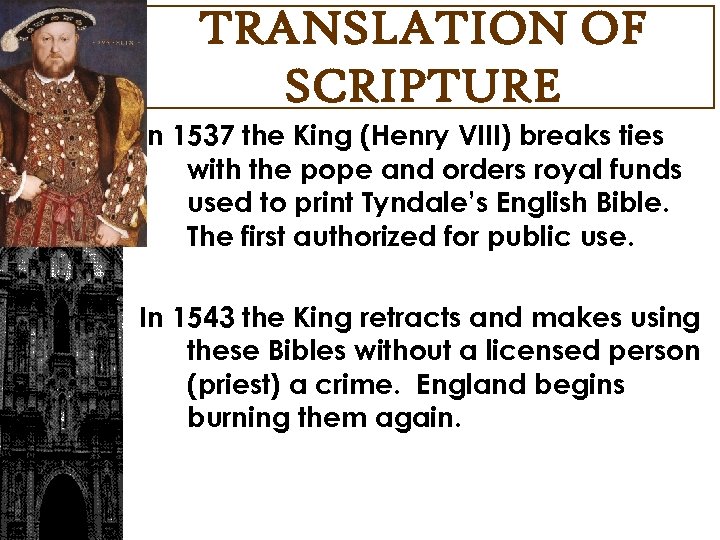
TRANSLATION OF SCRIPTURE In 1537 the King (Henry VIII) breaks ties with the pope and orders royal funds used to print Tyndale’s English Bible. The first authorized for public use. In 1543 the King retracts and makes using these Bibles without a licensed person (priest) a crime. England begins burning them again.
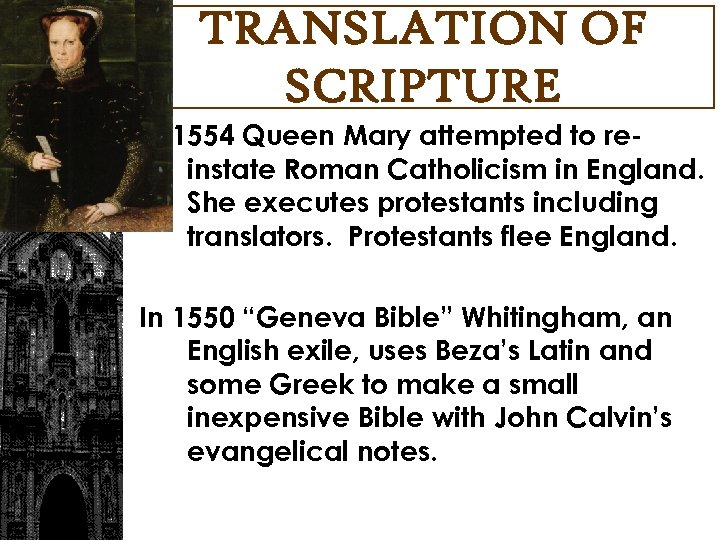
TRANSLATION OF SCRIPTURE In 1554 Queen Mary attempted to reinstate Roman Catholicism in England. She executes protestants including translators. Protestants flee England. In 1550 “Geneva Bible” Whitingham, an English exile, uses Beza’s Latin and some Greek to make a small inexpensive Bible with John Calvin’s evangelical notes.
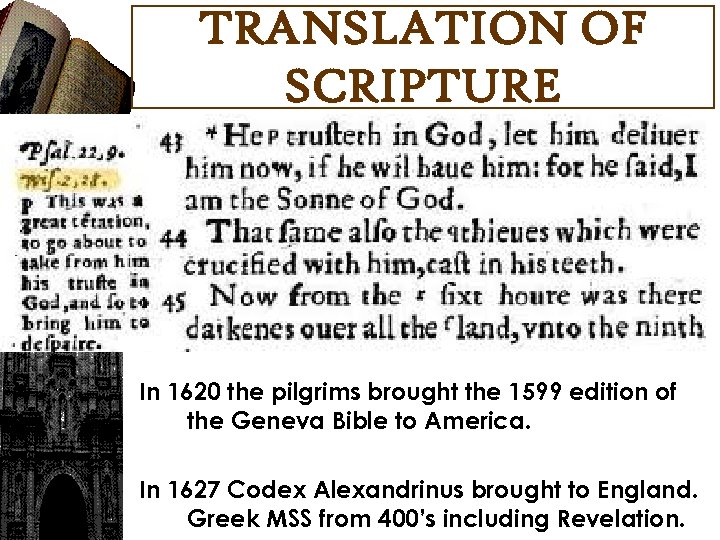
TRANSLATION OF SCRIPTURE In 1551 Verse numbers were added for the first time by Stephanus when he published the 4 th edition of Textus Receptus. In 1611 The King James bible was finished using Textus Receptus (with verses) as the Greek Text. In 1620 the pilgrims brought the 1599 edition of the Geneva Bible to America. In 1627 Codex Alexandrinus brought to England. Greek MSS from 400’s including Revelation.
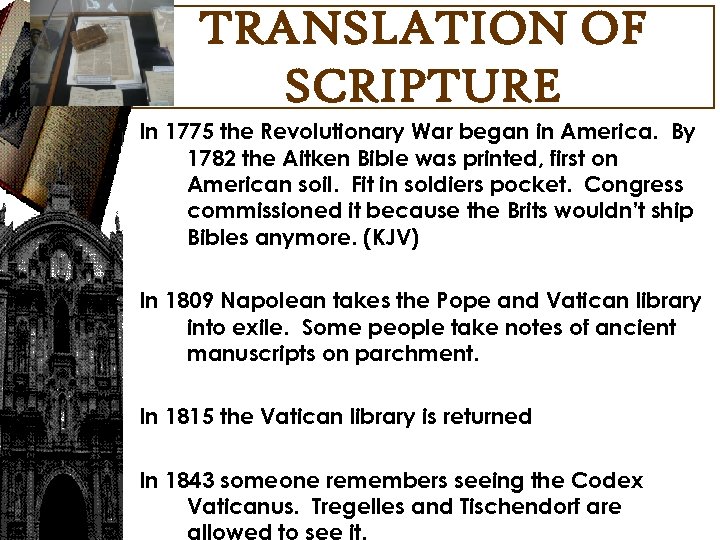
TRANSLATION OF SCRIPTURE In 1775 the Revolutionary War began in America. By 1782 the Aitken Bible was printed, first on American soil. Fit in soldiers pocket. Congress commissioned it because the Brits wouldn’t ship Bibles anymore. (KJV) In 1809 Napolean takes the Pope and Vatican library into exile. Some people take notes of ancient manuscripts on parchment. In 1815 the Vatican library is returned In 1843 someone remembers seeing the Codex Vaticanus. Tregelles and Tischendorf are
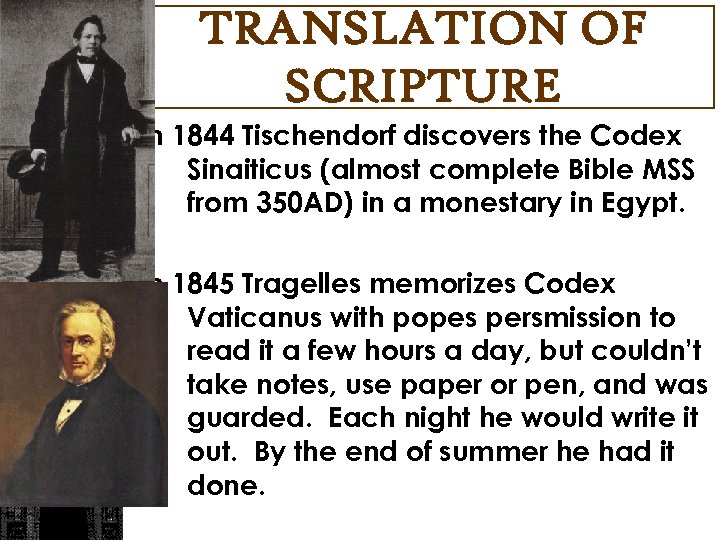
TRANSLATION OF SCRIPTURE In 1844 Tischendorf discovers the Codex Sinaiticus (almost complete Bible MSS from 350 AD) in a monestary in Egypt. In 1845 Tragelles memorizes Codex Vaticanus with popes persmission to read it a few hours a day, but couldn’t take notes, use paper or pen, and was guarded. Each night he would write it out. By the end of summer he had it done.
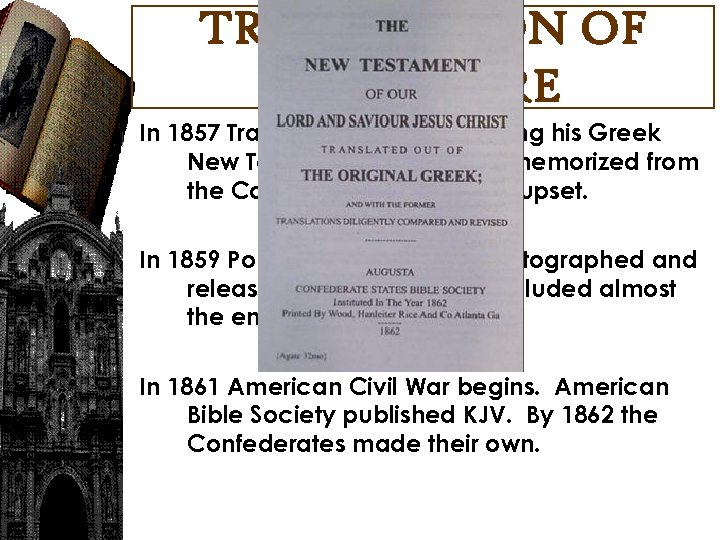
TRANSLATION OF SCRIPTURE In 1857 Tragelles begind publishing his Greek New Testament text that he memorized from the Codex Vaticanus. Pope upset. In 1859 Pope had the Codex photographed and released to the public. (it included almost the entire Bible) In 1861 American Civil War begins. American Bible Society published KJV. By 1862 the Confederates made their own.
TRANSLATION OF SCRIPTURE By 1860’s there are 3 very good Greek New Testament texts that far surpass the old Textus Receptus. 1) Tregelles 2. ) Tichendorf’s 3. ) Wescott and Hort’s (from Vaticanus, Sinaiticus, Bezae, and Old Latin) In 1870 the Convocation of Canterbury decided to revise the KJ Bible. Thousands of changes based on better textual evidence.
TRANSLATION OF SCRIPTURE In 1870 the English Revised Version is released. American scholars were invited to participate in it’s completion with the understanding that if their suggestions were not accepted they could not publish their own version until 1901 In 1901 the American Standard Version was published. In 1908 the Gideon’s began distributing their Bibles for free in America. (KJV) In 2012 they gave away 84. 7 million. This year Gideon’s International gives away 2 Bible’s per second world wide.
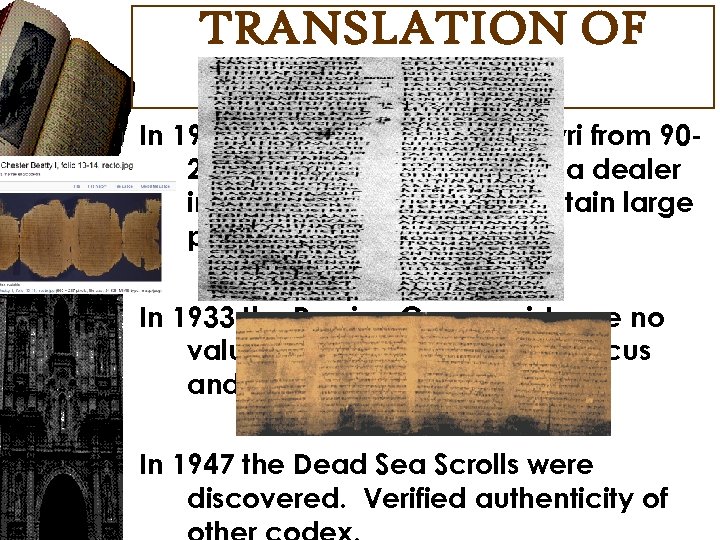
TRANSLATION OF SCRIPTURE In 1931 the Chester Beatty Papyri from 90200 AD are purchased from a dealer in Egypt. 3 manuscripts contain large portion of NT. In 1933 the Russian Communists see no value but cash in Codex Sinaiticus and sell it to Great Britian. In 1947 the Dead Sea Scrolls were discovered. Verified authenticity of
TRANSLATION OF SCRIPTURE In 1952 the English Revised and American Standard were accurate but hard to read. New manuscript finds demanded a revision of the Greek texts. The result was the Revised Standard Version. In 1961 The New English Bible a fresh translation in modern British idiom was published. Not a revision. Produced from a different text never before produced in English.
TRANSLATION OF SCRIPTURE In 1962 the Living Bible, Kenneth Taylor’s paraphrased NT from the American Standard released. In 1966 Good News NT Bible widely distributed. Influenced by the linguistic theory of dynamic equivalence. In 1971 the New American Standard, a revision of the American Standard (1901). Very good word for word Bible, but hard to read sometimes.
TRANSLATION OF SCRIPTURE In 1976 due to the success of the Good News Bible NT the entire Bible was done. Today’s English Version. In 1978 New International Version (NIV), a completely new rendering of the original languages. A thought for thought translation in contemporary English. In 1982 New King James, revision
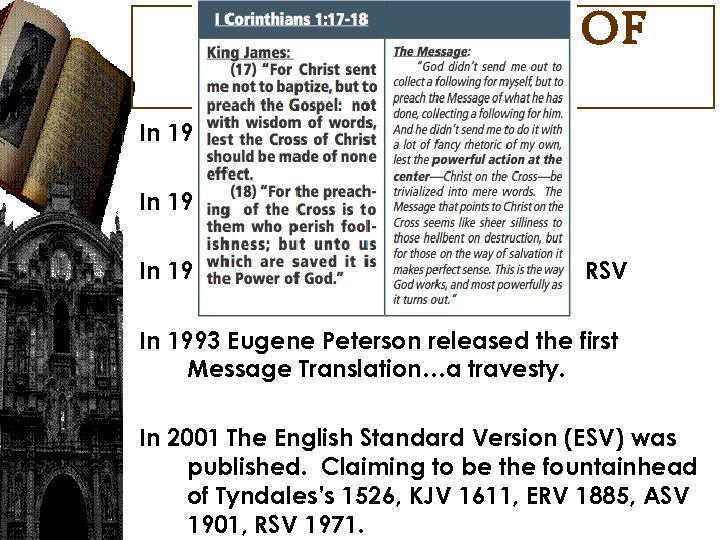
TRANSLATION OF SCRIPTURE In 1985 NIV revised In 1989 New English Bible revised In 1990 NAS revised sometimes called RSV In 1993 Eugene Peterson released the first Message Translation…a travesty. In 2001 The English Standard Version (ESV) was published. Claiming to be the fountainhead of Tyndales’s 1526, KJV 1611, ERV 1885, ASV 1901, RSV 1971.
TRANSLATION OF SCRIPTURE In 2011 ESV released a new revision based off newest Greek, Hebrew findings and correction to modern English in an essentially literal way. The ESV released a i. OS and Android app that is the only Bible app that can claim… 1. Free and NOT supported by ads 2. No internet connection needed 3. Re-sizeable font, quick search, viewed history, notes 4. Share favorite verses on Facebook or Twitter.
TRANSLATION OF SCRIPTURE
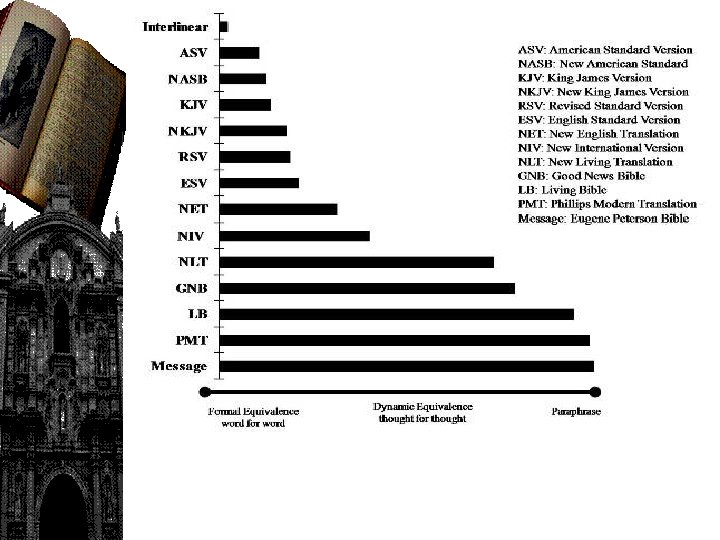
TRANSLATION OF SCRIPTURE • Formal Equivalence: Translations that seek to translate word for word (although this is really impossible). Examples: NAS, KJV, ASV, ESV Less readable, but better for study in contemporary languages. Why? Because they will usually attempt to make fewer interpretive decisions on any text that can be understood in many ways. This allows the reader to struggle through the options. • Dynamic Equivalence: Translations that seek to translate thought for thought. Examples: NIV, TNIV, NRSV Not quite as good for deep study, but usually better for reading and memorization. Dynamic equivalence translations make good pulpit or teaching Bibles.
TRANSLATION OF SCRIPTURE • Paraphrase: Translations that seek to use common • . language and idioms to get the basic point across in a very readable way. Examples: Message, Philip’s Translation, NLT, GNB While paraphrases are not good for study or memorization, they are very readable and cause you to read the text differently than you normally would. In this respect, they have great value.
Скачать презентацию SENIORS Tell your Tribond how you feel about
87b4ca5d75cb1673750b210bb3cbee09.ppt