


 Скачать презентацию SEND Linux Implementation Report Jonathan Wood Do Co
7391987e09c4aa77627c514b3a768dba.ppt
- Количество слайдов: 14
 SEND Linux Implementation Report Jonathan Wood Do. Co. Mo USA Labs IETF 58 November 2003
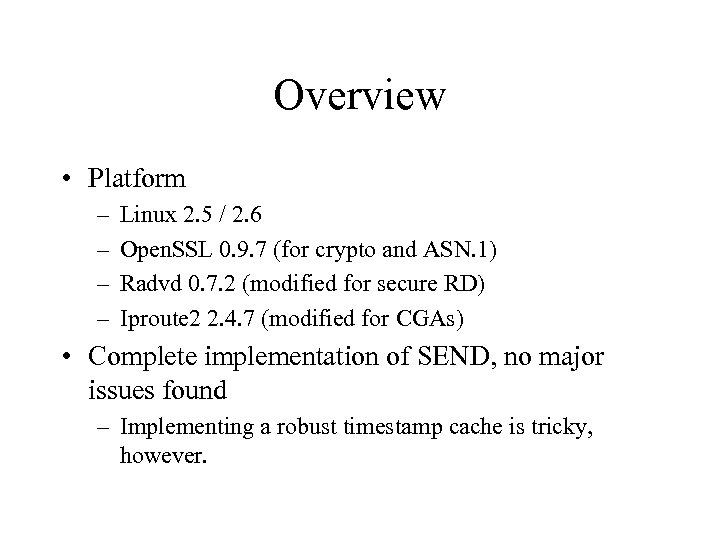 Overview • Platform – – Linux 2. 5 / 2. 6 Open. SSL 0. 9. 7 (for crypto and ASN. 1) Radvd 0. 7. 2 (modified for secure RD) Iproute 2 2. 4. 7 (modified for CGAs) • Complete implementation of SEND, no major issues found – Implementing a robust timestamp cache is tricky, however.
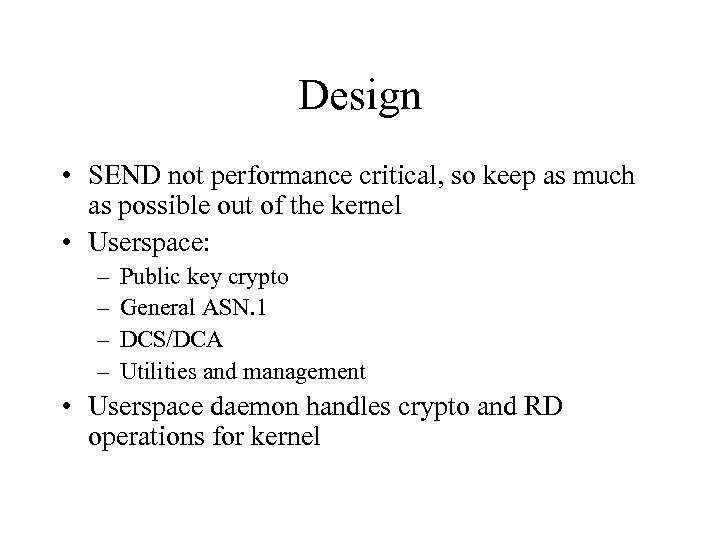 Design • SEND not performance critical, so keep as much as possible out of the kernel • Userspace: – – Public key crypto General ASN. 1 DCS/DCA Utilities and management • Userspace daemon handles crypto and RD operations for kernel
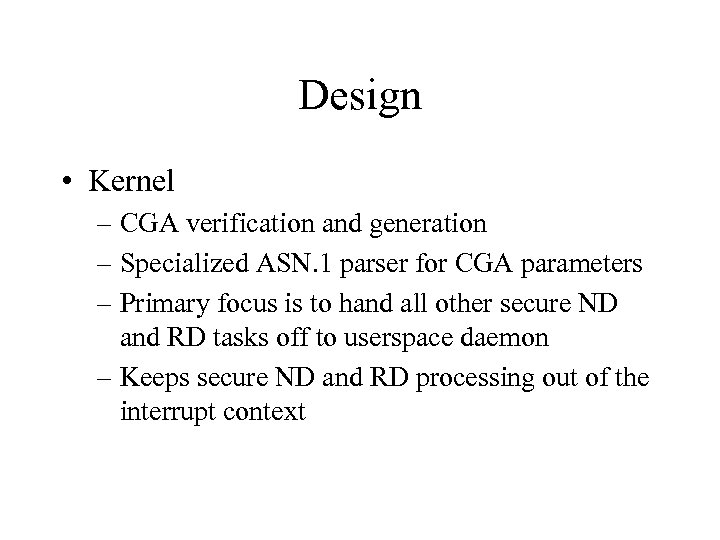 Design • Kernel – CGA verification and generation – Specialized ASN. 1 parser for CGA parameters – Primary focus is to hand all other secure ND and RD tasks off to userspace daemon – Keeps secure ND and RD processing out of the interrupt context
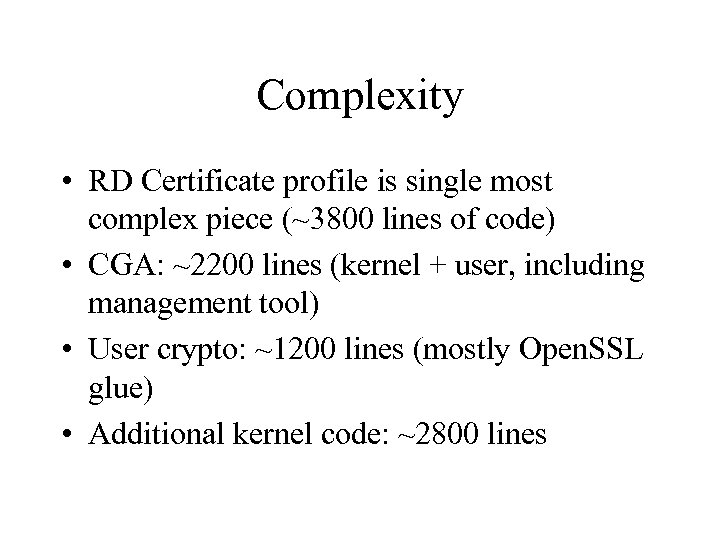 Complexity • RD Certificate profile is single most complex piece (~3800 lines of code) • CGA: ~2200 lines (kernel + user, including management tool) • User crypto: ~1200 lines (mostly Open. SSL glue) • Additional kernel code: ~2800 lines
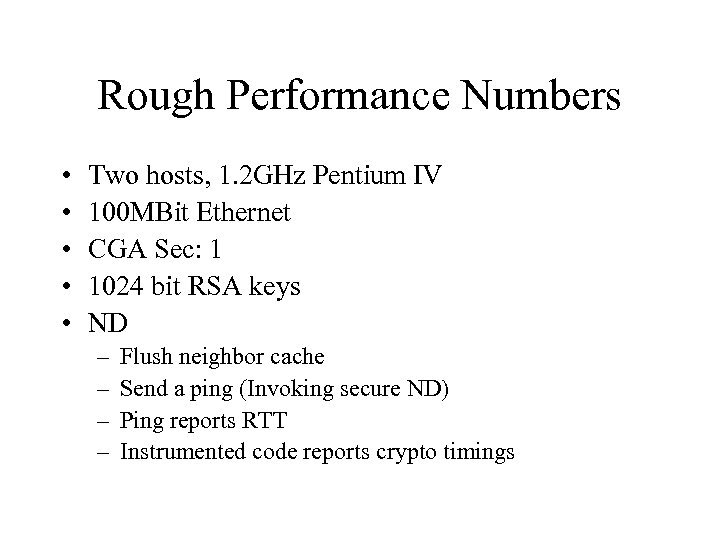 Rough Performance Numbers • • • Two hosts, 1. 2 GHz Pentium IV 100 MBit Ethernet CGA Sec: 1 1024 bit RSA keys ND – – Flush neighbor cache Send a ping (Invoking secure ND) Ping reports RTT Instrumented code reports crypto timings
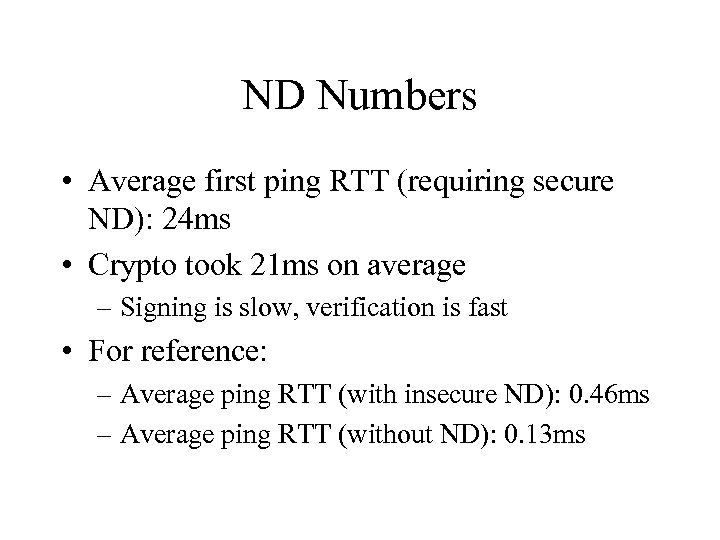 ND Numbers • Average first ping RTT (requiring secure ND): 24 ms • Crypto took 21 ms on average – Signing is slow, verification is fast • For reference: – Average ping RTT (with insecure ND): 0. 46 ms – Average ping RTT (without ND): 0. 13 ms
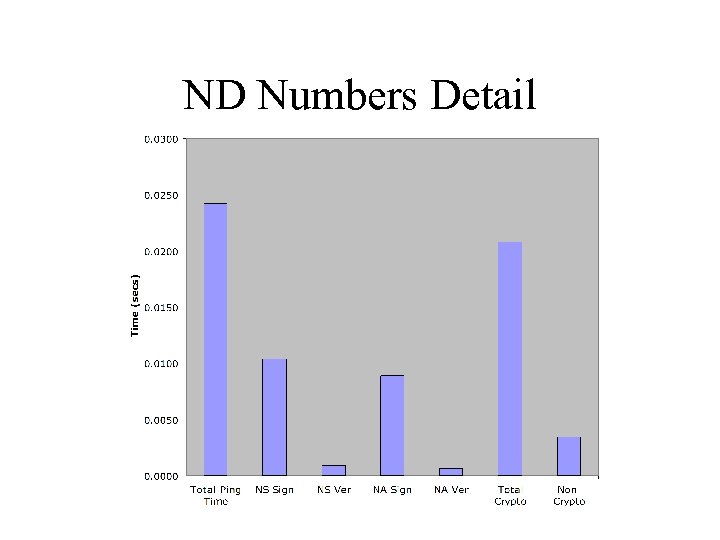 ND Numbers Detail
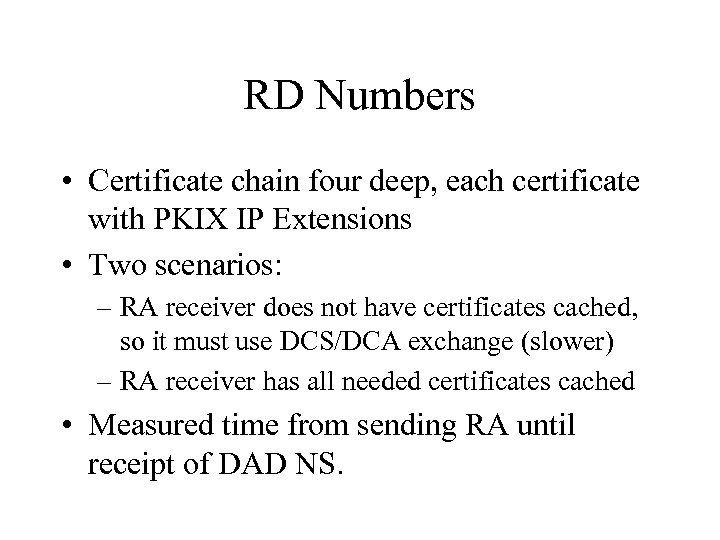 RD Numbers • Certificate chain four deep, each certificate with PKIX IP Extensions • Two scenarios: – RA receiver does not have certificates cached, so it must use DCS/DCA exchange (slower) – RA receiver has all needed certificates cached • Measured time from sending RA until receipt of DAD NS.
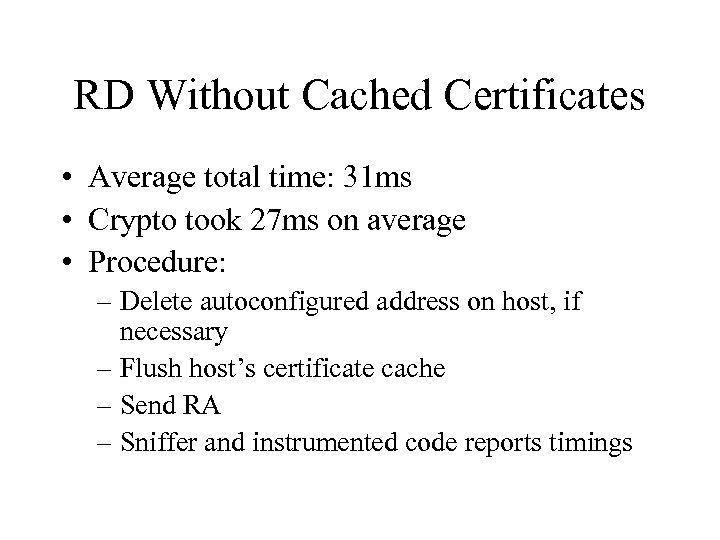 RD Without Cached Certificates • Average total time: 31 ms • Crypto took 27 ms on average • Procedure: – Delete autoconfigured address on host, if necessary – Flush host’s certificate cache – Send RA – Sniffer and instrumented code reports timings
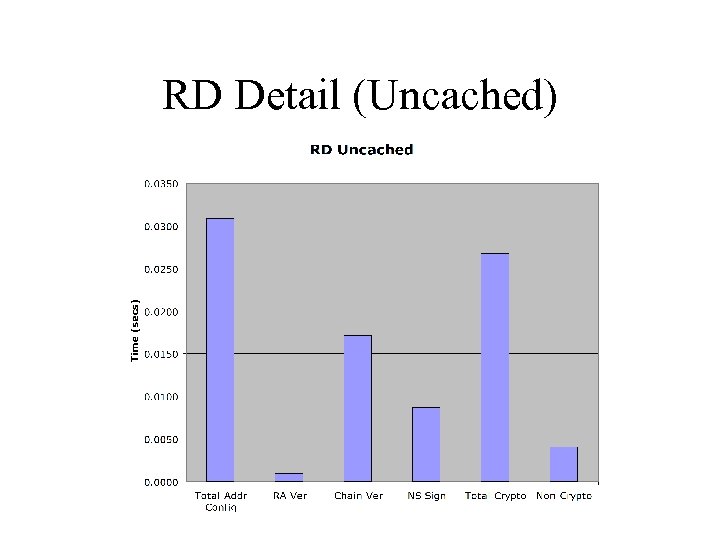 RD Detail (Uncached)
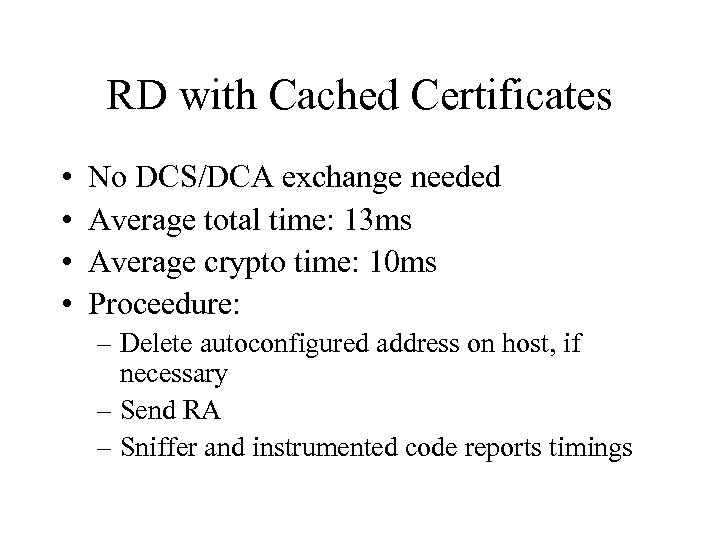 RD with Cached Certificates • • No DCS/DCA exchange needed Average total time: 13 ms Average crypto time: 10 ms Proceedure: – Delete autoconfigured address on host, if necessary – Send RA – Sniffer and instrumented code reports timings
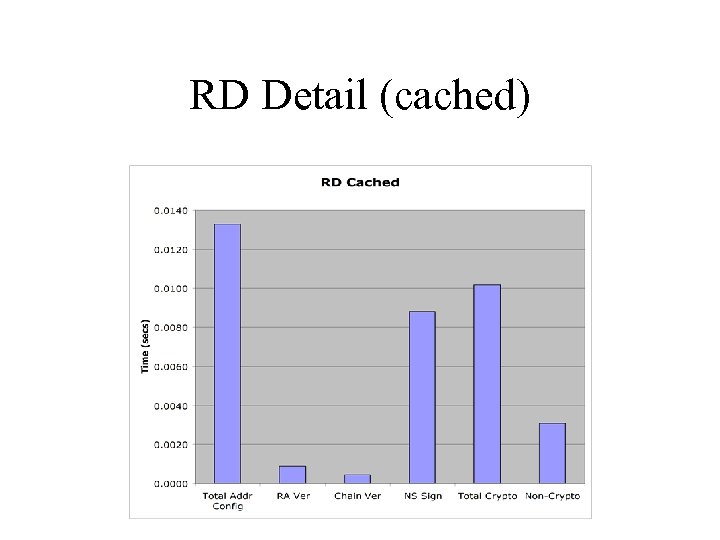 RD Detail (cached)
 Conclusion • Implementing SEND is straightforward. – No major problems. • Performance is about 2 orders of magnitude slower than without SEND. – Public key crypto is performance intensive. • But ND and RD are not typically critical path items. – Mobility may need attention.