


 Скачать презентацию Senate Finance Committee Interim Charge Review of Fees
1827faaa45411c610b84dfdf611e817a.ppt
- Количество слайдов: 13
 Senate Finance Committee Interim Charge: Review of Fees at State Regulatory Agencies Texas Department of Banking Testimony of: Stephanie Newberg and Gayle Griffin Deputy Banking Commissioners April 12, 2004 Offered by: Texas Department of Banking April 12, 2004 Senate Finance Committee
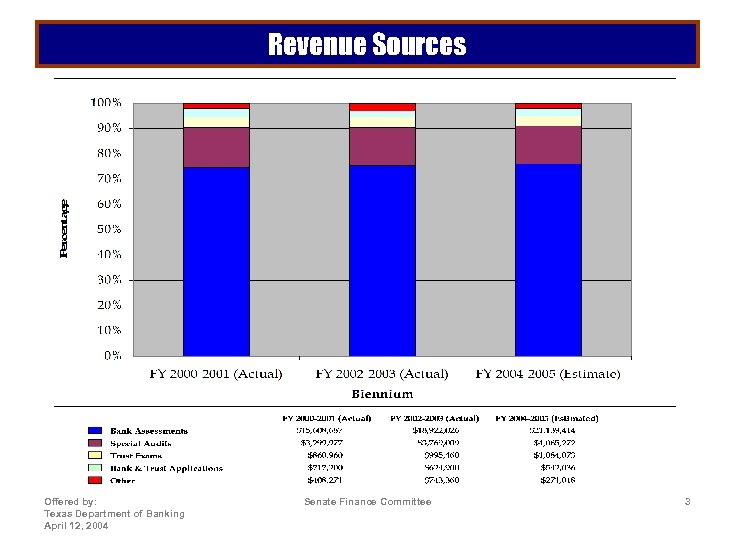
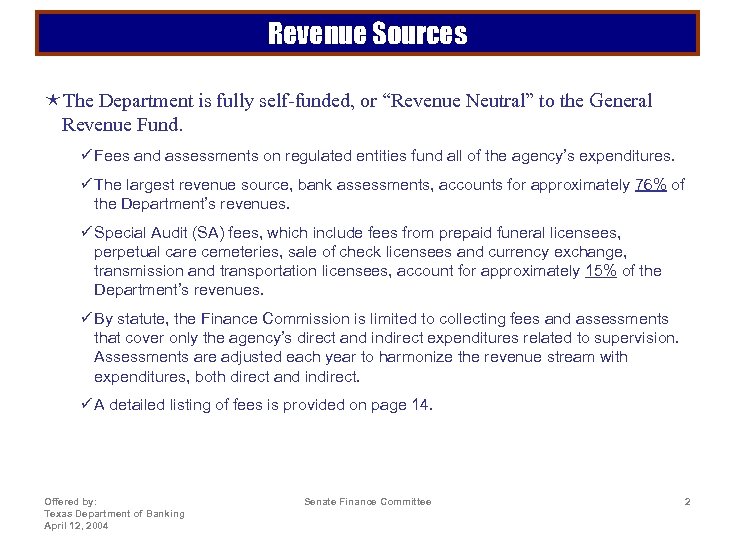 Revenue Sources éThe Department is fully self-funded, or “Revenue Neutral” to the General Revenue Fund. ü Fees and assessments on regulated entities fund all of the agency’s expenditures. ü The largest revenue source, bank assessments, accounts for approximately 76% of the Department’s revenues. ü Special Audit (SA) fees, which include fees from prepaid funeral licensees, perpetual care cemeteries, sale of check licensees and currency exchange, transmission and transportation licensees, account for approximately 15% of the Department’s revenues. ü By statute, the Finance Commission is limited to collecting fees and assessments that cover only the agency’s direct and indirect expenditures related to supervision. Assessments are adjusted each year to harmonize the revenue stream with expenditures, both direct and indirect. ü A detailed listing of fees is provided on page 14. Offered by: Texas Department of Banking April 12, 2004 Senate Finance Committee 2
 Revenue Sources Offered by: Texas Department of Banking April 12, 2004 Senate Finance Committee 3
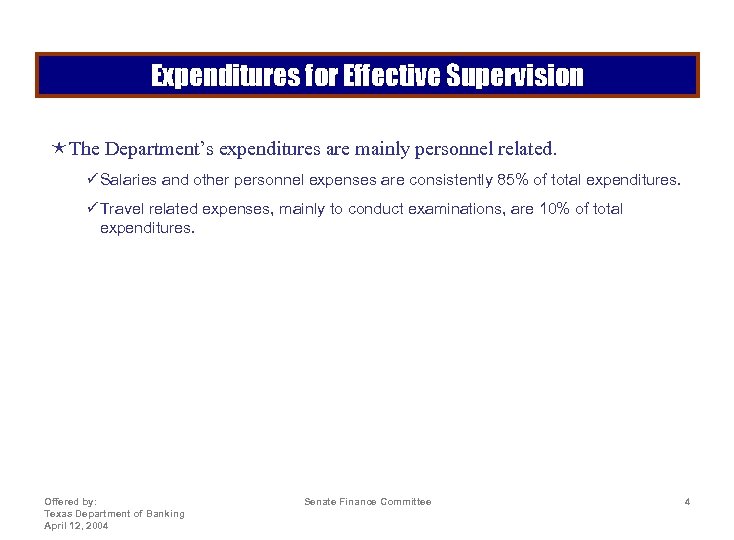 Expenditures for Effective Supervision éThe Department’s expenditures are mainly personnel related. üSalaries and other personnel expenses are consistently 85% of total expenditures. üTravel related expenses, mainly to conduct examinations, are 10% of total expenditures. Offered by: Texas Department of Banking April 12, 2004 Senate Finance Committee 4
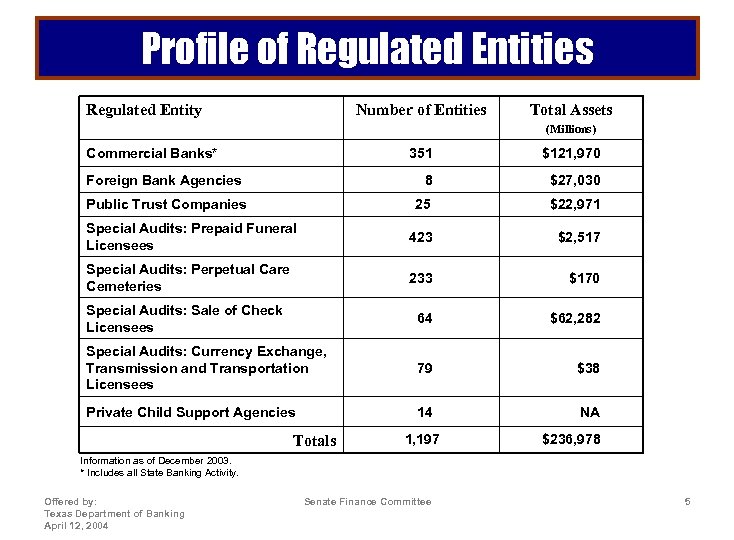 Profile of Regulated Entities Regulated Entity Number of Entities Total Assets (Millions) Commercial Banks* 351 $121, 970 8 $27, 030 25 $22, 971 Special Audits: Prepaid Funeral Licensees 423 $2, 517 Special Audits: Perpetual Care Cemeteries 233 $170 Special Audits: Sale of Check Licensees 64 $62, 282 Special Audits: Currency Exchange, Transmission and Transportation Licensees 79 $38 Private Child Support Agencies 14 NA Foreign Bank Agencies Public Trust Companies Totals 1, 197 $236, 978 Information as of December 2003. * Includes all State Banking Activity. Offered by: Texas Department of Banking April 12, 2004 Senate Finance Committee 5
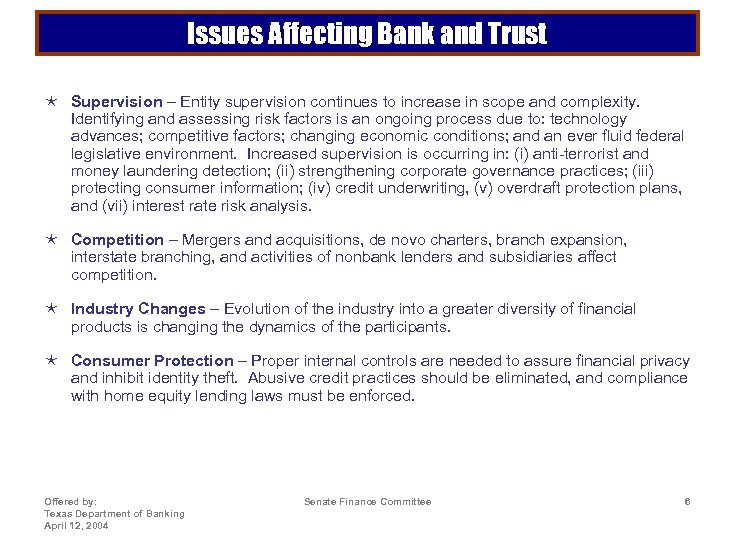 Issues Affecting Bank and Trust é Supervision – Entity supervision continues to increase in scope and complexity. Identifying and assessing risk factors is an ongoing process due to: technology advances; competitive factors; changing economic conditions; and an ever fluid federal legislative environment. Increased supervision is occurring in: (i) anti-terrorist and money laundering detection; (ii) strengthening corporate governance practices; (iii) protecting consumer information; (iv) credit underwriting, (v) overdraft protection plans, and (vii) interest rate risk analysis. é Competition – Mergers and acquisitions, de novo charters, branch expansion, interstate branching, and activities of nonbank lenders and subsidiaries affect competition. é Industry Changes – Evolution of the industry into a greater diversity of financial products is changing the dynamics of the participants. é Consumer Protection – Proper internal controls are needed to assure financial privacy and inhibit identity theft. Abusive credit practices should be eliminated, and compliance with home equity lending laws must be enforced. Offered by: Texas Department of Banking April 12, 2004 Senate Finance Committee 6
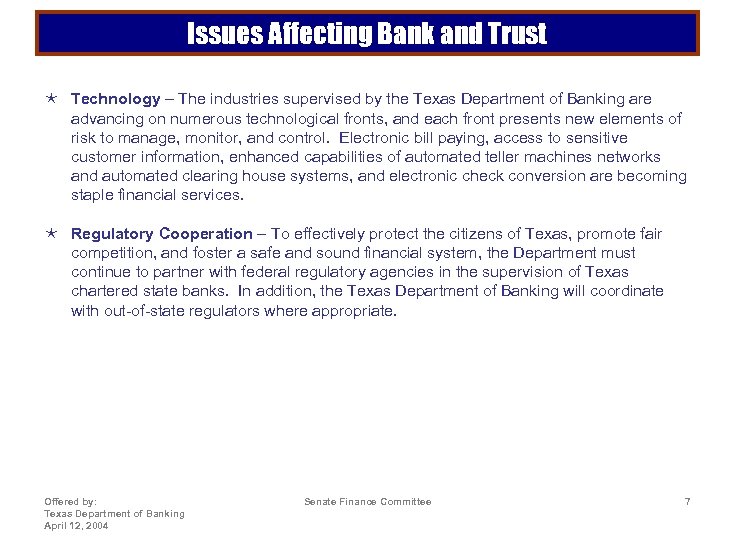 Issues Affecting Bank and Trust é Technology – The industries supervised by the Texas Department of Banking are advancing on numerous technological fronts, and each front presents new elements of risk to manage, monitor, and control. Electronic bill paying, access to sensitive customer information, enhanced capabilities of automated teller machines networks and automated clearing house systems, and electronic check conversion are becoming staple financial services. é Regulatory Cooperation – To effectively protect the citizens of Texas, promote fair competition, and foster a safe and sound financial system, the Department must continue to partner with federal regulatory agencies in the supervision of Texas chartered state banks. In addition, the Texas Department of Banking will coordinate with out-of-state regulators where appropriate. Offered by: Texas Department of Banking April 12, 2004 Senate Finance Committee 7
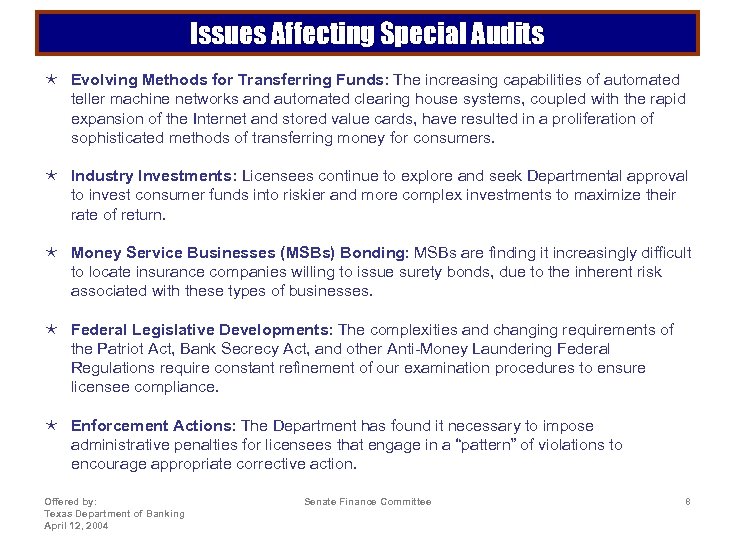 Issues Affecting Special Audits é Evolving Methods for Transferring Funds: The increasing capabilities of automated teller machine networks and automated clearing house systems, coupled with the rapid expansion of the Internet and stored value cards, have resulted in a proliferation of sophisticated methods of transferring money for consumers. é Industry Investments: Licensees continue to explore and seek Departmental approval to invest consumer funds into riskier and more complex investments to maximize their rate of return. é Money Service Businesses (MSBs) Bonding: MSBs are finding it increasingly difficult to locate insurance companies willing to issue surety bonds, due to the inherent risk associated with these types of businesses. é Federal Legislative Developments: The complexities and changing requirements of the Patriot Act, Bank Secrecy Act, and other Anti-Money Laundering Federal Regulations require constant refinement of our examination procedures to ensure licensee compliance. é Enforcement Actions: The Department has found it necessary to impose administrative penalties for licensees that engage in a “pattern” of violations to encourage appropriate corrective action. Offered by: Texas Department of Banking April 12, 2004 Senate Finance Committee 8
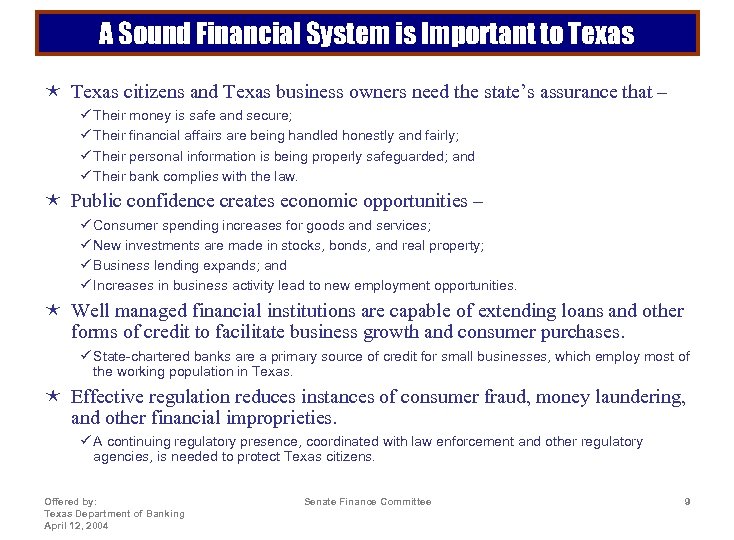 A Sound Financial System is Important to Texas é Texas citizens and Texas business owners need the state’s assurance that – ü Their money is safe and secure; ü Their financial affairs are being handled honestly and fairly; ü Their personal information is being properly safeguarded; and ü Their bank complies with the law. é Public confidence creates economic opportunities – ü Consumer spending increases for goods and services; ü New investments are made in stocks, bonds, and real property; ü Business lending expands; and ü Increases in business activity lead to new employment opportunities. é Well managed financial institutions are capable of extending loans and other forms of credit to facilitate business growth and consumer purchases. ü State-chartered banks are a primary source of credit for small businesses, which employ most of the working population in Texas. é Effective regulation reduces instances of consumer fraud, money laundering, and other financial improprieties. ü A continuing regulatory presence, coordinated with law enforcement and other regulatory agencies, is needed to protect Texas citizens. Offered by: Texas Department of Banking April 12, 2004 Senate Finance Committee 9
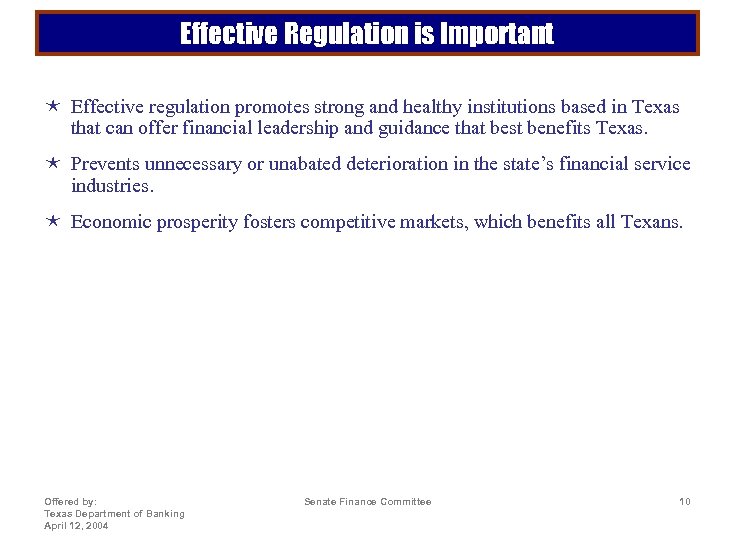 Effective Regulation is Important é Effective regulation promotes strong and healthy institutions based in Texas that can offer financial leadership and guidance that best benefits Texas. é Prevents unnecessary or unabated deterioration in the state’s financial service industries. é Economic prosperity fosters competitive markets, which benefits all Texans. Offered by: Texas Department of Banking April 12, 2004 Senate Finance Committee 10
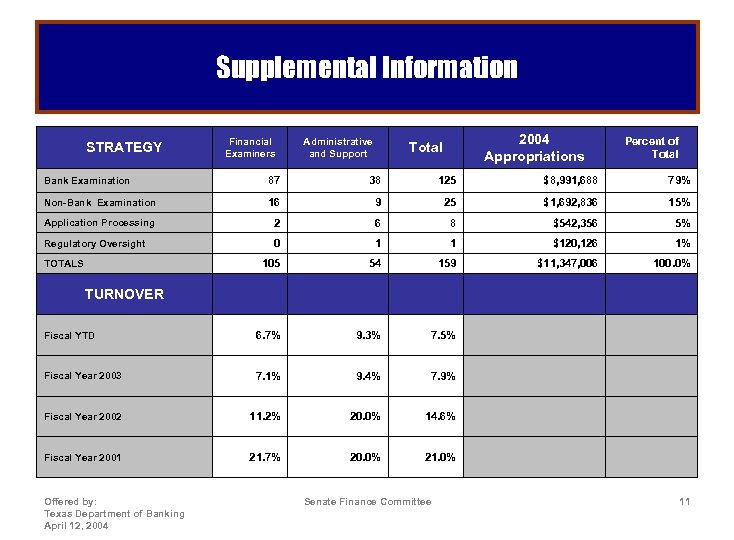 Supplemental Information STRATEGY Financial Examiners Administrative and Support 2004 Appropriations Total Percent of Total Bank Examination 87 38 125 $8, 991, 688 79% Non-Bank Examination 16 9 25 $1, 692, 836 15% Application Processing 2 6 8 $542, 356 5% Regulatory Oversight 0 1 1 $120, 126 1% 105 54 159 $11, 347, 006 100. 0% Fiscal YTD 6. 7% 9. 3% 7. 5% Fiscal Year 2003 7. 1% 9. 4% 7. 9% Fiscal Year 2002 11. 2% 20. 0% 14. 6% Fiscal Year 2001 21. 7% 20. 0% 21. 0% TOTALS TURNOVER Offered by: Texas Department of Banking April 12, 2004 Senate Finance Committee 11
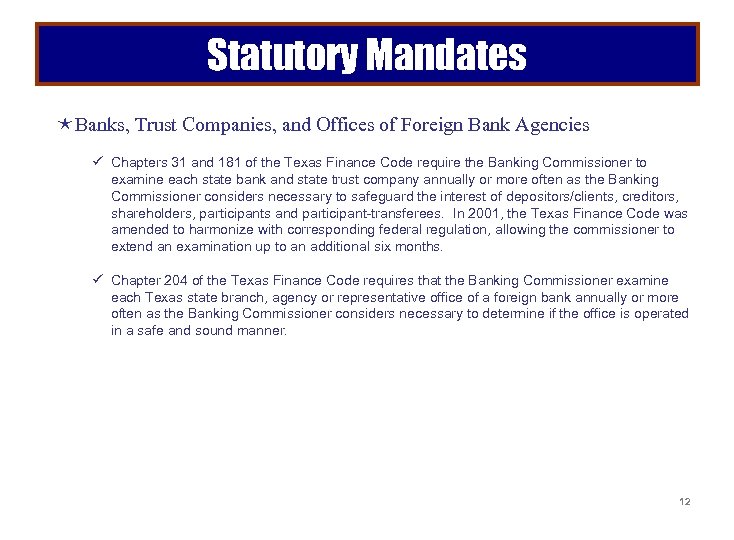 Statutory Mandates éBanks, Trust Companies, and Offices of Foreign Bank Agencies ü Chapters 31 and 181 of the Texas Finance Code require the Banking Commissioner to examine each state bank and state trust company annually or more often as the Banking Commissioner considers necessary to safeguard the interest of depositors/clients, creditors, shareholders, participants and participant-transferees. In 2001, the Texas Finance Code was amended to harmonize with corresponding federal regulation, allowing the commissioner to extend an examination up to an additional six months. ü Chapter 204 of the Texas Finance Code requires that the Banking Commissioner examine each Texas state branch, agency or representative office of a foreign bank annually or more often as the Banking Commissioner considers necessary to determine if the office is operated in a safe and sound manner. 12
 Statutory Mandates é Prepaid Funeral Contract Sellers, Perpetual Care Cemeteries, Currency Exchange Businesses, Sale of Check Licensees, and Private Child Support Enforcement Agencies ü Chapter 154 of the Texas Finance Code requires that the Banking Commissioner examine each prepaid funeral contract seller annually or more often as deemed necessary to protect the prepaid funds and to assure that the contracted services and merchandise are provided at the time of death. ü Chapter 712 of the Texas Health and Safety Code requires that the Banking Commissioner examine each perpetual care cemetery annually or more often as deemed necessary to protect and safeguard the perpetual care trust funds and to assure that the fund income is used to maintain and support cemetery maintenance. ü Chapter 153 of the Texas Finance Code requires that the Banking Commissioner examine each currency exchange, transportation and transmission licensee annually to protect and safeguard customer funds and prevent money laundering and funding of terrorist activities. ü Chapter 152 of the Texas Finance Code requires that the Banking Commissioner examine each sale of check licensee annually or more often as deemed necessary to protect and safeguard customer funds and prevent money laundering and funding of terrorist activities. ü Chapter 396 of the Texas Finance Code requires the Banking Commissioner to monitor private child support enforcement agencies through registration and investigation of consumer complaints. Offered by: Texas Department of Banking April 12, 2004 Senate Finance Committee 13