 Скачать презентацию Seminars on Academic Computing Wolfgang Bauer Physics Astronomy Michigan
1c8e26d1b2816fc78f651375e2fed5a5.ppt
- Количество слайдов: 15



Seminars on Academic Computing Wolfgang Bauer, Physics&Astronomy Michigan State University Virtual University Courses and Course Management Systems - the faculty perspective - the administrator perspective -
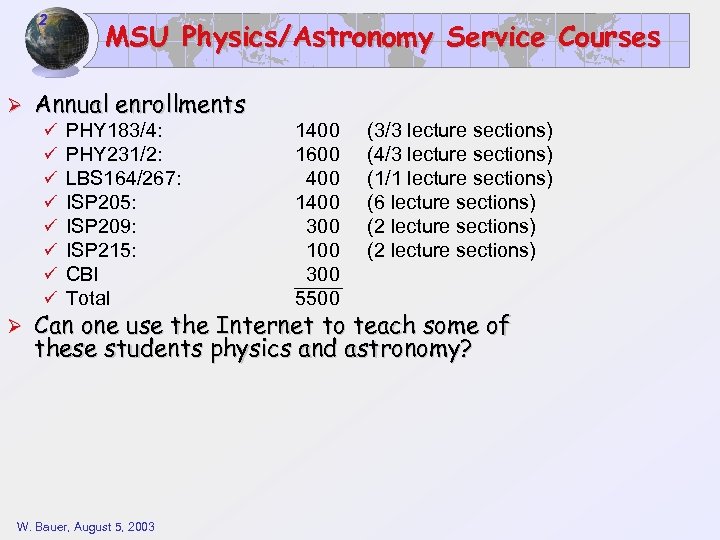
2 Ø Annual enrollments ü ü ü ü Ø MSU Physics/Astronomy Service Courses PHY 183/4: PHY 231/2: LBS 164/267: ISP 205: ISP 209: ISP 215: CBI Total 1400 1600 400 1400 300 100 300 5500 (3/3 lecture sections) (4/3 lecture sections) (1/1 lecture sections) (6 lecture sections) (2 lecture sections) Can one use the Internet to teach some of these students physics and astronomy? W. Bauer, August 5, 2003
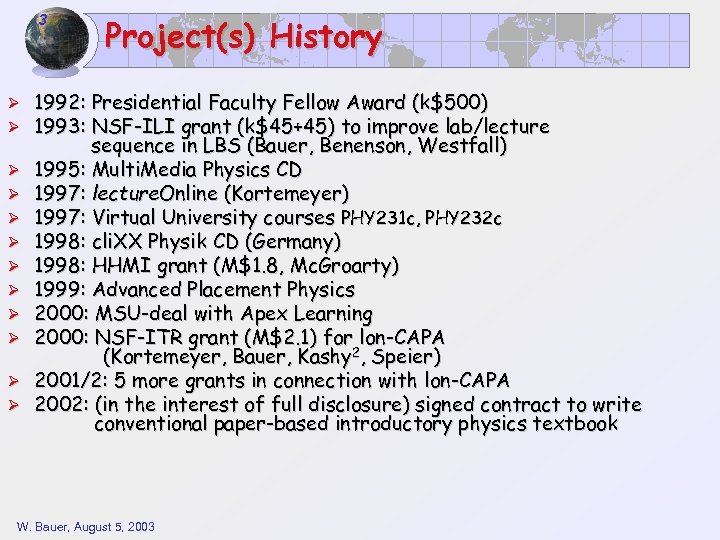
3 Ø Ø Ø Project(s) History 1992: Presidential Faculty Fellow Award (k$500) 1993: NSF-ILI grant (k$45+45) to improve lab/lecture sequence in LBS (Bauer, Benenson, Westfall) 1995: Multi. Media Physics CD 1997: lecture. Online (Kortemeyer) 1997: Virtual University courses PHY 231 c, PHY 232 c 1998: cli. XX Physik CD (Germany) 1998: HHMI grant (M$1. 8, Mc. Groarty) 1999: Advanced Placement Physics 2000: MSU-deal with Apex Learning 2000: NSF-ITR grant (M$2. 1) for lon-CAPA (Kortemeyer, Bauer, Kashy 2, Speier) 2001/2: 5 more grants in connection with lon-CAPA 2002: (in the interest of full disclosure) signed contract to write conventional paper-based introductory physics textbook W. Bauer, August 5, 2003
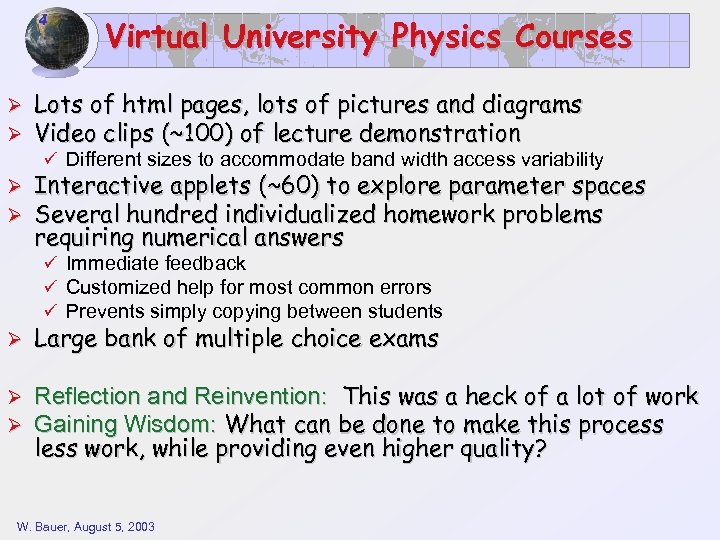
4 Ø Ø Virtual University Physics Courses Lots of html pages, lots of pictures and diagrams Video clips (~100) of lecture demonstration ü Different sizes to accommodate band width access variability Ø Ø Interactive applets (~60) to explore parameter spaces Several hundred individualized homework problems requiring numerical answers ü Immediate feedback ü Customized help for most common errors ü Prevents simply copying between students Ø Large bank of multiple choice exams Ø Ø Reflection and Reinvention: This was a heck of a lot of work Gaining Wisdom: What can be done to make this process less work, while providing even higher quality? W. Bauer, August 5, 2003
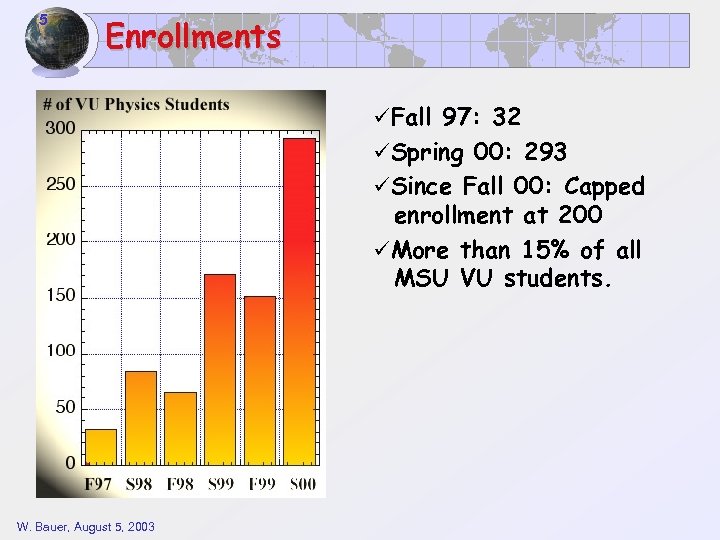
5 Enrollments üFall 97: 32 üSpring 00: 293 üSince Fall 00: Capped enrollment at 200 üMore than 15% of all MSU VU students. W. Bauer, August 5, 2003
6 Ø Ø Ø Do they learn better? Comparison study in Fall 1998: Taught lecture based PHY 231 and compared to PHY 231 c Same homework assignments, same exams, same grading system Virtual university students scored slightly higher on all three exams and on FCI baseline test, and obtained slightly higher final grades (2. 93 vs. 2. 87) on average One explanation: putting materials on www forces the students to engage in more active learning Another: VU students are self-selected group Needed: Controlled study W. Bauer, August 5, 2003
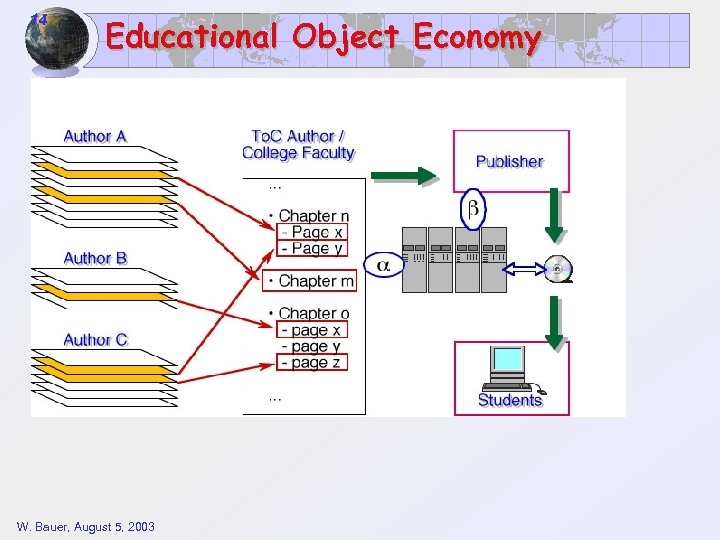
7 Ø Ø Ø mc 3: multimedia collaborative content creation Not-so-desirable model (1): Every person has to create a complete course from scratch Not-so-desirable model (2): Buy complete course off the shelf from a commercial publisher More efficient: ü Fully modularized system ü Semi-independent information units (a derivation, a homework problem, a video clip, an example, a graphic, an applet, . . . ) ü Common navigation interface ü Central pool (or synchronized servers) to store virtual resources ü Drag-and-drop convenience of course assembly W. Bauer, August 5, 2003
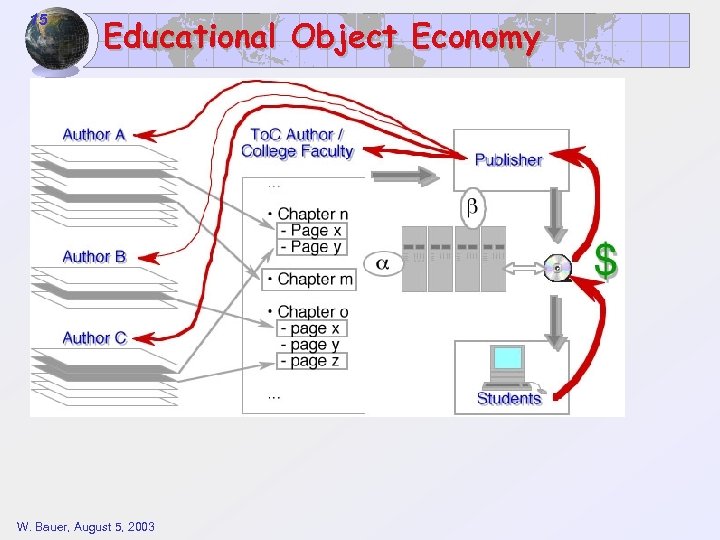
8 Construction of New Courses Database of individual resources Drag-and-drop object assembly Resource meta-data: ü Author, date, topic ü Subject categories, keywords ü Reviewer feedback (colleagues&students) ü Usage statistics ü (Price !!!) Ø May lead to an object economy with multiple feedback loops Ø Principles of self-organization: ü Evolution-like selection rules ü Sum is bigger than its parts Ø Ø Ø W. Bauer, August 5, 2003 NSF-ITR Grant: Investigation of a Model for Online Resource Creation and Sharing in Educational Settings PI: Kortemeyer Co-PIs: W. B. , Kashy 2, Speier
9 Student Perspective One size does not fit all Many different kinds of learners and learning styles Ø Lectures do not deal with this adequately Ø Neither do video tapes Ø Definite need to individualize on-line offerings Ø BIG advantage of internet, with its branching points (hyperlinks, scripts, interactive exercises, …) Ø Ø W. Bauer, August 5, 2003
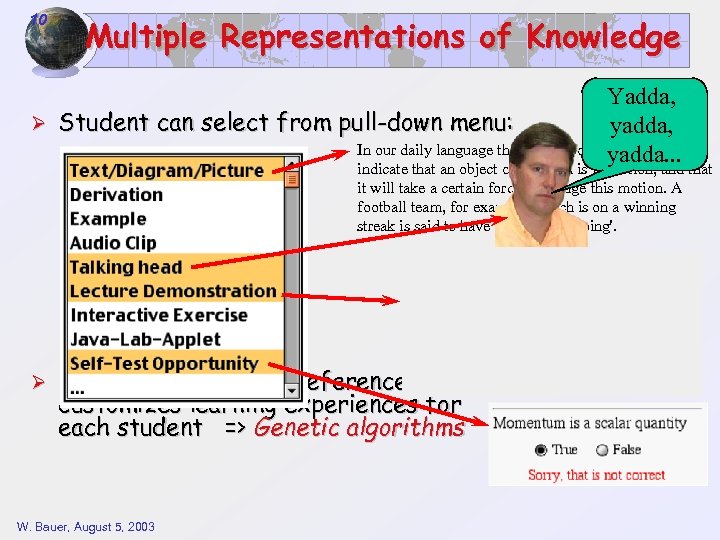
10 Multiple Representations of Knowledge Yadda, Ø Student can select from pull-down menu: yadda, In our daily language the word "momentum" is used to yadda. . . indicate that an object or a person is in motion, and that it will take a certain force to change this motion. A football team, for example, which is on a winning streak is said to have 'momentum going'. Ø System remembers preferences and customizes learning experiences for each student => Genetic algorithms W. Bauer, August 5, 2003
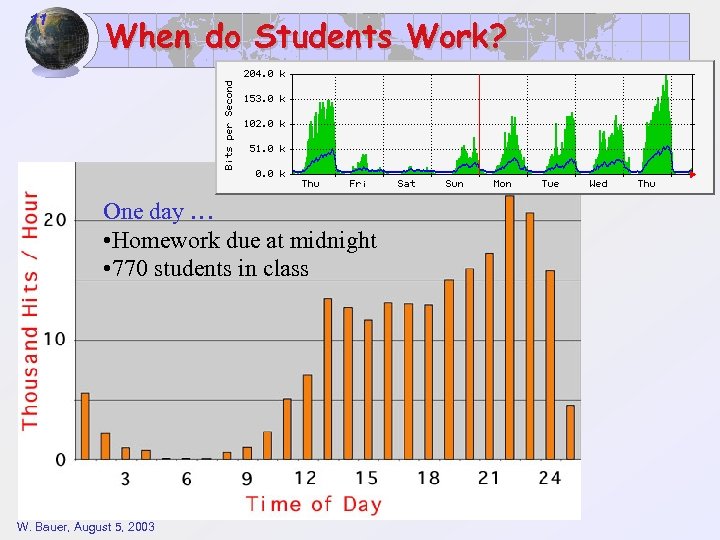
11 When do Students Work? One day … • Homework due at midnight • 770 students in class W. Bauer, August 5, 2003
12 How much does it cost? (we are definitely talking administrator perspective now!) Ø Ø Ø Initial cost of course creation can be very high Acquisition of course management system turns into a costly proposition Real costs in faculty and staff training Continuous costs in technology and content support Hidden costs in making yourself dependent on course management system provider ü Not just the ever-increasing license fees ü Also, the need to adhere to a rigid architecture designed by an external entity Ø Ø On-line education is not cheaper to offer => It needs to be better W. Bauer, August 5, 2003
13 Ø Ø Support Students work at all hours Support needs to be available at all hours ü Content support (teaching assistants) ü Technical support Ø Expensive! ü MSU Physics/Astronomy: provide open learning lab, staffed with TAs from noon to midnight ü Pooling of TAs for all introductory courses Ø Unavoidable? ü Experiment in VU class chat room: peer instruction, only limited hour of faculty presence W. Bauer, August 5, 2003
14 Educational Object Economy W. Bauer, August 5, 2003
15 Educational Object Economy W. Bauer, August 5, 2003
Скачать презентацию Seminars on Academic Computing Wolfgang Bauer Physics Astronomy Michigan
1c8e26d1b2816fc78f651375e2fed5a5.ppt