


 Скачать презентацию Seminarium Gridowe Performance analysis and Monitoring of Grid
0ebef77e42ce162a2ed04357f05495e6.ppt
- Количество слайдов: 21
 Seminarium Gridowe Performance analysis and Monitoring of Grid Applications in CG Part II: Monitoring Marian Bubak, Bartosz Baliś, Tomasz Szepieniec and Roland Wismüller
 Seminarium Gridowe Issues Application Monitoring (OCM-G) Complexity of Task 3. 3 2
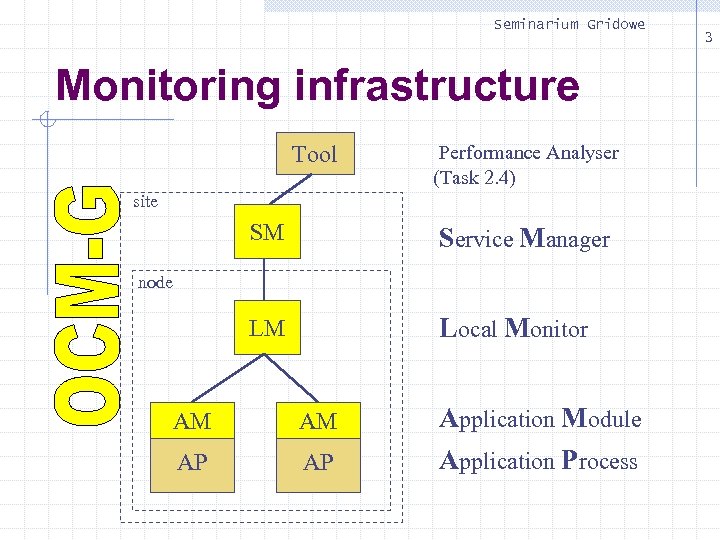 Seminarium Gridowe Monitoring infrastructure Tool Performance Analyser (Task 2. 4) site SM Service Manager LM Local Monitor node AM AM AP AP Application Module Application Process 3
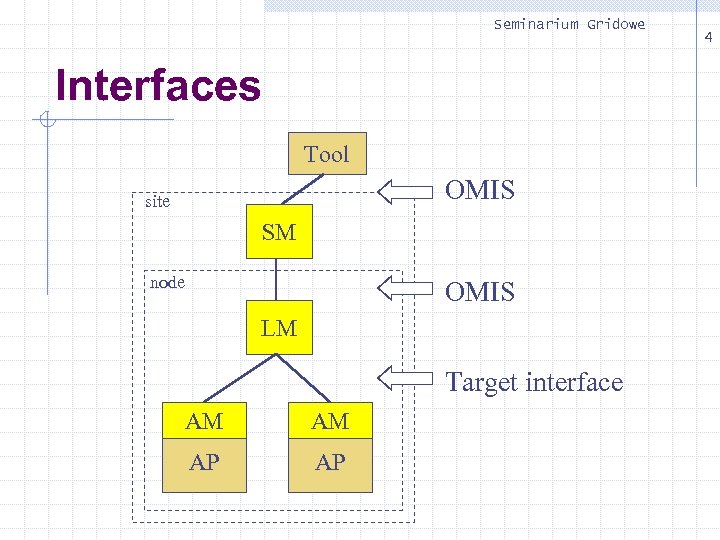 Seminarium Gridowe Interfaces Tool OMIS site SM node OMIS LM Target interface AM AM AP AP 4
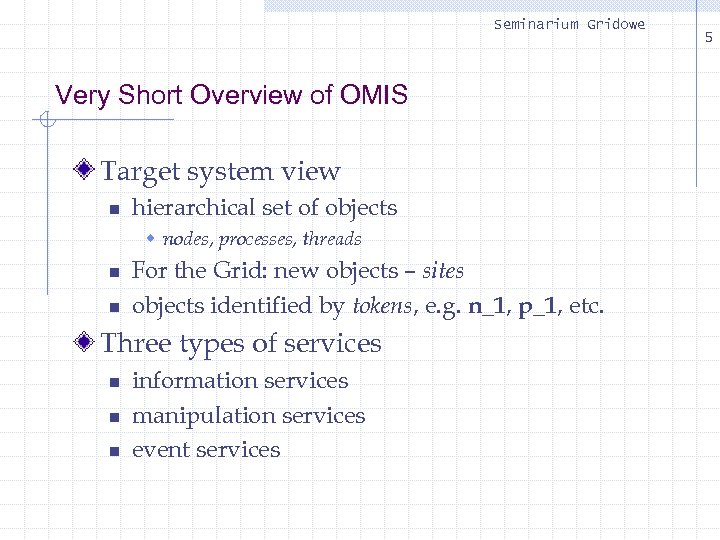 Seminarium Gridowe Very Short Overview of OMIS Target system view n hierarchical set of objects w nodes, processes, threads n n For the Grid: new objects – sites objects identified by tokens, e. g. n_1, p_1, etc. Three types of services n n n information services manipulation services event services 5
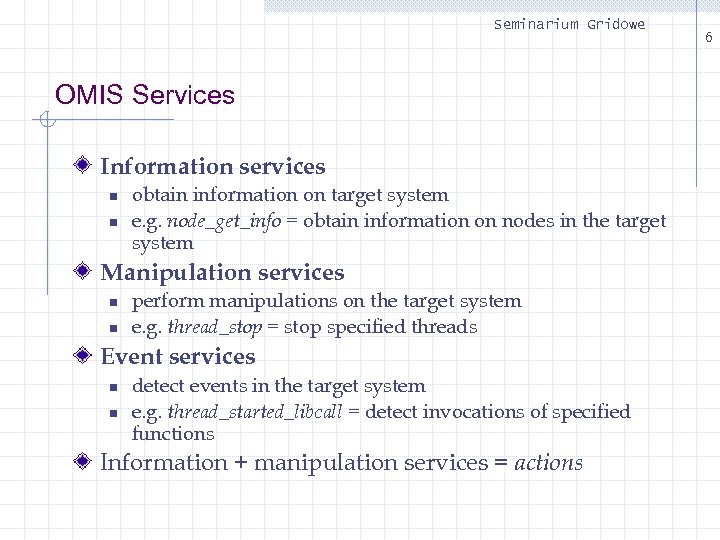 Seminarium Gridowe OMIS Services Information services n n obtain information on target system e. g. node_get_info = obtain information on nodes in the target system Manipulation services n n perform manipulations on the target system e. g. thread_stop = stop specified threads Event services n n detect events in the target system e. g. thread_started_libcall = detect invocations of specified functions Information + manipulation services = actions 6
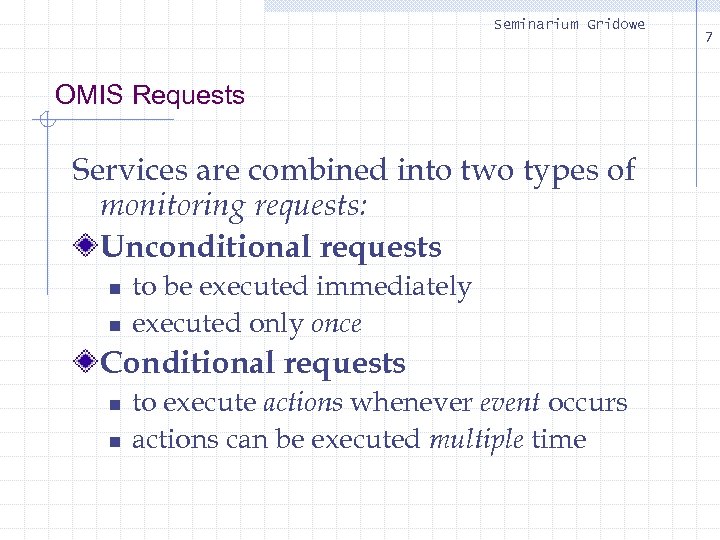 Seminarium Gridowe OMIS Requests Services are combined into two types of monitoring requests: Unconditional requests n n to be executed immediately executed only once Conditional requests n n to execute actions whenever event occurs actions can be executed multiple time 7
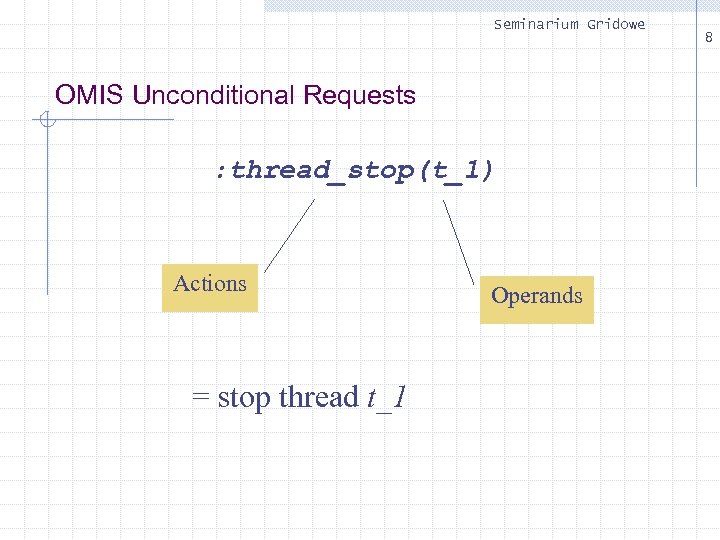 Seminarium Gridowe OMIS Unconditional Requests : thread_stop(t_1) Actions = stop thread t_1 Operands 8
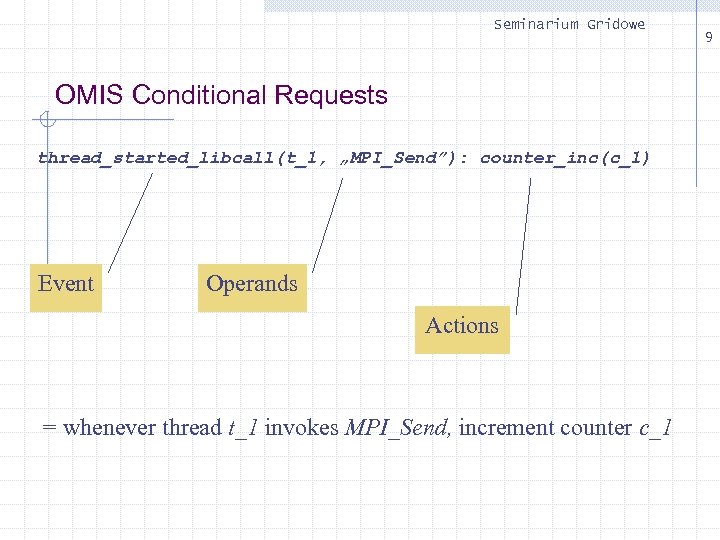 Seminarium Gridowe OMIS Conditional Requests thread_started_libcall(t_1, „MPI_Send”): counter_inc(c_1) Event Operands Actions = whenever thread t_1 invokes MPI_Send, increment counter c_1 9
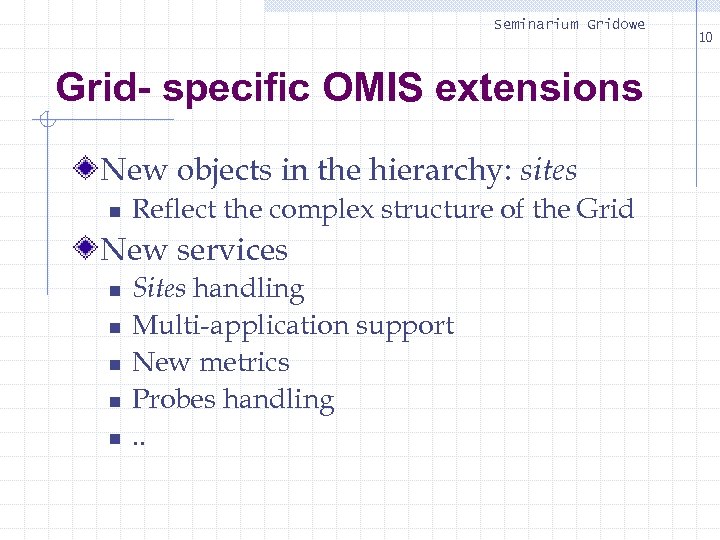 Seminarium Gridowe Grid- specific OMIS extensions New objects in the hierarchy: sites n Reflect the complex structure of the Grid New services n n n Sites handling Multi-application support New metrics Probes handling. . 10
![Seminarium Gridowe Request distribution TOOL thread_stop([a_1]) SM thread_stop([p 1, p 2]) LM stop P](https://present5.com/presentation/0ebef77e42ce162a2ed04357f05495e6/image-11.jpg "Seminarium Gridowe Request distribution TOOL thread_stop([a_1]) SM thread_stop([p 1, p 2]) LM stop P") Seminarium Gridowe Request distribution TOOL thread_stop([a_1]) SM thread_stop([p 1, p 2]) LM stop P 1 thread_stop([p 3]) LM stop P 2 P 3 11
Seminarium Gridowe Request distribution TOOL thread_stop([a_1]) SM thread_stop([p 1, p 2]) LM stop P 1 thread_stop([p 3]) LM stop P 2 P 3 11
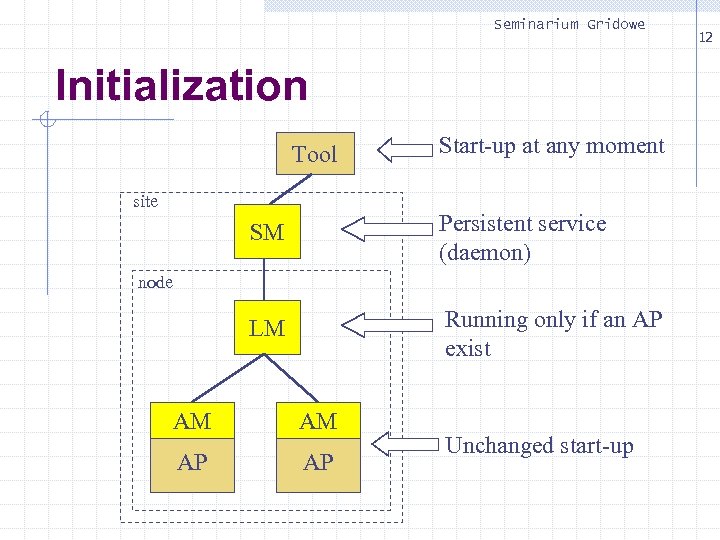 Seminarium Gridowe Initialization Tool site Start-up at any moment SM Persistent service (daemon) LM Running only if an AP exist node AM AM AP AP Unchanged start-up 12
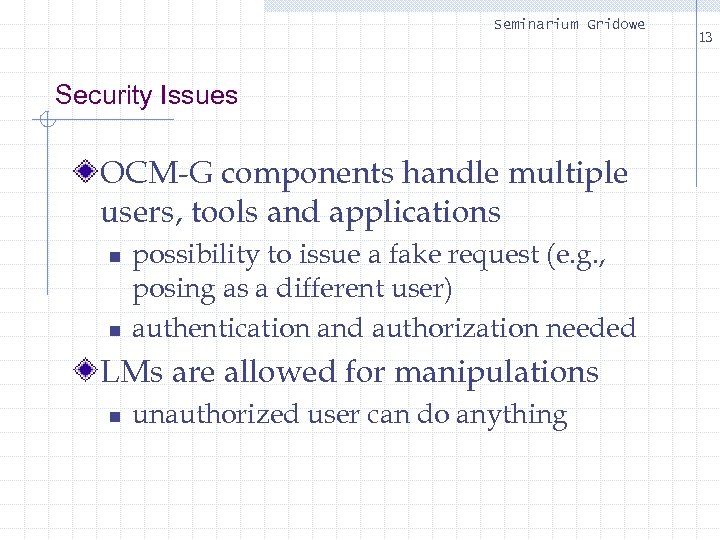 Seminarium Gridowe Security Issues OCM-G components handle multiple users, tools and applications n n possibility to issue a fake request (e. g. , posing as a different user) authentication and authorization needed LMs are allowed for manipulations n unauthorized user can do anything 13
 Seminarium Gridowe Security - Solutions LMs are user-bound n n Run as user processes Security ensured by OS mechanisms Service Managers are permanent n n n Run as unprivileged processes (nobody) User Grid Id checked internally (partial security) Grid certificates for users, tools and SMs incorporated (ultimate security) 14
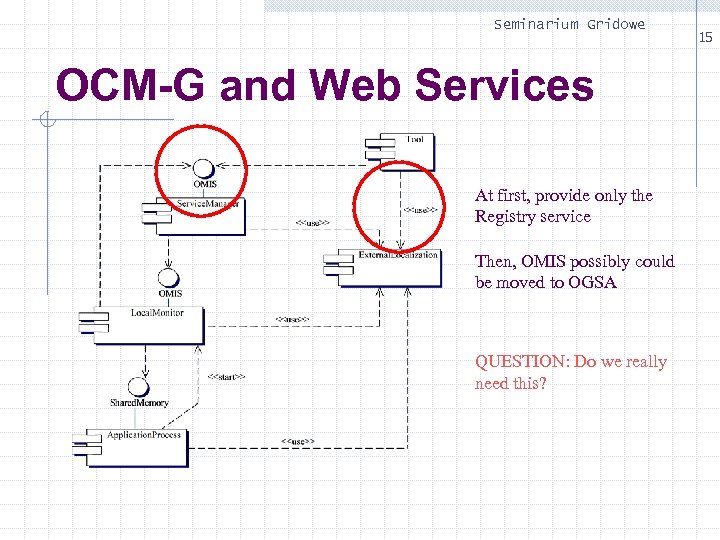 Seminarium Gridowe OCM-G and Web Services At first, provide only the Registry service Then, OMIS possibly could be moved to OGSA QUESTION: Do we really need this? 15
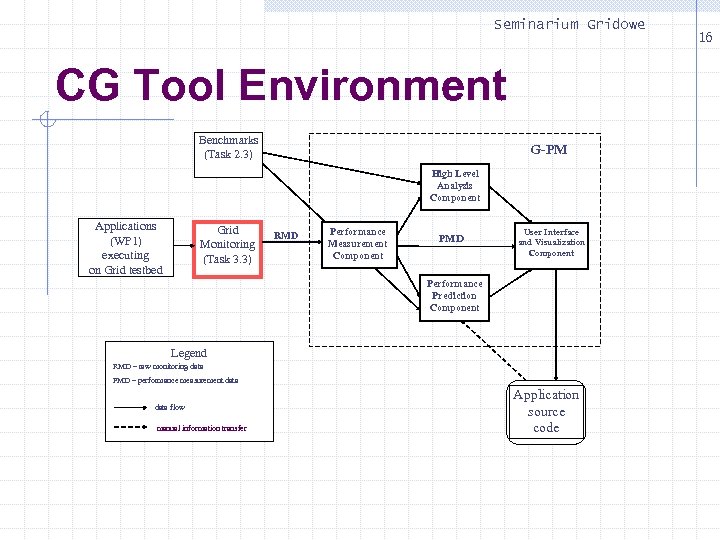 Seminarium Gridowe CG Tool Environment Benchmarks (Task 2. 3) G-PM High Level Analysis Component Applications (WP 1) executing on Grid testbed Grid Monitoring (Task 3. 3) RMD Performance Measurement Component PMD User Interface and Visualization Component Performance Prediction Component Legend RMD – raw monitoring data PMD – performance measurement data flow manual information transfer Application source code 16
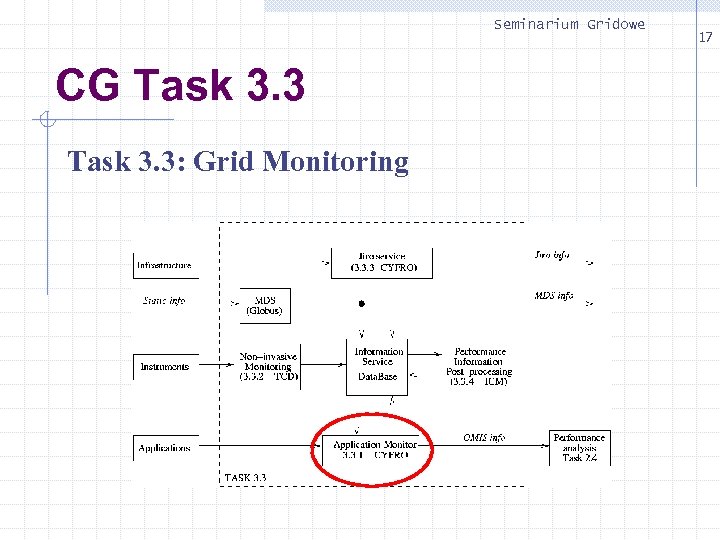 Seminarium Gridowe CG Task 3. 3: Grid Monitoring 17
 Seminarium Gridowe The Monitoring Need Resource Brokers n n n Infrastucture Postprocessing Statistics Applications Developing n n On-line Internals 18
 Seminarium Gridowe OCM-G Specific Application Monitoring to support development No monitoring on default Secured monitoring object Interface 19
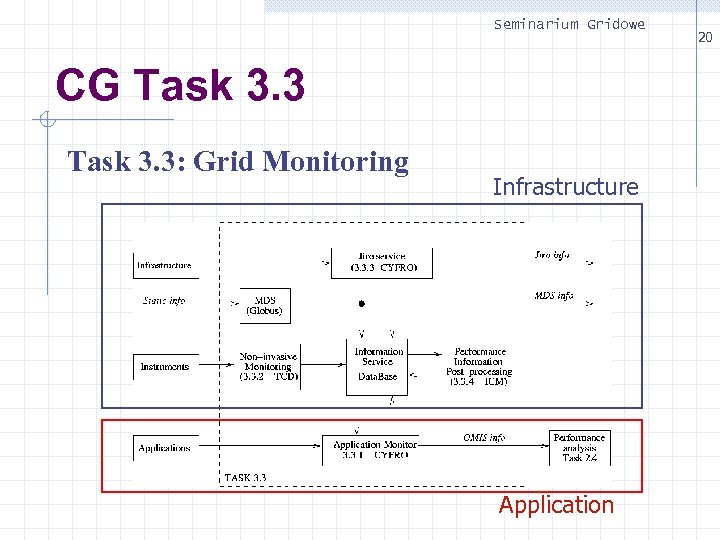 Seminarium Gridowe CG Task 3. 3: Grid Monitoring Infrastructure Application 20
 Dziękujemy za uwagę!