


 Скачать презентацию Seminar Université catholique de Louvain Institut de Physique
7875739a0cb04180001a39ed7a55b214.ppt
- Количество слайдов: 54
 Seminar, Université catholique de Louvain, Institut de Physique Nucléaire, Louvain-la-Neuve, Belgium , October 23, 2007 Radiation Tolerant Sensors for Solid State Tracking Detectors - CERN-RD 50 project – http: //www. cern. ch/rd 50 Michael Moll CERN - Geneva - Switzerland
 RD 50 Outline Introduction: LHC and LHC experiment Motivation to develop radiation harder detectors Introduction to the RD 50 collaboration Part I: Radiation Damage in Silicon Detectors (A very brief review) Microscopic defects (changes in bulk material) Macroscopic damage (changes in detector properties) Part II: RD 50 - Approaches to obtain radiation hard sensors Material Engineering Device Engineering Summary and preliminary conclusion Michael Moll – Louvain-la-Neuve, 23. October 2007 -2 -
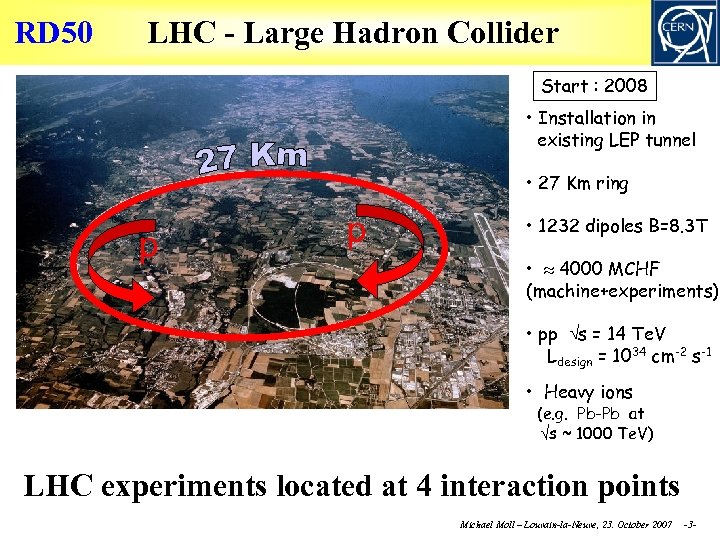 RD 50 LHC - Large Hadron Collider Start : 2008 • Installation in existing LEP tunnel • 27 Km ring p p • 1232 dipoles B=8. 3 T • 4000 MCHF (machine+experiments) • pp s = 14 Te. V Ldesign = 1034 cm-2 s-1 • Heavy ions (e. g. Pb-Pb at s ~ 1000 Te. V) LHC experiments located at 4 interaction points Michael Moll – Louvain-la-Neuve, 23. October 2007 -3 -
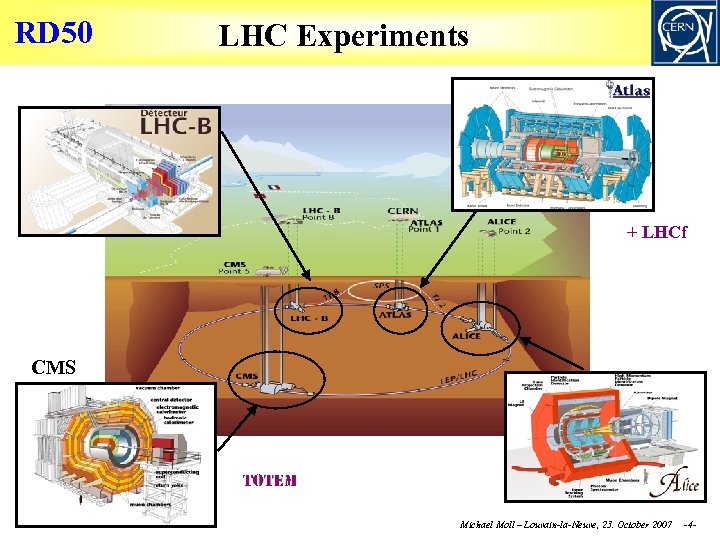 RD 50 LHC Experiments + LHCf CMS Michael Moll – Louvain-la-Neuve, 23. October 2007 -4 -
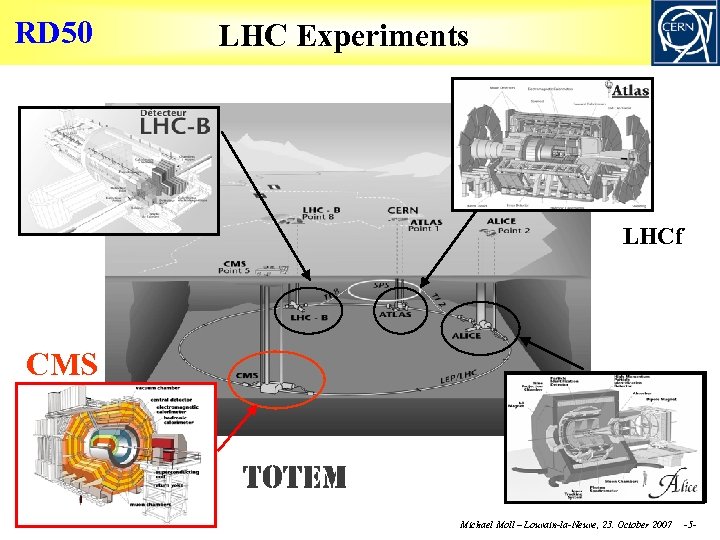 RD 50 LHC Experiments LHCf CMS Michael Moll – Louvain-la-Neuve, 23. October 2007 -5 -
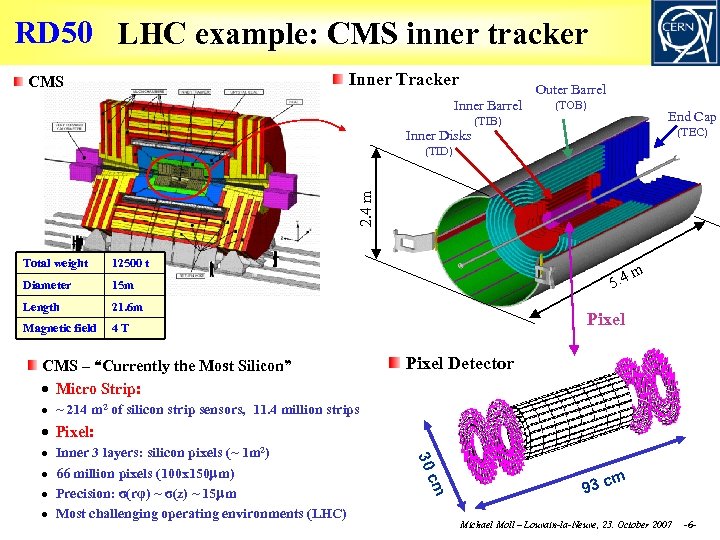 RD 50 LHC example: CMS inner tracker Inner Tracker CMS Outer Barrel Inner Barrel Inner Disks (TOB) End Cap (TIB) (TEC) 2. 4 m (TID) Total weight 12500 t Diameter 15 m Length 21. 6 m Magnetic field 4 T CMS – “Currently the Most Silicon” Micro Strip: m 5. 4 Pixel Detector ~ 214 m 2 of silicon strip sensors, 11. 4 million strips Pixel: cm Inner 3 layers: silicon pixels (~ 1 m 2) 66 million pixels (100 x 150 m) Precision: σ(rφ) ~ σ(z) ~ 15 m Most challenging operating environments (LHC) 30 m 93 c Michael Moll – Louvain-la-Neuve, 23. October 2007 -6 -
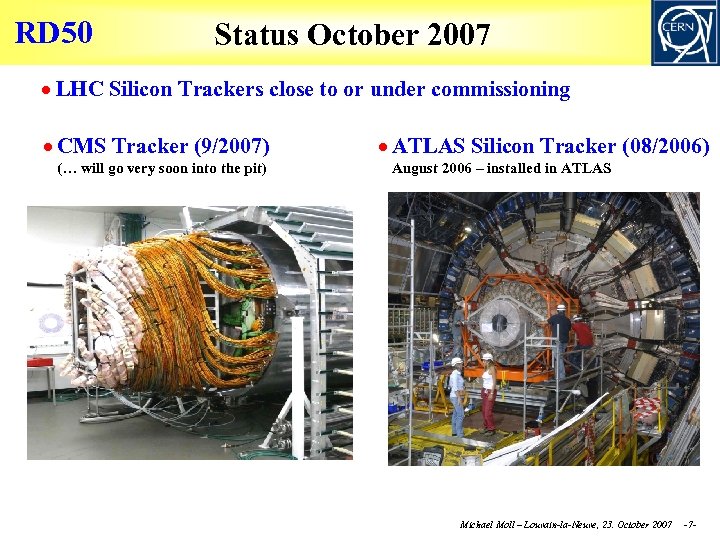 RD 50 Status October 2007 LHC Silicon Trackers close to or under commissioning CMS Tracker (9/2007) (… will go very soon into the pit) ATLAS Silicon Tracker (08/2006) August 2006 – installed in ATLAS Michael Moll – Louvain-la-Neuve, 23. October 2007 -7 -
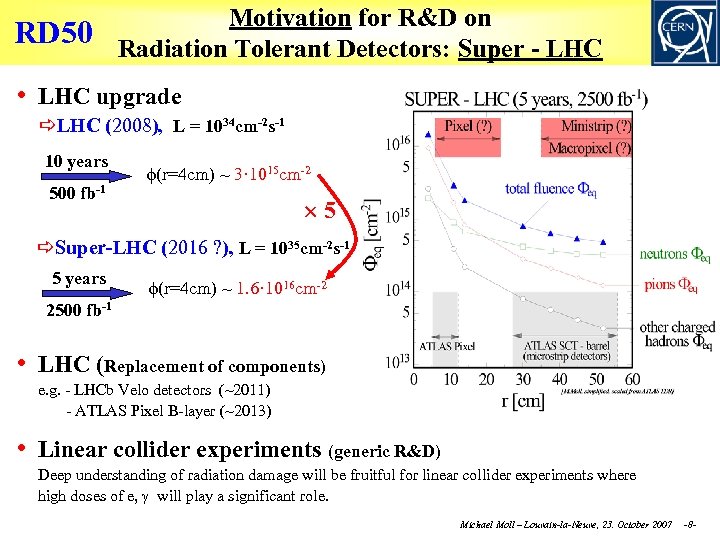 RD 50 Motivation for R&D on Radiation Tolerant Detectors: Super - LHC • LHC upgrade LHC (2008), L = 1034 cm-2 s-1 10 years f(r=4 cm) ~ 3· 1015 cm-2 500 fb-1 5 Super-LHC (2016 ? ), L = 1035 cm-2 s-1 5 years f(r=4 cm) ~ 1. 6· 1016 cm-2 2500 fb-1 • LHC (Replacement of components) e. g. - LHCb Velo detectors (~2011) - ATLAS Pixel B-layer (~2013) • Linear collider experiments (generic R&D) Deep understanding of radiation damage will be fruitful for linear collider experiments where high doses of e, will play a significant role. Michael Moll – Louvain-la-Neuve, 23. October 2007 -8 -
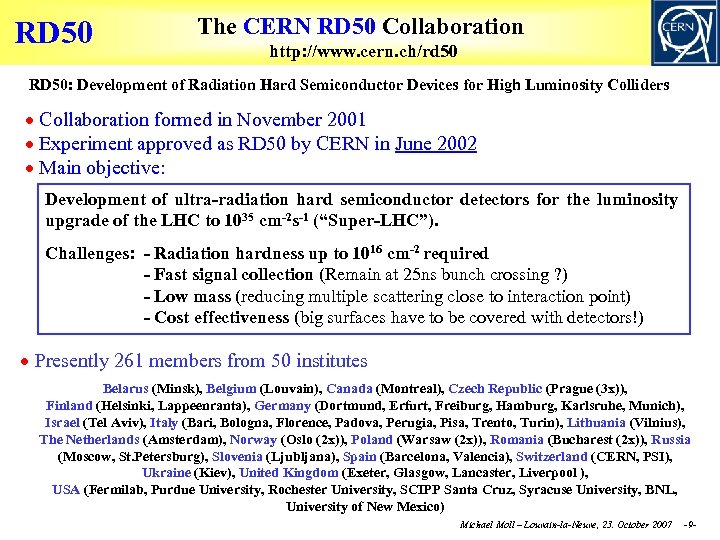 RD 50 The CERN RD 50 Collaboration http: //www. cern. ch/rd 50 RD 50: Development of Radiation Hard Semiconductor Devices for High Luminosity Colliders Collaboration formed in November 2001 Experiment approved as RD 50 by CERN in June 2002 Main objective: Development of ultra-radiation hard semiconductor detectors for the luminosity upgrade of the LHC to 1035 cm-2 s-1 (“Super-LHC”). Challenges: - Radiation hardness up to 1016 cm-2 required - Fast signal collection (Remain at 25 ns bunch crossing ? ) - Low mass (reducing multiple scattering close to interaction point) - Cost effectiveness (big surfaces have to be covered with detectors!) Presently 261 members from 50 institutes Belarus (Minsk), Belgium (Louvain), Canada (Montreal), Czech Republic (Prague (3 x)), Finland (Helsinki, Lappeenranta), Germany (Dortmund, Erfurt, Freiburg, Hamburg, Karlsruhe, Munich), Israel (Tel Aviv), Italy (Bari, Bologna, Florence, Padova, Perugia, Pisa, Trento, Turin), Lithuania (Vilnius), The Netherlands (Amsterdam), Norway (Oslo (2 x)), Poland (Warsaw (2 x)), Romania (Bucharest (2 x)), Russia (Moscow, St. Petersburg), Slovenia (Ljubljana), Spain (Barcelona, Valencia), Switzerland (CERN, PSI), Ukraine (Kiev), United Kingdom (Exeter, Glasgow, Lancaster, Liverpool ), USA (Fermilab, Purdue University, Rochester University, SCIPP Santa Cruz, Syracuse University, BNL, University of New Mexico) Michael Moll – Louvain-la-Neuve, 23. October 2007 -9 -
 RD 50 Outline Motivation to develop radiation harder detectors Introduction to the RD 50 collaboration Part I: Radiation Damage in Silicon Detectors (A very brief review) Microscopic defects Macroscopic damage (changes in bulk material) (changes in detector properties) Part II: RD 50 - Approaches to obtain radiation hard sensors Material Engineering Device Engineering Summary and preliminary conclusion Michael Moll – Louvain-la-Neuve, 23. October 2007 -10 -
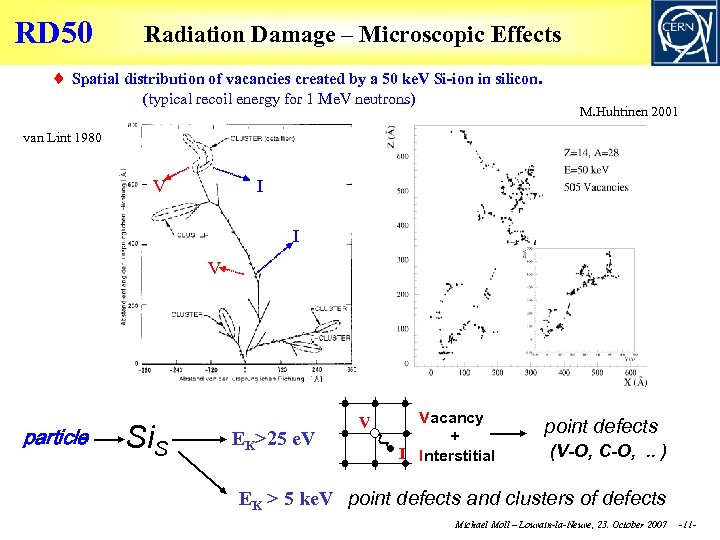 RD 50 Radiation Damage – Microscopic Effects ¨ Spatial distribution of vacancies created by a 50 ke. V Si-ion in silicon. (typical recoil energy for 1 Me. V neutrons) M. Huhtinen 2001 van Lint 1980 I V particle Si. S EK>25 e. V V Vacancy + I Interstitial point defects (V-O, C-O, . . ) EK > 5 ke. V point defects and clusters of defects Michael Moll – Louvain-la-Neuve, 23. October 2007 -11 -
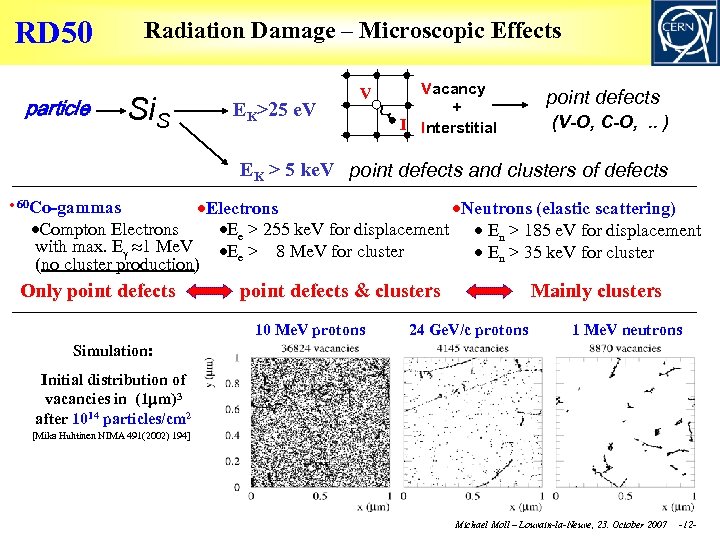 RD 50 particle Radiation Damage – Microscopic Effects Si. S EK>25 e. V V Vacancy + I Interstitial point defects (V-O, C-O, . . ) EK > 5 ke. V point defects and clusters of defects Electrons Neutrons (elastic scattering) Compton Electrons Ee > 255 ke. V for displacement En > 185 e. V for displacement with max. E 1 Me. V E > 8 Me. V for cluster En > 35 ke. V for cluster e (no cluster production) 60 Co-gammas Only point defects & clusters Mainly clusters 10 Me. V protons 24 Ge. V/c protons 1 Me. V neutrons Simulation: Initial distribution of vacancies in (1 m)3 after 1014 particles/cm 2 [Mika Huhtinen NIMA 491(2002) 194] Michael Moll – Louvain-la-Neuve, 23. October 2007 -12 -
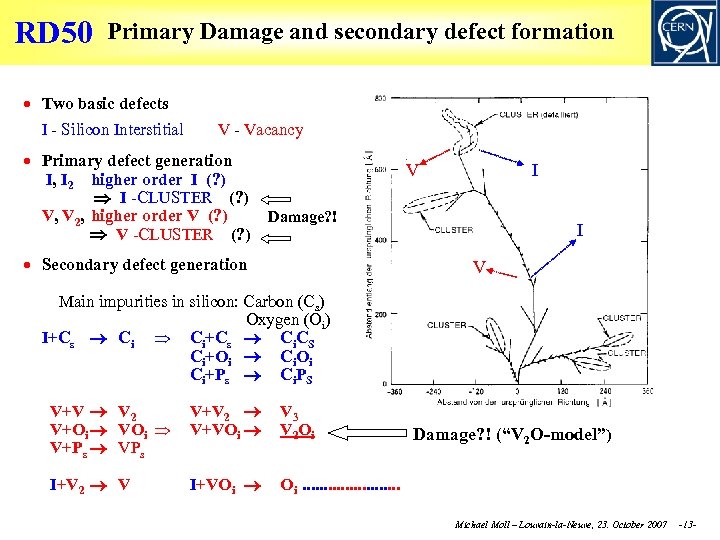 RD 50 Primary Damage and secondary defect formation Two basic defects I - Silicon Interstitial V - Vacancy Primary defect generation I, I 2 higher order I (? ) I -CLUSTER (? ) V, V 2, higher order V (? ) Damage? ! V -CLUSTER (? ) Secondary defect generation I V Main impurities in silicon: Carbon (Cs) Oxygen (Oi) I+Cs Ci+Cs Ci. CS Ci+Oi Ci. Oi Ci+Ps Ci. PS V+V V 2 V+Oi V+Ps VPs V+V 2 V+VOi V 3 V 2 O i I+V 2 V I+VOi Oi . . . Damage? ! (“V 2 O-model”) Michael Moll – Louvain-la-Neuve, 23. October 2007 -13 -
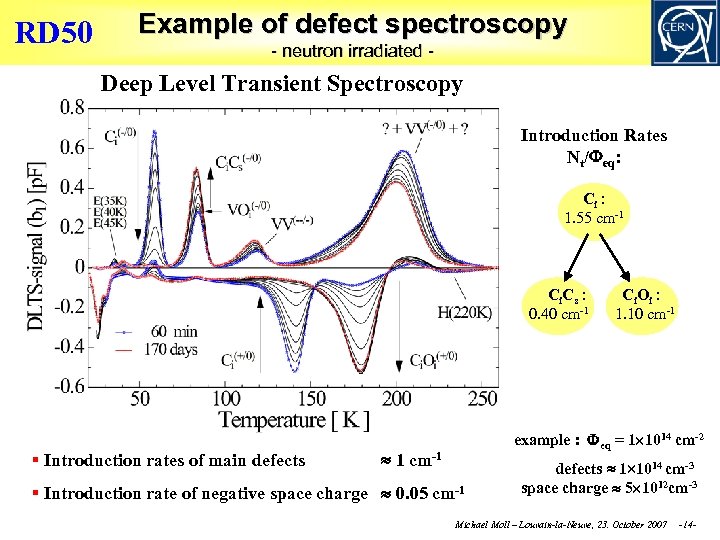 RD 50 Example of defect spectroscopy - neutron irradiated - Deep Level Transient Spectroscopy Introduction Rates Nt/ eq: Ci : 1. 55 cm-1 Ci. Cs : Ci. Oi : 0. 40 cm-1 1. 10 cm-1 example : eq = 1 1014 cm-2 § Introduction rates of main defects 1 cm-1 defects 1 1014 cm-3 § Introduction rate of negative space charge 0. 05 cm-1 space charge 5 1012 cm-3 Michael Moll – Louvain-la-Neuve, 23. October 2007 -14 -
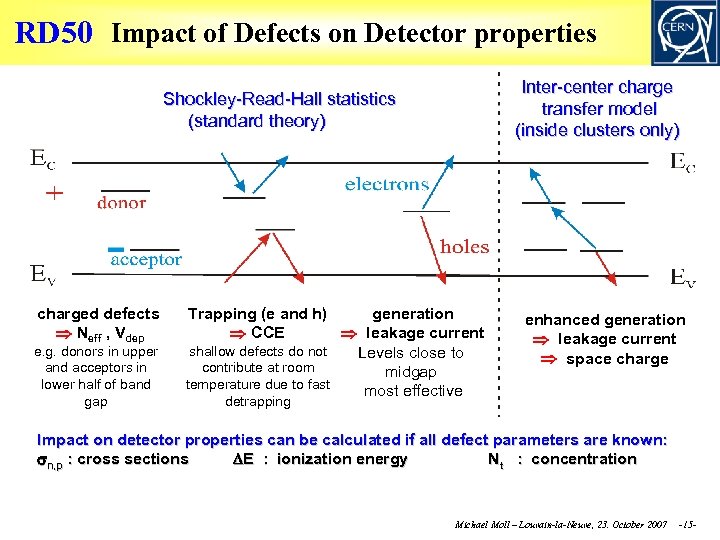 RD 50 Impact of Defects on Detector properties Inter-center charge transfer model (inside clusters only) Shockley-Read-Hall statistics (standard theory) charged defects Neff , Vdep e. g. donors in upper and acceptors in lower half of band gap Trapping (e and h) generation CCE leakage current shallow defects do not Levels close to contribute at room midgap temperature due to fast most effective enhanced generation leakage current space charge detrapping Impact on detector properties can be calculated if all defect parameters are known: n, p : cross sections E : ionization energy Nt : concentration Michael Moll – Louvain-la-Neuve, 23. October 2007 -15 -
![RD 50 Reverse biased abrupt p+-n junction Poisson’s equation Positive space charge, Neff =[P]](https://present5.com/presentation/7875739a0cb04180001a39ed7a55b214/image-16.jpg "RD 50 Reverse biased abrupt p+-n junction Poisson’s equation Positive space charge, Neff =[P]") RD 50 Reverse biased abrupt p+-n junction Poisson’s equation Positive space charge, Neff =[P] (ionized Phosphorus atoms) Electrical charge density Electrical field strength Full charge collection only for VB>Vdep ! depletion voltage Electron potential energy effective space charge density Michael Moll – Louvain-la-Neuve, 23. October 2007 -16 -
RD 50 Reverse biased abrupt p+-n junction Poisson’s equation Positive space charge, Neff =[P] (ionized Phosphorus atoms) Electrical charge density Electrical field strength Full charge collection only for VB>Vdep ! depletion voltage Electron potential energy effective space charge density Michael Moll – Louvain-la-Neuve, 23. October 2007 -16 -
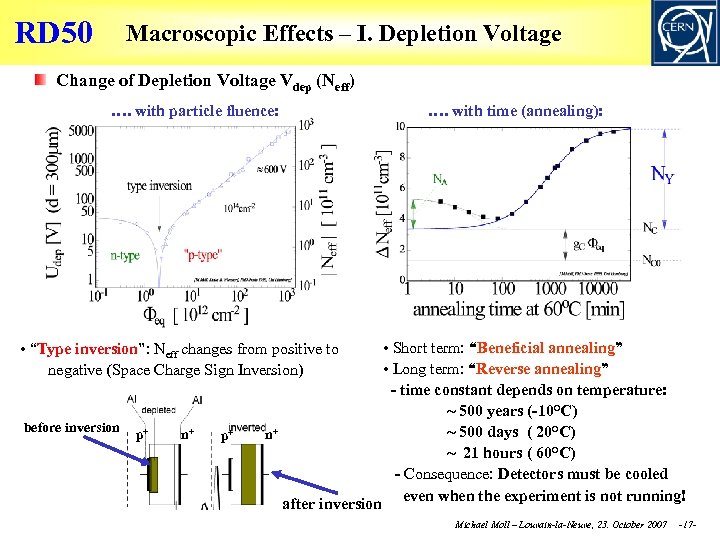 RD 50 Macroscopic Effects – I. Depletion Voltage Change of Depletion Voltage Vdep (Neff) …. with particle fluence: • “Type inversion”: Neff changes from positive to negative (Space Charge Sign Inversion) before inversion p+ n+ after inversion …. with time (annealing): • Short term: “Beneficial annealing” • Long term: “Reverse annealing” - time constant depends on temperature: ~ 500 years (-10°C) ~ 500 days ( 20°C) ~ 21 hours ( 60°C) - Consequence: Detectors must be cooled even when the experiment is not running! Michael Moll – Louvain-la-Neuve, 23. October 2007 -17 -
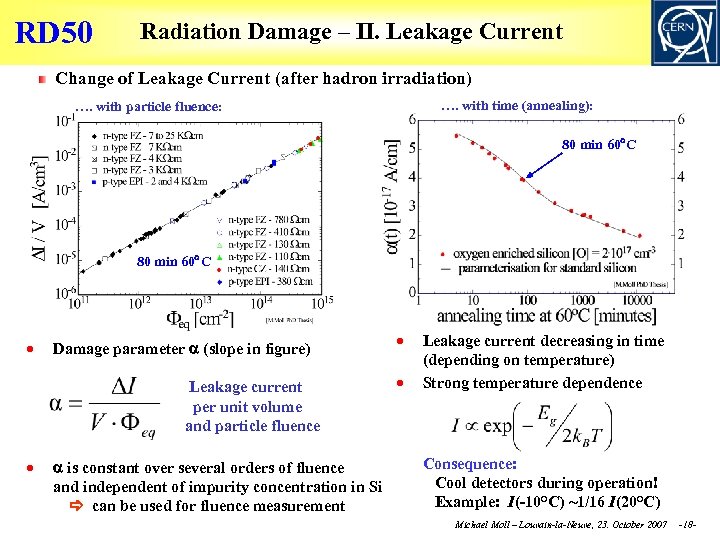 RD 50 Radiation Damage – II. Leakage Current Change of Leakage Current (after hadron irradiation) …. with time (annealing): …. with particle fluence: 80 min 60 C Damage parameter (slope in figure) Leakage current per unit volume and particle fluence is constant over several orders of fluence and independent of impurity concentration in Si can be used for fluence measurement Leakage current decreasing in time (depending on temperature) Strong temperature dependence Consequence: Cool detectors during operation! Example: I(-10°C) ~1/16 I(20°C) Michael Moll – Louvain-la-Neuve, 23. October 2007 -18 -
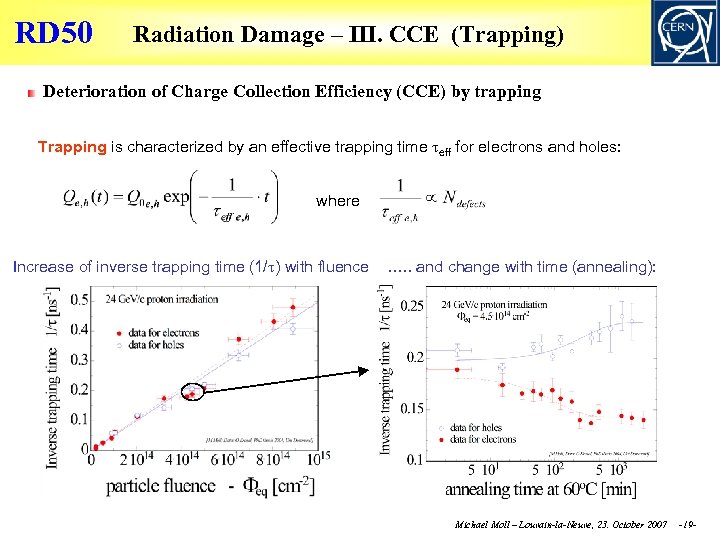 RD 50 Radiation Damage – III. CCE (Trapping) Deterioration of Charge Collection Efficiency (CCE) by trapping Trapping is characterized by an effective trapping time eff for electrons and holes: where …. . and change with time (annealing): Increase of inverse trapping time (1/ ) with fluence Michael Moll – Louvain-la-Neuve, 23. October 2007 -19 -
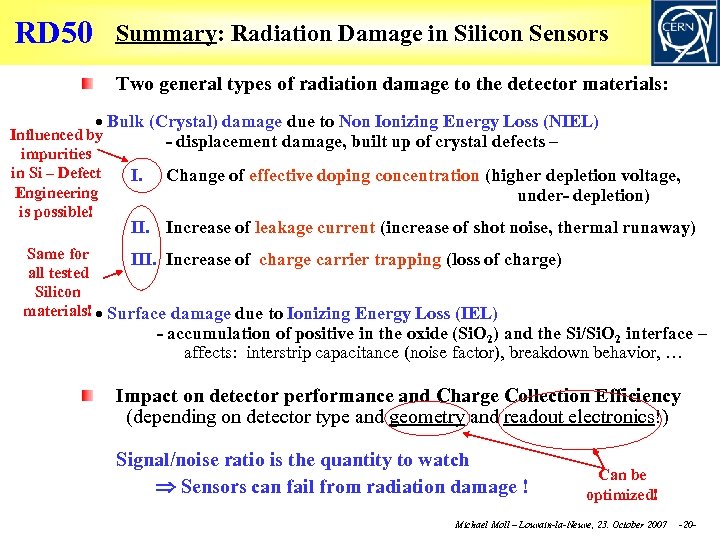 RD 50 Summary: Radiation Damage in Silicon Sensors Two general types of radiation damage to the detector materials: Bulk (Crystal) damage due to Non Ionizing Energy Loss (NIEL) Influenced by - displacement damage, built up of crystal defects – impurities in Si – Defect I. Change of effective doping concentration (higher depletion voltage, Engineering under- depletion) is possible! II. Increase of leakage current (increase of shot noise, thermal runaway) Same for III. Increase of charge carrier trapping (loss of charge) all tested Silicon materials! Surface damage due to Ionizing Energy Loss (IEL) - accumulation of positive in the oxide (Si. O 2) and the Si/Si. O 2 interface – affects: interstrip capacitance (noise factor), breakdown behavior, … Impact on detector performance and Charge Collection Efficiency (depending on detector type and geometry and readout electronics!) Signal/noise ratio is the quantity to watch Sensors can fail from radiation damage ! Can be optimized! Michael Moll – Louvain-la-Neuve, 23. October 2007 -20 -
 RD 50 Outline Motivation to develop radiation harder detectors Introduction to the RD 50 collaboration Part I: Radiation Damage in Silicon Detectors (A very brief review) Microscopic defects Macroscopic damage (changes in bulk material) (changes in detector properties) Part II: RD 50 - Approaches to obtain radiation hard sensors Material Engineering Device Engineering Summary and preliminary conclusion Michael Moll – Louvain-la-Neuve, 23. October 2007 -21 -
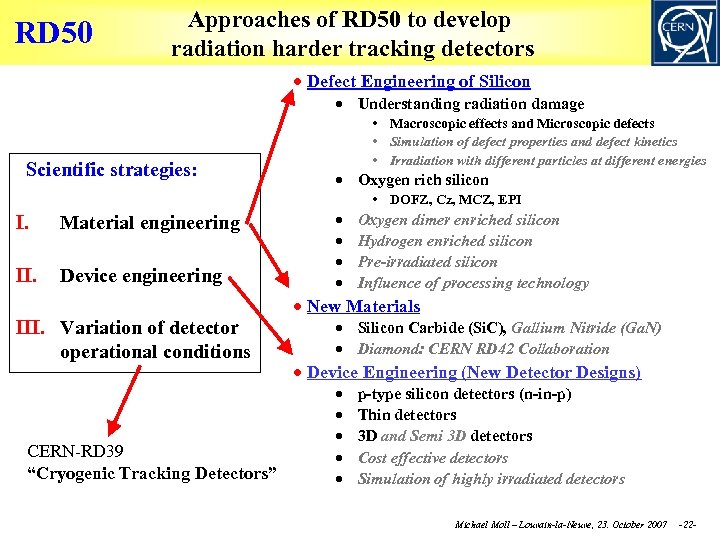 RD 50 Approaches of RD 50 to develop radiation harder tracking detectors Defect Engineering of Silicon Understanding radiation damage Scientific strategies: • Macroscopic effects and Microscopic defects • Simulation of defect properties and defect kinetics • Irradiation with different particles at different energies Oxygen rich silicon • DOFZ, Cz, MCZ, EPI I. Material engineering II. Device engineering Oxygen dimer enriched silicon Hydrogen enriched silicon Pre-irradiated silicon Influence of processing technology New Materials III. Variation of detector operational conditions CERN-RD 39 “Cryogenic Tracking Detectors” Silicon Carbide (Si. C), Gallium Nitride (Ga. N) Diamond: CERN RD 42 Collaboration Device Engineering (New Detector Designs) p-type silicon detectors (n-in-p) Thin detectors 3 D and Semi 3 D detectors Cost effective detectors Simulation of highly irradiated detectors Michael Moll – Louvain-la-Neuve, 23. October 2007 -22 -
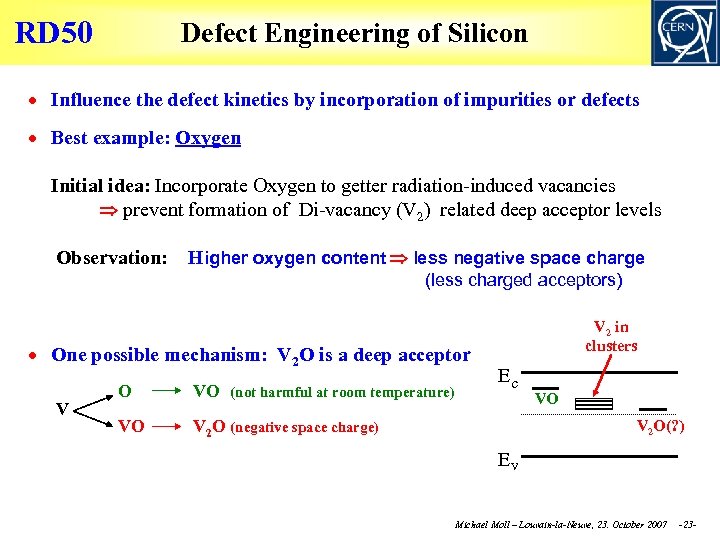 RD 50 Defect Engineering of Silicon Influence the defect kinetics by incorporation of impurities or defects Best example: Oxygen Initial idea: Incorporate Oxygen to getter radiation-induced vacancies prevent formation of Di-vacancy (V 2) related deep acceptor levels Observation: Higher oxygen content less negative space charge (less charged acceptors) One possible mechanism: V 2 O is a deep acceptor V O VO (not harmful at room temperature) VO V 2 in clusters Ec V 2 O (negative space charge) VO V 2 O(? ) EV Michael Moll – Louvain-la-Neuve, 23. October 2007 -23 -
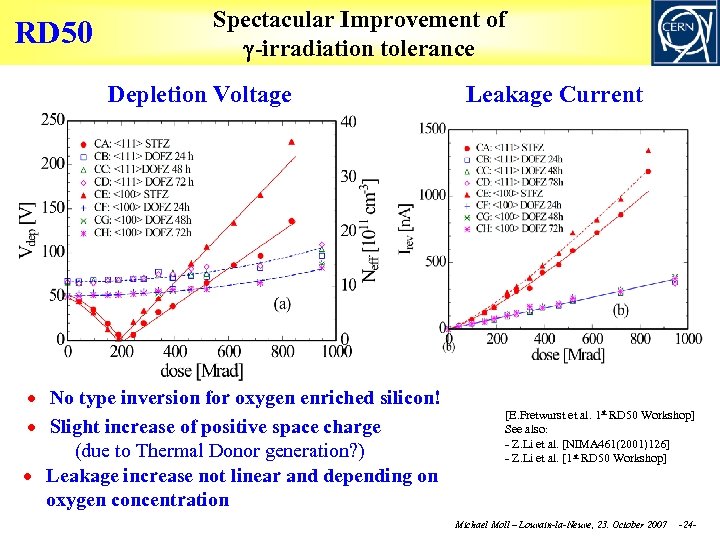 RD 50 Spectacular Improvement of g-irradiation tolerance Depletion Voltage No type inversion for oxygen enriched silicon! Slight increase of positive space charge (due to Thermal Donor generation? ) Leakage increase not linear and depending on oxygen concentration Leakage Current [E. Fretwurst et al. 1 st RD 50 Workshop] See also: - Z. Li et al. [NIMA 461(2001)126] - Z. Li et al. [1 st RD 50 Workshop] Michael Moll – Louvain-la-Neuve, 23. October 2007 -24 -
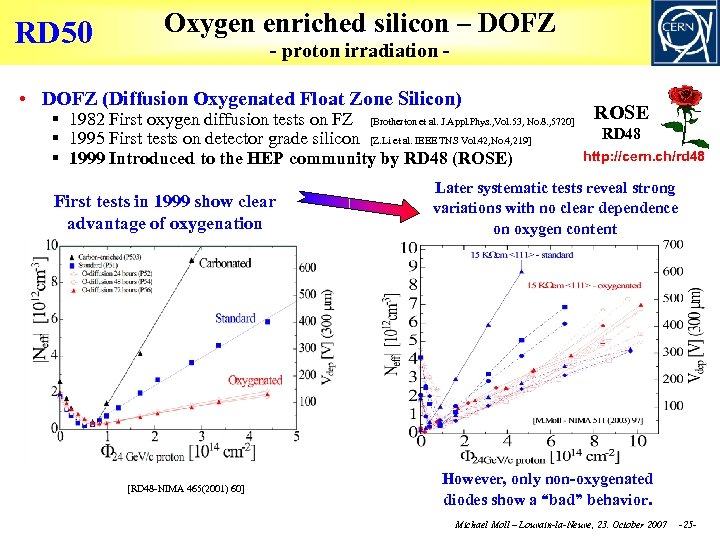 RD 50 Oxygen enriched silicon – DOFZ - proton irradiation - • DOFZ (Diffusion Oxygenated Float Zone Silicon) § 1982 First oxygen diffusion tests on FZ [Brotherton et al. J. Appl. Phys. , Vol. 53, No. 8. , 5720] § 1995 First tests on detector grade silicon [Z. Li et al. IEEE TNS Vol. 42, No. 4, 219] § 1999 Introduced to the HEP community by RD 48 (ROSE) First tests in 1999 show clear advantage of oxygenation [RD 48 -NIMA 465(2001) 60] ROSE RD 48 http: //cern. ch/rd 48 Later systematic tests reveal strong variations with no clear dependence on oxygen content However, only non-oxygenated diodes show a “bad” behavior. Michael Moll – Louvain-la-Neuve, 23. October 2007 -25 -
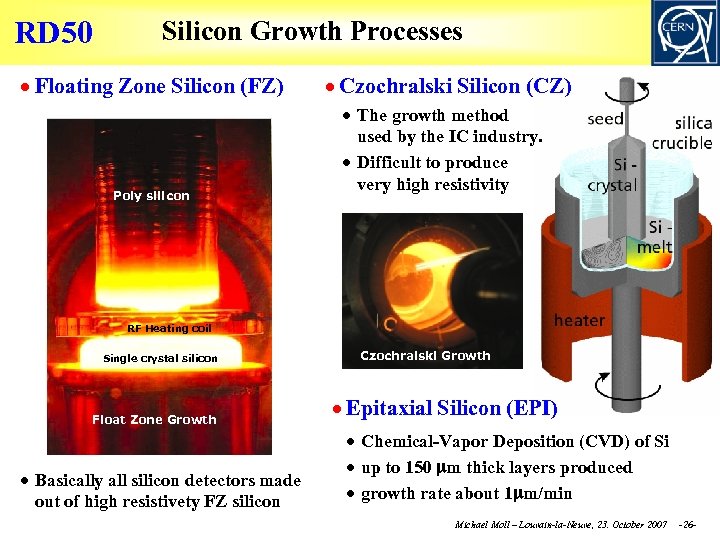 RD 50 Silicon Growth Processes Floating Zone Silicon (FZ) Poly silicon Czochralski Silicon (CZ) The growth method used by the IC industry. Difficult to produce very high resistivity RF Heating coil Single crystal silicon Float Zone Growth Basically all silicon detectors made out of high resistivety FZ silicon Czochralski Growth Epitaxial Silicon (EPI) Chemical-Vapor Deposition (CVD) of Si up to 150 m thick layers produced growth rate about 1 m/min Michael Moll – Louvain-la-Neuve, 23. October 2007 -26 -
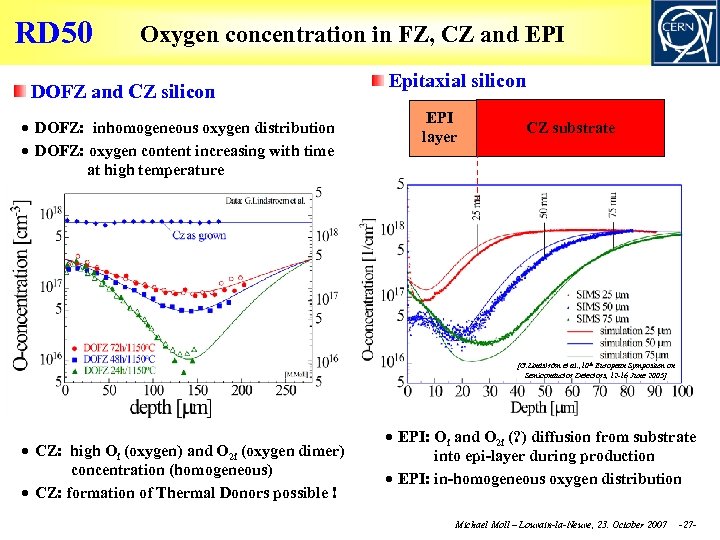 RD 50 Oxygen concentration in FZ, CZ and EPI DOFZ and CZ silicon DOFZ: inhomogeneous oxygen distribution DOFZ: oxygen content increasing with time at high temperature Epitaxial silicon EPI layer CZ substrate [G. Lindström et al. , 10 th European Symposium on Semiconductor Detectors, 12 -16 June 2005] CZ: high Oi (oxygen) and O 2 i (oxygen dimer) concentration (homogeneous) CZ: formation of Thermal Donors possible ! EPI: Oi and O 2 i (? ) diffusion from substrate into epi-layer during production EPI: in-homogeneous oxygen distribution Michael Moll – Louvain-la-Neuve, 23. October 2007 -27 -
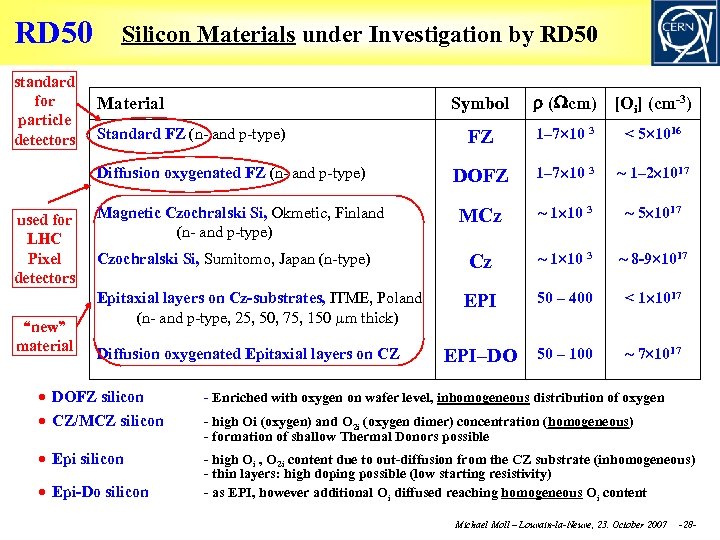 RD 50 standard for particle detectors Silicon Materials under Investigation by RD 50 Material Symbol Standard FZ (n- and p-type) Diffusion oxygenated FZ (n- and p-type) used for LHC Pixel detectors “new” material Magnetic Czochralski Si, Okmetic, Finland (n- and p-type) Czochralski Si, Sumitomo, Japan (n-type) Epitaxial layers on Cz-substrates, ITME, Poland (n- and p-type, 25, 50, 75, 150 mm thick) Diffusion oxygenated Epitaxial layers on CZ ( cm) [Oi] (cm-3) FZ 1– 7 10 3 < 5 1016 DOFZ 1– 7 10 3 ~ 1– 2 1017 MCz ~ 1 10 3 ~ 5 1017 Cz ~ 1 10 3 ~ 8 -9 1017 EPI 50 – 400 < 1 1017 EPI–DO 50 – 100 ~ 7 1017 DOFZ silicon CZ/MCZ silicon - Enriched with oxygen on wafer level, inhomogeneous distribution of oxygen Epi silicon - high Oi , O 2 i content due to out-diffusion from the CZ substrate (inhomogeneous) - thin layers: high doping possible (low starting resistivity) - as EPI, however additional Oi diffused reaching homogeneous Oi content Epi-Do silicon - high Oi (oxygen) and O 2 i (oxygen dimer) concentration (homogeneous) - formation of shallow Thermal Donors possible Michael Moll – Louvain-la-Neuve, 23. October 2007 -28 -
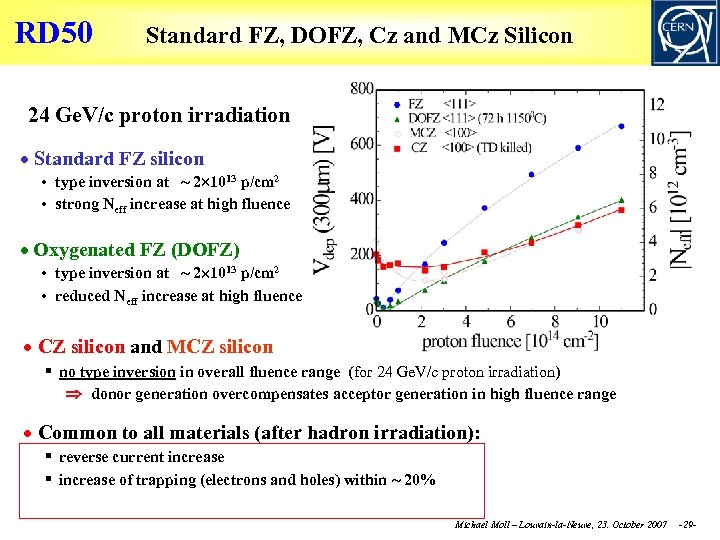 RD 50 Standard FZ, DOFZ, Cz and MCz Silicon 24 Ge. V/c proton irradiation Standard FZ silicon • type inversion at ~ 2 1013 p/cm 2 • strong Neff increase at high fluence Oxygenated FZ (DOFZ) • type inversion at ~ 2 1013 p/cm 2 • reduced Neff increase at high fluence CZ silicon and MCZ silicon § no type inversion in overall fluence range (for 24 Ge. V/c proton irradiation) donor generation overcompensates acceptor generation in high fluence range Common to all materials (after hadron irradiation): § reverse current increase § increase of trapping (electrons and holes) within ~ 20% Michael Moll – Louvain-la-Neuve, 23. October 2007 -29 -
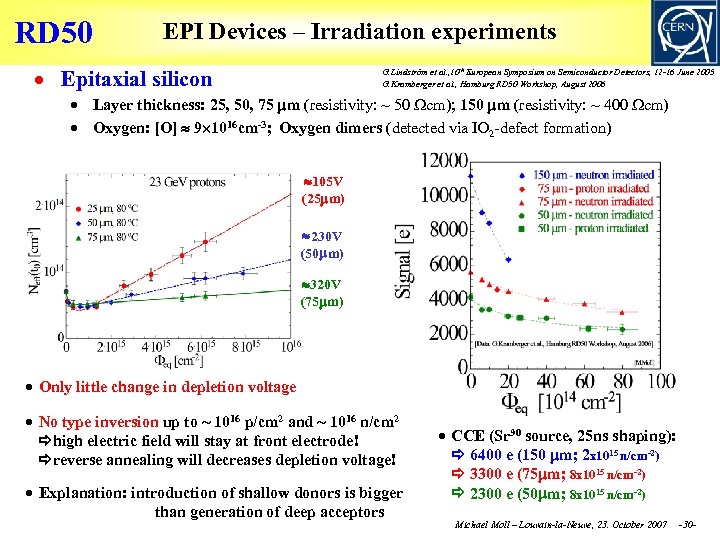 RD 50 EPI Devices – Irradiation experiments Epitaxial silicon G. Lindström et al. , 10 th European Symposium on Semiconductor Detectors, 12 -16 June 2005 G. Kramberger et al. , Hamburg RD 50 Workshop, August 2006 Layer thickness: 25, 50, 75 m (resistivity: ~ 50 cm); 150 m (resistivity: ~ 400 cm) Oxygen: [O] 9 1016 cm-3; Oxygen dimers (detected via IO 2 -defect formation) 105 V (25 m) 230 V (50 m) 320 V (75 m) Only little change in depletion voltage No type inversion up to ~ 1016 p/cm 2 and ~ 1016 n/cm 2 high electric field will stay at front electrode! reverse annealing will decreases depletion voltage! Explanation: introduction of shallow donors is bigger than generation of deep acceptors CCE (Sr 90 source, 25 ns shaping): 6400 e (150 m; 2 x 10¹⁵ n/cm-2) 3300 e (75 m; 8 x 10¹⁵ n/cm-2) 2300 e (50 m; 8 x 10¹⁵ n/cm-2) Michael Moll – Louvain-la-Neuve, 23. October 2007 -30 -
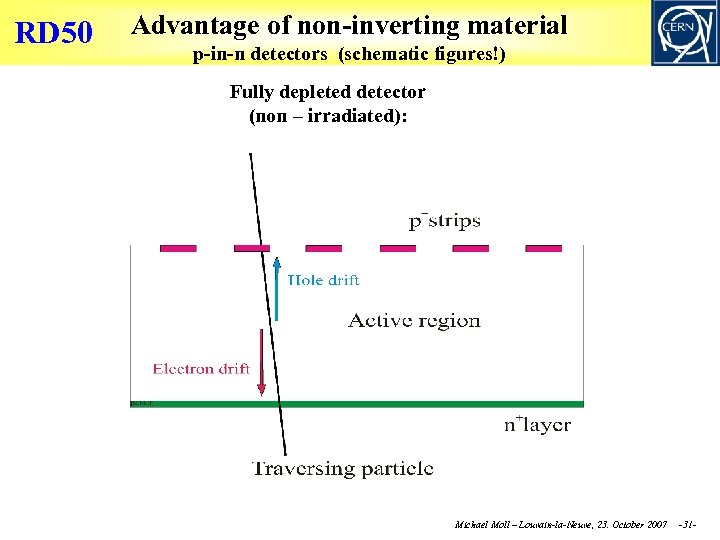 RD 50 Advantage of non-inverting material p-in-n detectors (schematic figures!) Fully depleted detector (non – irradiated): Michael Moll – Louvain-la-Neuve, 23. October 2007 -31 -
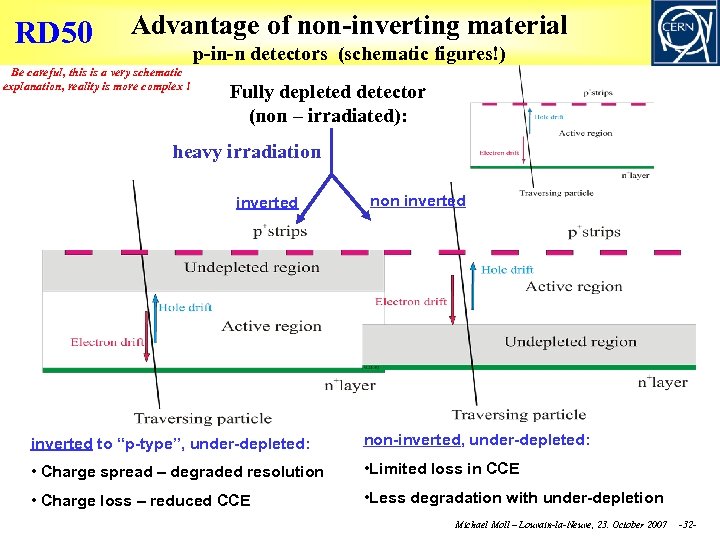 RD 50 Advantage of non-inverting material p-in-n detectors (schematic figures!) Be careful, this is a very schematic explanation, reality is more complex ! Fully depleted detector (non – irradiated): heavy irradiation inverted non inverted to “p-type”, under-depleted: non-inverted, under-depleted: • Charge spread – degraded resolution • Limited loss in CCE • Charge loss – reduced CCE • Less degradation with under-depletion Michael Moll – Louvain-la-Neuve, 23. October 2007 -32 -
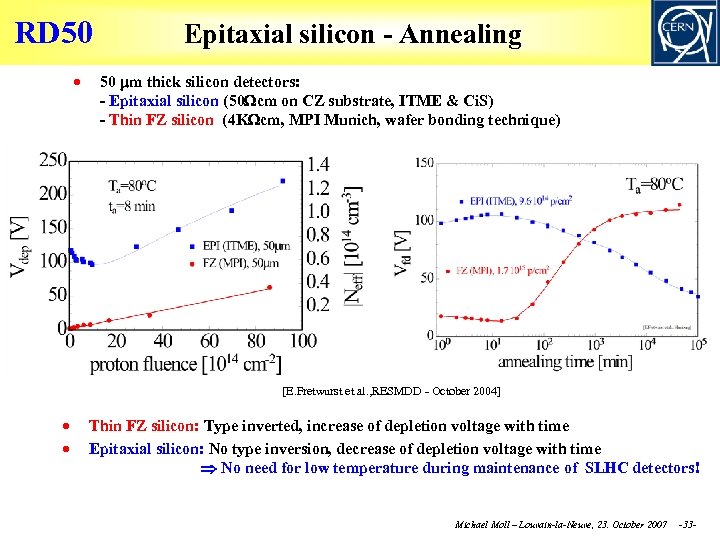 RD 50 Epitaxial silicon - Annealing 50 m thick silicon detectors: - Epitaxial silicon (50 cm on CZ substrate, ITME & Ci. S) - Thin FZ silicon (4 K cm, MPI Munich, wafer bonding technique) [E. Fretwurst et al. , RESMDD - October 2004] Thin FZ silicon: Type inverted, increase of depletion voltage with time Epitaxial silicon: No type inversion, decrease of depletion voltage with time No need for low temperature during maintenance of SLHC detectors! Michael Moll – Louvain-la-Neuve, 23. October 2007 -33 -
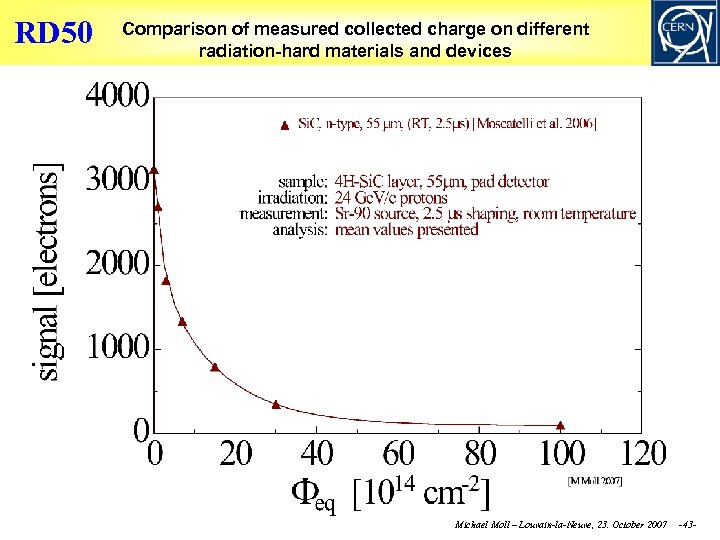
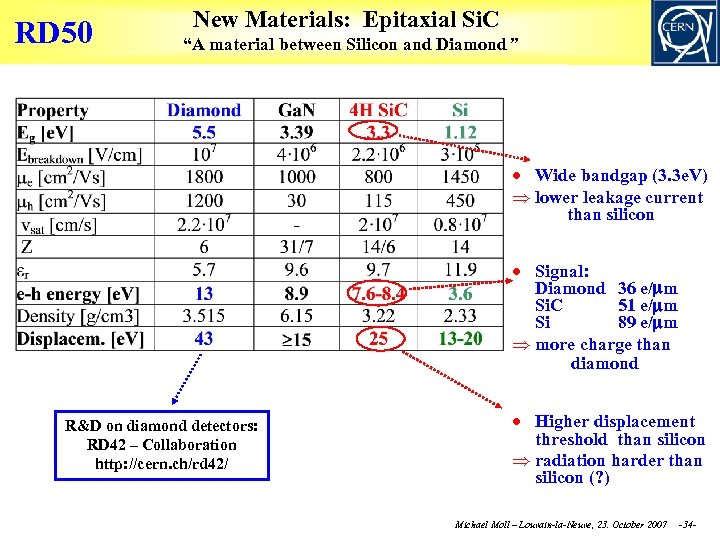 RD 50 New Materials: Epitaxial Si. C “A material between Silicon and Diamond” Wide bandgap (3. 3 e. V) lower leakage current than silicon Signal: Diamond 36 e/ m Si. C 51 e/ m Si 89 e/ m more charge than diamond R&D on diamond detectors: RD 42 – Collaboration http: //cern. ch/rd 42/ Higher displacement threshold than silicon radiation harder than silicon (? ) Michael Moll – Louvain-la-Neuve, 23. October 2007 -34 -
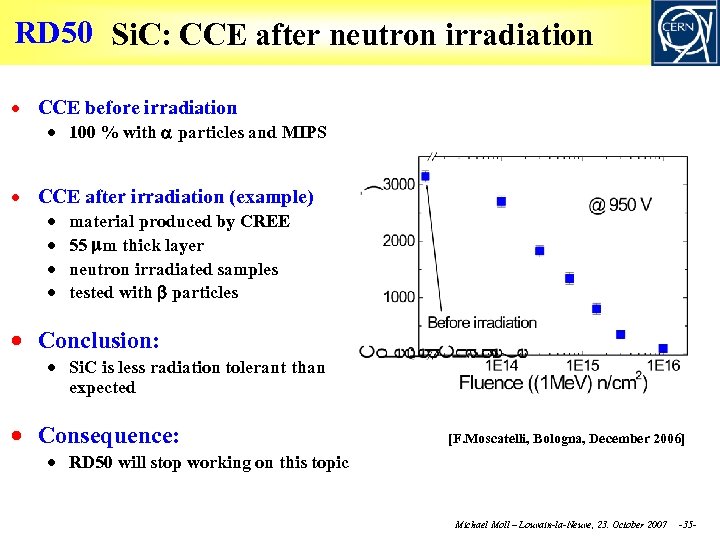 RD 50 Si. C: CCE after neutron irradiation CCE before irradiation 100 % with particles and MIPS CCE after irradiation (example) material produced by CREE 55 m thick layer neutron irradiated samples tested with b particles Conclusion: Si. C is less radiation tolerant than expected Consequence: [F. Moscatelli, Bologna, December 2006] RD 50 will stop working on this topic Michael Moll – Louvain-la-Neuve, 23. October 2007 -35 -
 RD 50 Outline Motivation to develop radiation harder detectors Introduction to the RD 50 collaboration Part I: Radiation Damage in Silicon Detectors (A very brief review) Microscopic defects Macroscopic damage (changes in bulk material) (changes in detector properties) Part II: RD 50 - Approaches to obtain radiation hard sensors Material Engineering Device Engineering Summary and preliminary conclusion Michael Moll – Louvain-la-Neuve, 23. October 2007 -36 -
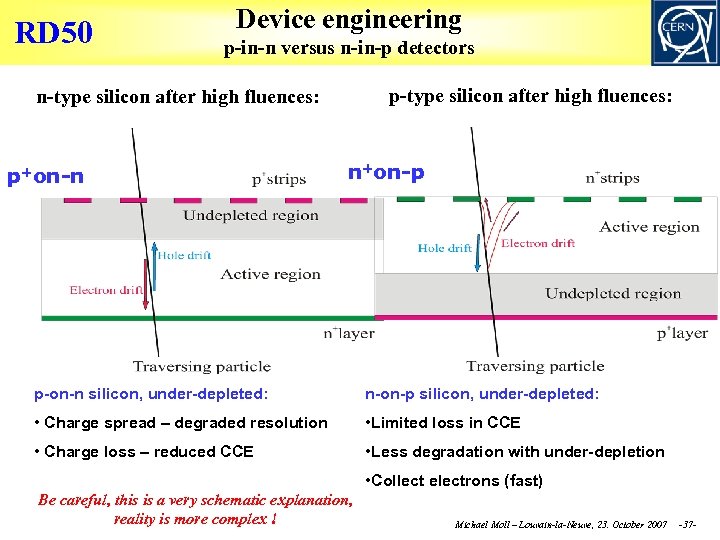 RD 50 Device engineering p-in-n versus n-in-p detectors p-type silicon after high fluences: n-type silicon after high fluences: p+on-n n+on-p p-on-n silicon, under-depleted: n-on-p silicon, under-depleted: • Charge spread – degraded resolution • Limited loss in CCE • Charge loss – reduced CCE • Less degradation with under-depletion • Collect electrons (fast) Be careful, this is a very schematic explanation, reality is more complex ! Michael Moll – Louvain-la-Neuve, 23. October 2007 -37 -
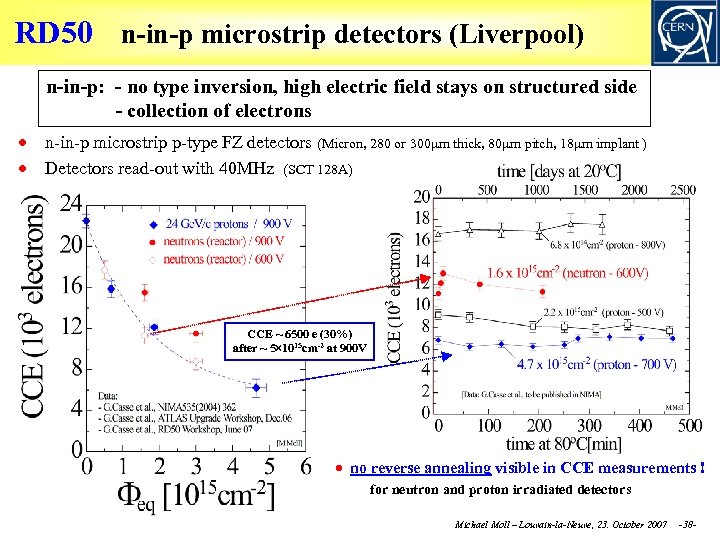 RD 50 n-in-p microstrip detectors (Liverpool) n-in-p: - no type inversion, high electric field stays on structured side - collection of electrons n-in-p microstrip p-type FZ detectors (Micron, 280 or 300 mm thick, 80 mm pitch, 18 mm implant ) Detectors read-out with 40 MHz (SCT 128 A) CCE ~ 6500 e (30%) after ~ 5 1015 cm-2 at 900 V no reverse annealing visible in CCE measurements ! for neutron and proton irradiated detectors Michael Moll – Louvain-la-Neuve, 23. October 2007 -38 -
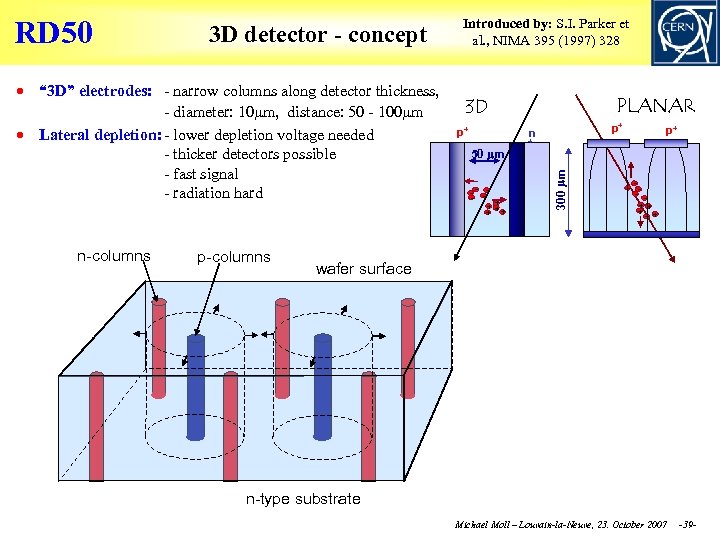 3 D detector - concept “ 3 D” electrodes: - narrow columns along detector thickness, - diameter: 10 mm, distance: 50 - 100 mm Lateral depletion: - lower depletion voltage needed - thicker detectors possible - fast signal - radiation hard n-columns p-columns Introduced by: S. I. Parker et al. , NIMA 395 (1997) 328 PLANAR 3 D p+ p+ n p+ + 50 m -- ++ + 300 m RD 50 - ++ + wafer surface n-type substrate Michael Moll – Louvain-la-Neuve, 23. October 2007 -39 -
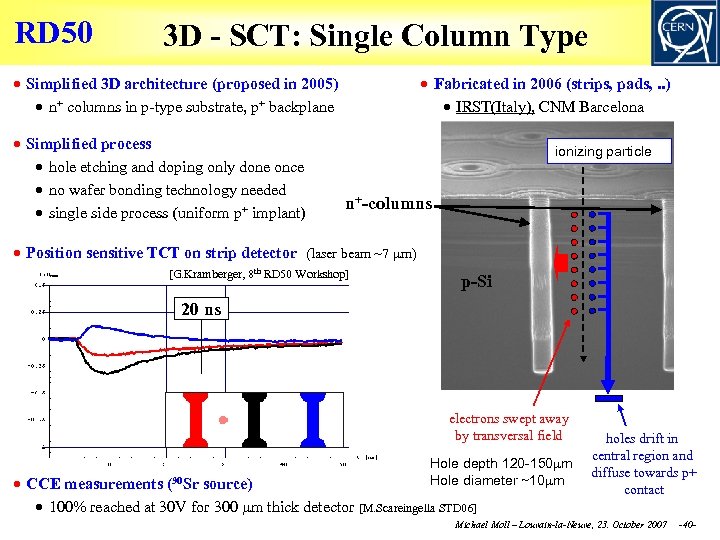 RD 50 3 D - SCT: Single Column Type Simplified 3 D architecture (proposed in 2005) n+ columns in p-type substrate, p+ backplane Simplified process hole etching and doping only done once no wafer bonding technology needed single side process (uniform p+ implant) Fabricated in 2006 (strips, pads, . . ) IRST(Italy), CNM Barcelona ionizing particle n+-columns Position sensitive TCT on strip detector (laser beam ~7 mm) [G. Kramberger, 8 th RD 50 Workshop] p-Si 20 ns electrons swept away by transversal field Hole depth 120 -150 mm Hole diameter ~10 mm CCE measurements (90 Sr source) 100% reached at 30 V for 300 mm thick detector [M. Scareingella STD 06] holes drift in central region and diffuse towards p+ contact Michael Moll – Louvain-la-Neuve, 23. October 2007 -40 -
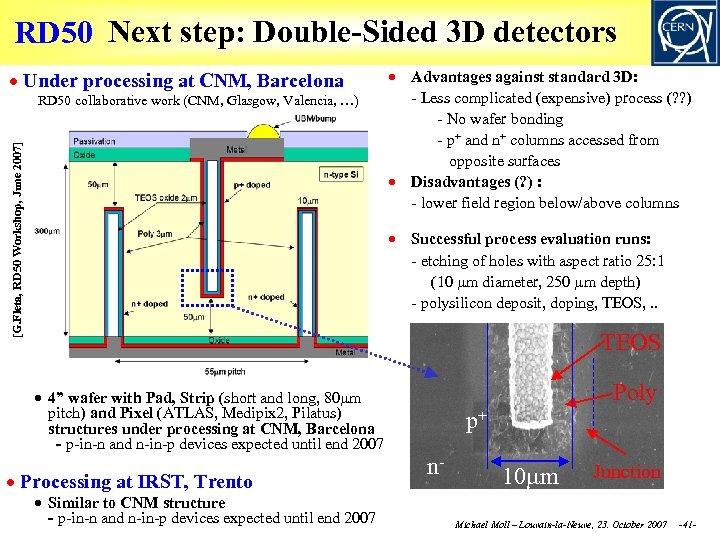 RD 50 Next step: Double-Sided 3 D detectors Under processing at CNM, Barcelona [G. Fleta, RD 50 Workshop, June 2007] RD 50 collaborative work (CNM, Glasgow, Valencia, …) Advantages against standard 3 D: - Less complicated (expensive) process (? ? ) - No wafer bonding - p+ and n+ columns accessed from opposite surfaces Disadvantages (? ) : - lower field region below/above columns Successful process evaluation runs: - etching of holes with aspect ratio 25: 1 (10 mm diameter, 250 mm depth) - polysilicon deposit, doping, TEOS, . . TEOS Poly 4” wafer with Pad, Strip (short and long, 80 mm pitch) and Pixel (ATLAS, Medipix 2, Pilatus) structures under processing at CNM, Barcelona - p-in-n and n-in-p devices expected until end 2007 Processing at IRST, Trento Similar to CNM structure - p-in-n and n-in-p devices expected until end 2007 p+ n- 10 mm Junction Michael Moll – Louvain-la-Neuve, 23. October 2007 -41 -
 RD 50 Comparison of measured collected charge on different radiation-hard materials and devices In the following: Comparison of collected charge as published in literature Be careful: Values obtained partly under different conditions irradiation temperature of measurement electronics used (shaping time, noise) type of device – strip detectors or pad detectors This comparison gives only an indication of which material/technology could be used, to be more specific, the exact application should be looked at! Remember: The obtained signal has still to be compared to the noise Acknowledgements: Recent data collections: Mara Bruzzi (Hiroschima conference 2006) Cinzia Da Via (Vertex conference 2006) Michael Moll – Louvain-la-Neuve, 23. October 2007 -42 -
 RD 50 Comparison of measured collected charge on different radiation-hard materials and devices Michael Moll – Louvain-la-Neuve, 23. October 2007 -43 -
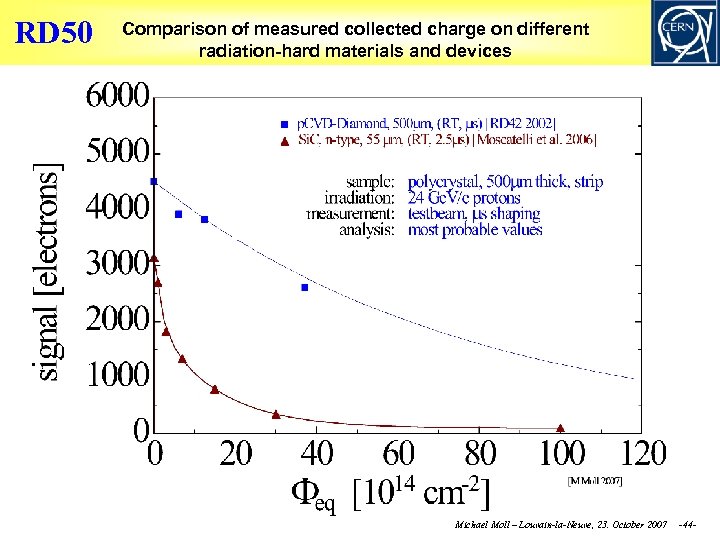 RD 50 Comparison of measured collected charge on different radiation-hard materials and devices Michael Moll – Louvain-la-Neuve, 23. October 2007 -44 -
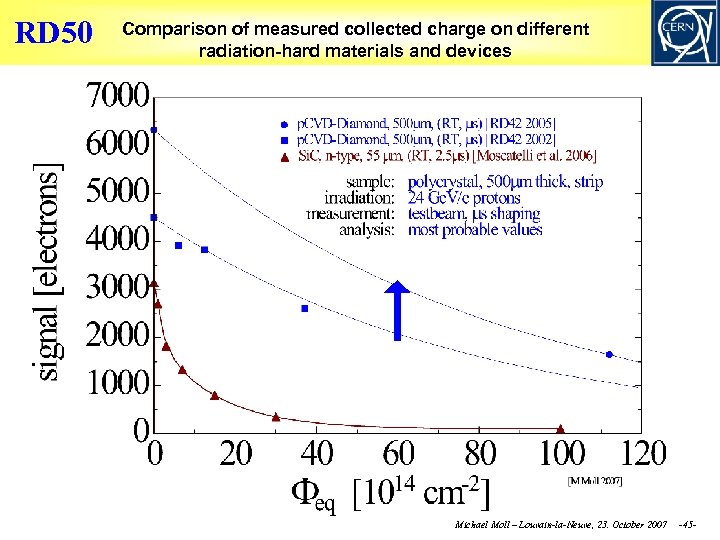 RD 50 Comparison of measured collected charge on different radiation-hard materials and devices Michael Moll – Louvain-la-Neuve, 23. October 2007 -45 -
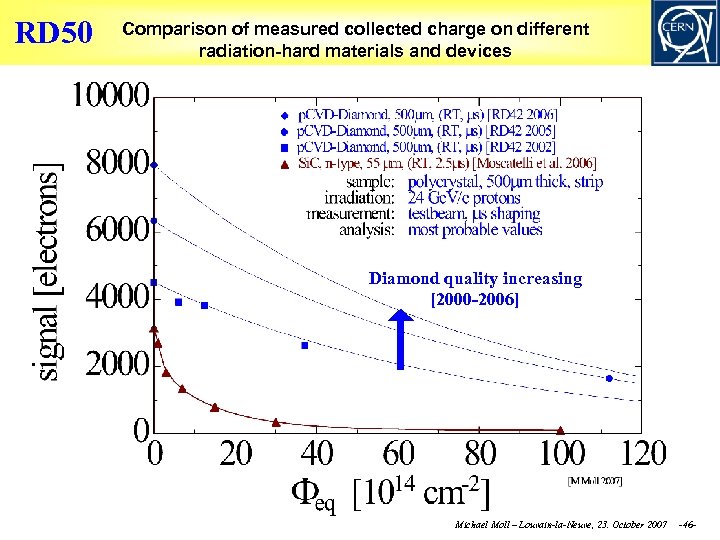 RD 50 Comparison of measured collected charge on different radiation-hard materials and devices Diamond quality increasing [2000 -2006] Michael Moll – Louvain-la-Neuve, 23. October 2007 -46 -
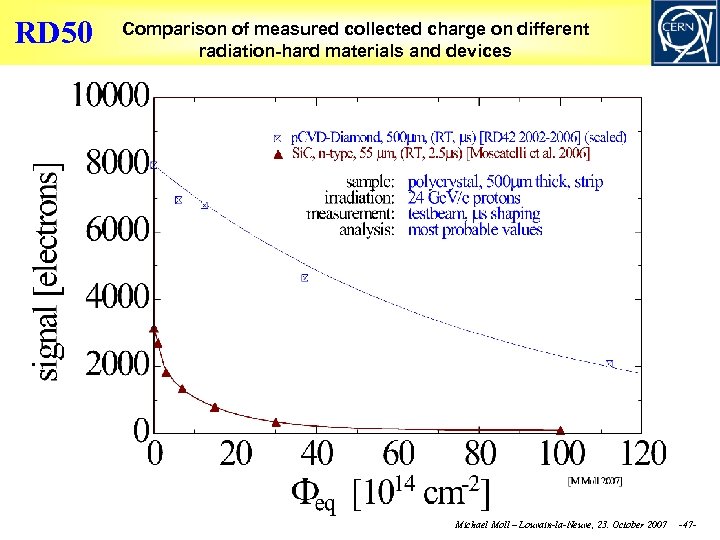 RD 50 Comparison of measured collected charge on different radiation-hard materials and devices Michael Moll – Louvain-la-Neuve, 23. October 2007 -47 -
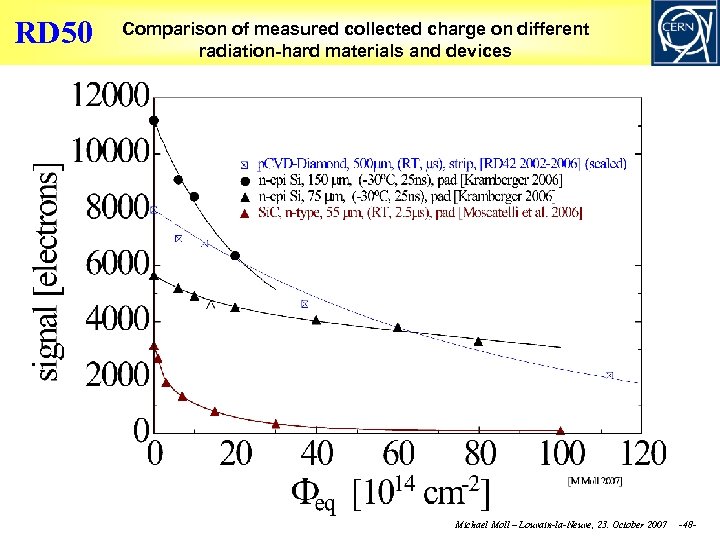 RD 50 Comparison of measured collected charge on different radiation-hard materials and devices Michael Moll – Louvain-la-Neuve, 23. October 2007 -48 -
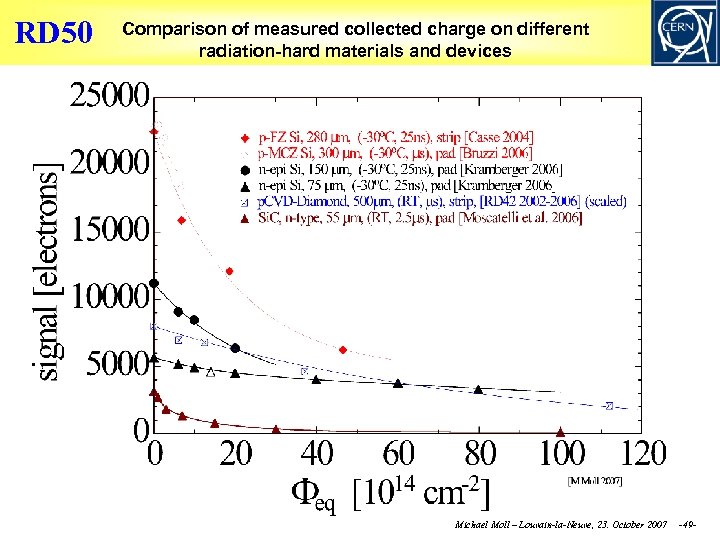 RD 50 Comparison of measured collected charge on different radiation-hard materials and devices Michael Moll – Louvain-la-Neuve, 23. October 2007 -49 -
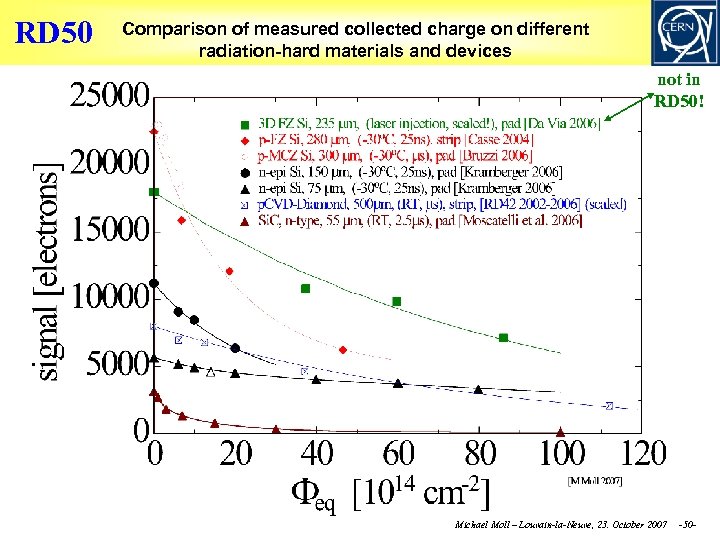 RD 50 Comparison of measured collected charge on different radiation-hard materials and devices not in RD 50! Michael Moll – Louvain-la-Neuve, 23. October 2007 -50 -
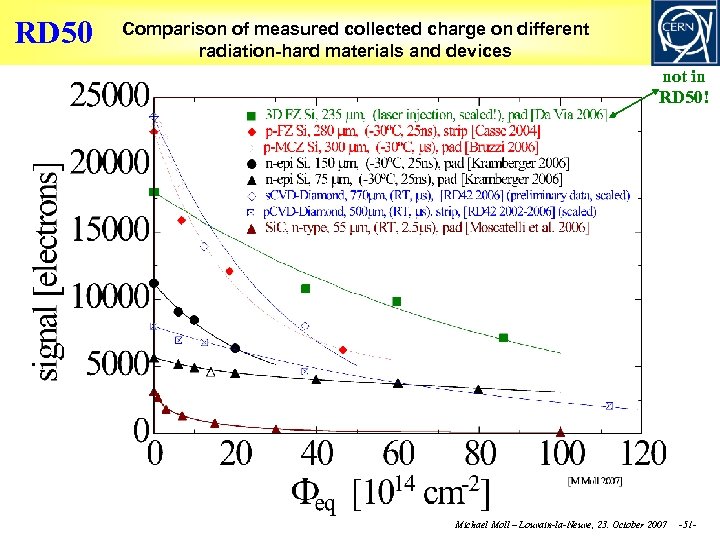 RD 50 Comparison of measured collected charge on different radiation-hard materials and devices not in RD 50! Michael Moll – Louvain-la-Neuve, 23. October 2007 -51 -
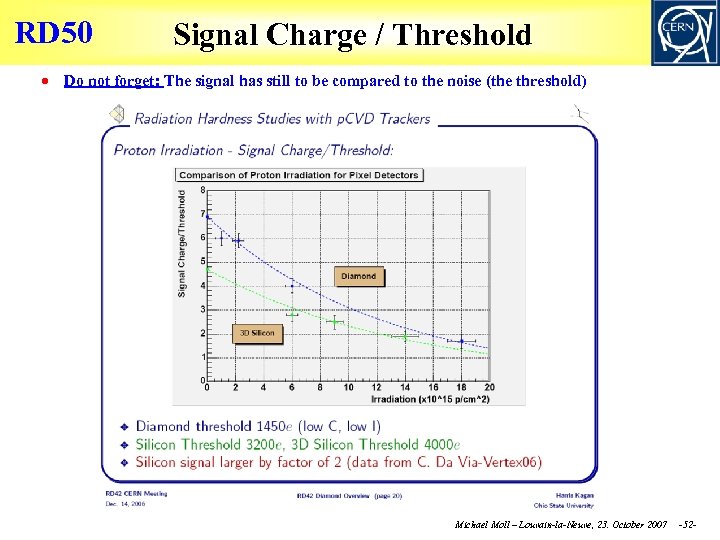 RD 50 Signal Charge / Threshold Do not forget: The signal has still to be compared to the noise (the threshold) Michael Moll – Louvain-la-Neuve, 23. October 2007 -52 -
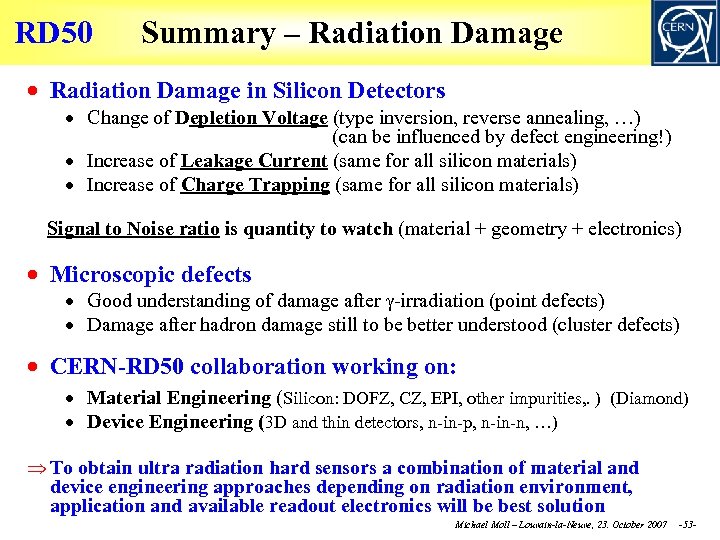 RD 50 Summary – Radiation Damage in Silicon Detectors Change of Depletion Voltage (type inversion, reverse annealing, …) (can be influenced by defect engineering!) Increase of Leakage Current (same for all silicon materials) Increase of Charge Trapping (same for all silicon materials) Signal to Noise ratio is quantity to watch (material + geometry + electronics) Microscopic defects Good understanding of damage after -irradiation (point defects) Damage after hadron damage still to be better understood (cluster defects) CERN-RD 50 collaboration working on: Material Engineering (Silicon: DOFZ, CZ, EPI, other impurities, . ) (Diamond) Device Engineering (3 D and thin detectors, n-in-p, n-in-n, …) To obtain ultra radiation hard sensors a combination of material and device engineering approaches depending on radiation environment, application and available readout electronics will be best solution Michael Moll – Louvain-la-Neuve, 23. October 2007 -53 -
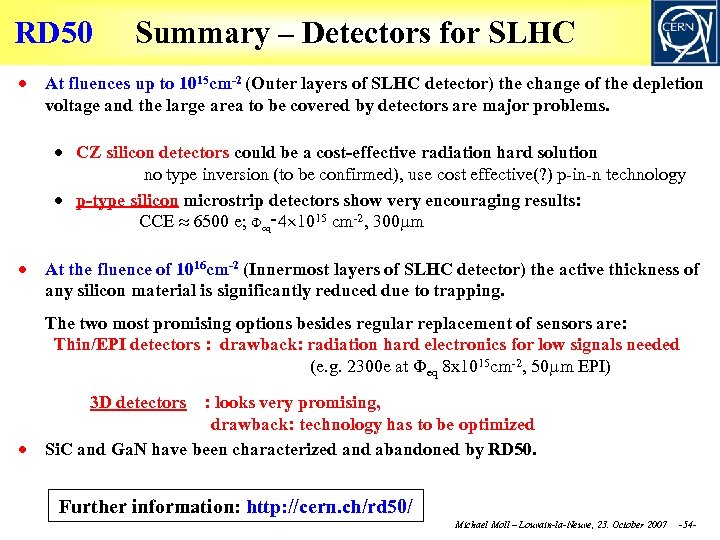 RD 50 Summary – Detectors for SLHC At fluences up to 1015 cm-2 (Outer layers of SLHC detector) the change of the depletion voltage and the large area to be covered by detectors are major problems. CZ silicon detectors could be a cost-effective radiation hard solution no type inversion (to be confirmed), use cost effective(? ) p-in-n technology p-type silicon microstrip detectors show very encouraging results: CCE 6500 e; Feq= 4 1015 cm-2, 300 mm At the fluence of 1016 cm-2 (Innermost layers of SLHC detector) the active thickness of any silicon material is significantly reduced due to trapping. The two most promising options besides regular replacement of sensors are: Thin/EPI detectors : drawback: radiation hard electronics for low signals needed (e. g. 2300 e at Feq 8 x 1015 cm-2, 50 mm EPI) 3 D detectors : looks very promising, drawback: technology has to be optimized Si. C and Ga. N have been characterized and abandoned by RD 50. Further information: http: //cern. ch/rd 50/ Michael Moll – Louvain-la-Neuve, 23. October 2007 -54 -