 Скачать презентацию Seminar Published papers By Dr Kamaran Faraj
9a01dd527d66b3f1ddb4d5f6539709c3.ppt
- Количество слайдов: 36




Seminar – Published papers By Dr. Kamaran Faraj

Objective The main aim of the named seminar publishedpapers is to show that all achieved papers by Author from years (2010 -2015) are not a copy from the Msc & Ph. D thesis or not part of the Msc & Ph. D thesis. Also n Shows some originality or new contribution in the published papers. n
Outline n n Introduction Web Technologies performance Analysis for Different Platforms and Hardware Architectures n Fingerprint and Barcode Reader for Voting System n Private-Wireless Local Area Network (WLAN) for Student Feedback System n E-recruitment Tiered Architecture in Feasibility Study Role Response Time analysis for Apache Web server versions based on 32 or 64 bit Architecture n
Introduction n The presentation of five published papers in a seminar by the Author Dr. kamaran Faraj, such as: A) Web Technologies performance Analysis for Different Platforms and Hardware Architectures B) Fingerprint and Barcode Reader for Voting System C) Private-Wireless Local Area Network (WLAN) for Student Feedback System D) E-recruitment Tiered Architecture in Feasibility Study Role E) Response Time analysis for Apache Web server versions based on 32 or 64 bits Architecture
Outline n n Introduction Web Technologies performance Analysis for Different Platforms and Hardware Architectures n Fingerprint and Barcode Reader for Voting System n Private-Wireless Local Area Network (WLAN) for Student Feedback System n E-recruitment Tiered Architecture in Feasibility Study Role Response Time analysis for Apache Web server versions based on 32 or 64 bit Architecture n
Web Technologies performance Analysis for Different Platforms and Hardware Architectures (Abstract) Performance is an important aspect either in real life, which is a Traditional Performance (TP) or virtually which is the world of technology, however technologies and performance together plays important roles in real life developments. This paper looks into Web Performance (WP) using different technologies (Modernize Performance), important to know that it is also Traditional Performance still very primitive, therefore the result of experiment is important to compare the performance of different technologies and the example would be a librarian performance. The result is vary based on the person’s abilities and their work task, however if the person chosen to search for a particular book, he/she requires time to complete a particular task, therefore Traditional Performance of a library book finding called Traditional Variability (TV), which is rate between active and passive librarian performance during a book search.
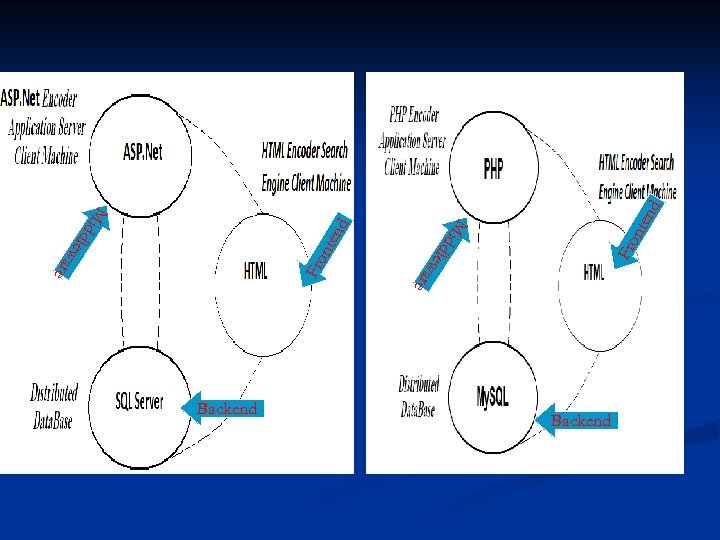
d nte n Fro re lew a nte n d M idd re lew a Backend
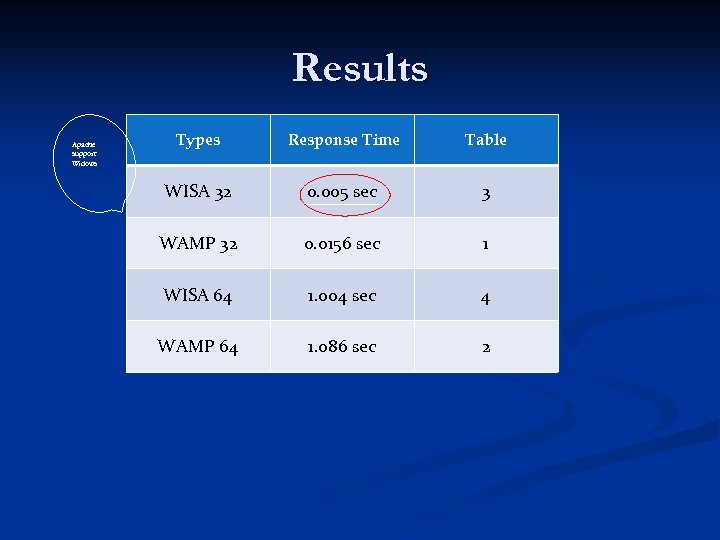
Results Apache support Widows Types Response Time Table WISA 32 0. 005 sec 3 WAMP 32 0. 0156 sec 1 WISA 64 1. 004 sec 4 WAMP 64 1. 086 sec 2
References 1. 2. 3. 4. 5. 6. 7. 8. 9. 10. Steve Souders. (2010). Google adds site speed to search ranking. Available: http: //www. stevesouders. com/blog/2010/04/09/google-adds-site-speed-to-search-ranking/. Last accessed 18 Aug 2013. J. S. Bridle, “Probabilistic Interpretation of Feedforward Classification Network Outputs, with Relationships to Statistical Pattern Recognition, ” Neurocomputing—Algorithms, Architectures and Applications, F. Fogelman. Soulie and J. Herault, eds. , NATO ASI Series F 68, Berlin: Springer-Verlag, pp. 227 -236, 1989. (Book style with paper title and edit Daniel, A. , “The E-business(R) Evolution: Living and Working in an Interconnected World”, Prentice Hall PTR, 2000. Jay, G. , and Brad, B. , ”Mysql/PHP Database Applications”, M&T Books, 2001. Clare, K. , Jan, B. , and John, K. , ”Designing Personalized User Experiences In e. Commerce”, Kluwer Academic Publishers Dordrecht, 2004. Carl, T. , Robert, W. , Richard, L. , and Kevin, R. , ”Impact of the Internet on the Recruitment of Skilled Labor”, Report for Construction Industry Studies, Report Number 17, pages 8 -17, Austin Texas, February 2001. Faraj, K. , “Automated Recruitment System”, Faculty Science, Computer Department, University of Sulamani, KRG 2010. Dr. Kamaran. A. A. Faraj and Aree. A. Najeb , " SMS- Classroom Feedback Systems", (accepted to be published at Tikrit Journal of Pure Science, vol. 18, Issue 2, August 2013). Erwin Z. (2011). What is XAMPP? . Available: http: //www. qwhatis. com/what-is-xampp/. Last accessed 20 Aug 2013 Vamsi. M, " Architecture Design Online Book Store Phase-II”, CIS 895 – MSE Project, Kansas State University, June 2013
Outline n n Introduction Web Technologies performance Analysis for Different Platforms and Hardware Architectures n Fingerprint and Barcode Reader for Voting System n Private-Wireless Local Area Network (WLAN) for Student Feedback System n E-recruitment Tiered Architecture in Feasibility Study Role Response Time analysis for Apache Web server versions based on 32 or 64 bit Architecture n
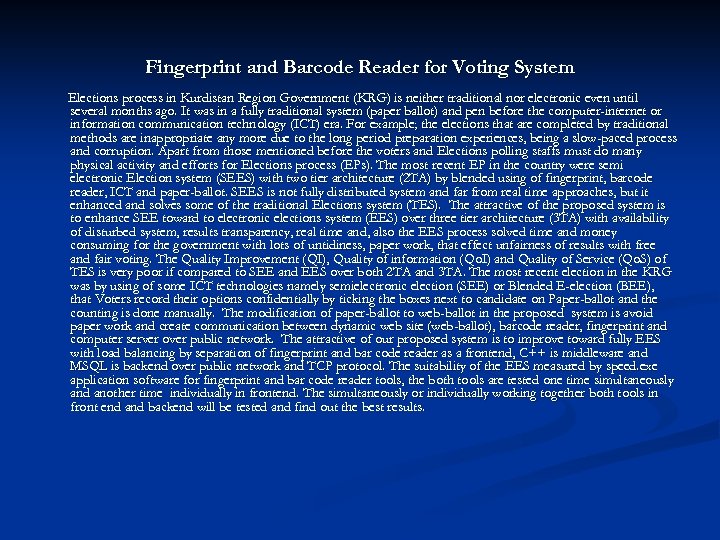
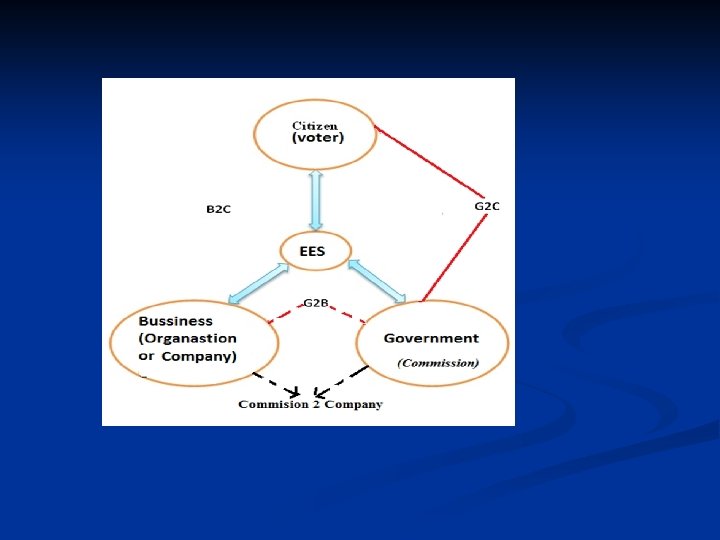
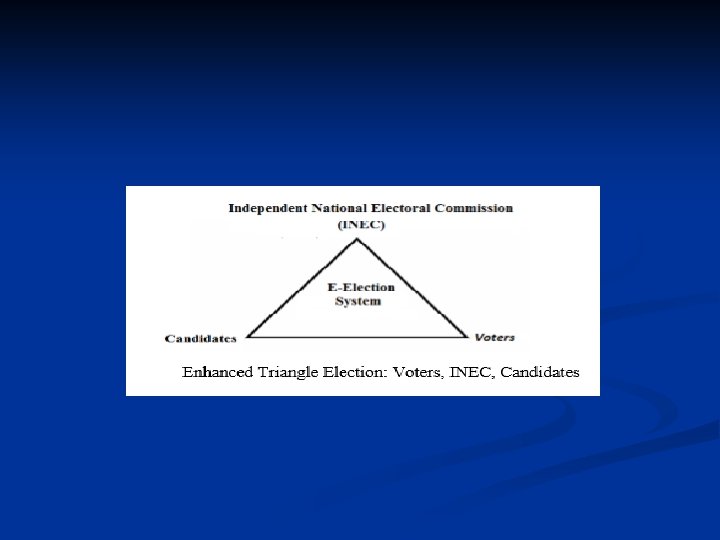
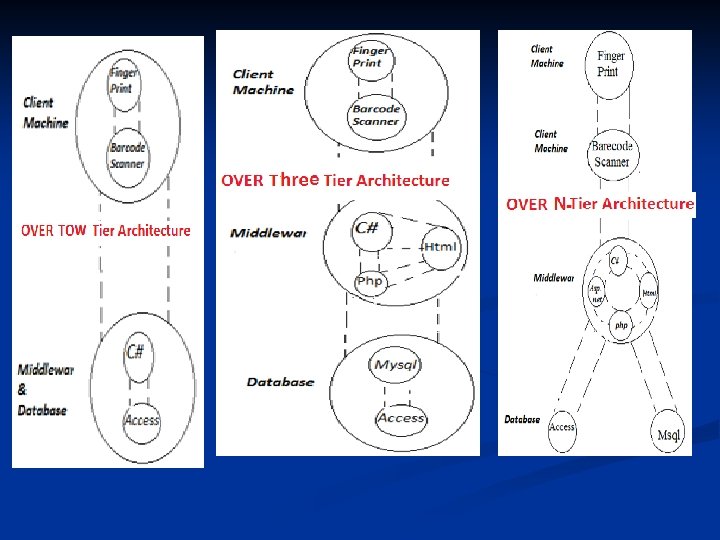
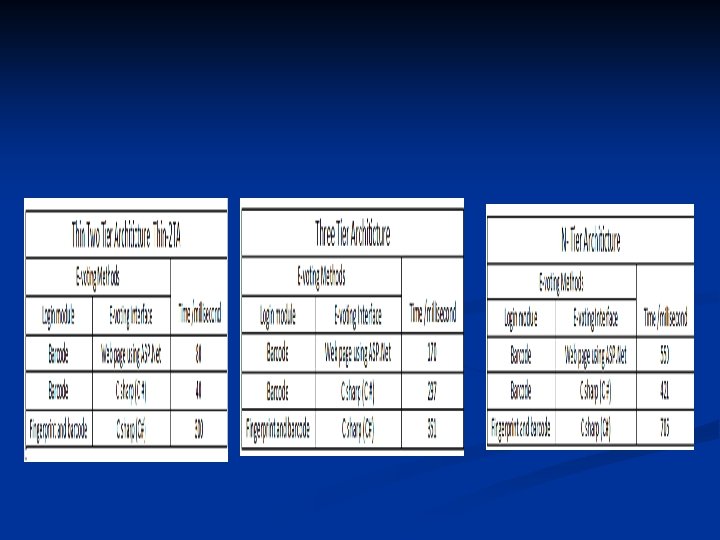
Fingerprint and Barcode Reader for Voting System Elections process in Kurdistan Region Government (KRG) is neither traditional nor electronic even until several months ago. It was in a fully traditional system (paper ballot) and pen before the computer-internet or information communication technology (ICT) era. For example; the elections that are completed by traditional methods are inappropriate any more due to the long period preparation experiences, being a slow-paced process and corruption. Apart from those mentioned before the voters and Elections polling staffs must do many physical activity and efforts for Elections process (EPs). The most recent EP in the country were semi electronic Election system (SEES) with two tier architecture (2 TA) by blended using of fingerprint, barcode reader, ICT and paper-ballot. SEES is not fully distributed system and far from real time approaches, but it enhanced and solves some of the traditional Elections system (TES). The attractive of the proposed system is to enhance SEE toward to electronic elections system (EES) over three tier architecture (3 TA) with availability of disturbed system, results transparency, real time and, also the EES process solved time and money consuming for the government with lots of untidiness, paper work, that effect unfairness of results with free and fair voting. The Quality Improvement (QI), Quality of information (Qo. I) and Quality of Service (Qo. S) of TES is very poor if compared to SEE and EES over both 2 TA and 3 TA. The most recent election in the KRG was by using of some ICT technologies namely semielectronic election (SEE) or Blended E-election (BEE), that Voters record their options confidentially by ticking the boxes next to candidate on Paper-ballot and the counting is done manually. The modification of paper-ballot to web-ballot in the proposed system is avoid paper work and create communication between dynamic web site (web-ballot), barcode reader, fingerprint and computer server over public network. The attractive of our proposed system is to improve toward fully EES with load balancing by separation of fingerprint and bar code reader as a frontend, C++ is middleware and MSQL is backend over public network and TCP protocol. The suitability of the EES measured by speed. exe application software for fingerprint and bar code reader tools, the both tools are tested one time simultaneously and another time individually in frontend. The simultaneously or individually working together both tools in front end and backend will be tested and find out the best results.
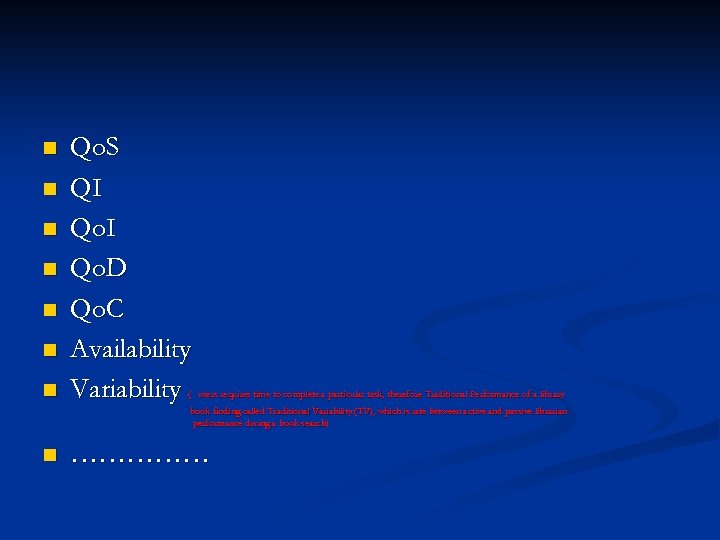
n n n n Qo. S QI Qo. D Qo. C Availability Variability ( users requires time to complete a particular task, therefore Traditional Performance of a library book finding called Traditional Variability (TV), which is rate between active and passive librarian performance during a book search) n ……………
![References n n n [HKZ 12] F. Hazzaa, S. Kadry, O. Zein , ”](https://present5.com/presentation/9a01dd527d66b3f1ddb4d5f6539709c3/image-18.jpg "References n n n [HKZ 12] F. Hazzaa, S. Kadry, O. Zein , ”")
References n n n [HKZ 12] F. Hazzaa, S. Kadry, O. Zein , ” Web- Based Voting System Using Hazzaa, Kadry, Fingerprint: Design and Implementation”, International Journal of Computer Implementation” Applications in Engineering Sciences , India, 2012. [BIKIJ 11] K. Baig, U. Ishtiaq, A. Kanwal, U. Ishtiaq, M. Javed, “ Electronic Voting Baig, Ishtiaq, A. Kanwal, Ishtiaq, Javed, “ System Using Fingerprint Matching with Gabor Filter”, COMSATS Institute of Filter” Information Technology, Lahore, 2011. [AZNJ 01] H. Ammar, X. Zhen, D. Nassar, Y. Jin , ” Web-Based Test Bed for Ammar, D. Nassar, Fingerprint Image Comparison”, Dept. of Computer Science and Electrical Comparison” Engineering West Virginia University, 2001. n n n n [AKSGA 12] W. Abdalla, A. Kamel, M. Soliman, M. Ghobrial, A. Ahmed, ” E- Voting Abdalla, Kamel, Soliman, Ghobrial, A. Ahmed, ” System”, Fayoum University, Saudi Arabia, 2012. System”, [MF 14] B. Mc. Guigan, N. Foster, ” What is e-Government? - wise. GEEK ”, B. Mc. Guigan, N. Foster, e-Government? Conjecture Corporation, Last Modified Date: 17 July 2014. [FM 14] K. Faraj, G. Mstafa, ” Tiered Architecture Analysis of Web Based K. Faraj, G. Mstafa, ” system”, Zhako University, 2014. system”, [FAMM 13] K. Faraj, T. Ahmad, R. Mohammed, M. Mohammed, ” Web. Technologies R. Mohammed, M. Mohammed, ” Performance Analysis for Different Platforms and Hardware Architectures”, Architectures” IRACST – International Journal of Computer Networks and Wireless Communications (IJCNWC), ISSN: 2250 -3501 Vol. 3, No 6, December 2013. [AZI 11] A. Aziz, ” Online Election System”, Department of Information System”, Technology, Pakistan, 2011. Technology, [HK 12] F. Hazzaa, S. Kadry, “New System of E-Voting Using Fingerprint”, Hazzaa, Kadry, Fingerprint” International Journal of Emerging Technology and Advanced Engineering, 2012. [TAB 13] Y. Tabra, “A Proposal for Internet Voting System in Iraq”, International Y. Tabra, Iraq” Journal of Advanced Research in Computer Science and Software Engineering, 2013 n n n [JD 13] Sri. Joshi, B. Desai, “Significance of Finger Print in On-line Voting: An “Significance Approach”, International Journal of Approach”, Engineering Science and Innovative Technology (IJESIT) Volume 2, Issue 1, January 2013. [KUM 12] J. Kumar, ” Biometrics-Voting” , RSS, India, 2012. Last Modified Kumar, ” Biometrics-Voting” Date: 17 May 2015. URL http: //sribhaviguru. com/index. php [AAUA 13] S. Abdulhamid , O. Adebayo , D. Ugiomoh , M. Abdul. Malik, ”The Design and Development of Real-Time E-Voting System in Nigeria with Emphasis on Security and Result Veracity”, I. J. Computer Network and Veracity”, Information Security, 2013. [Bam 10] M. Bamiah, ” A Trustable Electronic Government Voting Bamiah, Management Framework Using Trusted Platform Module (TPM)”, Staffordshire (TPM)” University, UK, 2010 University, UK, [AB 07] K. Ayo, O. Babajide, ” Design and Implementation of a secure IBabajide, ” Voting System”, Nigeria, 2007 System” [AB 11] A. Altun, M. Bdlgdn, ” Web based secure e-voting system with Altun, Bdlgdn, ” fingerprint Authentication”, Selcuk University, Technical Education Faculty, 42031, Authentication” Konya, Turkey, 2011. [ABDK 11] K. A , V. Baglkot, M. D, T. Ks, “Biometric Voting Machine”, MSRIT, Bangalore, 2011 Baglkot, Machine” , MSRIT, [OOOG 11] O. Okediran, O. Omidiora, O. Olabiyisi S, A. Ganiyu, ” A framework For Okediran, Omidiora, Ganiyu, ” A Multifaceted Electronic Voting System”, International Journal of Applied Science System” and Technology, USA, 2011. Technology, USA, [RW 04] K. Roger, B. Williams, ” Testing before the House administration K. Roger, B. Williams, Committee”, Georgia, 2004. Committee” Georgia, [DIM 09] E. Dimitrov, ” Fingerprints recognition”, Växjö University, MSI, Dimitrov, ” recognition”, University, MSI, Sweden, 2009 n n n [LLY 05] J. Lai, C. Lin, C. Yang, " Design and Implementation of an Electronic Voting System with Contactless IC Cards”, National Science Council grant, 2005. Cards”, [LEW 11] B. Lewoyehu, " Prospect of employing e-voting scheme in Ethiopia: Lewoyehu, " understanding perception of the government and opposition political parties”, Örebro University, Sweden, 2011. [OP 11] G. Ofori-Dwumfuo, E. Paatey, ” The Design of an Electronic Voting G. Ofori-Dwumfuo, Paatey, ” System”, Methodist University System” College, Ghana, 2011. [MA 13] M. Musa, F. Aliyu, ” Design of Electronic Voting Systems for Reducing M. Musa, F. Aliyu, Election Process”, International Journal of Recent. Technology and Engineering (IJRTE), Volume-2, Issue-1, March 2013. [GRI 02] D. Gritzalis , ” Secure Electronic voting ”, 7 th Computer Security Incidents Response Teams Workshop, Syros, Greece, September 2002. [AD 12] A. Anand, P. Divya 2, ” An Efficient Online Voting System”, International Anand, System” Journal of Modern Engineering Research (IJMER), 2012. [DSS 14] P. Dimple, S. Shradha, S. Sandhya ” e-voting system using QR code and P. Dimple, S. Shradha, Mobile OTP based on Android platform for modern individuals”, International individuals” Journal of Scientific & Engineering Research, 2014 [MT 11] R. Mishra, P. Trivedi, ” Student Attendance System Based On R. Mishra, P. Trivedi, ” Fingerprint Recognition and One-to-Many Matching”, National Institute of Technology Rourkela, Orissa, Rourkela, India, 2011. [AKU 10] D. Akunyili, ” ICT and E-government” The World Congress D. Akunyili, ” on Information Technology, Amasterdam, The Netherlands Technology, Amasterdam, 25 th-27 thmay 2010 n n [BAK 01] n n [RIL 05] URL http: //www. wisegeek. org/what-is-e-government. htm M. Backus, ”E-Governance and Developing M. Backus, Countries”, research report, 2001 Countries” C. RILEY, ” The Changing Role of the citizen in the ERILEY, ” governance & E-Democracy Equation ”, Commonwealth Centre for e-Governance, 2005. n n Last Modified Date: 17 May 2015. http: //www. tanzaniagateway. org/docs/Changing_role_of_the_citizen_in_the. Egovernance_E-democracy_equation_2003. pdf [DOR 12] S. Dorji , ” E-government initiatives in Bhutan: Government to Citizen , ” (G 2 C) service delivery initiative”, Murdoch University, 2012. initiative” n n n n [Man 01] S. Mandip, ”Development 3 Tier Revenue Forecasting System” of , B. Sc thesis, Mandip, ” Computer Science Department, University of Greenwich, 2001. [KJ 05] D. Kitlan, R. Joseph , ”Interoperability, An Examination of D. Kitlan, , ”Interoperability, Factors Affecting Multilevel E-Voting”, Pennsylvania State E-Voting”, University Harrisburg, Germany, 2005. [CJJ 04] K. Clare-Marie, B. Jan, K. John, ”Designing Personalized User John, ”Designing Experiences In e. Commerce”, Kluwer Academic Publishers, 2004 e. Commerce” [LT 02] J. Lerdorf, K. Tatroe, ”Creating Dynamic web Pages by Programming Lerdorf, Tatroe, ”Creating PHP”, O’Reilly & Associates, 2002 PHP” [GB 01] J. Greenspan, B. Bulger, ”Mysql/PHP Database Applications”, M&T Bulger, ”Mysql/PHP Applications” Books, 2001. [ACS 08] A. Aggrawal, N. Chaturvedi , D. Sisodia” Supermarket Billing , D. Sisodia” System”, International School of Informatics & Management System” Jaipur, sweeden , 2008. [CV 14] S. Carina-Elena, S. Valentin ” INFORMATION SYSTEMS AS A S. Carina-Elena,
Outline n n Introduction Web Technologies performance Analysis for Different Platforms and Hardware Architectures n Fingerprint and Barcode Reader for Voting System n Private-Wireless Local Area Network (WLAN) for Student Feedback System n E-recruitment Tiered Architecture in Feasibility Study Role Response Time analysis for Apache Web server versions based on 32 or 64 bit Architecture n
Private-Wireless Local Area Network (WLAN) for Student Feedback System (Abstract) n The developments of our society-student in universities of Kurdistan Region Government (KRG) help student’s to achieve most of their duties by using of technologies for example; using of mobile devices/SMS facility make student life very easy and quick response. For that reason the extremely numbers of use the mobile technology-SMS make load on mobile communication towers. As other part of the world the rush hours is from 9: 00 AM to 2: 00 PM in universities. One of the defaults of public network is heavy load during the rush hours and creates delay of reach the SMS on time, the others are costing students. Our proposed system solves that two mentioned problems and make students to use of mobile device less.
n Nowadays-younger students are very comfortable with using of computer technology than ever before! Especially, the using of personal computer (PC)-Laptop and Wireless network Communications (WNC) by Sulaimani’s University. The teachers and students are quickly increasing to use. The entire PCs in the Quality Assurance laboratory (QA-LAB) and the QA manager private PC are connect directly to Server. Undoubtedly, The Wireless Computer Communication System (WCCS) created an effective role in to student society and made it very fast growing in to educational sector (universities) as well as to the industrial sectors. For instance, in educational sector (universities) the WCCS modify the traditional (paper-and-pencil classroom feedback of lecturer evaluation by students) toward to WLFS (Wireless Laboratory Feedback System).
n Furthermore, most of the students were complaining about the uneconomic and long delay of short message service. Classroom Feedback System (SMS-CFS), because of the mobile communication users in the University campus are approximately 8000 from 9: 00 AM to 2: 00 PM. it is obvious, that amount of users creates an overload on public mobile network and affect SMS receive-time. WLFS is uncomplicated, non-traffic network and economical solution for replacing SMS-CFS and TF. Apart from that, our proposed system becomes an excellent guide for monitoring of high quality of teaching from teacher and level of students understanding in a class. Technically, thirty-five computers (clients) in a QA-LAB and QA Manager are connecting to (server) via private WLAN.
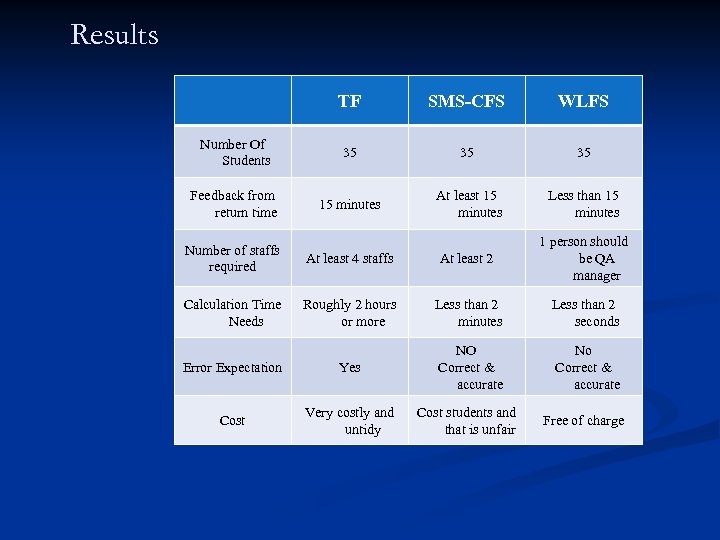
Results TF SMS-CFS WLFS Number Of Students 35 35 35 Feedback from return time 15 minutes At least 15 minutes Less than 15 minutes Number of staffs required At least 4 staffs At least 2 1 person should be QA manager Calculation Time Needs Roughly 2 hours or more Less than 2 minutes Less than 2 seconds Error Expectation Yes NO Correct & accurate No Correct & accurate Cost Very costly and untidy Cost students and that is unfair Free of charge
References 1. 2. 3. 4. 5. 6. 7. 8. Dr. Kamaran. A. A. Faraj and Aree. A. Najeb , " SMS- Classroom Feedback Systems", (accepted to be published at Tikrit Journal of Pure Science, vol. 18, Issue 2, August 2013). Faraj, K. , “Automated Recruitment System”, Faculty Science, Computer Department, University of Sulamani, KRG 2010. Daniel, A. , “The E-business(R) Evolution: Living and Working in an Interconnected World”, Prentice Hall PTR, 2000. Michael Grottk, Lei Li, Kalyanaraman Vaidyanathan, and Kishor Trivedi, “Analysis of Software Aging in a Web Server, IEEE TRANSACTIONS ON RELIABILITY, VOL. 55, NO. 3, SEPTEMBER 2006. Vangie Beal, " Apache Web server", [Online]. Available: http: //www. webopedia. com/TERM/ A/ Apache_ Web_server. html. “Apache 1. 3 API Documentation, ” Apache Software Foundation [Online]. Available: http: //httpd. apache. org/dev/apidoc_HARD_SERVER_LIMIT. html “Apache Core Features, ” [Online]. Available: http: //httpd. apache. org/docs/1. 3/mod/core. html “What Does Open Source Mean in Linux? Does Window Have A License to Prevent Window User To Use Certain Program, ” [Online]. Available: http: //answers. yahoo. com/question/index; _ylt=Awr. BT 9 ol 7 PZVo 8 EA_U 9 XNyo. A; _ylu=X 3 o. DMTBy. Mj. B 0 a G 5 z. BGNvb. G 8 DYm. Yx. BHBvcw. Mx. BHZ 0 a. WQDBHNl. Yw. Nz. Yw--? qid=20150815123156 AAxc 63 o Erwin Z. (2011). What is XAMPP? Available: http: //www. qwhatis. com/what-is-xampp/. Last accessed 20 July 2015
Outline n n Introduction Web Technologies performance Analysis for Different Platforms and Hardware Architectures n Fingerprint and Barcode Reader for Voting System n Private-Wireless Local Area Network (WLAN) for Student Feedback System n E-recruitment Tiered Architecture in Feasibility Study Role Response Time analysis for Apache Web server versions based on 32 or 64 bit Architecture n
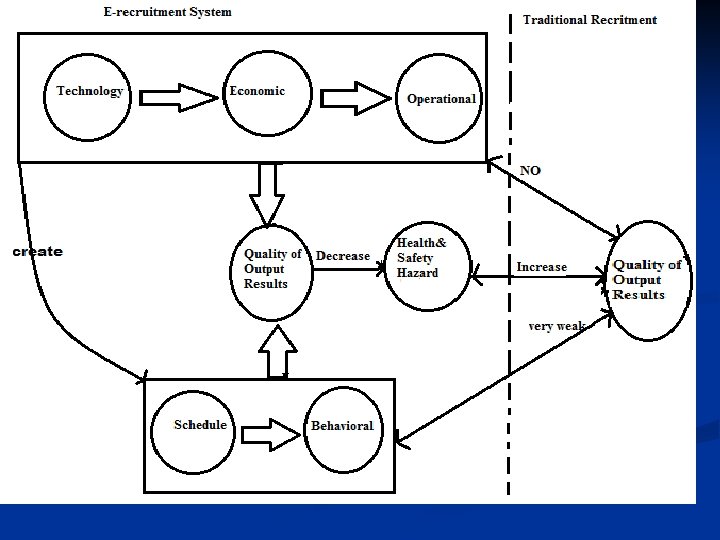
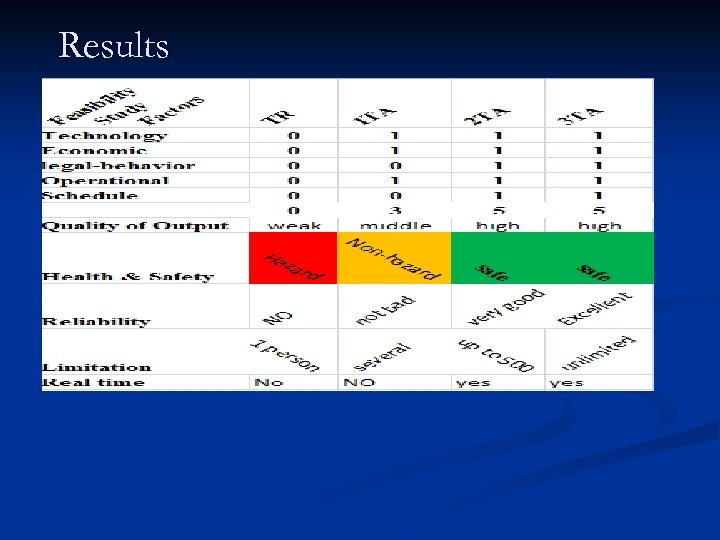
E-recruitment Tiered Architecture in Feasibility Study Role (Abstract) n One of the very important complement for feasibility study after log to connect to the recruitment management process is refers to study of feasibility in order to find out it’s feasible or not! For example; Traditional recruitment (TR) is not as feasible as the one tier architecture (1 TA) recruitment due to the unordinary problematic-output results of TR and hazard create to health and safety. 1 TA recruiting is computerized but it is run over dump-client/server based connection and the output result is better than TR, but its again not optimized output results. Nevertheless the intelligent-client/server based connection over (2 TA, 3 TA and NTA) systems are more feasible then the 1 TA as simplicity- output results with excellent time-consume, while the personal computers (PCs) become more popular and powerful as smart terminals. Hence, the today’s users (especially youngster society) neither satisfied with the TR processes nor 1 TA recruitment processing. After problem identifying and going toward to feasibility study to sort out of: What feasibility study type used from the TELOS (TELOS: five factors are collectively known as Technology, Economic, legal, operational, and Schedule) to achieve recruitment system over tiered architecture? But another important factor as a new contribution in this paper are used namely quality of output in the respect of time-consume by response time in mille-seconds measurement unit. Both Two tier architecture (2 TA) and three tier architecture (3 TA) are more feasible than the 1 TA and TR due to implantation of feasibility study with those five factors been mentioned and some other factors. In this paper, the quality of output and Design architecture of the system are another factor for deciding the level of system feasible. There is a direct relation between (output result and Design architecture) with feasibility study. The five mentioned factors are working collectively for providing better output result time. This paper shows the role of feasibility study in Tiered architecture design by response time or load time recruitment system.
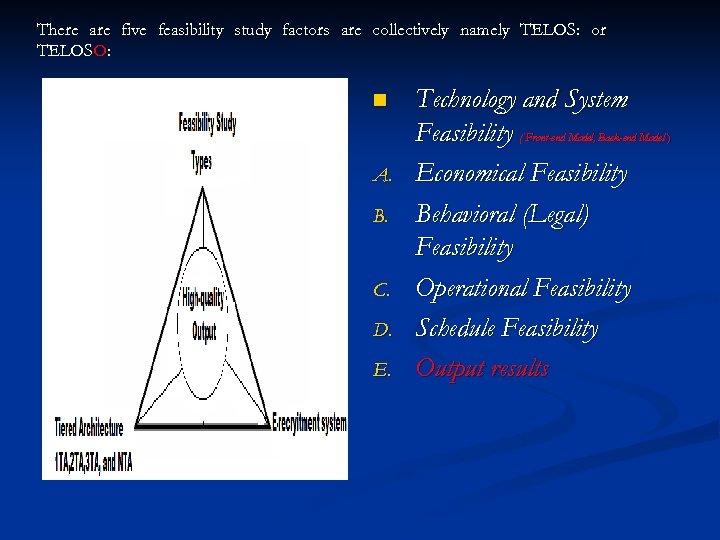
There are five feasibility study factors are collectively namely TELOS: or TELOSO: n A. B. C. D. E. Technology and System Feasibility ( Front-end Model, Back-end Model ) Economical Feasibility Behavioral (Legal) Feasibility Operational Feasibility Schedule Feasibility Output results
Results
![References [1]. Ankita Aggrawal, Neha Chaturvedi, Devendra Singh Sisodia, “Supermarket Billing System”, International School](https://present5.com/presentation/9a01dd527d66b3f1ddb4d5f6539709c3/image-30.jpg "References [1]. Ankita Aggrawal, Neha Chaturvedi, Devendra Singh Sisodia, “Supermarket Billing System”, International School")
References [1]. Ankita Aggrawal, Neha Chaturvedi, Devendra Singh Sisodia, “Supermarket Billing System”, International School of Informatics & Management, Jaipur, India , 2010 [2]. P. G. Chaitanya, Dr. K. V. Ramesh, ” Feasibility study on component based software architecture for large scale software systems”, (IJCSIT) International Journal of Computer Science and Information Technologies, Vol. 2 (3) , 2011. [3]. Simon Horsburgh, John D Langley, “Recruitment and retention of farm owners and workers for a six-month prospective injury study in New Zealand: a feasibility Study”, Journal of Occupational Medicine and Toxicology, New Zealand, 2011. [4]. Joseph Fong, Riemann Hui, ” Application of middleware in the three tier client/server database design methodology”, Brazil, 1999. [5]. Kamaran Faraj, “Automated recruitment system”, University of Sulamani, 2010. [6]. S. Somasegar, S. Guthrie. Patterns & practices Application Architecture Guide Layer Diagrams, 2010. [7]. Dr. kamran. Faraj, Gheyath. Osman” Tiered Architecture Analysis of Web Based Healthcare Systems, 2014.
Outline n n Introduction Web Technologies performance Analysis for Different Platforms and Hardware Architectures n Fingerprint and Barcode Reader for Voting System n Private-Wireless Local Area Network (WLAN) for Student Feedback System n E-recruitment Tiered Architecture in Feasibility Study Role Response Time analysis for Apache Web server versions based on 32 or 64 bit Architecture n
Response Time analysis for Apache Web server versions based on 32 or 64 bit Architecture response time (RT) has a significant feature in both of traditionally response time (TRT) with physical (face-to-face) Businesses, and Automated response time (ART) with web-based businesses. The TRT is very primitive in physical (face-to-face) business and depended on human activity with devices reliability as well. TRT is very changeable from one person to another person and very complicate to calculate results of response time analysis due to that the TRT very manually and far from using of modern technologies. Nevertheless in ART the response time depended on web technology components, one of the web technology components is software web server that is between frontend (presentation) and backend (database). Web server in any ART by Web-based response time (WRT) is more advanced than TRT. The example of open source web server is apache web server. In this paper the evaluation of response time for different versions of apache web servers which is compatibility with different Php. Myadmin-Easy. Php. Thus, each version of Easyphp is with different version of Apache, Mysql, Php (AMP). The versions of apache web servers which tested are: 1) Easy. Php 1. 7 with apache 1. 3. 27, 2) Easy. Php 1. 8 with apache 1. 3. 33, 3) Easy. Php 3 with apache 2. 2. 11 4) Easy. Php 5. 6. 3. 0 with apache 1. 3. 27, and 5) Easy. Php 12. 1 with apache 2. 4. 2. All those versions of apache web server will be test it by simple search engine for Page Generated in Seconds with 32 -bit computer Architecture and 64 -bits computer Architecture. Web server is one of the mostly important tiered architecture in web technology components that communicate between client side and server side. There are plenty of different versions of web servers with Phpmyadmin-Easyphp. In this paper, the response time of the best apache web server will be found out over either computer architecture 32 -bit or 64 -bit. Finally the relation between computer architecture and internet architecture became one of our aims. The only suitable methodology for this paper that related and followed is the waterfall model because it’s appropriate than the other methodologies.
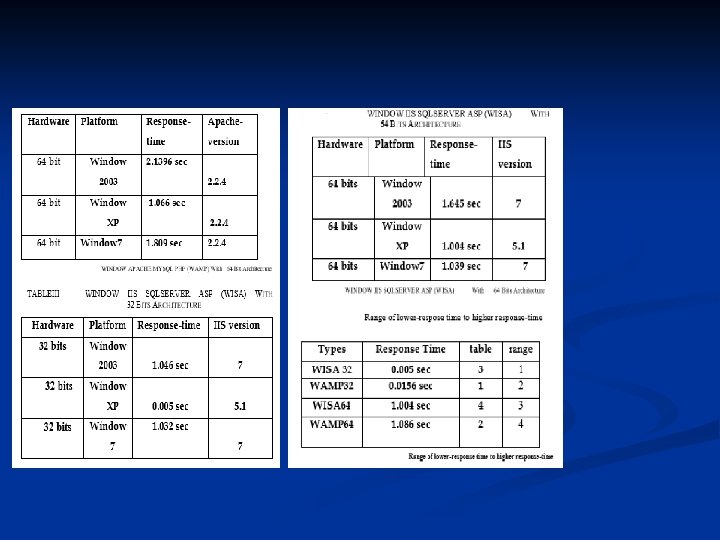
n our experiments consists of a server running Apache versions 1. 3. 27 in (Easy. PHP 1. 7 Versions), Apache 1. 3. 33 in (Easy. PHP 1. 8 Versions), Apache 2. 2. 11 in (Easy. PHP 3. 0 Versions), Apache 2. 2. 17 in (Easy. PHP 5. 3. 6. 0 Versions), 2. 4. 2 in (Easy. PHP 12. 1 Versions). All Easy. PHP is compatible with Mysql, apache, and PHP (MAP) over a windows platform that called (WAMP). All different versions of apache web server from past until now created new web server generation. This paper evaluate the best response of version
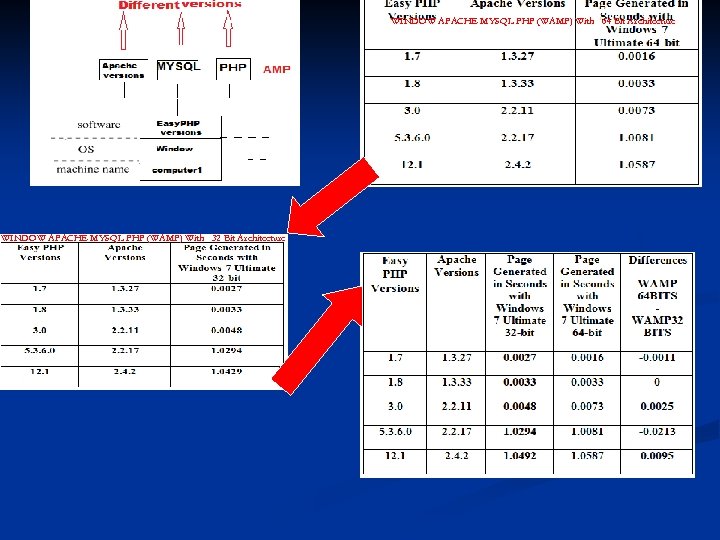
WINDOW APACHE MYSQL PHP (WAMP) With 64 Bit Architecture WINDOW APACHE MYSQL PHP (WAMP) With 32 Bit Architecture
![REFERENCES [1] Dr. Kamaran. A. A. Faraj and Aree. A. Najeb , " SMS-](https://present5.com/presentation/9a01dd527d66b3f1ddb4d5f6539709c3/image-35.jpg "REFERENCES [1] Dr. Kamaran. A. A. Faraj and Aree. A. Najeb , \" SMS-")
REFERENCES [1] Dr. Kamaran. A. A. Faraj and Aree. A. Najeb , " SMS- Classroom Feedback Systems", (accepted to be published at Tikrit Journal of Pure Science, vol. 18, Issue 2, August 2013). [2] Faraj, K. , “Automated Recruitment System”, Faculty Science, Computer Department, University of Sulamani, KRG 2010. [3] Daniel, A. , “The E-business(R) Evolution: Living and Working in an Interconnected World”, Prentice Hall PTR, 2000. [4] Michael Grottk, Lei Li, Kalyanaraman Vaidyanathan, and Kishor Trivedi, “Analysis of Software Aging in a Web Server, IEEE TRANSACTIONS ON RELIABILITY, VOL. 55, NO. 3, SEPTEMBER 2006. [5] Vangie Beal, " Apache Web server", [Online]. Available: www. webopedia. com/TERM/A/Apache_Web_server. html. [6] “Apache 1. 3 API Documentation, ” Apache Software Foundation [Online]. Available: http: //httpd. apache. org/dev/apidoc_HARD_SERVER _LIMIT. html [7] “Apache Core Features, ” [Online]. Available: http: //httpd. apache. org/docs/1. 3/mod/core. html [8] “What Does Open Source Mean in Linux? Does Window Have A License to Prevent Window User To Use Certain Program, ” [Online]. Available: http: //answers. yahoo. com/question/index; _ylt=Awr. BT 9 ol 7 P ZVo 8 EA_U 9 XNyo. A; _ylu=X 3 o. DMTBy. Mj. B 0 a. G 5 z. BGNvb G 8 DYm. Yx. BHBvcw. Mx. BHZ 0 a. WQDBHNl. Yw. Nz. Yw-? qid=20150815123156 AAxc 63 o [9] Erwin Z. (2011). What is XAMPP? Available: http: //www. qwhatis. com/what-is-xampp/. Last accessed 20 July 2015

Thanks and All the best? ?
Скачать презентацию Seminar Published papers By Dr Kamaran Faraj
9a01dd527d66b3f1ddb4d5f6539709c3.ppt