 Скачать презентацию Seminar on public procurement and e Procurement policies
a7c8b228c2422d1fda613c5d2f80025d.ppt
- Количество слайдов: 17



Seminar on public procurement and e. Procurement policies e. Procurement Policy in International Legal Documents (Kiev, 1 December 2011) 1
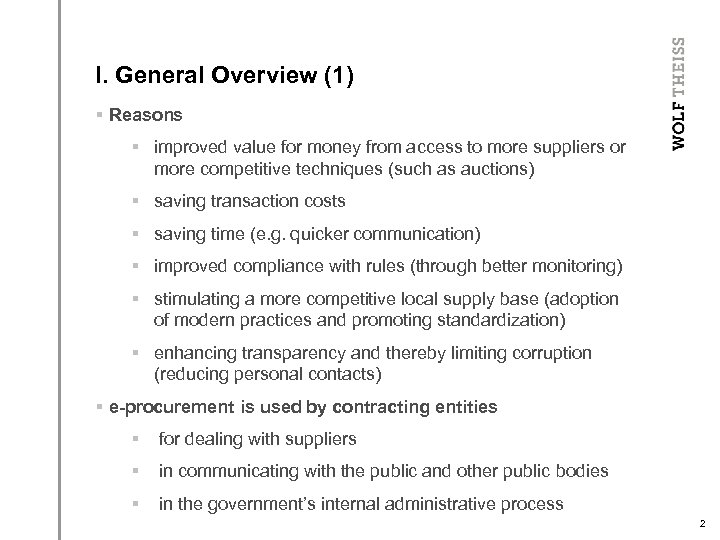
I. General Overview (1) § Reasons § improved value for money from access to more suppliers or more competitive techniques (such as auctions) § saving transaction costs § saving time (e. g. quicker communication) § improved compliance with rules (through better monitoring) § stimulating a more competitive local supply base (adoption of modern practices and promoting standardization) § enhancing transparency and thereby limiting corruption (reducing personal contacts) § e-procurement is used by contracting entities § for dealing with suppliers § in communicating with the public and other public bodies § in the government’s internal administrative process 2
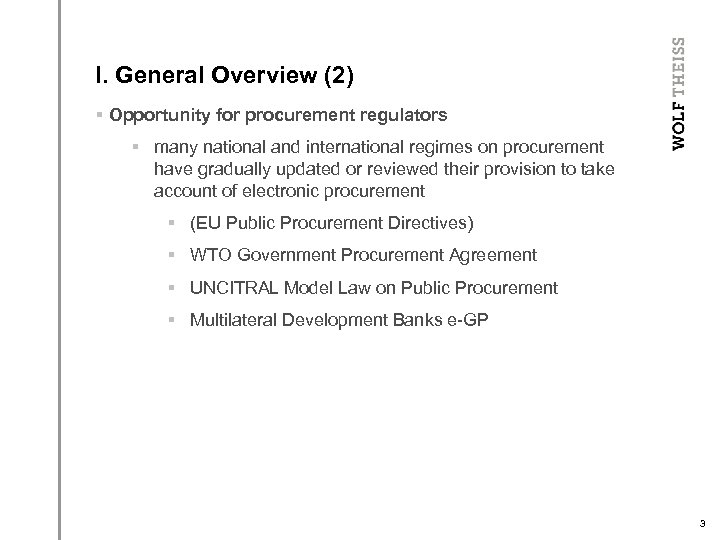
I. General Overview (2) § Opportunity for procurement regulators § many national and international regimes on procurement have gradually updated or reviewed their provision to take account of electronic procurement § (EU Public Procurement Directives) § WTO Government Procurement Agreement § UNCITRAL Model Law on Public Procurement § Multilateral Development Banks e-GP 3
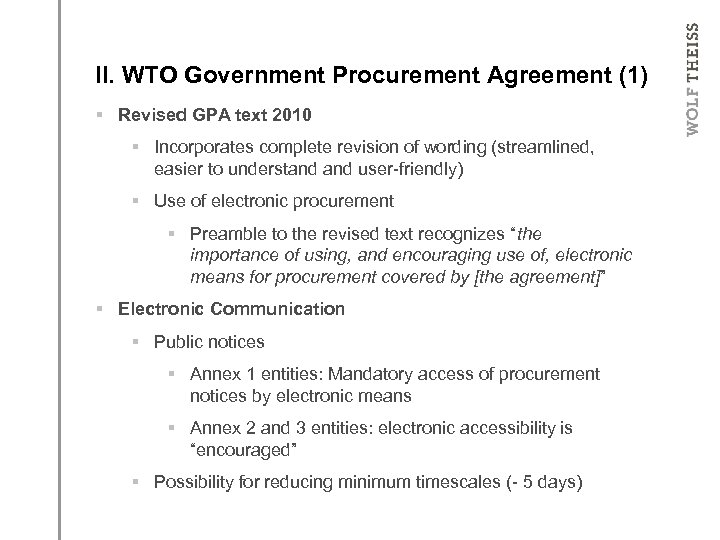
UNCITRAL Model Law II. WTO Government Procurement Agreement (1) § Revised GPA text 2010 § Incorporates complete revision of wording (streamlined, easier to understand user-friendly) § Use of electronic procurement § Preamble to the revised text recognizes “the importance of using, and encouraging use of, electronic means for procurement covered by [the agreement]” § Electronic Communication § Public notices § Annex 1 entities: Mandatory access of procurement notices by electronic means § Annex 2 and 3 entities: electronic accessibility is “encouraged” § Possibility for reducing minimum timescales (- 5 days) 4
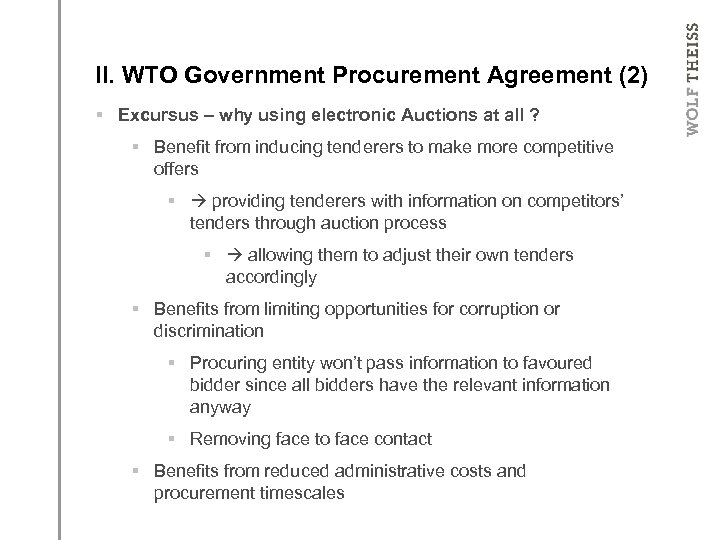
UNCITRAL Model Law II. WTO Government Procurement Agreement (2) § Excursus – why using electronic Auctions at all ? § Benefit from inducing tenderers to make more competitive offers § providing tenderers with information on competitors’ tenders through auction process § allowing them to adjust their own tenders accordingly § Benefits from limiting opportunities for corruption or discrimination § Procuring entity won’t pass information to favoured bidder since all bidders have the relevant information anyway § Removing face to face contact § Benefits from reduced administrative costs and procurement timescales 5
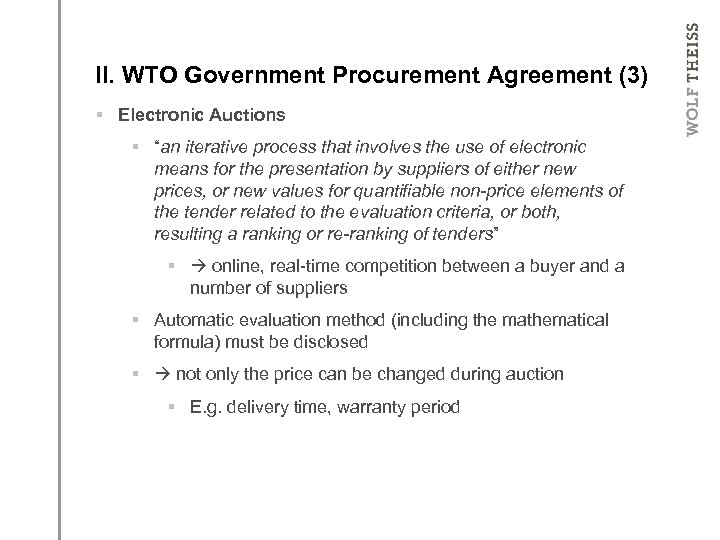
UNCITRAL Model Law II. WTO Government Procurement Agreement (3) § Electronic Auctions § “an iterative process that involves the use of electronic means for the presentation by suppliers of either new prices, or new values for quantifiable non-price elements of the tender related to the evaluation criteria, or both, resulting a ranking or re-ranking of tenders” § online, real-time competition between a buyer and a number of suppliers § Automatic evaluation method (including the mathematical formula) must be disclosed § not only the price can be changed during auction § E. g. delivery time, warranty period 6
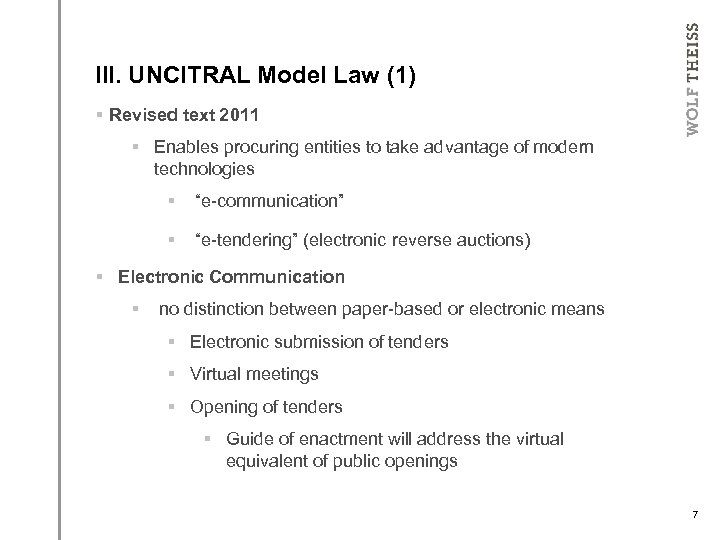
UNCITRAL Model Law and e-Procurement III. UNCITRAL Model Law (1) § Revised text 2011 § Enables procuring entities to take advantage of modern technologies § “e-communication” § “e-tendering” (electronic reverse auctions) § Electronic Communication § no distinction between paper-based or electronic means § Electronic submission of tenders § Virtual meetings § Opening of tenders § Guide of enactment will address the virtual equivalent of public openings 7
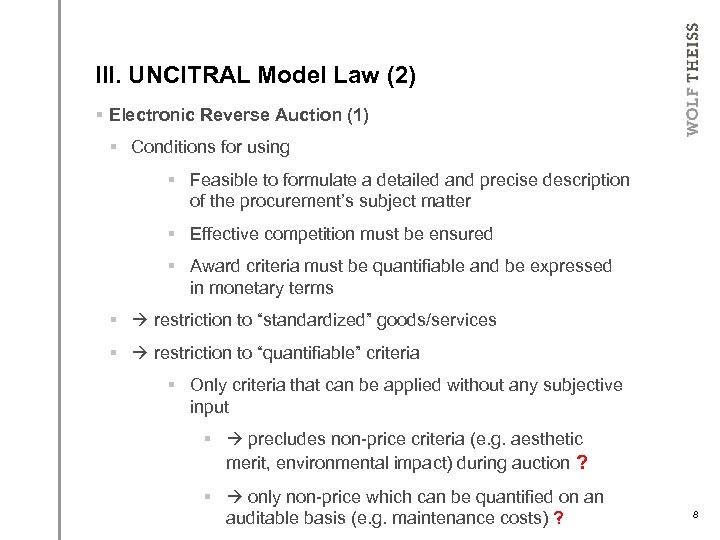
UNCITRAL Model Law and e-Procurement III. UNCITRAL Model Law (2) § Electronic Reverse Auction (1) § Conditions for using § Feasible to formulate a detailed and precise description of the procurement’s subject matter § Effective competition must be ensured § Award criteria must be quantifiable and be expressed in monetary terms § restriction to “standardized” goods/services § restriction to “quantifiable” criteria § Only criteria that can be applied without any subjective input § precludes non-price criteria (e. g. aesthetic merit, environmental impact) during auction ? § only non-price which can be quantified on an auditable basis (e. g. maintenance costs) ? 8
UNCITRAL Model Law and e-Procurement III. UNCITRAL Model Law (3) § Electronic Reverse Auction (2) § Very detailed set of rules (chapter VI) § Procedure § Type 1: e-auctions as a stand-alone procurement method (Art 53) § Type 2: e-auction as a phase of normal procurement methods (Art 54) § Requirements during e-auction § Automatic evaluation of all bids § Instantaneously information of its bid vis-à-vis other bids § Requirements after e-auction § Rejection of unresponsive bids / unqualified suppliers in Type 2 e-auctions § Rejection of abnormally low bids in Type 1/2 e-auctions 9
IV. Multilateral Development Banks e-GP (1) § Website www. mdb-egp. org § jointly sponsored by the Asian Development Bank (ADB), the Inter-American Development Bank (IADB), and the World Bank § e-GP as effective tool in the fight against corruption, the promotion of integration and the stimulation of greater productivity § e-GP group has achieved a high degree of harmonization in its approach to provide technical advice and support to member countries in developing national e-GP strategies and solutions § e-GP Tool Kit prepared by MDBs is the only updated international standard for e-tendering and e-auctions for the time being 10
IV. Multilateral Development Banks e-GP (2) § E-GP Tool Kit § provides member countries with strategic guidelines on the planning, management, implementation and support of e-GP § E. g. e-GP Strategic Planning Guide, International Survey of e-Procurement Systems, e-GP Standards Framework 11
IV. Multilateral Development Banks e-GP (3) § Excursus: World Bank § See Guidelines Procurement Under IBRD Loan And IDA Credits, May 2004, Revised October 1, 2006 at 2. 11 and 2. 44 § Provided that Bank is satisfied with adequacy of system § Multilateral development banks have published information on criteria that e-tendering must meet § www. mdb-egp. org 12
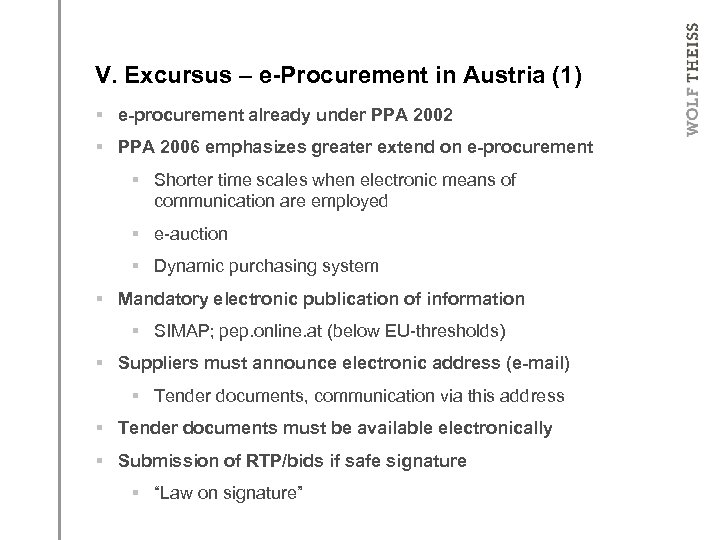
UNCITRAL Model Law V. Excursus – e-Procurement in Austria (1) § e-procurement already under PPA 2002 § PPA 2006 emphasizes greater extend on e-procurement § Shorter time scales when electronic means of communication are employed § e-auction § Dynamic purchasing system § Mandatory electronic publication of information § SIMAP; pep. online. at (below EU-thresholds) § Suppliers must announce electronic address (e-mail) § Tender documents, communication via this address § Tender documents must be available electronically § Submission of RTP/bids if safe signature § “Law on signature” 13
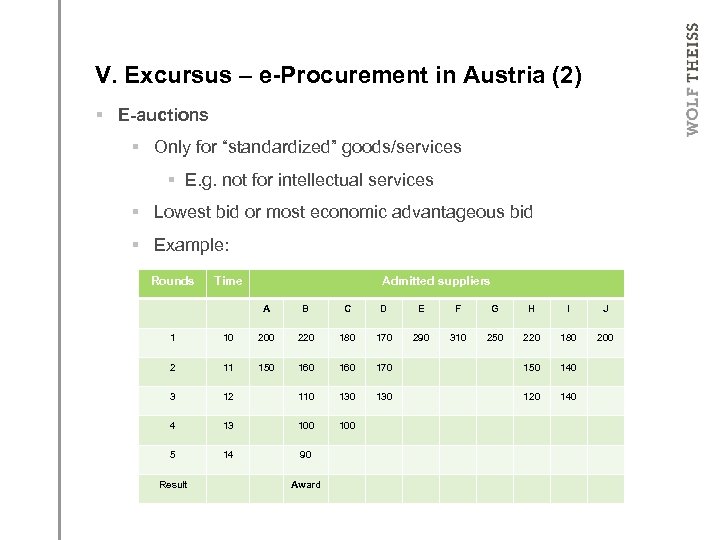
UNCITRAL Model Law V. Excursus – e-Procurement in Austria (2) § E-auctions § Only for “standardized” goods/services § E. g. not for intellectual services § Lowest bid or most economic advantageous bid § Example: Rounds Time Admitted suppliers A B C D E F G H I J 290 310 250 220 180 200 1 10 200 220 180 170 2 11 150 160 170 150 140 3 12 110 130 120 140 4 13 100 5 14 90 Result Award 14
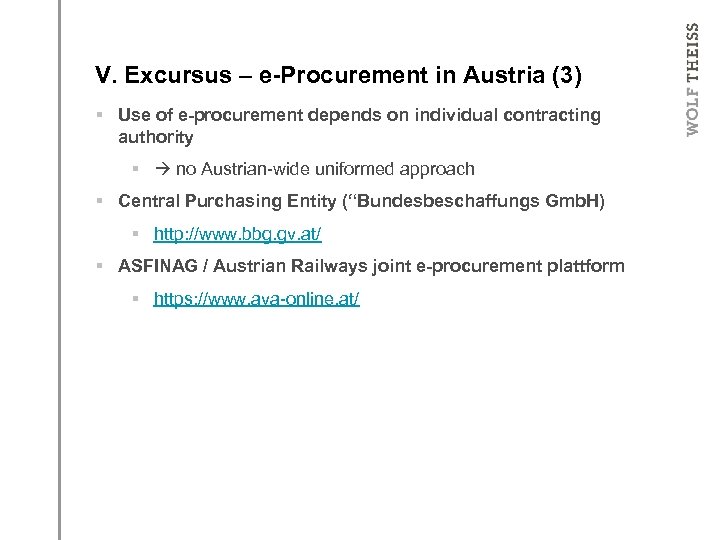
UNCITRAL Model Law V. Excursus – e-Procurement in Austria (3) § Use of e-procurement depends on individual contracting authority § no Austrian-wide uniformed approach § Central Purchasing Entity (“Bundesbeschaffungs Gmb. H) § http: //www. bbg. gv. at/ § ASFINAG / Austrian Railways joint e-procurement plattform § https: //www. ava-online. at/ 15
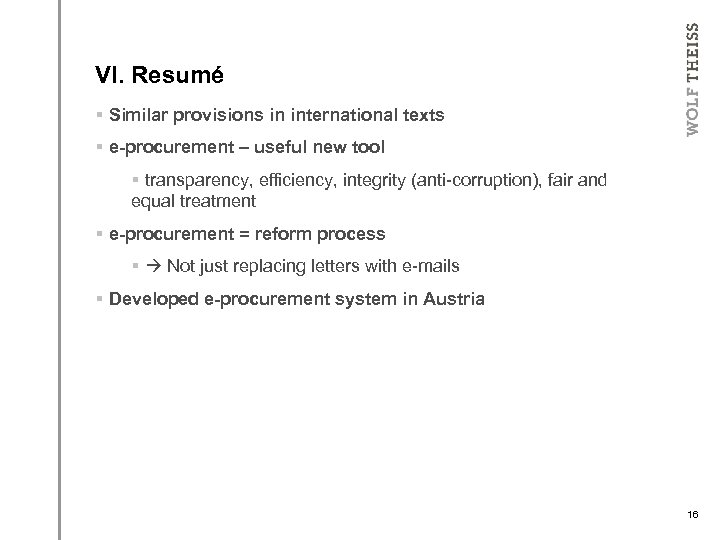
UNCITRAL Model Law and e-Procurement VI. Resumé § Similar provisions in international texts § e-procurement – useful new tool § transparency, efficiency, integrity (anti-corruption), fair and equal treatment § e-procurement = reform process § Not just replacing letters with e-mails § Developed e-procurement system in Austria 16
Contact Johannes S. Schnitzer Senior Associate, Vienna CONTACT WOLF THEISS Rechtsanwälte Gmb. H Schubertring 6, 1010 Vienna, Austria T: +43 1 515 10 5355 F: +43 1 515 10 665355 E: johannes. schnitzer@wolftheiss. com 17
Скачать презентацию Seminar on public procurement and e Procurement policies
a7c8b228c2422d1fda613c5d2f80025d.ppt