


 Скачать презентацию Seminar on organization of a statistical survey on
c0175ffd234513f7c6a006a13cf61dc8.ppt
- Количество слайдов: 27
 Seminar on organization of a statistical survey on house price changes and the calculation of the HICP Kiev, 27 – 28 February 2013 Conceptual issues relating to house price index calculations and the practical methods available David Fenwick National accounts Conceptual & measurement issues Stock versus sales weighted Decomposition of building & land Constant quality – mix-adjusted, hedonics, repeat sales
 Handbook on Residential Property Price Indices – represents current state-of-the-art • Makes recommendations on best practice – Including how to improve international comparability • Recommendations take into account the different situations confronted by countries – Most particularly data availability • Cannot be too prescriptive but • Increasing international comparability can be achieved by the introduction and adoption of standards on conceptual, methodological and computational issues • Conceptual basis of the index – Type of index to be compiled, will depend on its purpose • The System of National Accounts (SNA) 1993 should be used as conceptual framework • Chapter 4 describes conceptual framework • Chapters 5 to 8 describe the main statistical methods • Chapter 12 gives recommendations on best practice.
 Recommendations and Guidelines – the Laspeyres principle & the issue of weighting • Broadly speaking two separate Residential Property Price Indices can be distinguished – A constant quality price index for the stock of residential housing at a particular moment in time – A constant quality price index for residential property sales that took place during a particular period of time. • Also the scope of the index will depend on its use – Whether all properties should be covered or only new ones
 Recommendations and Guidelines – weighting & decomposition between building & land components • A stock-weighted index is appropriate when measuring the wealth associated with the ownership of residential property should be stock-weighted – A stock-weighted index is also appropriate for a financial stability indicator, in particularly to identify property price bubbles. • A sales-weighted index is appropriate for measuring the real output of the residential real estate industry – This is consistent in treatment to the acquisition or purchase of goods and services in a consumer price index. • A decomposition between the building & the land is an added complication – should be made where a country’s balance sheet estimates of national wealth make this distinction – may also be required when a residential property price index is an input into the CPI for the measurement of owner-occupier housing costs using the net-acquisition approach
 Recommendations and Guidelines – scope • A price index covering all residential property is appropriate for measuring the wealth associated with the ownership of residential property – The index should cover existing properties and properties which have been recently built – It should include conversions of existing property, for example where a warehouse has been converted into flats or an existing property has been subdivided. • An index covering all residential properties is also appropriate when used as a financial stability indicator • A price index covering new property only is appropriate for measuring the real output of the residential real estate industry • The value of new housing is part of gross investment – The cost of the land, apart from the value of any improvements made to this element, should be excluded • A price index restricted to new property is also appropriate for the inclusion of owner-occupier housing costs on a net-acquisition cost basis in a consumer price index – I. e. where the consumer price index covers the cost of acquiring properties which are new to the owner-occupier housing market
 Recommendations and Guidelines – constant quality • A residential property price index (stock or sales-weighted) compares the values of the stock or of the sales of residential property between two time periods – after allowing for changes in the attributes of the properties involved – Price changes need to be decomposed into those associated with changes in attributes and the residual which relates to the underlying “pure price” change • Challenging due to the following three factors – Residential properties are heterogeneous • No two properties are identical – Prices are often negotiated • The (asking) price of a property is not fixed & can change throughout the transaction process until the price is finalised • A property's market value can only be known with certainty after it has been sold – Property sales are infrequent • For example, typically less than ten per cent of housing stock changes hands every year • A given house is likely to have a confirmed value not more than every ten years
 Recommendations and Guidelines - Statistical methods for compiling constant quality indices • Stratification (“mix-adjustment”) – The most straightforward method for controlling for changes in the composition or ‘quality mix’ of properties sold – Also addresses any user need for sub-indices relating to different housing market segments • Stratification or “mix-adjustment” is an appropriate method where – An appropriate level of detail is chosen for the number of cells and can be applied in practice – A decomposition of the index into structure and land components is not required • Stratification/mix-adjustment is recommended where the volume of sales is large enough to support a detailed classification of properties
 Recommendations and Guidelines - Statistical methods for compiling constant quality indices • Hedonic regression • Simple concept - measures the empirical relationship between the observable attributes of a good or service e. g. a house & the price • But no uniformity in practical application or agreement on what is best practice – Although the ‘best’ form of the hedonic function may be linear rather than log -linear • Reflects fact that the value of a property is generally equal to the sum of the price of the structure and the price of the land • In practice, many explanatory variables will be categorical rather than continuous and represented by a set of dummy variables. • Two alternative methods of application of hedonics – Time dummy variables (revisions issue) versus predicted prices – Hedonic regression is generally the best technique for constructing a constant quality residential property price index using the predicted prices (imputations) approach (plus stratification)
 Recommendations and Guidelines - Statistical methods for compiling constant quality indices (repeat sales) • Repeat sales – Observes price development of a specific house over time by reference to selling price each time it is sold – The price development of a “representative” selection of houses during overlapping time periods can then be used to measure trend in property prices – Measuring the average price changes in repeat sales on same properties gives a like for like comparison • Recommendation -repeat sales method is not preferred above the hedonic method for constructing a constant quality residential property price index – Problem of home improvements – But methodology is satisfactory where • There is limited or no information on housing characteristics • There a relatively large number of repeat transactions – To provide enough data points to populate the required types of residences and where sample selection bias is not a problem – Repeat sales method is not recommended when distinction needed between price of structure & price of land
 Recommendations and Guidelines - Statistical methods for compiling constant quality indices (appraisal-based methods) • Appraisal-based methods (applied to matched-models) – Use “assessed” values e. g. valuations for taxation purposes or from specially commissioned surveys using estate agents • Often done by reference to similar properties that have been sold – Overcomes two problems associated with repeat sales methodology • The relatively small number of price observations which are generated • The susceptibility to sample selection bias e. g. High turnover amongst starter homes or houses that have been renovated – But cannot deal adequately with quality changes to individual houses (same as repeat sales) & relies on expert judgement
 Recommendations and Guidelines – Other statistical methods for compiling constant quality indices: appraisal-based methods SPAR INDEX • In some countries information on assessed values or appraisals of properties is available, which might be useful as proxies for selling prices or, more generally, market values • In countries where assessed values have been collected for tax purposes, appraisals will typically be available for all properties at a particular reference period – Assessed values can be used in addition to sale prices in a repeat sales framework to reduce the problem of inefficiency and the potential problem of sample selection bias – For each property sold in some comparison period there is a sale price & a base period “price” – the assessed value. Price relatives with a common base period – the valuation period – can then be constructed • The value-weighted arithmetic Sale Price Appraisal Ratio (or SPAR) index – Re-scales appraisal-based indices by dividing by the base-period values – Corrects for the potential bias which may result from inaccurate valuations – Problems (bias) can arise from frequent re-assessments and reduced precision over time can arise from new appraisals
 Recommendations and Guidelines – Other statistical methods for compiling constant quality indices: appraisal-based methods SPAR INDEX • The main advantages – It is consistent with index number theory & straight forward to compute • Being based on standard matched model methodology – Can benefit from many more observations than the repeat sales method • In which case less susceptible to problems arising from small number of price observations – It is not susceptible to sample selection bias – No revisions (because no modelling) • The main disadvantages – It cannot deal with major repairs or renovations (or depreciation) of the dwelling units, lack of data to decompose land from building – When the properties are reassessed and new appraisal data becomes available, the SPAR index can, and probably should be, rebased
 Recommendations and Guidelines – Other statistical methods for compiling constant quality indices: appraisal-based methods SPAR INDEX • Recommendation: preferred to the repeat sales methodology – if assessment data of sufficient quality is available • The SPAR methodology addresses some of the weaknesses of the repeat sales methodology – E. g. Selection bias – Free from revisions, no modelling • The SPAR methodology does have its drawbacks but is a recommended when hedonics (particularly in combination with stratification) is not possible • Used in several European countries, notably in Denmark, the Netherlands and Sweden
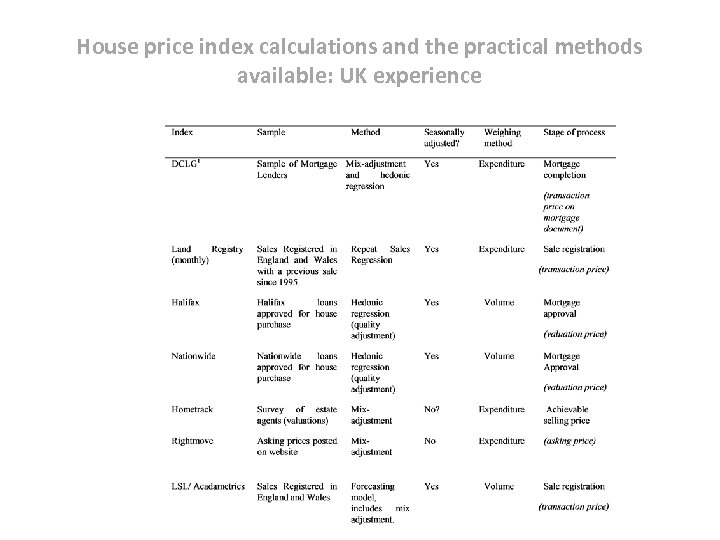
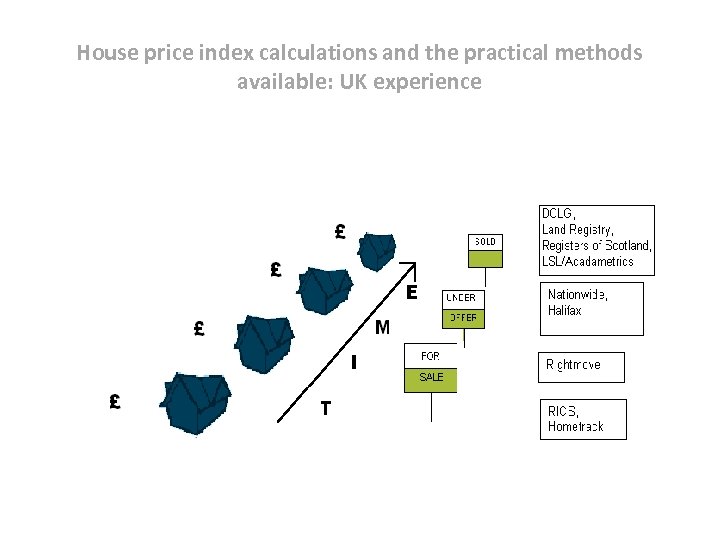
 House price index calculations and the practical methods available: UK experience • No single definitive official house price index – A number of UK government agencies produce/publish information on UK house prices • Including Office for National Statistics (ONS), Land Registry & Valuation Office • ONS responsible for official House Price Index (transferred from DCLG in April 2012) – There are other statistics on house prices which are produced by a range of private sector bodies using differing sources and measures
 House price index calculations and the practical methods available: UK experience
 House price index calculations and the practical methods available: UK experience
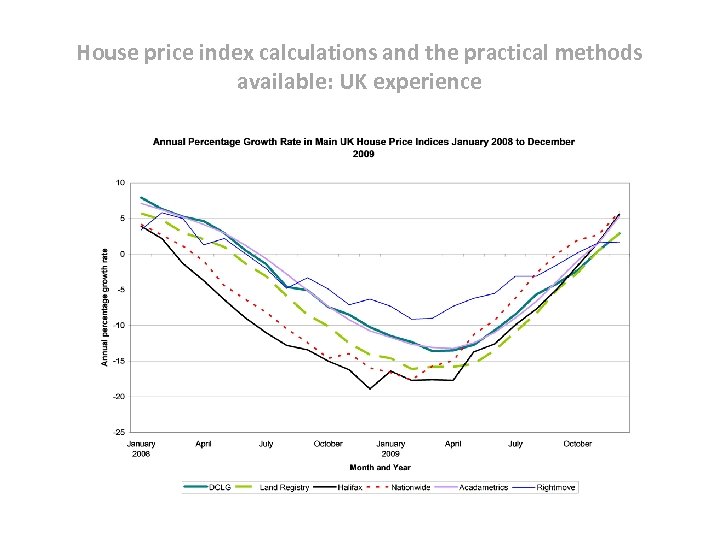 House price index calculations and the practical methods available: UK experience
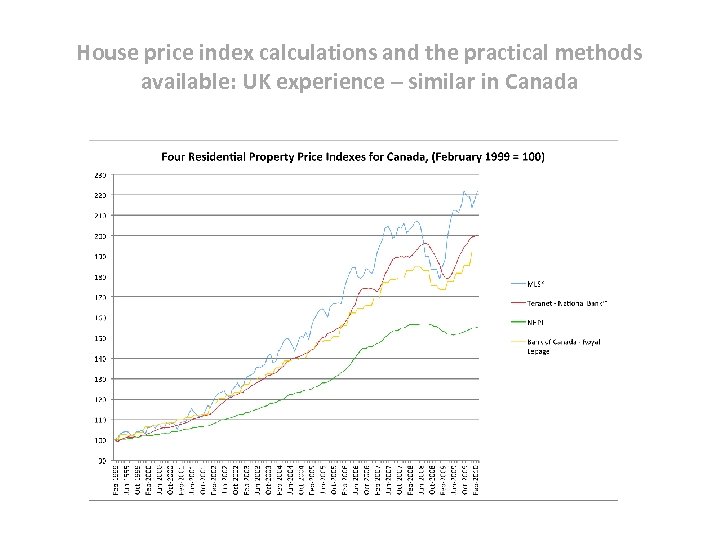 House price index calculations and the practical methods available: UK experience – similar in Canada
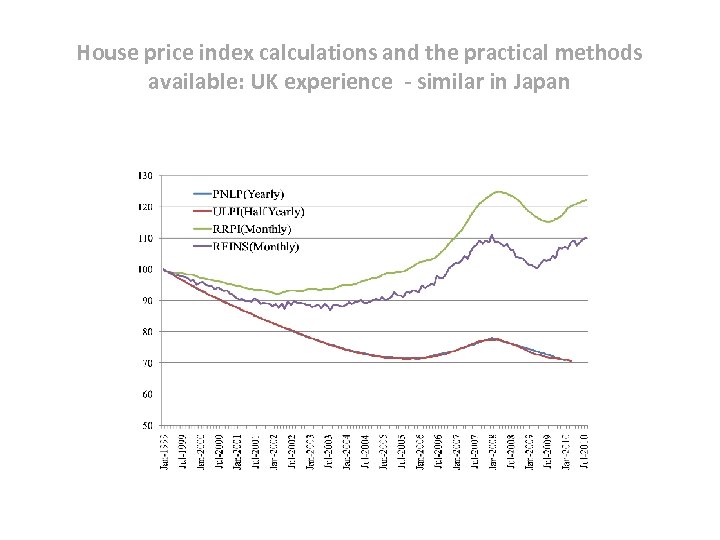 House price index calculations and the practical methods available: UK experience - similar in Japan
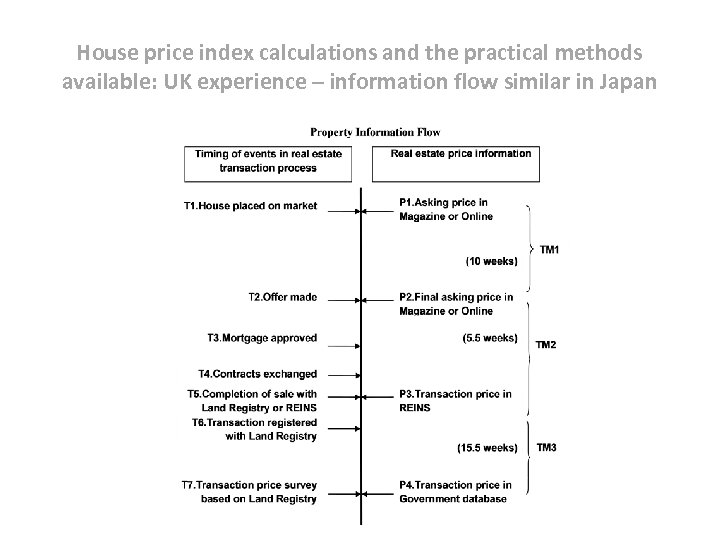 House price index calculations and the practical methods available: UK experience – information flow similar in Japan
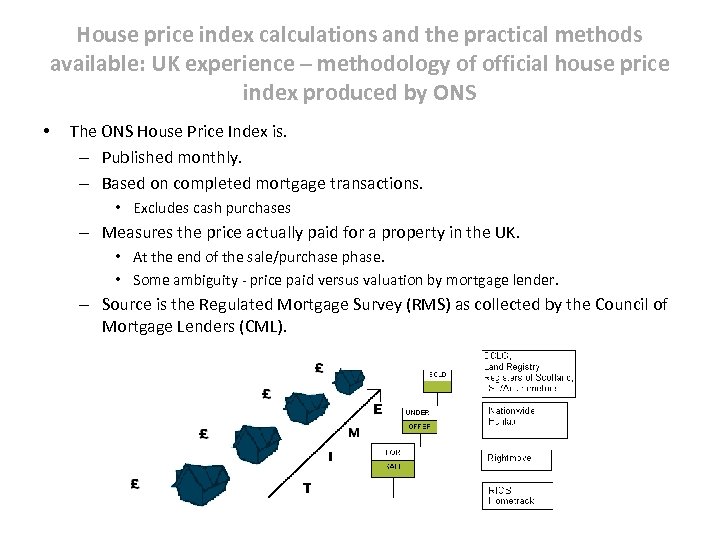 House price index calculations and the practical methods available: UK experience – methodology of official house price index produced by ONS • The ONS House Price Index is. – Published monthly. – Based on completed mortgage transactions. • Excludes cash purchases – Measures the price actually paid for a property in the UK. • At the end of the sale/purchase phase. • Some ambiguity - price paid versus valuation by mortgage lender. – Source is the Regulated Mortgage Survey (RMS) as collected by the Council of Mortgage Lenders (CML).
 House price index calculations and the practical methods available: UK experience - methodology of official house price index produced by ONS • The official index is a mix-adjusted chained Laspeyres-type price index. • Variables collected for mix-adjustment. – – – Locality (postcode). Type of dwelling (detached, terraced etc. ) Whether or not the property is new or old. Number of habitable rooms. Number of bedrooms. • Chain linking of the index is carried out annually. • Also records whether the buyer was a first time buyer or not.
 House price index calculations and the practical methods available: UK experience – official House Price Index • Weights are transaction weights (not stock), calculated using two data sources • Based on the preceding three years’ transactions – For England Wales, data as recorded by HM Land Registry (HMLR) are used. All house sales in England Wales are recorded with the HMLR and therefore this represents a complete data set for these periods – For Scotland Northern Ireland the same level of data is unavailable • The numbers of transactions in the RMS dataset are used as a proxy
 House price index calculations and the practical methods available: UK experience – official House Price Index • If a record has a missing value, it is imputed from the base data using the set of records with the same values for the non -missing variables. For example • If a record has missing values for the number of rooms and the old/new dwelling indicator – The number of records (N) with the same values for the other analysis variables (region, acorn group, cluster group, dwelling type, first time buyer marker, old/new property) plus price band is counted – A random number (n) in the range 0 to N is generated – The missing values are imputed by setting them to be the same as those of the nth record with the same values for the other analysis variables – If no matching records can be found, the least influential variable is dropped and the matching process repeated. • This process is repeated until only region and price band are left to be matched against
 House price index calculations and the practical methods available: UK experience – official House Price Index • The average price for each cell is calculated each month by fitting a regression model to the set of data covering the mortgage transactions reported during the most recent month. – The dependent variable is the natural log of the price. – The independent variables are • • • ONS’s Cluster group – a socio-economic and demographic area indicator Acorn class – a commercial geo-demographic and lifestyle classification First-time buyer or former owner occupier Dwelling type – e. g. detached house, flat etc Old /new property Number of rooms
 House price index calculations and the practical methods available: UK experience – official House Price Index • Limitations of the official house price index – ONS’s index only covers those properties purchased using a mortgage cash sales are explicitly excluded – The index is the least timely one, being published on the second Tuesday in the second month after the reference period. – No indices published lower than regional level • But not usually subject to revision • Technically the most rigorous of the available indices
 Recommendations and Guidelines Which method is best depends on local circumstances – the “best” may not be the “ideal” Meta-data on residential property price indices published by different countries is available from the website of the Bank for International Settlements (see www. bis. org/statistics http: //epp. eurostat. ec. europa. eu/portal/page/portal/hicp/methodology/owner_occupied_housing_hpi/rppi_h andbook • • • Different uses - different concepts? - Yes: addressed in Handbook Can international best practice be identified or is a flexible approach appropriate to reflect local circumstances? Yes: in principle, but cannot be too prescriptive Which techniques are most widely used? Relates to mix-adjustment – a number of options Can existing data sources be improved? Possibly: worth trying (new data collection expensive) What criteria should guide the production of Residential Property Price Indices? User driven? How far should and can a handbook go in answering these questions? Cannot be too prescriptive The End