


 Скачать презентацию Seminar for the European Commission Political Economy at
e28426bf0263798f4e5c76e5bfbf16ab.ppt
- Количество слайдов: 9
 Seminar for the European Commission Political Economy at Work What is Political Economy Analysis? Towards a common understanding
 What is PE? The interaction of political and economic processes in a society: the distribution of power and wealth between different groups and individuals, and the processes that create, sustain and transform these relationships over time. It’s more than politics: links with economic, social (and cultural? ) causes and also policy dimensions
 Theory and practice of development agencies have ignored politics Whatever the dominant approach: 1950 -60 s. Financing gaps, capital spending: fill funding gap, growth will follow. But wasteful investment, elite corruption; poor people neglected 1970 s. Basic needs, rural development : basic services for the poor. But large government, neglect of policy --- uneven development, failing growth 1980 s. Structural adjustment: get prices right and resources will be efficiently allocated. But ineffective conditionality – absence of political support 1990 s. Institution building/capacity development: put in place formal institutions, and build local capacity to run them. But neglect of state-building, and ineffective institutions
 Rationale for adopting PE • Raising development effectiveness and aid effectiveness –How link to Paris/Accra agenda? • Post 9/11, failing states, conflict, state-building
![[1] Formulated by David Booth of ODI Three forms of PE analysis 1. Understanding](https://present5.com/presentation/e28426bf0263798f4e5c76e5bfbf16ab/image-5.jpg "[1] Formulated by David Booth of ODI Three forms of PE analysis 1. Understanding") [1] Formulated by David Booth of ODI Three forms of PE analysis 1. Understanding behaviour by identifying systemic constraints: structural settings, historical legacies, power relations, institutions (rules) • • 2. Understanding institutions in terms of actors’ decision logics and choices • 3. E. g. The ‘natural resource curse’ Neo-patrimonialism as a state/society settlement E. g. Why democracy doesn’t (always) lead to better governance and services Locating the room-for-manoeuvre arising from dynamic features of change processes • E. g. Latin American social reforms, Indian economic policy post-1990 s
[1] Formulated by David Booth of ODI Three forms of PE analysis 1. Understanding behaviour by identifying systemic constraints: structural settings, historical legacies, power relations, institutions (rules) • • 2. Understanding institutions in terms of actors’ decision logics and choices • 3. E. g. The ‘natural resource curse’ Neo-patrimonialism as a state/society settlement E. g. Why democracy doesn’t (always) lead to better governance and services Locating the room-for-manoeuvre arising from dynamic features of change processes • E. g. Latin American social reforms, Indian economic policy post-1990 s
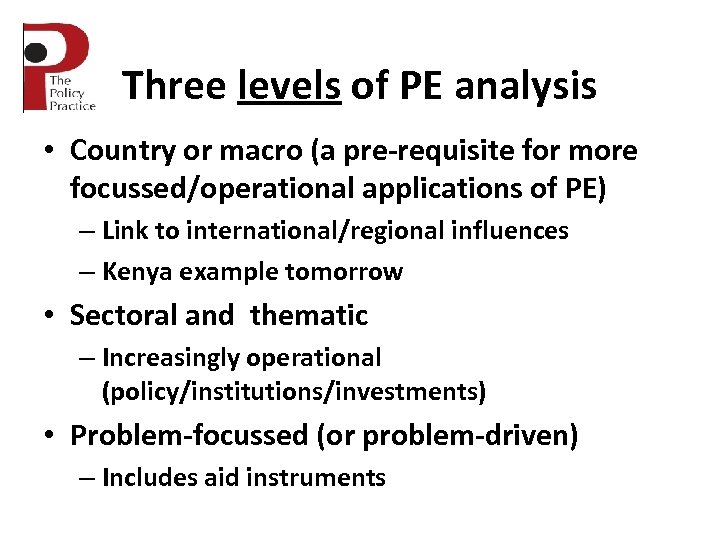 Three levels of PE analysis • Country or macro (a pre-requisite for more focussed/operational applications of PE) – Link to international/regional influences – Kenya example tomorrow • Sectoral and thematic – Increasingly operational (policy/institutions/investments) • Problem-focussed (or problem-driven) – Includes aid instruments
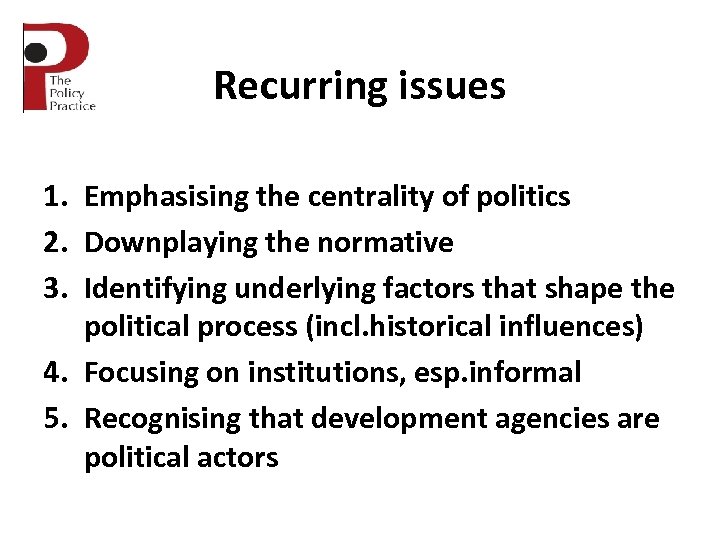 Recurring issues 1. Emphasising the centrality of politics 2. Downplaying the normative 3. Identifying underlying factors that shape the political process (incl. historical influences) 4. Focusing on institutions, esp. informal 5. Recognising that development agencies are political actors
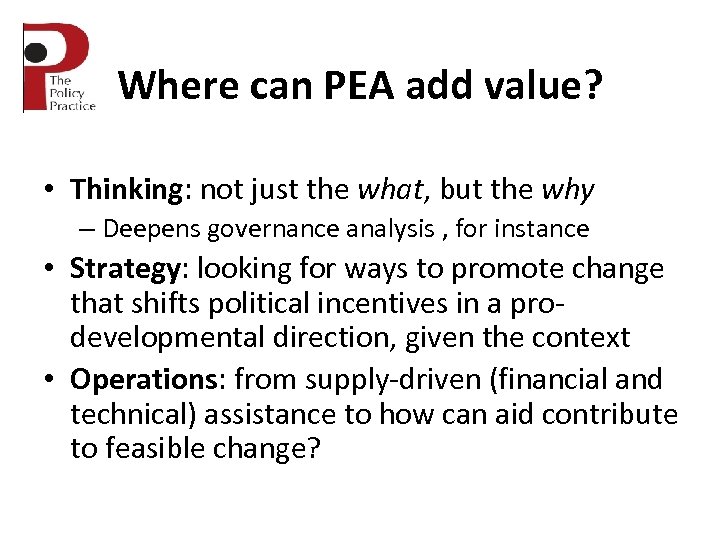 Where can PEA add value? • Thinking: not just the what, but the why – Deepens governance analysis , for instance • Strategy: looking for ways to promote change that shifts political incentives in a prodevelopmental direction, given the context • Operations: from supply-driven (financial and technical) assistance to how can aid contribute to feasible change?
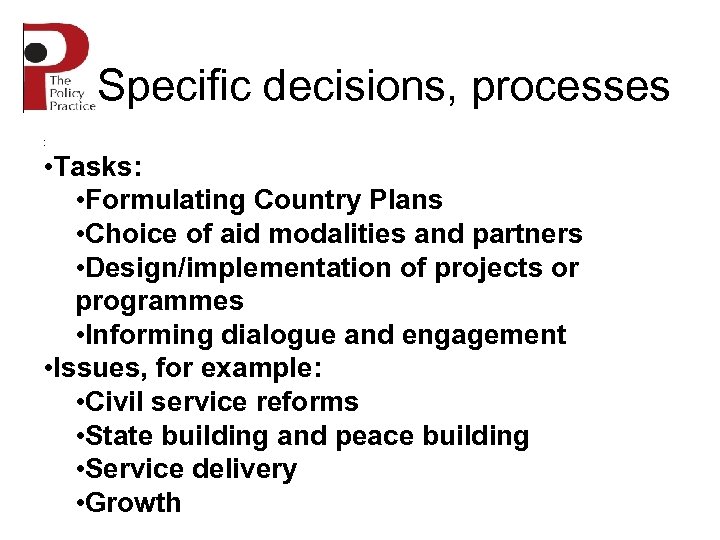 Specific decisions, processes : • Tasks: • Formulating Country Plans • Choice of aid modalities and partners • Design/implementation of projects or programmes • Informing dialogue and engagement • Issues, for example: • Civil service reforms • State building and peace building • Service delivery • Growth