


 Скачать презентацию Seminar Creativity Culture and Innovation looking for
cf26c85299ea1917ea532678d579b9d3.ppt
- Количество слайдов: 21
 Seminar “Creativity, Culture and Innovation – looking for new links” Brussels, 9 September 2010 Working Group on maximising the potential of Cultural and Creative Industries, in particular that of SMEs Fernando FREIRE DE SOUSA
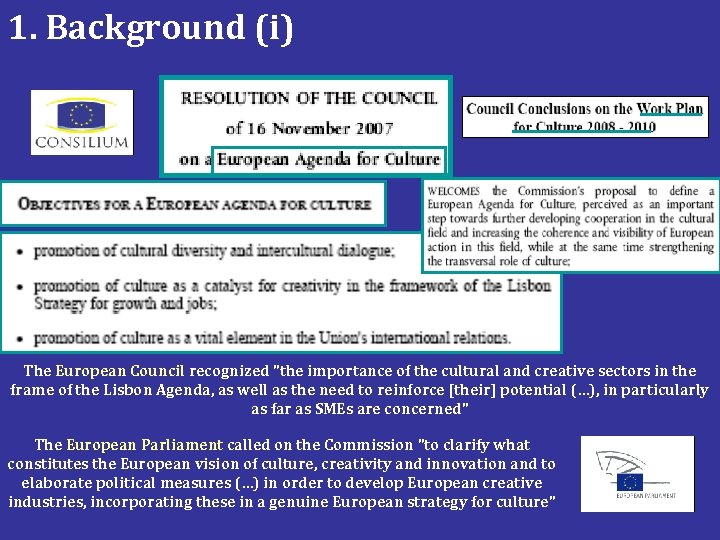 1. Background (i) The European Council recognized "the importance of the cultural and creative sectors in the frame of the Lisbon Agenda, as well as the need to reinforce [their] potential (…), in particularly as far as SMEs are concerned" The European Parliament called on the Commission "to clarify what constitutes the European vision of culture, creativity and innovation and to elaborate political measures (…) in order to develop European creative industries, incorporating these in a genuine European strategy for culture"
 1. Background (ii) Cultural Affairs Committee
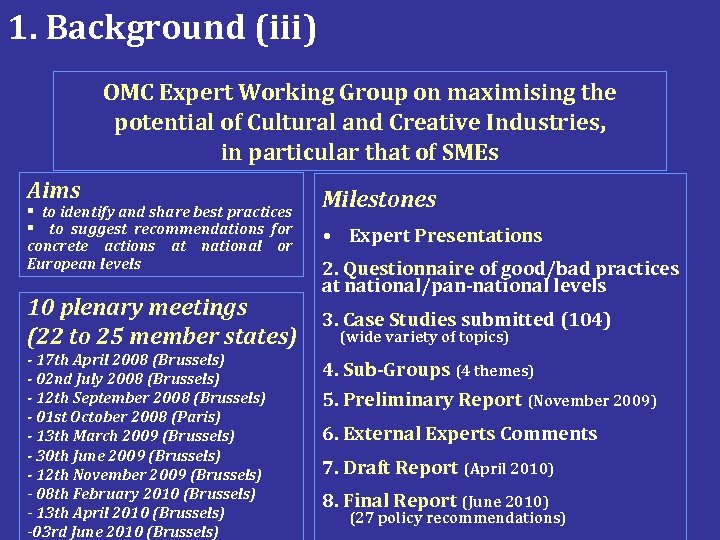 1. Background (iii) OMC Expert Working Group on maximising the potential of Cultural and Creative Industries, in particular that of SMEs Aims § to identify and share best practices § to suggest recommendations for concrete actions at national or European levels Milestones • Expert Presentations 2. Questionnaire of good/bad practices at national/pan-national levels 10 plenary meetings 3. Case Studies submitted (104) (wide variety of topics) (22 to 25 member states) - 17 th April 2008 (Brussels) - 02 nd July 2008 (Brussels) - 12 th September 2008 (Brussels) - 01 st October 2008 (Paris) - 13 th March 2009 (Brussels) - 30 th June 2009 (Brussels) - 12 th November 2009 (Brussels) - 08 th February 2010 (Brussels) - 13 th April 2010 (Brussels) -03 rd June 2010 (Brussels) 4. Sub-Groups (4 themes) 5. Preliminary Report (November 2009) 6. External Experts Comments 7. Draft Report (April 2010) 8. Final Report (June 2010) (27 policy recommendations)
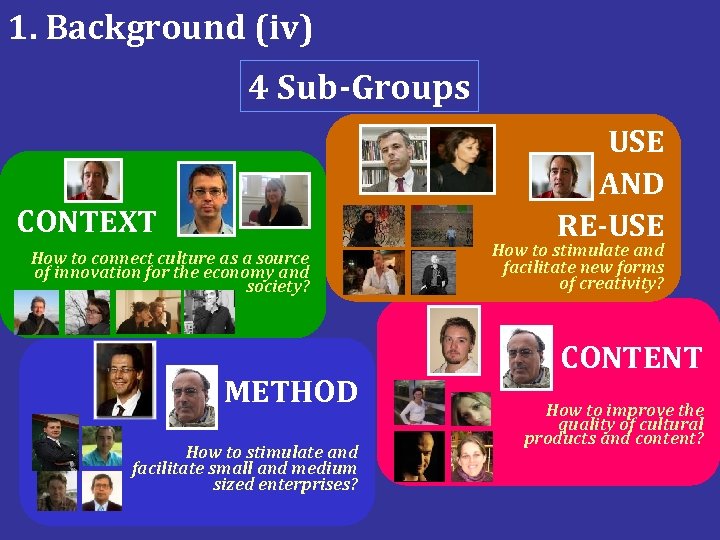 1. Background (iv) 4 Sub-Groups USE AND RE-USE CONTEXT How to connect culture as a source of innovation for the economy and society? METHOD How to stimulate and facilitate small and medium sized enterprises? How to stimulate and facilitate new forms of creativity? CONTENT How to improve the quality of cultural products and content?
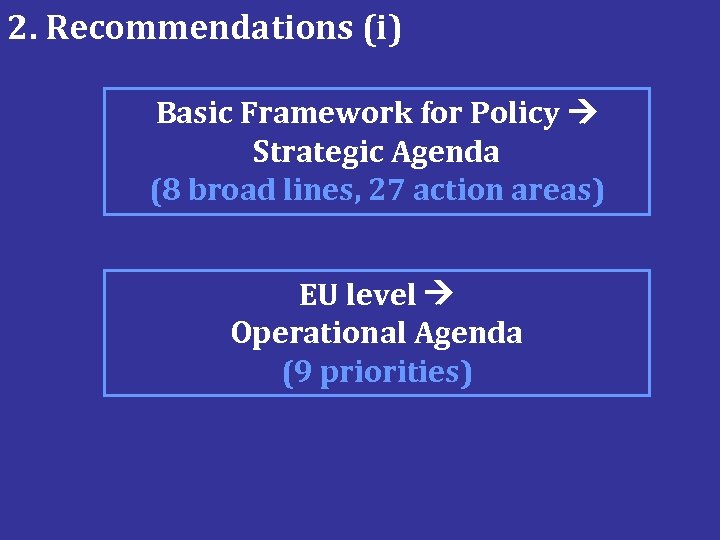 2. Recommendations (i) Basic Framework for Policy Strategic Agenda (8 broad lines, 27 action areas) EU level Operational Agenda (9 priorities)
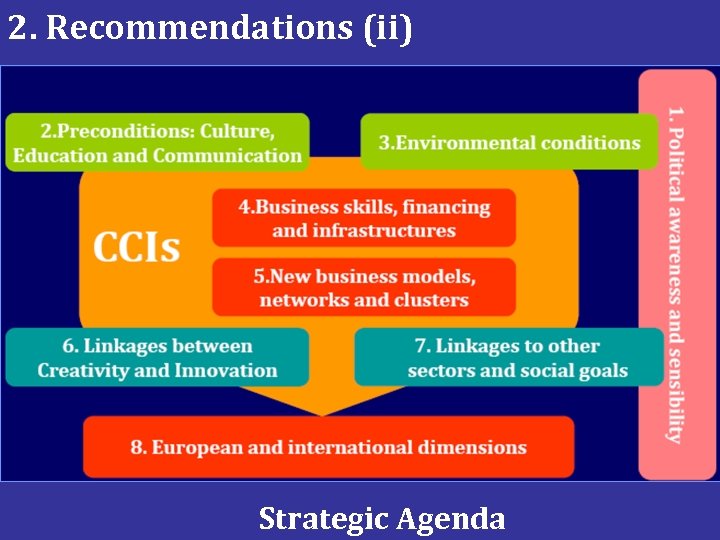 2. Recommendations (ii) Strategic Agenda
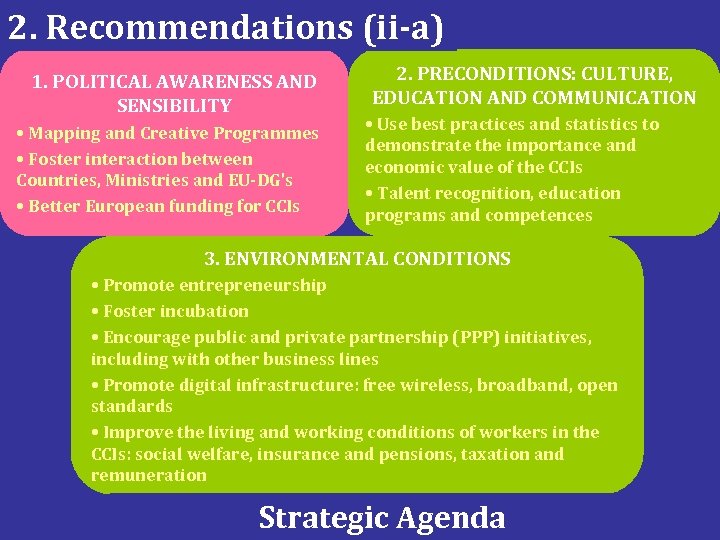 2. Recommendations (ii-a) 1. POLITICAL AWARENESS AND SENSIBILITY • Mapping and Creative Programmes • Foster interaction between Countries, Ministries and EU-DG’s • Better European funding for CCIs 2. PRECONDITIONS: CULTURE, EDUCATION AND COMMUNICATION • Use best practices and statistics to demonstrate the importance and economic value of the CCIs • Talent recognition, education programs and competences 3. ENVIRONMENTAL CONDITIONS • Promote entrepreneurship • Foster incubation • Encourage public and private partnership (PPP) initiatives, including with other business lines • Promote digital infrastructure: free wireless, broadband, open standards • Improve the living and working conditions of workers in the CCIs: social welfare, insurance and pensions, taxation and remuneration Strategic Agenda
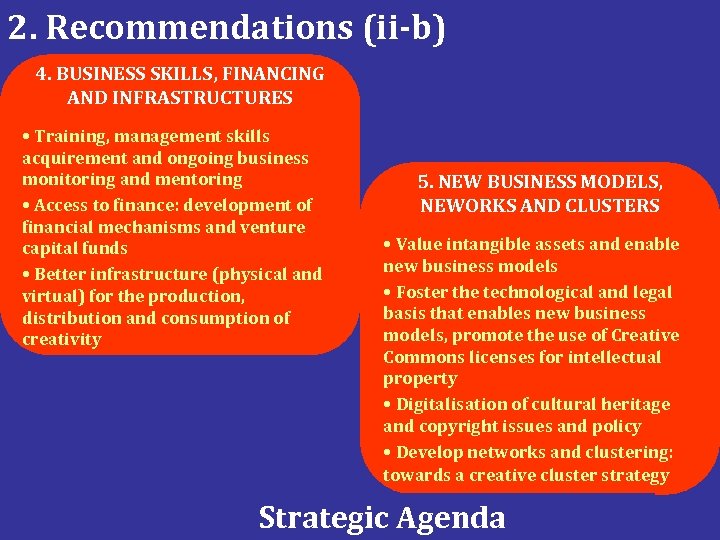 2. Recommendations (ii-b) 4. BUSINESS SKILLS, FINANCING AND INFRASTRUCTURES • Training, management skills acquirement and ongoing business monitoring and mentoring • Access to finance: development of financial mechanisms and venture capital funds • Better infrastructure (physical and virtual) for the production, distribution and consumption of creativity 5. NEW BUSINESS MODELS, NEWORKS AND CLUSTERS • Value intangible assets and enable new business models • Foster the technological and legal basis that enables new business models, promote the use of Creative Commons licenses for intellectual property • Digitalisation of cultural heritage and copyright issues and policy • Develop networks and clustering: towards a creative cluster strategy Strategic Agenda
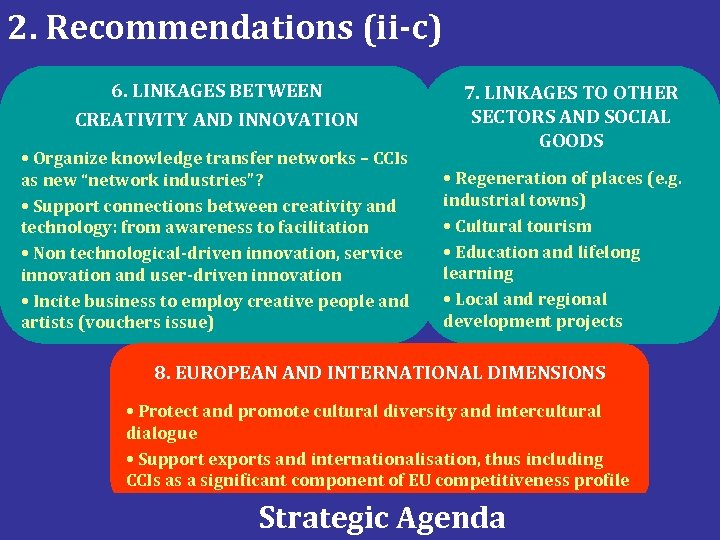 2. Recommendations (ii-c) 6. LINKAGES BETWEEN CREATIVITY AND INNOVATION • Organize knowledge transfer networks – CCIs as new “network industries”? • Support connections between creativity and technology: from awareness to facilitation • Non technological-driven innovation, service innovation and user-driven innovation • Incite business to employ creative people and artists (vouchers issue) 7. LINKAGES TO OTHER SECTORS AND SOCIAL GOODS • Regeneration of places (e. g. industrial towns) • Cultural tourism • Education and lifelong learning • Local and regional development projects 8. EUROPEAN AND INTERNATIONAL DIMENSIONS • Protect and promote cultural diversity and intercultural dialogue • Support exports and internationalisation, thus including CCIs as a significant component of EU competitiveness profile Strategic Agenda
 2. Recommendations (iii) v Access to finance: development of financial mechanisms and venture capital funds v Raise general awareness about the importance and economic value of the CCIs v Better European funding for CCIs v Digitalisation of cultural heritage and copyright issues and policy v Talent recognition, education programmes and competences v Foster incubation v Foster the technological and legal basis that enables new business models, promote the use of Creative Commons licenses for intellectual property v Develop networks and clustering: towards a creative cluster strategy v Support exports and internationalisation, thus including CCIs as a significant component of EU competitiveness profile Operational Agenda
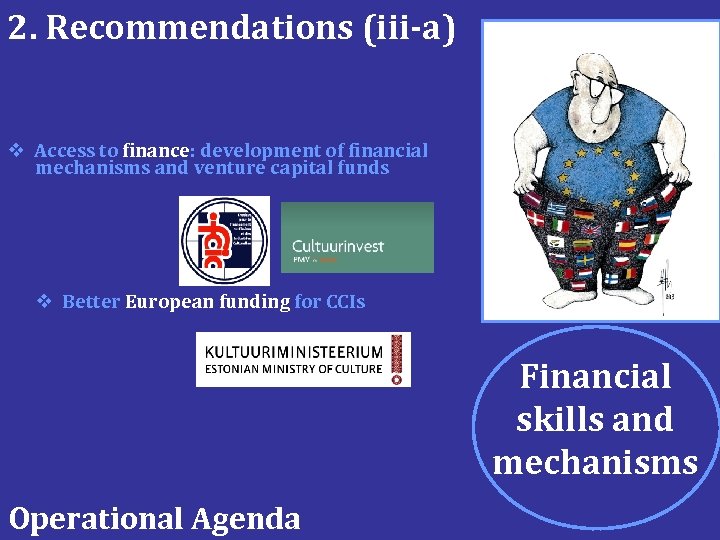 2. Recommendations (iii-a) v Access to finance: development of financial mechanisms and venture capital funds v Better European funding for CCIs Financial skills and mechanisms Operational Agenda
 2. Recommendations (iii-b) v Raise general awareness about the importance and economic value of the CCIs Awareness Operational Agenda
 2. Recommendations (iii-c) v Talent recognition, education programmes and competences Education & competences Operational Agenda
 2. Recommendations (iii-d) v Digitalisation of cultural heritage and copyright issues and policy v Foster incubation v Foster the technological and legal basis that enables new business models, promote the use of Creative Commons licenses for intellectual property Copyright & v Develop networks and clustering: towards a new business creative cluster strategy models Operational Agenda
 2. Recommendations (iii-e) v Support exports and internationalisation, thus including CCIs as a significant component of EU competitiveness profile Competitiveness Operational Agenda
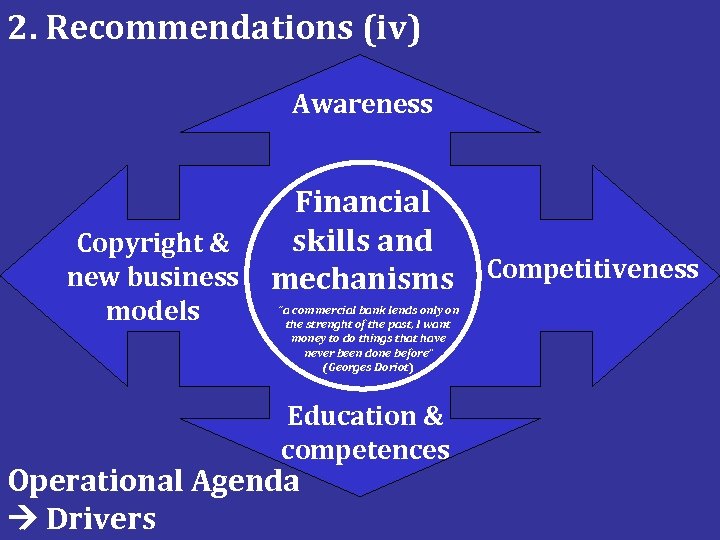 2. Recommendations (iv) Awareness Financial skills and Copyright & new business mechanisms Competitiveness models “a commercial bank lends only on the strenght of the past, I want money to do things that have never been done before” (Georges Doriot) Education & competences Operational Agenda Drivers
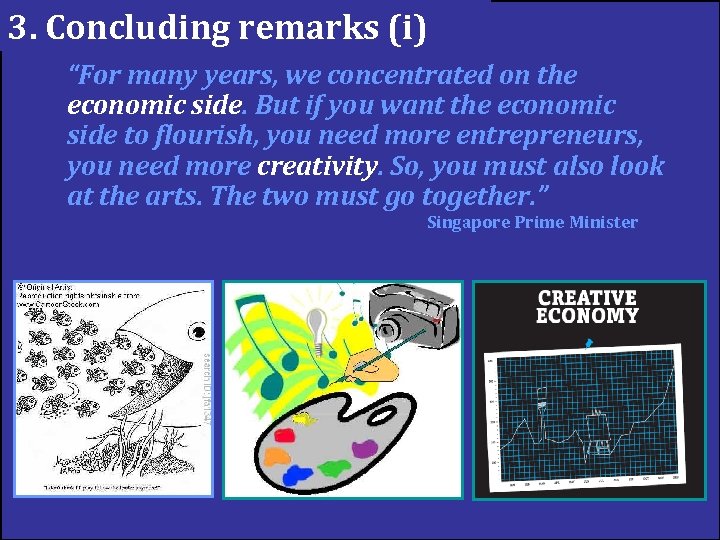 3. Concluding remarks (i) “For many years, we concentrated on the economic side. But if you want the economic side to flourish, you need more entrepreneurs, you need more creativity. So, you must also look at the arts. The two must go together. ” Singapore Prime Minister
 3. Concluding remarks (ii) • A great diversity of innovation drivers exist and emerge in different countries and sectors, but the pivotal role of creativity in processes of technological and non technological innovation (focused on scientific research, markets, business, marketing products and creative services) has to be recognised. • Walter Santagata (“Libro Bianco sulla Creativity”, 2007) suggests the significance of emphasizing the focus of creativity on the “world of material culture” (i. e. the set of goods and services which man has produced since the dawn of humanity to modify his relationship with nature and society as it developed). In this sense, the real impact of CCIs goes largely beyond its consideration in terms of markets and businesses and highlights the CCIs great importance for “social quality” (“the extent to which people can participate in social, economic and cultural life and in the development of their communities in conditions, which improve well-being and individual
 3. Concluding remarks (iii)
 Fernando FREIRE DE SOUSA (freire. sousa@rulesinv. com)