 Скачать презентацию Seminar at NCAR and UCAR-UOP —-Boulder CO USA
b4b0ae6d6254a2e66fa7fdec76a6a247.ppt
- Количество слайдов: 84



Seminar at NCAR and UCAR-UOP ----Boulder (CO) USA, 27 July 2006 Interoperability between Earth Sciences and GIS models: an holistic approach Stefano Nativi Italian National Research Council (Institute of Methodologies for Environmental Analysis) and University of Florence nativi@imaa. cnr. it
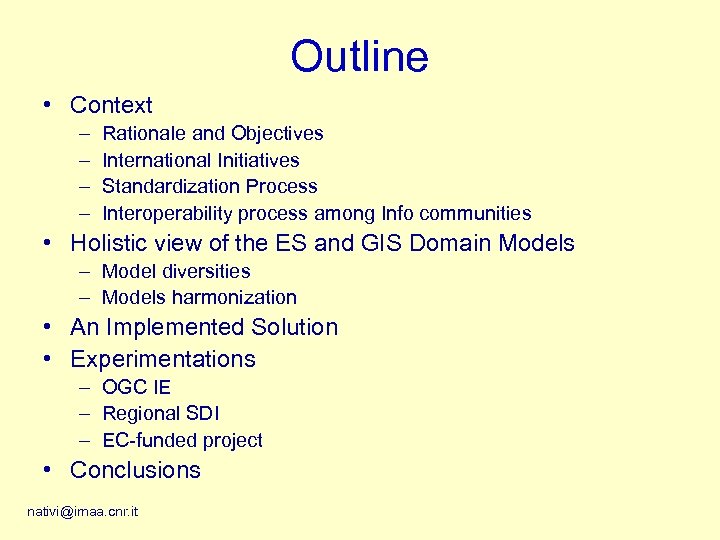
Outline • Context – – Rationale and Objectives International Initiatives Standardization Process Interoperability process among Info communities • Holistic view of the ES and GIS Domain Models – Model diversities – Models harmonization • An Implemented Solution • Experimentations – OGC IE – Regional SDI – EC-funded project • Conclusions nativi@imaa. cnr. it
Context nativi@imaa. cnr. it
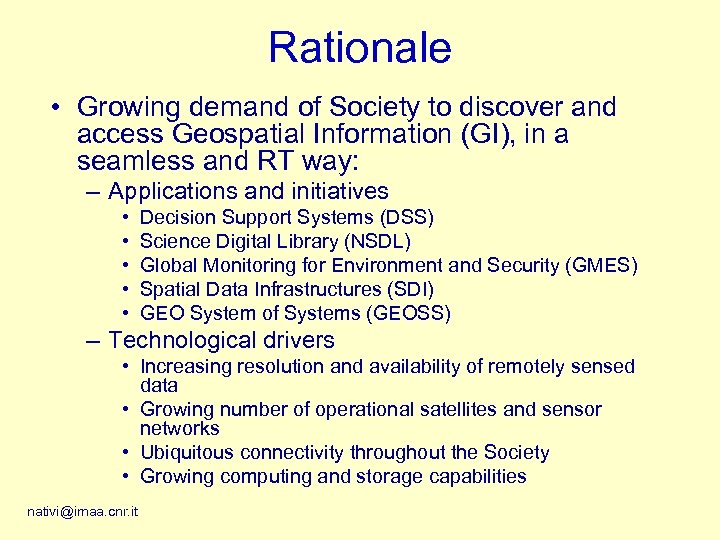
Rationale • Growing demand of Society to discover and access Geospatial Information (GI), in a seamless and RT way: – Applications and initiatives • • • Decision Support Systems (DSS) Science Digital Library (NSDL) Global Monitoring for Environment and Security (GMES) Spatial Data Infrastructures (SDI) GEO System of Systems (GEOSS) – Technological drivers • Increasing resolution and availability of remotely sensed data • Growing number of operational satellites and sensor networks • Ubiquitous connectivity throughout the Society • Growing computing and storage capabilities nativi@imaa. cnr. it
Initiatives and Programmes • GMES (Global Monitoring for Environment & Security) – to bring data and information providers together with users, …. and make environmental and security-related information available to the people who need it through enhanced or new services • IST (Information Society Technology -and Media) –Env sector – focus on the future generation of technologies in which computers and networks will be integrated into the everyday environment, rendering accessible a multitude of services and applications through easy-to-use human interfaces. • GEOSS (Global Earth Observation System of Systems) – realize a future wherein decisions and actions for the benefit of human kind are informed via coordinated, comprehensive, and sustained Earth observations. . . The purpose of GEOSS is. . . to improve monitoring of the state of the Earth, increase understanding of Earth processes, and enhance prediction of the behaviour of the Earth system nativi@imaa. cnr. it
Initiatives and Programmes • DGIWG (Digital Geospatial Information Working Group) – have access to compatible geospatial information for joint operations. • NSDL (National Science Digital Library) – to enhance science, technology, engineering and mathematics education through a partnership of digital libraries joined by common technical and organizational frameworks. nativi@imaa. cnr. it
Initiatives and Programmes • Spatial Data Infrastructures (Geographic Data Infrastructures) – INSPIRE (The INfrastructure for SPatial Info. Rmation in Europe ) • creation of a European spatial information infrastructure that delivers to the users integrated spatial information services. – NSDI (National Spatial Data Infrastructure) • share geographic data among all users could produce significant savings for data collection and use and enhance decision making – NFGIS (National Fundamental Geographic Information System) • provide China a common, basic spatial information system nativi@imaa. cnr. it
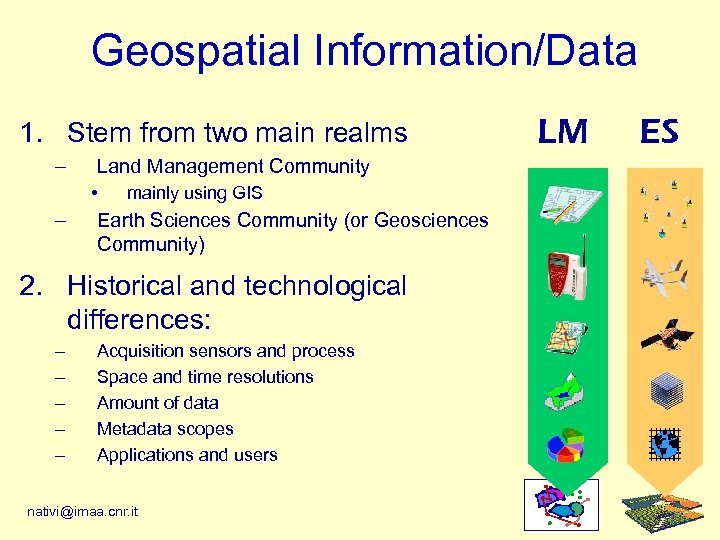
Geospatial Information/Data 1. Stem from two main realms – Land Management Community • – mainly using GIS Earth Sciences Community (or Geosciences Community) 2. Historical and technological differences: – – – Acquisition sensors and process Space and time resolutions Amount of data Metadata scopes Applications and users nativi@imaa. cnr. it LM ES
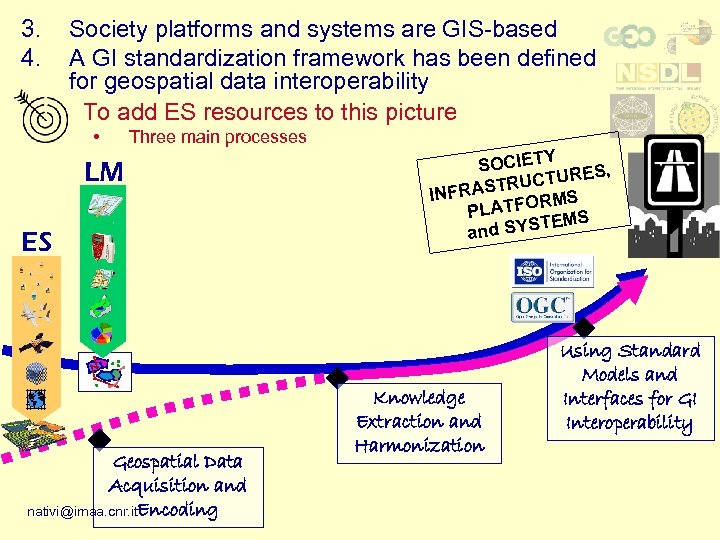
3. 4. Society platforms and systems are GIS-based A GI standardization framework has been defined for geospatial data interoperability To add ES resources to this picture • Three main processes LM ES Geospatial Data Acquisition and nativi@imaa. cnr. it. Encoding Y SOCIET RES, TRUCTU INFRAS MS LATFOR S P TEM and SYS Knowledge Extraction and Harmonization Using Standard Models and Interfaces for GI Interoperability
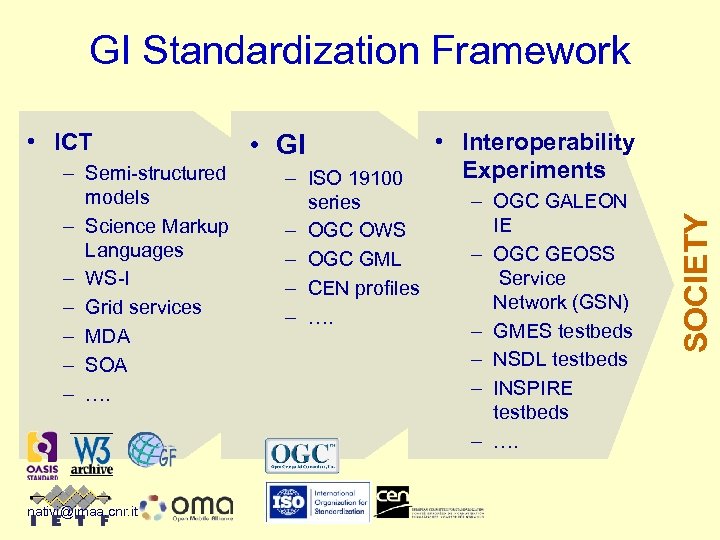
GI Standardization Framework – Semi-structured models – Science Markup Languages – WS-I – Grid services – MDA – SOA – …. nativi@imaa. cnr. it • GI – ISO 19100 series – OGC OWS – OGC GML – CEN profiles – …. • Interoperability Experiments – OGC GALEON IE – OGC GEOSS Service Network (GSN) – GMES testbeds – NSDL testbeds – INSPIRE testbeds – …. SOCIETY • ICT
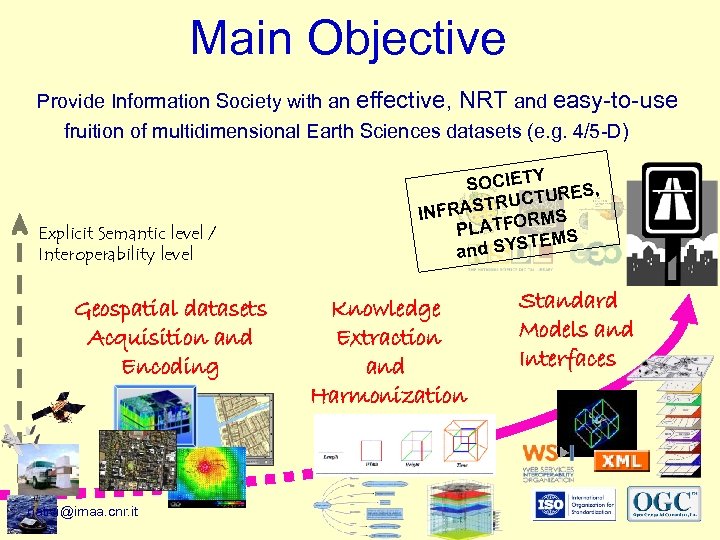
Main Objective Provide Information Society with an effective, NRT and easy-to-use fruition of multidimensional Earth Sciences datasets (e. g. 4/5 -D) Explicit Semantic level / Interoperability level Geospatial datasets Acquisition and Encoding nativi@imaa. cnr. it Y SOCIET S, UCTURE TR INFRAS MS LATFOR S P TEM and SYS Knowledge Extraction and Harmonization Standard Models and Interfaces
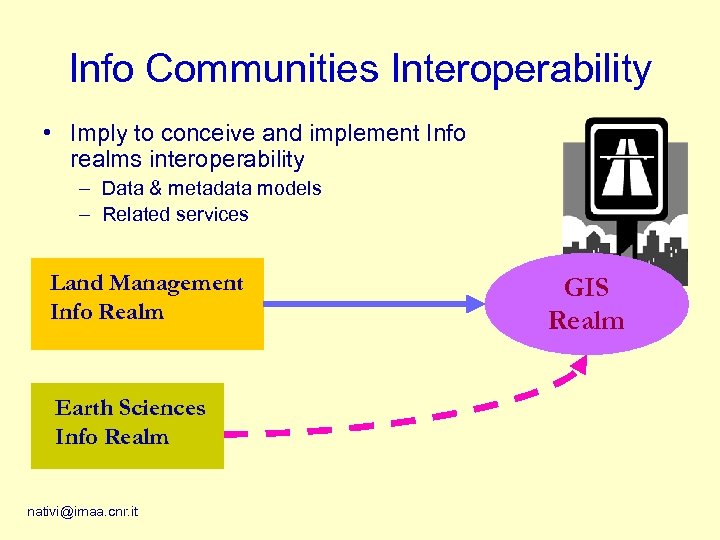
Info Communities Interoperability • Imply to conceive and implement Info realms interoperability – Data & metadata models – Related services Land Management Info Realm Earth Sciences Info Realm nativi@imaa. cnr. it GIS Realm
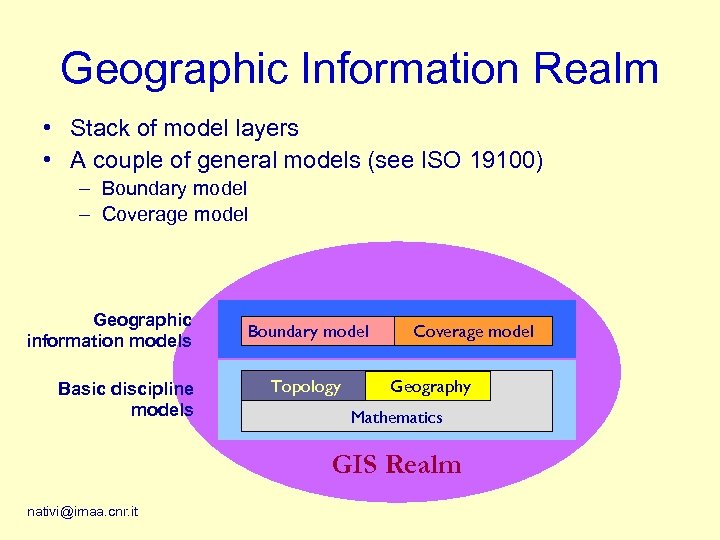
Geographic Information Realm • Stack of model layers • A couple of general models (see ISO 19100) – Boundary model – Coverage model Geographic information models Basic discipline models Boundary model Topology Coverage model Geography Mathematics GIS Realm nativi@imaa. cnr. it
Earth Science (Geoscience) Info Communities • Disciplinary Communities – – Geology Oceanography, limnology, hydrology Glaciology Atmospheric Sciences • Meteorology, Climatology, Aeronomy, … • Interdisciplinary Communities – – – Atmospheric chemistry Paleoceanography and Paleoclimatology Biogeochemistry Mineralogy …. • Basic Disciplines – physics, geography, mathematics, chemistry and biology nativi@imaa. cnr. it [from Wikipedia the Free Encyclopedia]
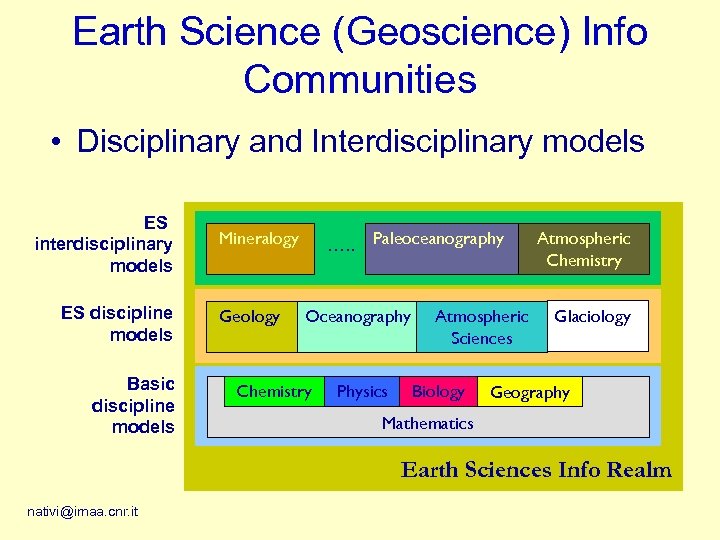
Earth Science (Geoscience) Info Communities • Disciplinary and Interdisciplinary models ES interdisciplinary models ES discipline models Basic discipline models Mineralogy Geology …. . Paleoceanography Oceanography Chemistry Physics Atmospheric Sciences Biology Atmospheric Chemistry Glaciology Geography Mathematics Earth Sciences Info Realm nativi@imaa. cnr. it
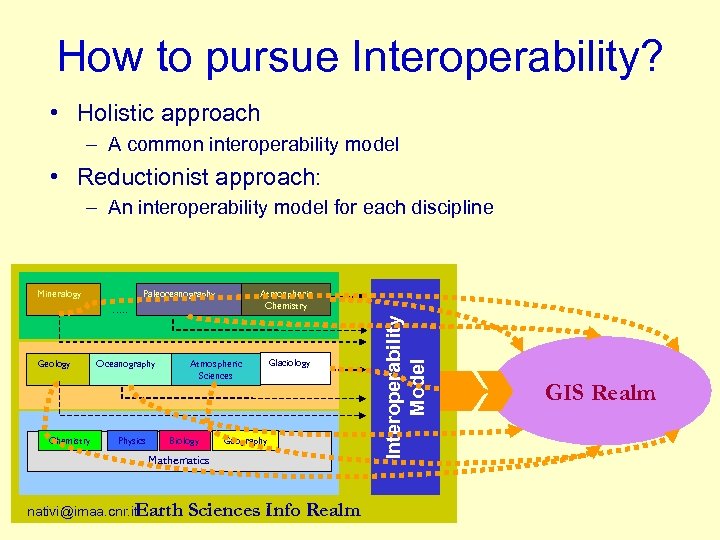
How to pursue Interoperability? • Holistic approach – A common interoperability model • Reductionist approach: – An interoperability model for each discipline Paleoceanography Atmospheric Chemistry …. . Geology Chemistry Oceanography Physics Atmospheric Sciences Biology Glaciology Geography Mathematics Earth nativi@imaa. cnr. it Sciences Info Realm Interoperability Model Mineralogy GIS Realm
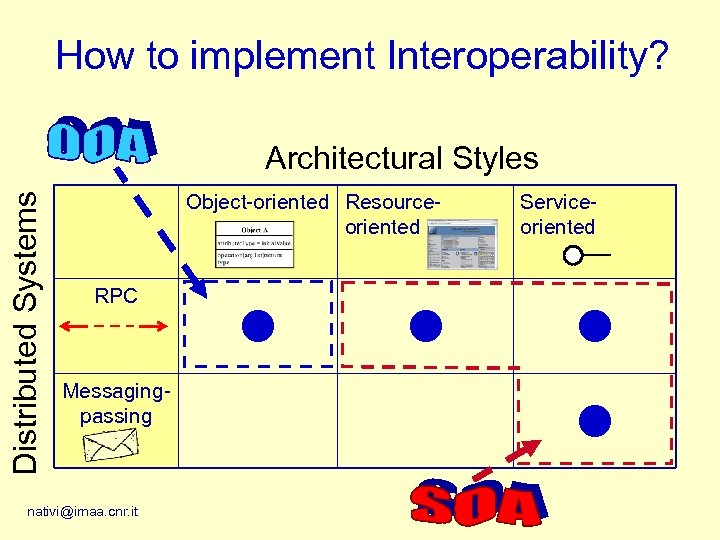
How to implement Interoperability? Distributed Systems Architectural Styles Object-oriented Resourceoriented RPC Messagingpassing nativi@imaa. cnr. it Serviceoriented
SOA: Service Oriented Architecture • Suitable for extensible and heterogeneous distributed systems • Interoperability is granted by declaring in a selfcontained, self-explanatory and neutral way 1. 2. nativi@imaa. cnr. it Application Interfaces Service specification (protocol based; e. g. WSDL) Payload data models Important part of the service description; semi-structured models (e. g. XML schema)
SOA: payload data models harmonization • GIS realm – OGC GML (Geography Markup Language) – Product related • Google KML (Keyhole Markup Language) -- Google. Earth • ESRI Arc. Xml (Arc e. Xtensible Markup Language) -- Arc. IMS • Earth Science info realm – Plethora of new MLs • Holistic approach (at different model levels) – ESML, nc. ML, HDF XML encoding, Geo. Sci. ML, Sensor. ML, etc. • Reductionist approach nativi@imaa. cnr. it – – – – Structural Geology ML (SGeo. ML) Exploration and Mining ML (XMML) Marine. XML Hydrological XML Consortium (Hydro. XC) Climate Data ML (CDML) Climate Science Modelling Language (CSML) Digital Weather ML (DWML) ….
SOA: Interface protocols adapters • GIS realm – OWS (i. e. WMS, WFS, WCS, CS-W, WPS, …. ) – Product related • Google Map and Google Earth service interfaces • Arc. IMS service interfaces • Earth Science info realm – Holistic approach (at different levels) – OPe. NDAP, THREDDS catalog service, … – Reductionist approach – CDI, EOLI, … nativi@imaa. cnr. it
Domain Models: an holistic view nativi@imaa. cnr. it
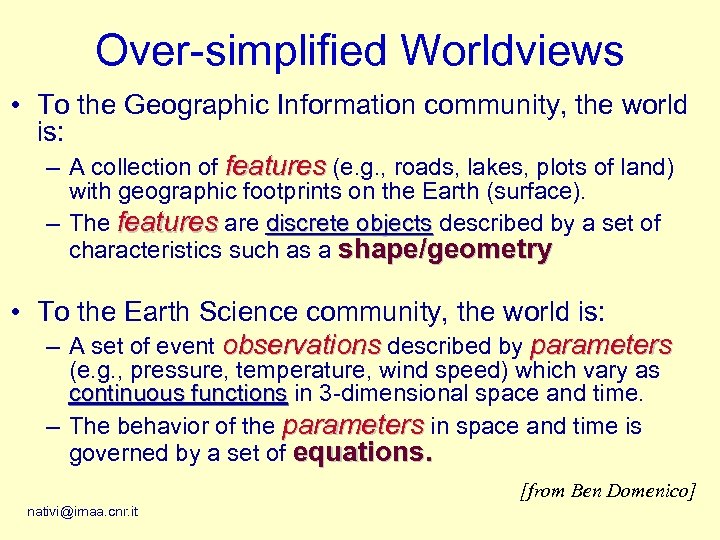
Over-simplified Worldviews • To the Geographic Information community, the world is: – A collection of features (e. g. , roads, lakes, plots of land) with geographic footprints on the Earth (surface). – The features are discrete objects described by a set of characteristics such as a shape/geometry • To the Earth Science community, the world is: – A set of event observations described by parameters (e. g. , pressure, temperature, wind speed) which vary as continuous functions in 3 -dimensional space and time. – The behavior of the parameters in space and time is governed by a set of equations. [from Ben Domenico] nativi@imaa. cnr. it
![A visual example: Traditional GIS view nativi@imaa. cnr. it [from Ben Domenico]](https://present5.com/presentation/b4b0ae6d6254a2e66fa7fdec76a6a247/image-23.jpg "A visual example: Traditional GIS view nativi@imaa. cnr. it [from Ben Domenico]")
A visual example: Traditional GIS view nativi@imaa. cnr. it [from Ben Domenico]
![A visual example: Atmospheric Science view nativi@imaa. cnr. it [from Ben Domenico]](https://present5.com/presentation/b4b0ae6d6254a2e66fa7fdec76a6a247/image-24.jpg "A visual example: Atmospheric Science view nativi@imaa. cnr. it [from Ben Domenico]")
A visual example: Atmospheric Science view nativi@imaa. cnr. it [from Ben Domenico]
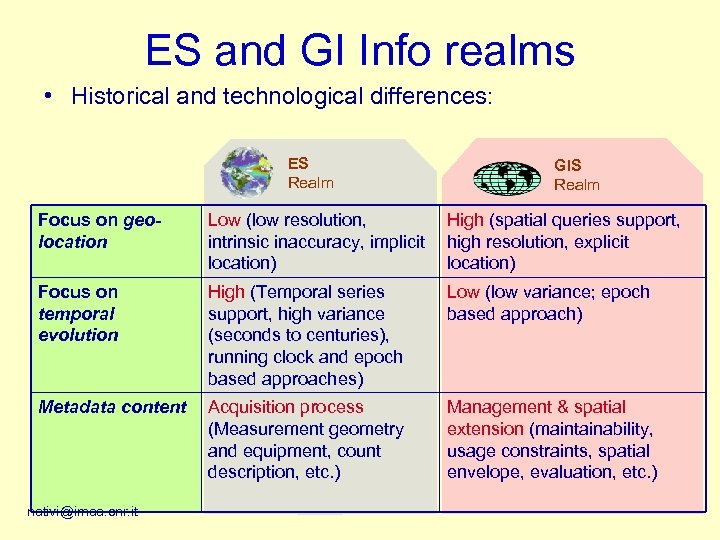
ES and GI Info realms • Historical and technological differences: ES Realm GIS Realm Focus on geolocation Low (low resolution, intrinsic inaccuracy, implicit location) High (spatial queries support, high resolution, explicit location) Focus on temporal evolution High (Temporal series support, high variance (seconds to centuries), running clock and epoch based approaches) Low (low variance; epoch based approach) Metadata content Acquisition process (Measurement geometry and equipment, count description, etc. ) Management & spatial extension (maintainability, usage constraints, spatial envelope, evaluation, etc. ) nativi@imaa. cnr. it
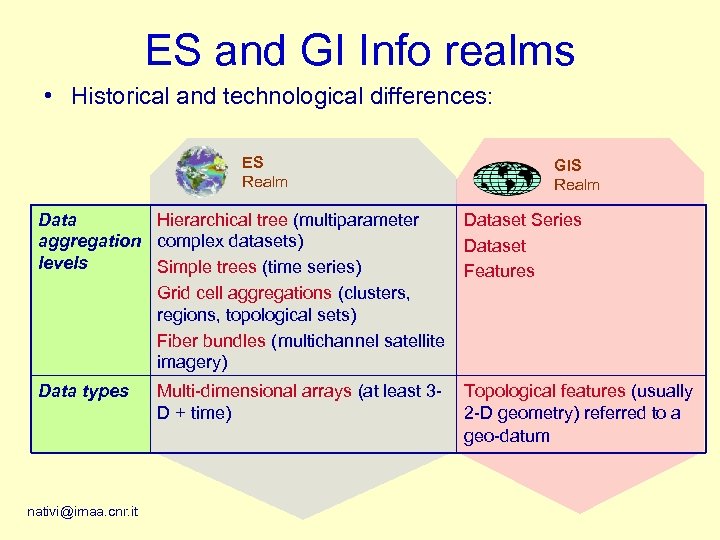
ES and GI Info realms • Historical and technological differences: ES Realm GIS Realm Data Hierarchical tree (multiparameter aggregation complex datasets) levels Simple trees (time series) Grid cell aggregations (clusters, regions, topological sets) Fiber bundles (multichannel satellite imagery) Dataset Series Dataset Features Data types Topological features (usually 2 -D geometry) referred to a geo-datum nativi@imaa. cnr. it Multi-dimensional arrays (at least 3 D + time)
![Netcdf-3 Data Model nativi@imaa. cnr. it [from J. Caron]](https://present5.com/presentation/b4b0ae6d6254a2e66fa7fdec76a6a247/image-27.jpg "Netcdf-3 Data Model nativi@imaa. cnr. it [from J. Caron]")
Netcdf-3 Data Model nativi@imaa. cnr. it [from J. Caron]
![OPe. NDAP Data Model (DAP-2) nativi@imaa. cnr. it [from J. Caron]](https://present5.com/presentation/b4b0ae6d6254a2e66fa7fdec76a6a247/image-28.jpg "OPe. NDAP Data Model (DAP-2) nativi@imaa. cnr. it [from J. Caron]")
OPe. NDAP Data Model (DAP-2) nativi@imaa. cnr. it [from J. Caron]
![HDF 5 Data Model nativi@imaa. cnr. it [from J. Caron]](https://present5.com/presentation/b4b0ae6d6254a2e66fa7fdec76a6a247/image-29.jpg "HDF 5 Data Model nativi@imaa. cnr. it [from J. Caron]")
HDF 5 Data Model nativi@imaa. cnr. it [from J. Caron]
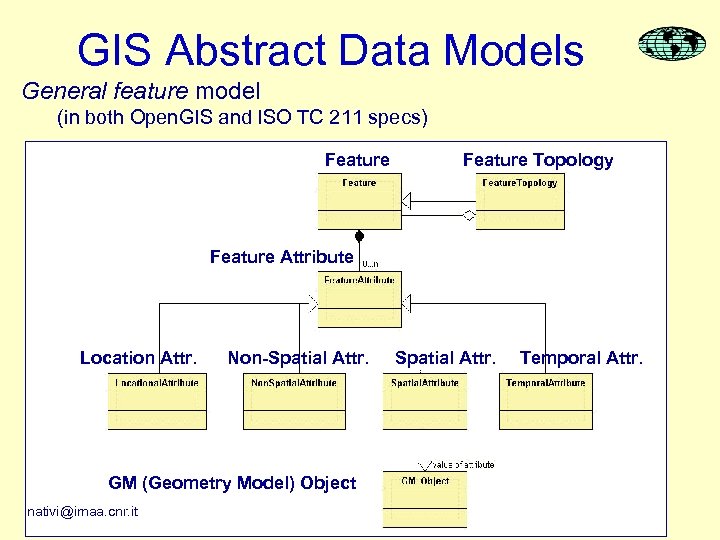
GIS Abstract Data Models General feature model (in both Open. GIS and ISO TC 211 specs) Feature Topology Feature Attribute Location Attr. Non-Spatial Attr. GM (Geometry Model) Object nativi@imaa. cnr. it Spatial Attr. Temporal Attr.
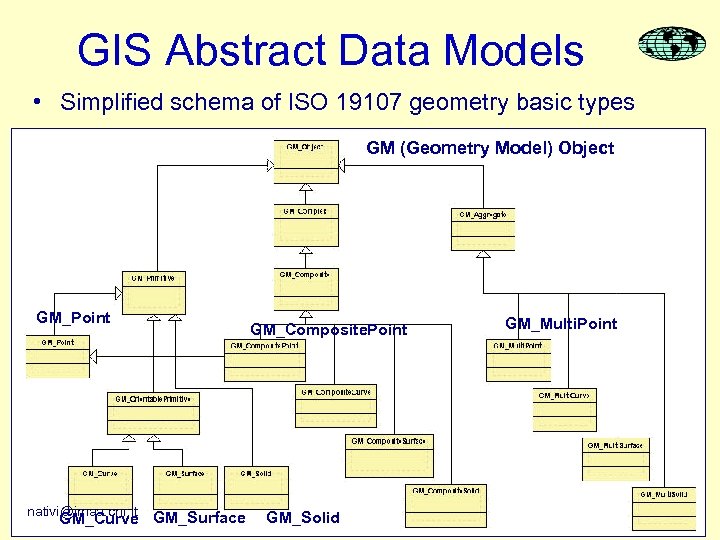
GIS Abstract Data Models • Simplified schema of ISO 19107 geometry basic types GM (Geometry Model) Object GM_Point nativi@imaa. cnr. it GM_Curve GM_Surface GM_Composite. Point GM_Solid GM_Multi. Point
Domain Models Harmonization abstract solution: an holistic approach nativi@imaa. cnr. it
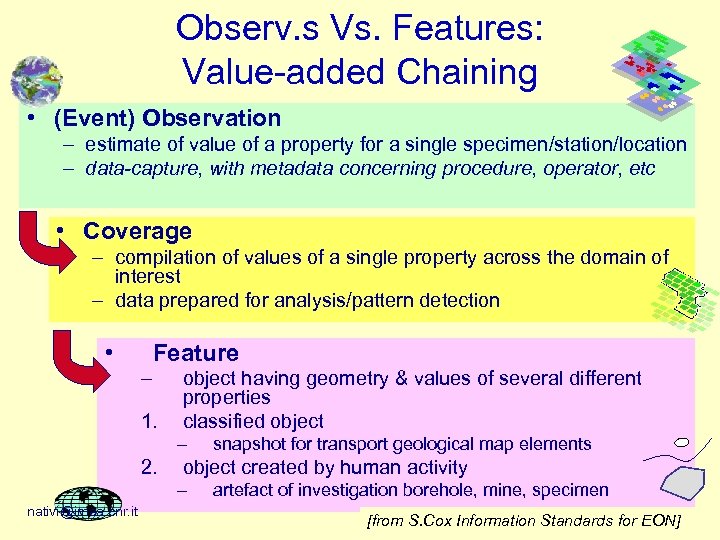
Observ. s Vs. Features: Value-added Chaining • (Event) Observation – estimate of value of a property for a single specimen/station/location – data-capture, with metadata concerning procedure, operator, etc • Coverage – compilation of values of a single property across the domain of interest – data prepared for analysis/pattern detection • Feature – 1. object having geometry & values of several different properties classified object – 2. object created by human activity – nativi@imaa. cnr. it snapshot for transport geological map elements artefact of investigation borehole, mine, specimen [from S. Cox Information Standards for EON]
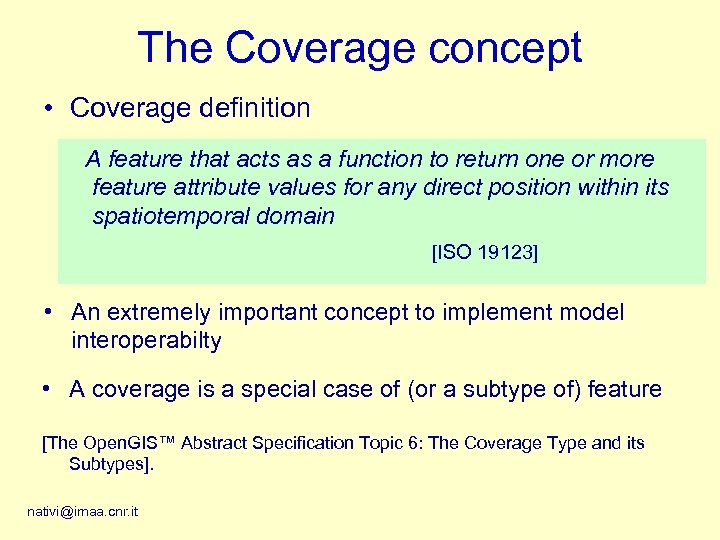
The Coverage concept • Coverage definition A feature that acts as a function to return one or more feature attribute values for any direct position within its spatiotemporal domain [ISO 19123] • An extremely important concept to implement model interoperabilty • A coverage is a special case of (or a subtype of) feature [The Open. GIS™ Abstract Specification Topic 6: The Coverage Type and its Subtypes]. nativi@imaa. cnr. it
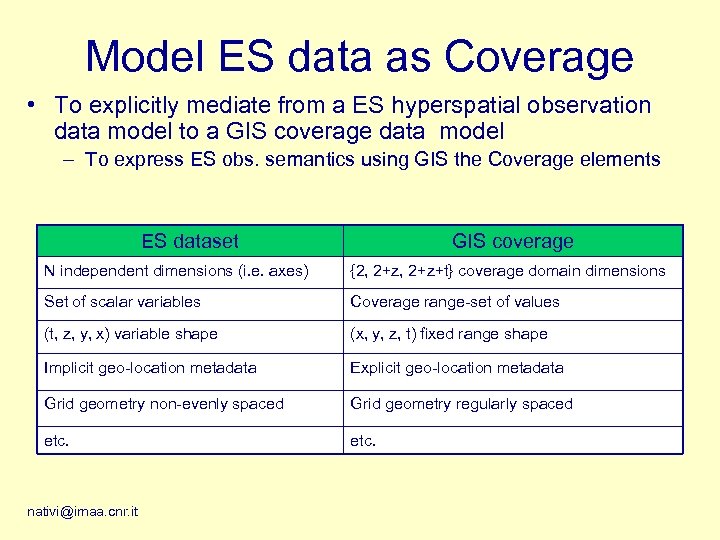
Model ES data as Coverage • To explicitly mediate from a ES hyperspatial observation data model to a GIS coverage data model – To express ES obs. semantics using GIS the Coverage elements ES dataset GIS coverage N independent dimensions (i. e. axes) {2, 2+z+t} coverage domain dimensions Set of scalar variables Coverage range-set of values (t, z, y, x) variable shape (x, y, z, t) fixed range shape Implicit geo-location metadata Explicit geo-location metadata Grid geometry non-evenly spaced Grid geometry regularly spaced etc. nativi@imaa. cnr. it
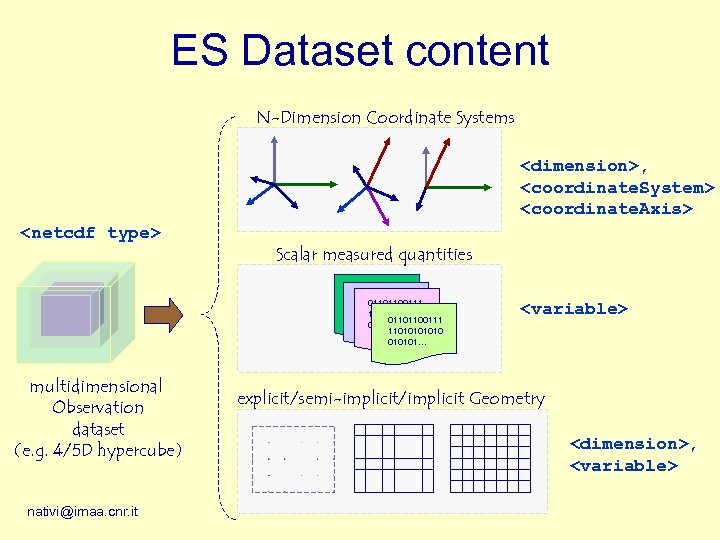
ES Dataset content N-Dimension Coordinate Systems <dimension>, <coordinate. System> <coordinate. Axis> <netcdf type> Scalar measured quantities 01101100111 1101010 01101100111 010101… 11010101… multidimensional Observation dataset (e. g. 4/5 D hypercube) nativi@imaa. cnr. it <variable> explicit/semi-implicit/implicit Geometry <dimension>, <variable>
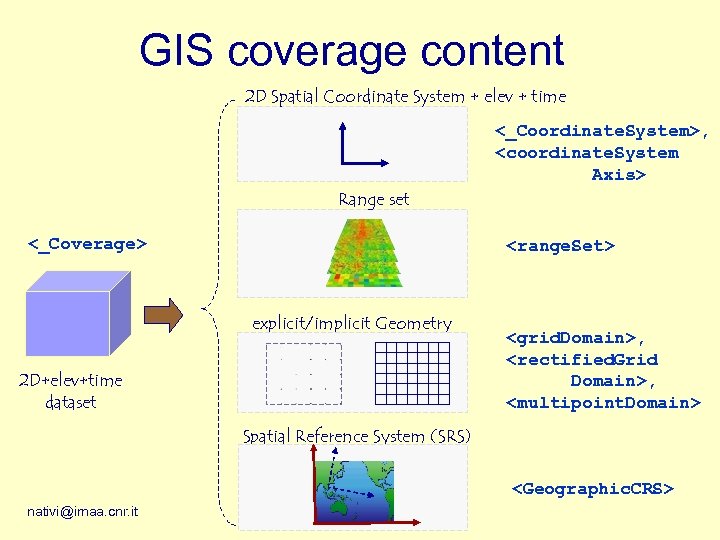
GIS coverage content 2 D Spatial Coordinate System + elev + time <_Coordinate. System>, <coordinate. System Axis> Range set <_Coverage> <range. Set> explicit/implicit Geometry 2 D+elev+time dataset <grid. Domain>, <rectified. Grid Domain>, <multipoint. Domain> Spatial Reference System (SRS) <Geographic. CRS> nativi@imaa. cnr. it
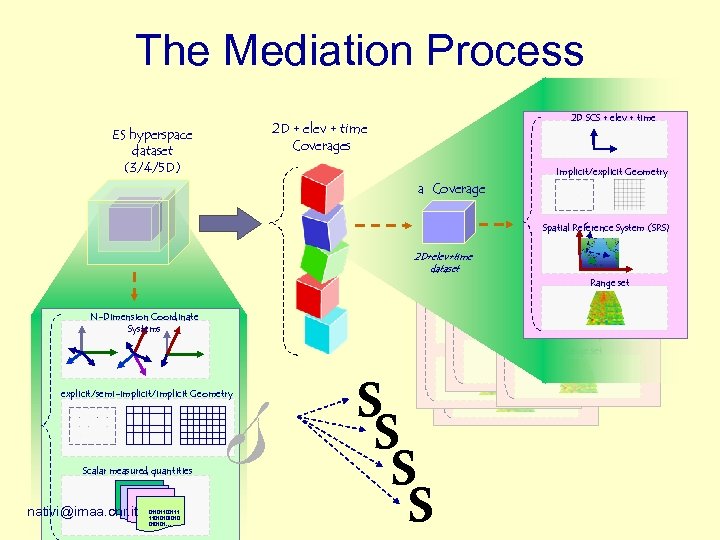
The Mediation Process 2 D SCS + elev + time 2 D + elev + time Coverages ES hyperspace dataset (3/4/5 D) a 2 Dimension Coordinate System Implicit/explicit Geometry 2 Dimension Coverage Coordinate System 2 Dimension Coordinate System Implicit/explicit. Spatial Reference System (SRS) Geometry Implicit/explicit Geometry 2 D+elev+time Implicit/explicit Geometry dataset Spatial Reference System (SRS) Range set Spatial(SRS) Reference System (SRS) Spatial Reference System N-Dimension Coordinate Systems s explicit/semi-implicit/implicit Geometry Scalar measured quantities 01101100111 1101010 01101100111 010101… 11010101… nativi@imaa. cnr. it Spatial Reference System (SRS) Range set S S Range set
Introduced GIS Coverage concepts in brief • A dataset origins several different coverages • Each coverage is characterized by a domain, a range-set and is referenced by a CS/CRS • Each coverage is optionally described by a geographic extent • Each domain is characterized by a geometry – Supported domains: evenly spaced grid domain, non evenly spaced grid domain and multipoint domain • Each range-set lists or points set of values associated to each domain location – Supported range-set types: scalar range-set and parametric range-set nativi@imaa. cnr. it
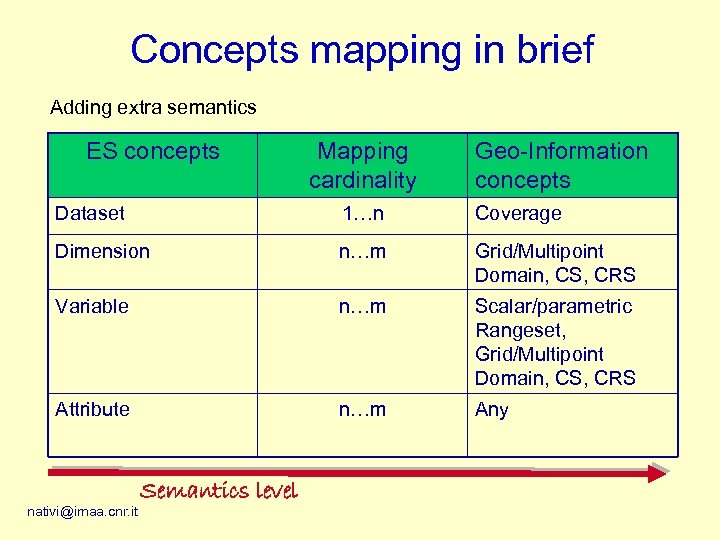
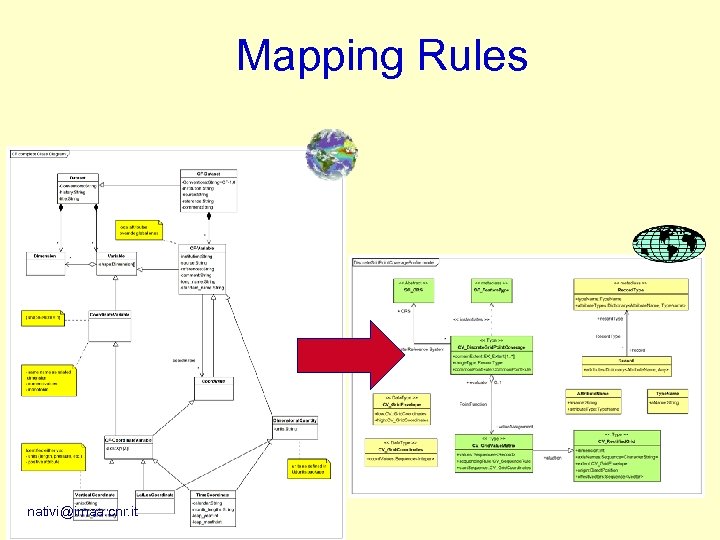
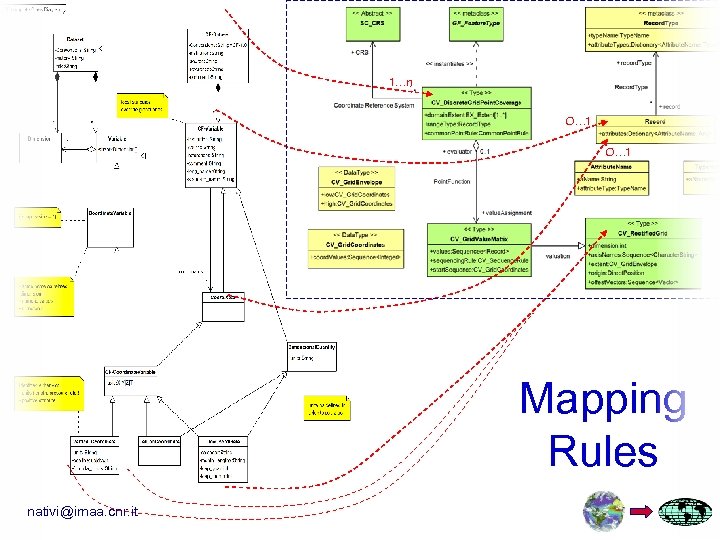
Concepts mapping in brief Adding extra semantics ES concepts Mapping cardinality Geo-Information concepts Dataset 1…n Coverage Dimension n…m Grid/Multipoint Domain, CS, CRS Variable n…m Scalar/parametric Rangeset, Grid/Multipoint Domain, CS, CRS Attribute n…m Any nativi@imaa. cnr. it Semantics level
An Implemented Solution nativi@imaa. cnr. it
The Implementation • ES data model – net. CDF – Extra metadata: CF conventions • GIS Coverage model – ISO 19123: Discrete. Grid. Point. Coverage • Harmonization implementation-style – Declarative style • Mediation Markup Language • Rule-based procedure nativi@imaa. cnr. it
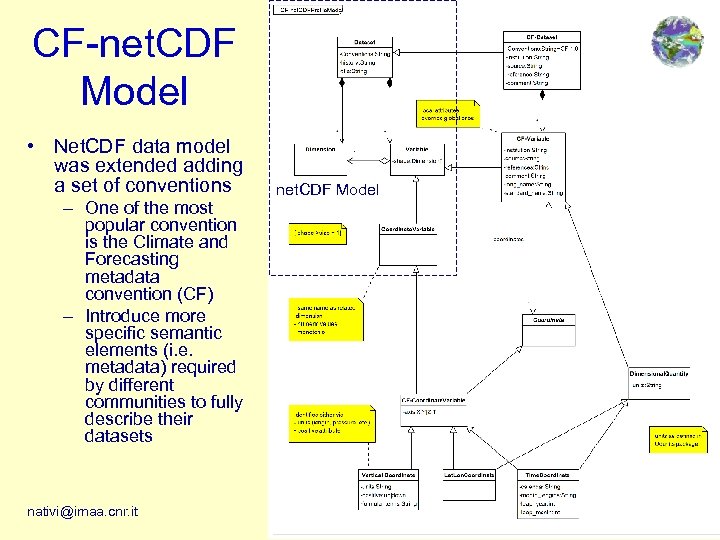
CF-net. CDF Model • Net. CDF data model was extended adding a set of conventions – One of the most popular convention is the Climate and Forecasting metadata convention (CF) – Introduce more specific semantic elements (i. e. metadata) required by different communities to fully describe their datasets nativi@imaa. cnr. it net. CDF Model
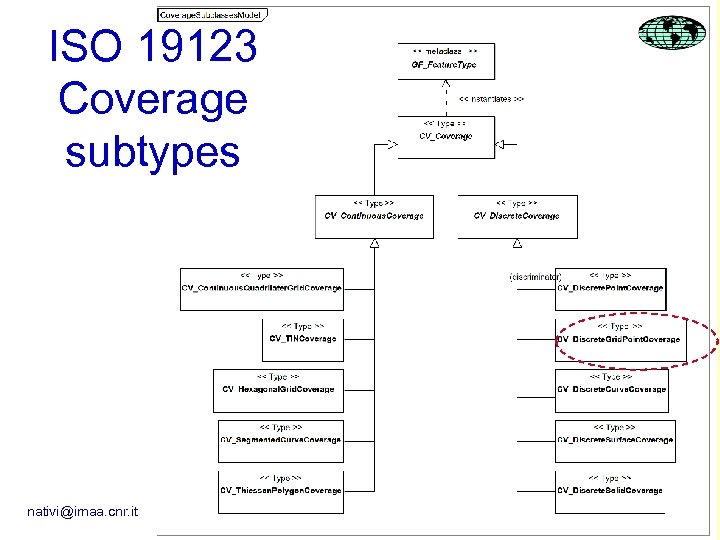
ISO 19123 Coverage subtypes nativi@imaa. cnr. it
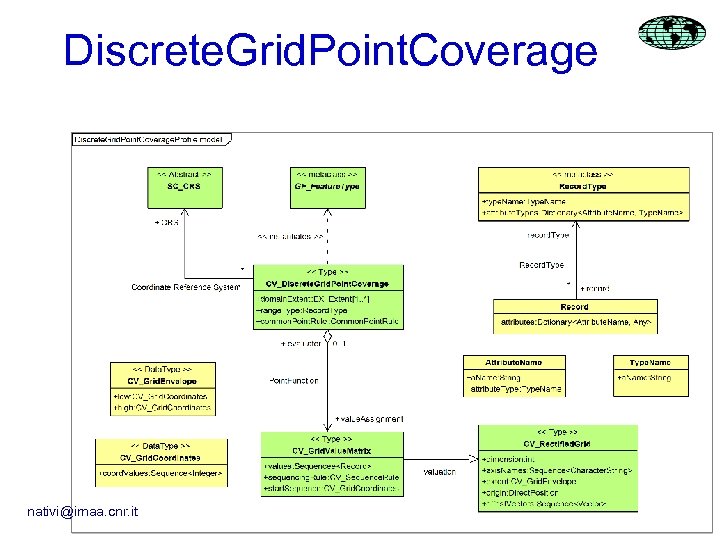
Discrete. Grid. Point. Coverage nativi@imaa. cnr. it
Mapping Rules nativi@imaa. cnr. it
1…n 0… 1 Mapping Rules nativi@imaa. cnr. it
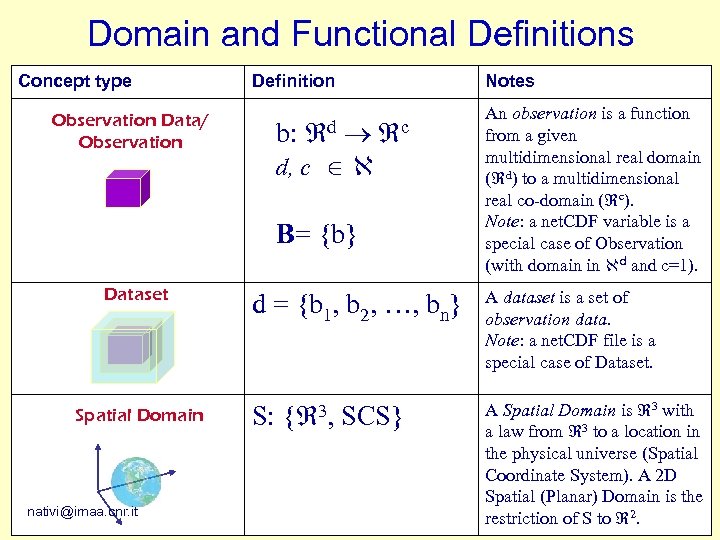
Domain and Functional Definitions Concept type Definition Observation Data/ Observation Notes b: d c d, c B= {b} Dataset Spatial Domain nativi@imaa. cnr. it d = {b 1, b 2, …, bn} S: { 3, SCS} An observation is a function from a given multidimensional real domain ( d) to a multidimensional real co-domain ( c). Note: a net. CDF variable is a special case of Observation (with domain in d and c=1). A dataset is a set of observation data. Note: a net. CDF file is a special case of Dataset. A Spatial Domain is 3 with a law from 3 to a location in the physical universe (Spatial Coordinate System). A 2 D Spatial (Planar) Domain is the restriction of S to 2.
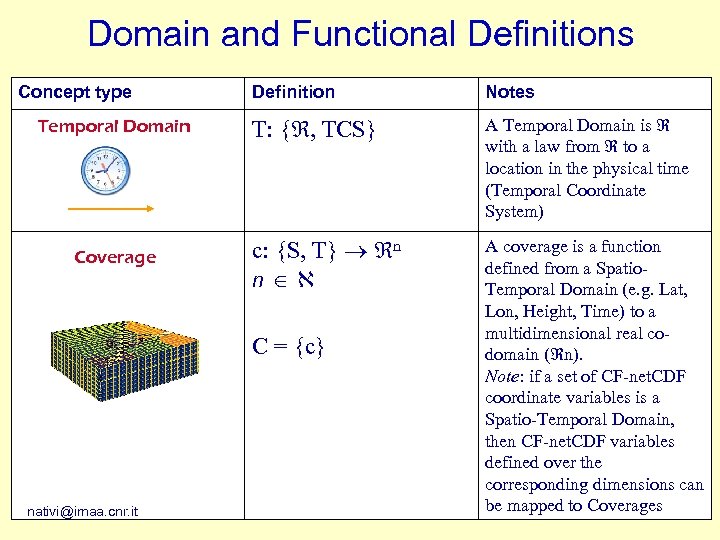
Domain and Functional Definitions Concept type Temporal Domain Coverage Definition Notes T: { , TCS} A Temporal Domain is with a law from to a location in the physical time (Temporal Coordinate System) c: {S, T} n n A coverage is a function defined from a Spatio. Temporal Domain (e. g. Lat, Lon, Height, Time) to a multidimensional real codomain ( n). Note: if a set of CF-net. CDF coordinate variables is a Spatio-Temporal Domain, then CF-net. CDF variables defined over the corresponding dimensions can be mapped to Coverages C = {c} nativi@imaa. cnr. it
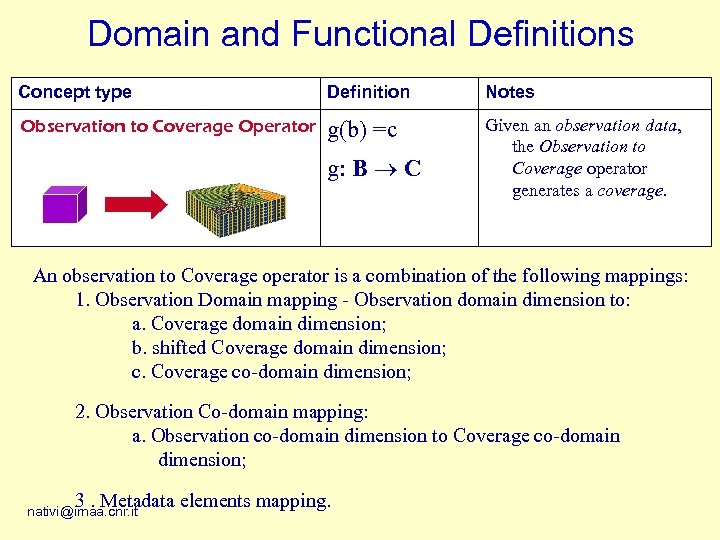
Domain and Functional Definitions Concept type Definition Notes Observation to Coverage Operator g(b) =c Given an observation data, the Observation to Coverage operator generates a coverage. g: B C An observation to Coverage operator is a combination of the following mappings: 1. Observation Domain mapping - Observation domain dimension to: a. Coverage domain dimension; b. shifted Coverage domain dimension; c. Coverage co-domain dimension; 2. Observation Co-domain mapping: a. Observation co-domain dimension to Coverage co-domain dimension; 3. Metadata elements mapping. nativi@imaa. cnr. it
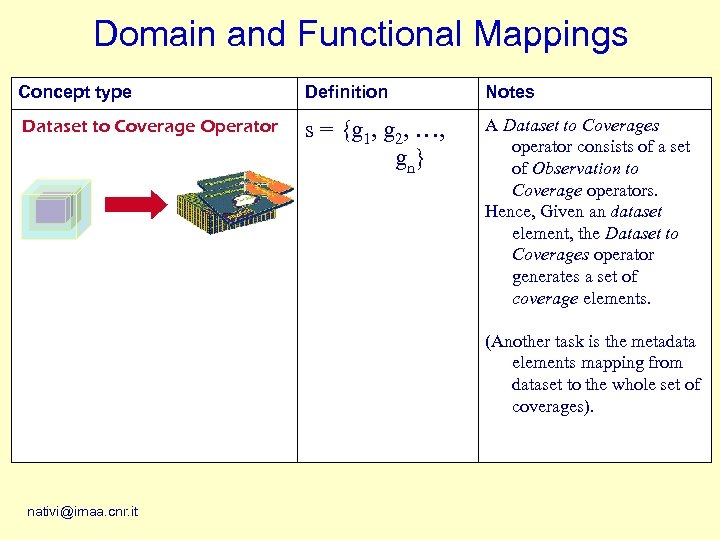
Domain and Functional Mappings Concept type Definition Notes Dataset to Coverage Operator s = {g 1, g 2, …, gn} A Dataset to Coverages operator consists of a set of Observation to Coverage operators. Hence, Given an dataset element, the Dataset to Coverages operator generates a set of coverage elements. (Another task is the metadata elements mapping from dataset to the whole set of coverages). nativi@imaa. cnr. it
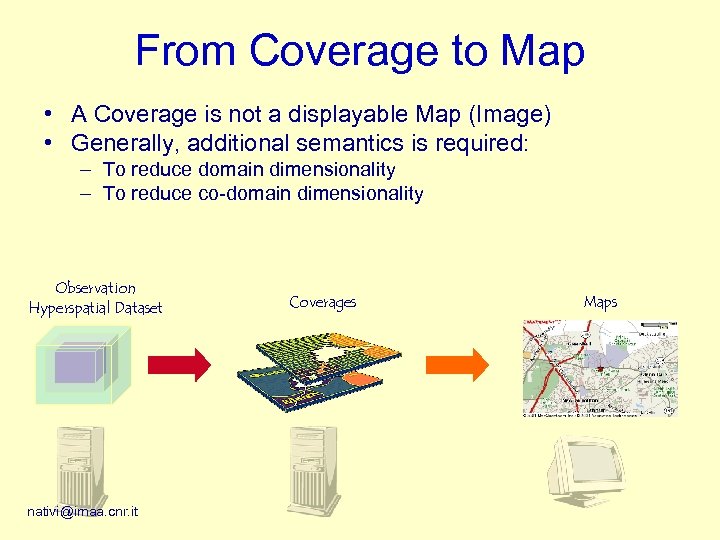
From Coverage to Map • A Coverage is not a displayable Map (Image) • Generally, additional semantics is required: – To reduce domain dimensionality – To reduce co-domain dimensionality Observation Hyperspatial Dataset nativi@imaa. cnr. it Coverages Maps
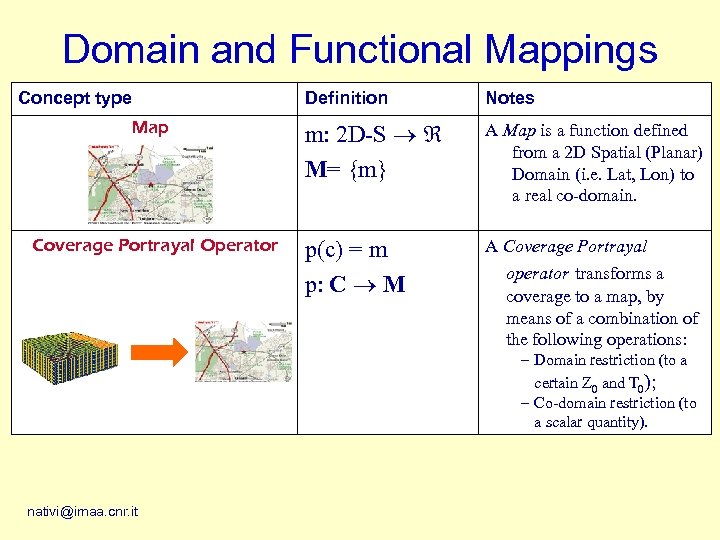
Domain and Functional Mappings Concept type Map Coverage Portrayal Operator Definition Notes m: 2 D-S M= {m} A Map is a function defined from a 2 D Spatial (Planar) Domain (i. e. Lat, Lon) to a real co-domain. p(c) = m p: C M A Coverage Portrayal operator transforms a coverage to a map, by means of a combination of the following operations: – Domain restriction (to a certain Z 0 and T 0); – Co-domain restriction (to a scalar quantity). nativi@imaa. cnr. it
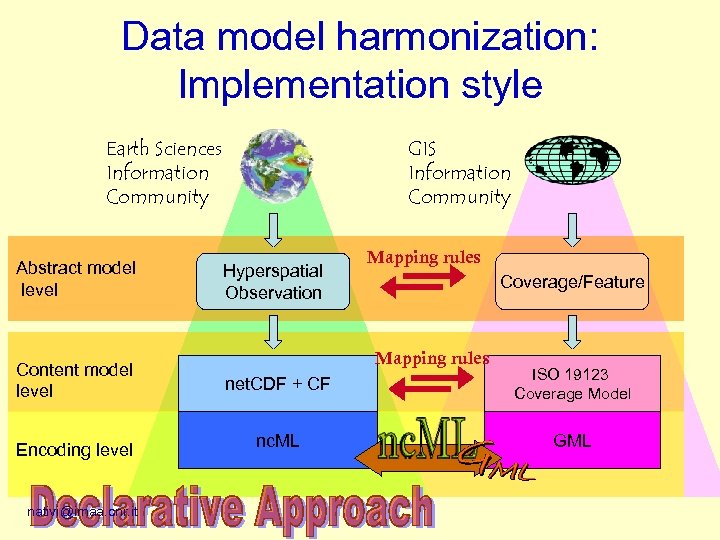
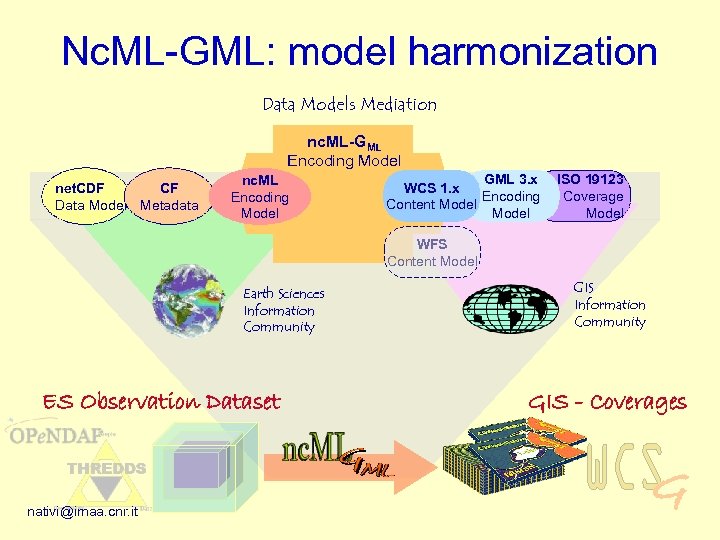
Data model harmonization: Implementation style Earth Sciences Information Community Abstract model level GIS Information Community Hyperspatial Observation Mapping rules Coverage/Feature Mapping rules Content model level net. CDF + CF ISO 19123 Coverage Model Encoding level nc. ML GML nativi@imaa. cnr. it
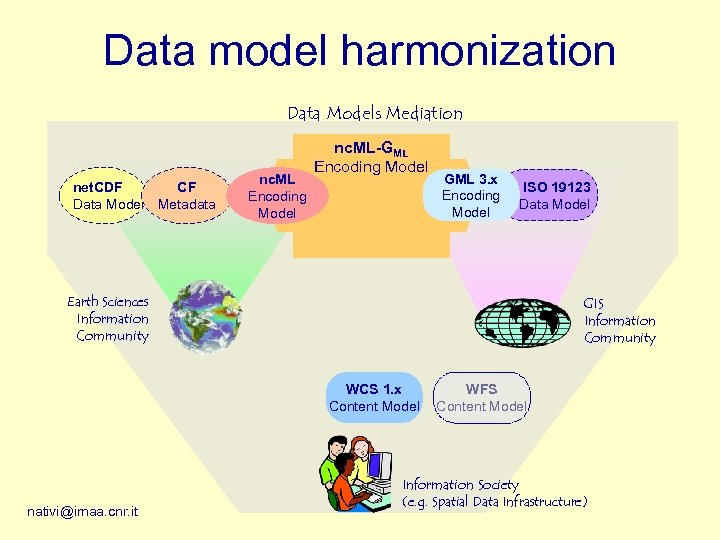
Data model harmonization Data Models Mediation net. CDF CF Data Model Metadata nc. ML Encoding Model nc. ML-GML Encoding Model GML 3. x Encoding Model ISO 19123 Data Model Earth Sciences Information Community GIS Information Community WCS 1. x Content Model nativi@imaa. cnr. it WFS Content Model Information Society (e. g. Spatial Data Infrastructure)
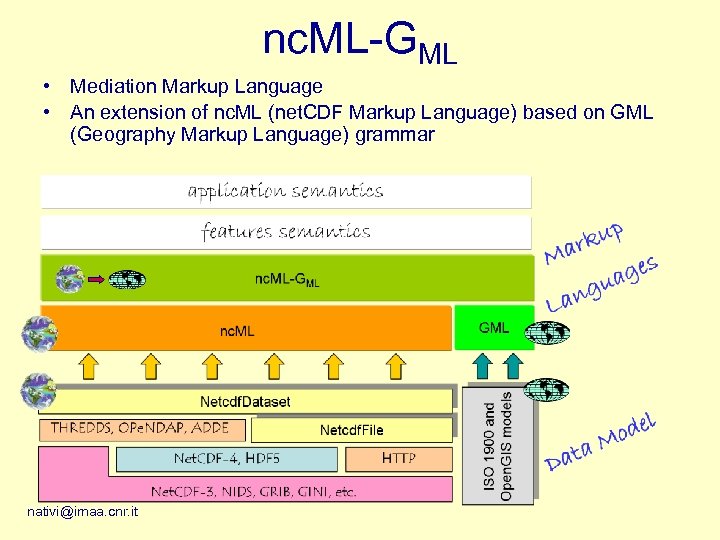
nc. ML-GML • Mediation Markup Language • An extension of nc. ML (net. CDF Markup Language) based on GML (Geography Markup Language) grammar nativi@imaa. cnr. it
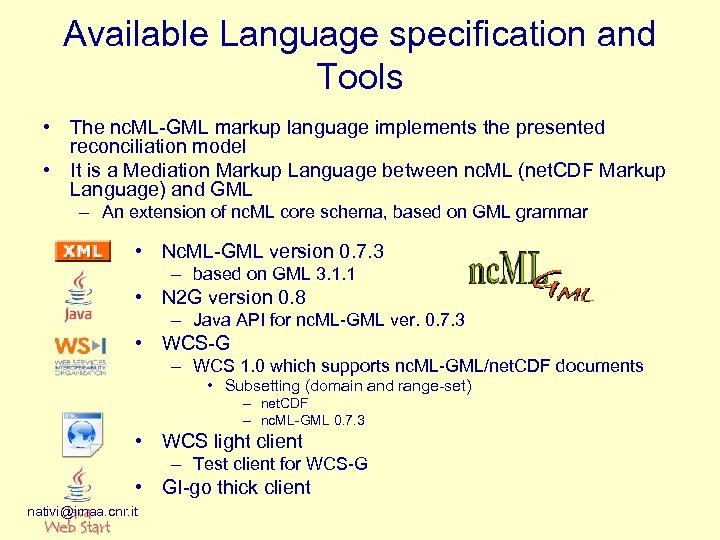
Available Language specification and Tools • The nc. ML-GML markup language implements the presented reconciliation model • It is a Mediation Markup Language between nc. ML (net. CDF Markup Language) and GML – An extension of nc. ML core schema, based on GML grammar • Nc. ML-GML version 0. 7. 3 – based on GML 3. 1. 1 • N 2 G version 0. 8 – Java API for nc. ML-GML ver. 0. 7. 3 • WCS-G – WCS 1. 0 which supports nc. ML-GML/net. CDF documents • Subsetting (domain and range-set) – net. CDF – nc. ML-GML 0. 7. 3 • WCS light client – Test client for WCS-G • GI-go thick client nativi@imaa. cnr. it Java Web Start
Experiments nativi@imaa. cnr. it
OGC GALEON IE • OGC Interoperability experiment: Geo-interface for Air, Land, Earth, Oceans Net. CDF • Ben Domenico (UCAR/UNIDATA) is the PI • Main objectives – Evaluate net. CDF/OPe. NDAP as WCS data transport vehicle – Evaluate effectiveness of nc. ML-GML in WCS data encoding – Investigate WCS protocol adequacy for serving and interacting with (4 and 5 D) datasets involving multiple parameters (e. g. , temperature, pressure, wind speed and direction) –. . . suggest extensions to WCS and GML spec. s nativi@imaa. cnr. it
GALEON • Partecipants – Unidata/UCAR – NASA Geospatial Interoperability Office – IMAA CNR / University of Florence – George Mason University – Cad. Corp – JPL – Interactive Instruments – University of Applied Sciences – International University Bremen – NERC NCAS/British Atmospheric Data Center – University of Alabama Huntsville – Research Systems, Inc. (IDL) – Texas A&M University nativi@imaa. cnr. it
GALEON • Interested Observers – EDINA: Edinburgh U. Data Library – Harvard University – ESRI • OGC non-member Interest in Gateway Implementation – University of Rhode Island (OPe. NDAP group) – Pacific Marine Environment Laboratory (PMEL) – Marine Metadata Initiative lead by MBARI (Monterey Bay Aquarium Research Institute) – GODAE (Global Ocean Data Assimilation Experiment) led by FNMOC (Fleet Numerical Meteorological and Oceanographic Center) – Many current THREDDS/OPe. NDAP server sites – KLNMI, Metoffice, etc. nativi@imaa. cnr. it
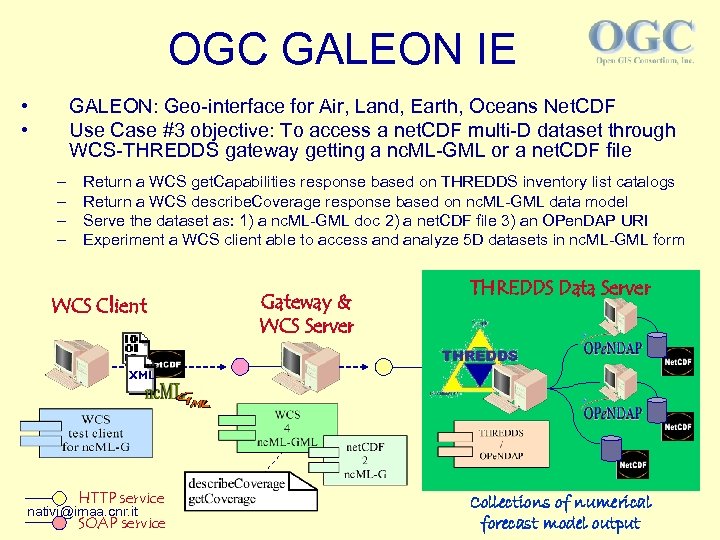
OGC GALEON IE • • GALEON: Geo-interface for Air, Land, Earth, Oceans Net. CDF Use Case #3 objective: To access a net. CDF multi-D dataset through WCS-THREDDS gateway getting a nc. ML-GML or a net. CDF file – – Return a WCS get. Capabilities response based on THREDDS inventory list catalogs Return a WCS describe. Coverage response based on nc. ML-GML data model Serve the dataset as: 1) a nc. ML-GML doc 2) a net. CDF file 3) an OPen. DAP URI Experiment a WCS client able to access and analyze 5 D datasets in nc. ML-GML form WCS Client Gateway & WCS Server THREDDS Data Server XML HTTP service nativi@imaa. cnr. it SOAP service Collections of numerical forecast model output
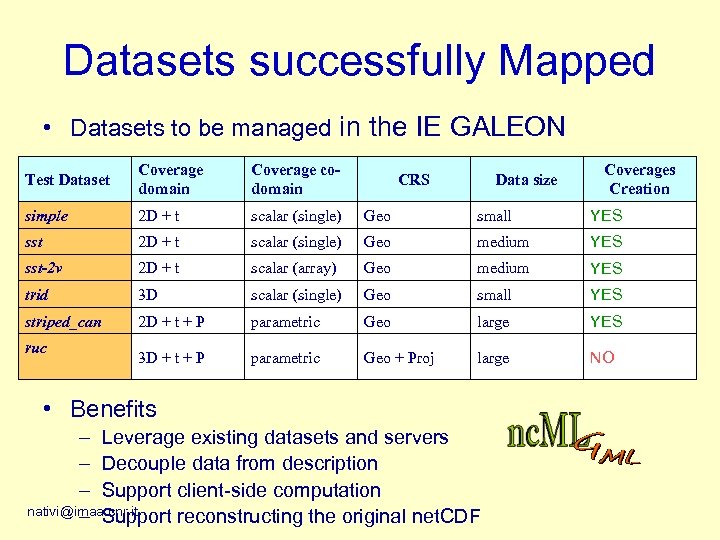
Datasets successfully Mapped • Datasets to be managed in the IE GALEON Test Dataset Coverage domain Coverage codomain simple 2 D + t scalar (single) Geo small YES sst 2 D + t scalar (single) Geo medium YES sst-2 v 2 D + t scalar (array) Geo medium YES trid 3 D scalar (single) Geo small YES striped_can 2 D + t + P parametric Geo large YES 3 D + t + P parametric Geo + Proj large NO ruc CRS Data size • Benefits – Leverage existing datasets and servers – Decouple data from description – Support client-side computation nativi@imaa. cnr. it – Support reconstructing the original net. CDF Coverages Creation
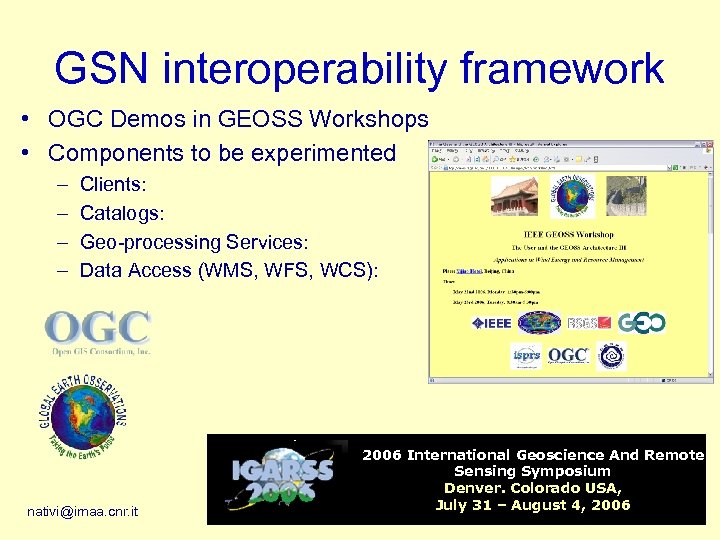
GSN interoperability framework • OGC Demos in GEOSS Workshops • Components to be experimented – – Clients: Catalogs: Geo-processing Services: Data Access (WMS, WFS, WCS): nativi@imaa. cnr. it 2006 International Geoscience And Remote Sensing Symposium Denver. Colorado USA, July 31 – August 4, 2006
SDI Experiment nativi@imaa. cnr. it
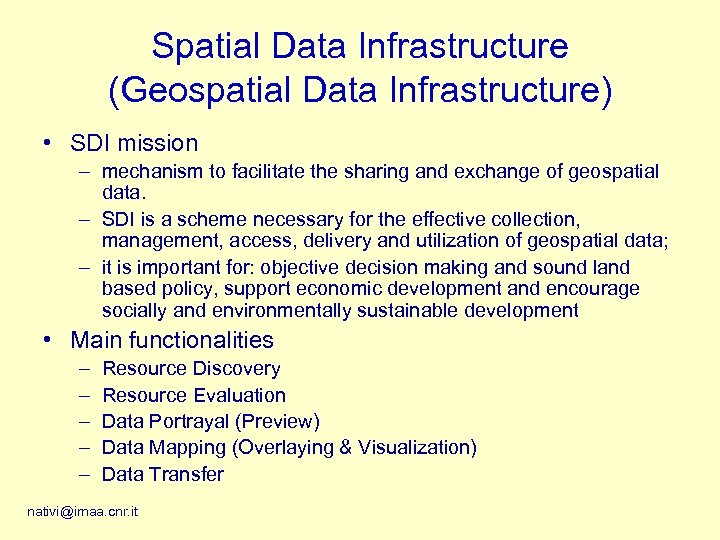
Spatial Data Infrastructure (Geospatial Data Infrastructure) • SDI mission – mechanism to facilitate the sharing and exchange of geospatial data. – SDI is a scheme necessary for the effective collection, management, access, delivery and utilization of geospatial data; – it is important for: objective decision making and sound land based policy, support economic development and encourage socially and environmentally sustainable development • Main functionalities – – – Resource Discovery Resource Evaluation Data Portrayal (Preview) Data Mapping (Overlaying & Visualization) Data Transfer nativi@imaa. cnr. it
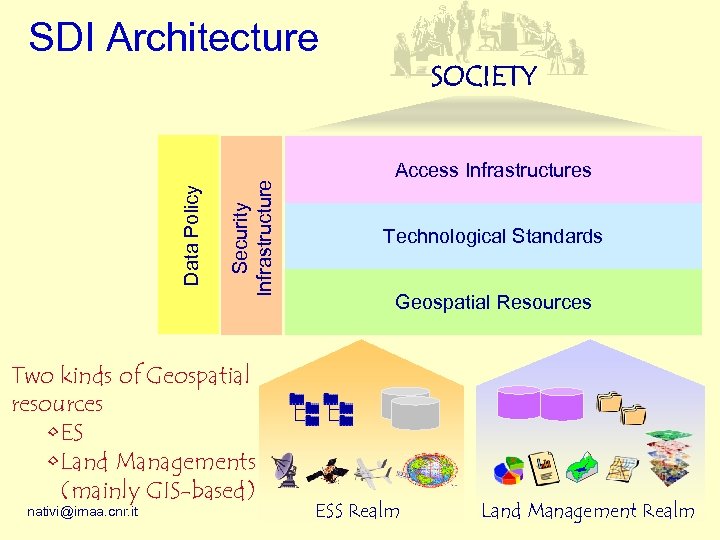
Security Infrastructure Data Policy SDI Architecture Two kinds of Geospatial resources • ES • Land Managements (mainly GIS-based) nativi@imaa. cnr. it SOCIETY Access Infrastructures Technological Standards Geospatial Resources ESS Realm Land Management Realm
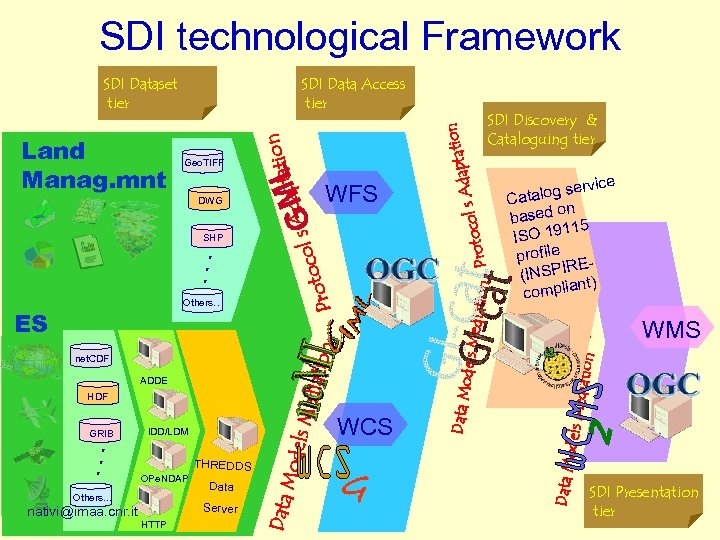
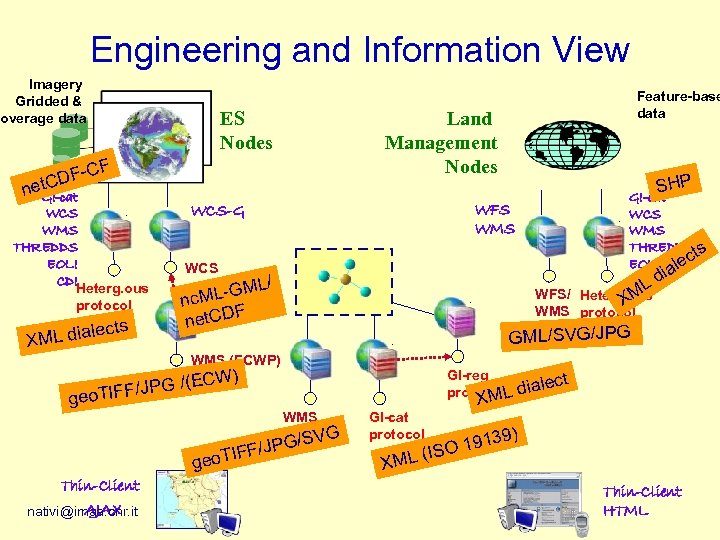
SDI technological Framework OPe. NDAP Others. . . Data Server nativi@imaa. cnr. it HTTP G ion ediation Protoco 2 dapt col s A ptat l s Ada WMS odels M THREDDS WCS vice log ser Cata on based 115 ISO 19 profile RE(INSPI t) an compli Data M . . . IDD/LDM Data ADDE HDF Mod els M ediat net. CDF GRIB ation ES SDI Discovery & Cataloguing tier ediation Proto Others. . . odels M . . . WFS Data M SHP G DWG ls toco Pro Geo. TIFF ti apta Ad Land Manag. mnt SDI Data Access tier L on M SDI Dataset tier SDI Presentation tier
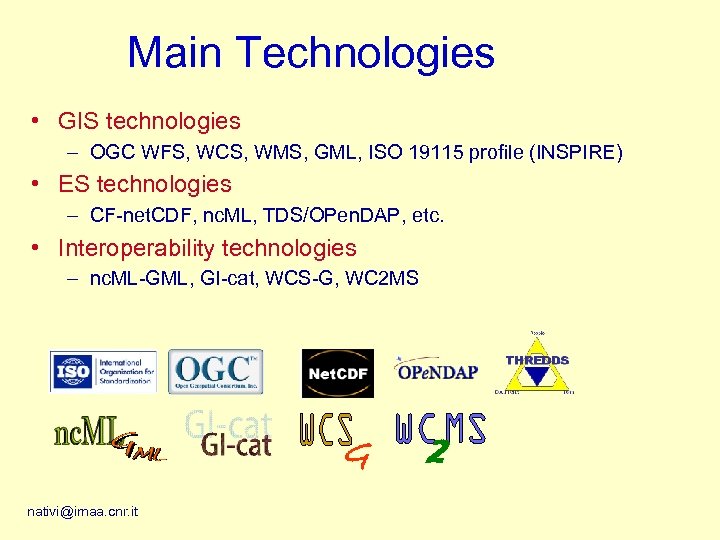
Main Technologies • GIS technologies – OGC WFS, WCS, WMS, GML, ISO 19115 profile (INSPIRE) • ES technologies – CF-net. CDF, nc. ML, TDS/OPen. DAP, etc. • Interoperability technologies – nc. ML-GML, GI-cat, WCS-G, WC 2 MS G nativi@imaa. cnr. it 2
Nc. ML-GML: model harmonization Data Models Mediation nc. ML-GML Encoding Model net. CDF CF Data Model Metadata nc. ML Encoding Model GML 3. x WCS 1. x Encoding Content Model ISO 19123 Coverage Model WFS Content Model Earth Sciences Information Community ES Observation Dataset nativi@imaa. cnr. it GIS Information Community GIS - Coverages G
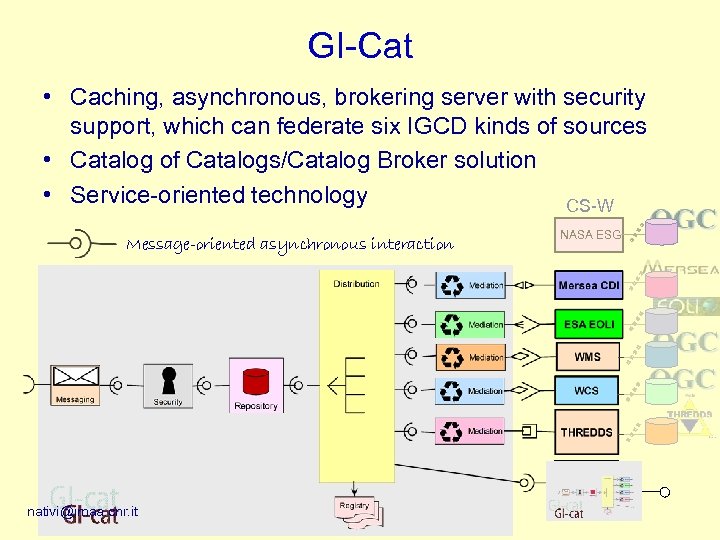
GI-Cat • Caching, asynchronous, brokering server with security support, which can federate six IGCD kinds of sources • Catalog of Catalogs/Catalog Broker solution • Service-oriented technology CS-W Message-oriented asynchronous interaction nativi@imaa. cnr. it NASA ESG
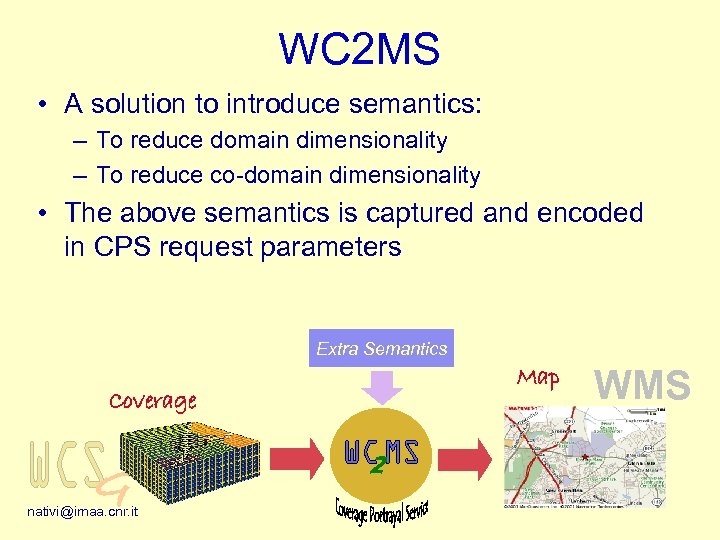
WC 2 MS • A solution to introduce semantics: – To reduce domain dimensionality – To reduce co-domain dimensionality • The above semantics is captured and encoded in CPS request parameters Extra Semantics Map Coverage G nativi@imaa. cnr. it 2 WMS
Engineering and Information View Imagery Gridded & Coverage data ES Nodes Land Management Nodes F DF-C net. C GI-cat WCS WMS THREDDS EOLI CDI Heterg. ous protocol lects XML dia SHP GI-cat WFS WMS WCS-G WCS WMS THREDDS ts EOLI lec ia CDI d WFS/ Heterg. ous ML X WMS protocol WCS ML/ ML-G nc F WC 2 MS net. CD GML/SVG/JPG WMS (ECWP) CW) /JPG /(E geo. TIFF GI-reg protocol L M X WMS G SV /JPG/ TIFF geo Thin-Client AJAX nativi@imaa. cnr. it Feature-base data GI-cat protocol XML t dialec 9) ( 913 ISO 1 Thin-Client HTML
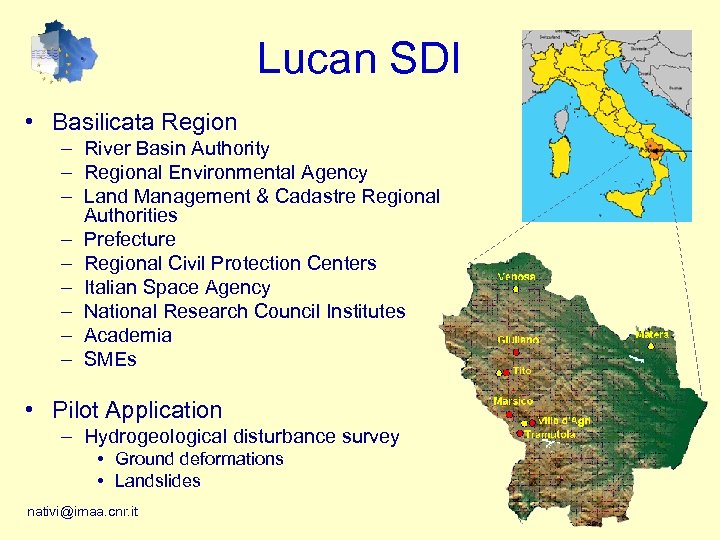
Lucan SDI • Basilicata Region – River Basin Authority – Regional Environmental Agency – Land Management & Cadastre Regional Authorities – Prefecture – Regional Civil Protection Centers – Italian Space Agency – National Research Council Institutes – Academia – SMEs • Pilot Application – Hydrogeological disturbance survey • Ground deformations • Landslides nativi@imaa. cnr. it
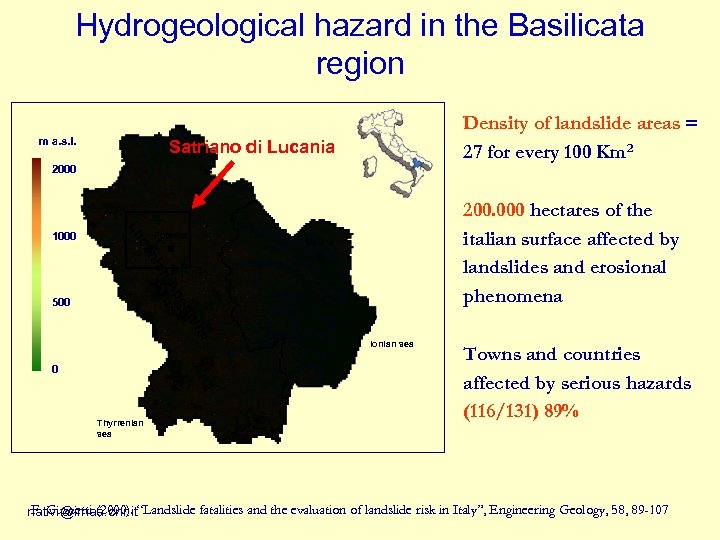
Hydrogeological hazard in the Basilicata region m a. s. l. Density of landslide areas = 27 for every 100 Km 2 Satriano di Lucania 2000 Lu . . Potenza Matera ian n ca 1000 200. 000 hectares of the italian surface affected by landslides and erosional phenomena Ap e nin en 500 0 Thyrrenian sea Ionian sea Towns and countries affected by serious hazards (116/131) 89% F. Guzzetti (2000). nativi@imaa. cnr. it“Landslide fatalities and the evaluation of landslide risk in Italy”, Engineering Geology, 58, 89 -107
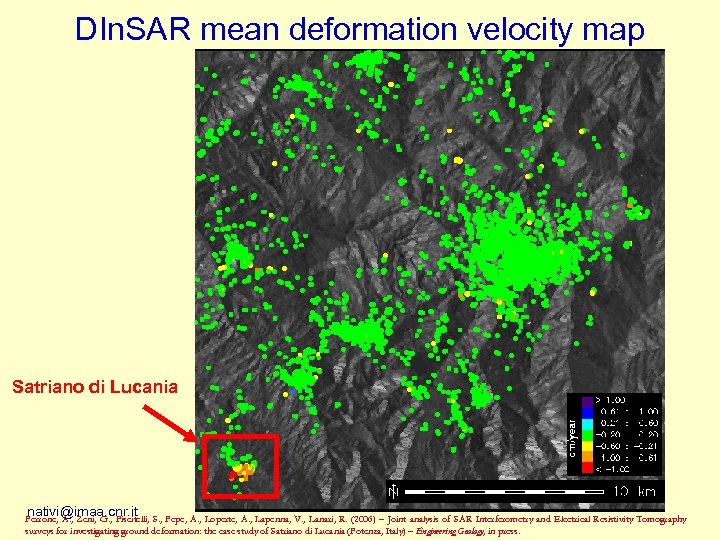
DIn. SAR mean deformation velocity map Satriano di Lucania nativi@imaa. cnr. it Perrone, A. , Zeni, G. , Piscitelli, S. , Pepe, A. , Loperte, A. , Lapenna, V. , Lanari, R. (2006) – Joint analysis of SAR Interferometry and Electrical Resistivity Tomography surveys for investigating ground deformation: the case study of Satriano di Lucania (Potenza, Italy) – Engineering Geology, in press.
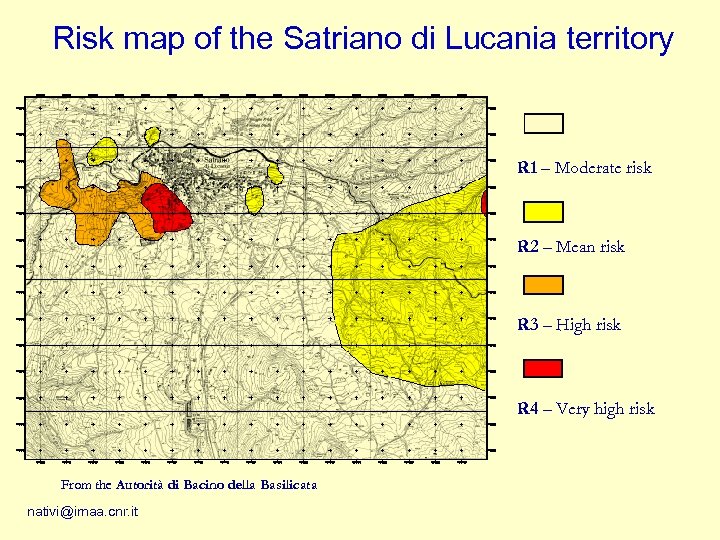
Risk map of the Satriano di Lucania territory R 1 – Moderate risk R 2 – Mean risk R 3 – High risk R 4 – Very high risk From the Autorità di Bacino della Basilicata nativi@imaa. cnr. it
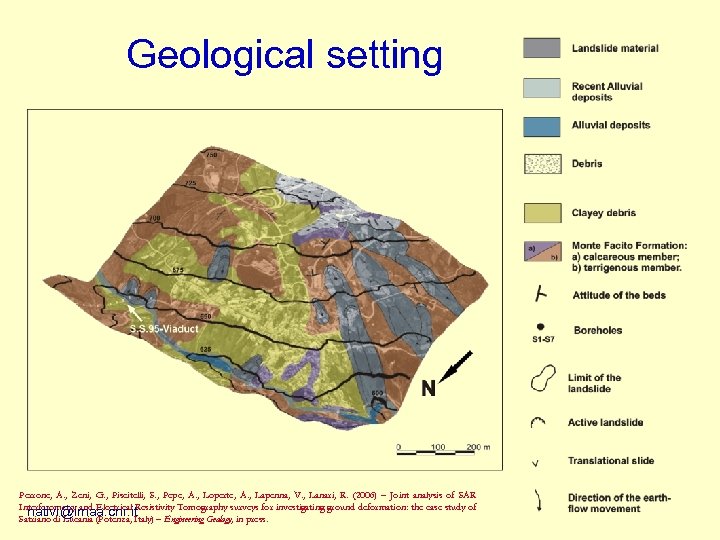
Geological setting Perrone, A. , Zeni, G. , Piscitelli, S. , Pepe, A. , Loperte, A. , Lapenna, V. , Lanari, R. (2006) – Joint analysis of SAR Interferometry and Electrical Resistivity Tomography surveys for investigating ground deformation: the case study of nativi@imaa. cnr. it Satriano di Lucania (Potenza, Italy) – Engineering Geology, in press.
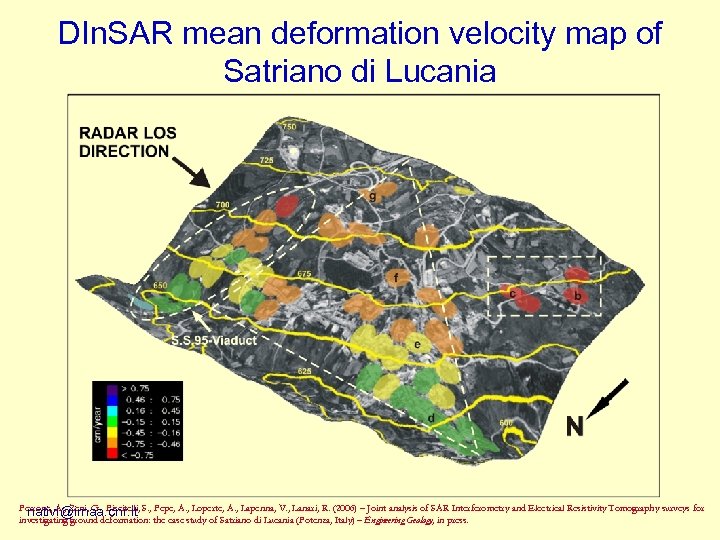
DIn. SAR mean deformation velocity map of Satriano di Lucania Perrone, A. , Zeni, G. , Piscitelli, S. , Pepe, A. , Loperte, A. , Lapenna, V. , Lanari, R. (2006) – Joint analysis of SAR Interferometry and Electrical Resistivity Tomography surveys for nativi@imaa. cnr. it investigating ground deformation: the case study of Satriano di Lucania (Potenza, Italy) – Engineering Geology, in press.
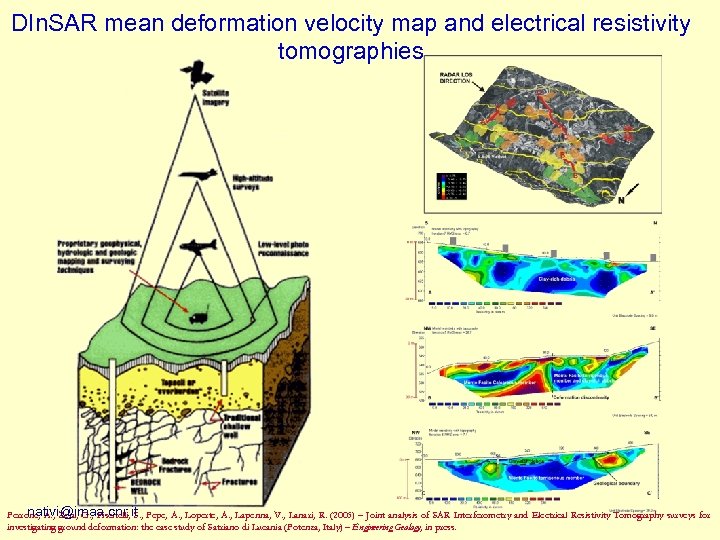
DIn. SAR mean deformation velocity map and electrical resistivity tomographies nativi@imaa. cnr. it Perrone, A. , Zeni, G. , Piscitelli, S. , Pepe, A. , Loperte, A. , Lapenna, V. , Lanari, R. (2006) – Joint analysis of SAR Interferometry and Electrical Resistivity Tomography surveys for investigating ground deformation: the case study of Satriano di Lucania (Potenza, Italy) – Engineering Geology, in press.
CYCLOPS Project nativi@imaa. cnr. it
CYCLOPS project • CYber-Infrastructure for Civi. L protection Operative Procedure. S • Special Support Action funded by the EC • Support the GMES Community to develop specific services based on Grid technology • Multidisciplinary project – Civil Protections/GMES Community • Italian CP, French CP, Portuguese CP, Prefecture of Chania (Greece) – Grid Community • INFN/CERN (EGEE people) – Geospatial Community • CNR-IMAA, TEI (Greece) • website: http: //www. cyclops-project. eu nativi@imaa. cnr. it
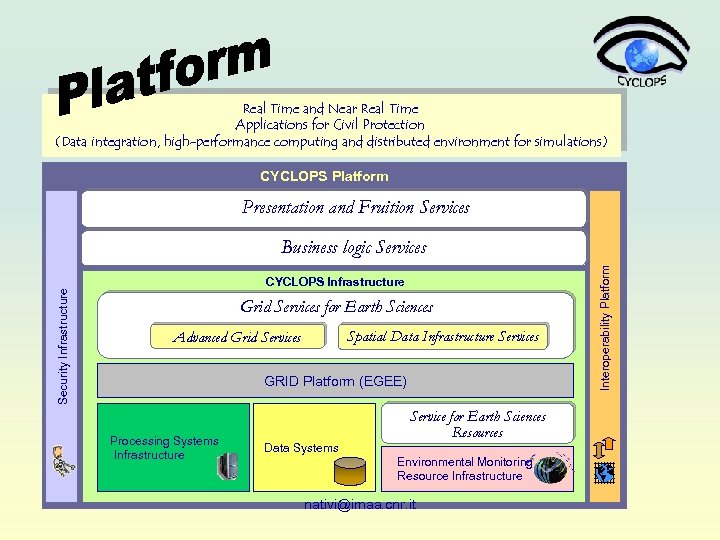
Real Time and Near Real Time Applications for Civil Protection (Data integration, high-performance computing and distributed environment for simulations) CYCLOPS Platform Presentation and Fruition Services CYCLOPS Infrastructure Grid Services for Earth Sciences Spatial Data Infrastructure Services Advanced Grid Services GRID Platform (EGEE) Processing Systems Infrastructure Service for Earth Sciences Resources Data Systems Environmental Monitoring Resource Infrastructure nativi@imaa. cnr. it Interoperability Platform Security Infrastructure Business logic Services
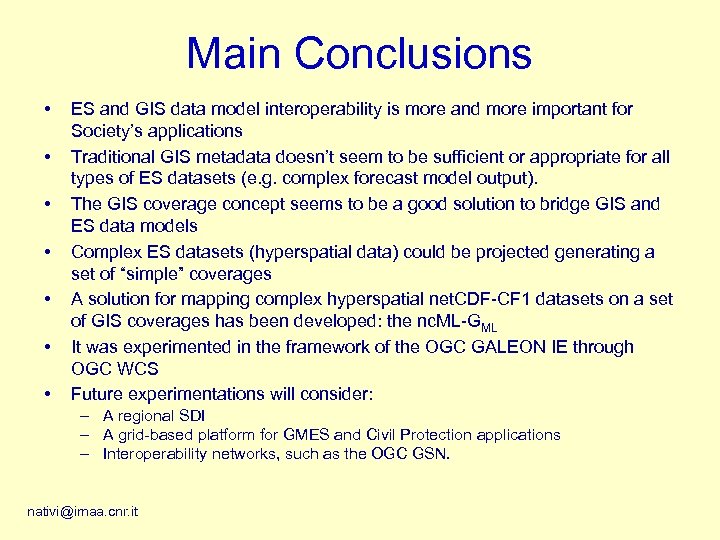
Main Conclusions • • ES and GIS data model interoperability is more and more important for Society’s applications Traditional GIS metadata doesn’t seem to be sufficient or appropriate for all types of ES datasets (e. g. complex forecast model output). The GIS coverage concept seems to be a good solution to bridge GIS and ES data models Complex ES datasets (hyperspatial data) could be projected generating a set of “simple” coverages A solution for mapping complex hyperspatial net. CDF-CF 1 datasets on a set of GIS coverages has been developed: the nc. ML-GML It was experimented in the framework of the OGC GALEON IE through OGC WCS Future experimentations will consider: – A regional SDI – A grid-based platform for GMES and Civil Protection applications – Interoperability networks, such as the OGC GSN. nativi@imaa. cnr. it
Скачать презентацию Seminar at NCAR and UCAR-UOP —-Boulder CO USA
b4b0ae6d6254a2e66fa7fdec76a6a247.ppt