


 Скачать презентацию SÉMINAIRE INTERNATIONAL SUR LA FORMATION PROFESSIONNNELLE Systèmes
1cca935676582bf38f836b2a97b64d1a.ppt
- Количество слайдов: 19
 SÉMINAIRE INTERNATIONAL SUR LA FORMATION PROFESSIONNNELLE : Systèmes, innovations et résultats THE VOCATIONAL TRAINING SYSTEM IN MEXICO: MAIN TRAITS, ACTORS, STRENGTHS AND WEAKNESSES Arnulfo Arteaga García Sergio Sierra Romero Roberto Flores Lima Montreal June 6 -8, 2005
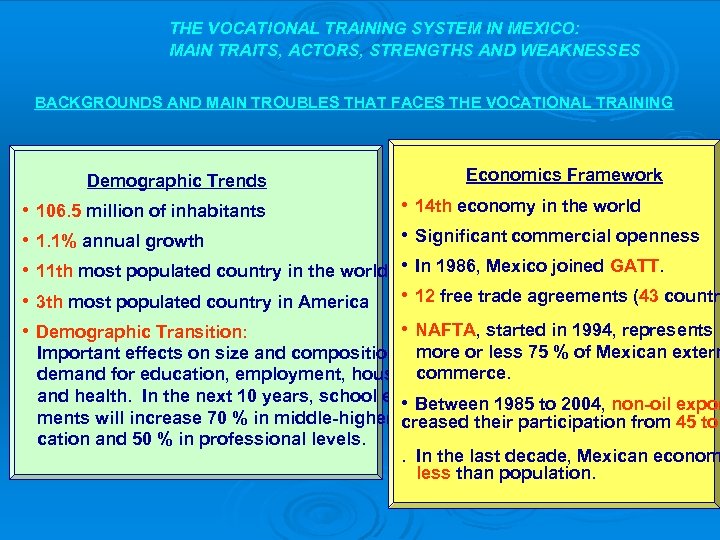 THE VOCATIONAL TRAINING SYSTEM IN MEXICO: MAIN TRAITS, ACTORS, STRENGTHS AND WEAKNESSES BACKGROUNDS AND MAIN TROUBLES THAT FACES THE VOCATIONAL TRAINING Demographic Trends • • 1. 1% annual growth 11 th most populated country in the world • • 3 th most populated country in America 106. 5 million of inhabitants Economics Framework 14 th economy in the world Significant commercial openness In 1986, Mexico joined GATT. 12 free trade agreements (43 countri • NAFTA, started in 1994, represents Demographic Transition: more or less 75 % of Mexican extern Important effects on size and composition of commerce. demand for education, employment, housing and health. In the next 10 years, school enroll • Between 1985 to 2004, non-oil expor ments will increase 70 % in middle-higher educreased their participation from 45 to cation and 50 % in professional levels. . In the last decade, Mexican econom less than population.
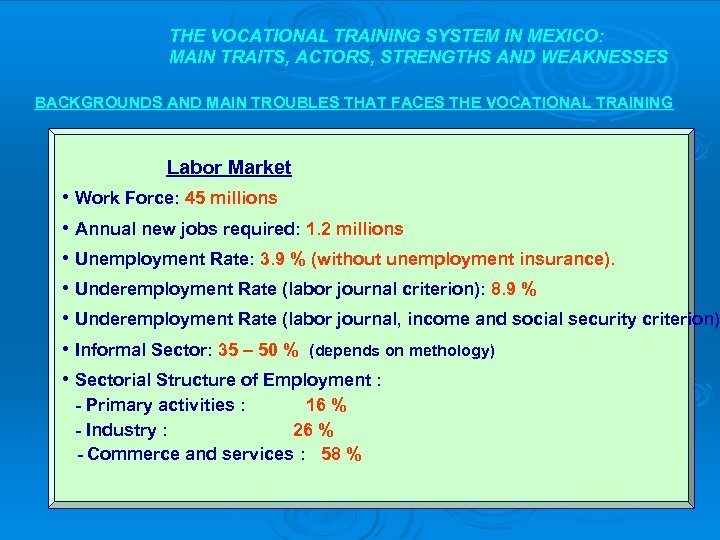 THE VOCATIONAL TRAINING SYSTEM IN MEXICO: MAIN TRAITS, ACTORS, STRENGTHS AND WEAKNESSES BACKGROUNDS AND MAIN TROUBLES THAT FACES THE VOCATIONAL TRAINING Labor Market • • Work Force: 45 millions Annual new jobs required: 1. 2 millions Unemployment Rate: 3. 9 % (without unemployment insurance). Underemployment Rate (labor journal criterion): 8. 9 % Underemployment Rate (labor journal, income and social security criterion) Informal Sector: 35 – 50 % (depends on methology) Sectorial Structure of Employment : - Primary activities : 16 % - Industry : 26 % - Commerce and services : 58 %
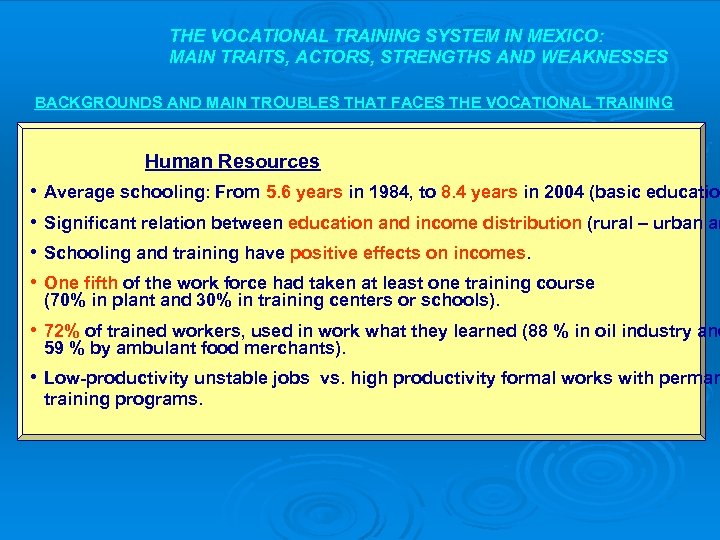 THE VOCATIONAL TRAINING SYSTEM IN MEXICO: MAIN TRAITS, ACTORS, STRENGTHS AND WEAKNESSES BACKGROUNDS AND MAIN TROUBLES THAT FACES THE VOCATIONAL TRAINING Human Resources • • Average schooling: From 5. 6 years in 1984, to 8. 4 years in 2004 (basic education Significant relation between education and income distribution (rural – urban ar Schooling and training have positive effects on incomes. One fifth of the work force had taken at least one training course (70% in plant and 30% in training centers or schools). • 72% of trained workers, used in work what they learned (88 % in oil industry and 59 % by ambulant food merchants). • Low-productivity unstable jobs vs. high productivity formal works with perman training programs.
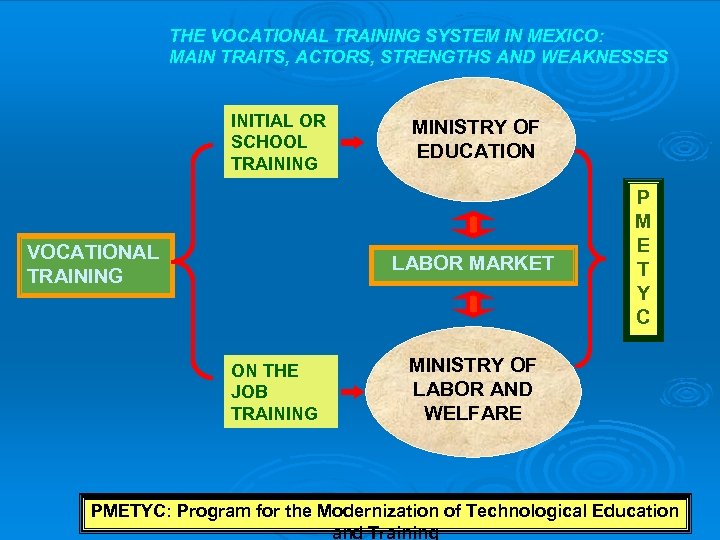 THE VOCATIONAL TRAINING SYSTEM IN MEXICO: MAIN TRAITS, ACTORS, STRENGTHS AND WEAKNESSES INITIAL OR SCHOOL TRAINING VOCATIONAL TRAINING MINISTRY OF EDUCATION LABOR MARKET ON THE JOB TRAINING P M E T Y C MINISTRY OF LABOR AND WELFARE PMETYC: Program for the Modernization of Technological Education and Training
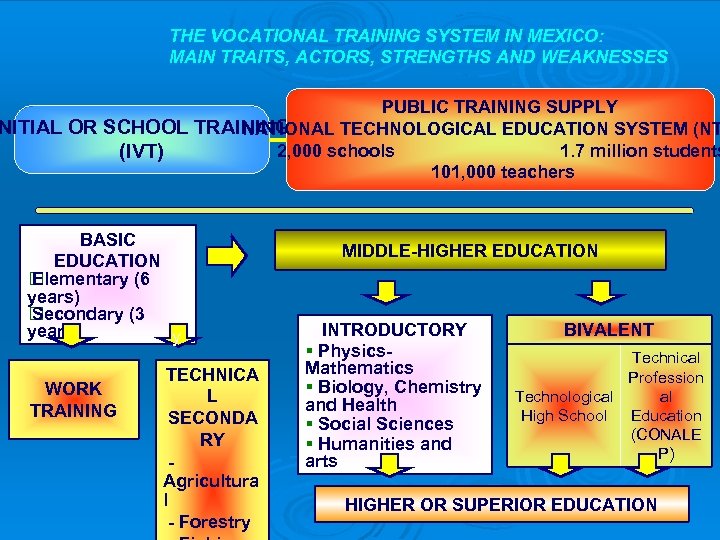 THE VOCATIONAL TRAINING SYSTEM IN MEXICO: MAIN TRAITS, ACTORS, STRENGTHS AND WEAKNESSES PUBLIC TRAINING SUPPLY NITIAL OR SCHOOL TRAINING NATIONAL TECHNOLOGICAL EDUCATION SYSTEM (NT 2, 000 schools 1. 7 million students (IVT) 101, 000 teachers BASIC EDUCATION Elementary (6 years) Secondary (3 years) y WORK TRAINING TECHNICA L SECONDA RY Agricultura l - Forestry MIDDLE-HIGHER EDUCATION INTRODUCTORY § Physics. Mathematics § Biology, Chemistry and Health § Social Sciences § Humanities and arts BIVALENT Technical Profession al Technological High School Education (CONALE P) HIGHER OR SUPERIOR EDUCATION
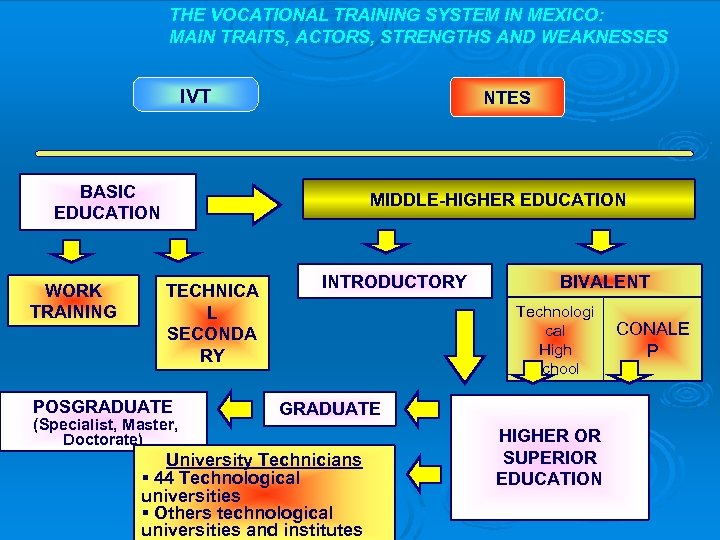 THE VOCATIONAL TRAINING SYSTEM IN MEXICO: MAIN TRAITS, ACTORS, STRENGTHS AND WEAKNESSES IVT NTES BASIC EDUCATION WORK TRAINING MIDDLE-HIGHER EDUCATION TECHNICA L SECONDA RY POSGRADUATE (Specialist, Master, Doctorate) INTRODUCTORY BIVALENT Technologi cal High School GRADUATE University Technicians § 44 Technological universities § Others technological universities and institutes HIGHER OR SUPERIOR EDUCATION CONALE P
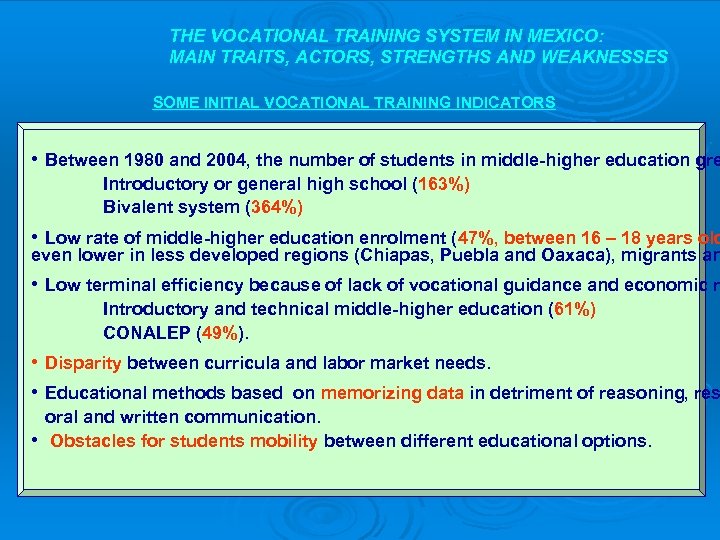 THE VOCATIONAL TRAINING SYSTEM IN MEXICO: MAIN TRAITS, ACTORS, STRENGTHS AND WEAKNESSES SOME INITIAL VOCATIONAL TRAINING INDICATORS • Between 1980 and 2004, the number of students in middle-higher education gre Introductory or general high school (163%) Bivalent system (364%) • Low rate of middle-higher education enrolment (47%, between 16 – 18 years old even lower in less developed regions (Chiapas, Puebla and Oaxaca), migrants an • Low terminal efficiency because of lack of vocational guidance and economic r Introductory and technical middle-higher education (61%) CONALEP (49%). • Disparity between curricula and labor market needs. • Educational methods based on memorizing data in detriment of reasoning, res oral and written communication. • Obstacles for students mobility between different educational options.
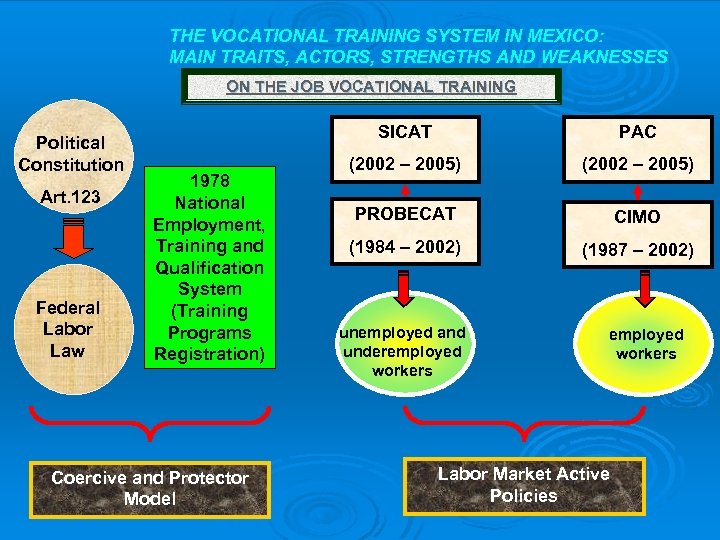 THE VOCATIONAL TRAINING SYSTEM IN MEXICO: MAIN TRAITS, ACTORS, STRENGTHS AND WEAKNESSES ON THE JOB VOCATIONAL TRAINING Political Constitution Art. 123 Federal Labor Law SICAT 1978 National Employment, Training and Qualification System (Training Programs Registration) Coercive and Protector Model PAC (2002 – 2005) PROBECAT CIMO (1984 – 2002) (1987 – 2002) unemployed and underemployed workers Labor Market Active Policies
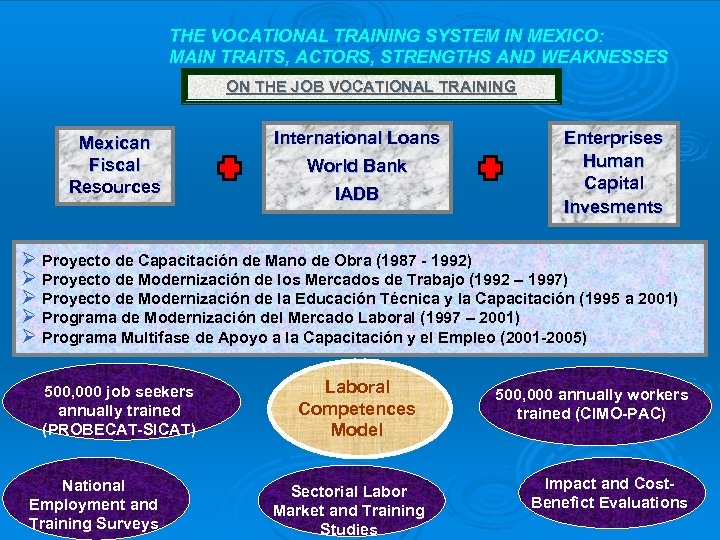 THE VOCATIONAL TRAINING SYSTEM IN MEXICO: MAIN TRAITS, ACTORS, STRENGTHS AND WEAKNESSES ON THE JOB VOCATIONAL TRAINING Mexican Fiscal Resources International Loans World Bank IADB Enterprises Human Capital Invesments Ø Proyecto de Capacitación de Mano de Obra (1987 - 1992) Ø Proyecto de Modernización de los Mercados de Trabajo (1992 – 1997) Ø Proyecto de Modernización de la Educación Técnica y la Capacitación (1995 a 2001) Ø Programa de Modernización del Mercado Laboral (1997 – 2001) Ø Programa Multifase de Apoyo a la Capacitación y el Empleo (2001 -2005) 500, 000 job seekers annually trained (PROBECAT-SICAT) National Employment and Training Surveys Laboral Competences Model Sectorial Labor Market and Training Studies 500, 000 annually workers trained (CIMO-PAC) Impact and Cost. Benefict Evaluations
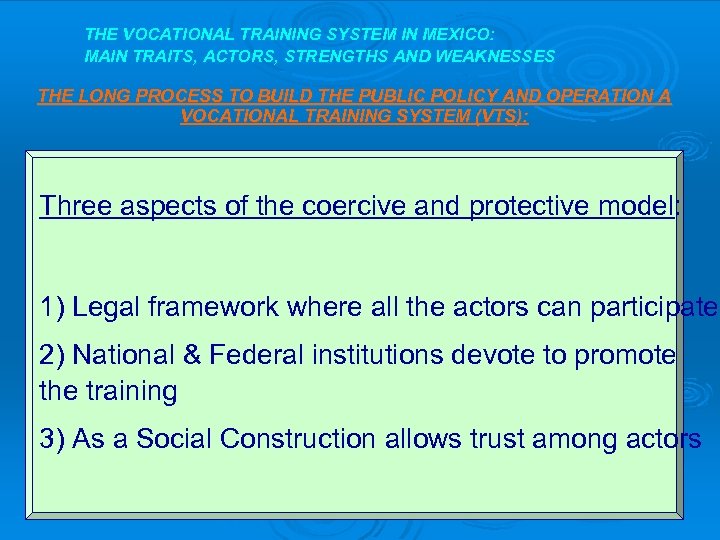 THE VOCATIONAL TRAINING SYSTEM IN MEXICO: MAIN TRAITS, ACTORS, STRENGTHS AND WEAKNESSES THE LONG PROCESS TO BUILD THE PUBLIC POLICY AND OPERATION A VOCATIONAL TRAINING SYSTEM (VTS): Three aspects of the coercive and protective model: 1) Legal framework where all the actors can participate. 2) National & Federal institutions devote to promote the training 3) As a Social Construction allows trust among actors
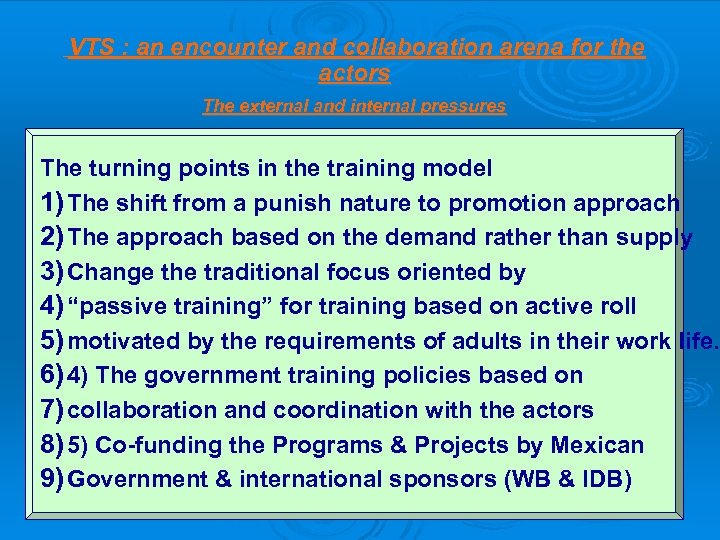 VTS : an encounter and collaboration arena for the actors The external and internal pressures The turning points in the training model 1) The shift from a punish nature to promotion approach 2) The approach based on the demand rather than supply 3) Change the traditional focus oriented by 4) “passive training” for training based on active roll 5) motivated by the requirements of adults in their work life. 6) 4) The government training policies based on 7) collaboration and coordination with the actors 8) 5) Co-funding the Programs & Projects by Mexican 9) Government & international sponsors (WB & IDB)
 The Program for the Modernization of Technological Education and Training (PMETYC) Like an instrument to change the VTS The principal goal of the PMETYC: …laying the foundations to allow the restructuring of the different forms of training for the labor force, and also for training increase its quality and become more flexible and relevant in terms of needs of workers and the national productive sector”
 The Components of the (PMETYC) I Standardized and Certificate Labor Competence Systems • Operated by Standardized and Certificate of Labor Competence Council (CONOCER) • Supported by public resources but non-official organization • Tripartite structure: 6 Government Ministries (Labor & Education operators); national organizations of employers (6), workers (5) peasants (1) The main objectives • Create the Systems for the standardization and certification of la competence • Creation of Committees for standardization by economic sector (tripartite structure including the educations institutions)
 The Components of the (PMETYC) I Standardized and Certificate Labor Competence Systems Some features about CONOCER: • Multilevel technical groups of experts in the laboral function. • 12 laboral competence areas • 62 committees and 602 norms on laboral competence. • Separated evaluation and certification process (and agents). • In 2003, CONOCER stopped operations because the Government decided to change the juridical figure.
 The Components of the (PMETYC) II Transforming the Training Supply • Operated by Education Ministry. • Training curricula adapted to productive requirements. • Oriented to facilitate the transit between education and work throughout productive life. • Education and training based on laboral competences (EBC)
 The Components of the (PMETYC) III Incentives for the demand of training an certification of competences • Operated by Labor Ministry • Create support schemes for detecting training needs a financed some of the training, evaluation and certifica actions (PROBECAT and CIMO). • The role of government is to build bridges between training and consultants services, and micro, small a mid-size businesses.
 The Components of the (PMETYC) IV Information, Evaluation, Studies and Research. • Operated by Labor and Education Ministries and CO • Integrated Information systems (laboral competence n National Occupation Catalogue and Educational curric • Studies related with laboral, educational and training m • Evaluating the project’s impact with the purpose of stra oriented CONOCER’s actions and policies.
 SOME CHALLENGES FOR CONOCER • Updating many of the Technical Standards of Labor Competen • Application and validation of more than 600 norms in the labor • Adjusting evaluation and certification cost. • Recover among all the actors, the legitimacy gained a non official institution with all the actors.