


 Скачать презентацию SEMICON West 2006 STEP Methods to Measure Improve Equipment
32ca88b032313b258fac428ada5b5117.ppt
- Количество слайдов: 32
 SEMICON West 2006 STEP Methods to Measure/Improve Equipment Productivity SEMI Software Standards Enabling Equipment Productivity & Performance Data Collection Blaine Crandell & Associates blainecrandell@aol. com July 12, 2006 Event, Venue information
 Information & Control Committee Charter SEMI software standards developed by Information & Control Committee, whose charter is: To explore, evaluate, discuss, and formulate consensus based specifications that, through voluntary compliance, will enhance the manufacturing capability of the semiconductor industry. Its scope is limited to exploring and developing standards that pertain to the interface of manufacturing tools to each other, to control computers, or to human operators, for the purpose of transferring commands and data used during the manufacturing process. July 12, 2006 SEMICON West 2006 STEP 2
 Key Software Standards Supporting Equipment Performance Data Collection • E 4 – SEMI Equipment Communications Standard 1 Message Transfer (SECS-I) • E 5 – SEMI Equipment Communications Standard 2 MESSAGE CONTENT (SECS-II) • E 30 – Generic Model for Communications and Control of Manufacturing Equipment (GEM) • E 37 – High-Speed SECS Message Services (HSMS) Generic Services • E 39 – Object Services Standard: Concepts, Behavior, and Services • E 58 – Automated Reliability, Availability, and Maintainability Standard (ARAMS): Concepts, Behavior and Services • E 116 – Specification for Equipment Performance Tracking • E 120 – Specification for the Common Equipment Model (CEM) July 12, 2006 SEMICON West 2006 STEP 3
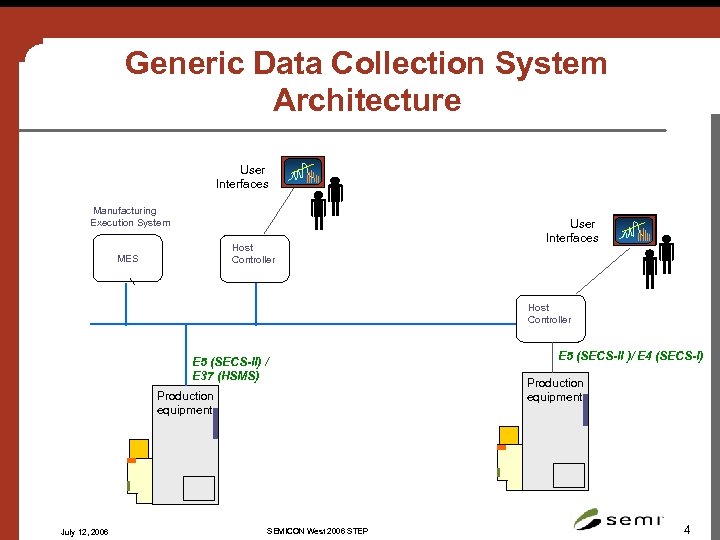 Generic Data Collection System Architecture User Interfaces Manufacturing Execution System Host Controller MES User Interfaces Host Controller E 5 (SECS-II) / E 37 (HSMS) Production equipment July 12, 2006 SEMICON West 2006 STEP E 5 (SECS-II )/ E 4 (SECS-I) Production equipment 4
 E 39 - OSS E 39 – OBJECT SERVICES STANDARD: CONCEPTS, BEHAVIOR, AND SERVICES (OSS) • Originally published in 1995 • Developed by a task force under the SEMI Information & Control Committee • Last revised in 2003 (SEMI E 39 -0703) July 12, 2006 SEMICON West 2006 STEP 5
 E 39 - OSS • Provides general terminology, conventions, and notation for describing behavior and data in terms of objects and object attributes. • Provides basic services for reading object attributes, setting their values, and for asking for an object's contents. • Intended to be referenced by other standards which define specific objects to reduce redundancy. July 12, 2006 SEMICON West 2006 STEP 6
 E 120 - CEM E 120 – SPECIFICATION FOR THE COMMON EQUIPMENT MODEL (CEM) • Originally published in 2003 • Developed by a task force under the SEMI Information & Control Committee • Last revised in 2006 (SEMI E 120 -0706) July 12, 2006 SEMICON West 2006 STEP 7
 E 120 - CEM • Provides a generally applicable object model of semiconductor equipment structure. • Intended Usage – Guide to equipment suppliers on how to represent the external view of their equipment to the factory host – Base model to be used and extended by other SEMI equipment communication standards – Reference for the creation of technology-specific object model definitions, such as XML schema July 12, 2006 SEMICON West 2006 STEP 8
 E 5 – SECS-II E 5 – SEMI EQUIPMENT COMMUNICATIONS STANDARD 2 MESSAGE CONTENT (SECS-II) • Originally published in 1982 • Developed by a task force under the SEMI Information & Control Committee • Last revised in 2006 (SEMI E 5 -0706) July 12, 2006 SEMICON West 2006 STEP 9
 E 5 – SECS-II • Specifies a message protocol defining the details of the messages exchanged between semiconductor equipment and host control systems • Gives form and meaning to messages exchanged between equipment and host using a message transfer protocol, such as SECS-I (E 4) or HSMS (E 37) • Enables the semiconductor manufacturer to develop standard, reusable “host control” systems to: – Automate equipment control (to prevent misprocessing due to human error) – Provide automated data collection – Provide alarm handling • Creates categories (streams) of messages to support similar or related activities July 12, 2006 SEMICON West 2006 STEP 10
 E 5 – SECS-II • • • • • Stream 1 Equipment Status Stream 2 Equipment Control and Diagnostics Stream 3 Material Status Stream 4 Material Control Stream 5 Exception Handling Stream 6 Data Collection Stream 7 Process Program Management Stream 8 Control Program Transfer Stream 9 System Errors Stream 10 Terminal Services Stream 11 Host File Services (Deleted) Stream 12 Wafer Mapping Stream 13 Data Set Transfers Stream 14 Object Services Stream 15 Recipe Management Stream 16 Processing Management Stream 17 Equipment Control and Diagnostics Stream 18 Subsystem Control and Data July 12, 2006 SEMICON West 2006 STEP 11
 E 30 - GEM E 30 – GENERIC MODEL FOR COMMUNICATIONS AND CONTROL OF MANUFACTURING EQUIPMENT (GEM) • Originally published in 1992 • Developed by a task force under the SEMI Information & Control Committee • Last revised in 2003 (SEMI E 30 -1103 E) July 12, 2006 SEMICON West 2006 STEP 12
 E 30 - GEM • E 30 defines a Processing State Model for semiconductor equipment, and standard automated messages that can used by a host computer to control equipment activity and receive equipment processing data. • E 30 proposed as Equipment Utilization enabler by Jerry Secrest in “Using GEM to measure Equipment Utilization” [Solid State Technology, June 1998]. – Use E 30 with a simple spreadsheet to provide straightforward method to measure equipment utilization • E 30 is not largely used for equipment performance tracking. – Does not specify standard messages that indicate state transitions in the Processing State Model July 12, 2006 SEMICON West 2006 STEP 13
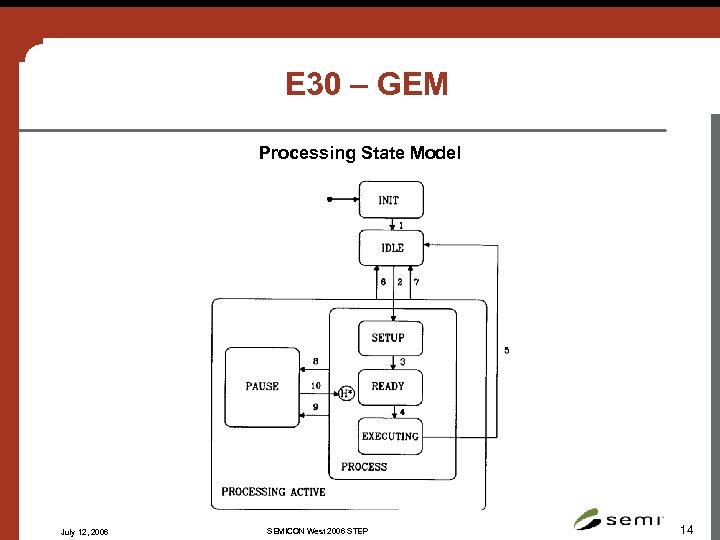 E 30 – GEM Processing State Model July 12, 2006 SEMICON West 2006 STEP 14
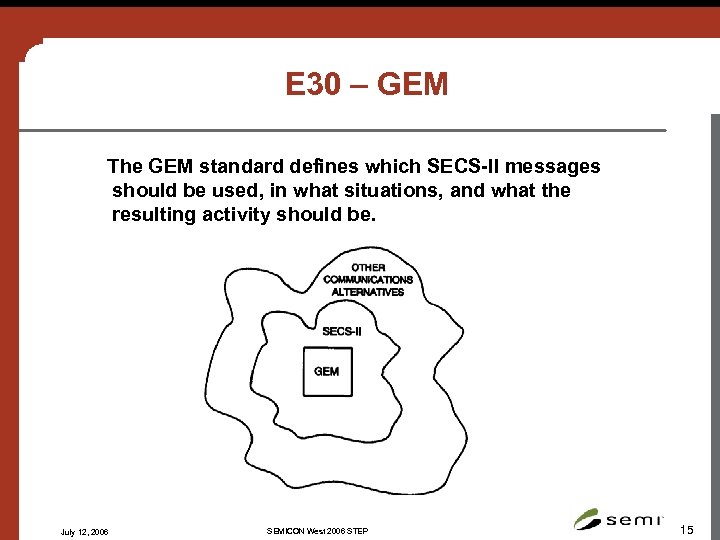 E 30 – GEM The GEM standard defines which SECS-II messages should be used, in what situations, and what the resulting activity should be. July 12, 2006 SEMICON West 2006 STEP 15
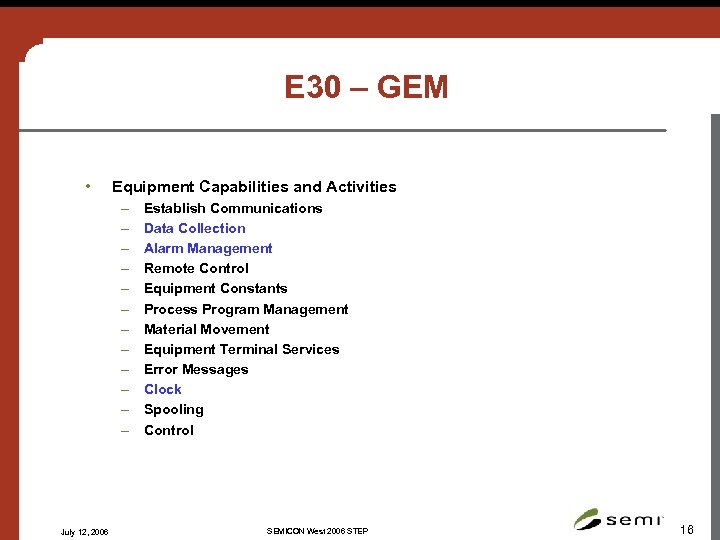 E 30 – GEM • Equipment Capabilities and Activities – – – July 12, 2006 Establish Communications Data Collection Alarm Management Remote Control Equipment Constants Process Program Management Material Movement Equipment Terminal Services Error Messages Clock Spooling Control SEMICON West 2006 STEP 16
 E 58 - ARAMS E 58 – AUTOMATED RELIABILITY, AVAILABILITY, AND MAINTAINABILITY STANDARD (ARAMS): CONCEPTS, BEHAVIOR, AND SERVICES • Originally published in 1997 • Developed by a joint task force under the SEMI Information & Control Committee (primary) and the SEMI Metrics Committee • Last revised in 2003 (SEMI E 58 -0703) July 12, 2006 SEMICON West 2006 STEP 17
 E 58 - ARAMS • Maps automated equipment messages to E 10 states • Provides a method for production equipment to report E 10 state changes to a host computer • Provides standard equipment codes for representing substates of the six E 10 equipment states • Provides a method, through the human interface, for a user to select a state and substate combination, that results in an ARAMS substate code – The equipment then determines the appropriate ARAMS state/substate based on this code. July 12, 2006 SEMICON West 2006 STEP 18
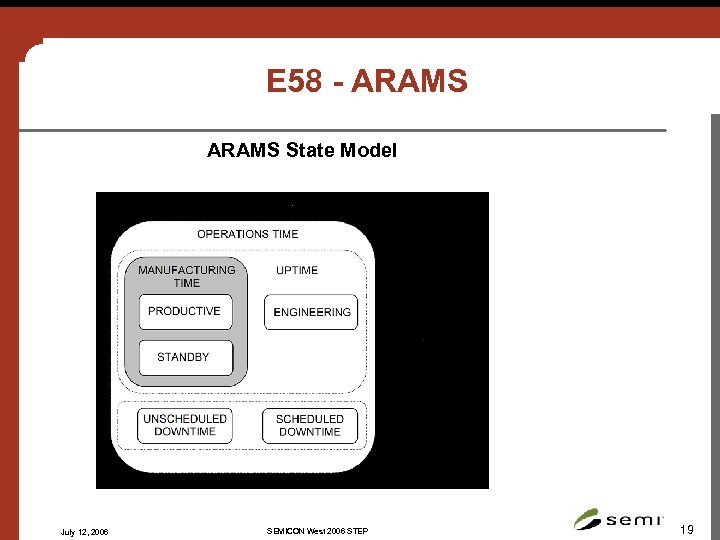 E 58 - ARAMS State Model July 12, 2006 SEMICON West 2006 STEP 19
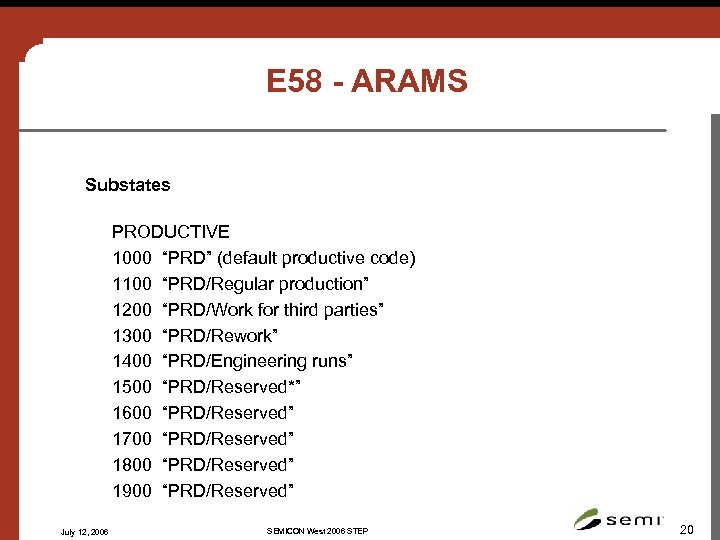 E 58 - ARAMS Substates PRODUCTIVE 1000 “PRD” (default productive code) 1100 “PRD/Regular production” 1200 “PRD/Work for third parties” 1300 “PRD/Rework” 1400 “PRD/Engineering runs” 1500 “PRD/Reserved*” 1600 “PRD/Reserved” 1700 “PRD/Reserved” 1800 “PRD/Reserved” 1900 “PRD/Reserved” July 12, 2006 SEMICON West 2006 STEP 20
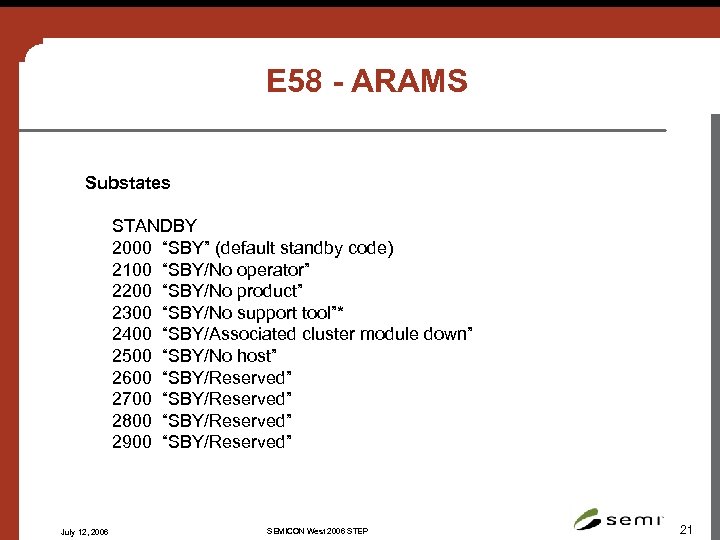 E 58 - ARAMS Substates STANDBY 2000 “SBY” (default standby code) 2100 “SBY/No operator” 2200 “SBY/No product” 2300 “SBY/No support tool”* 2400 “SBY/Associated cluster module down” 2500 “SBY/No host” 2600 “SBY/Reserved” 2700 “SBY/Reserved” 2800 “SBY/Reserved” 2900 “SBY/Reserved” July 12, 2006 SEMICON West 2006 STEP 21
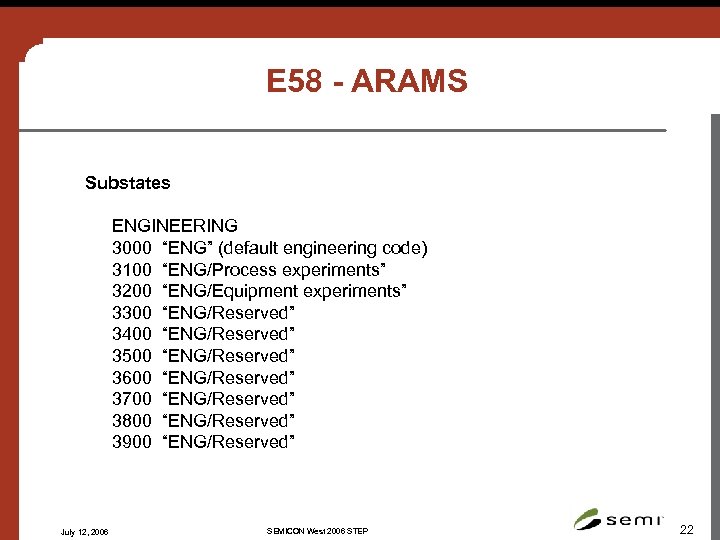 E 58 - ARAMS Substates ENGINEERING 3000 “ENG” (default engineering code) 3100 “ENG/Process experiments” 3200 “ENG/Equipment experiments” 3300 “ENG/Reserved” 3400 “ENG/Reserved” 3500 “ENG/Reserved” 3600 “ENG/Reserved” 3700 “ENG/Reserved” 3800 “ENG/Reserved” 3900 “ENG/Reserved” July 12, 2006 SEMICON West 2006 STEP 22
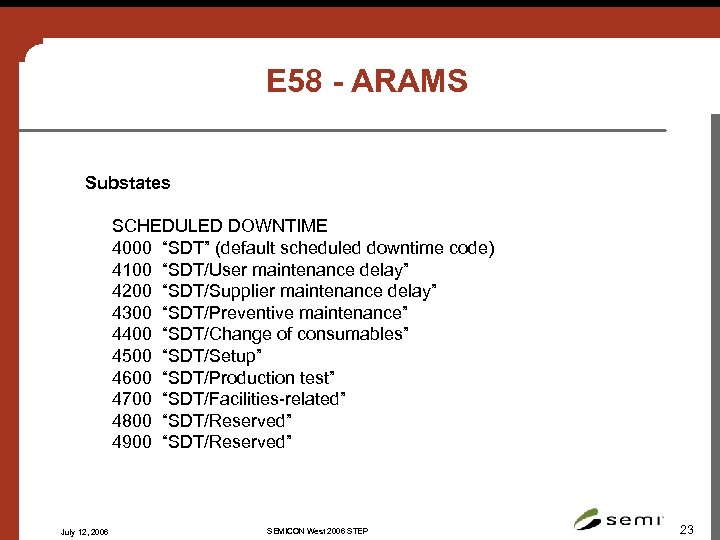 E 58 - ARAMS Substates SCHEDULED DOWNTIME 4000 “SDT” (default scheduled downtime code) 4100 “SDT/User maintenance delay” 4200 “SDT/Supplier maintenance delay” 4300 “SDT/Preventive maintenance” 4400 “SDT/Change of consumables” 4500 “SDT/Setup” 4600 “SDT/Production test” 4700 “SDT/Facilities-related” 4800 “SDT/Reserved” 4900 “SDT/Reserved” July 12, 2006 SEMICON West 2006 STEP 23
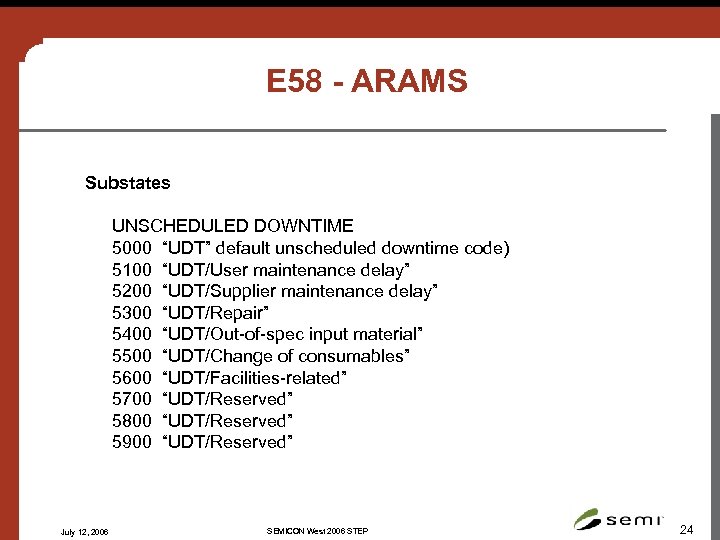 E 58 - ARAMS Substates UNSCHEDULED DOWNTIME 5000 “UDT” default unscheduled downtime code) 5100 “UDT/User maintenance delay” 5200 “UDT/Supplier maintenance delay” 5300 “UDT/Repair” 5400 “UDT/Out-of-spec input material” 5500 “UDT/Change of consumables” 5600 “UDT/Facilities-related” 5700 “UDT/Reserved” 5800 “UDT/Reserved” 5900 “UDT/Reserved” July 12, 2006 SEMICON West 2006 STEP 24
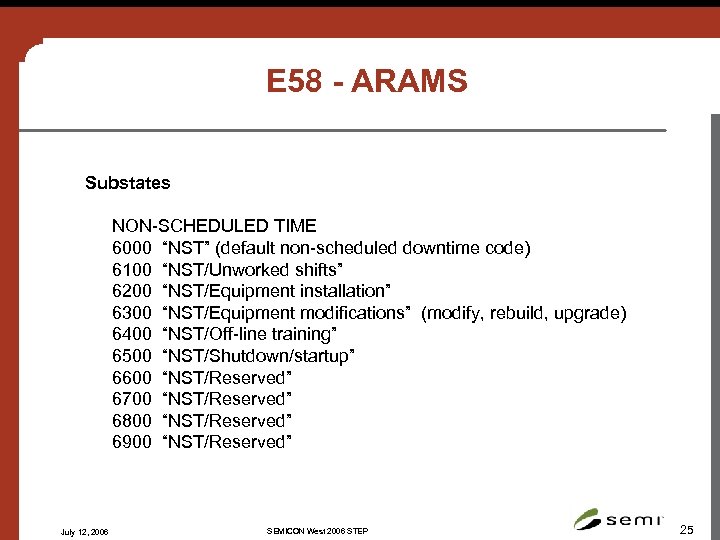 E 58 - ARAMS Substates NON-SCHEDULED TIME 6000 “NST” (default non-scheduled downtime code) 6100 “NST/Unworked shifts” 6200 “NST/Equipment installation” 6300 “NST/Equipment modifications” (modify, rebuild, upgrade) 6400 “NST/Off-line training” 6500 “NST/Shutdown/startup” 6600 “NST/Reserved” 6700 “NST/Reserved” 6800 “NST/Reserved” 6900 “NST/Reserved” July 12, 2006 SEMICON West 2006 STEP 25
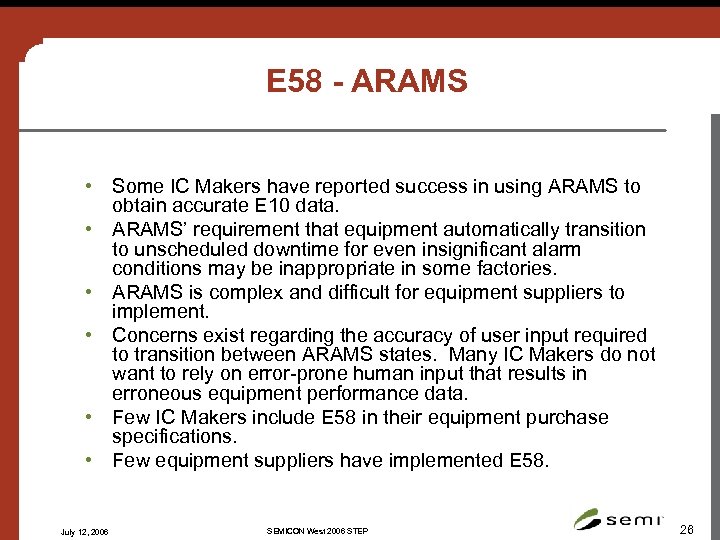 E 58 - ARAMS • Some IC Makers have reported success in using ARAMS to obtain accurate E 10 data. • ARAMS’ requirement that equipment automatically transition to unscheduled downtime for even insignificant alarm conditions may be inappropriate in some factories. • ARAMS is complex and difficult for equipment suppliers to implement. • Concerns exist regarding the accuracy of user input required to transition between ARAMS states. Many IC Makers do not want to rely on error-prone human input that results in erroneous equipment performance data. • Few IC Makers include E 58 in their equipment purchase specifications. • Few equipment suppliers have implemented E 58. July 12, 2006 SEMICON West 2006 STEP 26
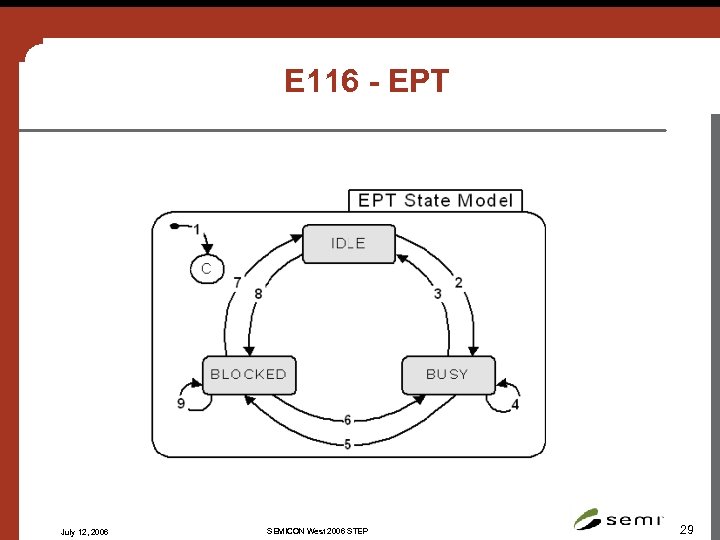
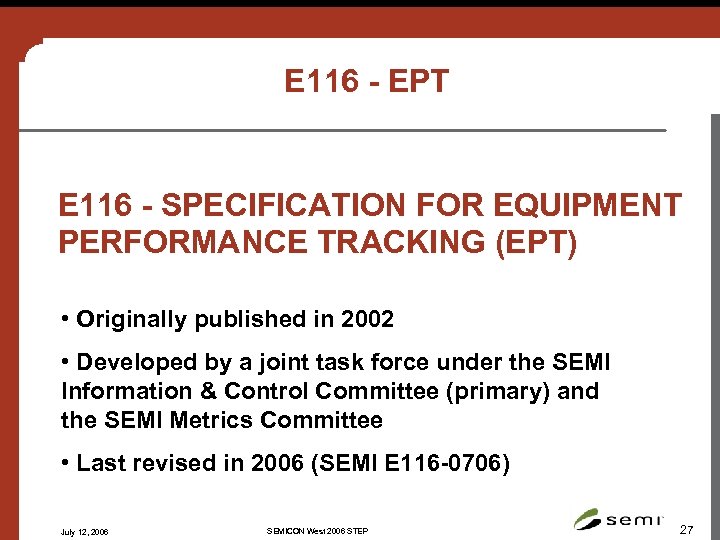 E 116 - EPT E 116 - SPECIFICATION FOR EQUIPMENT PERFORMANCE TRACKING (EPT) • Originally published in 2002 • Developed by a joint task force under the SEMI Information & Control Committee (primary) and the SEMI Metrics Committee • Last revised in 2006 (SEMI E 116 -0706) July 12, 2006 SEMICON West 2006 STEP 27
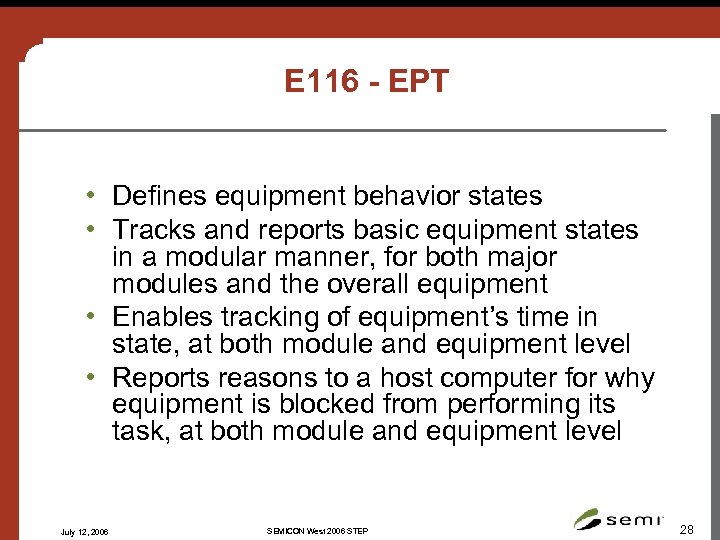 E 116 - EPT • Defines equipment behavior states • Tracks and reports basic equipment states in a modular manner, for both major modules and the overall equipment • Enables tracking of equipment’s time in state, at both module and equipment level • Reports reasons to a host computer for why equipment is blocked from performing its task, at both module and equipment level July 12, 2006 SEMICON West 2006 STEP 28
 E 116 - EPT July 12, 2006 SEMICON West 2006 STEP 29
 E 116 - EPT Key Points • Concentrates solely on data collected from the equipment without manual intervention • Key Requirements – Modularization – Idle, Busy, and Blocked events (time-stamped) with reason for transition from one state to another • Does not focus on E 10 state information – IC Maker can calculate E 10 accurately from equipment data combined with MES information. July 12, 2006 SEMICON West 2006 STEP 30
 E 116 - EPT • E 116 is the preferred standard for tracking equipment performance data. • Some IC Makers are requesting E 116 compliance in equipment purchase specifications. • Some equipment suppliers have implemented E 116 in their equipment. July 12, 2006 SEMICON West 2006 STEP 31
 Summary Software standards enabling equipment performance monitoring are available now. They are improving and can provide reliable and accurate equipment performance data. July 12, 2006 SEMICON West 2006 STEP 32