


 Скачать презентацию Semi-plenary session Role of the state in reduction amplification
d387a7a51463cb39ec9c2f954dd03b26.ppt
- Количество слайдов: 26
 Semi-plenary session: “Role of the state in reduction/amplification of inequality” State retrenchments and class dynamics: the “new” middle class under strain Louis Chauvel Pr at Sciences-Po University Paris and Institut Universitaire de France Site : http: //louis. chauvel. free. fr chauvel@sciences-po. fr 1
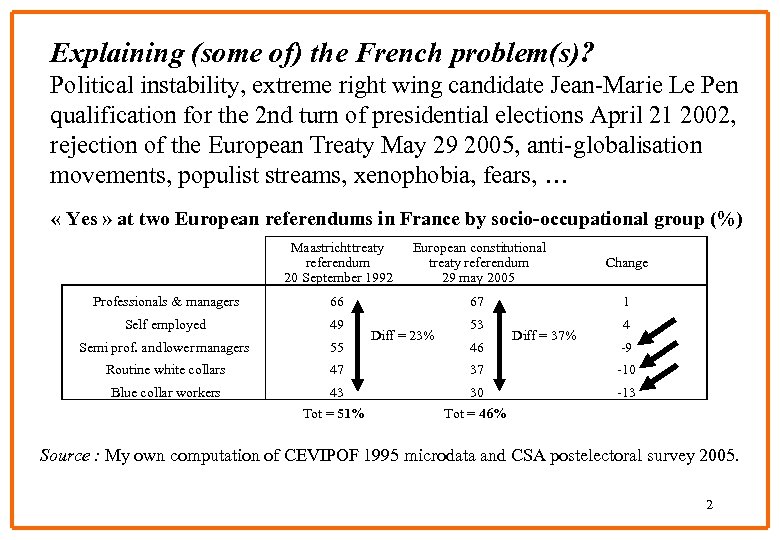 Explaining (some of) the French problem(s)? Political instability, extreme right wing candidate Jean-Marie Le Pen qualification for the 2 nd turn of presidential elections April 21 2002, rejection of the European Treaty May 29 2005, anti-globalisation movements, populist streams, xenophobia, fears, … « Yes » at two European referendums in France by socio-occupational group (%) European constitutional treaty referendum 29 may 2005 Change Professionals & managers 66 67 1 Self employed 49 Semi prof. and lower managers 55 Routine white collars 47 37 -10 Blue collar workers Maastricht treaty referendum 20 September 1992 43 30 -13 Tot = 51% Diff = 23% 53 46 Diff = 37% 4 -9 Tot = 46% Source : My own computation of CEVIPOF 1995 microdata and CSA postelectoral survey 2005. 2
 Plan l. Europe as a middle-class exception in the world l. Objective degree of inequality and class consciousness: paradoxical dynamics l. The middle class dynamics and welfare state retrenchments l. Conclusion : toward a sociology of European backlashes ? 3
 1. The social specificity of Europe in the world l. An affluent and relatively equal club l. Europe as a strong middle class (“median class”) l. Complex evolutions during the last 20 years… 4
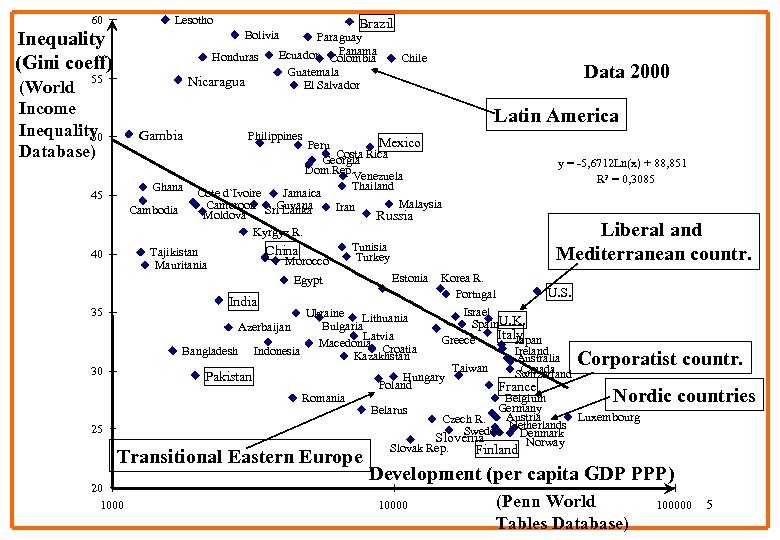 60 Lesotho Inequality (Gini coeff) Bolivia Honduras 55 Nicaragua (World Income Inequality 50 Database) Brazil Paraguay Panama Ecuador Colombia Guatemala El Salvador Chile Data 2000 Latin America Gambia 45 Philippines Mexico Peru Costa Rica Georgia y = -5, 6712 Ln(x) + 88, 851 Dom. Rep. Venezuela R 2 = 0, 3085 Thailand Ghana Cote d`Ivoire Jamaica Malaysia Cameroon Sri Lanka Guyana Iran Cambodia Moldova Russia Kyrgyz R. Tunisia China Tajikistan Turkey Morocco Mauritania Estonia Korea R. Egypt U. S. Portugal India Israel Ukraine Lithuania Spain. U. K. Bulgaria Azerbaijan Italy Latvia Greece Japan Macedonia Croatia Bangladesh Indonesia Ireland Kazakhstan Australia Taiwan Canada Switzerland Hungary Pakistan Poland France Romania Belgium Germany Belarus Austria Luxembourg Czech R. Sweden Netherlands Denmark Slovenia Norway Slovak Rep. Liberal and Mediterranean countr. 40 35 Corporatist countr. 30 Nordic countries 25 Transitional Eastern Europe 20 1000 Finland Development (per capita GDP PPP) 10000 (Penn World Tables Database) 100000 5
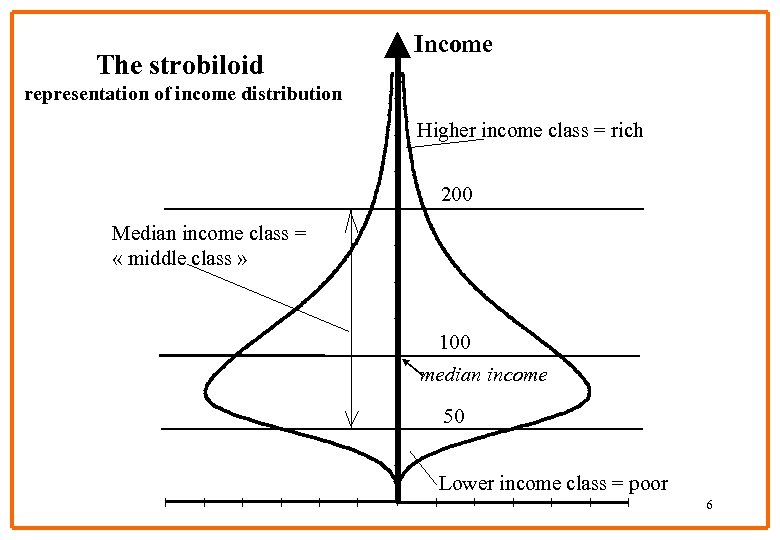 The strobiloid Income representation of income distribution Higher income class = rich 200 Median income class = « middle class » 100 median income 50 Lower income class = poor 6
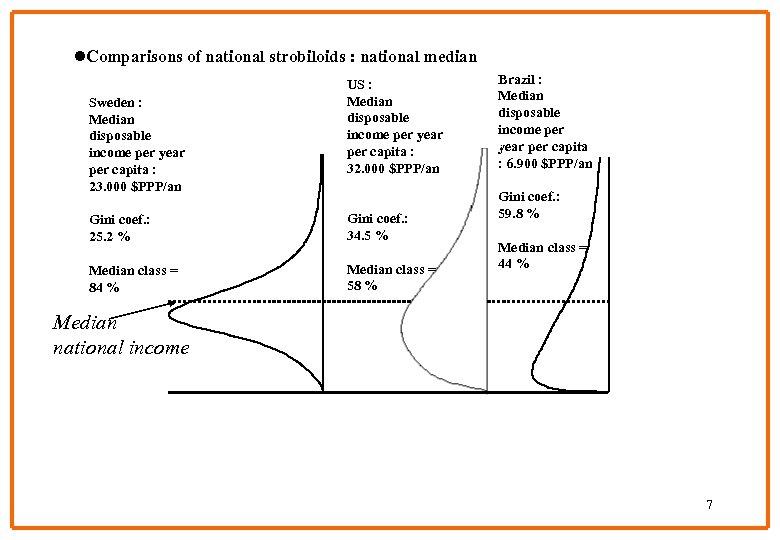 l. Comparisons of national strobiloids : national median Sweden : Median disposable income per year per capita : 23. 000 $PPP/an US : Median disposable income per year per capita : 32. 000 $PPP/an Gini coef. : 25. 2 % Gini coef. : 34. 5 % Median class = 84 % Median class = 58 % Brazil : Median disposable income per year per capita : 6. 900 $PPP/an Gini coef. : 59. 8 % Median class = 44 % Median national income 7
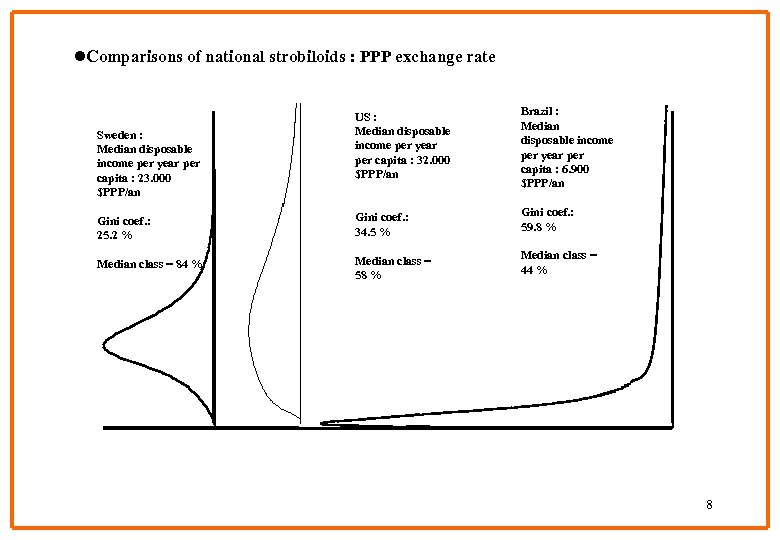 l. Comparisons of national strobiloids : PPP exchange rate US : Median disposable income per year per capita : 32. 000 $PPP/an Brazil : Median disposable income per year per capita : 6. 900 $PPP/an Gini coef. : 25. 2 % Gini coef. : 34. 5 % Gini coef. : 59. 8 % Median class = 84 % Median class = 58 % Median class = 44 % Sweden : Median disposable income per year per capita : 23. 000 $PPP/an 8
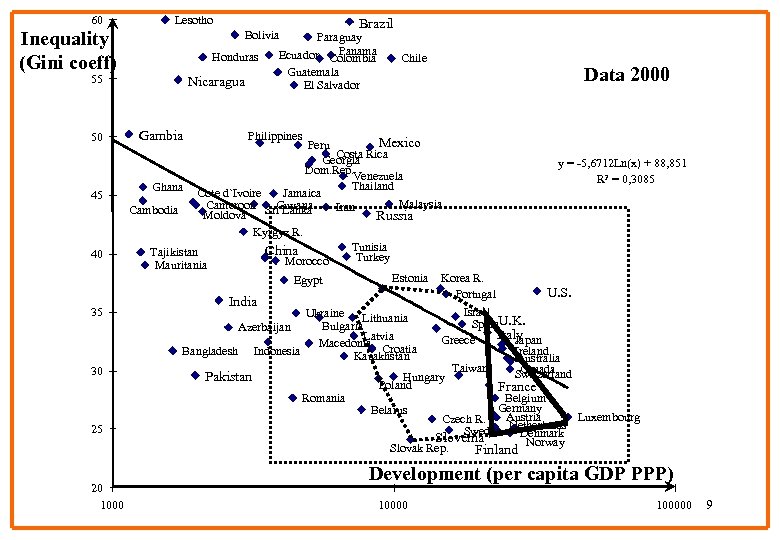 60 Lesotho Inequality (Gini coeff) Bolivia Honduras 55 50 45 40 35 30 25 Nicaragua Gambia Brazil Paraguay Panama Ecuador Colombia Guatemala El Salvador Chile Data 2000 Philippines Mexico Peru Costa Rica Georgia y = -5, 6712 Ln(x) + 88, 851 Dom. Rep. Venezuela R 2 = 0, 3085 Thailand Ghana Cote d`Ivoire Jamaica Malaysia Cameroon Sri Lanka Guyana Iran Cambodia Moldova Russia Kyrgyz R. Tunisia China Tajikistan Turkey Morocco Mauritania Estonia Korea R. Egypt U. S. Portugal India Israel Ukraine Lithuania Spain. U. K. Bulgaria Azerbaijan Italy Latvia Greece Japan Macedonia Croatia Bangladesh Indonesia Ireland Kazakhstan Australia Taiwan Canada Switzerland Hungary Pakistan Poland France Romania Belgium Germany Belarus Austria Luxembourg Czech R. Sweden Netherlands Denmark Slovenia Norway Slovak Rep. Finland 20 1000 Development (per capita GDP PPP) 100000 9
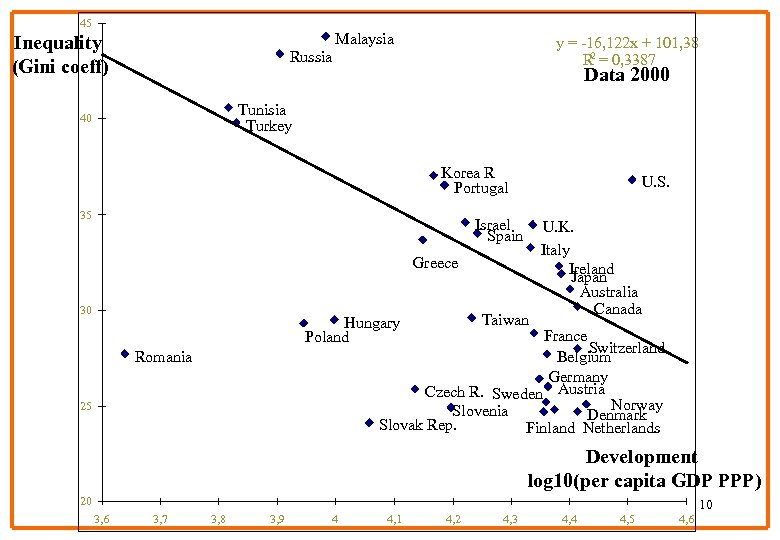 45 Inequality (Gini coeff) Russia Malaysia y = -16, 122 x + 101, 38 R 2 = 0, 3387 Data 2000 Tunisia Turkey 40 Korea R Portugal 35 U. S. Israel Spain Greece 30 Taiwan Hungary Poland U. K. Italy Ireland Japan Australia Canada France Switzerland. Belgium Germany Czech R. Sweden Austria Norway Slovenia Denmark Slovak Rep. Finland Netherlands Romania 25 Development log 10(per capita GDP PPP) 20 10 3, 6 3, 7 3, 8 3, 9 4 4, 1 4, 2 4, 3 4, 4 4, 5 4, 6
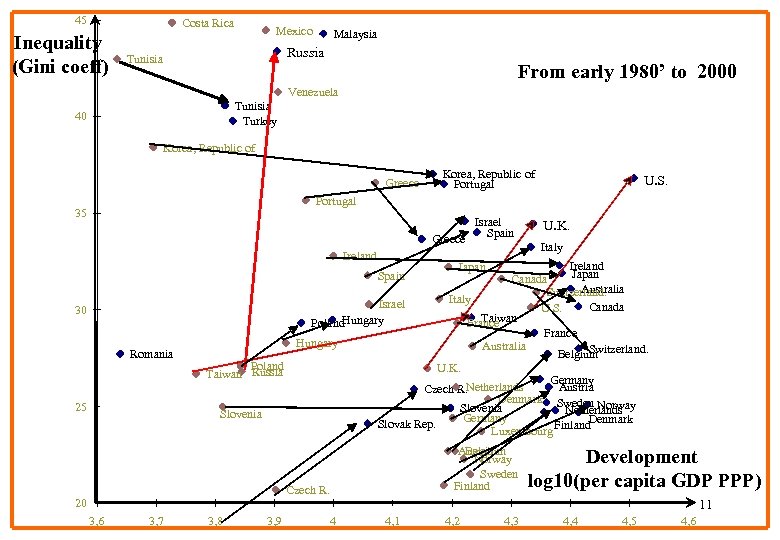 45 Inequality (Gini coeff) Costa Rica Mexico Russia Tunisia From early 1980’ to 2000 Venezuela Tunisia Turkey 40 Malaysia Korea, Republic of Greece Portugal 35 Greece Ireland Spain Israel Hungary Poland 30 Romania 25 20 3, 6 Hungary Poland Taiwan Russia Slovenia 3, 8 U. K . Italy Ireland Japan Canada Australia Switzerland. Italy Canada U. S. Taiwan France Australia Switzerland. Belgium Japan Germany Austria Czech R. Netherlands Denmark Sweden Norway Slovenia Netherlands Germany Denmark Slovak Rep. Finland Luxembourg 3, 9 Israel Spain U. S . U. K. Austria Belgium Norway Sweden Finland Czech R. 3, 7 Korea, Republic of Portugal 4 4, 1 4, 2 4, 3 Development log 10(per capita GDP PPP) 4, 4 4, 5 11 4, 6
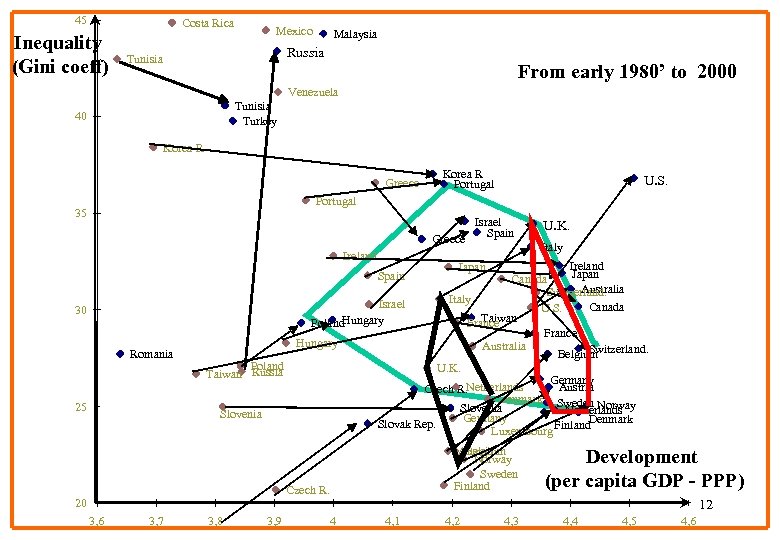 45 Inequality (Gini coeff) Costa Rica Mexico Russia Tunisia From early 1980’ to 2000 Venezuela Tunisia Turkey 40 Malaysia Korea R Greece Portugal 35 Greece Ireland Spain Israel Hungary Poland 30 Romania 25 20 3, 6 Hungary Poland Taiwan Russia Slovenia 3, 8 U. K . Italy Ireland Japan Canada Australia Switzerland. Italy Canada U. S. Taiwan France Australia Switzerland. Belgium Japan Germany Austria Czech R. Netherlands Denmark Sweden Norway Slovenia Netherlands Germany Denmark Slovak Rep. Finland Luxembourg 3, 9 Israel Spain U. S . U. K. Austria Belgium Norway Sweden Finland Czech R. 3, 7 Korea R Portugal 4 4, 1 4, 2 4, 3 Development (per capita GDP - PPP) 4, 4 4, 5 12 4, 6
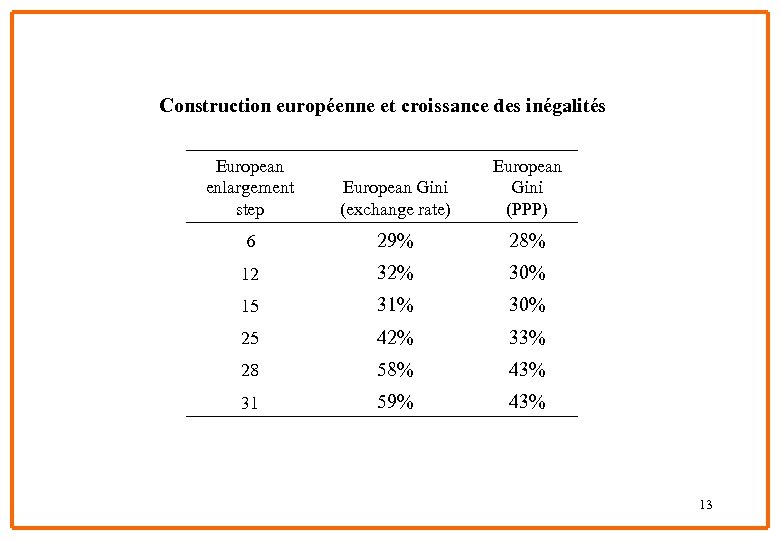 Construction européenne et croissance des inégalités European enlargement step European Gini (exchange rate) European Gini (PPP) 6 29% 28% 12 32% 30% 15 31% 30% 25 42% 33% 28 58% 43% 31 59% 43% 13
 2. Objective intensity of inequality and class consciousness: paradoxical dynamics (in the French case) l. Distinction between objective and subjective class systems l. Class system without class consciousness l. The spiral of social classes 14
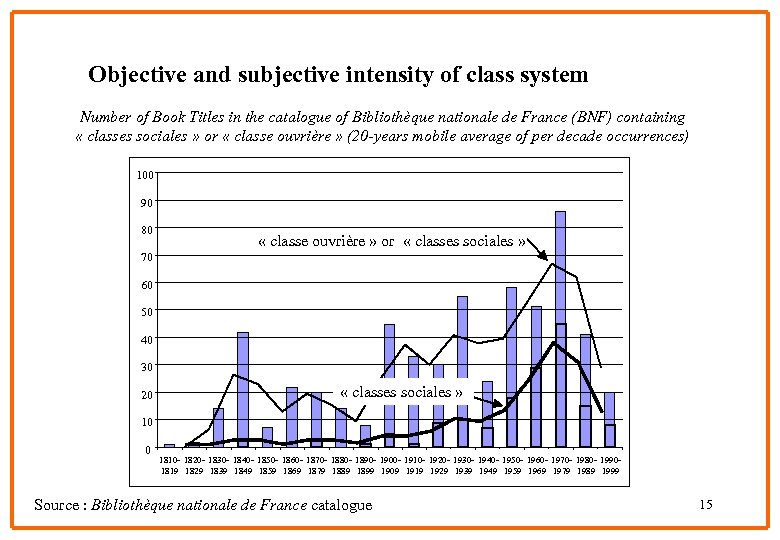 Objective and subjective intensity of class system Number of Book Titles in the catalogue of Bibliothèque nationale de France (BNF) containing « classes sociales » or « classe ouvrière » (20 -years mobile average of per decade occurrences) 100 90 80 « classe ouvrière » or « classes sociales » 70 60 50 40 30 20 « classes sociales » 10 0 1810 - 1820 - 1830 - 1840 - 1850 - 1860 - 1870 - 1880 - 1890 - 1900 - 1910 - 1920 - 1930 - 1940 - 1950 - 1960 - 1970 - 1980 - 19901819 1829 1839 1849 1859 1869 1879 1889 1899 1909 1919 1929 1939 1949 1959 1969 1979 1989 1999 Source : Bibliothèque nationale de France catalogue 15
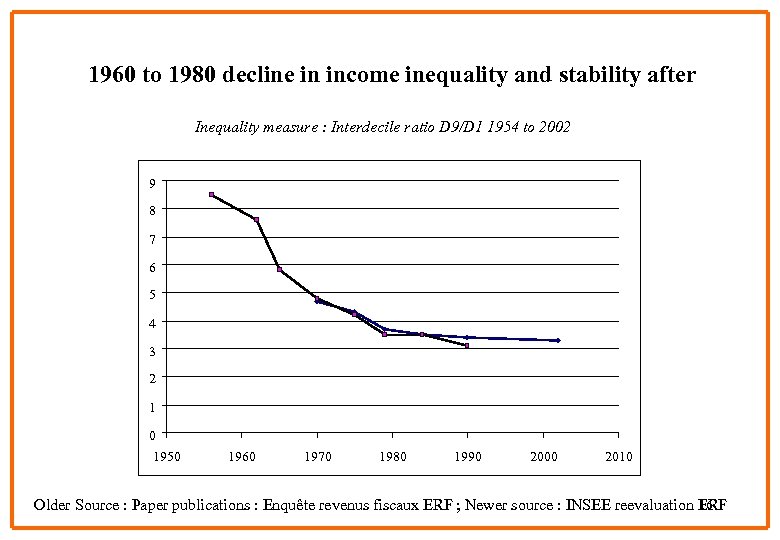 1960 to 1980 decline in income inequality and stability after Inequality measure : Interdecile ratio D 9/D 1 1954 to 2002 9 8 7 6 5 4 3 2 1 0 1950 1960 1970 1980 1990 2000 2010 16 Older Source : Paper publications : Enquête revenus fiscaux ERF ; Newer source : INSEE reevaluation ERF
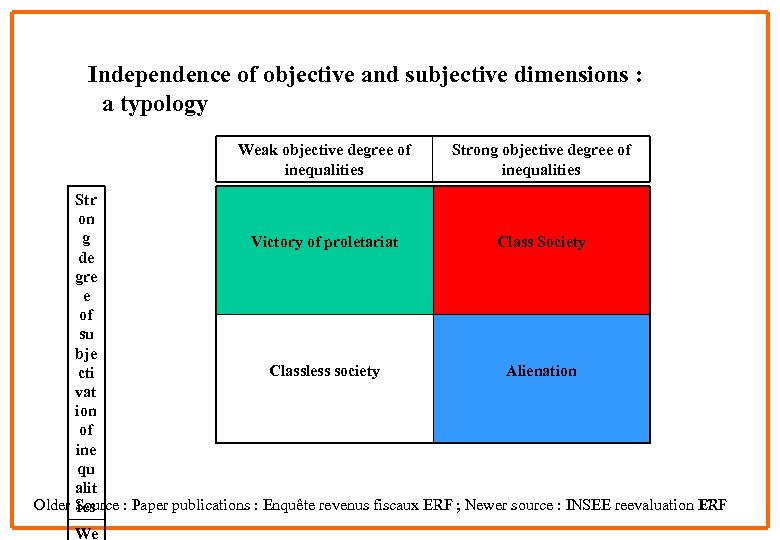 Independence of objective and subjective dimensions : a typology Weak objective degree of inequalities Strong objective degree of inequalities Str on g Class Society Victory of proletariat de gre e of su bje Classless society Alienation cti vat ion of ine qu alit 17 Older Source : Paper publications : Enquête revenus fiscaux ERF ; Newer source : INSEE reevaluation ERF ies We
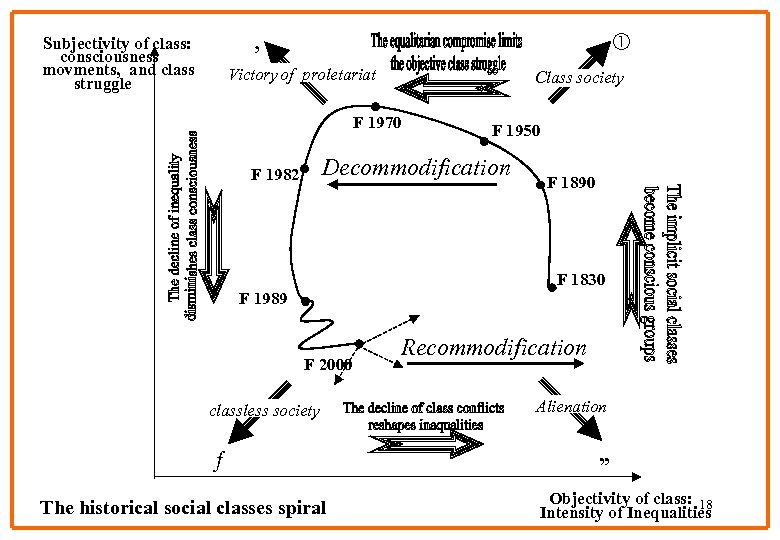 Subjectivity of class: consciousness movments, and class struggle ‚ Victory of proletariat Class society F 1970 F 1950 Decommodification F 1982 F 1890 F 1830 F 1989 F 2000 classless society ƒ The historical social classes spiral Recommodification Alienation „ Objectivity of class: 18 Intensity of Inequalities
 3. The middle class dynamics and Welfare state expansions and retrenchments l. Back to Schmoller : the state and the “new middle class(es)” l. Post-affluent societies: the lost paradise of the new middle class l. The fate of generational dynamics 19
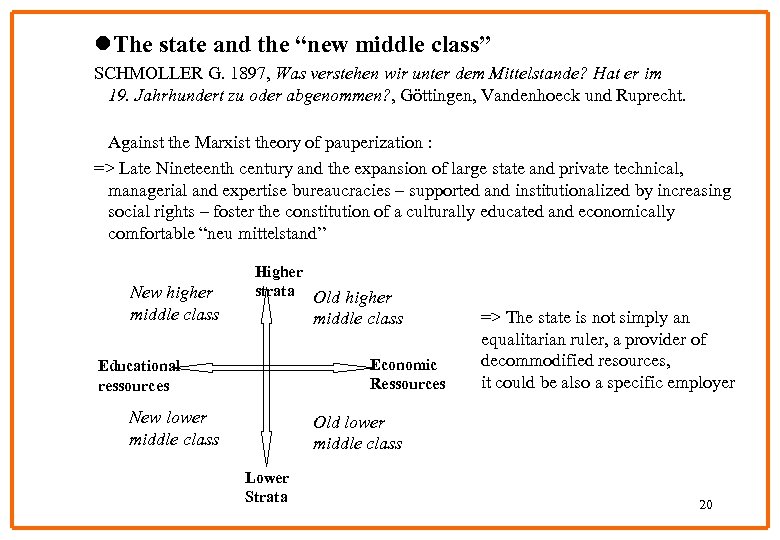 l. The state and the “new middle class” SCHMOLLER G. 1897, Was verstehen wir unter dem Mittelstande? Hat er im 19. Jahrhundert zu oder abgenommen? , Göttingen, Vandenhoeck und Ruprecht. Against the Marxist theory of pauperization : => Late Nineteenth century and the expansion of large state and private technical, managerial and expertise bureaucracies – supported and institutionalized by increasing social rights – foster the constitution of a culturally educated and economically comfortable “neu mittelstand” New higher middle class Higher strata Old higher middle class Economic Ressources Educational ressources New lower middle class => The state is not simply an equalitarian ruler, a provider of decommodified resources, it could be also a specific employer Old lower middle class Lower Strata 20
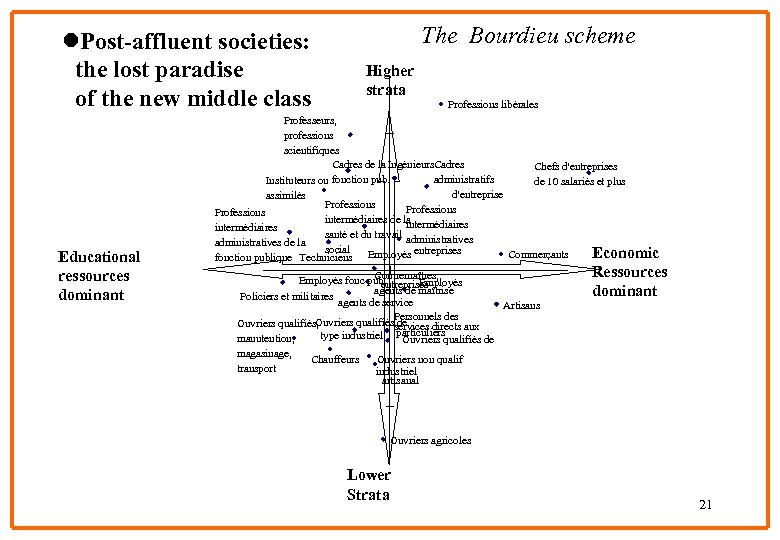 l. Post-affluent societies: the lost paradise of the new middle class Educational ressources dominant The Bourdieu scheme Higher strata Professions libérales Professeurs, professions scientifiques Cadres de la Ingénieurs. Cadres Chefs d'entreprises fonction pub. administratifs Instituteurs ou de 10 salariés et plus d'entreprise assimilés Professions intermédiaires de la intermédiaires santé et du travail administratives de la social entreprises Economic Commerçants fonction publique Techniciens Employés Contremaîtres, Employés fonc pub, Employés entreprises agents de maîtrise Policiers et militaires agents de service Artisans Personnels des Ouvriers qualifiés de Ouvriers qualifiés, services directs aux type industriel particuliers manutention, Ouvriers qualifiés de magasinage, Chauffeurs Ouvriers non qualif transport industriel artisanal Ressources dominant Ouvriers agricoles Lower Strata 21
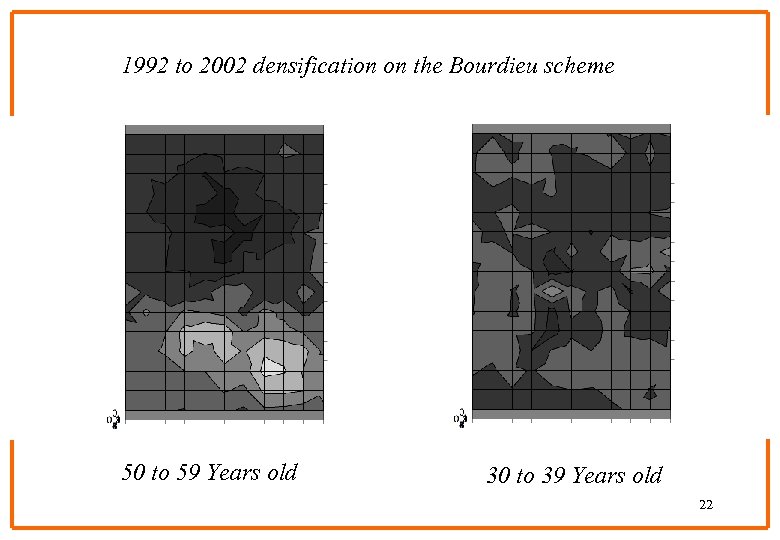 1992 to 2002 densification on the Bourdieu scheme 50 to 59 Years old 30 to 39 Years old 22
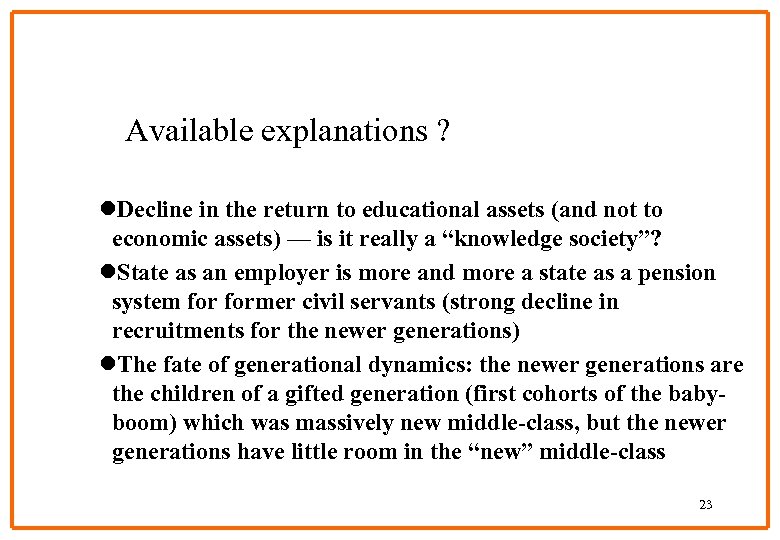 Available explanations ? l. Decline in the return to educational assets (and not to economic assets) — is it really a “knowledge society”? l. State as an employer is more and more a state as a pension system former civil servants (strong decline in recruitments for the newer generations) l. The fate of generational dynamics: the newer generations are the children of a gifted generation (first cohorts of the babyboom) which was massively new middle-class, but the newer generations have little room in the “new” middle-class 23
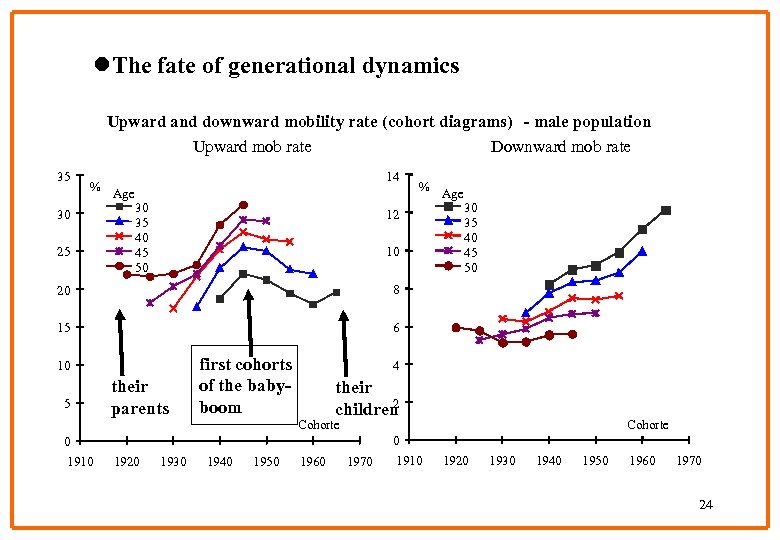 l. The fate of generational dynamics Upward and downward mobility rate (cohort diagrams) - male population Upward mob rate Downward mob rate 35 % 30 25 14 Age 30 35 40 45 50 % 12 10 20 30 35 40 45 50 8 15 Age 6 10 5 0 1910 their parents first cohorts of the babyboom 4 their 2 children Cohorte 0 1920 1930 1940 1950 1960 1970 1910 1920 1930 1940 1950 1960 1970 24
 4. Conclusion: Farewell to the “new” middle class? l. What is ever “new” with new middle class, 1 century later? l. A social backlash after affluence? l. Which consequences? l. Which are the accurate social policies: feeding the poor (bread and circuses), or rehomogeneisation of Europe)? l. Are sociologists the next slice of the salami? 25
 Semi-plenary session: “Role of the state in reduction/amplification of inequality” THE END Louis Chauvel Pr at Sciences-Po University Paris and Institut Universitaire de France Site : http: //louis. chauvel. free. fr chauvel@sciences-po. fr 26