


 Скачать презентацию Semey State Medical University Features of collection anamnesis
Nurtoleuova K SIW.ppt
- Количество слайдов: 20
 Semey State Medical University Features of collection anamnesis in children. Rules of examination of child at different age. Ethical issues. Prepared by: Nurtoleuova K, 548 group Checked by: Orazgaliyeva Zh. S. Semey, 2016
 Plan: I. Introduction II. The main part ü Questioning of the child ü Anamnesis morbi ü Anamnesis vitae ü Rules of general examination ü Ethical issues III. Conclusion References
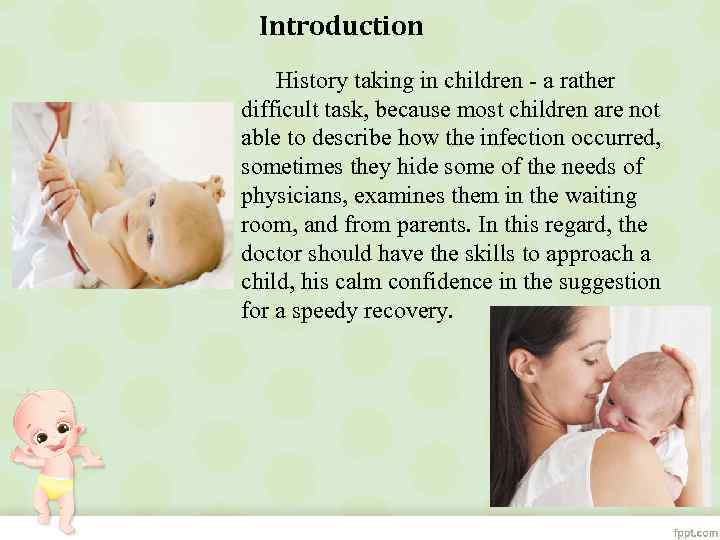 Introduction History taking in children - a rather difficult task, because most children are not able to describe how the infection occurred, sometimes they hide some of the needs of physicians, examines them in the waiting room, and from parents. In this regard, the doctor should have the skills to approach a child, his calm confidence in the suggestion for a speedy recovery.
 QUESTIONING (INTERROGATIO) Examination always begins with the questioning. Without exaggeration, we can say that carefully collected history gives your doctor, at least half of the information necessary for correct diagnosis. For the pediatrician questioning is particularly important, because in the meantime it is necessary not only to receive the most complete information, but also to establish contact with the child and his family. It is very important to be very friendly, calm and confident. In a conversation with the parents should quietly listen them and at the same time with leading questions and clarifications to get the necessary information. Young children advisable to interest by toy or subjects interest to him, it is appropriate to play a bit with the baby. There a history of present illness (anamnesis morbi) and life history (anamnesis vitae).
 ANAMNESIS MORBI Complaints according to which parents are need to help. After receiving information from the parents and the child need to clarify every complaint by additional questions. For example, with complaints of abdominal pain is necessary to specify the location, intensity, relationship to food intake and time of day. Then, find out the time when there were complaints, the circumstances in which they arose; current of the disease since its inception. In addition, they ask about the possible pathology of all organs and systems, even in cases where the parents do not pay attention to it. Wondered, what was common manifestations of the disease were noted (fever, chills, insomnia, appetite, mood changes).
 ANAMNESIS MORBI Due to the fact that different age periods have a higher value certain nuances of life, medical history at different ages has some peculiarities. So, in clarifying history of life in children up to 3 years, special attention should be paid to the peculiarities of prenatal, intranatal and early postnatal periods.
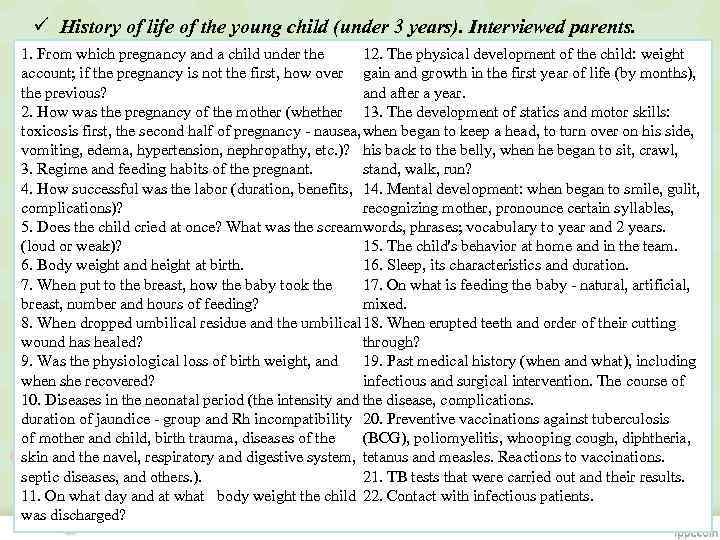 ü History of life of the young child (under 3 years). Interviewed parents. 1. From which pregnancy and a child under the 12. The physical development of the child: weight account; if the pregnancy is not the first, how over gain and growth in the first year of life (by months), and after a year. the previous? 2. How was the pregnancy of the mother (whether 13. The development of statics and motor skills: toxicosis first, the second half of pregnancy - nausea, when began to keep a head, to turn over on his side, vomiting, edema, hypertension, nephropathy, etc. )? his back to the belly, when he began to sit, crawl, stand, walk, run? 3. Regime and feeding habits of the pregnant. 4. How successful was the labor (duration, benefits, 14. Mental development: when began to smile, gulit, recognizing mother, pronounce certain syllables, complications)? 5. Does the child cried at once? What was the screamwords, phrases; vocabulary to year and 2 years. 15. The child's behavior at home and in the team. (loud or weak)? 16. Sleep, its characteristics and duration. 6. Body weight and height at birth. 17. On what is feeding the baby - natural, artificial, 7. When put to the breast, how the baby took the mixed. breast, number and hours of feeding? 8. When dropped umbilical residue and the umbilical 18. When erupted teeth and order of their cutting through? wound has healed? 19. Past medical history (when and what), including 9. Was the physiological loss of birth weight, and infectious and surgical intervention. The course of when she recovered? 10. Diseases in the neonatal period (the intensity and the disease, complications. duration of jaundice - group and Rh incompatibility 20. Preventive vaccinations against tuberculosis (BCG), poliomyelitis, whooping cough, diphtheria, of mother and child, birth trauma, diseases of the skin and the navel, respiratory and digestive system, tetanus and measles. Reactions to vaccinations. 21. TB tests that were carried out and their results. septic diseases, and others. ). 11. On what day and at what body weight the child 22. Contact with infectious patients. was discharged?
 When collecting history in older children, particular attention should be paid to peculiarities of the conditions and lifestyle. ü Life history older children 1. What is the child under the account? 2. How developed in early childhood? 3. The behavior in the house and in the team, for students - school performance, which subjects prefers. 4. Past medical and surgical interventions. 5. Vaccinations. 6. Tuberculin tests when carried out, their outcome. 7. Contact with infectious patients. 8. The sexual development of the child (the time of appearance of secondary sexual characteristics and their sequence).
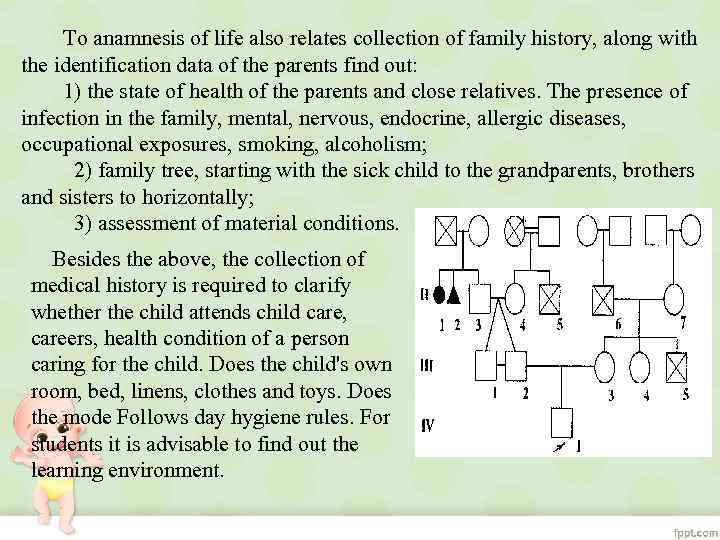 To anamnesis of life also relates collection of family history, along with the identification data of the parents find out: 1) the state of health of the parents and close relatives. The presence of infection in the family, mental, nervous, endocrine, allergic diseases, occupational exposures, smoking, alcoholism; 2) family tree, starting with the sick child to the grandparents, brothers and sisters to horizontally; 3) assessment of material conditions. Besides the above, the collection of medical history is required to clarify whether the child attends child care, careers, health condition of a person caring for the child. Does the child's own room, bed, linens, clothes and toys. Does the mode Follows day hygiene rules. For students it is advisable to find out the learning environment.
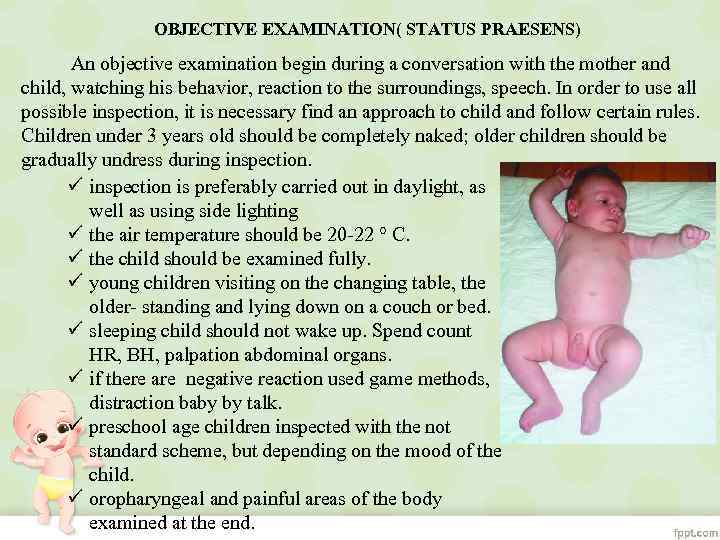 OBJECTIVE EXAMINATION( STATUS PRAESENS) An objective examination begin during a conversation with the mother and child, watching his behavior, reaction to the surroundings, speech. In order to use all possible inspection, it is necessary find an approach to child and follow certain rules. Children under 3 years old should be completely naked; older children should be gradually undress during inspection. ü inspection is preferably carried out in daylight, as well as using side lighting ü the air temperature should be 20 -22 ° C. ü the child should be examined fully. ü young children visiting on the changing table, the older- standing and lying down on a couch or bed. ü sleeping child should not wake up. Spend count HR, BH, palpation abdominal organs. ü if there are negative reaction used game methods, distraction baby by talk. ü preschool age children inspected with the not standard scheme, but depending on the mood of the child. ü oropharyngeal and painful areas of the body examined at the end.
 During the general examination reveal the most severe symptoms , assess the physical development of the child, and then examine the organs and systems on the conventional scheme. 1. Assess the general condition of child 2. Physical development 3. Assess the organs and systems. 4. Assess the psychomotor development.
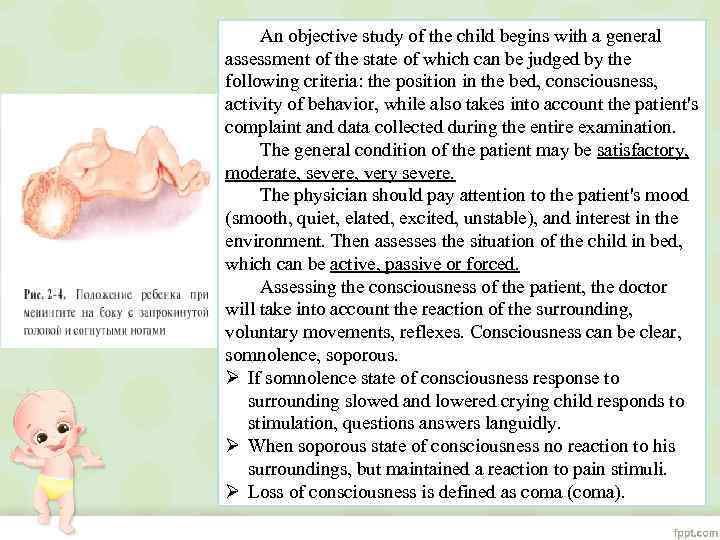 An objective study of the child begins with a general assessment of the state of which can be judged by the following criteria: the position in the bed, consciousness, activity of behavior, while also takes into account the patient's complaint and data collected during the entire examination. The general condition of the patient may be satisfactory, moderate, severe, very severe. The physician should pay attention to the patient's mood (smooth, quiet, elated, excited, unstable), and interest in the environment. Then assesses the situation of the child in bed, which can be active, passive or forced. Assessing the consciousness of the patient, the doctor will take into account the reaction of the surrounding, voluntary movements, reflexes. Consciousness can be clear, somnolence, soporous. Ø If somnolence state of consciousness response to surrounding slowed and lowered crying child responds to stimulation, questions answers languidly. Ø When soporous state of consciousness no reaction to his surroundings, but maintained a reaction to pain stimuli. Ø Loss of consciousness is defined as coma (coma).
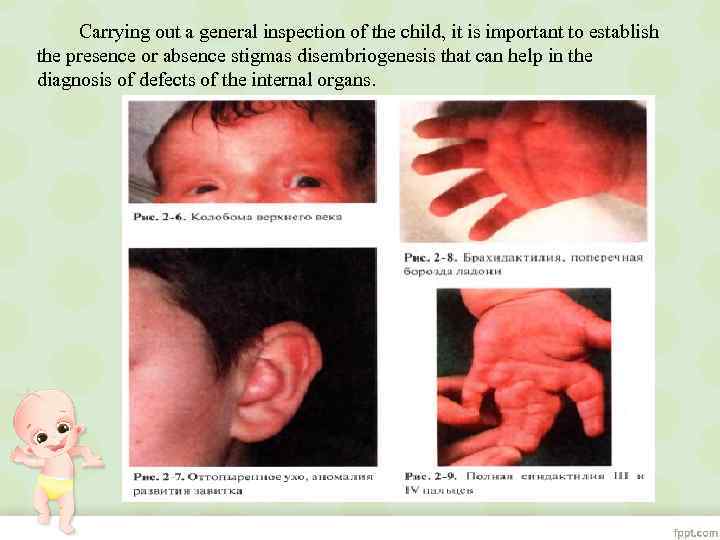 Carrying out a general inspection of the child, it is important to establish the presence or absence stigmas disembriogenesis that can help in the diagnosis of defects of the internal organs.
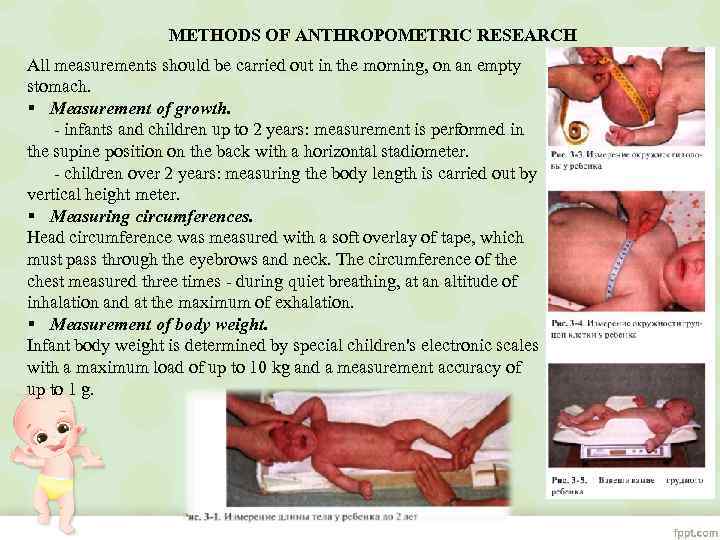 METHODS OF ANTHROPOMETRIC RESEARCH All measurements should be carried out in the morning, on an empty stomach. § Measurement of growth. - infants and children up to 2 years: measurement is performed in the supine position on the back with a horizontal stadiometer. - children over 2 years: measuring the body length is carried out by vertical height meter. § Measuring circumferences. Head circumference was measured with a soft overlay of tape, which must pass through the eyebrows and neck. The circumference of the chest measured three times - during quiet breathing, at an altitude of inhalation and at the maximum of exhalation. § Measurement of body weight. Infant body weight is determined by special children's electronic scales with a maximum load of up to 10 kg and a measurement accuracy of up to 1 g.
 ASSESS THE ORGANS AND SYSTEMS 1. Methods of investigations of the skin and subcutaneous tissue. Ø During the inspection of the skin should be carefully examine the skin folds, armpits, palms, soles, interdigital spaces but on legs, the skin of the ear shells, the scalp, the anus area. Ø Palpation of the baby's skin should be gentle, superficial. Hands of a doctor should be clean, dry and warm. With palpation-defined by the thickness, flexibility, humidity and skin temperature. Ø A study of the subcutaneous fat layer. Ø Investigation of soft tissue turgor 2. Methods of investigations of bones and joints Ø An objective study of bones and joints by visual inspection, palpation and measurement. 3. Methods of investigations of the muscular system. Ø Investigation by visual inspection and palpation - assessed the degree of muscle development, their possible atrophy, asymmetry, paralysis and paresis, acquired musculoskeletal system deformity and congenital anomalies of development, soreness and any educational muscle. Evaluated the tone, muscle strength and motor activity.
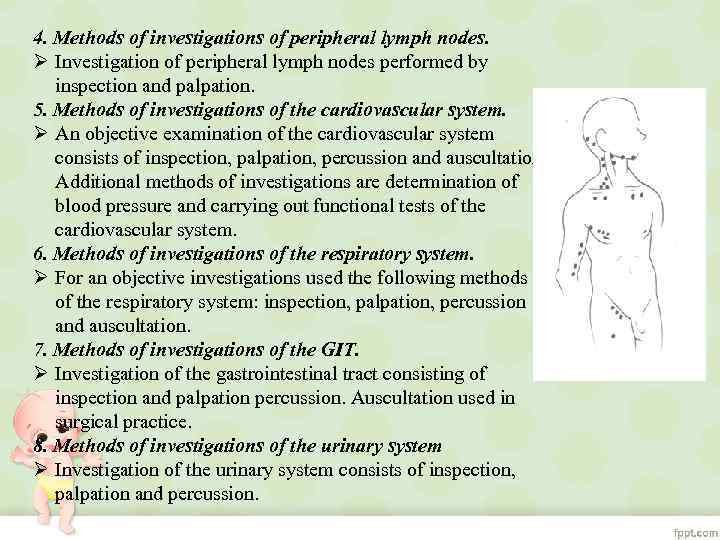 4. Methods of investigations of peripheral lymph nodes. Ø Investigation of peripheral lymph nodes performed by inspection and palpation. 5. Methods of investigations of the cardiovascular system. Ø An objective examination of the cardiovascular system consists of inspection, palpation, percussion and auscultation. Additional methods of investigations are determination of blood pressure and carrying out functional tests of the cardiovascular system. 6. Methods of investigations of the respiratory system. Ø For an objective investigations used the following methods of the respiratory system: inspection, palpation, percussion and auscultation. 7. Methods of investigations of the GIT. Ø Investigation of the gastrointestinal tract consisting of inspection and palpation percussion. Auscultation used in surgical practice. 8. Methods of investigations of the urinary system Ø Investigation of the urinary system consists of inspection, palpation and percussion.
 A pediatrician should know the age characteristics of the nervous system baby, to be able to assess his neurological status, refer the patient to a specialist (neurologist, psychiatrist) if necessary. There are three groups of reflexes in the newborn: 1. The first group includes the unconditioned reflexes that persist throughout life. They are divided into swallowing reflex, papillary reflex, sneeze reflex, blinking or corneal reflex, glabellar reflex, yawn reflex, cough reflex, gag reflex, and tendon reflexes 2. The second group includes the transitional reflexes or reflexes of neonate and infancy. • The reflexes of oral automatism. • Spinal automatism. • Myelocephalic reflex. 3. The third group includes the righting reflexes that reflexes are absent in the newborn and appear during infancy. • Upper Landau’s reflex appears at 4 month. When an infant is placed on the abdomen, he can lift the head and the front portion of the chest about 90 degrees above the table, bearing his weight on the forearms. • Low Landau’s reflex appears at 5 -6 month. When an infant prones he extends and holds (lifts) his legs. • Parachute reflex elicits a protective response to falling, and appears at 7 months.
 In pediatric practice, there are situations in which there is a no specific decision on the action plan. Knowledge of ethical theories and principles that provide the foundation for medical practice, it is useful for the understanding of emerging issues. It is important to justify decisions regarding diagnosis or treatment in accordance with ethical principles and words that are understandable to all stakeholders. Principles of Medical Ethics are: • Do no harm - psychological and / or physical. • Mercy - vindicated the obligation to do good. • Fairness - honesty toward all, impartiality and equality in health care. • Respect for personal autonomy - respect the rights of individuals to take informed and considered decisions about themselves and in accordance with their abilities. • The veracity and confidentiality - the important aspects of autonomy that support the confidence necessary for the relationship between doctor and patient. • Duty - a moral obligation to act independently of the consequences in accordance with the laws of morality, which are common and the same for all, and to respect the human being as an independent person. • Use - the obligation to bring the maximum benefit to the greatest number of people. • Rights - institutionalized rules of morality, such as the right to life, respect, education, which imposes a moral obligation on the other.
 Conclusion General examination of the child has a great diagnostic value: the doctor not only gets an overview of the health status patient in general, but in some cases can diagnose from the "first look. Correctly collected anamnesis and properly inspection can prevent many diseases among child population and decrease death rate.
 References 1. Кассирский И. А. О врачевании. - Москва: Медицина, 1970. - 271 с. 2. Лисицин Ю. И. Медицинская этика, деонтология и биоэтика // Проблемы социальной гигиены и история медицины. - 1998. - № 2. - С. 7 -13. 3. http: //meduniver. com/Medical/profilaktika/etika_v_pediatrii. html 4. Пропедевтика детских болезней - Геппе Н. А. - Учебник.