Скачать презентацию SEMEY STATE MEDICAL UNIVERSITY Chair of anatomy and
do not open.pptx
- Количество слайдов: 18
 SEMEY STATE MEDICAL UNIVERSITY Chair of anatomy and histology Concept on hormones and their significance in organism. Concept on cells-targets and receptors to hormones. Pineal gland. Single hormone-producing cells. Prepared by: Zhumakanova T. M Speciality: Dentistry Course: 2 (gr 207) Dicsipline: Histology Checked by: Uzbekova S. E Semey 2017
 Plan I. Intoduction II. Main part 1. Classification of hormones 2. Significance of hormones in organism. Concept on cells-targets and receptors to hormones. 3. Pineal gland. Structure, cellular composition of pineal gland. Hormone and age-realted changes of pineal gland. 4. Single hormone-producing cells. III. Conclusion IV. References
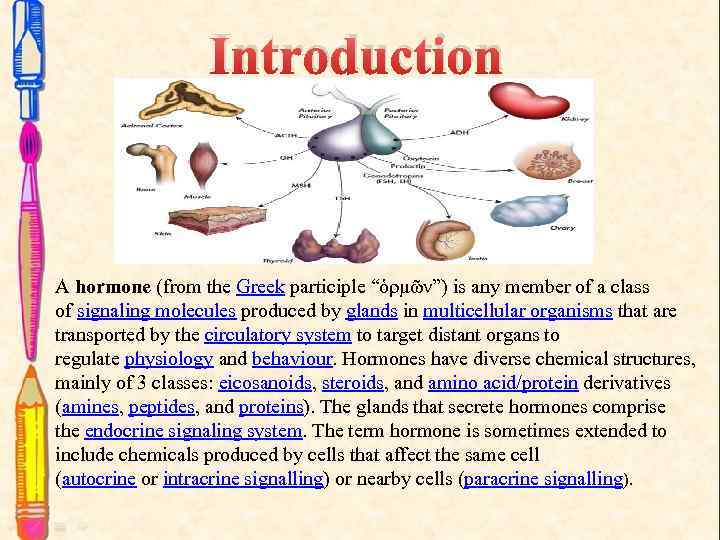 Introduction A hormone (from the Greek participle “ὁρμῶν”) is any member of a class of signaling molecules produced by glands in multicellular organisms that are transported by the circulatory system to target distant organs to regulate physiology and behaviour. Hormones have diverse chemical structures, mainly of 3 classes: eicosanoids, steroids, and amino acid/protein derivatives (amines, peptides, and proteins). The glands that secrete hormones comprise the endocrine signaling system. The term hormone is sometimes extended to include chemicals produced by cells that affect the same cell (autocrine or intracrine signalling) or nearby cells (paracrine signalling).
 Main part General characteristics of hormones are as follows: 1)-Hormones are secreted by endocrine cells 2)-Hormones are chemical messengers. 3)-The are chemical signals that circulate in the body fluids. 4 -The hormones regulate the behavior of the target cells. 5*Hormones, unlike enzymes do not catalyze any reaction. 6*They are secreted only when needed, they are not stored prior to requirement. 7*Hormones may be proteinaceous or non-proteinaceous in nature (amino -acids or steroids). 8*The secretion of hormones is regulated by the nervous system through the feed back effect. 9*Hormones usually cause long term effects like change in behavior, growth, etc. 10*The hormones function is to stimulate or inhibit the target organs.
 Traditional Classification Hormones are classified traditionally into three types: Classical hormones - These hormones are secreted from the endocrine cells into the interstitial fluid. These hormones diffuse into the bloodstream and are distributed to all body parts by the circulatory system. Neurohormones - These hormones are synthesized by the neuroendocrine cells and are secreted at the nerve terminals. They are transported around the body through the blood vessels, into which they were diffused. Local hormones - These hormones are secreted into the interstitial fluid and they act locally in two ways. Some hormones act on the neighboring cells and are known as paracrine hormones and some hormones act on the cells from which they were secreted, they are autocrine hormones.
 Structural Classification Hormones are structurally classified into four groups steroids, peptides, amino acids and fatty acids. Steroid hormones are derived from cholesterol and are soluble in lipids. The steroid hormones include the sex hormones and the hormones produced by the adrenal gland. The sex hormone include androgens, estrogens and progesterone. The adrenal hormones are mineralcorticosteroids and glucocorticosteroids. Steroids hormones are important as they take part in important functions including water balance, sexual development and stress response. Amino acid derivative hormones - These hormones are derived from amino acids like tyrosine and tyroptophan. Two types of tyrosine derived hormones, they are thyroid hormone and catecholamines. Thyroid hormone is the most important as it regulates the develpment of organs and metabolism. Catecholamines - Norepoinephrine and epinephrine are catecholamines. They are stress hormones and ar neurotransmiiters. , Tryptophan amino acid is the precursor of hormones like serotonin and melatonin. Serotonin regulates the movement of the intestines and is also associated with mood and low levels of this hormones often result in depression.
 On the Basis of Mode of Action Based on the mode of action hormones are classified into quick acting hormones and short acting hormones. Quick acting hormones - These hormones initiate immediate response from their target cells. These hormones have outer plasma membrane receptors on the target cell, they are large sized. Example: Protein and amine hormones. Short acting hormones - These hormones initiate a delayed response. These hormones are small in size and they bind to the protein receptors present in the cytosol. Example: steroid hormones of reproductive organs and sdrenal cortex.
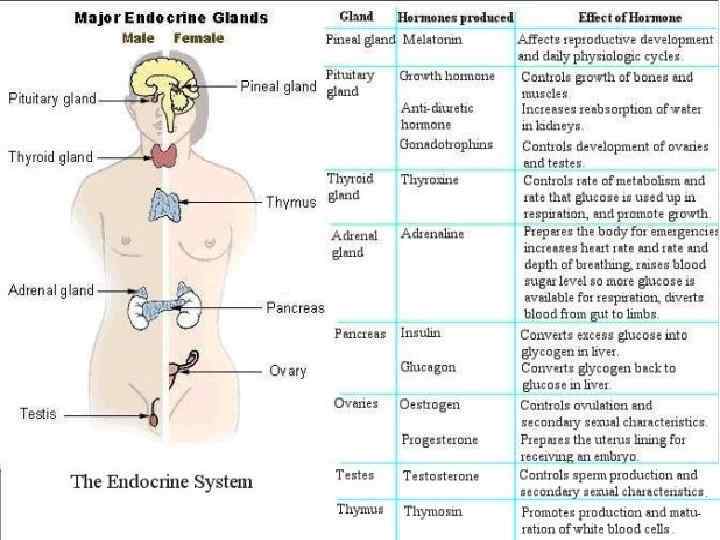
 Significanse of hormones in organizm Effects of hormones in mammals: *They stimulate or inhibit growth. *Hormones control the wake-up cycle and the circadian rhythms. *Are responsible for mood swings. *Induces or suppresses apoptosis. *Activates or inhibits the immune system. *Regulates metabolism. *Prepares body for mating, fleeing, flighting and other activity. *Also prepares body for new mode of life like puberty, parenting and menopause. *It controls the activity of the reproductive cycle. *Controls hunger.
 Pineal gland
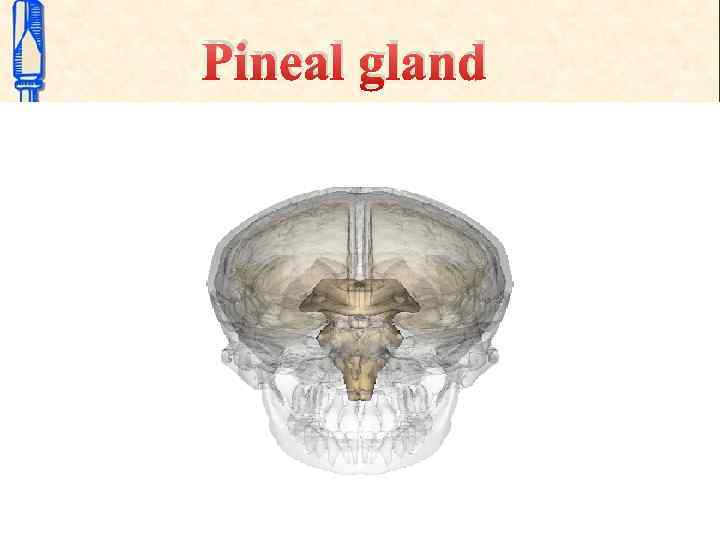
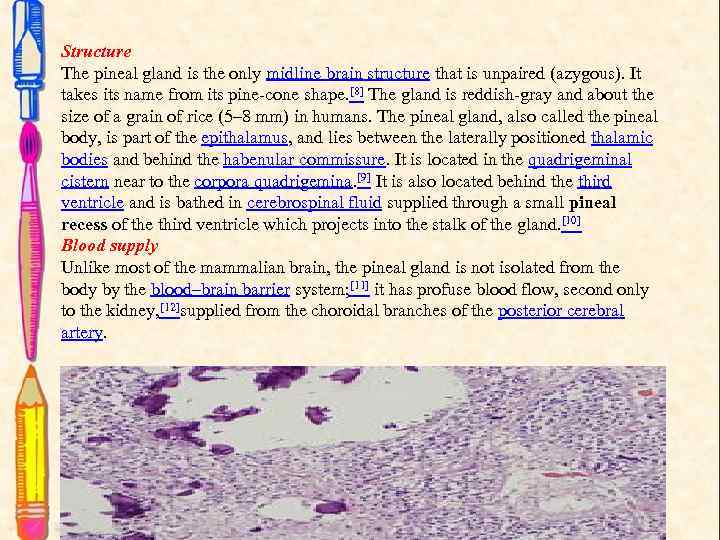 Structure The pineal gland is the only midline brain structure that is unpaired (azygous). It takes its name from its pine-cone shape. [8] The gland is reddish-gray and about the size of a grain of rice (5– 8 mm) in humans. The pineal gland, also called the pineal body, is part of the epithalamus, and lies between the laterally positioned thalamic bodies and behind the habenular commissure. It is located in the quadrigeminal cistern near to the corpora quadrigemina. [9] It is also located behind the third ventricle and is bathed in cerebrospinal fluid supplied through a small pineal recess of the third ventricle which projects into the stalk of the gland. [10] Blood supply Unlike most of the mammalian brain, the pineal gland is not isolated from the body by the blood–brain barrier system; [11] it has profuse blood flow, second only to the kidney, [12]supplied from the choroidal branches of the posterior cerebral artery.
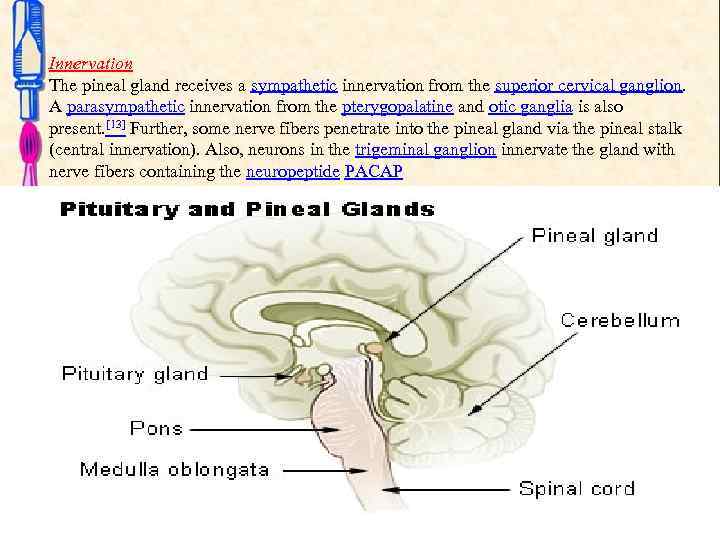 Innervation The pineal gland receives a sympathetic innervation from the superior cervical ganglion. A parasympathetic innervation from the pterygopalatine and otic ganglia is also present. [13] Further, some nerve fibers penetrate into the pineal gland via the pineal stalk (central innervation). Also, neurons in the trigeminal ganglion innervate the gland with nerve fibers containing the neuropeptide PACAP
 Function of pineal gland The primary function of the pineal gland is to produce melatonin. Melatonin has various functions in the central nervous system, the most important of which is to help modulate sleep patterns. Melatonin production is stimulated by darkness and inhibited by light. ]Light sensitive nerve cells in the retina detect light and send this signal to the suprachiasmatic nucleus (SCN), synchronizing the SCN to the day-night cycle. Nerve fibers then relay the daylight information from the SCN to the paraventricular nuclei (PVN), then to the spinal cord and via the sympathetic system to superior cervical ganglia (SCG), and from there into the pineal gland.
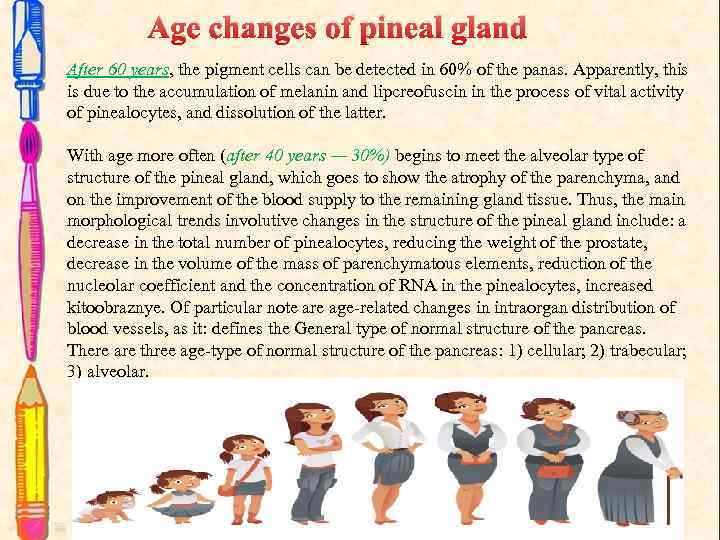 Age changes of pineal gland After 60 years, the pigment cells can be detected in 60% of the panas. Apparently, this is due to the accumulation of melanin and lipcreofuscin in the process of vital activity of pinealocytes, and dissolution of the latter. With age more often (after 40 years — 30%) begins to meet the alveolar type of structure of the pineal gland, which goes to show the atrophy of the parenchyma, and on the improvement of the blood supply to the remaining gland tissue. Thus, the main morphological trends involutive changes in the structure of the pineal gland include: a decrease in the total number of pinealocytes, reducing the weight of the prostate, decrease in the volume of the mass of parenchymatous elements, reduction of the nucleolar coefficient and the concentration of RNA in the pinealocytes, increased kitoobraznye. Of particular note are age-related changes in intraorgan distribution of blood vessels, as it: defines the General type of normal structure of the pancreas. There are three age-type of normal structure of the pancreas: 1) cellular; 2) trabecular; 3) alveolar.
 Conclusion Hormones are special chemical messengers in the body that are created in the endocrine glands. These messengers control most major bodily functions, from simple basic needs like hunger to complex systems like reproduction, and even the emotions and mood. Understanding the major hormone functions will help patients take control of their health.
 References Internet resources 1. www. wikipedia. org 2 studopedia. ru