 Скачать презентацию Semesterisation and Degree programmes in the Built Environment
183e20491b42edf6e45e2283770830ff.ppt
- Количество слайдов: 43



Semesterisation and Degree programmes in the Built Environment School of the Built Environment 1
Structure of the Academic year • From September 2008 the university is changing its academic year from a term system to semesters. • We are changing from 3, 10 week terms to 2 longer semesters for on campus courses. There is a third teaching period for our Approved Learning Partners • As part of implementation of these changes the university has reviewed how we deliver our courses in terms of module size, number of modules and methods of assessment. School of the Built Environment 2
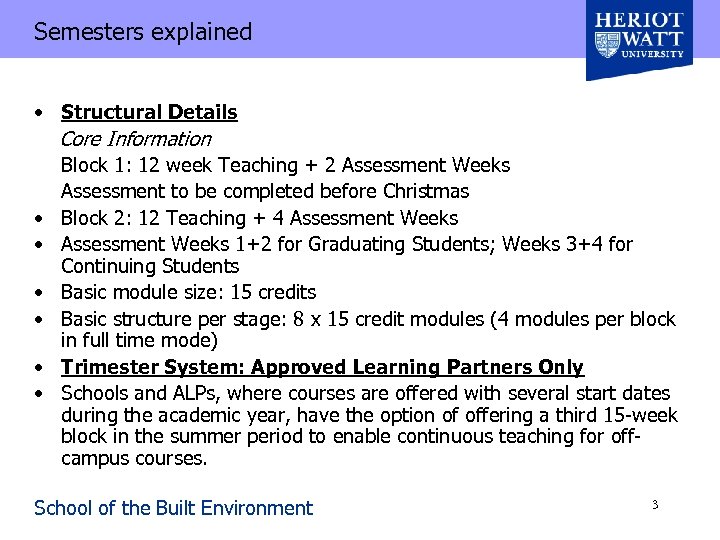
Semesters explained • Structural Details Core Information Block 1: 12 week Teaching + 2 Assessment Weeks Assessment to be completed before Christmas • Block 2: 12 Teaching + 4 Assessment Weeks • Assessment Weeks 1+2 for Graduating Students; Weeks 3+4 for Continuing Students • Basic module size: 15 credits • Basic structure per stage: 8 x 15 credit modules (4 modules per block in full time mode) • Trimester System: Approved Learning Partners Only • Schools and ALPs, where courses are offered with several start dates during the academic year, have the option of offering a third 15 -week block in the summer period to enable continuous teaching for offcampus courses. School of the Built Environment 3
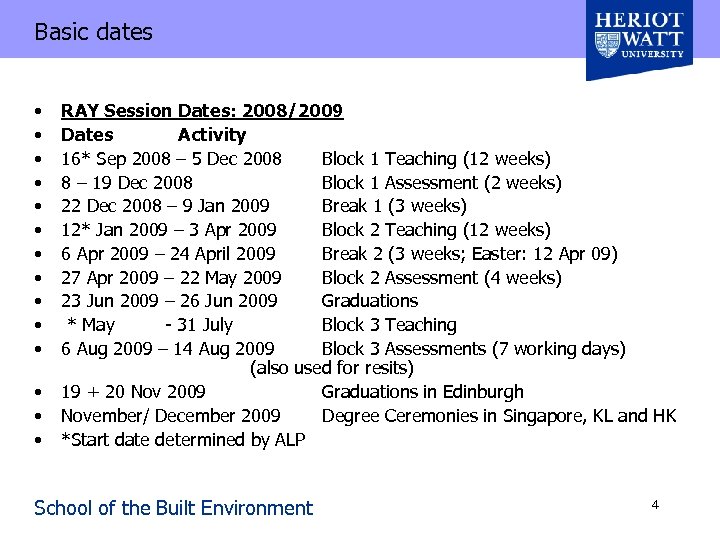
Basic dates • • • • RAY Session Dates: 2008/2009 Dates Activity 16* Sep 2008 – 5 Dec 2008 Block 1 Teaching (12 weeks) 8 – 19 Dec 2008 Block 1 Assessment (2 weeks) 22 Dec 2008 – 9 Jan 2009 Break 1 (3 weeks) 12* Jan 2009 – 3 Apr 2009 Block 2 Teaching (12 weeks) 6 Apr 2009 – 24 April 2009 Break 2 (3 weeks; Easter: 12 Apr 09) 27 Apr 2009 – 22 May 2009 Block 2 Assessment (4 weeks) 23 Jun 2009 – 26 Jun 2009 Graduations * May - 31 July Block 3 Teaching 6 Aug 2009 – 14 Aug 2009 Block 3 Assessments (7 working days) (also used for resits) 19 + 20 Nov 2009 Graduations in Edinburgh November/ December 2009 Degree Ceremonies in Singapore, KL and HK *Start date determined by ALP School of the Built Environment 4
Postgraduate courses Construction Project Management, Facilities Management, Quantity Surveying Building Surveying (new in 2009) Real Estate Investment and Finance Civil Engineering and Construction Management Safety Risk Management Building Services Engineering (replaced by Architectural Engineering in 2009) School of the Built Environment 5
Postgraduate Course Structure 8 Taught Modules for PG diploma Plus 1 Dissertation for MSc School of the Built Environment 6
Assessment • 8 taught modules, each worth 15 credits (was 12) – Each module: - 1 written examination of 2 hours for single modules 3 hours for synoptic pair – plus - 1 assignment per module – Not all modules are assessed by examination. • 1 (Research) Dissertation : 15, 000 words worth 60 credits (84) • Project report (previously 24 credits) is no longer required for Pg diploma. • Marking Scheme Grade average 70% average 50 - 69% average 40 -49% School of the Built Environment Award Distinction MSc. Pass Diploma Pass 7
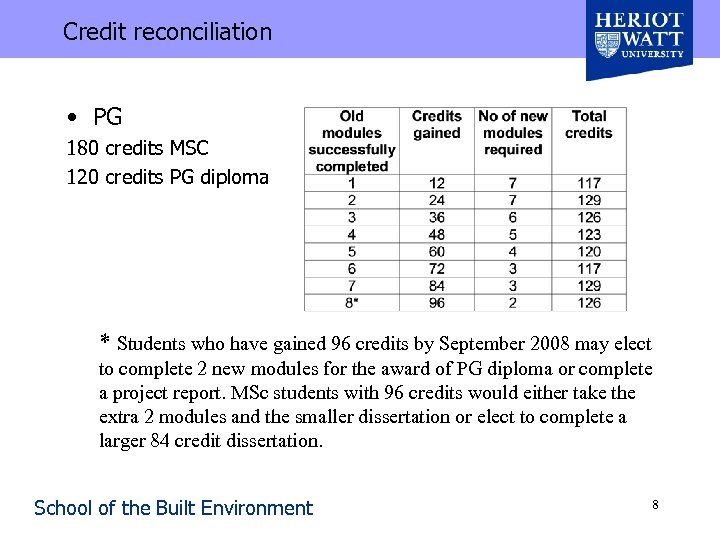
Credit reconciliation • PG 180 credits MSC 120 credits PG diploma * Students who have gained 96 credits by September 2008 may elect to complete 2 new modules for the award of PG diploma or complete a project report. MSc students with 96 credits would either take the extra 2 modules and the smaller dissertation or elect to complete a larger 84 credit dissertation. School of the Built Environment 8
Examination • Written Examination is set by HWU December, April/May and August Same Examination Papers for all internal and external students. • Students are given 1 re-sit opportunity if required. There is a charge for the re-sit School of the Built Environment 9
Taught Modules- Construction Project Management • • Project Management Theory & Practice People and Organizational Management in the Built Environment Construction Financial Management (previously CFM 2) Contracts and Procurement Project Management Strategic Issues Value and Risk Management Project Management: Case Study Micro Economics • (Arrangement of modules is subject to change by HWU) School of the Built Environment 10
Facilities Management • Service Procurement and Provision • Space Planning and Management • Business Management for Built Environment Professionals • Sustainable Practices for FM • Contracts and Procurement • Asset Maintenance Management • People and Organisational Management in the Built Environment • Value and Risk Management • (Arrangement of modules is subject to change by HWU) School of the Built Environment 11
Quantity Surveying • Construction Technology • People and Organizational Management in the Built Environment • Quantity Surveying Financial Management (previously CFM 1) • Construction Financial Management (previously CFM 2) • Contracts and Procurement • Value and Risk Management • Business Management for Built Environment Professionals • Real Estate Management and Sustainability (replaces micro-economics) School of the Built Environment 12
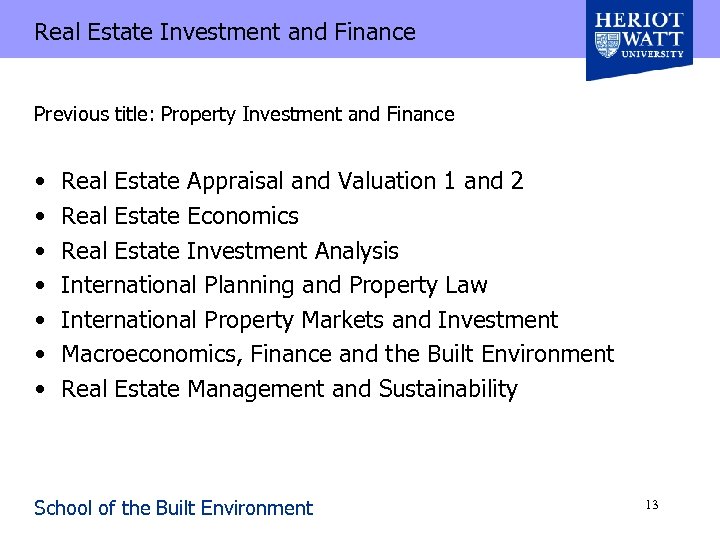
Real Estate Investment and Finance Previous title: Property Investment and Finance • • Real Estate Appraisal and Valuation 1 and 2 Real Estate Economics Real Estate Investment Analysis International Planning and Property Law International Property Markets and Investment Macroeconomics, Finance and the Built Environment Real Estate Management and Sustainability School of the Built Environment 13
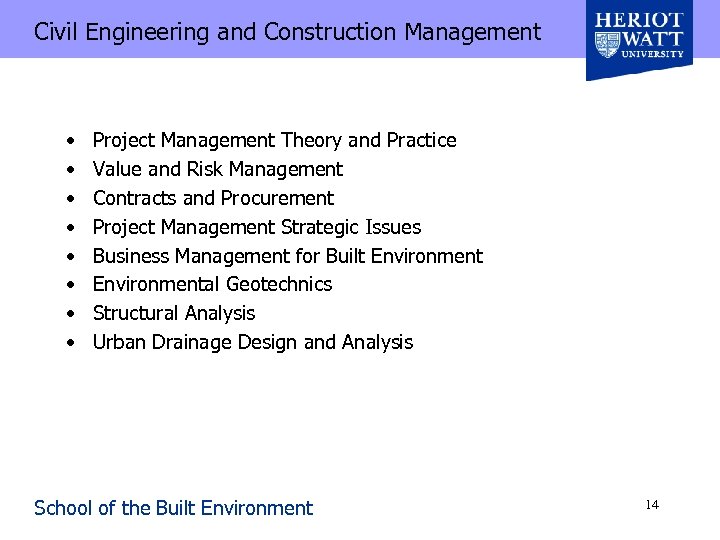
Civil Engineering and Construction Management • • Project Management Theory and Practice Value and Risk Management Contracts and Procurement Project Management Strategic Issues Business Management for Built Environmental Geotechnics Structural Analysis Urban Drainage Design and Analysis School of the Built Environment 14
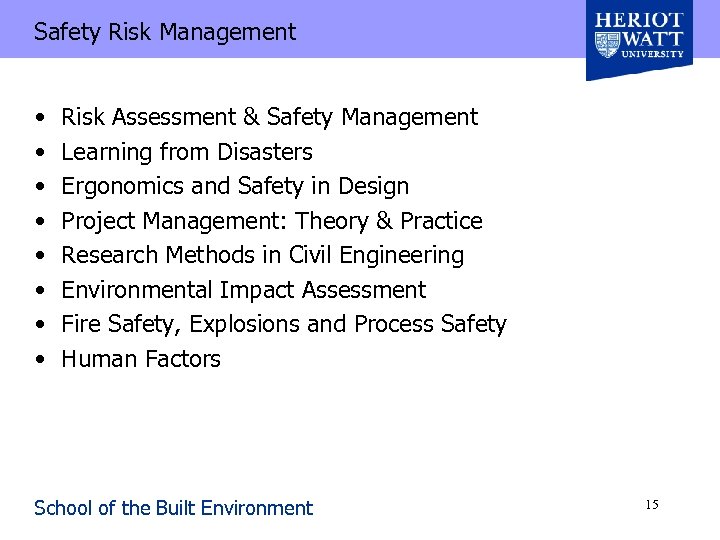
Safety Risk Management • • Risk Assessment & Safety Management Learning from Disasters Ergonomics and Safety in Design Project Management: Theory & Practice Research Methods in Civil Engineering Environmental Impact Assessment Fire Safety, Explosions and Process Safety Human Factors School of the Built Environment 15
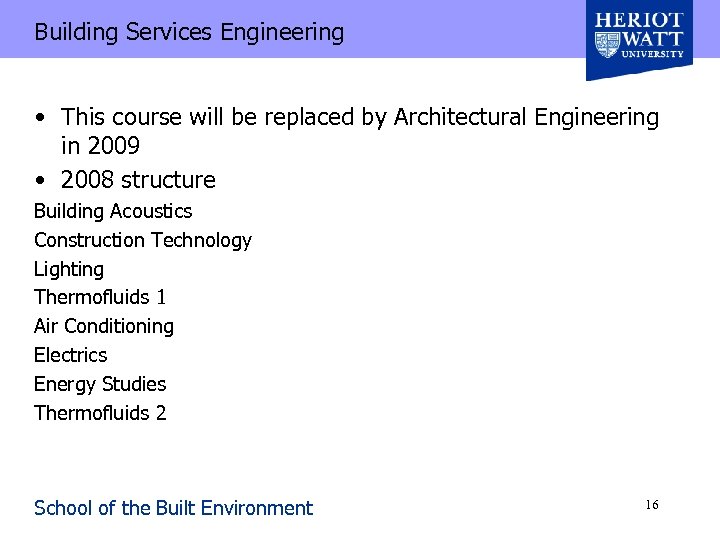
Building Services Engineering • This course will be replaced by Architectural Engineering in 2009 • 2008 structure Building Acoustics Construction Technology Lighting Thermofluids 1 Air Conditioning Electrics Energy Studies Thermofluids 2 School of the Built Environment 16
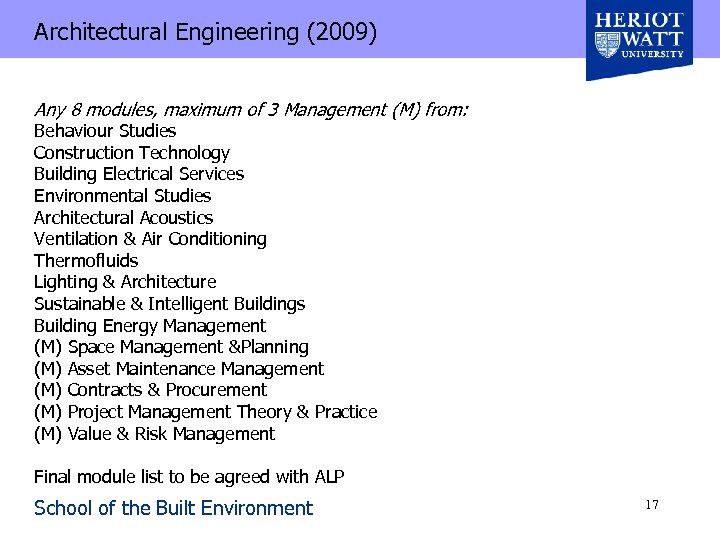
Architectural Engineering (2009) Any 8 modules, maximum of 3 Management (M) from: Behaviour Studies Construction Technology Building Electrical Services Environmental Studies Architectural Acoustics Ventilation & Air Conditioning Thermofluids Lighting & Architecture Sustainable & Intelligent Buildings Building Energy Management (M) Space Management &Planning (M) Asset Maintenance Management (M) Contracts & Procurement (M) Project Management Theory & Practice (M) Value & Risk Management Final module list to be agreed with ALP School of the Built Environment 17
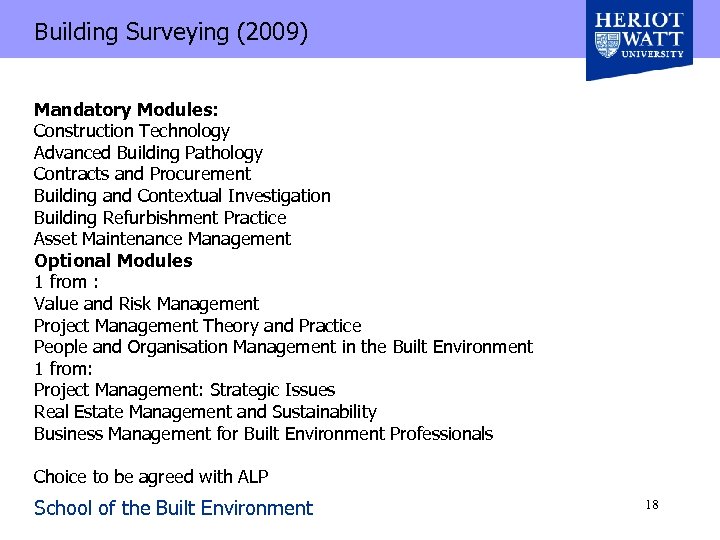
Building Surveying (2009) Mandatory Modules: Construction Technology Advanced Building Pathology Contracts and Procurement Building and Contextual Investigation Building Refurbishment Practice Asset Maintenance Management Optional Modules 1 from : Value and Risk Management Project Management Theory and Practice People and Organisation Management in the Built Environment 1 from: Project Management: Strategic Issues Real Estate Management and Sustainability Business Management for Built Environment Professionals Choice to be agreed with ALP School of the Built Environment 18
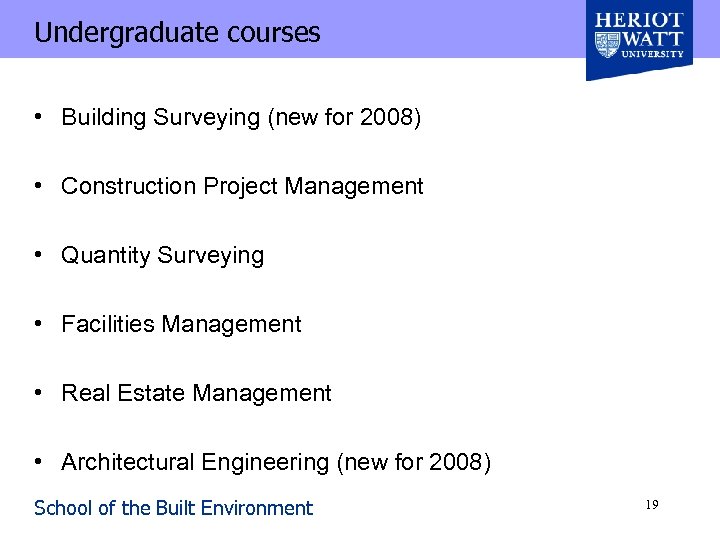
Undergraduate courses • Building Surveying (new for 2008) • Construction Project Management • Quantity Surveying • Facilities Management • Real Estate Management • Architectural Engineering (new for 2008) School of the Built Environment 19
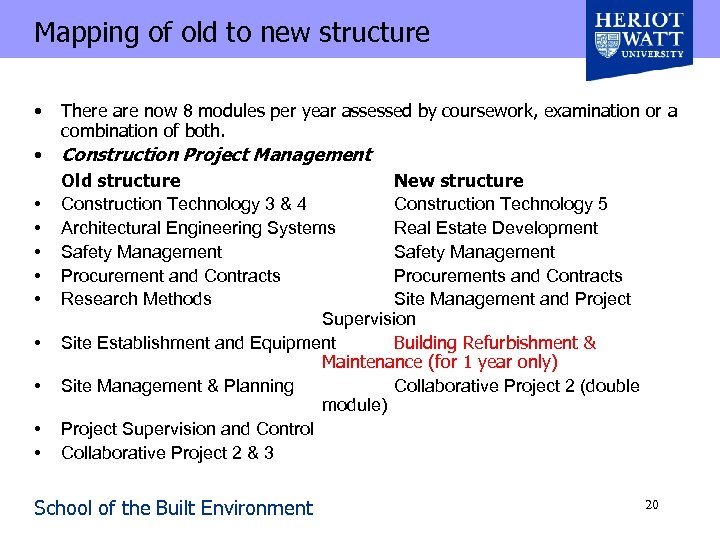
Mapping of old to new structure • There are now 8 modules per year assessed by coursework, examination or a combination of both. • Construction Project Management • • • Old structure New structure Construction Technology 3 & 4 Construction Technology 5 Architectural Engineering Systems Real Estate Development Safety Management Procurement and Contracts Procurements and Contracts Research Methods Site Management and Project Supervision Site Establishment and Equipment Building Refurbishment & Maintenance (for 1 year only) Site Management & Planning Collaborative Project 2 (double module) Project Supervision and Control Collaborative Project 2 & 3 School of the Built Environment 20
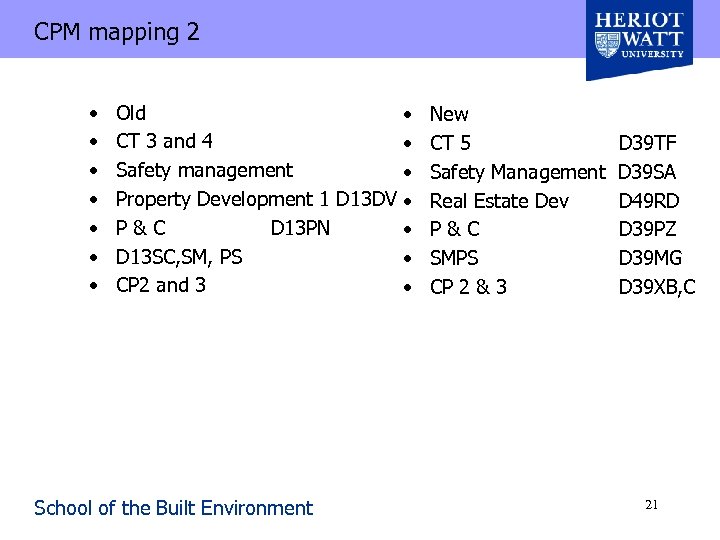
CPM mapping 2 • • Old • New CT 3 and 4 • CT 5 Safety management • Safety Management Property Development 1 D 13 DV • Real Estate Dev P&C D 13 PN • P&C D 13 SC, SM, PS • SMPS CP 2 and 3 • CP 2 & 3 School of the Built Environment D 39 TF D 39 SA D 49 RD D 39 PZ D 39 MG D 39 XB, C 21
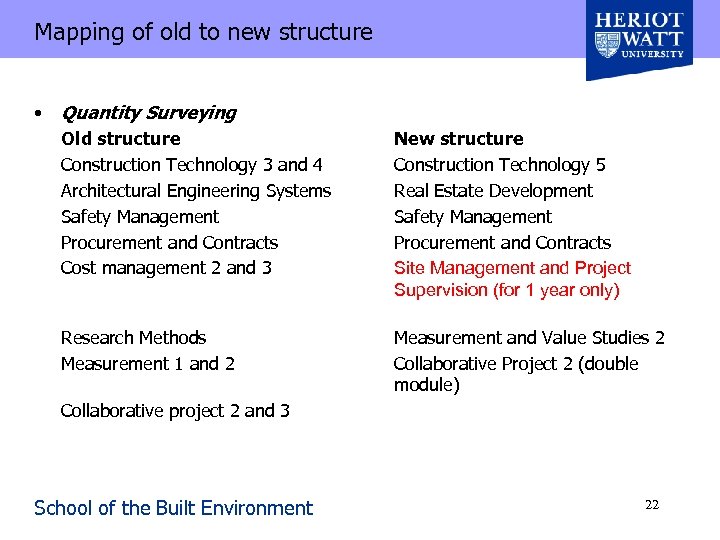
Mapping of old to new structure • Quantity Surveying Old structure Construction Technology 3 and 4 Architectural Engineering Systems Safety Management Procurement and Contracts Cost management 2 and 3 New structure Construction Technology 5 Real Estate Development Safety Management Procurement and Contracts Site Management and Project Supervision (for 1 year only) Research Methods Measurement 1 and 2 Measurement and Value Studies 2 Collaborative Project 2 (double module) Collaborative project 2 and 3 School of the Built Environment 22
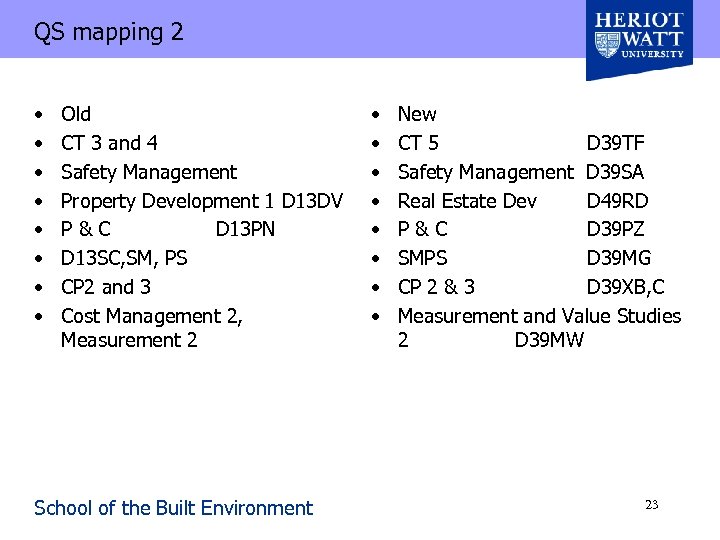
QS mapping 2 • • Old CT 3 and 4 Safety Management Property Development 1 D 13 DV P&C D 13 PN D 13 SC, SM, PS CP 2 and 3 Cost Management 2, Measurement 2 School of the Built Environment • • New CT 5 D 39 TF Safety Management D 39 SA Real Estate Dev D 49 RD P&C D 39 PZ SMPS D 39 MG CP 2 & 3 D 39 XB, C Measurement and Value Studies 2 D 39 MW 23
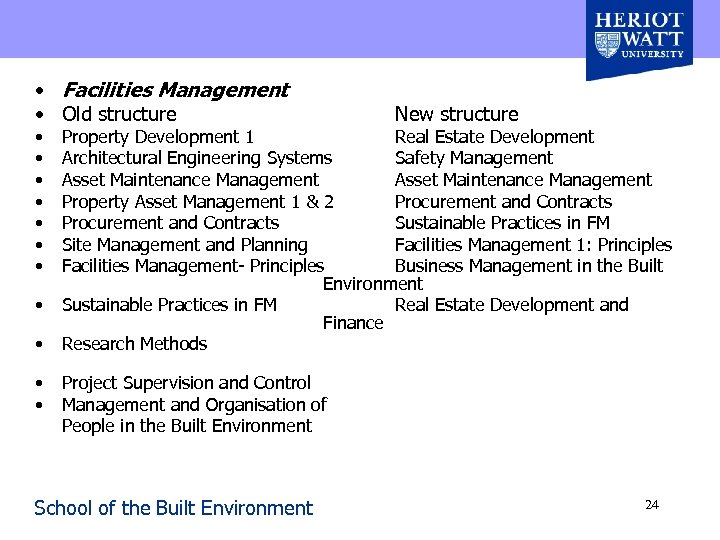
• Facilities Management • Old structure • • • New structure Property Development 1 Real Estate Development Architectural Engineering Systems Safety Management Asset Maintenance Management Property Asset Management 1 & 2 Procurement and Contracts Sustainable Practices in FM Site Management and Planning Facilities Management 1: Principles Facilities Management- Principles Business Management in the Built Environment Sustainable Practices in FM Real Estate Development and Finance Research Methods Project Supervision and Control Management and Organisation of People in the Built Environment School of the Built Environment 24
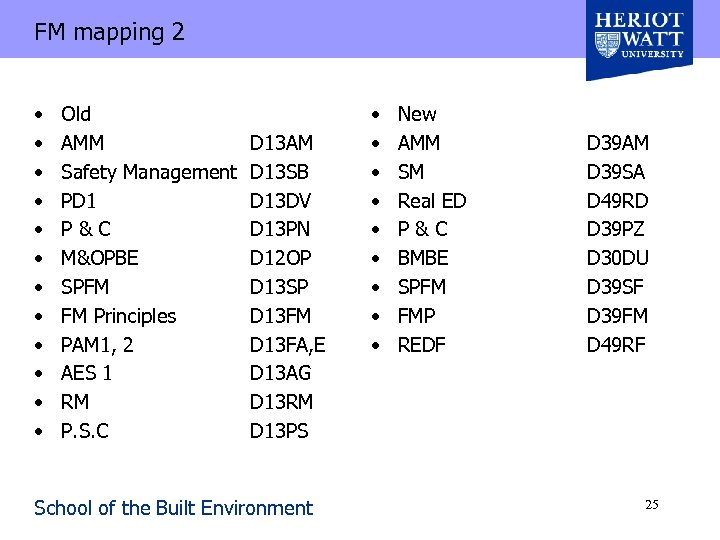
FM mapping 2 • • • Old AMM Safety Management PD 1 P&C M&OPBE SPFM FM Principles PAM 1, 2 AES 1 RM P. S. C D 13 AM D 13 SB D 13 DV D 13 PN D 12 OP D 13 SP D 13 FM D 13 FA, E D 13 AG D 13 RM D 13 PS School of the Built Environment • • • New AMM SM Real ED P&C BMBE SPFM FMP REDF D 39 AM D 39 SA D 49 RD D 39 PZ D 30 DU D 39 SF D 39 FM D 49 RF 25
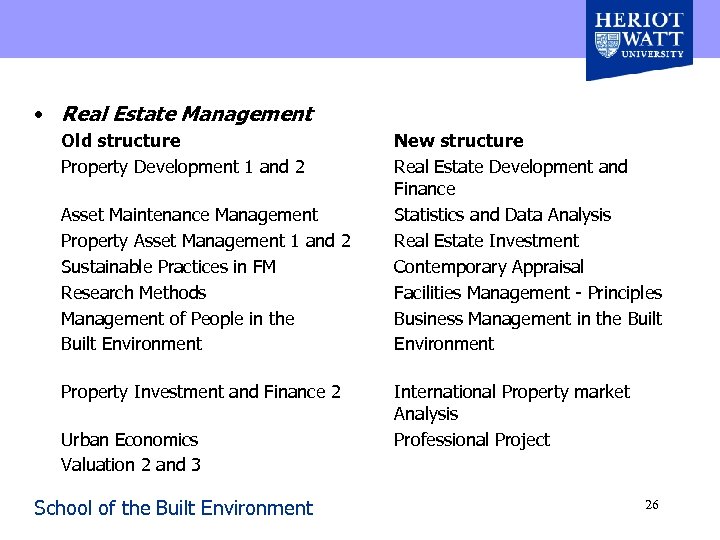
• Real Estate Management Old structure Property Development 1 and 2 Asset Maintenance Management Property Asset Management 1 and 2 Sustainable Practices in FM Research Methods Management of People in the Built Environment Property Investment and Finance 2 Urban Economics Valuation 2 and 3 School of the Built Environment New structure Real Estate Development and Finance Statistics and Data Analysis Real Estate Investment Contemporary Appraisal Facilities Management - Principles Business Management in the Built Environment International Property market Analysis Professional Project 26
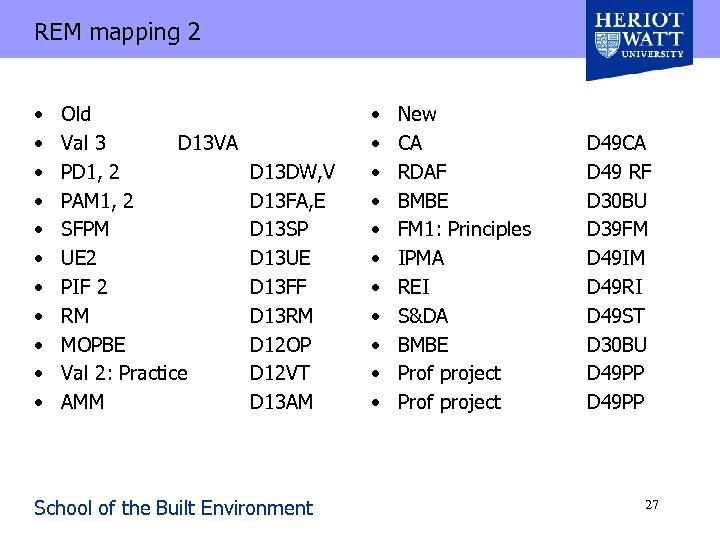
REM mapping 2 • • • Old Val 3 D 13 VA PD 1, 2 PAM 1, 2 SFPM UE 2 PIF 2 RM MOPBE Val 2: Practice AMM D 13 DW, V D 13 FA, E D 13 SP D 13 UE D 13 FF D 13 RM D 12 OP D 12 VT D 13 AM School of the Built Environment • • • New CA RDAF BMBE FM 1: Principles IPMA REI S&DA BMBE Prof project D 49 CA D 49 RF D 30 BU D 39 FM D 49 IM D 49 RI D 49 ST D 30 BU D 49 PP 27
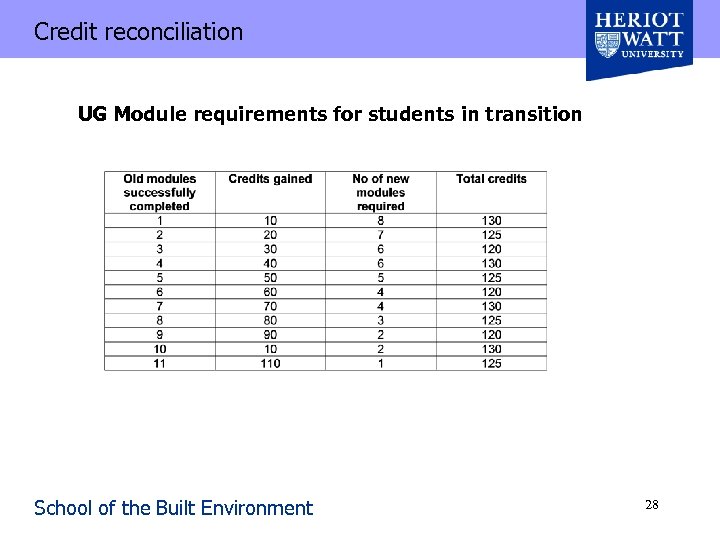
Credit reconciliation UG Module requirements for students in transition School of the Built Environment 28
New courses structures • Architectural Engineering Environmental Science & Human Responses (30 credits) Critical Studies Inclusive and Safe Environments Safety Management Energy & Buildings Design Software Applications Design Project School of the Built Environment 29
• Building Surveying Construction Technology 5 Safety Management Building Pathology & Inspection Procurement and Contracts Building Refurbishment & Maintenance Site Management and Project Supervision (for 1 year only) Collaborative Project 2 (30 credits) School of the Built Environment 30
Examinations • Examinations are taken in December, April/May and August • All students have 1 re-sit opportunity per module. There is a charge for the resit. • All examinations and coursework are set and marked by HWU staff. • The on-campus and off-campus assessments are the same. School of the Built Environment 31
Degree award • Each module is worth 15 credits. (previously 12 modules each of 10 credits) • Students who successfully complete all 8 modules at level 3 may graduate BSc • Students may, as an alternative to graduating at the end of the year, may continue with their studies to obtain an honours degree. • In general on campus and off campus students perform equally well. We do not anticipate this will change as a result of restructuring. • As part of this efforts to ensure the high quality of our degrees is maintained, ALPs are obliged to take part in an annual review of the programmes and we encourage students and staff to give formal feedback about their course and individual modules. School of the Built Environment 32
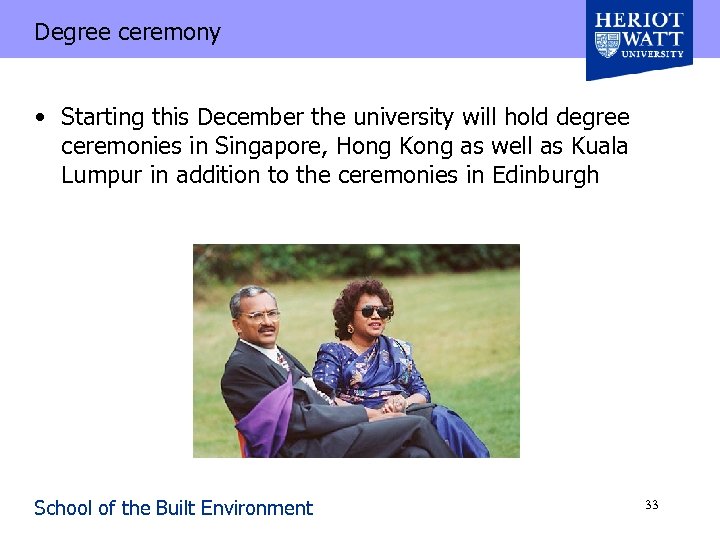
Degree ceremony • Starting this December the university will hold degree ceremonies in Singapore, Hong Kong as well as Kuala Lumpur in addition to the ceremonies in Edinburgh School of the Built Environment 33
Aims and objectives • Each course has clearly defined aims and objectives. These are outlined in the approved course notes and descriptors held at each ALP. • There also descriptors for each module. These are also held by the ALP. • We recommend that students take the time to read both the course and module desriptors. School of the Built Environment 34
Sample course description extracts (1) • • • • • 10. Educational Aims of the Courses The educational aims of the Facilities Management courses are as follows: To provide a knowledge and skill level commensurate with practise as a facilities manager. To enable the student to understand the concept of facilities management and the broad definition that can arise from the management of multiple buildings functions. To provide an understanding of management techniques both general and subject specific which is essential to the discipline. To enable students to develop to their maximum capacity to ensure best achievement compatible with ability. To enable students to maximise their potential by developing transferable skills with subject skills. The general aim being to produce graduates who can: confidently and competently deal with complex situations make professionally competent judgements in the workplace environment demonstrate effective self management in planning and implementing solutions to problems demonstrate scholarship through development of personal skills and knowledge broaden knowledge and skill base in the field of facilities management develop subject-specific knowledge in the field of facilities management use knowledge, understanding and skills in a systematic and critical assessment of a range of situations communicate effectively using subject specific knowledge and skills apply subject-related transferable skills in facilities management professional practice. School of the Built Environment 35
Sample course description extract (2) • • • Professional Awareness Understand the roles and responsibilities governing facilities management practice, and appreciate the need for professional and ethical behaviour. A professional approach to undertaking tasks, including a sense of responsibility and ethical conduct. Take responsibility for personal, professional and social awareness development in the context of the appropriate professional body requirements. Understanding, Knowledge and Cognitive Skills The specialisms listed below are achieved by all graduands: An ability to ensure that the resources of the built environment are used to best advantage from project inception to demolition An understanding of the interrelationships between economics, technology, management and law can be used to add value to the financial and procurement management of projects An understanding of the core processes related to the facilities management discipline A knowledge and understanding of issues related to the briefing, design management, procurement, planning, programming, quality management and safety arrangements needed to produce building projects An ability to evaluate complex problems and formulate original ideas and proposals in the field of the built environment Legislation is covered at the strategic level in the context of management skills. A broad working knowledge of practice and associated legislation is offered but students will recognise that management of others means that specific skill bases can be used as a tool. School of the Built Environment 36
Sample course description extract (3) • Scholarship, Enquiry and Research • Generation of written and oral reports in a variety of styles suited to the differing contexts of facilities management; including the skills of focusing on key points, concluding and recommending actions. • Evaluation of complex problems arising in asset maintenance management, workspace management, continuity planning and translating these into FM strategy and/or policy. • Gather and analyse information from a number of sources, and make informed judgements based on the body of evidence. • Develop appropriate ethical conduct in the face of conflicting professional pressures. • Determine client objectives and needs when undertaking an analysis, and develop the IT and communication skills required in the presentation of appropriate advice. • Apply professional knowledge and skills to the solving of real life problems, and provide clients with reliable advice. School of the Built Environment 37
Course description notes • These deal with the progression and award rules for a degree course. • For example the notes specify the number of credits required to advance from one stage of a course to another and the minimum number of grade D passes required for progression to the honours year. School of the Built Environment 38
Module descriptor example Pre-requisites None Linked Modules (specify if synoptic) None Excluded Modules None Replacement Module Code: Date Of Replacement: Availability as an Elective Yes No Degrees for which this is a core module BSc Construction Project Management BSc Construction Management (Building Services) BSc Quantity Surveying (Building Services) BSc Building Surveying BSc Facilities Management MEng / BSc Architectural Engineering Aims To provide an understanding of: -the health & safety problems associated with the construction industry, the safety law in the UK relevant to construction operations and the office environment theory and practice of safety management in the construction industry Syllabus the safety problem - review of the major health and safety problems within the construction industry construction safety law - the main laws that are applicable to the situation managing health and safety in construction School of the Built Environment 39
Module descriptor example creating a safer construction site - training & site practice Office safety – legislation and practice The way ahead – new thoughts and government initiatives Learning Outcomes Subject Mastery On completion of the module the student should be able to play an active and positive supportive role in promoting and managing safety in the construction situation. Personal Abilities Students should be able to demonstrate an understanding of the complexity, both in technical and managerial terms, of the construction process and show the theory of safety can be applied. Assessment Methods 100% by examination 2 hours duration Re-assessment by examination 2 hours duration. Date and Version Date of Proposal January 2008 Date of Approval by School Committee 23 January 2008 Date of Implementation. September 2008 Version Number 1. 00 School of the Built Environment 40
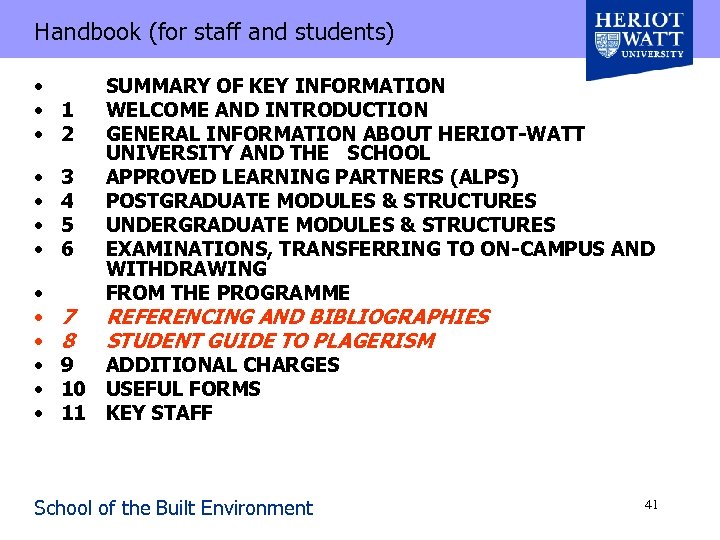
Handbook (for staff and students) • • 1 • 2 • • • 3 4 5 6 7 8 SUMMARY OF KEY INFORMATION WELCOME AND INTRODUCTION GENERAL INFORMATION ABOUT HERIOT-WATT UNIVERSITY AND THE SCHOOL APPROVED LEARNING PARTNERS (ALPS) POSTGRADUATE MODULES & STRUCTURES UNDERGRADUATE MODULES & STRUCTURES EXAMINATIONS, TRANSFERRING TO ON-CAMPUS AND WITHDRAWING FROM THE PROGRAMME REFERENCING AND BIBLIOGRAPHIES STUDENT GUIDE TO PLAGERISM 9 ADDITIONAL CHARGES 10 USEFUL FORMS 11 KEY STAFF School of the Built Environment 41
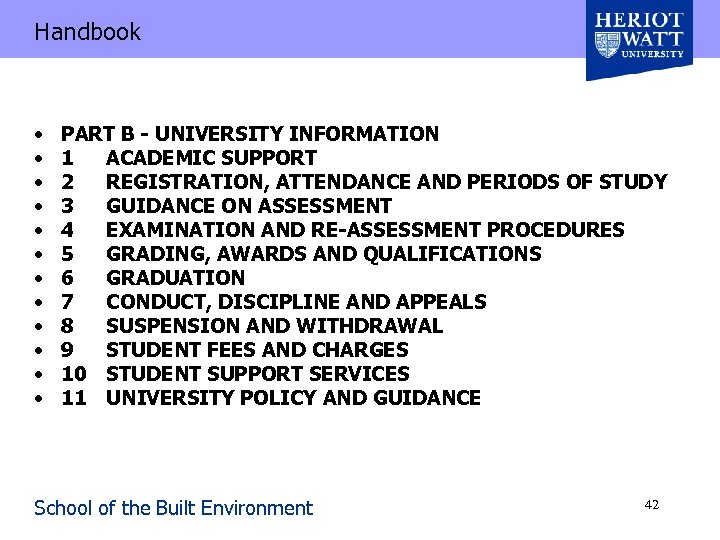
Handbook • • • PART B - UNIVERSITY INFORMATION 1 ACADEMIC SUPPORT 2 REGISTRATION, ATTENDANCE AND PERIODS OF STUDY 3 GUIDANCE ON ASSESSMENT 4 EXAMINATION AND RE-ASSESSMENT PROCEDURES 5 GRADING, AWARDS AND QUALIFICATIONS 6 GRADUATION 7 CONDUCT, DISCIPLINE AND APPEALS 8 SUSPENSION AND WITHDRAWAL 9 STUDENT FEES AND CHARGES 10 STUDENT SUPPORT SERVICES 11 UNIVERSITY POLICY AND GUIDANCE School of the Built Environment 42
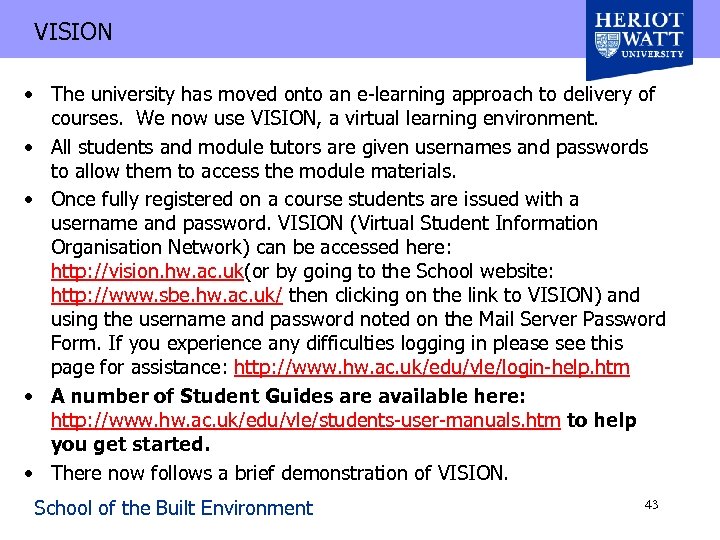
VISION • The university has moved onto an e-learning approach to delivery of courses. We now use VISION, a virtual learning environment. • All students and module tutors are given usernames and passwords to allow them to access the module materials. • Once fully registered on a course students are issued with a username and password. VISION (Virtual Student Information Organisation Network) can be accessed here: http: //vision. hw. ac. uk(or by going to the School website: http: //www. sbe. hw. ac. uk/ then clicking on the link to VISION) and using the username and password noted on the Mail Server Password Form. If you experience any difficulties logging in please see this page for assistance: http: //www. hw. ac. uk/edu/vle/login-help. htm • A number of Student Guides are available here: http: //www. hw. ac. uk/edu/vle/students-user-manuals. htm to help you get started. • There now follows a brief demonstration of VISION. School of the Built Environment 43
Скачать презентацию Semesterisation and Degree programmes in the Built Environment
183e20491b42edf6e45e2283770830ff.ppt