 Скачать презентацию SEMASIOLOGY SEMASIOLOGY p Semasiology from Greek σημασία
Semasiology.ppt
- Количество слайдов: 11



SEMASIOLOGY
SEMASIOLOGY p Semasiology (from Greek: σημασία (semasia) "signification, meaning" σημαίνω (semaino) "indicate, signify") is a discipline within linguistics concerned with the question "what does the word mean? ". It is an area of Lexicology that is devoted to the study of
SEMASIOLOGY The term was first used by Christian Karl Reisig in 1825 in his “Vorlesungen über lateinische Sprachwissenschaft” (Lectures on Latin Linguistics) and was in use in English by 1847. Semantics replaced it in its original meaning, beginning in
SEMASIOLOGY There are 2 approaches to the problem: 1) the referential approach, which formulates the essence of meaning as the interdependence between words and things or concepts they denote; 2) the functional approach, which studies the functions of a word in speech. This approach is (sometimes described as contextual) based on the analysis of various contexts.
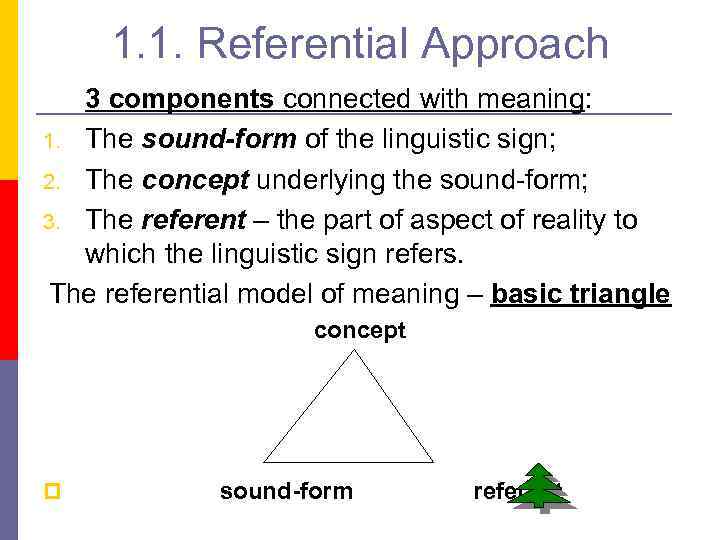
1. 1. Referential Approach 3 components connected with meaning: 1. The sound-form of the linguistic sign; 2. The concept underlying the sound-form; 3. The referent – the part of aspect of reality to which the linguistic sign refers. The referential model of meaning – basic triangle concept p sound-form referent
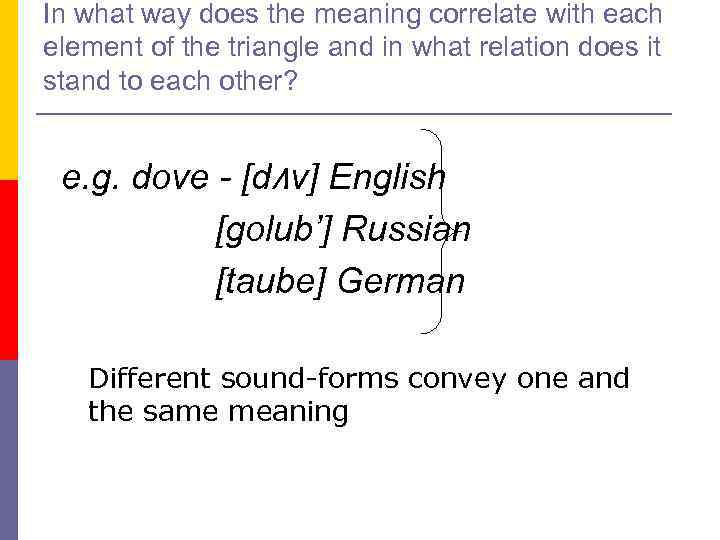
In what way does the meaning correlate with each element of the triangle and in what relation does it stand to each other? e. g. dove - [d۸ v] English [golub’] Russian [taube] German Different sound-forms convey one and the same meaning
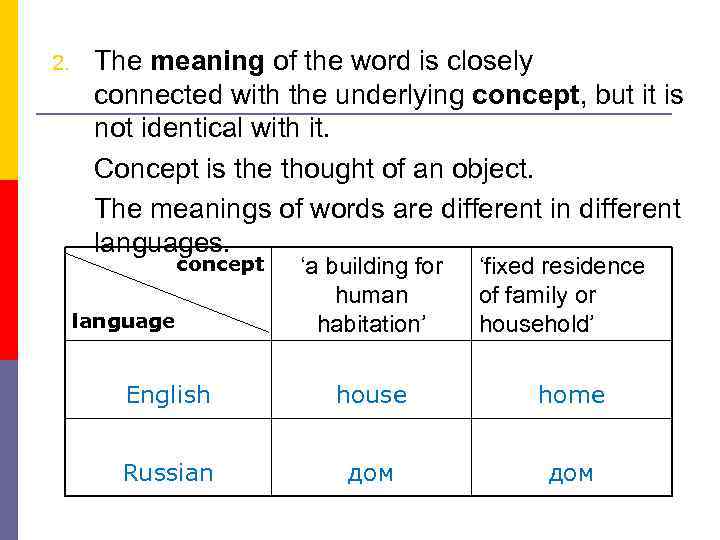
2. The meaning of the word is closely connected with the underlying concept, but it is not identical with it. Concept is the thought of an object. The meanings of words are different in different languages. concept language ‘a building for human habitation’ ‘fixed residence of family or household’ English house home Russian дом
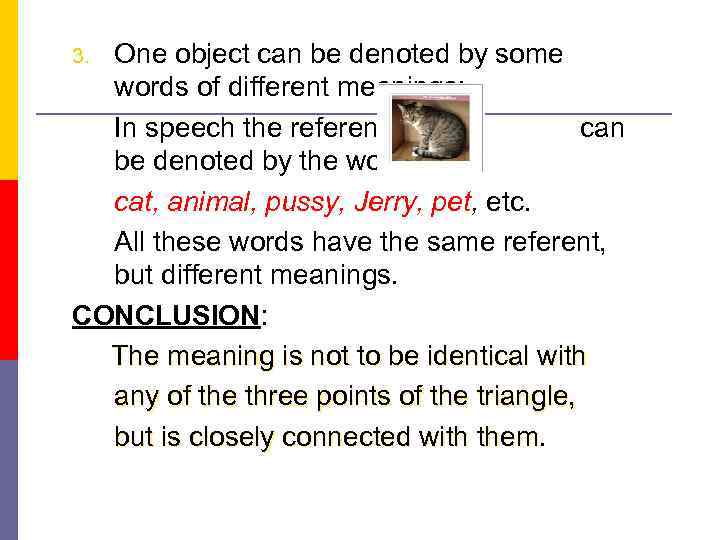
One object can be denoted by some words of different meanings: In speech the referent of can be denoted by the word cat, animal, pussy, Jerry, pet, etc. All these words have the same referent, but different meanings. CONCLUSION: The meaning is not to be identical with any of the three points of the triangle, but is closely connected with them 3.
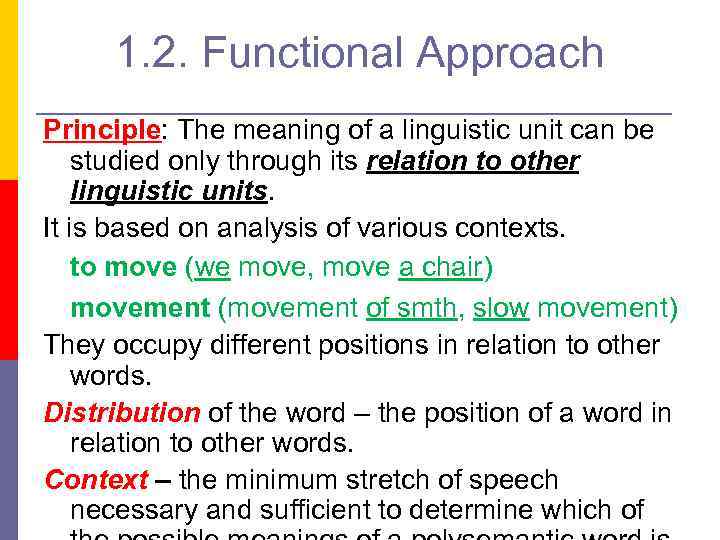
1. 2. Functional Approach Principle: The meaning of a linguistic unit can be studied only through its relation to other linguistic units. It is based on analysis of various contexts. to move (we move, move a chair) movement (movement of smth, slow movement) They occupy different positions in relation to other words. Distribution of the word – the position of a word in relation to other words. Context – the minimum stretch of speech necessary and sufficient to determine which of
Meaning a component of a word through which a concept is communicated, in this way endowing the word with the ability to denote objects,
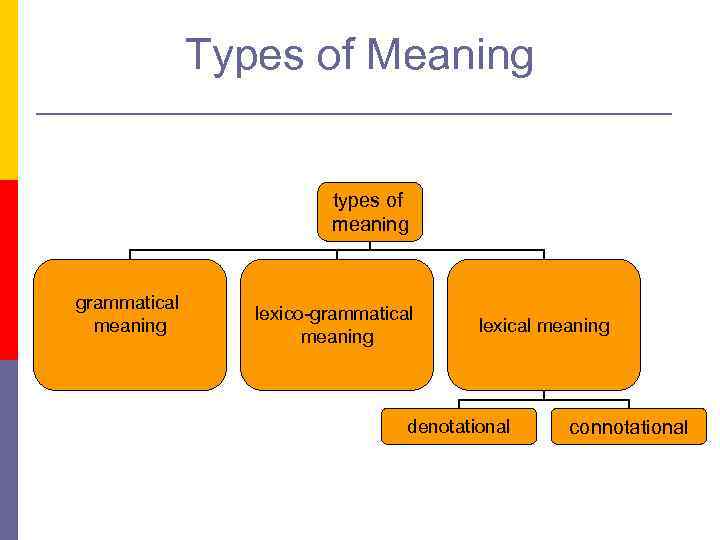
Types of Meaning types of meaning grammatical meaning lexico-grammatical meaning lexical meaning denotational connotational
Скачать презентацию SEMASIOLOGY SEMASIOLOGY p Semasiology from Greek σημασία
Semasiology.ppt