 Скачать презентацию Semantically-aided Data-aware Service Workflow Composition Ondrej Habala Marek
c661114b6a9a087d9c5c2ca7f3147e3f.ppt
- Количество слайдов: 15



Semantically-aided Data-aware Service Workflow Composition Ondrej Habala, Marek Paralič, Viera Rozinajová, Peter Bartalos Marek. Paralic@tuke. sk Technical University of Košice, Slovakia SOFSEM 2009 Špindlerův Mlýn, Czech Republic, 24. - 30. 1. 2009 1
Content Introduction - Semantics and Web services Motivation for the SEMCO-WS Architecture of the system for semantic composition of services Ontologies for Automatic Workflow Management Support of Collaboration in the SEMCO-WS Environment Design of the process of automated data reuse Workflow Composition and Execution Module Conclusion and Future Work SOFSEM 2009 Špindlerův Mlýn, Czech Republic, 24. - 30. 1. 2009 2
Introduction Semantic Web Services (SWS) – extension of Web Service technologies with semantics in order to automate tasks common when using WS Tasks: publishing, discovery, selection, composition, invocation, deployment and ontology management SWS frameworks combine semantic description of WS capabilities, input, outputs and behavior with the syntactic description in WSDL and XML -Schema SOFSEM 2009 Špindlerův Mlýn, Czech Republic, 24. - 30. 1. 2009 3
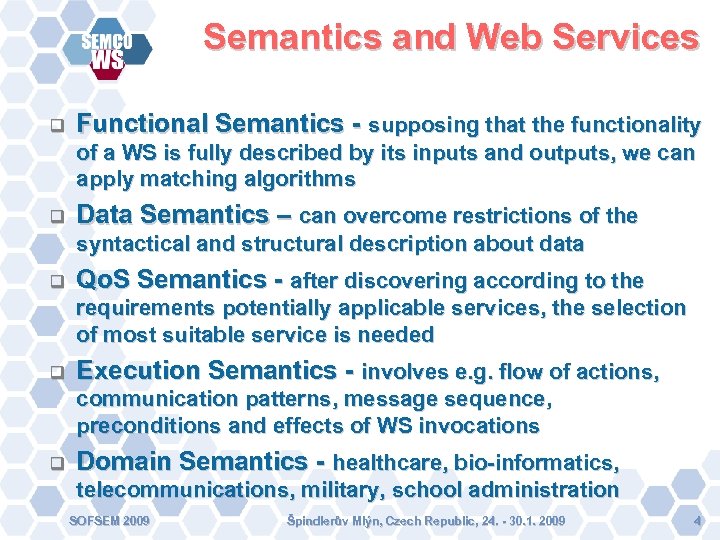
Semantics and Web Services Functional Semantics - supposing that the functionality of a WS is fully described by its inputs and outputs, we can apply matching algorithms Data Semantics – can overcome restrictions of the syntactical and structural description about data Qo. S Semantics - after discovering according to the requirements potentially applicable services, the selection of most suitable service is needed Execution Semantics - involves e. g. flow of actions, communication patterns, message sequence, preconditions and effects of WS invocations Domain Semantics - healthcare, bio-informatics, telecommunications, military, school administration SOFSEM 2009 Špindlerův Mlýn, Czech Republic, 24. - 30. 1. 2009 4
Motivation Meteorological and hydrological experiments Semantic Composition of Web and Grid Services (SEMCO-WS) – tries to deal also with the “what” of automated workflow composition New environmental risk management application Knowledge Based Workflow System for Grid Applications (K-Wf Grid) Lot of data is reused in several experiments Successful, but not everything it was hoped to achieve Simplified workflow construction Interesting problem SOFSEM 2009 Špindlerův Mlýn, Czech Republic, 24. - 30. 1. 2009 5
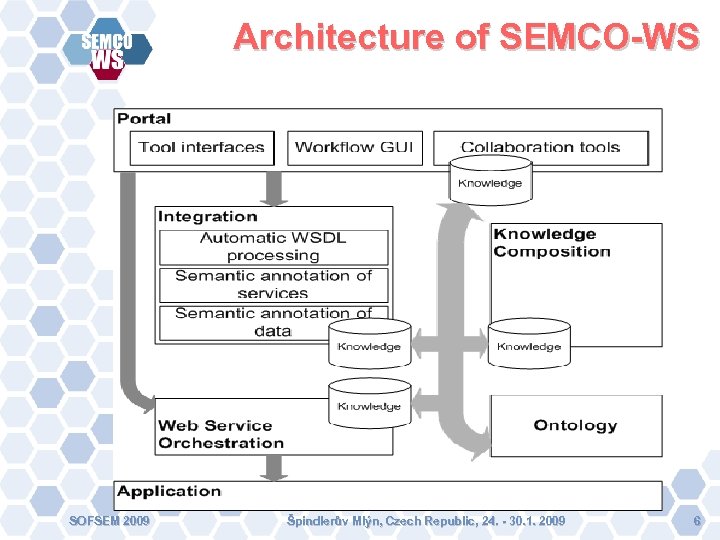
Architecture of SEMCO-WS SOFSEM 2009 Špindlerův Mlýn, Czech Republic, 24. - 30. 1. 2009 6
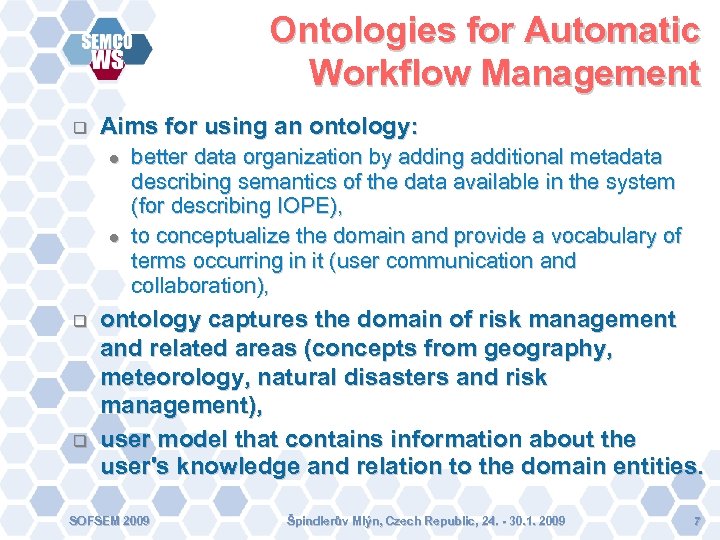
Ontologies for Automatic Workflow Management Aims for using an ontology: better data organization by adding additional metadata describing semantics of the data available in the system (for describing IOPE), to conceptualize the domain and provide a vocabulary of terms occurring in it (user communication and collaboration), ontology captures the domain of risk management and related areas (concepts from geography, meteorology, natural disasters and risk management), user model that contains information about the user's knowledge and relation to the domain entities. SOFSEM 2009 Špindlerův Mlýn, Czech Republic, 24. - 30. 1. 2009 7
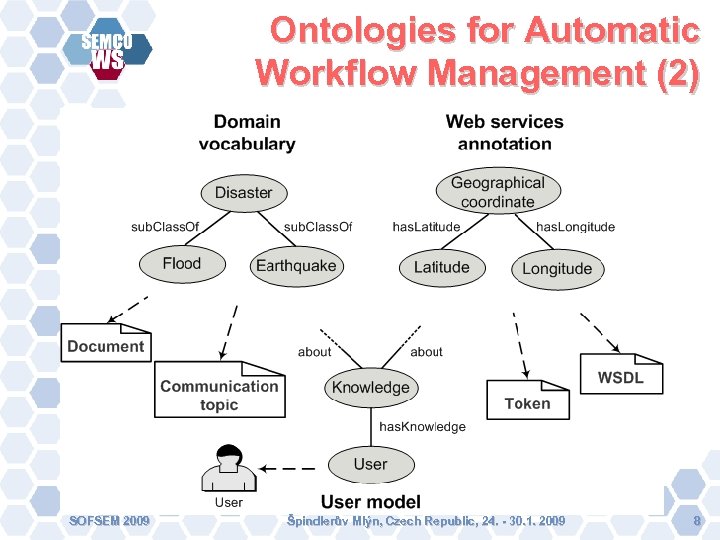
Ontologies for Automatic Workflow Management (2) SOFSEM 2009 Špindlerův Mlýn, Czech Republic, 24. - 30. 1. 2009 8
Support of Collaboration our aim is to provide knowledge-based collaboration tool first we designed the communication tool facilitating the users to communicate in standard ways then we augmented the tool utilizing the semantic information incorporated in ontology - the main aspects: processing on-line discussion dividing the discussion according to given criteria into the units getting the areas of interest that were discussed according to these areas of interest offering the previous discussions to the given topic or providing other relevant documents SOFSEM 2009 Špindlerův Mlýn, Czech Republic, 24. - 30. 1. 2009 9
Workflow Composition and Execution Module Petri net model for the workflow description, Abstract Workflow Composition Tool (AWCT) is responsible for workflow construction and uses backtracking from the final activity to the initial activities of the workflow, Executable Workflow Composition Tool (EWCT) Extended process of workflow refinement that changes an abstract workflow into the executable one, Workflow Execution Engine (Wf. EE) is the place where workflow is running in, it works on Petri-net principle of passing tokens, SOFSEM 2009 Špindlerův Mlýn, Czech Republic, 24. - 30. 1. 2009 10
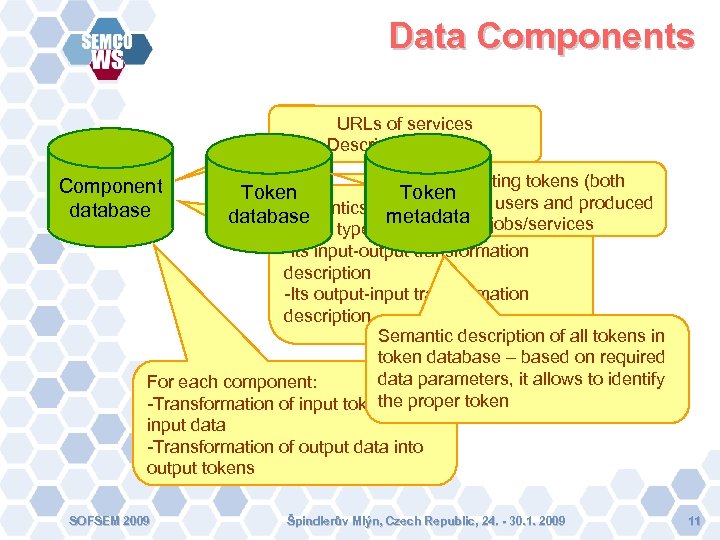
Data Components URLs of services Descriptions of jobs Component database All existing tokens (both Token by users and produced created Semantics of each component: database metadataby jobs/services -What type of data it produces -Its input-output transformation description -Its output-input transformation description Semantic description of all tokens in token database – based on required data parameters, it allows to identify For each component: the proper token -Transformation of input tokens into input data -Transformation of output data into output tokens SOFSEM 2009 Špindlerův Mlýn, Czech Republic, 24. - 30. 1. 2009 11
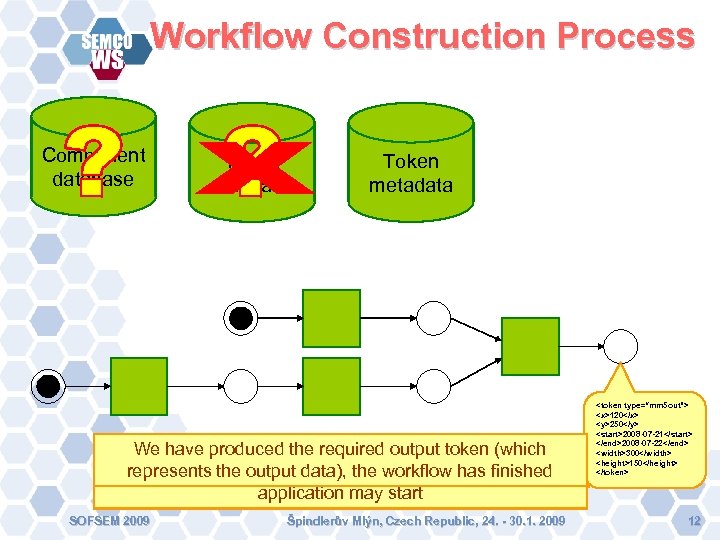
Workflow Construction Process Component database Token metadata Now wehavefound a serviceswhich isoutputto produce the We have produced the required need only existing input We have found service which able token (which required token whichdescription service or and output tokens; for we semantic requires two the required and Werepresentsathehave a workflow for a input data, finished Nostart with the however, itwould and of the has job which Wesuch token; is output data), thesatisfy input tokens, the look so found; we look workflow requirements the search continues application may such can produce token of start type SOFSEM 2009 Špindlerův Mlýn, Czech Republic, 24. - 30. 1. 2009 <token type=“mm 5 out”> <x>120</x> <y>250</y> <start>2008 -07 -21</start> </end>2008 -07 -22</end> <width>300</width> <height>150</height> </token> 12
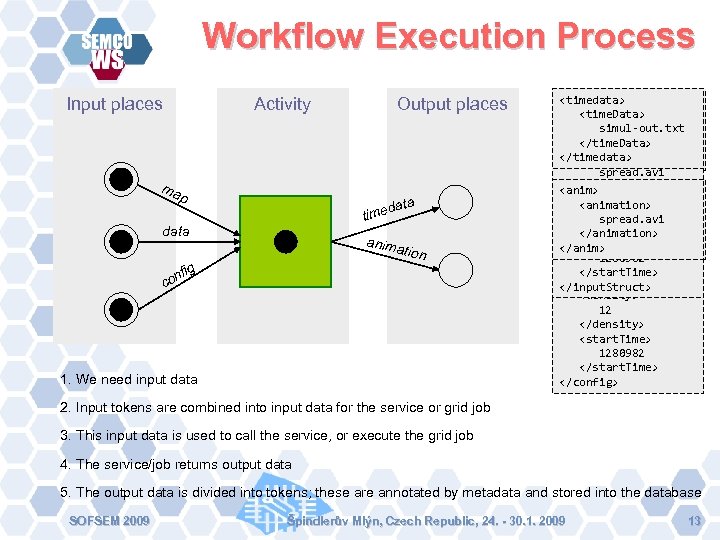
Workflow Execution Process Input places Activity ma p Output places ata d time data anim ation fig n co 1. We need input data <timedata> <output. Struct> <input. Struct> <map> <time. Data> <map. File> simul-out. txt map 317. tif </time. Data> </map. File> </timedata> <animation> <data. File> </map> spread. avi disp. Data. bin </animation> </data. File> <anim> <data> </output. Struct> <density> <animation> <data. File> 12 spread. avi disp. Data. bin </density> </animation> </data. File> <start. Time> </anim> </data> 1280982 </start. Time> <config> </input. Struct> <density> 12 </density> <start. Time> 1280982 </start. Time> </config> 2. Input tokens are combined into input data for the service or grid job 3. This input data is used to call the service, or execute the grid job 4. The service/job returns output data 5. The output data is divided into tokens; these are annotated by metadata and stored into the database SOFSEM 2009 Špindlerův Mlýn, Czech Republic, 24. - 30. 1. 2009 13
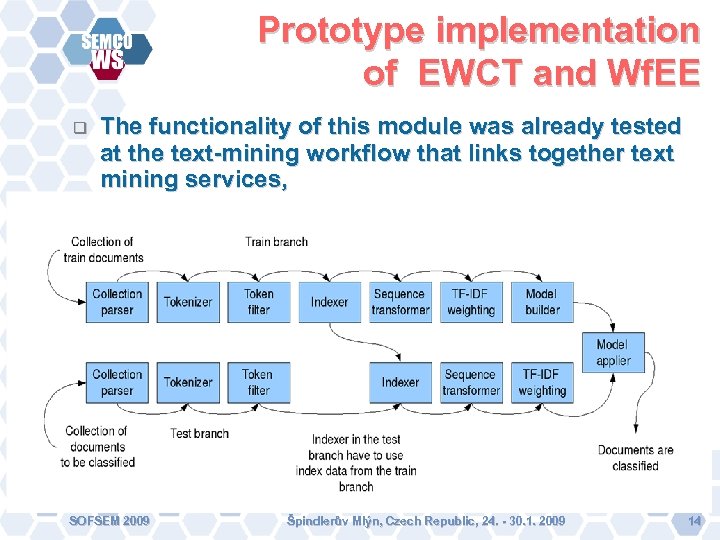
Prototype implementation of EWCT and Wf. EE The functionality of this module was already tested at the text-mining workflow that links together text mining services, SOFSEM 2009 Špindlerův Mlýn, Czech Republic, 24. - 30. 1. 2009 14
Conclusions and Future Work Software solution for automatic service workflow management, which considers not only services, but also existing data in workflow construction, Ontology describing semantics of the services from which the workflows are being composed, as well as of the available data and of the users which use the software, and of course the domain vocabulary, Users are able to exchange data and knowledge, and cooperate in the workflow construction and execution process. Future research: full management of services using the WSRF family of standards, richer monitoring during the execution phase in order to get more relevant Qo. S parameters SOFSEM 2009 Špindlerův Mlýn, Czech Republic, 24. - 30. 1. 2009 15
Скачать презентацию Semantically-aided Data-aware Service Workflow Composition Ondrej Habala Marek
c661114b6a9a087d9c5c2ca7f3147e3f.ppt