 Скачать презентацию Semantic Web Services for Smart Devices based on
95c472a5e494f4f8263f3c1f405e786b.ppt
- Количество слайдов: 40



Semantic Web Services for Smart Devices based on Mobile Agents Vagan Terziyan Industrial Ontologies Group http: //www. cs. jyu. fi/ai/Onto. Group/index. html University of Jyväskylä
Content • • • Resources in Semantic Web and Beyond Global Understanding Environment Resource Adaptation Remote Diagnostics of Resources Resource Maintenance and Networking Mobile Service Components (Agents) 2
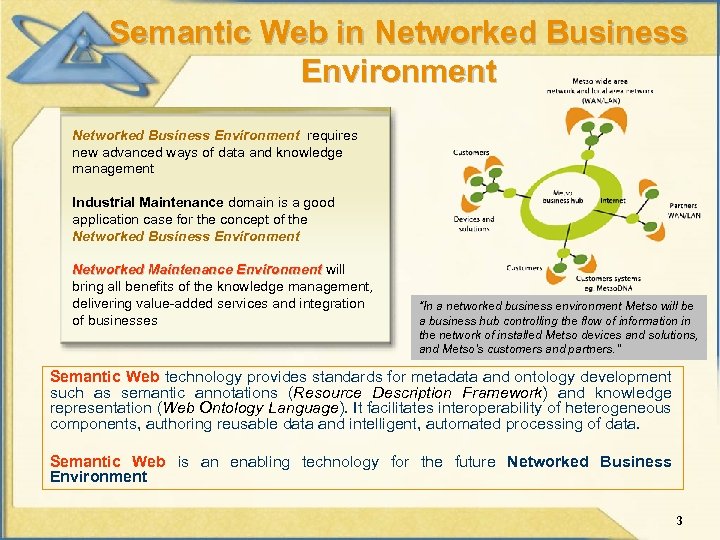
Semantic Web in Networked Business Environment requires new advanced ways of data and knowledge management Industrial Maintenance domain is a good application case for the concept of the Networked Business Environment Networked Maintenance Environment will bring all benefits of the knowledge management, delivering value-added services and integration of businesses “In a networked business environment Metso will be a business hub controlling the flow of information in the network of installed Metso devices and solutions, and Metso’s customers and partners. ” Semantic Web technology provides standards for metadata and ontology development such as semantic annotations (Resource Description Framework) and knowledge representation (Web Ontology Language). It facilitates interoperability of heterogeneous components, authoring reusable data and intelligent, automated processing of data. Semantic Web is an enabling technology for the future Networked Business Environment 3
MAIN RESEARCH OBJECTIVE to combine the emerging Semantic Web, Web Services, Peer-to-Peer, Machine Learning and Agent technologies for the development of a global and smart maintenance management environment, to provide Webbased support for the predictive maintenance of industrial devices by utilizing heterogeneous and interoperable Web resources, services and human experts
Industrial Resources Classes of resources in maintenance systems: • • • Devices - increasingly complex machines, equipment, etc. , that require costs-demanding support Processing Units (Services) – embedded, local and remote systems, for automated intelligent monitoring, diagnostics and control over devices Humans (Experts) – qualified users of the system, operators, maintenance experts, a limited resource that should be reused 5
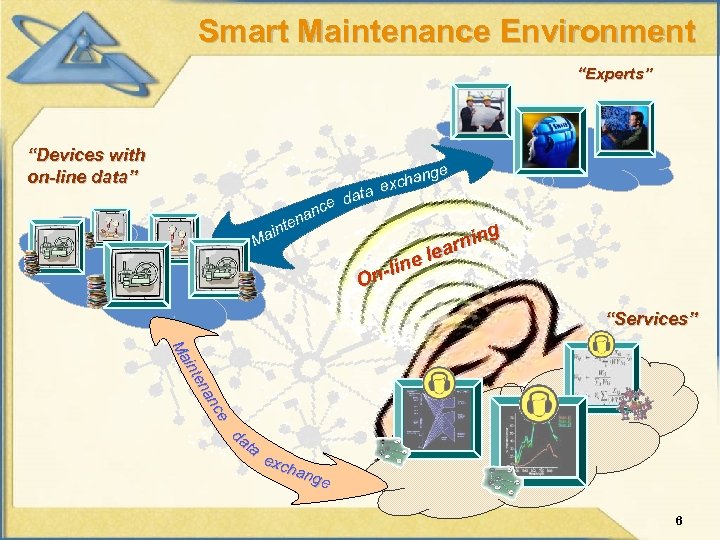
Smart Maintenance Environment “Experts” “Devices with on-line data” nge xcha e data ce an n inte Ma e -lin On g rnin lea “Services” e e nc an na en ne iintt Ma M da ta exc han ge 6
Self-maintenance • Do not expect that someone cares about you, take care yourself even if you are just an industrial device ! • You should be proactive enough to “realize” that you exist and want to be in a “good shape”; • You should be sensitive enough to “feel” your own state and condition; • You should be smart enough to “understand” that you need some maintenance. 7
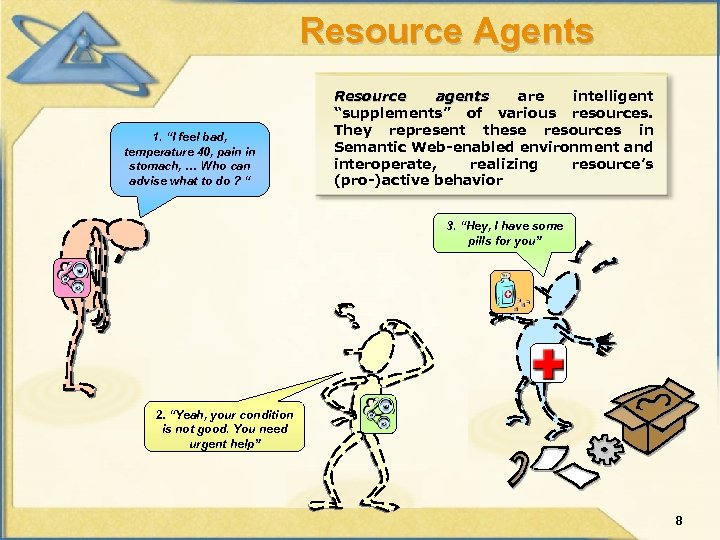
Resource Agents 1. “I feel bad, temperature 40, pain in stomach, … Who can advise what to do ? “ Resource agents are intelligent “supplements” of various resources. They represent these resources in Semantic Web-enabled environment and interoperate, realizing resource’s (pro-)active behavior 3. “Hey, I have some pills for you” 2. “Yeah, your condition is not good. You need urgent help” 8
Research Challenges • Resource Adaptation and Interoperability (Semantic Web) q Unify data representation for heterogeneous environment q Provide basis for communication • Resource Proactivity and Mobility (Agent Technology) Design of framework for delivering self-maintained resources to industrial systems • Resource Interaction (Peer-to-Peer, Web Services technologies) q Design of goal-driven co-operating resources q Resource-to-Resource communication models in distributed environment (in the context of industrial maintenance) q Design of communication infrastructure q 9
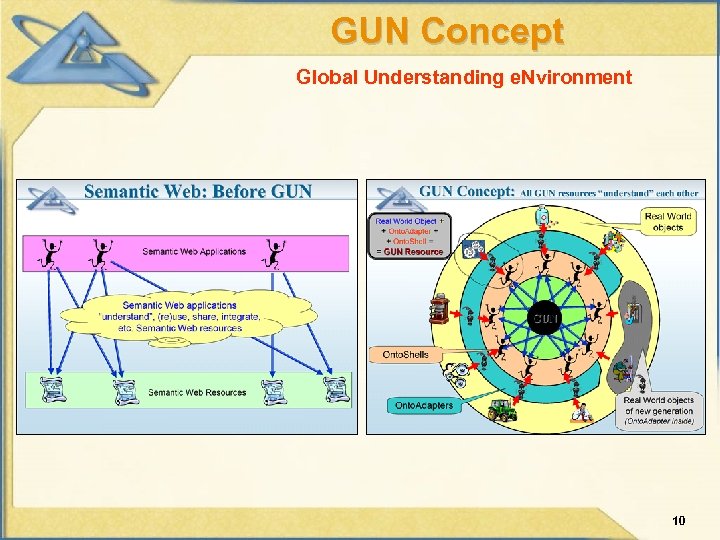
GUN Concept Global Understanding e. Nvironment 10
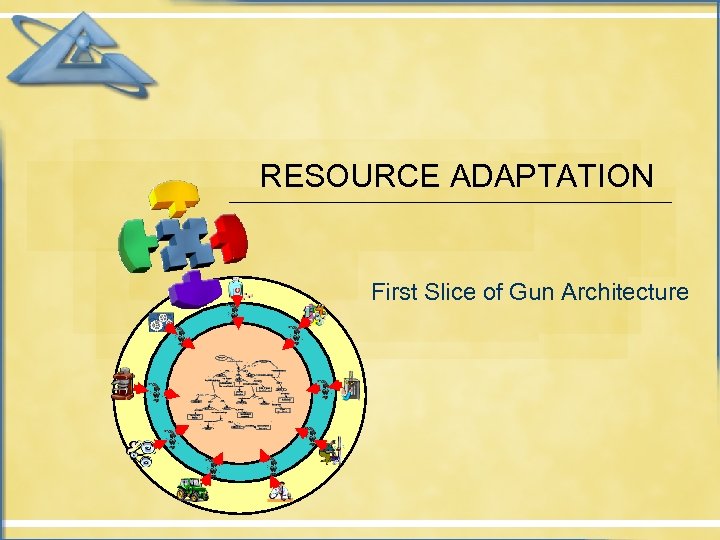
RESOURCE ADAPTATION First Slice of Gun Architecture
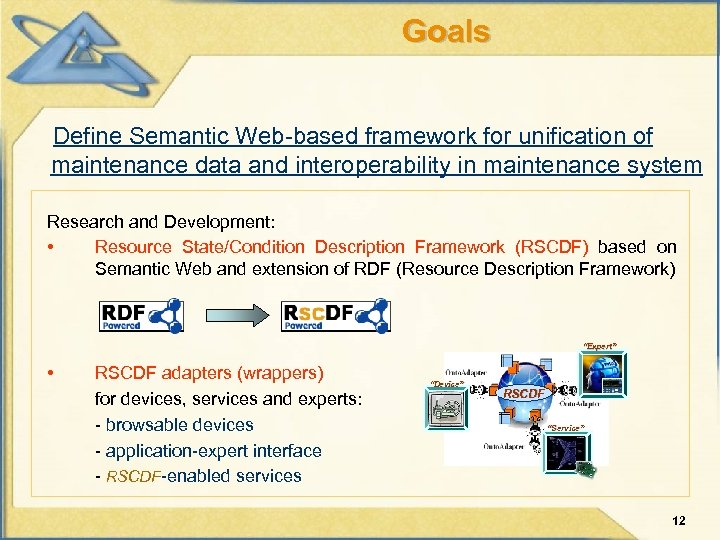
Goals Define Semantic Web-based framework for unification of maintenance data and interoperability in maintenance system Research and Development: • Resource State/Condition Description Framework (RSCDF) based on Semantic Web and extension of RDF (Resource Description Framework) “Expert” • RSCDF adapters (wrappers) for devices, services and experts: - browsable devices - application-expert interface - RSCDF-enabled services “Device” RSCDF “Service” 12
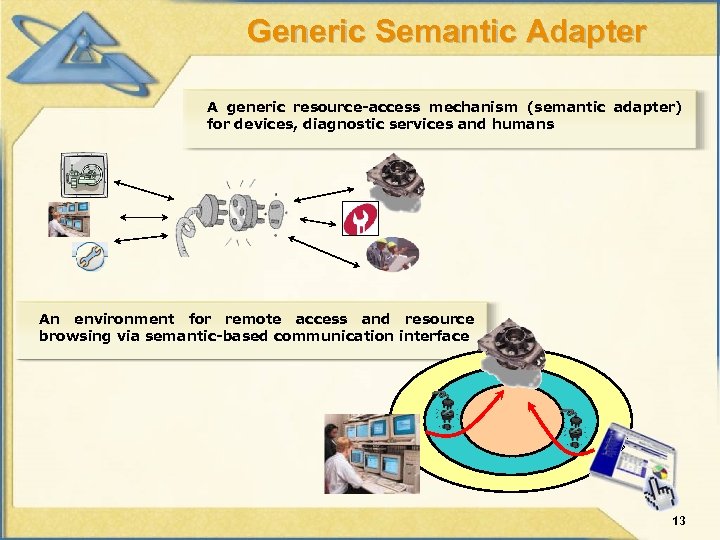
Generic Semantic Adapter A generic resource-access mechanism (semantic adapter) for devices, diagnostic services and humans An environment for remote access and resource browsing via semantic-based communication interface 13
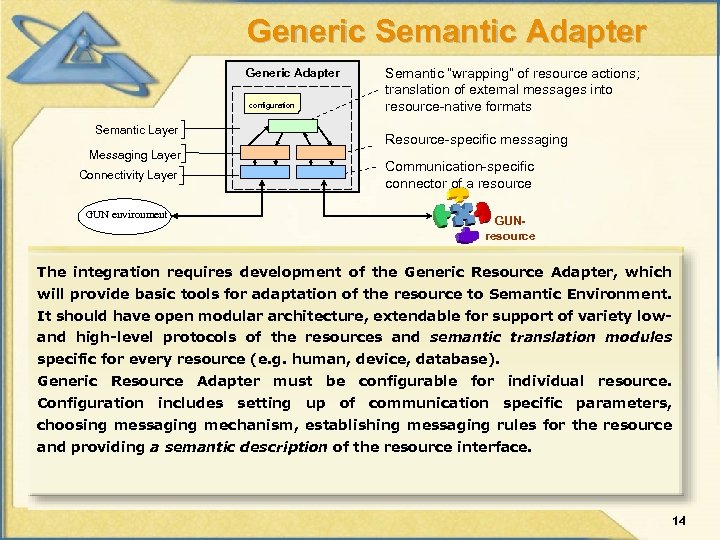
Generic Semantic Adapter Generic Adapter configuration Semantic Layer Messaging Layer Connectivity Layer GUN environment Semantic “wrapping” of resource actions; translation of external messages into resource-native formats Resource-specific messaging Communication-specific connector of a resource GUNresource The integration requires development of the Generic Resource Adapter, which will provide basic tools for adaptation of the resource to Semantic Environment. It should have open modular architecture, extendable for support of variety lowand high-level protocols of the resources and semantic translation modules specific for every resource (e. g. human, device, database). Generic Resource Adapter must be configurable for individual resource. Configuration includes setting up of communication specific parameters, choosing messaging mechanism, establishing messaging rules for the resource and providing a semantic description of the resource interface. 14
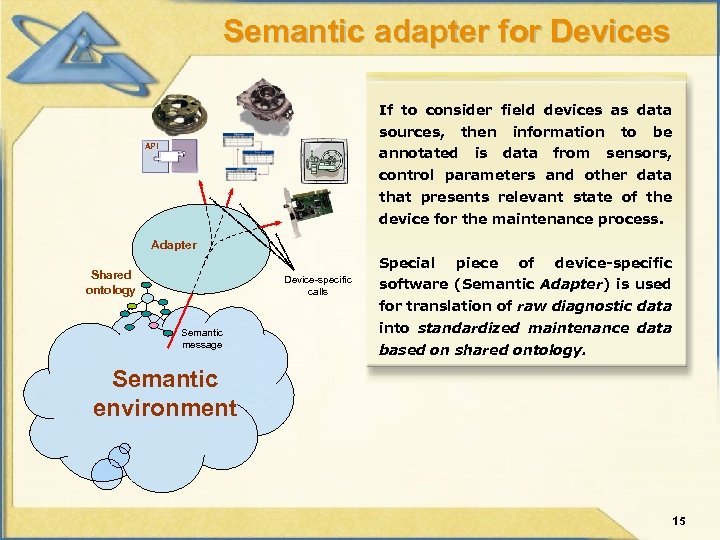
Semantic adapter for Devices If to consider field devices as data sources, API then annotated is information data from to be sensors, control parameters and other data that presents relevant state of the device for the maintenance process. Adapter Special Shared ontology Device-specific calls Semantic message piece of device-specific software (Semantic Adapter) is used for translation of raw diagnostic data into standardized maintenance data based on shared ontology. Semantic environment 15
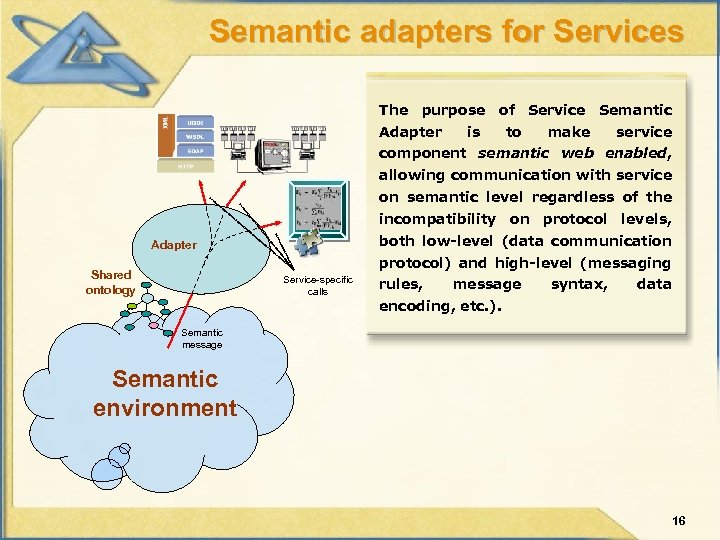
Semantic adapters for Services The purpose of Service Semantic Adapter is to make service component semantic web enabled, allowing communication with service on semantic level regardless of the incompatibility on protocol levels, both low-level (data communication Adapter protocol) and high-level (messaging Shared ontology Service-specific calls rules, message syntax, data encoding, etc. ). Semantic message Semantic environment 16
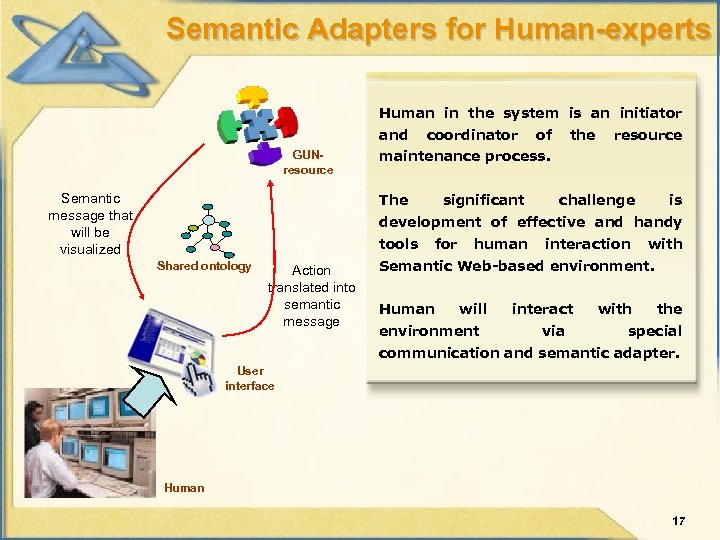
Semantic Adapters for Human-experts Human in the system is an initiator and GUNresource Semantic message that will be visualized coordinator of the resource maintenance process. The significant challenge is development of effective and handy tools Shared ontology Action translated into semantic message for human interaction with Semantic Web-based environment. Human will environment interact via with the special communication and semantic adapter. User interface Human 17
REMOTE DIAGNOSTICS Second Slice of Gun Architecture
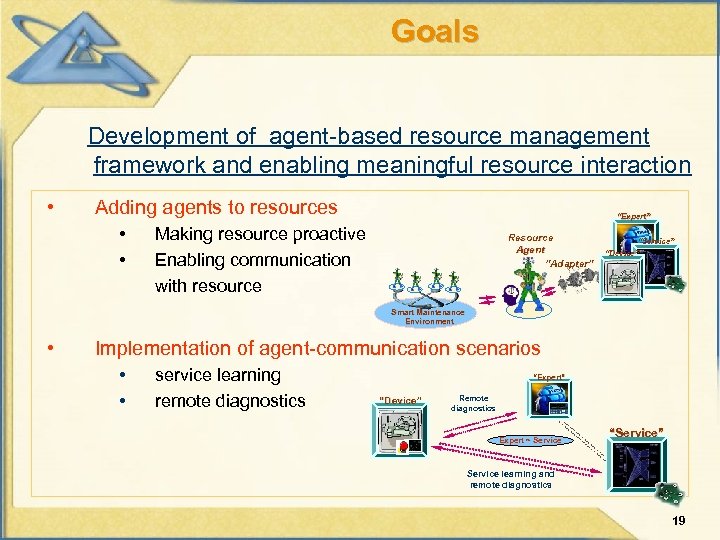
Goals Development of agent-based resource management framework and enabling meaningful resource interaction • Adding agents to resources • • “Expert” Making resource proactive Enabling communication with resource Resource Agent ”Adapter” “Service” “Device” Smart Maintenance Environment • Implementation of agent-communication scenarios • • service learning remote diagnostics “Expert” “Device” Remote diagnostics Expert ~ Service “Service” Service learning and remote diagnostics 19
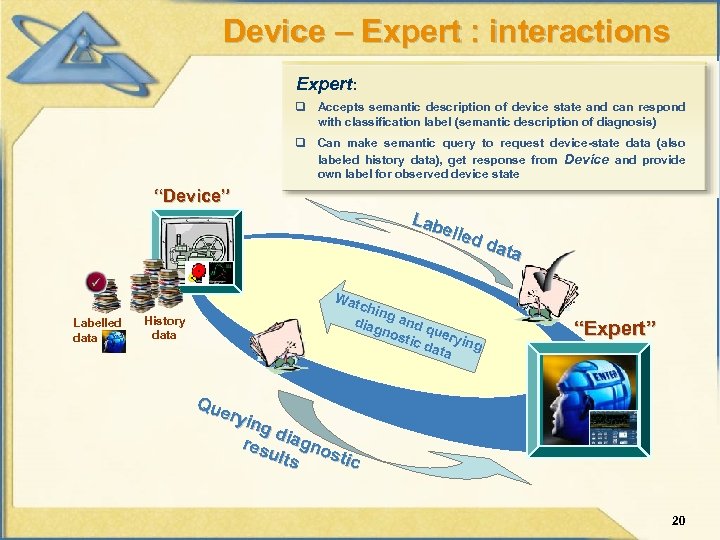
Device – Expert : interactions Expert: q Accepts semantic description of device state and can respond with classification label (semantic description of diagnosis) q Can make semantic query to request device-state data (also labeled history data), get response from Device and provide own label for observed device state “Device” Lab elle d da ta Wat Labelled data History data chin diag g and q nos u tic d erying ata “Expert” Que ryin gd res iagno ults stic 20
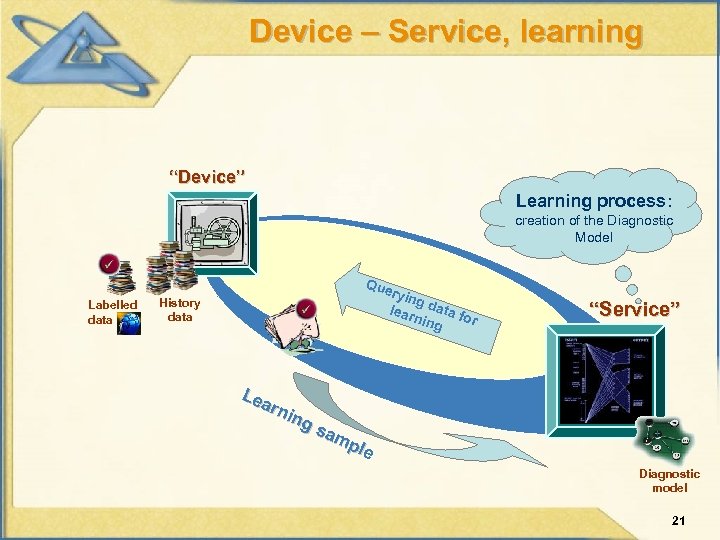
Device – Service, learning “Device” Learning process: creation of the Diagnostic Model Labelled data Que ryin g lear data f or ning History data Lea rni ng “Service” sam ple Diagnostic model 21
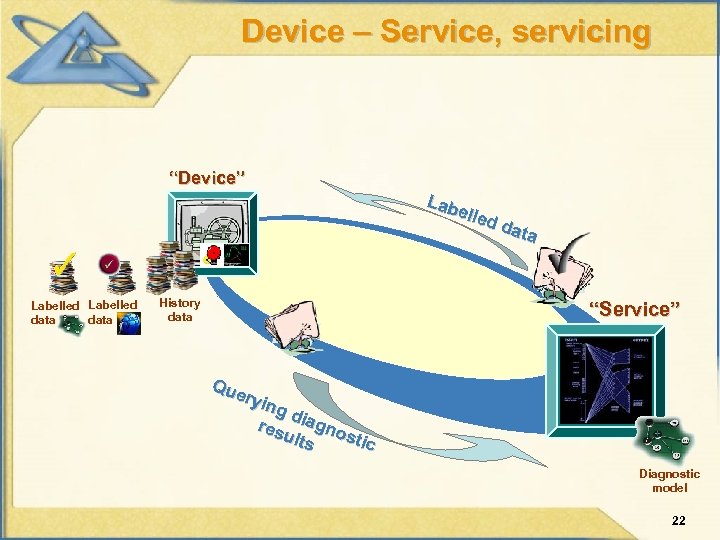
Device – Service, servicing “Device” Lab elle d da ta Labelled data History data “Service” Que ryin gd res iagno ults stic Diagnostic model 22
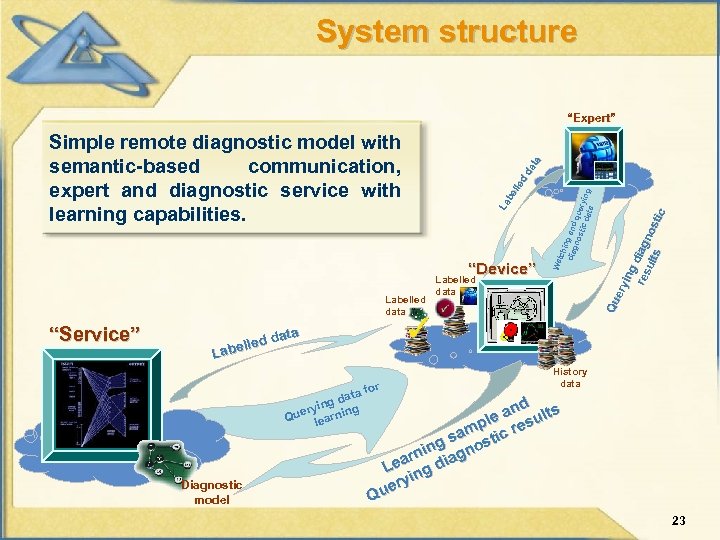
System structure “Device” Labelled data “Service” Labelled data Qu ery ing res diag ult nos s tic La be lle d da ta Simple remote diagnostic model with semantic-based communication, expert and diagnostic service with learning capabilities. Wa tch in dia g and gno stic query dat ing a “Expert” data lled Labe r ta fo g da g ryin Que learnin Diagnostic model History data nd e a sults pl am tic re s ing gnos n ear g dia L n i ery Qu 23
MAINTENANCE NETWORKING Third Slice of Gun Architecture
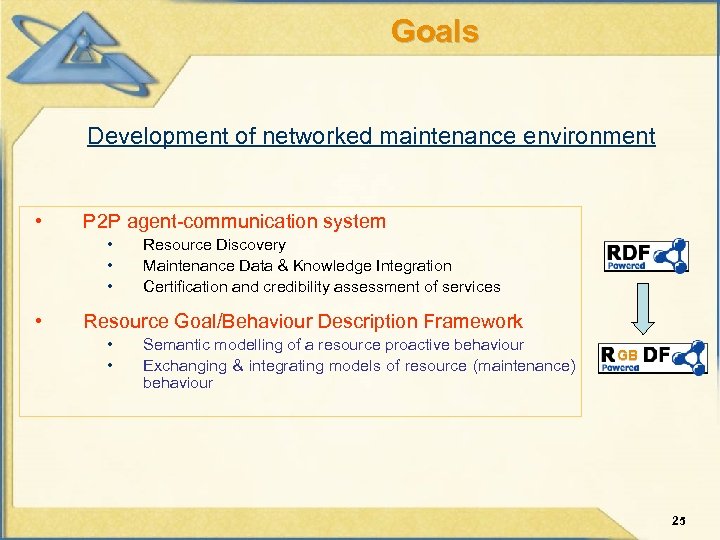
Goals Development of networked maintenance environment • P 2 P agent-communication system • • Resource Discovery Maintenance Data & Knowledge Integration Certification and credibility assessment of services Resource Goal/Behaviour Description Framework • • Semantic modelling of a resource proactive behaviour Exchanging & integrating models of resource (maintenance) behaviour GB 25
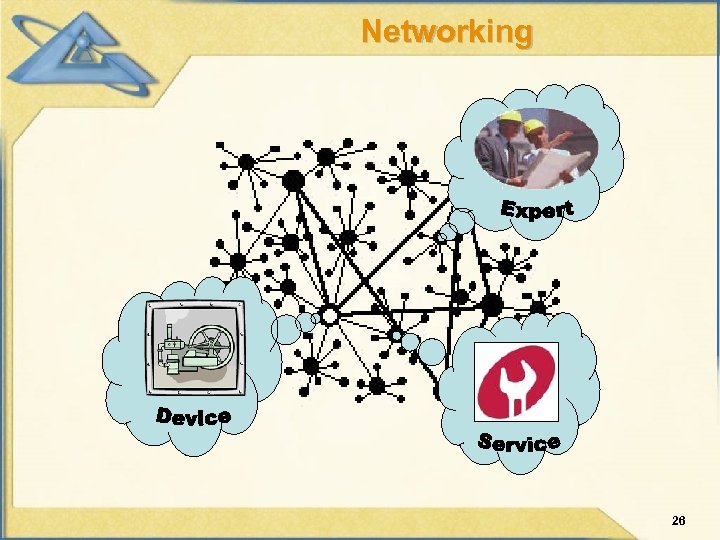
Networking 26
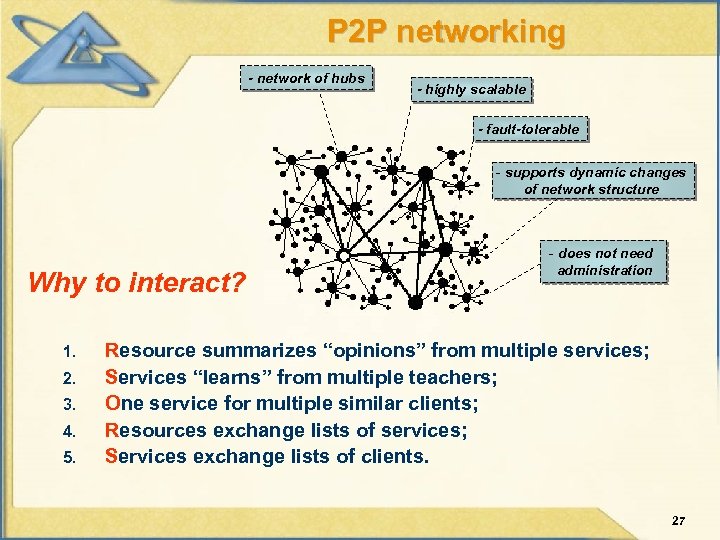
P 2 P networking - network of hubs - highly scalable - fault-tolerable - supports dynamic changes of network structure Why to interact? 1. 2. 3. 4. 5. - does not need administration Resource summarizes “opinions” from multiple services; Services “learns” from multiple teachers; One service for multiple similar clients; Resources exchange lists of services; Services exchange lists of clients. 27
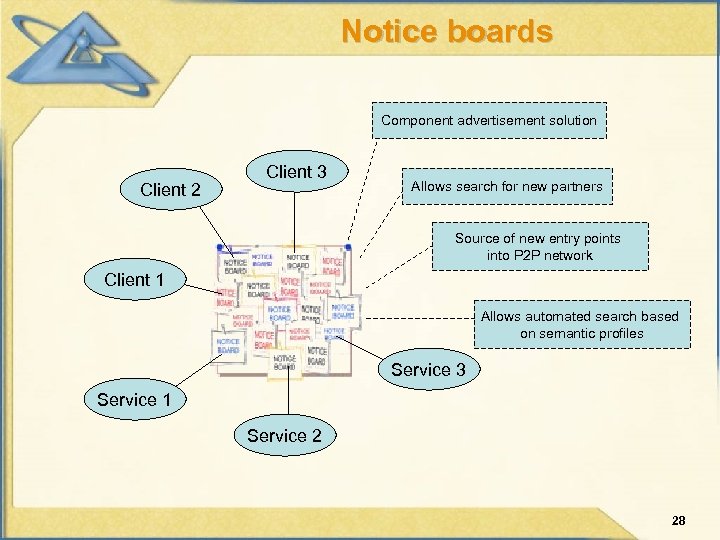
Notice boards Component advertisement solution Client 2 Client 3 Allows search for new partners Source of new entry points into P 2 P network Client 1 Allows automated search based on semantic profiles Service 3 Service 1 Service 2 28
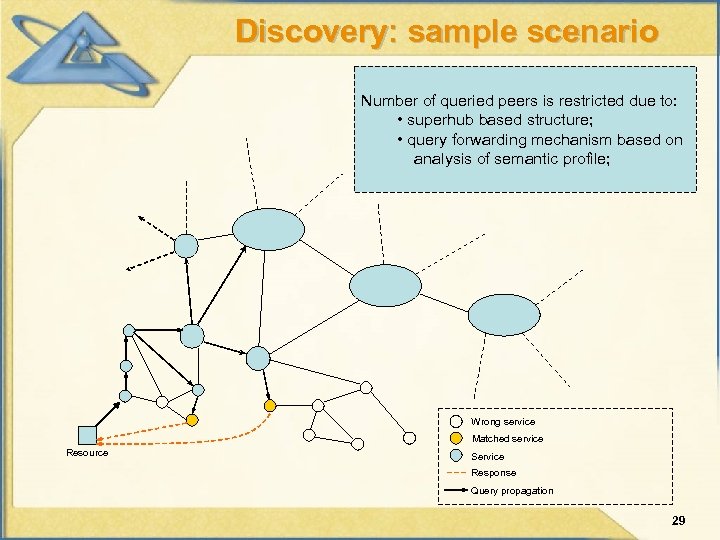
Discovery: sample scenario Number of queried peers is restricted due to: • superhub based structure; • query forwarding mechanism based on analysis of semantic profile; Wrong service Matched service Resource Service Response Query propagation 29
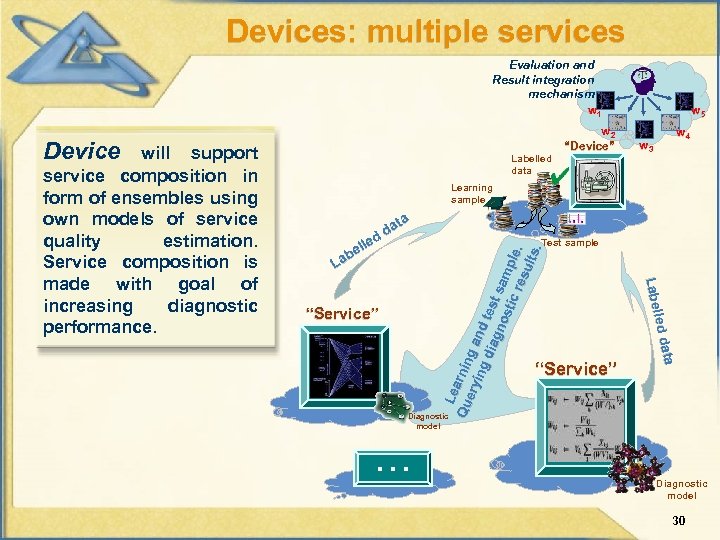
Devices: multiple services Evaluation and Result integration mechanism w 1 Device Labelled data w 3 w 4 Learning sample “Service” Test sample Le Qu arnin e ry g ing and dia t est gno s stic a mpl res e. ults. ta da ed ell b La “Service” t ata led da lled d Label Labe will support service composition in form of ensembles using own models of service quality estimation. Service composition is made with goal of increasing diagnostic performance. w 2 “Device” w 5 Diagnostic model … Diagnostic model 30
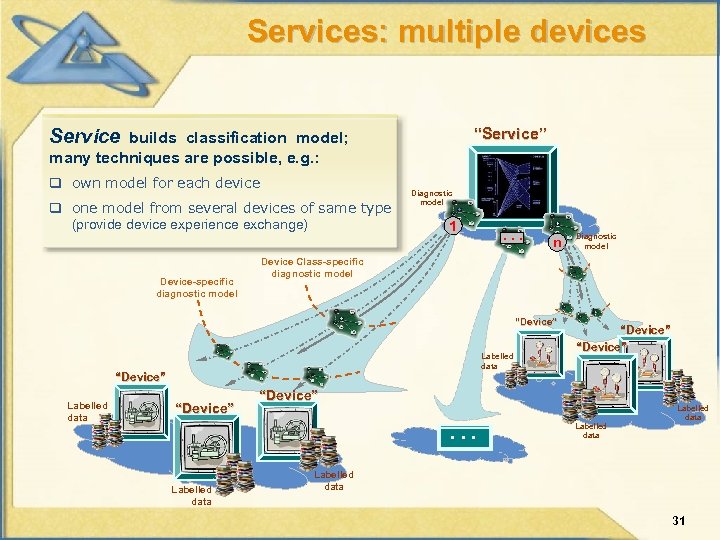
Services: multiple devices “Service” Service builds classification model; many techniques are possible, e. g. : q own model for each device q one model from several devices of same type (provide device experience exchange) Device-specific diagnostic model Diagnostic model 1 … n Device Class-specific diagnostic model “Device” Labelled data Diagnostic model “Device” … Labelled data 31
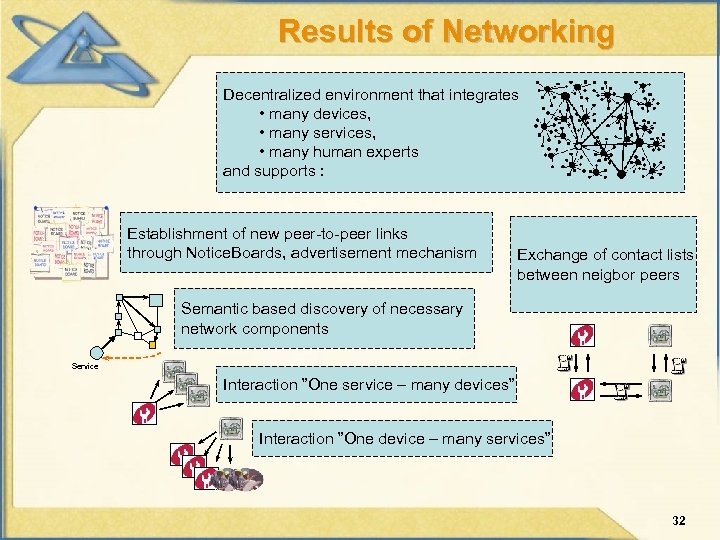
Results of Networking Decentralized environment that integrates • many devices, • many services, • many human experts and supports : Establishment of new peer-to-peer links through Notice. Boards, advertisement mechanism Exchange of contact lists between neigbor peers Semantic based discovery of necessary network components Service Interaction ”One service – many devices” Interaction ”One device – many services” 32
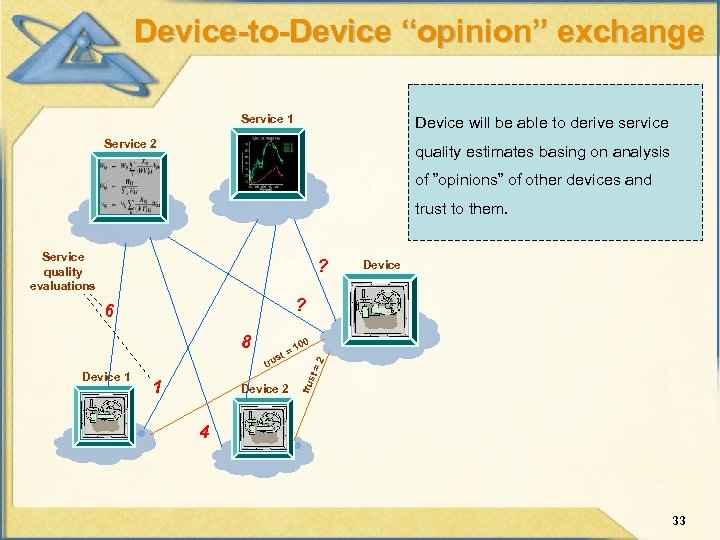
Device-to-Device “opinion” exchange Service 1 Device will be able to derive service Service 2 quality estimates basing on analysis of ”opinions” of other devices and trust to them. Service quality evaluations ? ? t 1 Device 2 0 10 2 t= rus st = 8 tru 6 Device 1 Device 4 33
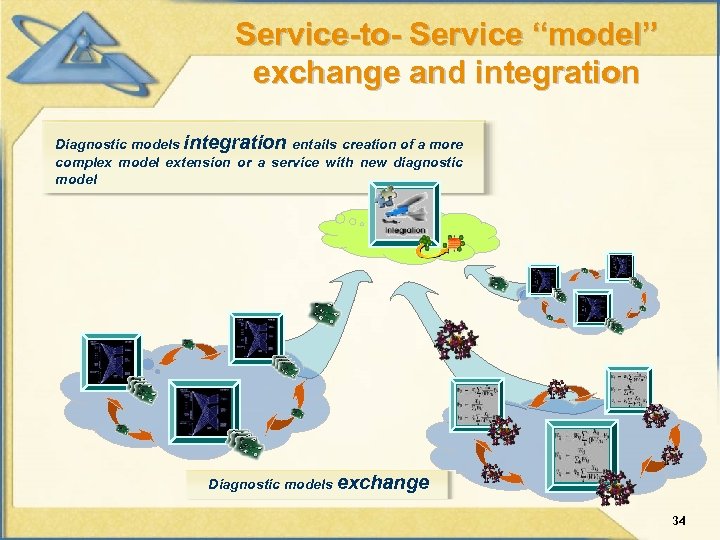
Service-to- Service “model” exchange and integration Diagnostic models integration entails creation of a more complex model extension or a service with new diagnostic model Diagnostic models exchange 34
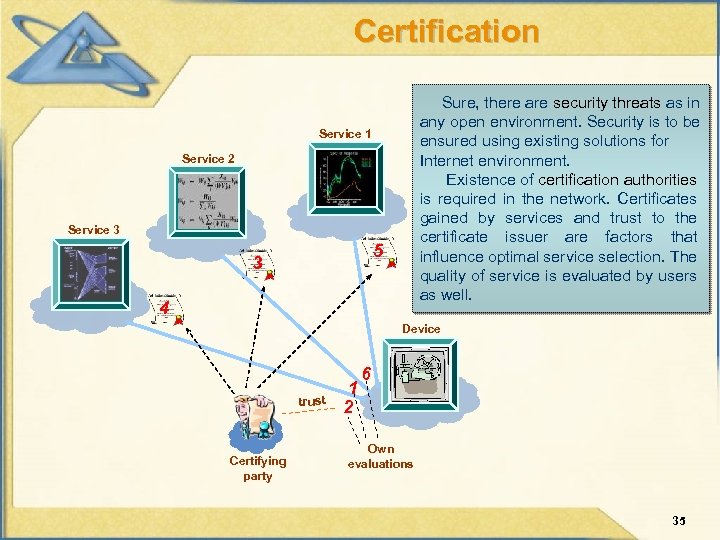
Certification Sure, there are security threats as in any open environment. Security is to be ensured using existing solutions for Internet environment. Existence of certification authorities is required in the network. Certificates gained by services and trust to the certificate issuer are factors that influence optimal service selection. The quality of service is evaluated by users as well. Service 1 Service 2 Service 3 5 3 4 Device trust Certifying party 1 2 6 Own evaluations 35
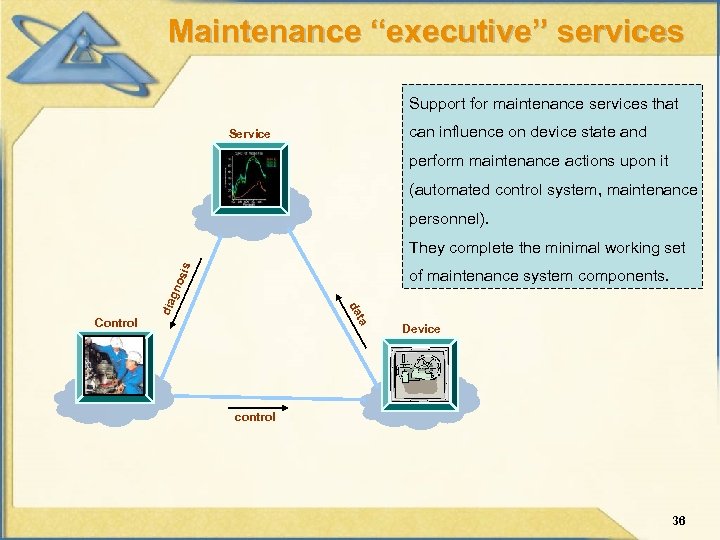
Maintenance “executive” services Support for maintenance services that can influence on device state and Service perform maintenance actions upon it (automated control system, maintenance personnel). gno sis They complete the minimal working set da dia of maintenance system components. ta Control Device control 36
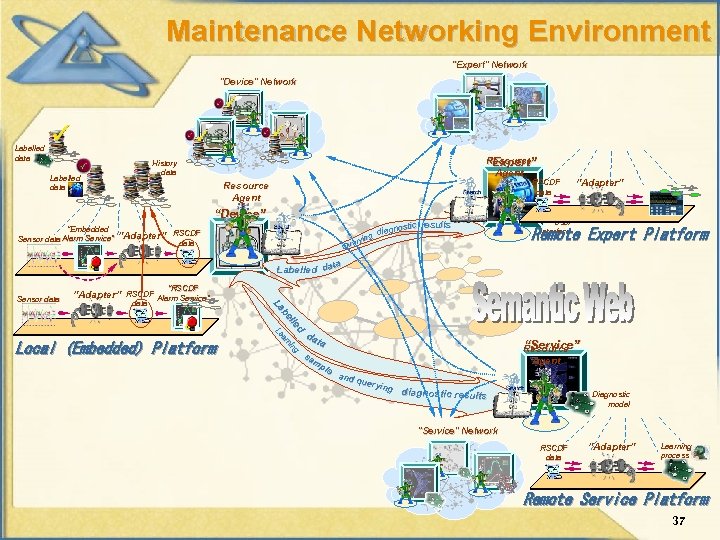
Maintenance Networking Environment “Expert” Network “Device” Network Labelled data Resource “Expert” Agent History data Labelled data RSCDF data Resource Agent “Device” “Embedded Sensor data Alarm Service” ”Adapter” ostic results iagn o g d ryin Que RSCDF data ”Adapter” User interface Remote Expert Platform a Labelled dat ”Adapter” “RSCDF Alarm Service” data Local (Embedded) Platform d g ed iing llle be earrn a be L La La Sensor data da ta sa mp le “Service” Resource Agent and q uery ing diagnostic results Diagnostic model “Service” Network RSCDF data ”Adapter” Learning process Remote Service Platform 37
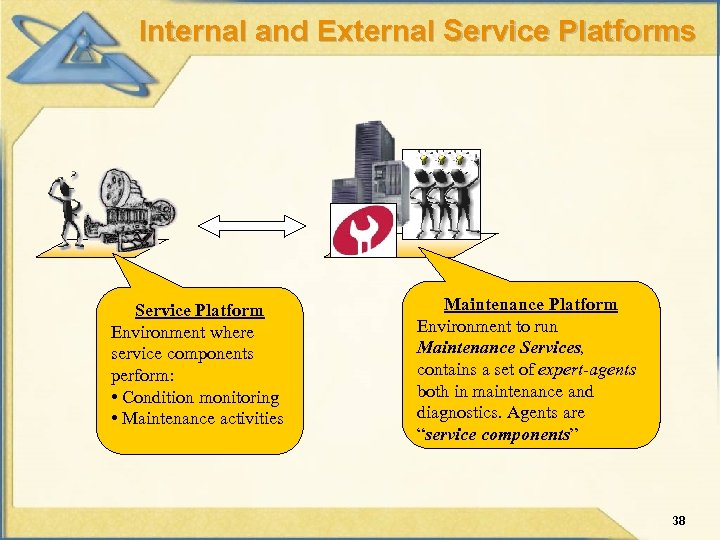
Internal and External Service Platforms Service Platform Environment where service components perform: • Condition monitoring • Maintenance activities Maintenance Platform Environment to run Maintenance Services, contains a set of expert-agents both in maintenance and diagnostics. Agents are “service components” 38
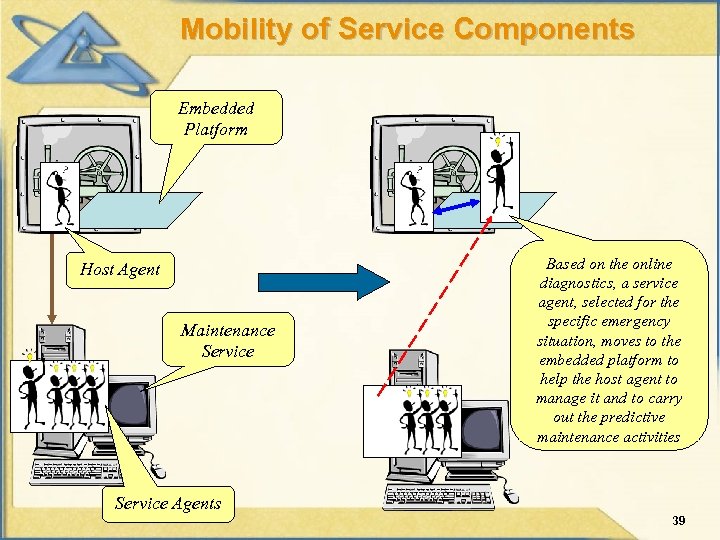
Mobility of Service Components Embedded Platform Host Agent Maintenance Service Based on the online diagnostics, a service agent, selected for the specific emergency situation, moves to the embedded platform to help the host agent to manage it and to carry out the predictive maintenance activities Service Agents 39
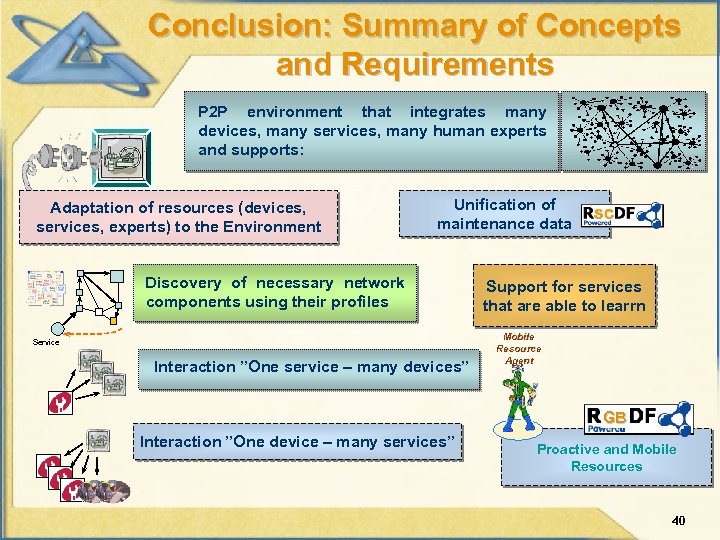
Conclusion: Summary of Concepts and Requirements P 2 P environment that integrates many devices, many services, many human experts and supports: Adaptation of resources (devices, services, experts) to the Environment Unification of maintenance data Discovery of necessary network components using their profiles Service Interaction ”One service – many devices” Support for services that are able to learrn Mobile Resource Agent GB Interaction ”One device – many services” Proactive and Mobile Resources 40
Скачать презентацию Semantic Web Services for Smart Devices based on
95c472a5e494f4f8263f3c1f405e786b.ppt