 Скачать презентацию Semantic Web Overview Diane Vizine-Goetz OCLC Research
f3e1f23921b1395f42b8095da30b7504.ppt
- Количество слайдов: 29



Semantic Web Overview Diane Vizine-Goetz OCLC Research
Outline • Semantic Web vision • Core technologies • OCLC Web services
The Vision “The Semantic Web is not a separate Web but an extension of the current one, in which information is given well-defined meaning, better enabling computers and people to work in cooperation. ” [1]
More on the Vision “. . . information on the web needs to be in a form that machines can ‘understand’ rather than simply display. The concept of machine -understandable documents does not imply some magical artificial intelligence allowing machines to comprehend human mumblings. It relies solely on a machine’s ability to solve well-defined problems by performing welldefined operations on well-defined data. ” [2]
Core technologies • e. Xtensible Markup Language (XML) • Resource Description Framework (RDF) • Ontologies • Software agents
XML (e. Xtensible Markup Language) • Standard designed to transmit structured data to Web applications • Describes structure & content • Provides syntactic interoperability • XML namespaces qualify element names uniquely on the Web in order to avoid conflicts between elements with the same name
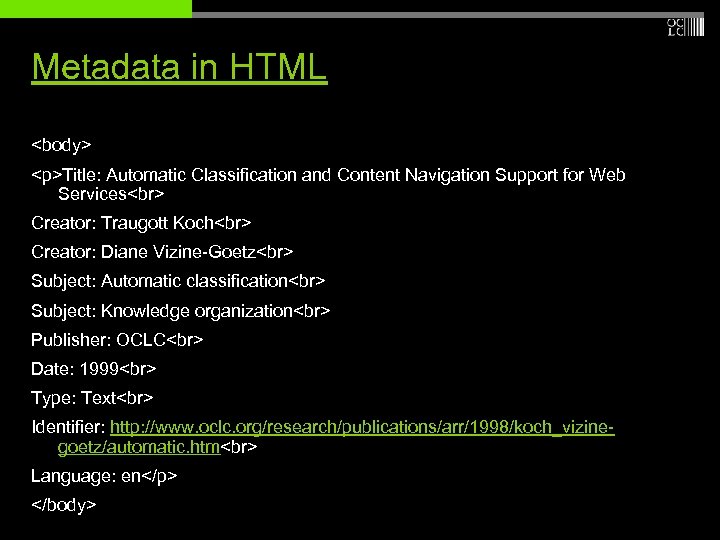
Metadata in HTML <body> <p>Title: Automatic Classification and Content Navigation Support for Web Services Creator: Traugott Koch Creator: Diane Vizine-Goetz Subject: Automatic classification Subject: Knowledge organization Publisher: OCLC Date: 1999 Type: Text Identifier: http: //www. oclc. org/research/publications/arr/1998/koch_vizinegoetz/automatic. htm Language: en</p> </body>
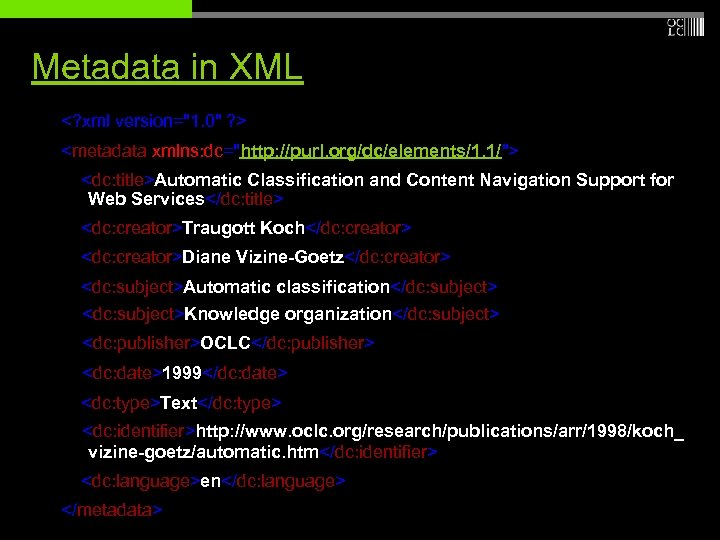
Metadata in XML <? xml version="1. 0" ? > <metadata xmlns: dc="http: //purl. org/dc/elements/1. 1/"> <dc: title>Automatic Classification and Content Navigation Support for Web Services</dc: title> <dc: creator>Traugott Koch</dc: creator> <dc: creator>Diane Vizine-Goetz</dc: creator> <dc: subject>Automatic classification</dc: subject> <dc: subject>Knowledge organization</dc: subject> <dc: publisher>OCLC</dc: publisher> <dc: date>1999</dc: date> <dc: type>Text</dc: type> <dc: identifier>http: //www. oclc. org/research/publications/arr/1998/koch_ vizine-goetz/automatic. htm</dc: identifier> <dc: language>en</dc: language> </metadata>
RDF (Resource Description Framework) • Provides a mechanism for encoding meaning • Simple way to state facts (e. g. , properties, characteristics) about web resources • Employs URIs to identify resources • Data interoperability layer
URIs link concepts to unique definitions • dc: creator – Traugott Koch • http: //www. oclc. org/LCNAF/n 93 -57973 – Diane Vizine-Goetz • http: //www. oclc. org/LCNAF/n 86 -846300 • dc: subject – Automatic classification • http: //www. oclc. org/LCSAF/sh 85 -10088 – Knowledge organization • http: //www. oclc. org/LCSAF/sh 85 -10088
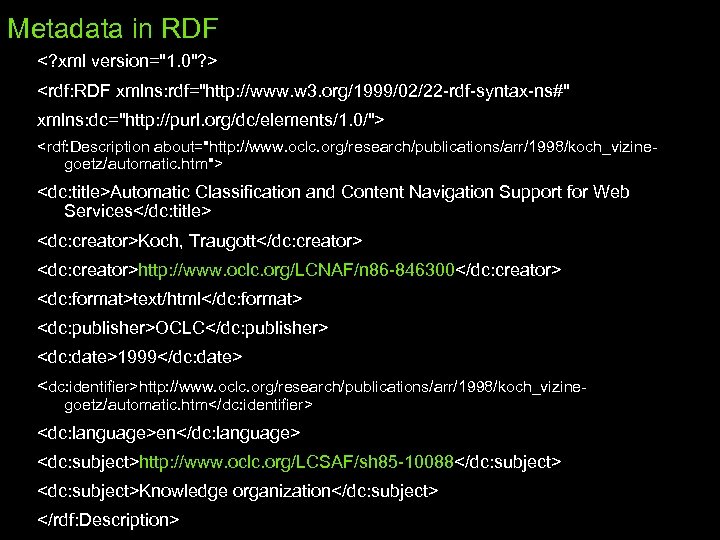
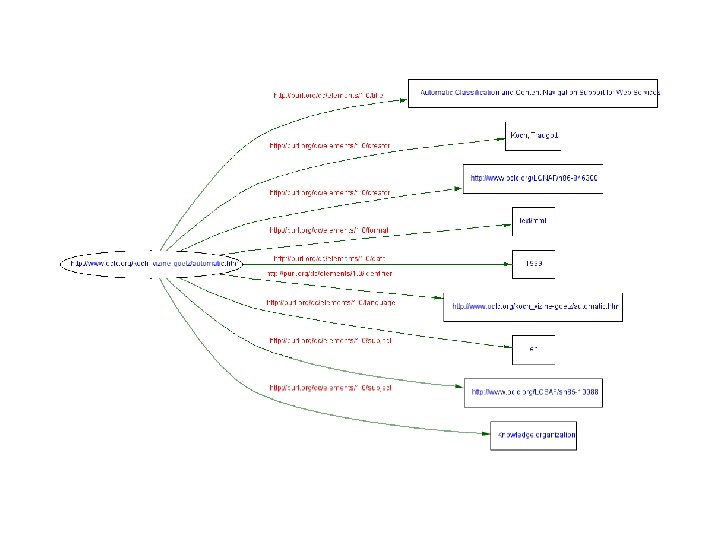
Metadata in RDF <? xml version="1. 0"? > <rdf: RDF xmlns: rdf="http: //www. w 3. org/1999/02/22 -rdf-syntax-ns#" xmlns: dc="http: //purl. org/dc/elements/1. 0/"> <rdf: Description about="http: //www. oclc. org/research/publications/arr/1998/koch_vizinegoetz/automatic. htm"> <dc: title>Automatic Classification and Content Navigation Support for Web Services</dc: title> <dc: creator>Koch, Traugott</dc: creator> <dc: creator>http: //www. oclc. org/LCNAF/n 86 -846300</dc: creator> <dc: format>text/html</dc: format> <dc: publisher>OCLC</dc: publisher> <dc: date>1999</dc: date> <dc: identifier>http: //www. oclc. org/research/publications/arr/1998/koch_vizinegoetz/automatic. htm</dc: identifier> <dc: language>en</dc: language> <dc: subject>http: //www. oclc. org/LCSAF/sh 85 -10088</dc: subject> <dc: subject>Knowledge organization</dc: subject> </rdf: Description>
Ontologies • An ontology formally defines a common set of terms that are used to describe and represent a domain (e. g. , librarianship, medicine, etc. ) • Ontologies include computer-usable definitions of basic concepts in the domain and the relationships among them • Ontologies are usually expressed in a logicbased language
Ontologies • A web ontology language, the logic layer, will provide a language for describing the set of inferences that can be made for a collection of data • For example, a search program using an ontology might look only for resources described by precise concepts, from a given set of KO resources, instead of simple keywords (see RDF example)
Ontologies, taxonomies, vocabularies, etc. • Ontology - used to describe knowledge organization resources with varying degrees of structure – Linguistic and lexical ontologies (Word. Net) – Vocabularies (Dublin Core) – Taxonomies (Yahoo, Open Directory) – Thesauri (AAT, INSPEC Thesaurus, Me. SH) – Classification schemes (DDC, UDC) • Web ontologies might use one or more of the above KO resources
Software agents • “. . . programs that collect Web content from diverse sources, process the information and exchange the results with other programs” [1] • Software agents will become effective as more well-defined content & other agents become available
![Layers of the Semantic Web [2]](https://present5.com/presentation/f3e1f23921b1395f42b8095da30b7504/image-17.jpg "Layers of the Semantic Web [2]")
Layers of the Semantic Web [2]
![Recap vision and goal “ …aim of the SW [Semantic Web] vision is to](https://present5.com/presentation/f3e1f23921b1395f42b8095da30b7504/image-18.jpg "Recap vision and goal “ …aim of the SW [Semantic Web] vision is to")
Recap vision and goal “ …aim of the SW [Semantic Web] vision is to make Web information practically processible by a computer. Underlying this is the goal of making the Web more effective for its users…by the automation or enabling of things that are currently difficult to do: locating content, collating and cross-relating content, drawing conclusions from information found in two or more separate sources. ” [5]
Caveat “… the new technology, like the old, involves asking people to make some extra effort, in repayment for which they will get substantial new functionality -- just as the extra effort of producing HTML markup (Hyper. Text Markup Language) is outweighed by the benefit of having content searchable on the web. ” [2]
OCLC Web Services • Unbundle metadata services from CORC system – Extract metadata from resource – Automatically assign subject terms – Control names and subjects
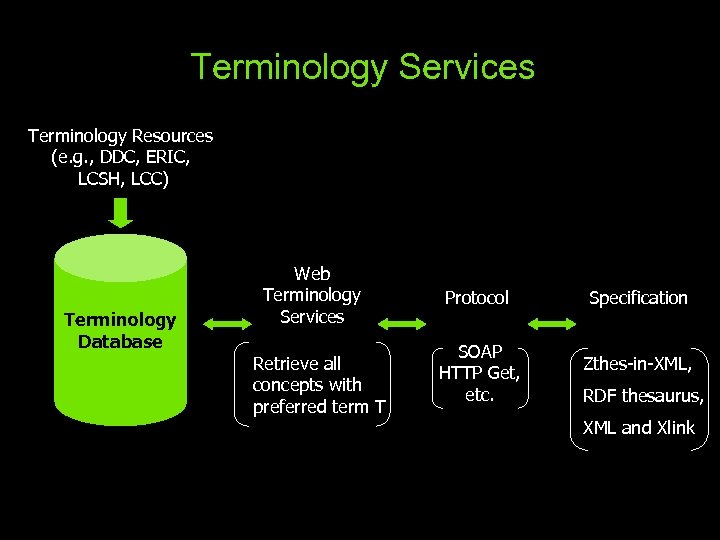
OCLC Web Services • Offer a range of terminology services that supports multiple – Terminology resources – Methods and Services – Protocols – Specifications for knowledge organization resources
Unrestricted Terminology Resources • Available now – LC Name & Subject Authority Files – LC Children’s Headings (AC Program) • In the queue – ERIC thesaurus & GEM subject headings – FAST (under development) – GSAFD file (form & genre categories for fiction) – LC Classification – Me. SH
Restricted Terminology Resources • Available now – Dewey Decimal Classification – PAIS Subject Headings – Sears Subject Headings • Under discussion – Canadian Subject Headings (NLC) – RVM (Bibliothèque de l'Université Laval) & RAMEAU (Bibliothèque nationale de France) – SWD (Die Deutsche Bibliothek) – Te Pātaka (Subject headings for New Zealand Primary Schools)
Multiple Protocols • SOAP • HTTP Get • HTTP Post • Z 39. 50
Multiple Specifications • Zthes-in-XML • MARC-in-XML • RDF thesaurus specification • XML and Xlink
Projects & Prototypes • e. Print archive – Automated assignment of DDC categories and other controlled subject terms • OCLC & Northwestern University – Provide a Web service to verify DDC numbers • Prototype – LCCN Web Service Demo
Terminology Services Terminology Resources (e. g. , DDC, ERIC, LCSH, LCC) Terminology Database Web Terminology Services Retrieve all concepts with preferred term T Protocol SOAP HTTP Get, etc. Specification Zthes-in-XML, RDF thesaurus, XML and Xlink
References & suggested resources 1. The Semantic Web by Tim Berners-Lee, James Hendler & Ora Lassila – 2. http: //www. sciam. com/2001/0501 issue/0501 berners-lee. html Scientific publishing on the 'semantic web‘ by Tim Berners-Lee & James Hendler – 3. http: //www. nature. com/nature/debates/e-access/Articles/bernerslee. htm Text markup and the cost of access by Jon Bosak – 4. http: //www. nature. com/nature/debates/e-access/Articles/bosak. html XML and the Second-Generation Web by by Jon Bosak and Tim Bray – 5. http: //www. sciam. com/1999/0599 issue/0599 bosak. html Building the Semantic Web by Edd Dumbill – http: //www. xml. com/pub/a/2001/03/07/buildingsw. html
References & suggested resources 6. RDF Primer – 7. http: //www. w 3. org/2001/09/rdfprimer/rdf-primer-20020315. html Requirements for a Web Ontology Language – http: //www. w 3. org/TR/2002/WD-webont-req-20020307/
Скачать презентацию Semantic Web Overview Diane Vizine-Goetz OCLC Research
f3e1f23921b1395f42b8095da30b7504.ppt