 Скачать презентацию Semantic Web in Action Ontology-driven information search integration
4f68c7d7a1a66b7ddc754017d7df8fb3.ppt
- Количество слайдов: 56



Semantic Web in Action Ontology-driven information search, integration and analysis Net Object Days and MATES, Erfurt, September 23, 2003 Amit Sheth Semagix, Inc. and LSDIS Lab, University of Georgia Talk Abstract
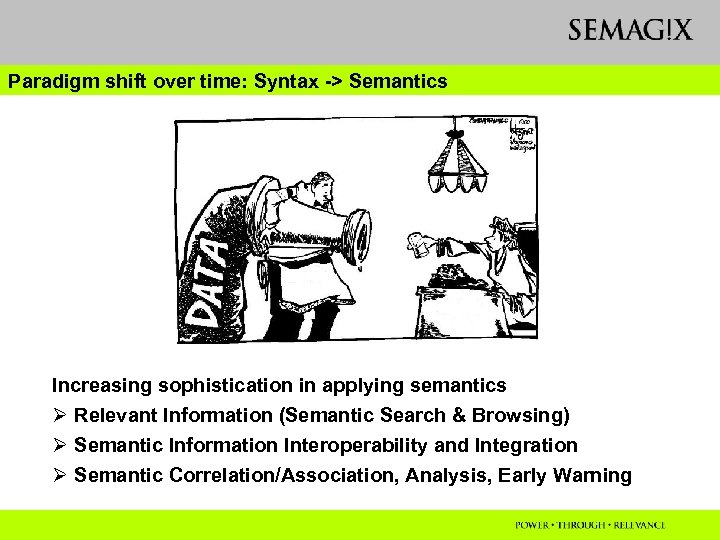
Paradigm shift over time: Syntax -> Semantics Increasing sophistication in applying semantics Ø Relevant Information (Semantic Search & Browsing) Ø Semantic Information Interoperability and Integration Ø Semantic Correlation/Association, Analysis, Early Warning
Ontology at the heart of the Semantic Web Ontology provides underpinning for semantic techniques in information systems. u A model/representation of the real world (relevant set of interconnected concepts, entities, attributes, relationships, domain vocabulary and factual knowledge). u Basis of capturing agreement, and of applying knowledge u Enabler for improved information systems functionalities and the Semantic Web Ontology = Schema (Description) + Knowledge Base (Description Base) i. e, both T-nodes and A-nodes
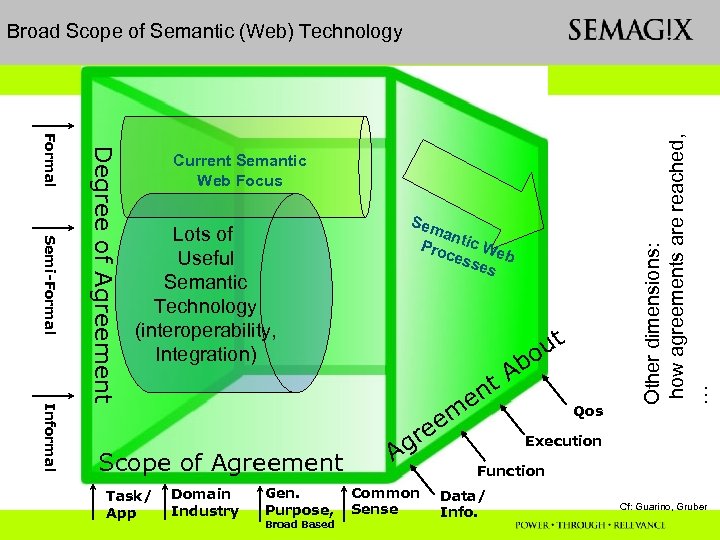
Semi-Formal Informal Degree of Agreement Formal Current Semantic Web Focus Lots of Useful Semantic Technology (interoperability, Integration) Ab t em e Scope of Agreement Task/ App Sem an Pro tic We ces b ses Domain Industry Gen. Purpose, Broad Based gr A Common Sense ut o en Qos Other dimensions: how agreements are reached, … Broad Scope of Semantic (Web) Technology Execution Function Data/ Info. Cf: Guarino, Gruber
Ontology-driven Information Systems are becoming reality Software and practical tools to support key capabilities and requirements for such a system are now available: u Ontology creation and maintenance u Knowledge-based (and other techniques) supporting Automatic Classification u Ontology-driven Semantic Metadata Extraction/Annotation u Utilizing semantic metadata and ontology v Semantic search/querying/browsing v Information and application integration - normalization v Analysis/Mining/Discovery - relationships Achieved in the context of successful technology transfer from academic research (LSDIS lab, UGA’s SCORE technology) into commercial product (Semagix’s Freedom)
Practical Experiences on Ontology Management today u What types of ontologies are needed and developed for semantic applications today? v Is there a typical ontology? u How are such ontologies built? u Who builds them? How long it takes? How are ontologies maintained? v People (expertise), time, money u How large ontologies become (scalability)? u How are ontologies used and what are computational issues?
Types of Ontologies (or things close to ontology) u Upper ontologies: modeling of time, space, process, etc u Broad-based or general purpose ontology/nomenclatures: Cyc, CIRCA ontology (Applied Semantics), Word. Net u Domain-specific or Industry specific ontologies v News: politics, sports, business, entertainment v Financial Market v Terrorism v (GO (a nomenclature), UMLS inspired ontology, …) u Application Specific and Task specific ontologies v Anti-money laundering v Equity Research
Building ontology u Three broad approaches: v social process/manual: many years, committees u Based on metadata standard v automatic taxonomy generation (statistical clustering/NLP): limitation/problems on quality, dependence on corpus, naming v Descriptional component (schema) designed by domain experts; Description base (assertional component, extension) by automated processes Option 2 is being investigated in a an ontology learning system at UGA; Option 3 is currently supported by Semangix Freedom
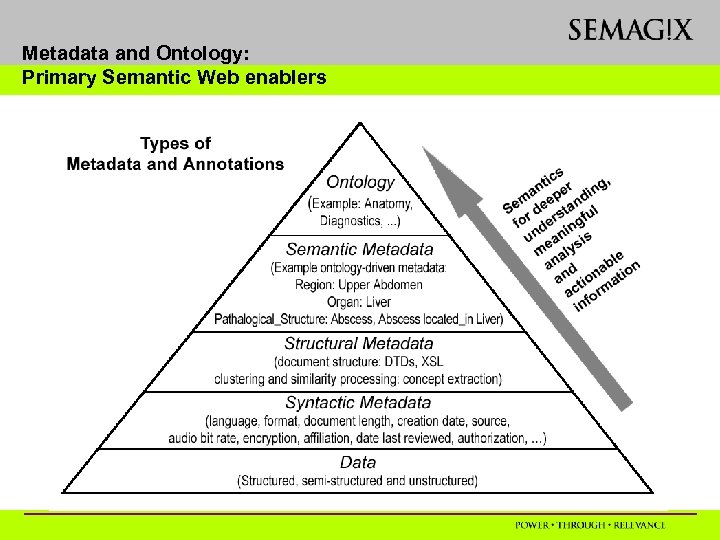
Metadata and Ontology: Primary Semantic Web enablers
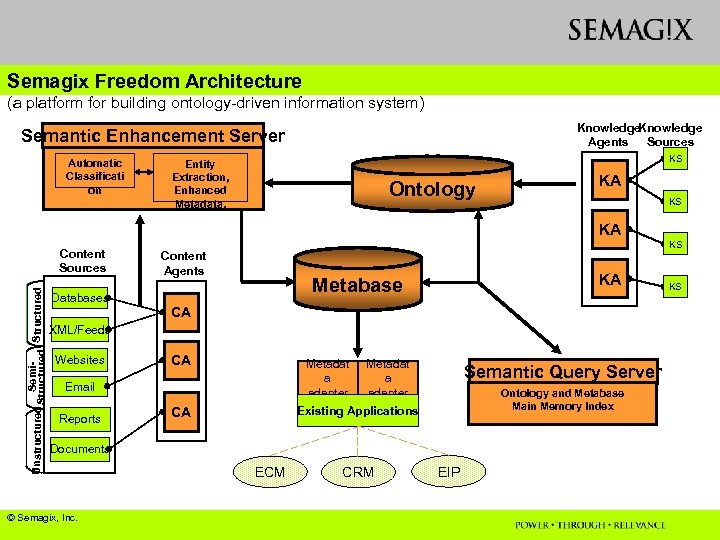
Semagix Freedom Architecture (a platform for building ontology-driven information system) Knowledge Agents Sources Semantic Enhancement Server Automatic Classificati on KS Entity Extraction, Enhanced Metadata, Ontology KA KS KA Semi. Unstructured Structured Content Sources Databases KS Content Agents KA Metabase CA XML/Feeds Websites CA Metadat a adapter Email Reports Metadat a adapter Semantic Query Server Ontology and Metabase Main Memory Index Existing Applications CA Documents © Semagix, Inc. ECM CRM EIP KS
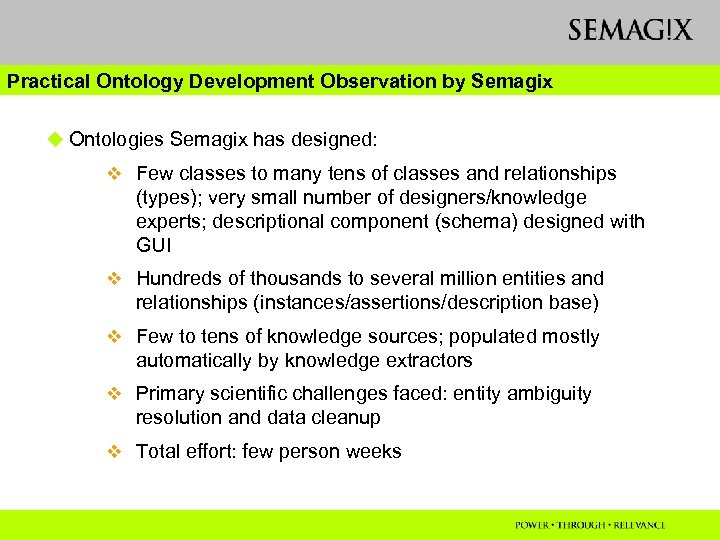
Practical Ontology Development Observation by Semagix u Ontologies Semagix has designed: v Few classes to many tens of classes and relationships (types); very small number of designers/knowledge experts; descriptional component (schema) designed with GUI v Hundreds of thousands to several million entities and relationships (instances/assertions/description base) v Few to tens of knowledge sources; populated mostly automatically by knowledge extractors v Primary scientific challenges faced: entity ambiguity resolution and data cleanup v Total effort: few person weeks
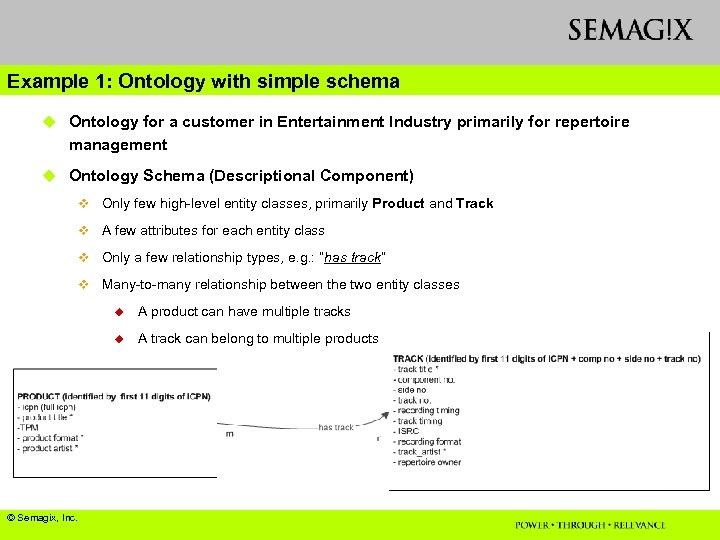
Example 1: Ontology with simple schema u Ontology for a customer in Entertainment Industry primarily for repertoire management u Ontology Schema (Descriptional Component) v Only few high-level entity classes, primarily Product and Track v A few attributes for each entity class v Only a few relationship types, e. g. : “has track” v Many-to-many relationship between the two entity classes u u © Semagix, Inc. A product can have multiple tracks A track can belong to multiple products
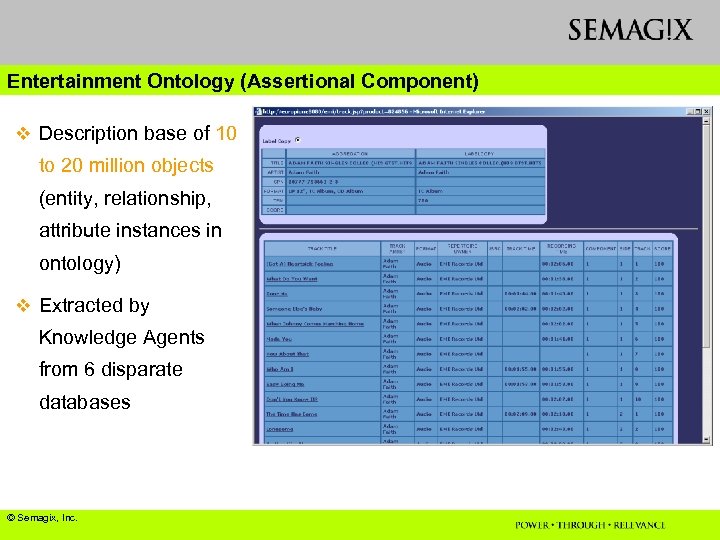
Entertainment Ontology (Assertional Component) v Description base of 10 to 20 million objects (entity, relationship, attribute instances in ontology) v Extracted by Knowledge Agents from 6 disparate databases © Semagix, Inc.
Technical Challenges Faced u ‘Dirty’ data v Inconsistent field values v Unfilled field values v Field values appearing to mean the same, but are different u Non-normalized Data v Different names to mean the same object (schematic heterogeneity) Ambiguity Resoulution u Upper case vs. Lower case text analysis u Scoring (for identity resolution) and pre-processing (for normalization) parameters changed frequently by customer, necessitating constant update of algorithms u Modelling the ontology so that appropriate level (not too much, not too less) of information is modelled u Optimizing the storage of the huge data v How to load it into Freedom’s main memory system
Effort Involved u Ontology Schema Build-Out (descriptional component) Essentially an iterative approach to refining the ontology schema based on periodic customer feedback v Due to iterative decision making process with the multi-national customer, overall finalization of ontology took 3 -4 weeks to complete; not complex otherwise v Ontology Population (assertional component/description base) v 6 Knowledge Agents, one for each database; writing agents took about a day v Automated extraction using Knowledge Agents took a few days for all the Agents, with a few days of validation
Ontology Creation and Maintenance Process
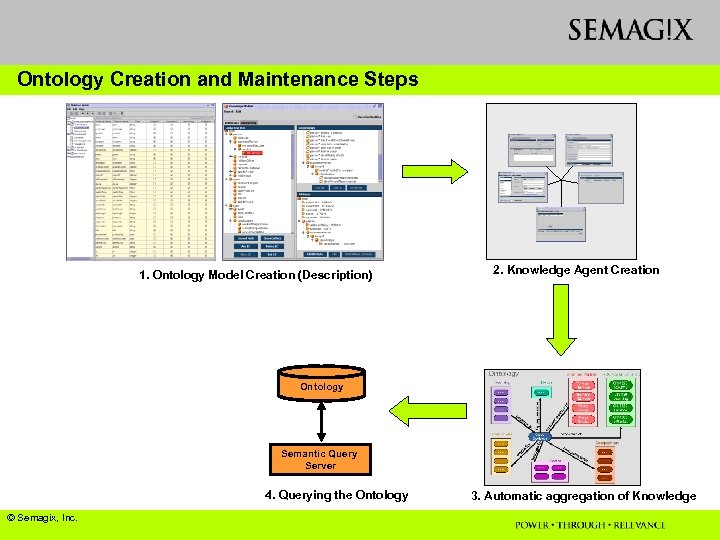
Ontology Creation and Maintenance Steps 1. Ontology Model Creation (Description) 2. Knowledge Agent Creation Ontology Semantic Query Server 4. Querying the Ontology © Semagix, Inc. 3. Automatic aggregation of Knowledge
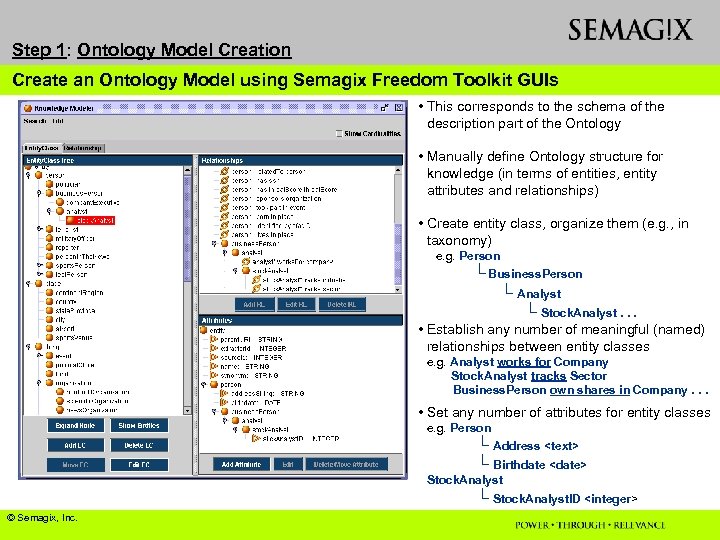
Step 1: Ontology Model Creation Create an Ontology Model using Semagix Freedom Toolkit GUIs • This corresponds to the schema of the description part of the Ontology • Manually define Ontology structure for knowledge (in terms of entities, entity attributes and relationships) • Create entity class, organize them (e. g. , in taxonomy) e. g. Person └ Business. Person └ Analyst └ Stock. Analyst. . . • Establish any number of meaningful (named) relationships between entity classes e. g. Analyst works for Company Stock. Analyst tracks Sector Business. Person own shares in Company. . . • Set any number of attributes for entity classes e. g. Person └ Address <text> └ Birthdate <date> Stock. Analyst └ Stock. Analyst. ID <integer> © Semagix, Inc.
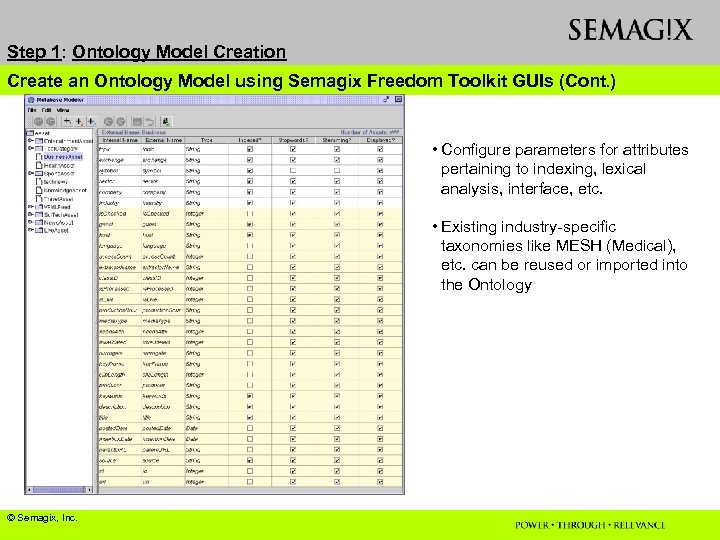
Step 1: Ontology Model Creation Create an Ontology Model using Semagix Freedom Toolkit GUIs (Cont. ) • Configure parameters for attributes pertaining to indexing, lexical analysis, interface, etc. • Existing industry-specific taxonomies like MESH (Medical), etc. can be reused or imported into the Ontology © Semagix, Inc.
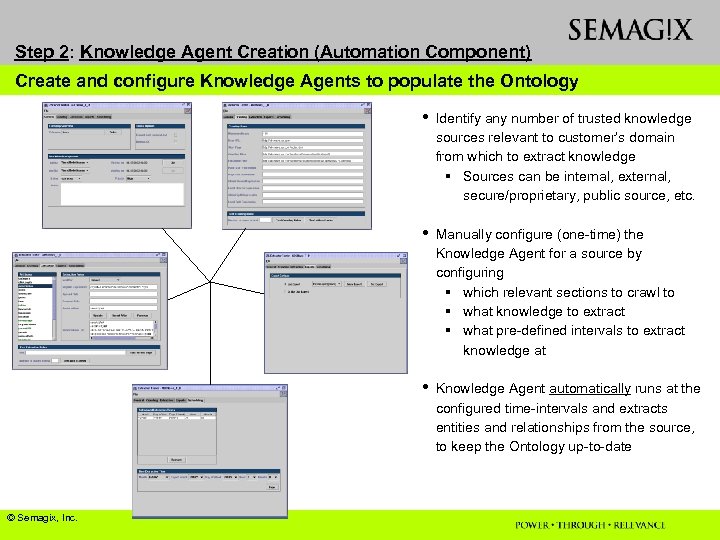
Step 2: Knowledge Agent Creation (Automation Component) Create and configure Knowledge Agents to populate the Ontology • • Manually configure (one-time) the Knowledge Agent for a source by configuring § which relevant sections to crawl to § what knowledge to extract § what pre-defined intervals to extract knowledge at • © Semagix, Inc. Identify any number of trusted knowledge sources relevant to customer’s domain from which to extract knowledge § Sources can be internal, external, secure/proprietary, public source, etc. Knowledge Agent automatically runs at the configured time-intervals and extracts entities and relationships from the source, to keep the Ontology up-to-date
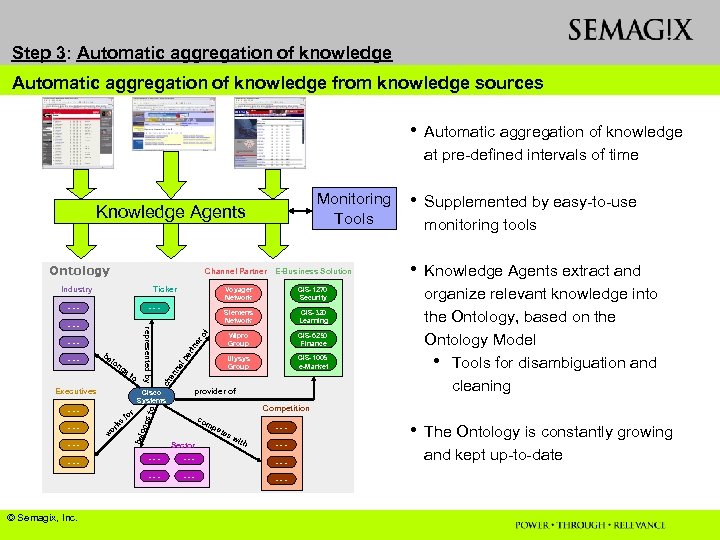
Step 3: Automatic aggregation of knowledge from knowledge sources • Automatic aggregation of knowledge at pre-defined intervals of time Monitoring Tools Knowledge Agents Ontology Channel Partner E-Business Solution Industry Ticker s to Executives of provider of Competition co mp ong ks or w bel --- r fo CIS-1005 e-Market er Cisco Systems ----- Ulysys Group pa rtn ng CIS-6250 Finance ne l be lo s to --- Sector ete --- sw ith --- © Semagix, Inc. --- --- --- organize relevant knowledge into the Ontology, based on the Ontology Model • Tools for disambiguation and cleaning CIS-320 Learning Wipro Group • Knowledge Agents extract and an --- represented by --- monitoring tools CIS-1270 Security Siemens Network --- ch --- Voyager Network • Supplemented by easy-to-use --- • The Ontology is constantly growing and kept up-to-date
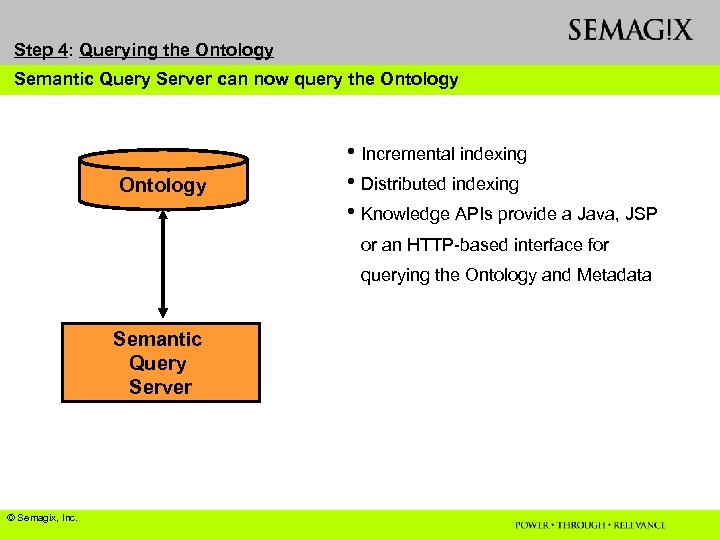
Step 4: Querying the Ontology Semantic Query Server can now query the Ontology • Incremental indexing • Distributed indexing • Knowledge APIs provide a Java, JSP or an HTTP-based interface for querying the Ontology and Metadata Semantic Query Server © Semagix, Inc.
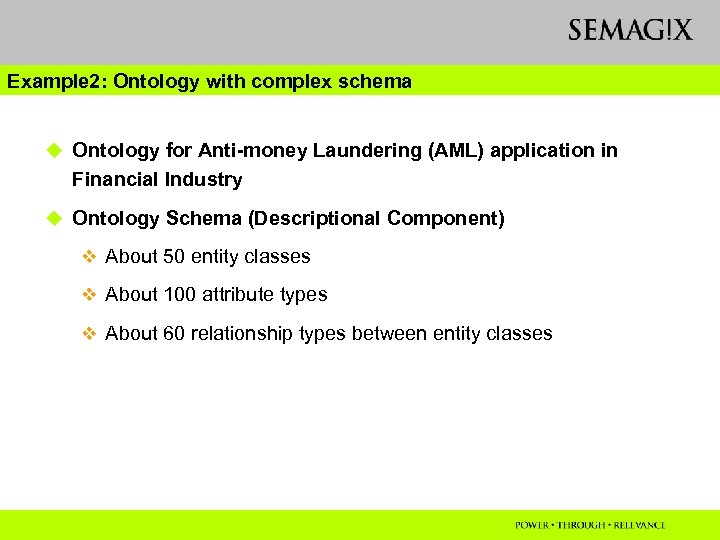
Example 2: Ontology with complex schema u Ontology for Anti-money Laundering (AML) application in Financial Industry u Ontology Schema (Descriptional Component) v About 50 entity classes v About 100 attribute types v About 60 relationship types between entity classes
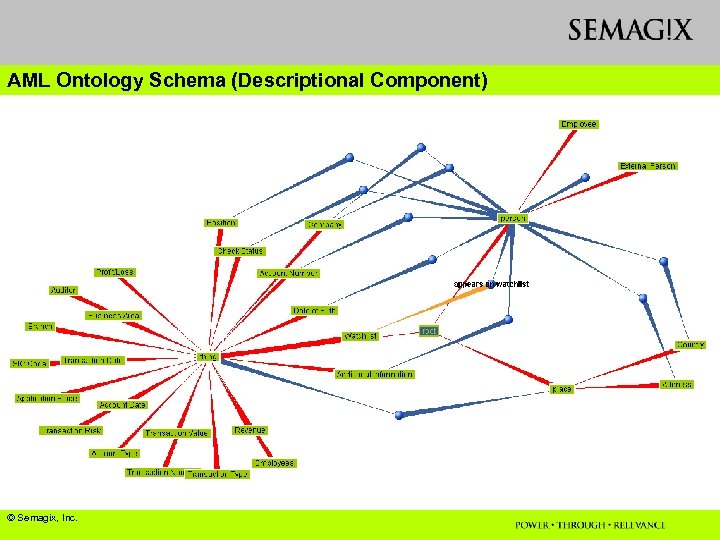
AML Ontology Schema (Descriptional Component) © Semagix, Inc.
AML (Anti-Money Laundering) Ontology Schema (Assertional Component) u About 1. 5 M entities, attributes and relationships u 4 primary (licensed or public) sources for knowledge extraction v. Dun and Bradstreet v. Corporate 192 v. Companies House v. Hoovers Effort Involved u Ontology schema design: less than a week (with periodic extensions) u Automated Ontology population using Knowledge Agents: a few days
Technical Challenges Faced u Complex ambiguity resolution at entity extraction time u Modelling the ontology to capture adequate details of the domain for intended application v Ensuring that the risk algorithm (link score analysis) can be implemented with the needed parameters u Knowledge extraction from sources that needed extended cookie/HTTPS handling u Adding entities on the fly (dynamic ontology)
Metadata Extraction from Heterogeneous, Distributed Content:
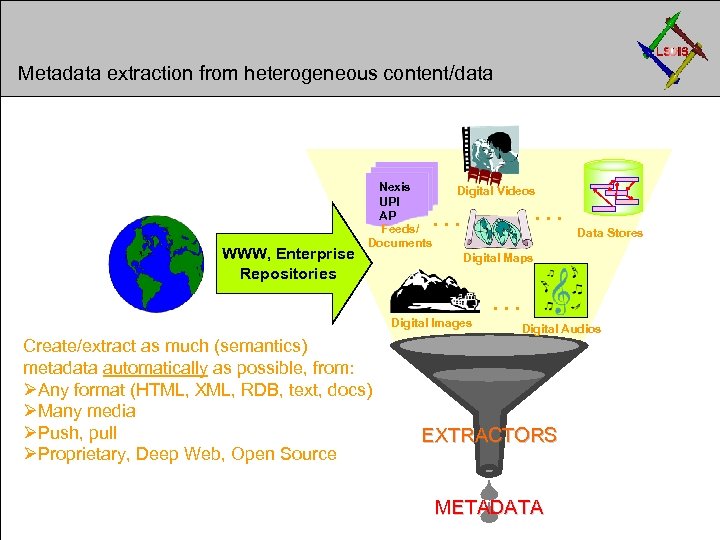
Metadata extraction from heterogeneous content/data WWW, Enterprise Repositories Nexis UPI AP Feeds/ Documents Digital Videos . . . Data Stores Digital Maps . . . Digital Images Create/extract as much (semantics) metadata automatically as possible, from: ØAny format (HTML, XML, RDB, text, docs) ØMany media ØPush, pull ØProprietary, Deep Web, Open Source Digital Audios EXTRACTORS METADATA
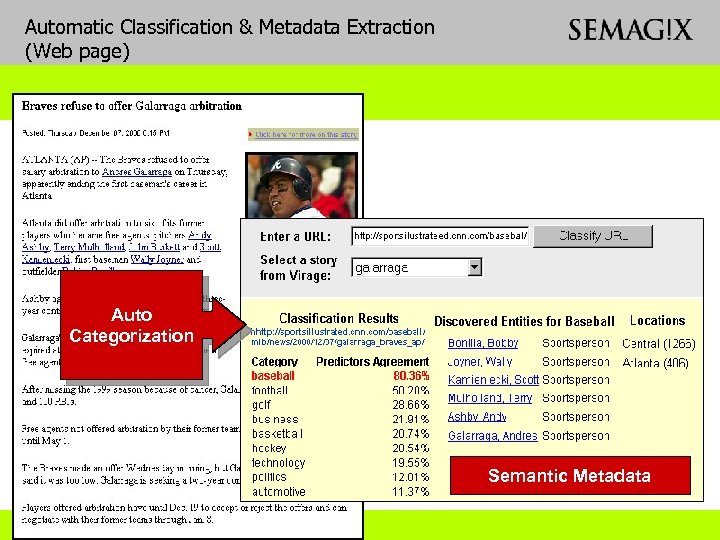
Automatic Classification & Metadata Extraction (Web page) Video with Editorialized Text on the Web Auto Categorization Semantic Metadata
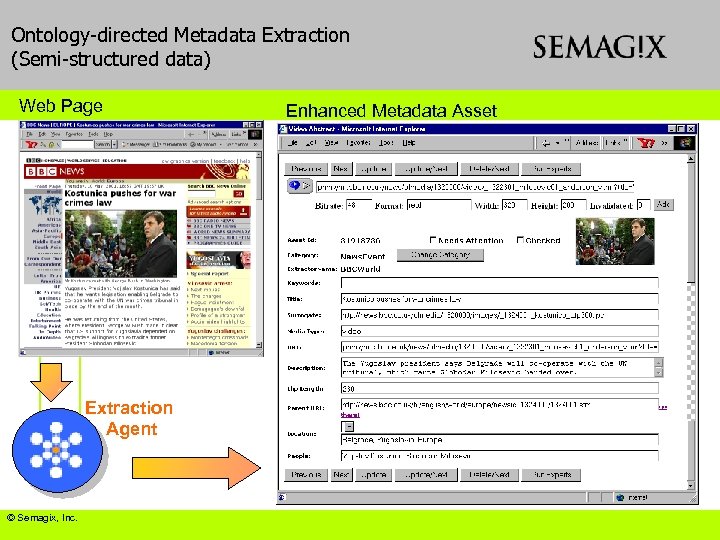
Ontology-directed Metadata Extraction (Semi-structured data) Web Page Extraction Agent © Semagix, Inc. Enhanced Metadata Asset
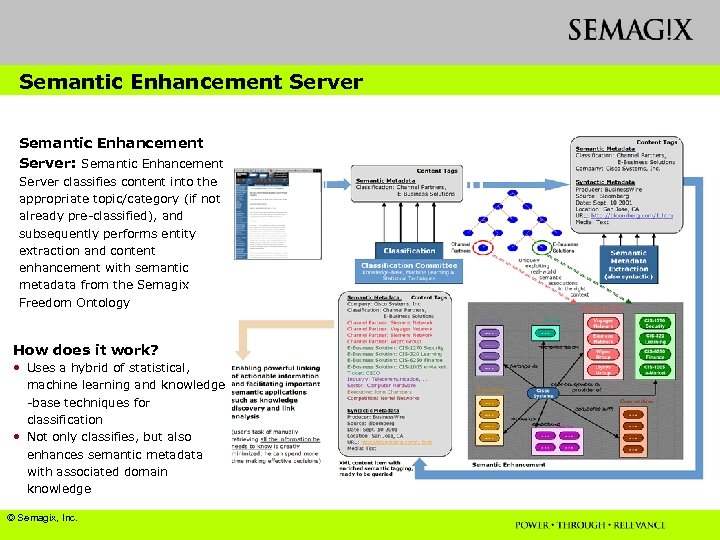
Semantic Enhancement Server: Semantic Enhancement Server classifies content into the appropriate topic/category (if not already pre-classified), and subsequently performs entity extraction and content enhancement with semantic metadata from the Semagix Freedom Ontology How does it work? • Uses a hybrid of statistical, machine learning and knowledge -base techniques for classification • Not only classifies, but also enhances semantic metadata with associated domain knowledge © Semagix, Inc.
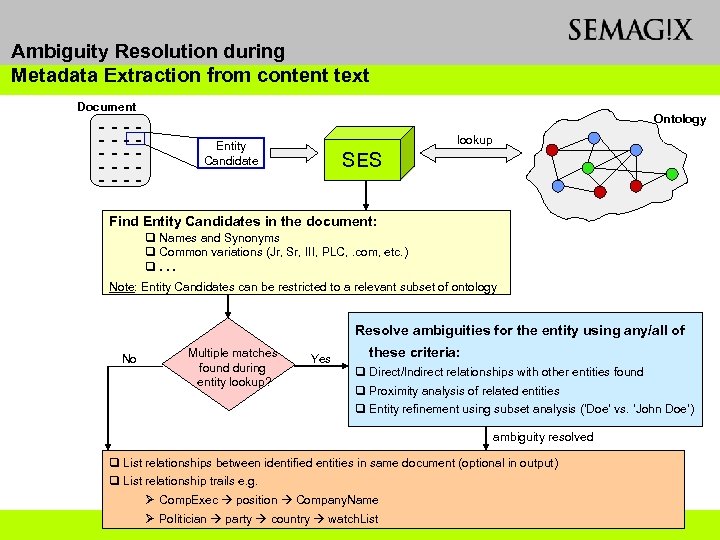
Ambiguity Resolution during Metadata Extraction from content text Document -------- Ontology lookup Entity Candidate SES Find Entity Candidates in the document: q Names and Synonyms q Common variations (Jr, Sr, III, PLC, . com, etc. ) q. . . Note: Entity Candidates can be restricted to a relevant subset of ontology Resolve ambiguities for the entity using any/all of No Multiple matches found during entity lookup? Yes these criteria: q Direct/Indirect relationships with other entities found q Proximity analysis of related entities q Entity refinement using subset analysis (‘Doe’ vs. ‘John Doe’) ambiguity resolved q List relationships between identified entities in same document (optional in output) q List relationship trails e. g. Ø Comp. Exec position Company. Name Ø Politician party country watch. List
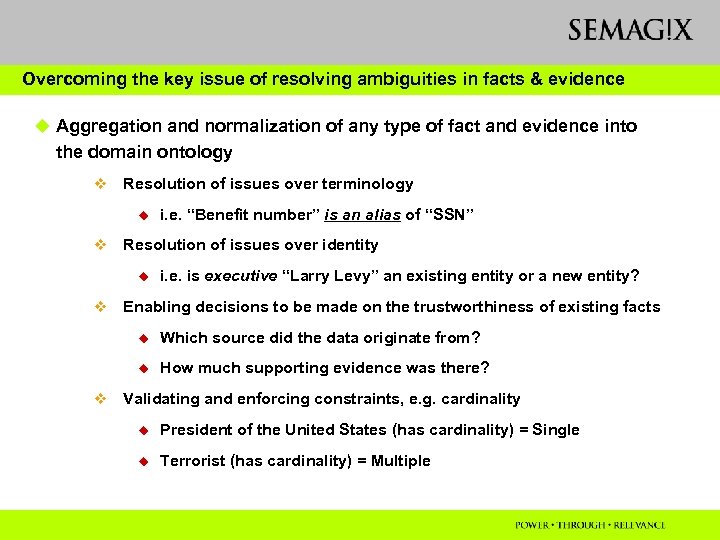
Overcoming the key issue of resolving ambiguities in facts & evidence u Aggregation and normalization of any type of fact and evidence into the domain ontology v Resolution of issues over terminology u v Resolution of issues over identity u v i. e. “Benefit number” is an alias of “SSN” i. e. is executive “Larry Levy” an existing entity or a new entity? Enabling decisions to be made on the trustworthiness of existing facts u u v Which source did the data originate from? How much supporting evidence was there? Validating and enforcing constraints, e. g. cardinality u President of the United States (has cardinality) = Single u Terrorist (has cardinality) = Multiple
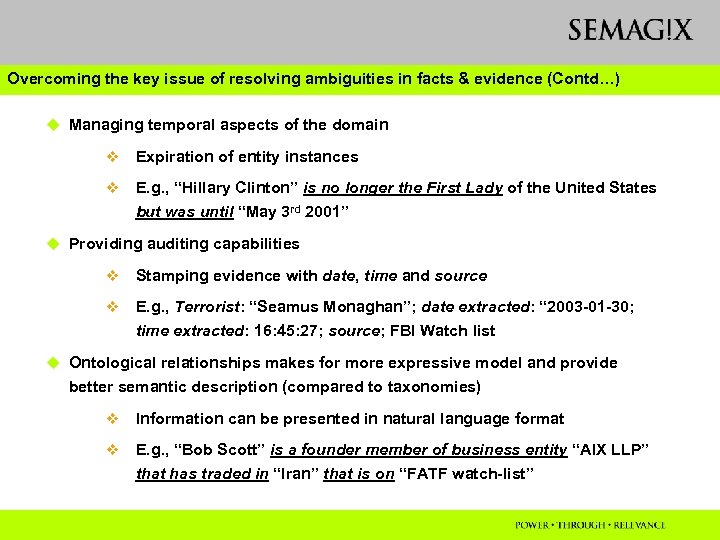
Overcoming the key issue of resolving ambiguities in facts & evidence (Contd…) u Managing temporal aspects of the domain v Expiration of entity instances v E. g. , “Hillary Clinton” is no longer the First Lady of the United States but was until “May 3 rd 2001” u Providing auditing capabilities v Stamping evidence with date, time and source v E. g. , Terrorist: “Seamus Monaghan”; date extracted: “ 2003 -01 -30; time extracted: 16: 45: 27; source; FBI Watch list u Ontological relationships makes for more expressive model and provide better semantic description (compared to taxonomies) v Information can be presented in natural language format v E. g. , “Bob Scott” is a founder member of business entity “AIX LLP” that has traded in “Iran” that is on “FATF watch-list”
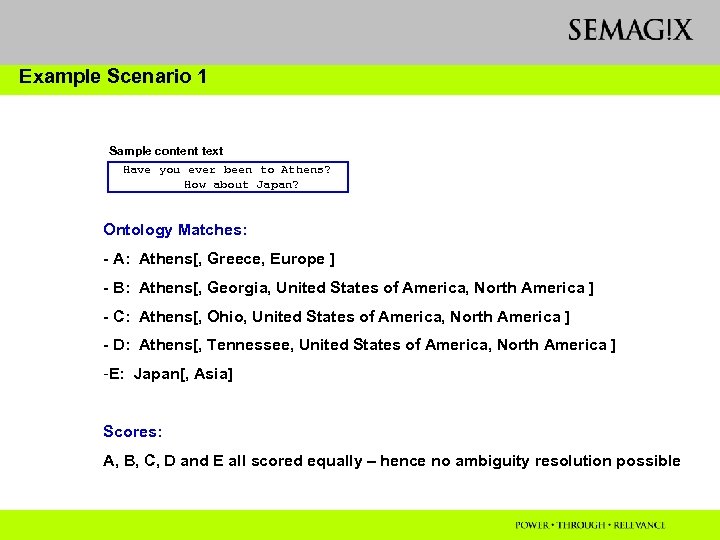
Example Scenario 1 Sample content text Have you ever been to Athens? How about Japan? Ontology Matches: - A: Athens[, Greece, Europe ] - B: Athens[, Georgia, United States of America, North America ] - C: Athens[, Ohio, United States of America, North America ] - D: Athens[, Tennessee, United States of America, North America ] -E: Japan[, Asia] Scores: A, B, C, D and E all scored equally – hence no ambiguity resolution possible
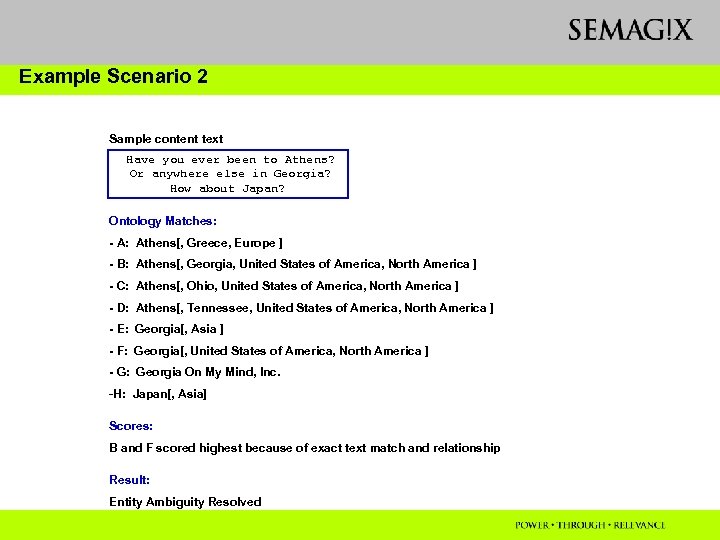
Example Scenario 2 Sample content text Have you ever been to Athens? Or anywhere else in Georgia? How about Japan? Ontology Matches: - A: Athens[, Greece, Europe ] - B: Athens[, Georgia, United States of America, North America ] - C: Athens[, Ohio, United States of America, North America ] - D: Athens[, Tennessee, United States of America, North America ] - E: Georgia[, Asia ] - F: Georgia[, United States of America, North America ] - G: Georgia On My Mind, Inc. -H: Japan[, Asia] Scores: B and F scored highest because of exact text match and relationship Result: Entity Ambiguity Resolved
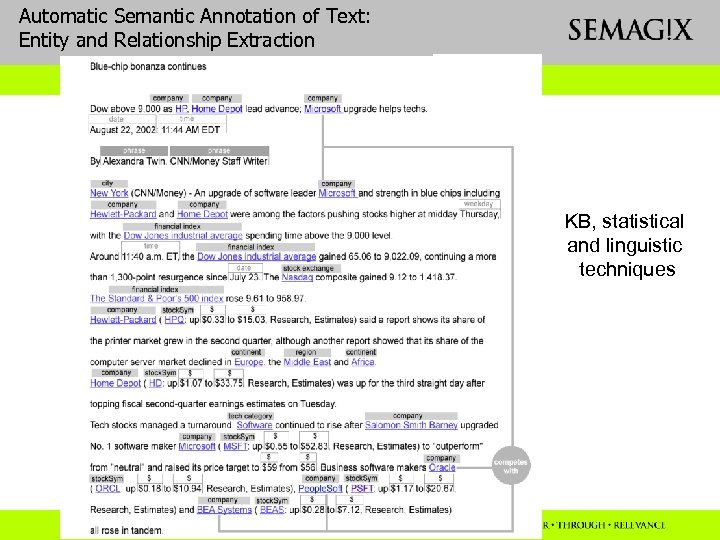
Automatic Semantic Annotation of Text: Entity and Relationship Extraction KB, statistical and linguistic techniques
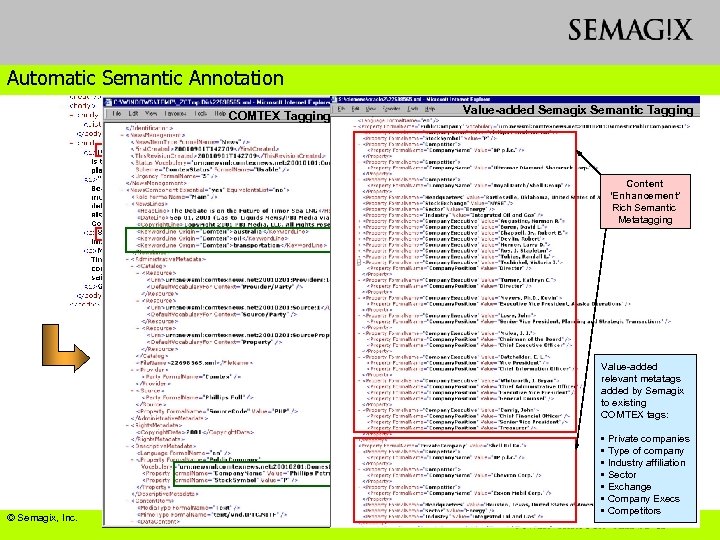
Automatic Semantic Annotation COMTEX Tagging Value-added Semagix Semantic Tagging Content ‘Enhancement’ Rich Semantic Metatagging Limited tagging (mostly syntactic) Value-added relevant metatags added by Semagix to existing COMTEX tags: © Semagix, Inc. • Private companies • Type of company • Industry affiliation • Sector • Exchange • Company Execs • Competitors
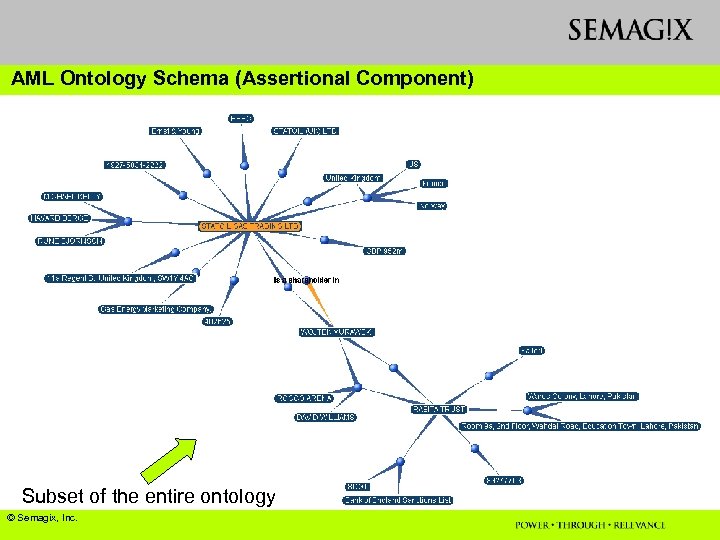
AML Ontology Schema (Assertional Component) Subset of the entire ontology © Semagix, Inc.
Performance Issues Ontology Storage and Access u Ontology typically stores millions of entities, attributes and relationships for any given application u Natural implication how to store it efficiently and most optimally so that accessing ontology does not degrade performance? u What are the storage scheme possibilities? v Database storage (RDBMS) v can logic-based /prolog systems handle this size and computation? v. . . u Any of the above typical storage schemes poses performance challenges for mass applications
Semantic Query Processing and Analytics • Solution: In-memory semantic querying (semantic querying in RAM) • Complex queries involving Ontology and Metadata • Incremental indexing • Distributed indexing • High performance: 10 M queries/hr; less than 10 ms for typical search queries • 2 orders of magnitude faster than RDBMS for complex analytical queries • Knowledge APIs provide a Java, JSP or an HTTP-based interface for querying the Ontology and Metadata
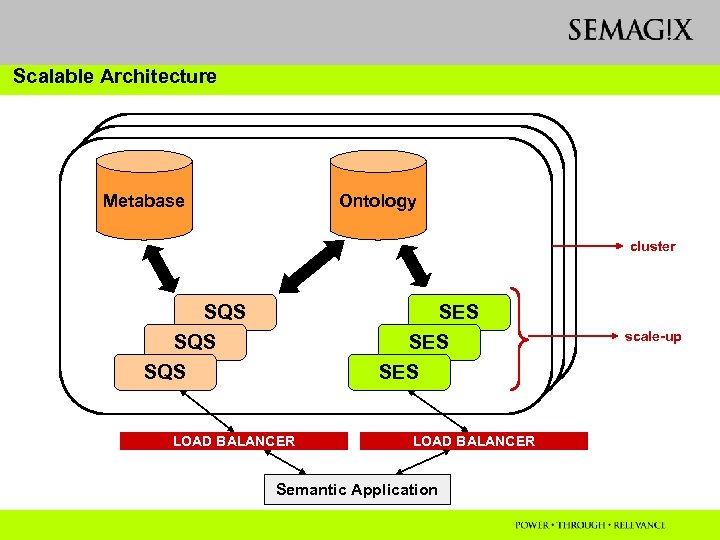
Scalable Architecture Metabase Ontology cluster SQS SQS SES SES LOAD BALANCER Semantic Application scale-up
Few Application Examples
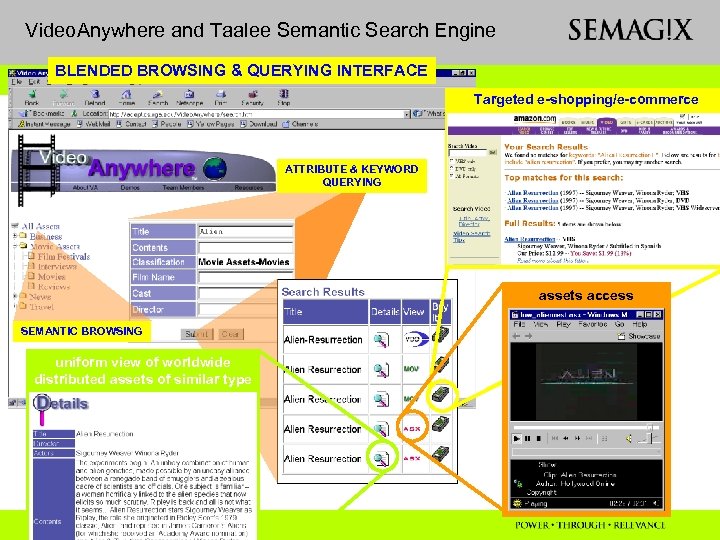
Video. Anywhere and Taalee Semantic Search Engine BLENDED BROWSING & QUERYING INTERFACE Targeted e-shopping/e-commerce ATTRIBUTE & KEYWORD QUERYING assets access SEMANTIC BROWSING uniform view of worldwide distributed assets of similar type
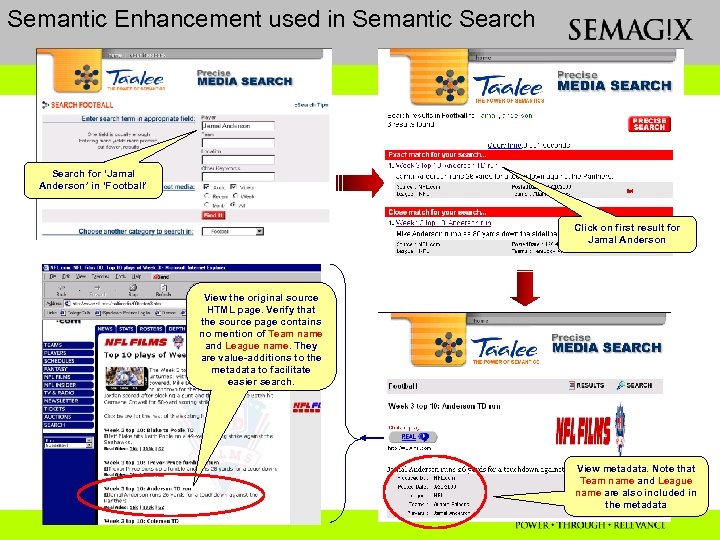
Semantic Enhancement used in Semantic Search for ‘Jamal Anderson’ in ‘Football’ Click on first result for Jamal Anderson View the original source HTML page. Verify that the source page contains no mention of Team name and League name. They are value-additions to the metadata to facilitate easier search. View metadata. Note that Team name and League name are also included in the metadata
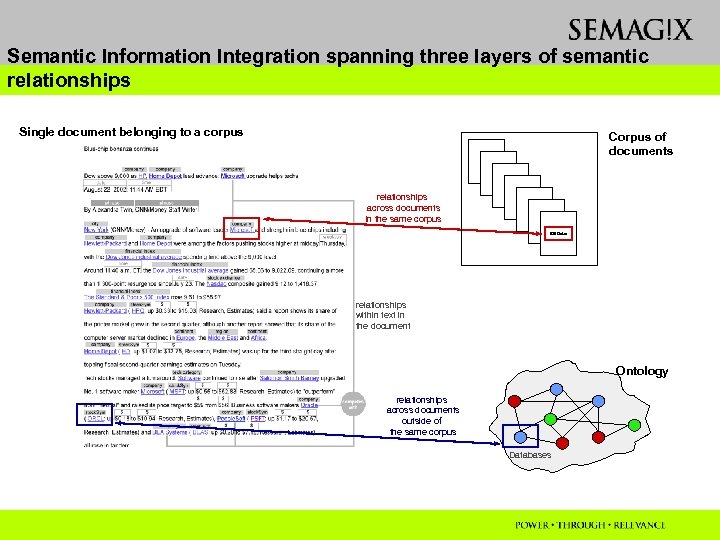
Semantic Information Integration spanning three layers of semantic relationships Single document belonging to a corpus Corpus of documents relationships across documents in the same corpus Bill Gates relationships within text in the document Ontology relationships across documents outside of the same corpus Databases
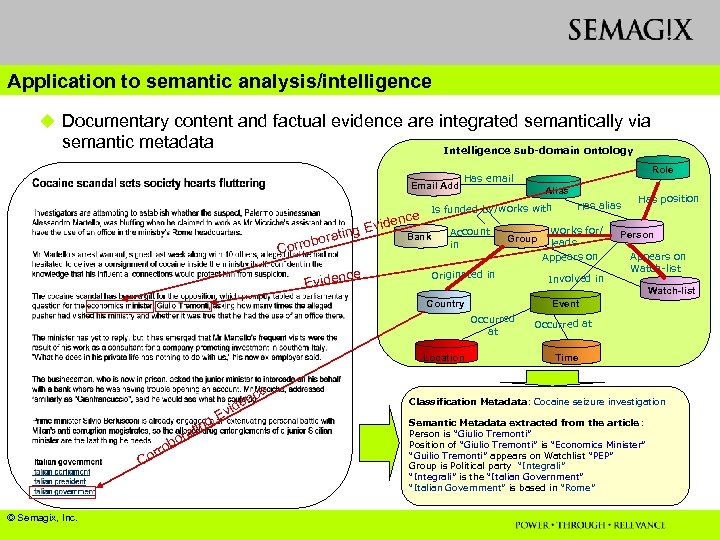
Application to semantic analysis/intelligence u Documentary content and factual evidence are integrated semantically via semantic metadata Intelligence sub-domain ontology Email Add e denc g Evi oratin orrob C ce Eviden Alias Is funded by/works with Bank Account in Group Originated in Location ob ti ora rr Co © Semagix, Inc. n Works for/ leads Appears on Involved in Has position Person Appears on Watch-list Occurred at ce Has alias Event Country n ide v g. E Role Has email Occurred at Time Classification Metadata: Cocaine seizure investigation Semantic Metadata extracted from the article: Person is “Giulio Tremonti” Position of “Giulio Tremonti” is “Economics Minister” “Guilio Tremonti” appears on Watchlist “PEP” Group is Political party “Integrali” is the “Italian Government” is based in “Rome”
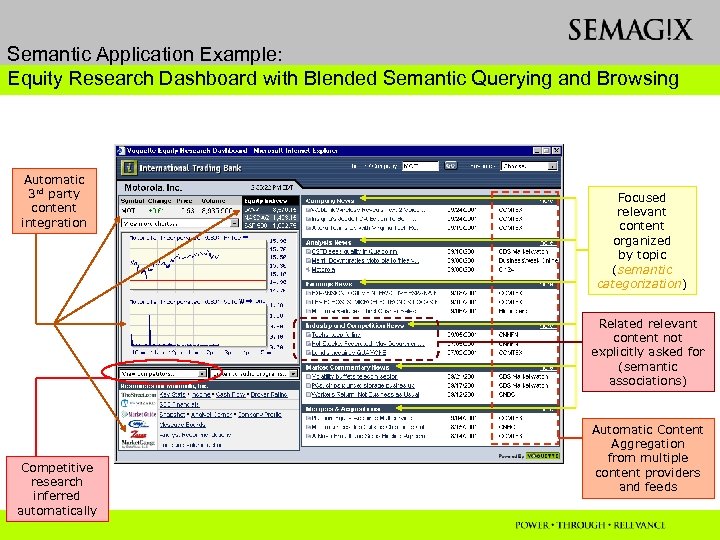
Semantic Application Example: Equity Research Dashboard with Blended Semantic Querying and Browsing Automatic 3 rd party content integration Focused relevant content organized by topic (semantic categorization) Related relevant content not explicitly asked for (semantic associations) Competitive research inferred automatically Automatic Content Aggregation from multiple content providers and feeds
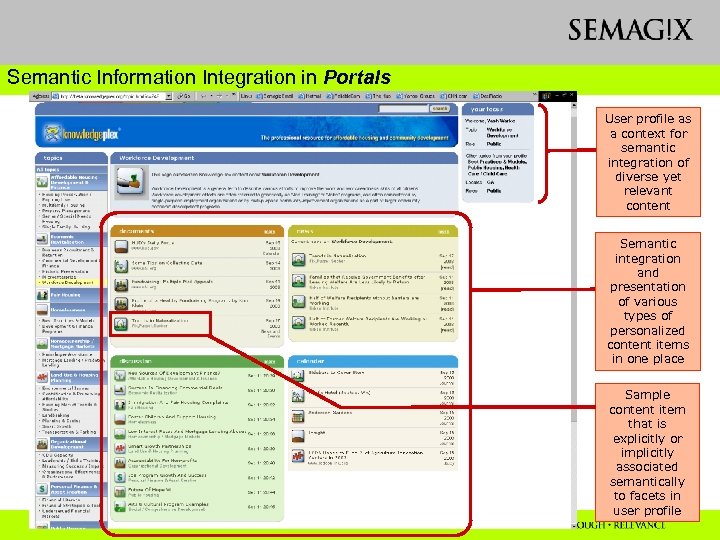
Semantic Information Integration in Portals User profile as a context for semantic integration of diverse yet relevant content Semantic integration and presentation of various types of personalized content items in one place Sample content item that is explicitly or implicitly associated semantically to facets in user profile
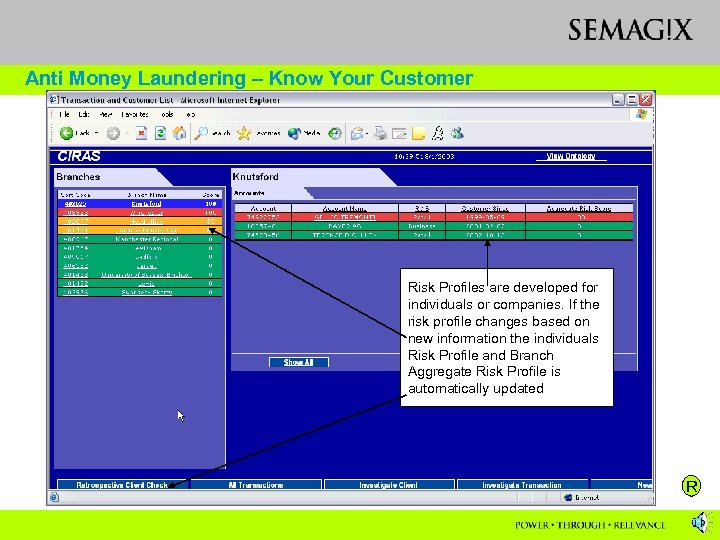
Anti Money Laundering – Know Your Customer Risk Profiles are developed for individuals or companies. If the risk profile changes based on new information the individuals Risk Profile and Branch Aggregate Risk Profile is automatically updated R
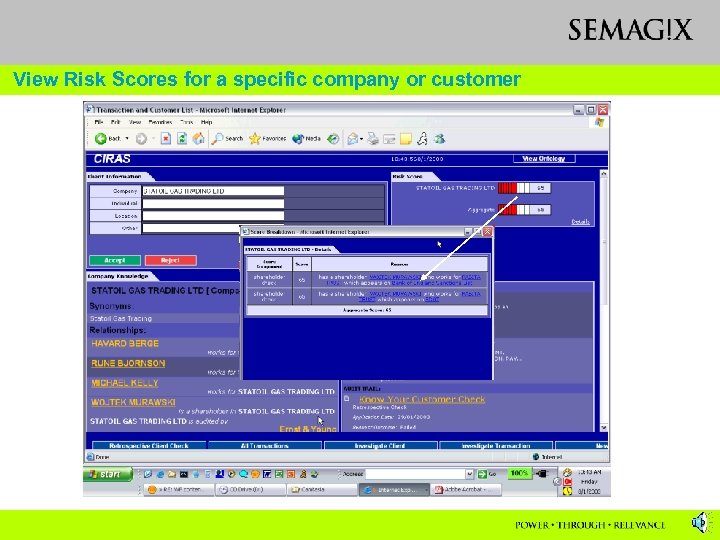
View Risk Scores for a specific company or customer
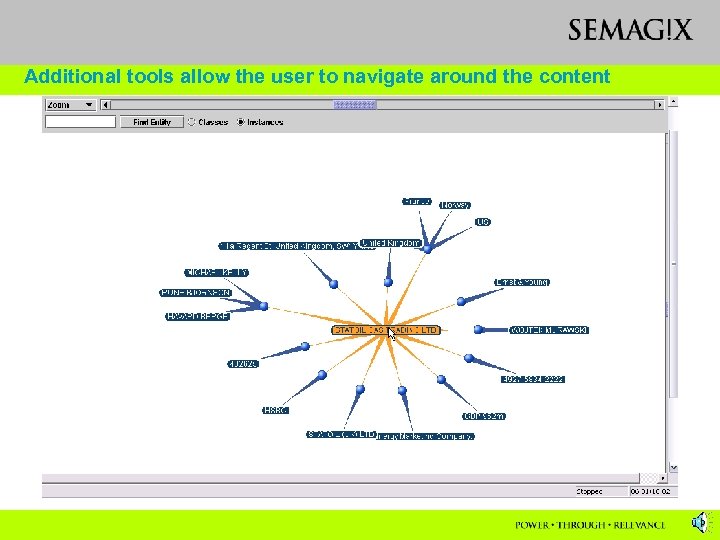
Additional tools allow the user to navigate around the content
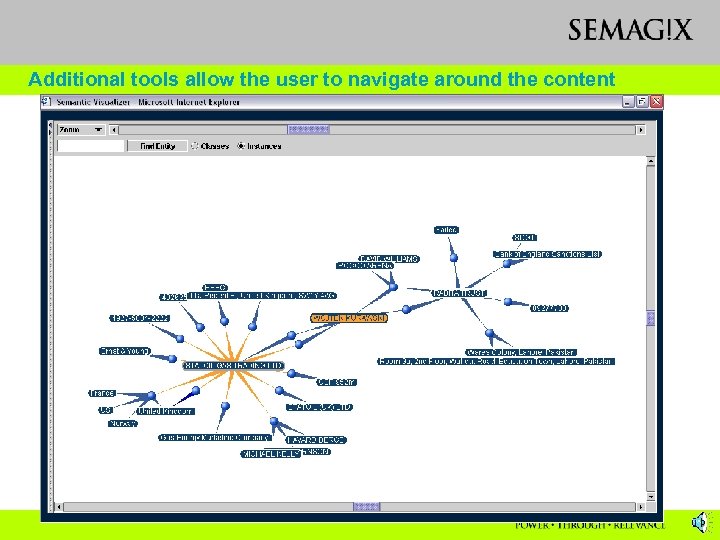
Additional tools allow the user to navigate around the content
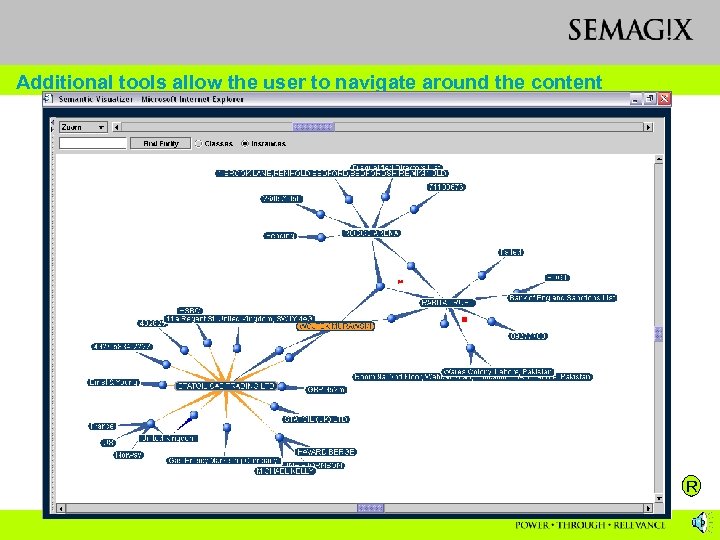
Additional tools allow the user to navigate around the content R
Conclusion u Great progress from work in semantic information interoperability/integration of early 90 s until now, re-energized by the vision of Semantic Web, related standards and technological advances u Technology beyond proof of concept u But lots of difficult research and engineering challenges ahead u More: (Technology) http: //www. semagix. com/downloads. shtml (Research) http: //lsdis. cs. uga. edu/proj/SAI/ u Demos available
Скачать презентацию Semantic Web in Action Ontology-driven information search integration
4f68c7d7a1a66b7ddc754017d7df8fb3.ppt