


 Скачать презентацию Semantic Technologies Towards Making a Difference in Scientific
78caa4a6987fac40d86ba89ee82d919f.ppt
- Количество слайдов: 75
 Semantic Technologies: Towards Making a Difference in Scientific Data Management Bertram Ludäscher (ludaesch@sdsc. edu) Associate Professor Dept. of Computer Science & Genome Center University of California, Davis Fellow San Diego Supercomputer Center University of California, San Diego UC DAVIS Department of Computer Science San Diego Supercomputer Center
 Outline • Semantics & Scientific Data Integration • Semantics & Scientific Workflow Management • Conclusions DOE NC Meeting, Boulder, Dec 1 st 2004 2 Semantic Technologies in SDM, B. Ludäscher
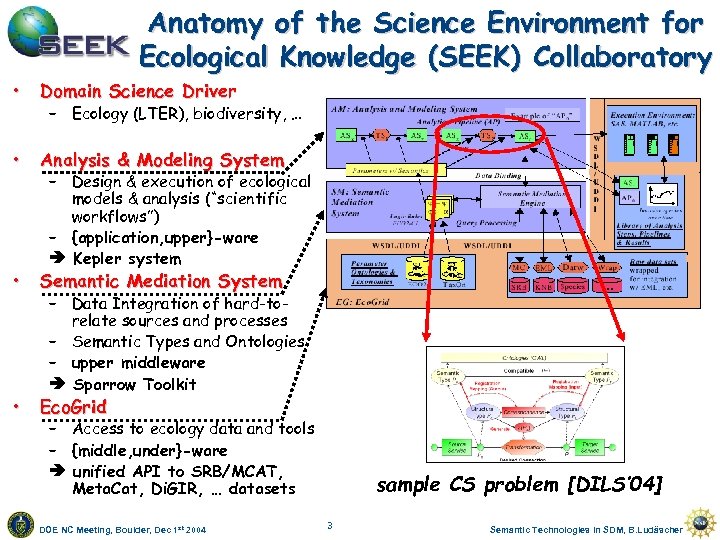 Anatomy of the Science Environment for Ecological Knowledge (SEEK) Collaboratory • Domain Science Driver • Analysis & Modeling System • Semantic Mediation System • Eco. Grid – Ecology (LTER), biodiversity, … – Design & execution of ecological models & analysis (“scientific workflows”) – {application, upper}-ware Kepler system – Data Integration of hard-torelate sources and processes – Semantic Types and Ontologies – upper middleware Sparrow Toolkit – Access to ecology data and tools – {middle, under}-ware unified API to SRB/MCAT, Meta. Cat, Di. GIR, … datasets DOE NC Meeting, Boulder, Dec 1 st 2004 sample CS problem [DILS’ 04] 3 Semantic Technologies in SDM, B. Ludäscher
 Common Collaboratories / Distributed Science / Cyberinfrastructure Pieces • Seamless and uniform data access (“Data-Grid”) – data & metadata registry • distributed and high performance computing platform (“Compute-Grid”) – service registry • User-friendly workbench / problem-solving environment – scientific workflow system • A common problem: – integrating (or at least linking) data from multiple sites, investigators, communities, …, scales, …, species, … Federated, integrated, mediated databases – often use of semantic extensions (e. g. ontologies) DOE NC Meeting, Boulder, Dec 1 st 2004 4 Semantic Technologies in SDM, B. Ludäscher
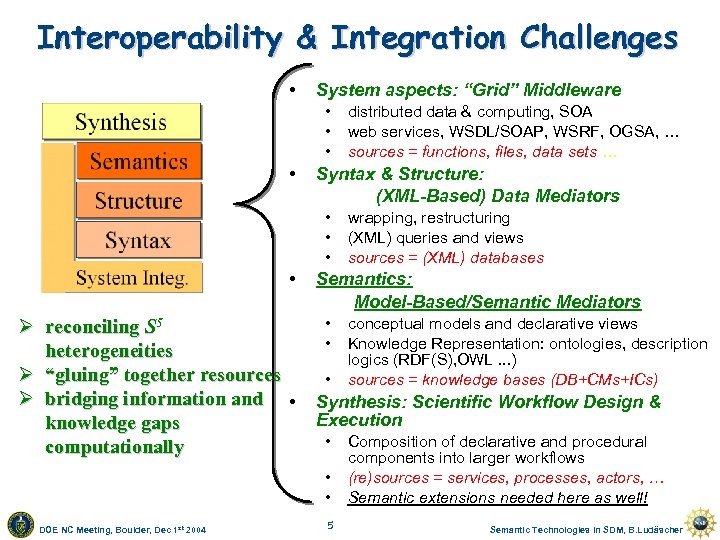 Interoperability & Integration Challenges • System aspects: “Grid” Middleware • • Syntax & Structure: (XML-Based) Data Mediators • • Ø reconciling S 5 heterogeneities Ø “gluing” together resources Ø bridging information and • knowledge gaps computationally wrapping, restructuring (XML) queries and views sources = (XML) databases Semantics: Model-Based/Semantic Mediators • • • conceptual models and declarative views Knowledge Representation: ontologies, description logics (RDF(S), OWL. . . ) sources = knowledge bases (DB+CMs+ICs) Synthesis: Scientific Workflow Design & Execution • • • DOE NC Meeting, Boulder, Dec 1 st 2004 distributed data & computing, SOA web services, WSDL/SOAP, WSRF, OGSA, … sources = functions, files, data sets … 5 Composition of declarative and procedural components into larger workflows (re)sources = services, processes, actors, … Semantic extensions needed here as well! Semantic Technologies in SDM, B. Ludäscher
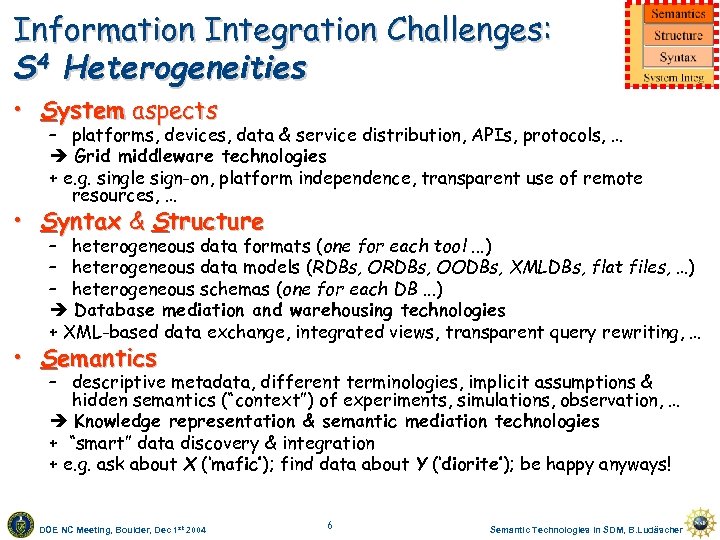 Information Integration Challenges: S 4 Heterogeneities • System aspects – platforms, devices, data & service distribution, APIs, protocols, … Grid middleware technologies + e. g. single sign-on, platform independence, transparent use of remote resources, … • Syntax & Structure – heterogeneous data formats (one for each tool. . . ) – heterogeneous data models (RDBs, OODBs, XMLDBs, flat files, …) – heterogeneous schemas (one for each DB. . . ) Database mediation and warehousing technologies + XML-based data exchange, integrated views, transparent query rewriting, … • Semantics – descriptive metadata, different terminologies, implicit assumptions & hidden semantics (“context”) of experiments, simulations, observation, … Knowledge representation & semantic mediation technologies + “smart” data discovery & integration + e. g. ask about X (‘mafic’); find data about Y (‘diorite’); be happy anyways! DOE NC Meeting, Boulder, Dec 1 st 2004 6 Semantic Technologies in SDM, B. Ludäscher
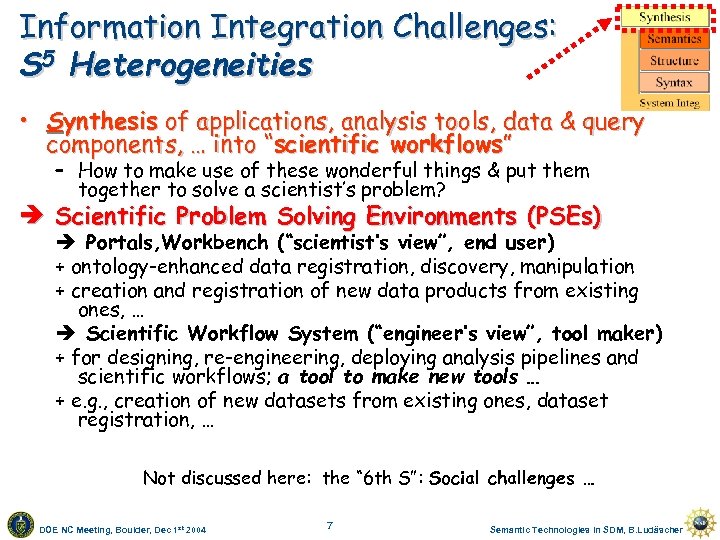 Information Integration Challenges: S 5 Heterogeneities • Synthesis of applications, analysis tools, data & query components, … into “scientific workflows” – How to make use of these wonderful things & put them together to solve a scientist’s problem? Scientific Problem Solving Environments (PSEs) Portals, Workbench (“scientist’s view”, end user) + ontology-enhanced data registration, discovery, manipulation + creation and registration of new data products from existing ones, … Scientific Workflow System (“engineer’s view”, tool maker) + for designing, re-engineering, deploying analysis pipelines and scientific workflows; a tool to make new tools … + e. g. , creation of new datasets from existing ones, dataset registration, … Not discussed here: the “ 6 th S”: Social challenges … DOE NC Meeting, Boulder, Dec 1 st 2004 7 Semantic Technologies in SDM, B. Ludäscher
 Our Focus • Scientific Data Integration: – need DB/DI + KR (“semantic mediation”) • Automation of Scientific Data Analysis, Process & Application Integration – need for scientific workflow systems – need for semantic extensions • But first: – Some data & information integration problems DOE NC Meeting, Boulder, Dec 1 st 2004 8 Semantic Technologies in SDM, B. Ludäscher
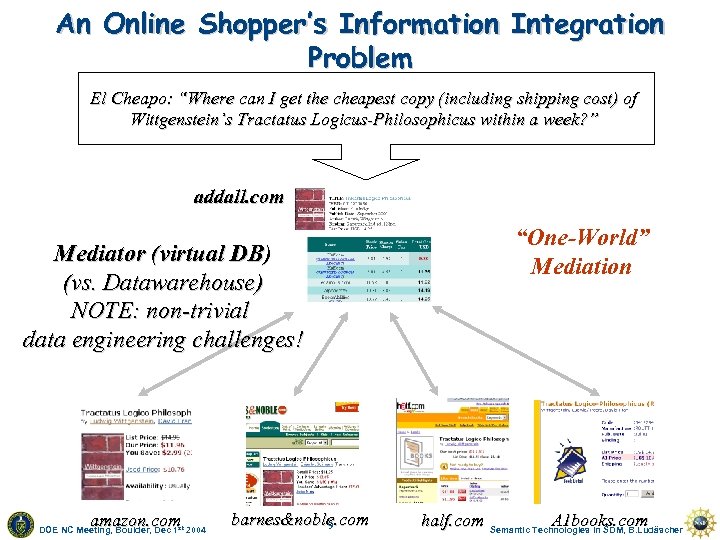 An Online Shopper’s Information Integration Problem El Cheapo: “Where can I get the cheapest copy (including shipping cost) of Wittgenstein’s Tractatus Logicus-Philosophicus within a week? ” addall. com ? Mediator (virtual DB) Information (vs. Datawarehouse) Integration NOTE: non-trivial data engineering challenges! amazon. com DOE NC Meeting, Boulder, Dec 1 st 2004 barnes&noble. com 9 “One-World” Mediation A 1 books. com half. com Semantic Technologies in SDM, B. Ludäscher
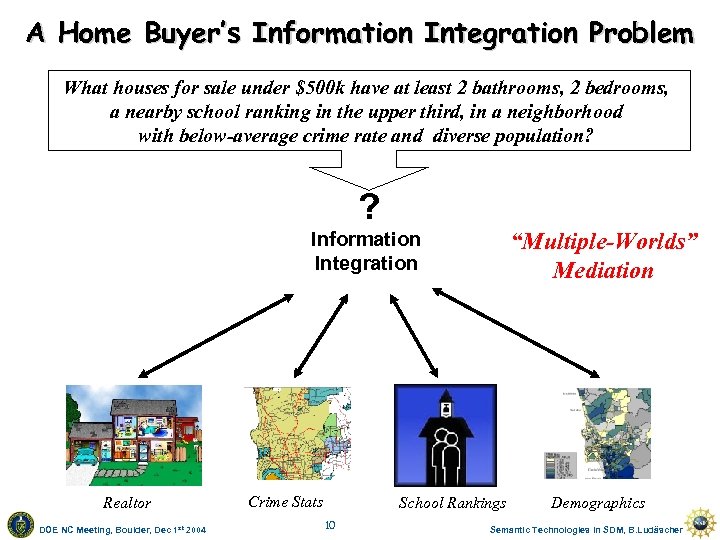 A Home Buyer’s Information Integration Problem What houses for sale under $500 k have at least 2 bathrooms, 2 bedrooms, a nearby school ranking in the upper third, in a neighborhood with below-average crime rate and diverse population? ? “Multiple-Worlds” Mediation Information Integration Realtor DOE NC Meeting, Boulder, Dec 1 st 2004 Crime Stats School Rankings 10 Demographics Semantic Technologies in SDM, B. Ludäscher
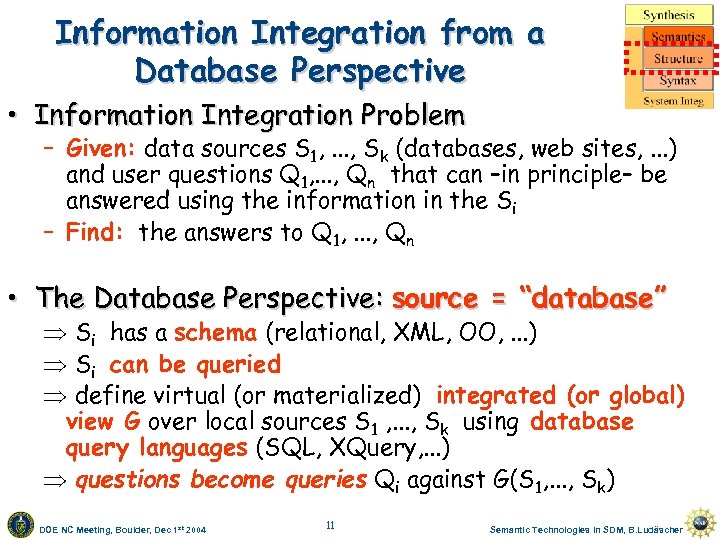 Information Integration from a Database Perspective • Information Integration Problem – Given: data sources S 1, . . . , Sk (databases, web sites, . . . ) and user questions Q 1, . . . , Qn that can –in principle– be answered using the information in the Si – Find: the answers to Q 1, . . . , Qn • The Database Perspective: source = “database” Þ Si has a schema (relational, XML, OO, . . . ) Þ Si can be queried Þ define virtual (or materialized) integrated (or global) view G over local sources S 1 , . . . , Sk using database query languages (SQL, XQuery, . . . ) Þ questions become queries Qi against G(S 1, . . . , Sk) DOE NC Meeting, Boulder, Dec 1 st 2004 11 Semantic Technologies in SDM, B. Ludäscher
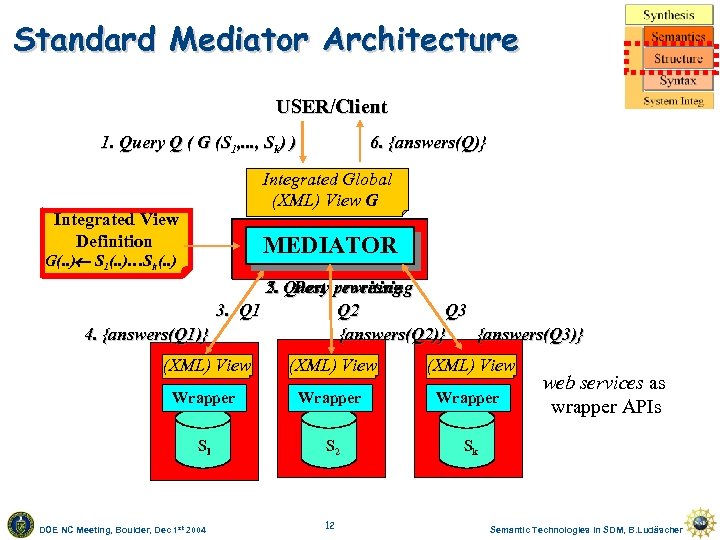 Standard Mediator Architecture USER/Client 1. Query Q ( G (S 1, . . . , Sk) ) 6. {answers(Q)} Integrated Global (XML) View G Integrated View Definition MEDIATOR G(. . ) S 1(. . )…Sk(. . ) 2. Query rewriting 5. Post processing 3. Q 1 Q 2 Q 3 4. {answers(Q 1)} {answers(Q 2)} {answers(Q 3)} (XML) View Wrapper S 1 S 2 Sk DOE NC Meeting, Boulder, Dec 1 st 2004 12 web services as wrapper APIs Semantic Technologies in SDM, B. Ludäscher
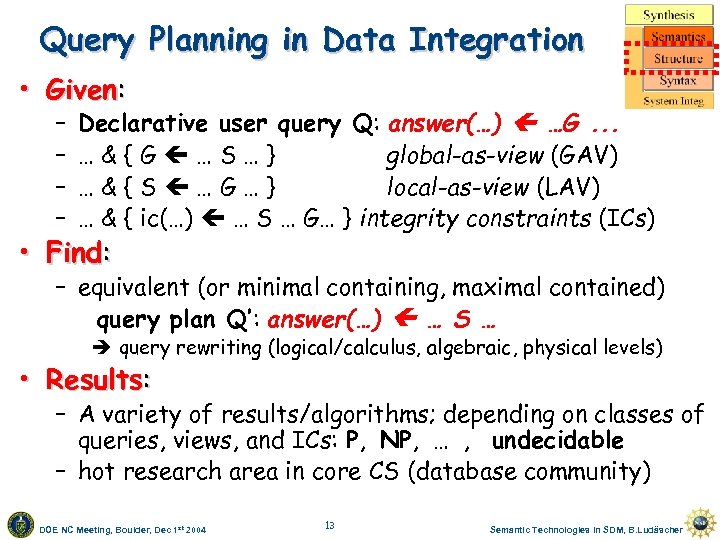 Query Planning in Data Integration • Given: – – Declarative user query Q: answer(…) …G. . . …&{G …S…} global-as-view (GAV) …&{S …G…} local-as-view (LAV) … & { ic(…) … S … G… } integrity constraints (ICs) • Find: – equivalent (or minimal containing, maximal contained) query plan Q’: answer(…) … S … query rewriting (logical/calculus, algebraic, physical levels) • Results: – A variety of results/algorithms; depending on classes of queries, views, and ICs: P, NP, … , undecidable – hot research area in core CS (database community) DOE NC Meeting, Boulder, Dec 1 st 2004 13 Semantic Technologies in SDM, B. Ludäscher
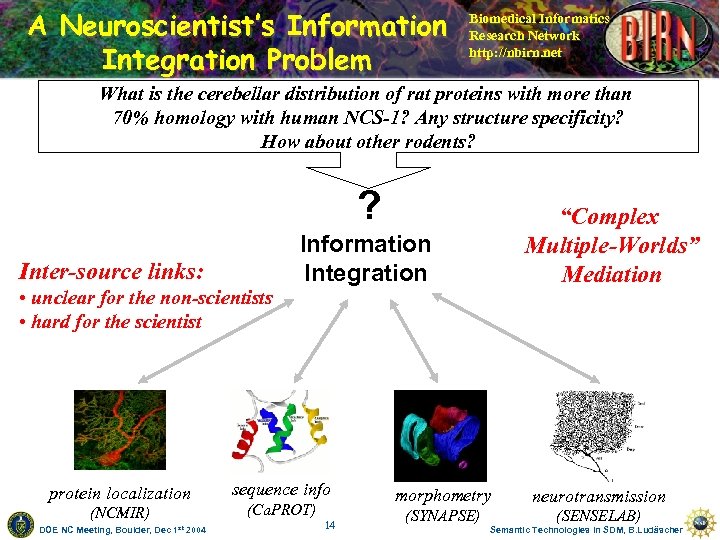 A Neuroscientist’s Information Integration Problem Biomedical Informatics Research Network http: //nbirn. net What is the cerebellar distribution of rat proteins with more than 70% homology with human NCS-1? Any structure specificity? How about other rodents? ? Inter-source links: • unclear for the non-scientists • hard for the scientist protein localization (NCMIR) DOE NC Meeting, Boulder, Dec 1 st 2004 “Complex Multiple-Worlds” Mediation Information Integration sequence info (Ca. PROT) 14 morphometry neurotransmission (SYNAPSE) (SENSELAB) Semantic Technologies in SDM, B. Ludäscher
 DOE NC Meeting, Boulder, Dec 1 st 2004 15 Semantic Technologies in SDM, B. Ludäscher
 Scientific Data Integration using Semantic Extensions DOE NC Meeting, Boulder, Dec 1 st 2004 16 Semantic Technologies in SDM, B. Ludäscher
 Example: Geologic Map Integration • Given: – Geologic maps from different state geological surveys (shapefiles w/ different data schemas) – Different ontologies: • Geologic age ontology (e. g. USGS) • Rock classification ontologies: – Multiple hierarchies (chemical, fabric, texture, genesis) from Geological Survey of Canada (GSC) – Single hierarchy from British Geological Survey (BGS) • Problem: – Support uniform queries across all maps – … possibly using different ontologies – Support registration w/ ontology A, querying w/ ontology B DOE NC Meeting, Boulder, Dec 1 st 2004 17 Semantic Technologies in SDM, B. Ludäscher
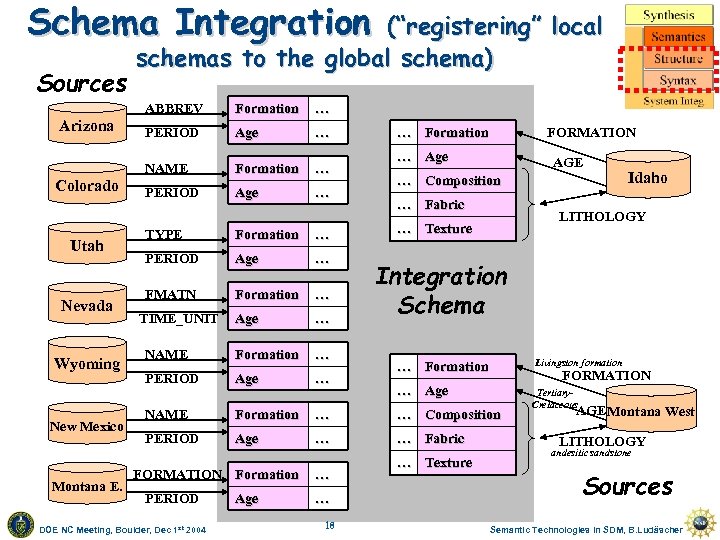 Schema Integration Sources (“registering” local schemas to the global schema) ABBREV Colorado Utah Nevada Wyoming New Mexico Montana E. … PERIOD Age … NAME Arizona Formation … PERIOD Age … TYPE Formation … PERIOD Age … FMATN Formation … Age … NAME Formation … PERIOD Age … TIME_UNIT … Formation FORMATION … Age AGE … Composition … Fabric LITHOLOGY … Texture Integration Schema Livingston formation … Formation FORMATION … Age NAME Formation … … Composition PERIOD Age … … Fabric FORMATION Formation PERIOD DOE NC Meeting, Boulder, Dec 1 st 2004 Age … … 18 Idaho … Texture Tertiary. Cretaceous AGEMontana West LITHOLOGY andesitic sandstone Sources Semantic Technologies in SDM, B. Ludäscher
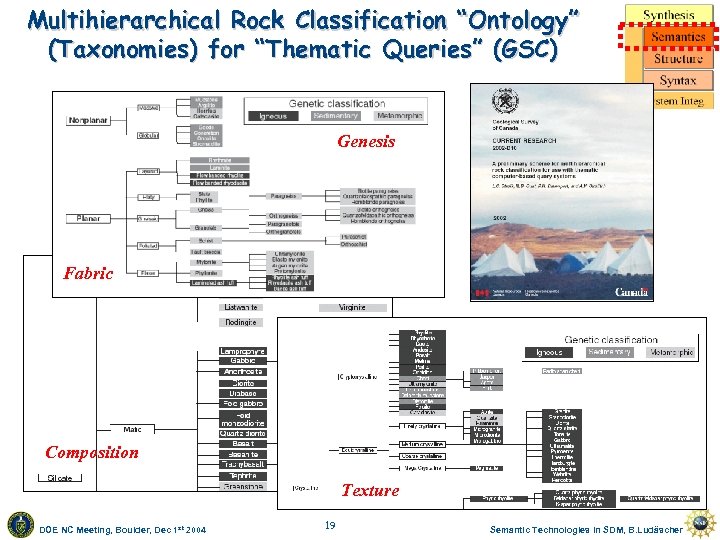 Multihierarchical Rock Classification “Ontology” (Taxonomies) for “Thematic Queries” (GSC) Genesis Fabric Composition Texture DOE NC Meeting, Boulder, Dec 1 st 2004 19 Semantic Technologies in SDM, B. Ludäscher
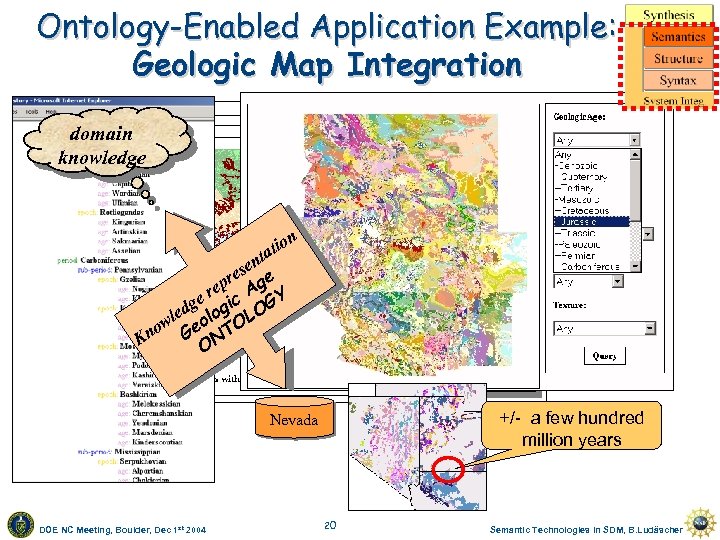 Ontology-Enabled Application Example: Geologic Map Integration domain knowledge n Show io tat sen e re ep Ag Y r ge gic OG led olo L w no Ge NTO K O formations where AGE = ‘Paleozic’ (without age ontology) (with age ontology) +/- a few hundred million years Nevada DOE NC Meeting, Boulder, Dec 1 st 2004 Show formations where AGE = ‘Paleozic’ 20 Semantic Technologies in SDM, B. Ludäscher
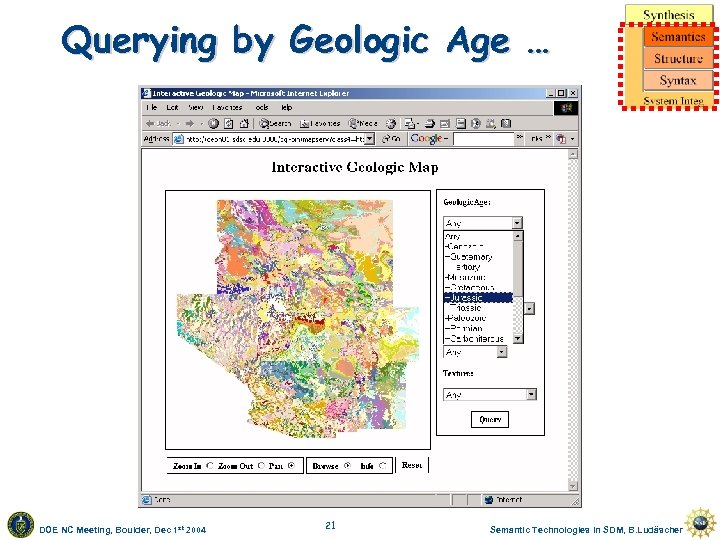 Querying by Geologic Age … DOE NC Meeting, Boulder, Dec 1 st 2004 21 Semantic Technologies in SDM, B. Ludäscher
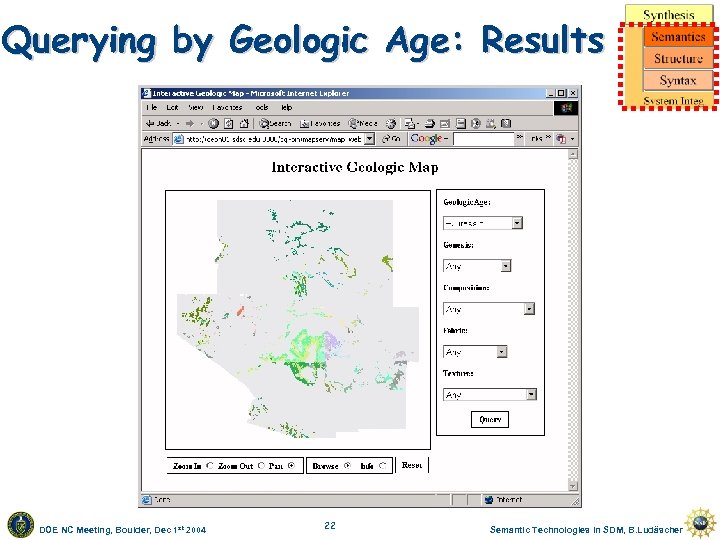 Querying by Geologic Age: Results DOE NC Meeting, Boulder, Dec 1 st 2004 22 Semantic Technologies in SDM, B. Ludäscher
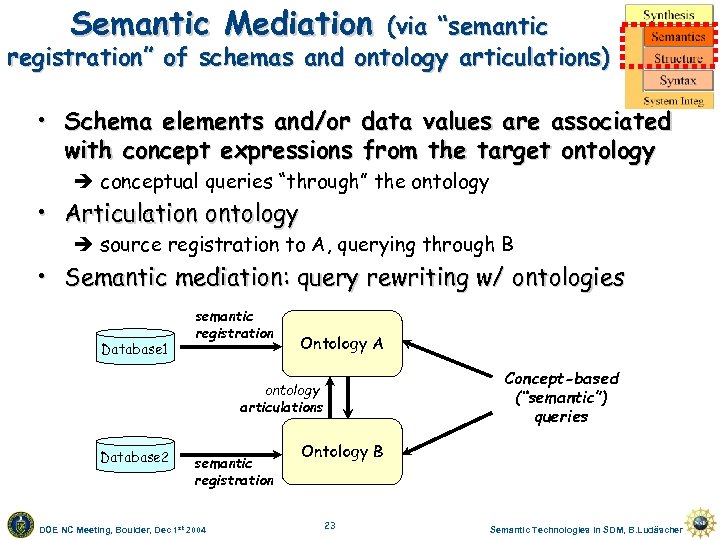 Semantic Mediation (via “semantic registration” of schemas and ontology articulations) • Schema elements and/or data values are associated with concept expressions from the target ontology conceptual queries “through” the ontology • Articulation ontology source registration to A, querying through B • Semantic mediation: query rewriting w/ ontologies Database 1 semantic registration Ontology A Concept-based (“semantic”) queries ontology articulations Database 2 semantic registration DOE NC Meeting, Boulder, Dec 1 st 2004 Ontology B 23 Semantic Technologies in SDM, B. Ludäscher
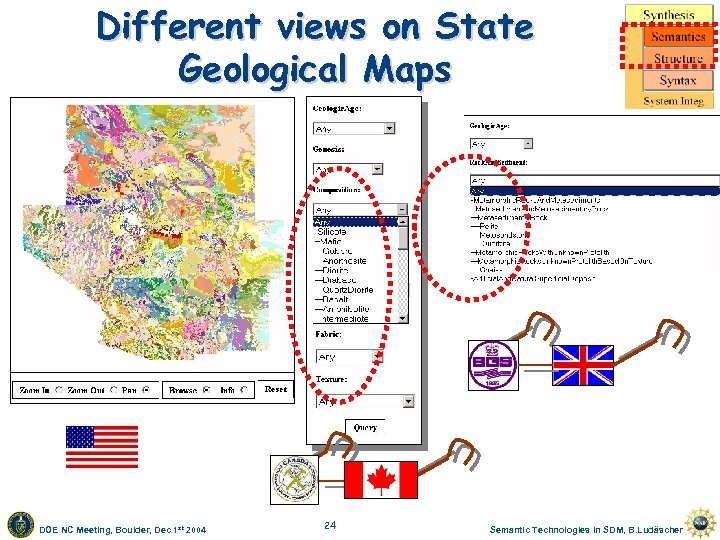 Different views on State Geological Maps DOE NC Meeting, Boulder, Dec 1 st 2004 24 Semantic Technologies in SDM, B. Ludäscher
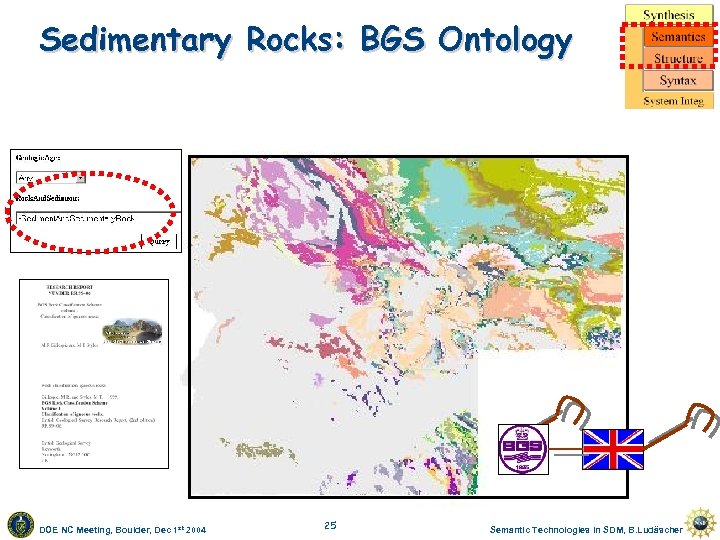 Sedimentary Rocks: BGS Ontology DOE NC Meeting, Boulder, Dec 1 st 2004 25 Semantic Technologies in SDM, B. Ludäscher
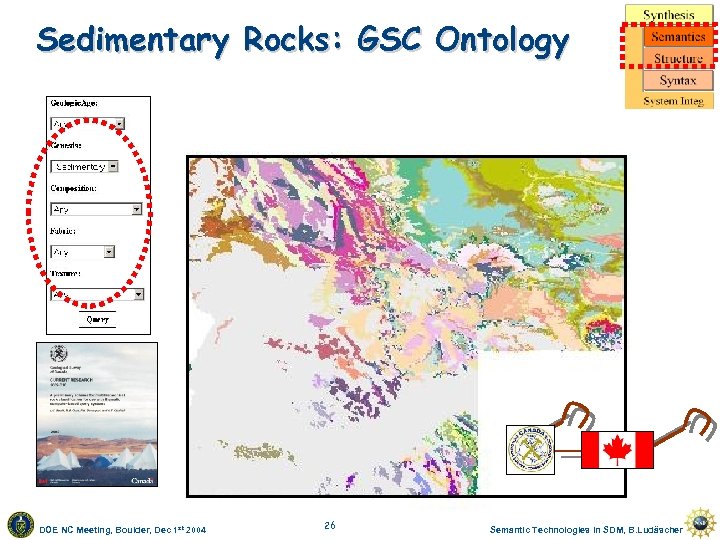 Sedimentary Rocks: GSC Ontology DOE NC Meeting, Boulder, Dec 1 st 2004 26 Semantic Technologies in SDM, B. Ludäscher
 Some Thoughts … • Translate this idea of multiple conceptual (ontology) views to your domain! – e. g. datasets biological pathways registration • Your data is valuable (time & $$$ spent in producing it) data (re-)usability • Metadata helps to discover, localize, assess relevant data sets, given particular scientific questions & queries • Does your system “understand” what to do with the metadata? • Capturing more semantics of a data set in a way that humans and systems can exploit it is an investment in reusability – “We are producing more and more data” – Today “we can store everything!” – But can we use anything? (i. e. , is anyone looking at the data after the initial creation? ) • Design system, interfaces, data and metadata models with reusability in mind (think archives and “time capsules”) • This may even be pushed to the experiment/simulation/workflow design… DOE NC Meeting, Boulder, Dec 1 st 2004 27 Semantic Technologies in SDM, B. Ludäscher
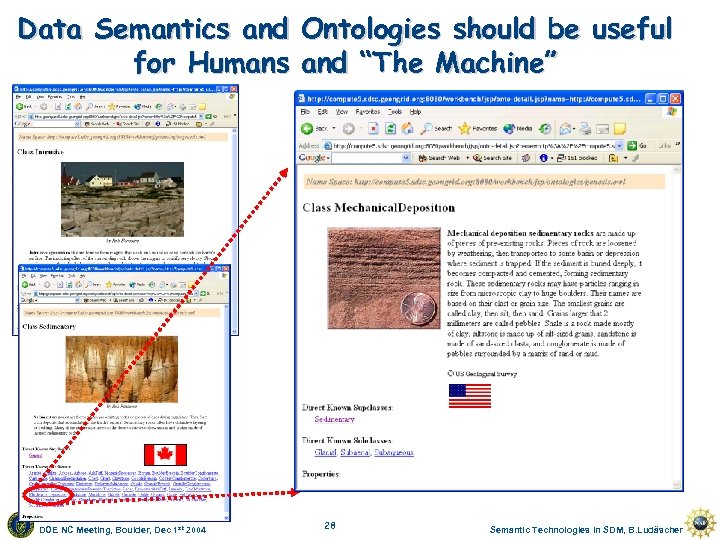 Data Semantics and Ontologies should be useful for Humans and “The Machine” DOE NC Meeting, Boulder, Dec 1 st 2004 28 Semantic Technologies in SDM, B. Ludäscher
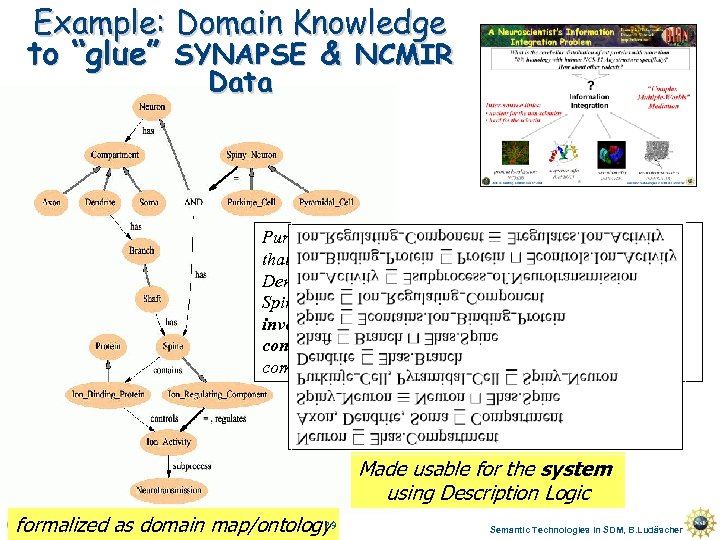 Example: Domain Knowledge to “glue” SYNAPSE & NCMIR Data Purkinje cells and Pyramidal cells have dendrites that have higher-order branches that contain spines. Dendritic spines are ion (calcium) regulating components. Spines have ion binding proteins. Neurotransmission involves ionic activity (release). Ion-binding proteins control ion activity (propagation) in a cell. Ion-regulating components of cells affect ionic activity (release). domain expert knowledge Made usable for the system using Description Logic 29 formalized as domain map/ontology DOE NC Meeting, Boulder, Dec 1 2004 st Semantic Technologies in SDM, B. Ludäscher
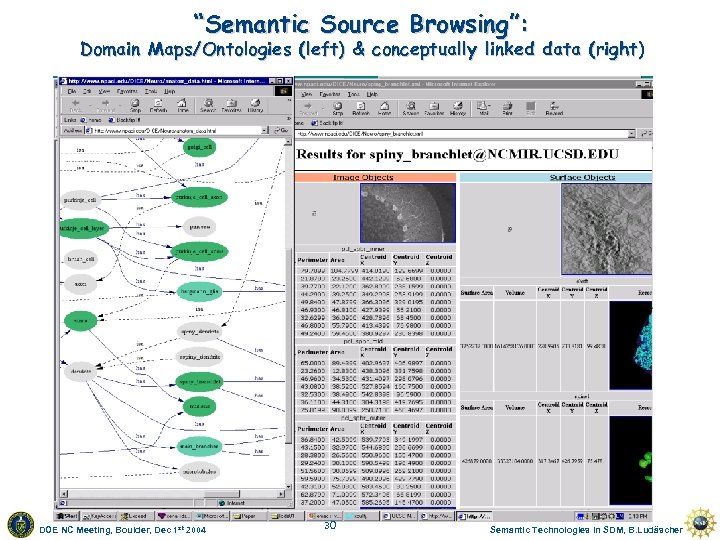 “Semantic Source Browsing”: Domain Maps/Ontologies (left) & conceptually linked data (right) DOE NC Meeting, Boulder, Dec 1 st 2004 30 Semantic Technologies in SDM, B. Ludäscher
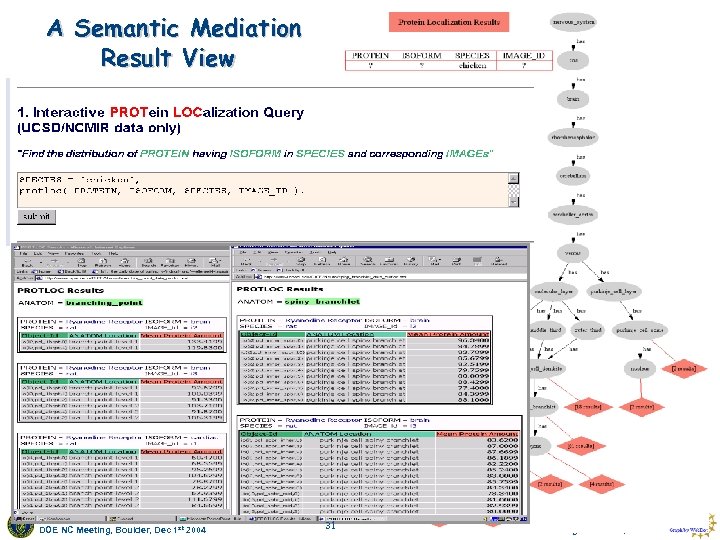 A Semantic Mediation Result View DOE NC Meeting, Boulder, Dec 1 st 2004 31 Semantic Technologies in SDM, B. Ludäscher
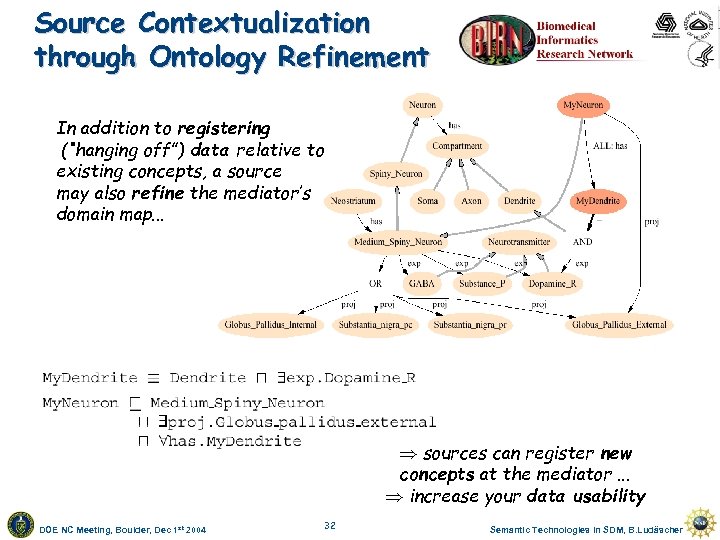 Source Contextualization through Ontology Refinement In addition to registering (“hanging off”) data relative to existing concepts, a source may also refine the mediator’s domain map. . . Þ sources can register new concepts at the mediator. . . Þ increase your data usability DOE NC Meeting, Boulder, Dec 1 st 2004 32 Semantic Technologies in SDM, B. Ludäscher
 Outline • Semantics & Scientific Data Integration • Semantics & Scientific Workflow Management • Conclusions DOE NC Meeting, Boulder, Dec 1 st 2004 33 Semantic Technologies in SDM, B. Ludäscher
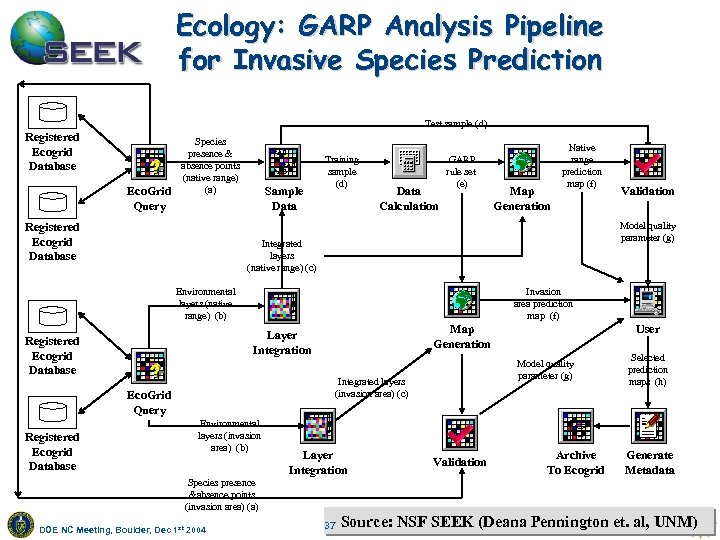
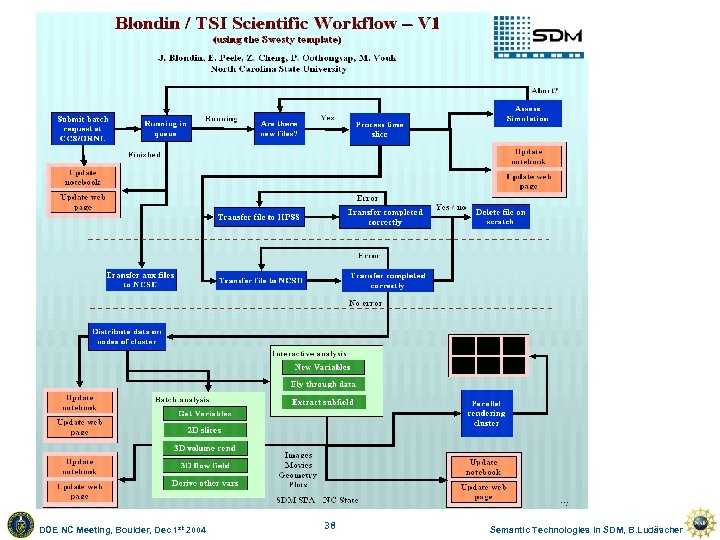
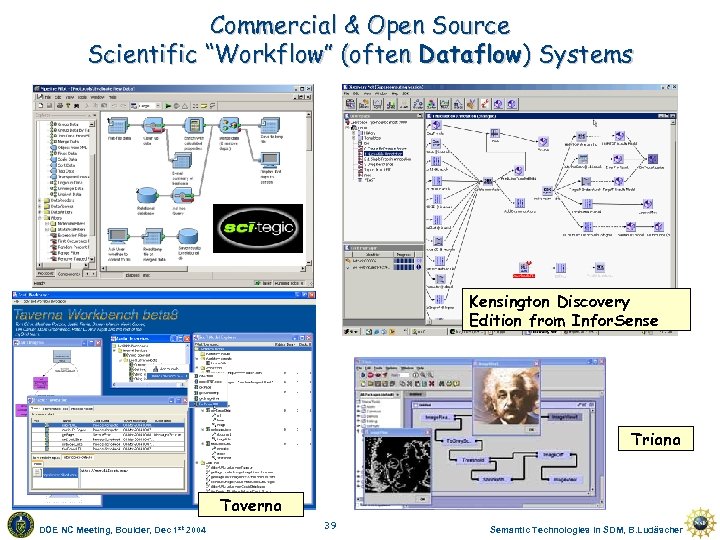
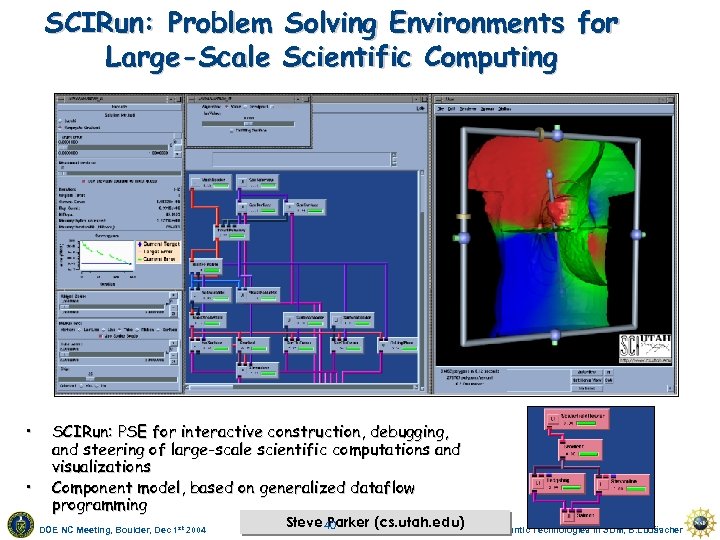
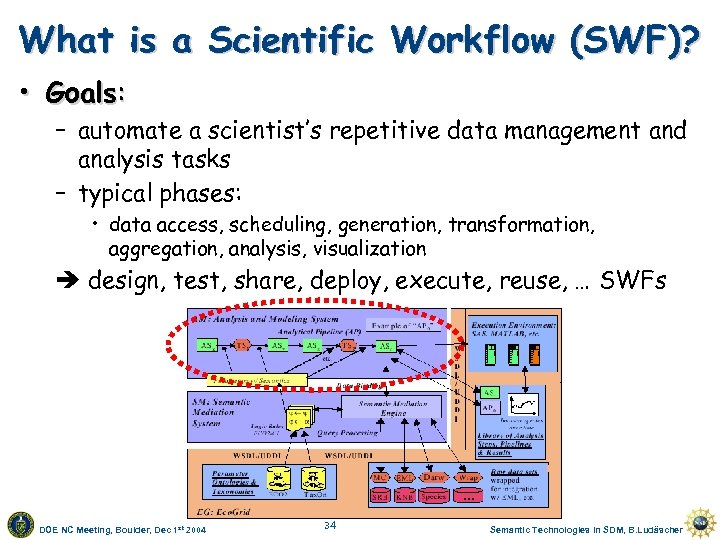 What is a Scientific Workflow (SWF)? • Goals: – automate a scientist’s repetitive data management and analysis tasks – typical phases: • data access, scheduling, generation, transformation, aggregation, analysis, visualization design, test, share, deploy, execute, reuse, … SWFs DOE NC Meeting, Boulder, Dec 1 st 2004 34 Semantic Technologies in SDM, B. Ludäscher
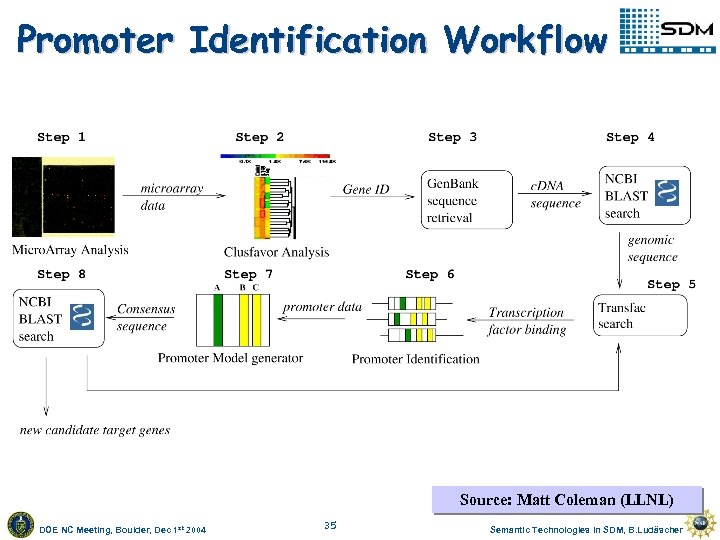 Promoter Identification Workflow Source: Matt Coleman (LLNL) DOE NC Meeting, Boulder, Dec 1 st 2004 35 Semantic Technologies in SDM, B. Ludäscher
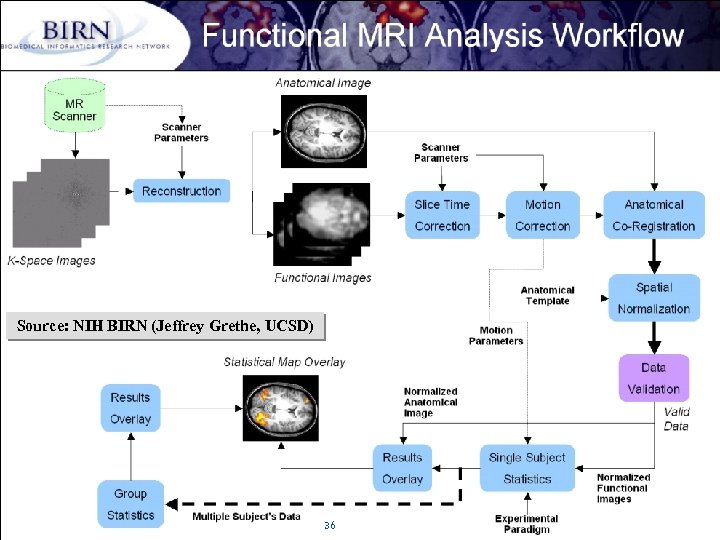 Source: NIH BIRN (Jeffrey Grethe, UCSD) DOE NC Meeting, Boulder, Dec 1 st 2004 36 Semantic Technologies in SDM, B. Ludäscher
 Ecology: GARP Analysis Pipeline for Invasive Species Prediction Test sample (d) Registered Ecogrid Database Eco. Grid Query Species presence & absence points (native range) (a) Registered Ecogrid Database +A 1 +A 2 +A 3 Sample Data Training sample (d) Data Calculation GARP rule set (e) Integrated layers (native range) (c) Invasion area prediction map (f) Map Generation Layer Integration Registered Ecogrid Database Validation Model quality parameter (g) Environmental layers (native range) (b) Environmental layers (invasion area) (b) Layer Integration User Model quality parameter (g) Integrated layers (invasion area) (c) Eco. Grid Query Registered Ecogrid Database Map Generation Native range prediction map (f) Validation Archive To Ecogrid Selected prediction maps (h) Generate Metadata Species presence &absence points (invasion area) (a) DOE NC Meeting, Boulder, Dec 1 st 2004 37 Source: NSF SEEK (Deana Pennington et. B. Ludäscher al, UNM) Semantic Technologies in SDM,
 DOE NC Meeting, Boulder, Dec 1 st 2004 38 Semantic Technologies in SDM, B. Ludäscher
 Commercial & Open Source Scientific “Workflow” (often Dataflow) Systems Kensington Discovery Edition from Infor. Sense Triana Taverna DOE NC Meeting, Boulder, Dec 1 st 2004 39 Semantic Technologies in SDM, B. Ludäscher
 SCIRun: Problem Solving Environments for Large-Scale Scientific Computing • • SCIRun: PSE for interactive construction, debugging, and steering of large-scale scientific computations and visualizations Component model, based on generalized dataflow programming DOE NC Meeting, Boulder, Dec 1 st 2004 Steve 40 Parker (cs. utah. edu) Semantic Technologies in SDM, B. Ludäscher
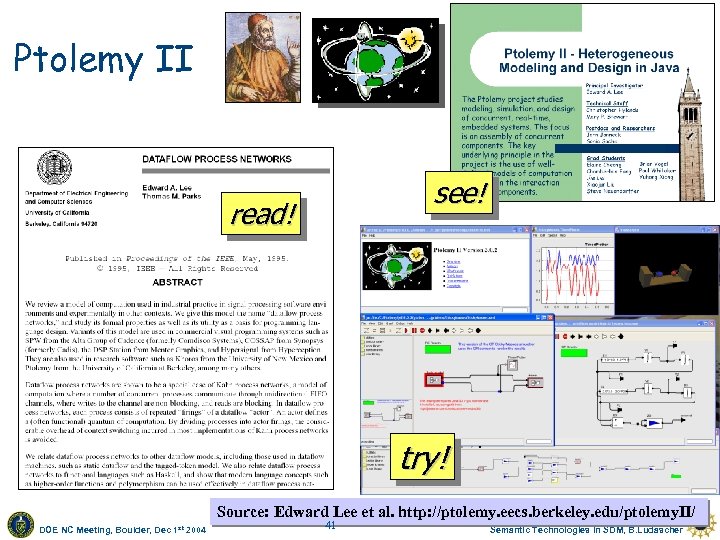 Ptolemy II see! read! try! Source: Edward Lee et al. http: //ptolemy. eecs. berkeley. edu/ptolemy. II/ DOE NC Meeting, Boulder, Dec 1 st 2004 41 Semantic Technologies in SDM, B. Ludäscher
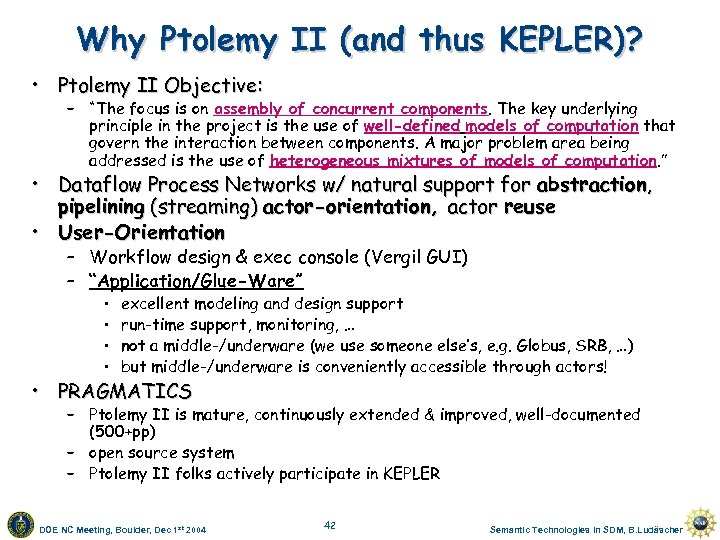 Why Ptolemy II (and thus KEPLER)? • Ptolemy II Objective: – “The focus is on assembly of concurrent components. The key underlying principle in the project is the use of well-defined models of computation that govern the interaction between components. A major problem area being addressed is the use of heterogeneous mixtures of models of computation. ” • Dataflow Process Networks w/ natural support for abstraction, pipelining (streaming) actor-orientation, actor reuse • User-Orientation – Workflow design & exec console (Vergil GUI) – “Application/Glue-Ware” • • excellent modeling and design support run-time support, monitoring, … not a middle-/underware (we use someone else’s, e. g. Globus, SRB, …) but middle-/underware is conveniently accessible through actors! • PRAGMATICS – Ptolemy II is mature, continuously extended & improved, well-documented (500+pp) – open source system – Ptolemy II folks actively participate in KEPLER DOE NC Meeting, Boulder, Dec 1 st 2004 42 Semantic Technologies in SDM, B. Ludäscher
 KEPLER/CSP: Contributors, Sponsors, Projects (or loosely coupled Communicating Sequential Persons ; -) Ilkay Altintas SDM, Resurgence Kim Baldridge Resurgence, NMI Chad Berkley SEEK Shawn Bowers SEEK www. kepler-project. org Terence Critchlow SDM Tobin Fricke ROADNet Jeffrey Grethe BIRN Christopher H. Brooks Ptolemy II Zhengang Cheng SDM Dan Higgins SEEK Efrat Jaeger GEON Ptolemy II DOE NC Meeting, Boulder, Dec 1 st 2004 43 Semantic Technologies in SDM, B. Ludäscher
 KEPLER: An Open Collaboration • Initiated by members from DOE SDM/SPA and NSF SEEK; now several other projects (GEON, Ptolemy II, EOL, Resurgence/NMI, …) • Open Source (BSD-style license) • Intensive Communications: – Web-archived mailing lists – IRC (!) – Meetings, Hackathons • Co-development: – via shared CVS repository DOE NC Meeting, Boulder, Dec 1 st 2004 44 Semantic Technologies in SDM, B. Ludäscher
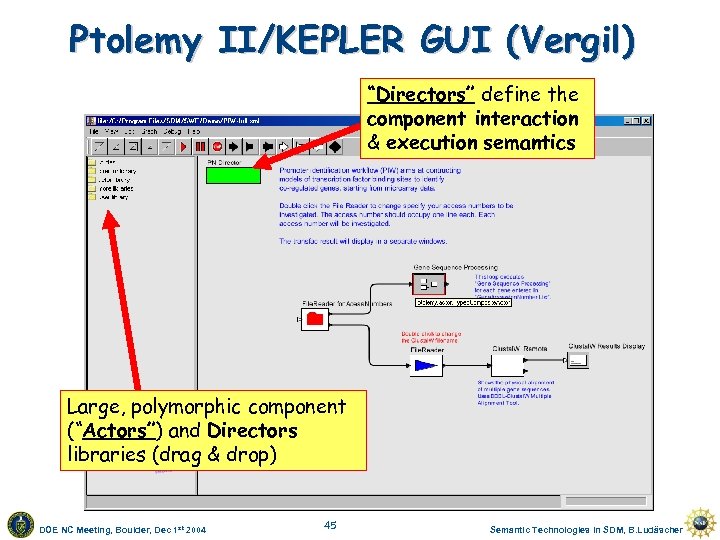 Ptolemy II/KEPLER GUI (Vergil) “Directors” define the component interaction & execution semantics Large, polymorphic component (“Actors”) and Directors libraries (drag & drop) DOE NC Meeting, Boulder, Dec 1 st 2004 45 Semantic Technologies in SDM, B. Ludäscher
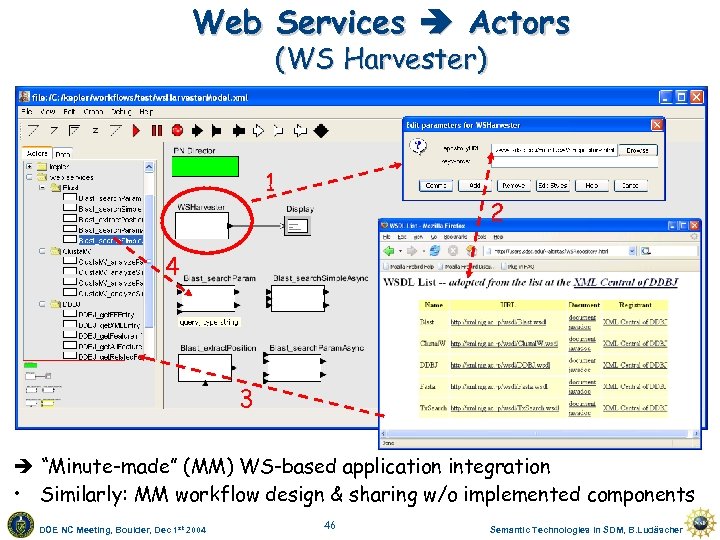 Web Services Actors (WS Harvester) 1 2 4 3 “Minute-made” (MM) WS-based application integration • Similarly: MM workflow design & sharing w/o implemented components DOE NC Meeting, Boulder, Dec 1 st 2004 46 Semantic Technologies in SDM, B. Ludäscher
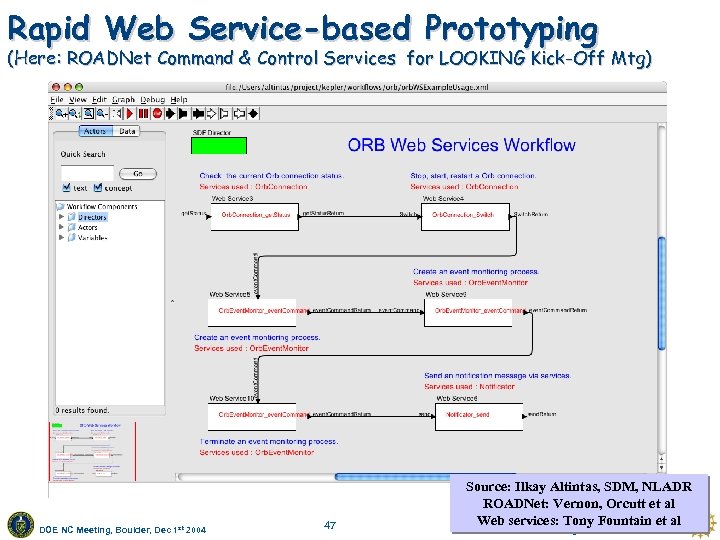 Rapid Web Service-based Prototyping (Here: ROADNet Command & Control Services for LOOKING Kick-Off Mtg) DOE NC Meeting, Boulder, Dec 1 st 2004 47 Source: Ilkay Altintas, SDM, NLADR ROADNet: Vernon, Orcutt et al Web services: Tony Fountain et al Semantic Technologies in SDM, B. Ludäscher
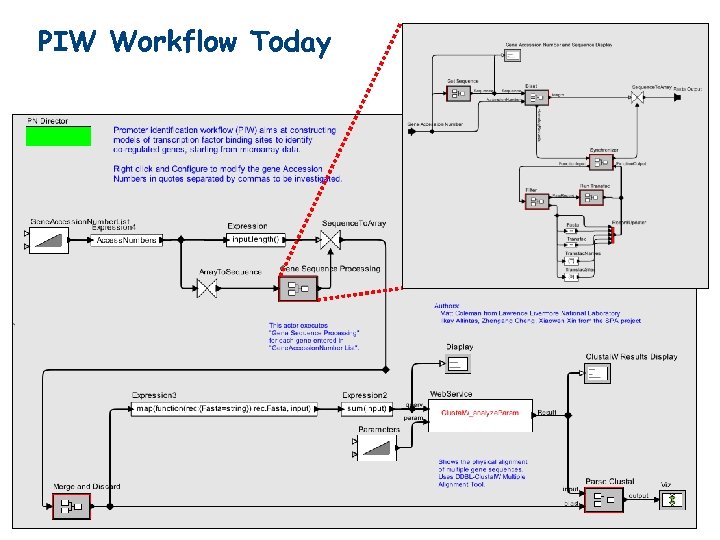
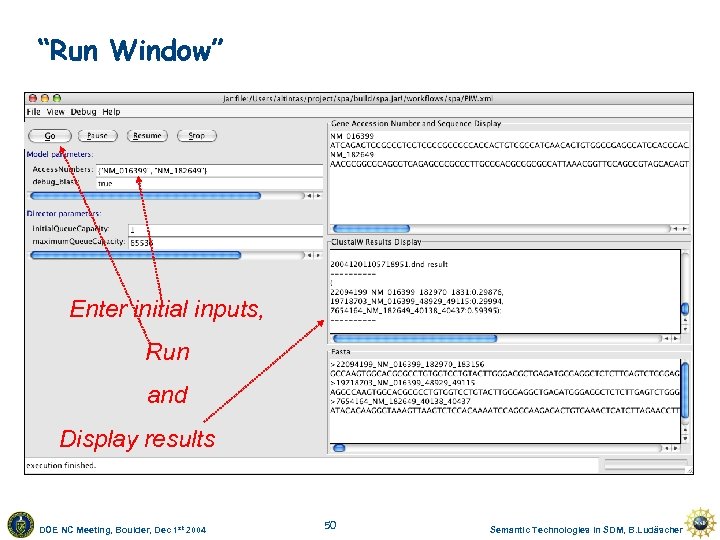
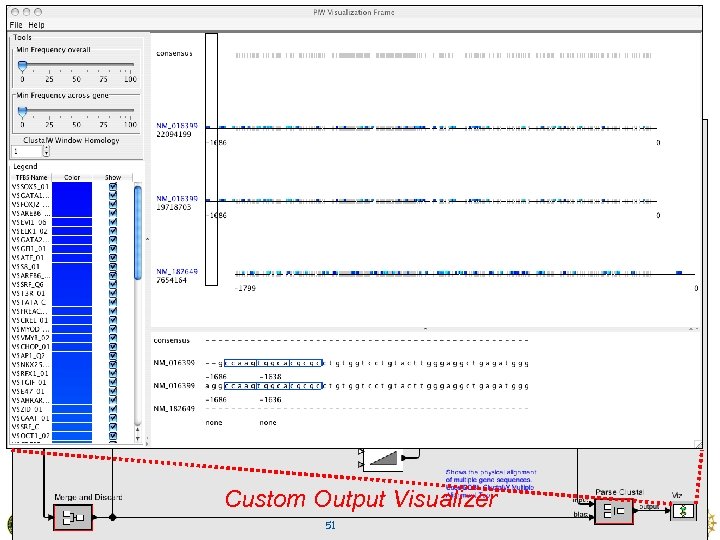
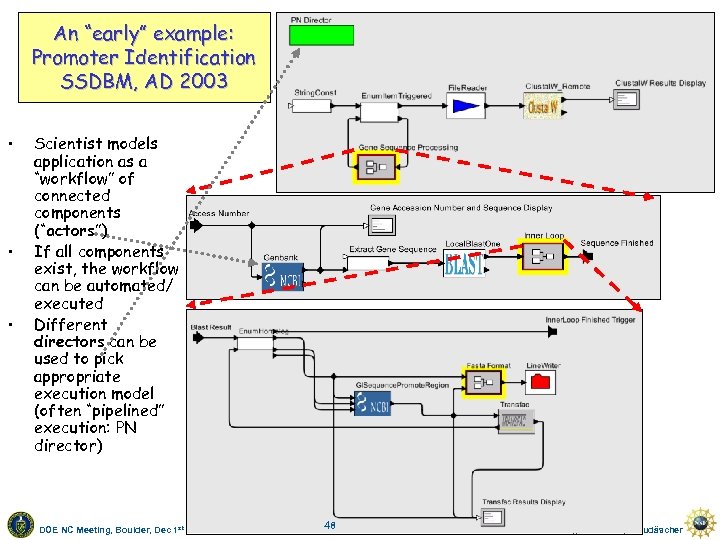 An “early” example: Promoter Identification SSDBM, AD 2003 • • • Scientist models application as a “workflow” of connected components (“actors”) If all components exist, the workflow can be automated/ executed Different directors can be used to pick appropriate execution model (often “pipelined” execution: PN director) DOE NC Meeting, Boulder, Dec 1 st 2004 48 Semantic Technologies in SDM, B. Ludäscher
 PIW Workflow Today
 “Run Window” Enter initial inputs, Run and Display results DOE NC Meeting, Boulder, Dec 1 st 2004 50 Semantic Technologies in SDM, B. Ludäscher
 Custom Output Visualizer DOE NC Meeting, Boulder, Dec 1 st 2004 51 Semantic Technologies in SDM, B. Ludäscher
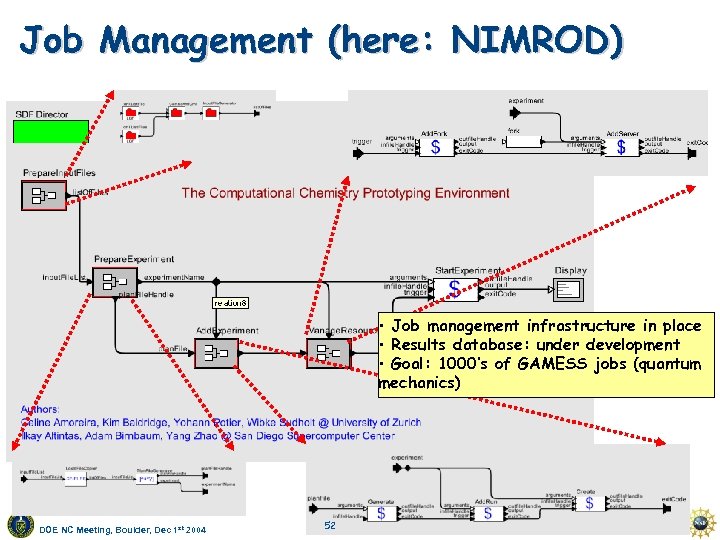 Job Management (here: NIMROD) • Job management infrastructure in place • Results database: under development • Goal: 1000’s of GAMESS jobs (quantum mechanics) DOE NC Meeting, Boulder, Dec 1 st 2004 52 Semantic Technologies in SDM, B. Ludäscher
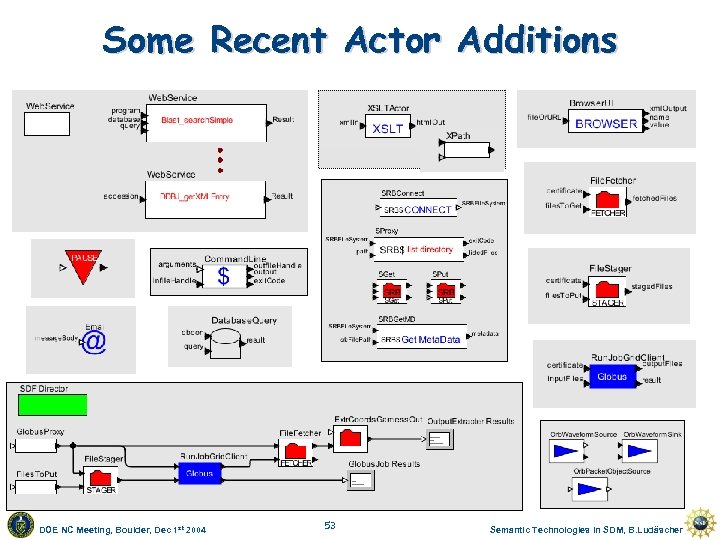 Some Recent Actor Additions DOE NC Meeting, Boulder, Dec 1 st 2004 53 Semantic Technologies in SDM, B. Ludäscher
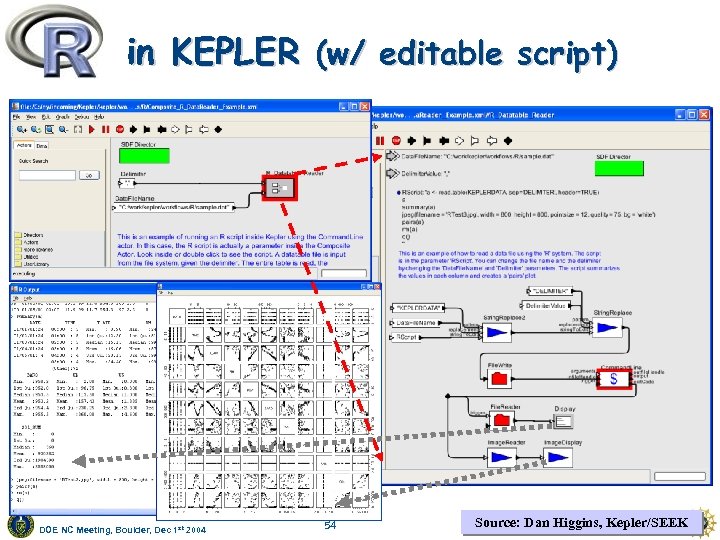 in KEPLER (w/ editable script) DOE NC Meeting, Boulder, Dec 1 st 2004 54 Source: Dan Higgins, SDM, B. Ludäscher Kepler/SEEK Semantic Technologies in
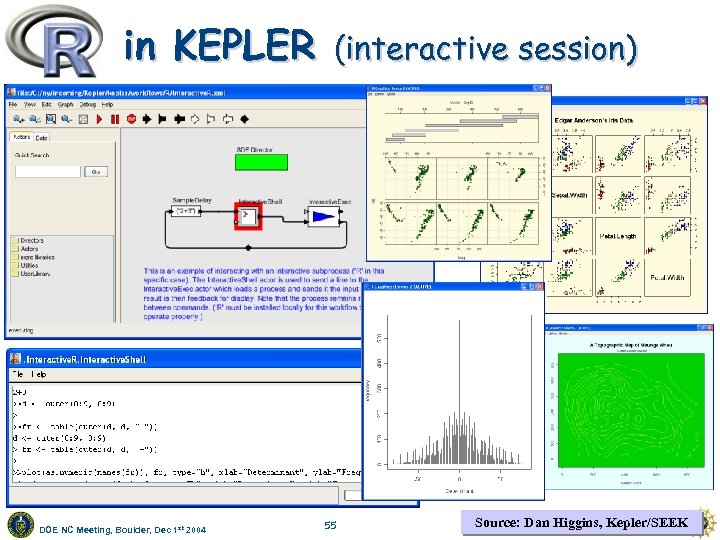 in KEPLER DOE NC Meeting, Boulder, Dec 1 st 2004 (interactive session) 55 Source: Dan Higgins, SDM, B. Ludäscher Kepler/SEEK Semantic Technologies in
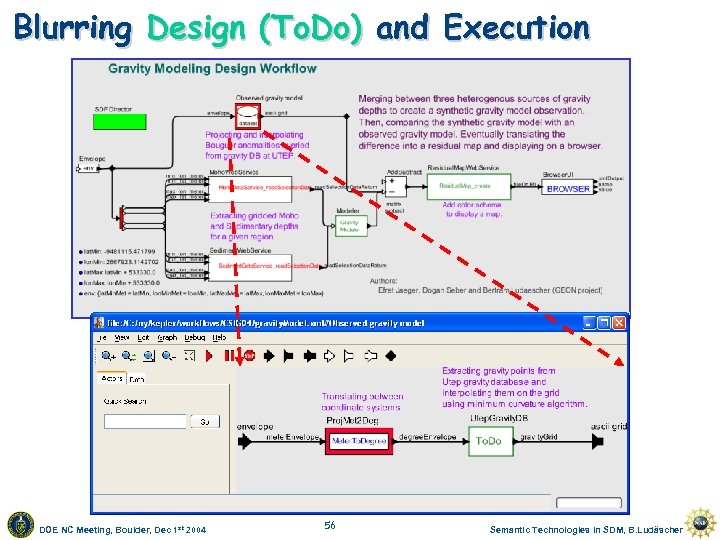 Blurring Design (To. Do) and Execution DOE NC Meeting, Boulder, Dec 1 st 2004 56 Semantic Technologies in SDM, B. Ludäscher
 Some Scientific Workflow Challenges • Typical Features – – – – data-intensive and/or compute-intensive plumbing-intensive (consecutive web services won’t fit) dataflow-oriented distributed (remote data, remote processing) user-interaction “in the middle”, … … vs. (C-z; bg; fg)-ing (“detach” and reconnect) advanced programming constructs (map(f), zip, takewhile, …) – logging, provenance, “registering back” (intermediate) products… DOE NC Meeting, Boulder, Dec 1 st 2004 57 Semantic Technologies in SDM, B. Ludäscher
 Scientific Workflows & Semantics • Registering data to ontologies: semantic types (in addition to structural data types) • Smarter data set discovery & integration • Now also: – Smarter workflow design – More “intelligent” (semantics-aware) component composition – Improved (re-)usability of data, services (actors), and workflows – Given semantic type of my input ports, what other data sets / actors produce such input DOE NC Meeting, Boulder, Dec 1 st 2004 58 Semantic Technologies in SDM, B. Ludäscher
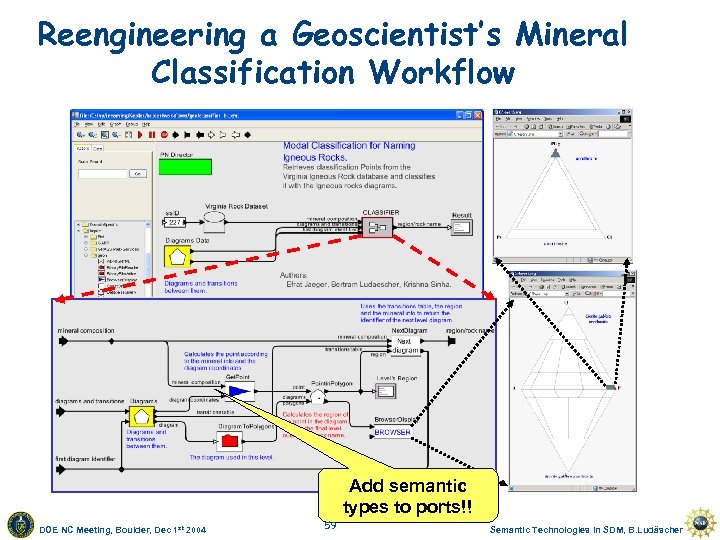 Reengineering a Geoscientist’s Mineral Classification Workflow Add semantic types to ports!! DOE NC Meeting, Boulder, Dec 1 st 2004 59 Semantic Technologies in SDM, B. Ludäscher
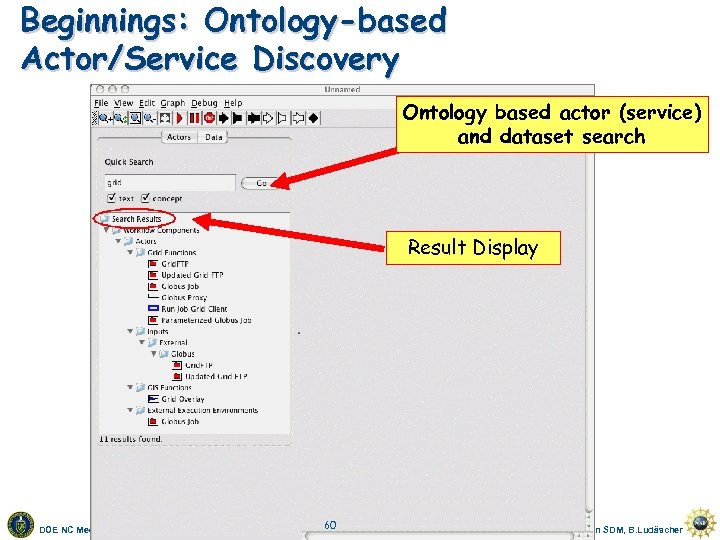 Beginnings: Ontology-based Actor/Service Discovery Ontology based actor (service) and dataset search Result Display DOE NC Meeting, Boulder, Dec 1 st 2004 60 Semantic Technologies in SDM, B. Ludäscher
 Semantics & Scientific Workflows Data comes from heterogeneous sources – – Real-world observations Spatial-temporal contexts Collection/measurement protocols and procedures Many representations for the same information (count, area, density) – Schematically heterogeneous Data discovered and “synthesized” manually Hard to reuse/repurpose existing analytical steps (another form of heterogeneity) DOE NC Meeting, Boulder, Dec 1 st 2004 61 Semantic Technologies in SDM, B. Ludäscher
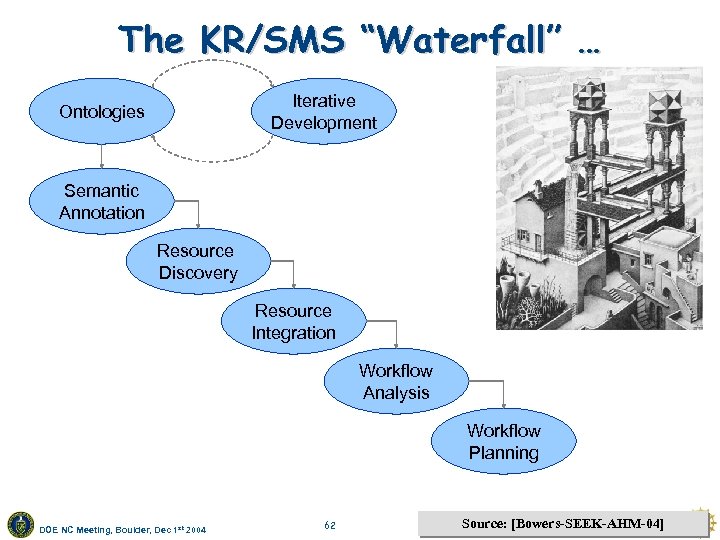 The KR/SMS “Waterfall” … Iterative Development Ontologies Semantic Annotation Resource Discovery Resource Integration Workflow Analysis Workflow Planning DOE NC Meeting, Boulder, Dec 1 st 2004 62 Source: [Bowers-SEEK-AHM-04] Semantic Technologies in SDM, B. Ludäscher
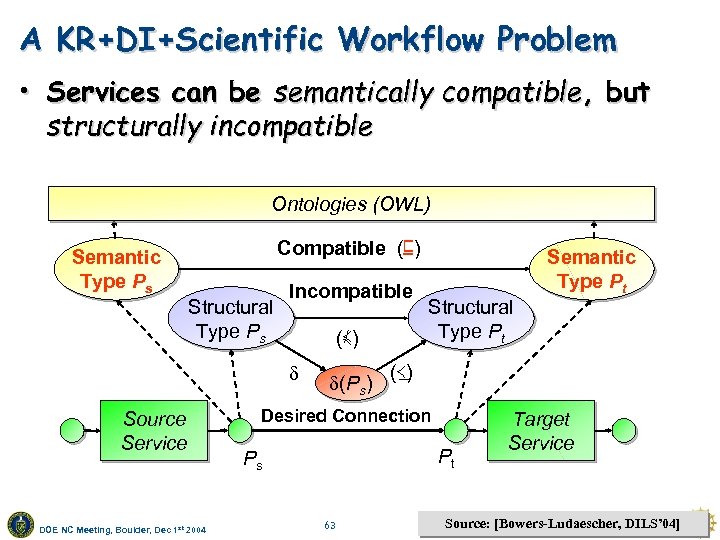 A KR+DI+Scientific Workflow Problem • Services can be semantically compatible, but structurally incompatible Ontologies (OWL) Semantic Type Ps Compatible (⊑) Structural Type Ps Incompatible (⋠) Source Service DOE NC Meeting, Boulder, Dec 1 st 2004 (Ps) Structural Type Pt (≺) Desired Connection Pt Ps 63 Semantic Type Pt Target Service Source: Semantic Technologies in SDM, DILS’ 04] [Bowers-Ludaescher, B. Ludäscher
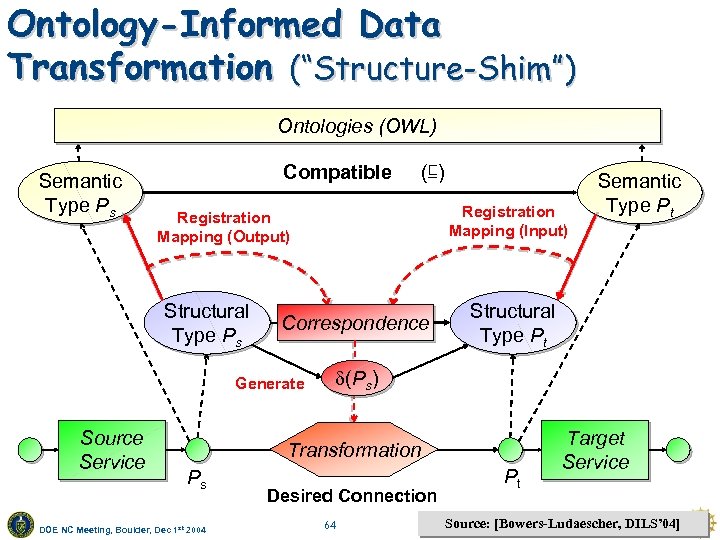 Ontology-Informed Data Transformation (“Structure-Shim”) Ontologies (OWL) Semantic Type Ps Compatible Registration Mapping (Input) Registration Mapping (Output) Structural Type Ps Correspondence Generate Source Service (⊑) Structural Type Pt (Ps) Transformation Ps DOE NC Meeting, Boulder, Dec 1 st 2004 Semantic Type Pt Desired Connection 64 Pt Target Service Source: Semantic Technologies in SDM, DILS’ 04] [Bowers-Ludaescher, B. Ludäscher
 Outline • Scientific Data Integration • Scientific Workflow Management • Musings & Conclusions DOE NC Meeting, Boulder, Dec 1 st 2004 65 Semantic Technologies in SDM, B. Ludäscher
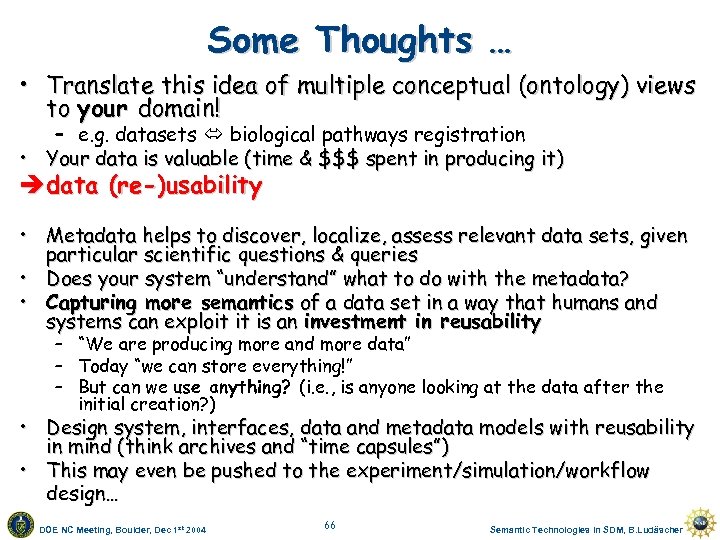 Some Thoughts … • Translate this idea of multiple conceptual (ontology) views to your domain! – e. g. datasets biological pathways registration • Your data is valuable (time & $$$ spent in producing it) data (re-)usability • Metadata helps to discover, localize, assess relevant data sets, given particular scientific questions & queries • Does your system “understand” what to do with the metadata? • Capturing more semantics of a data set in a way that humans and systems can exploit it is an investment in reusability – “We are producing more and more data” – Today “we can store everything!” – But can we use anything? (i. e. , is anyone looking at the data after the initial creation? ) • Design system, interfaces, data and metadata models with reusability in mind (think archives and “time capsules”) • This may even be pushed to the experiment/simulation/workflow design… DOE NC Meeting, Boulder, Dec 1 st 2004 66 Semantic Technologies in SDM, B. Ludäscher
 The Future • We start to see the benefits of semantic technologies in scientific data management – BTW: semantic technologies have been there for a while! • think conceptual models, ER diagrams, … • or Gottlob Frege (German mathematician, logician, philosopher; 1848 -1925) • Today: momentum through “Semantic Web”, “Semantic Grid” • Where will semantics lead us in 10, 20, 50 years? DOE NC Meeting, Boulder, Dec 1 st 2004 67 Semantic Technologies in SDM, B. Ludäscher
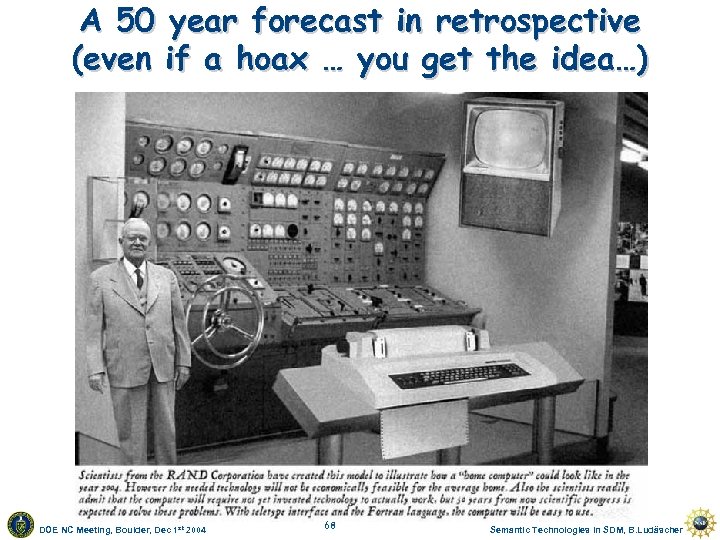 A 50 year forecast in retrospective (even if a hoax … you get the idea…) DOE NC Meeting, Boulder, Dec 1 st 2004 68 Semantic Technologies in SDM, B. Ludäscher
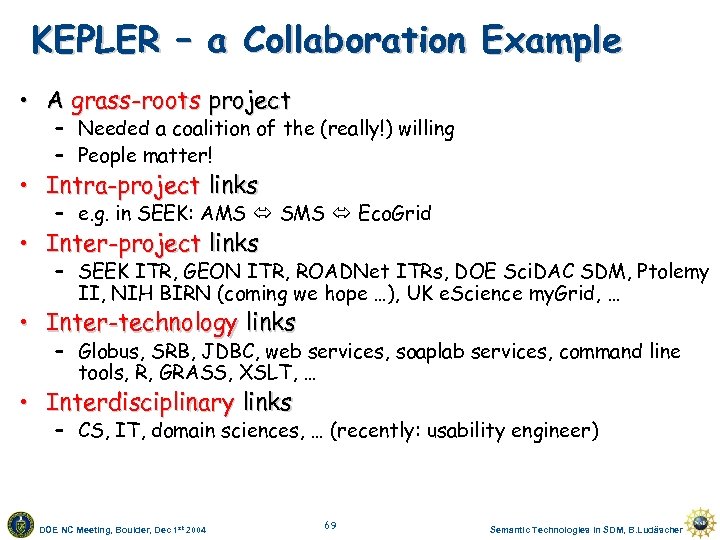 KEPLER – a Collaboration Example • A grass-roots project – Needed a coalition of the (really!) willing – People matter! • Intra-project links – e. g. in SEEK: AMS SMS Eco. Grid • Inter-project links – SEEK ITR, GEON ITR, ROADNet ITRs, DOE Sci. DAC SDM, Ptolemy II, NIH BIRN (coming we hope …), UK e. Science my. Grid, … • Inter-technology links – Globus, SRB, JDBC, web services, soaplab services, command line tools, R, GRASS, XSLT, … • Interdisciplinary links – CS, IT, domain sciences, … (recently: usability engineer) DOE NC Meeting, Boulder, Dec 1 st 2004 69 Semantic Technologies in SDM, B. Ludäscher
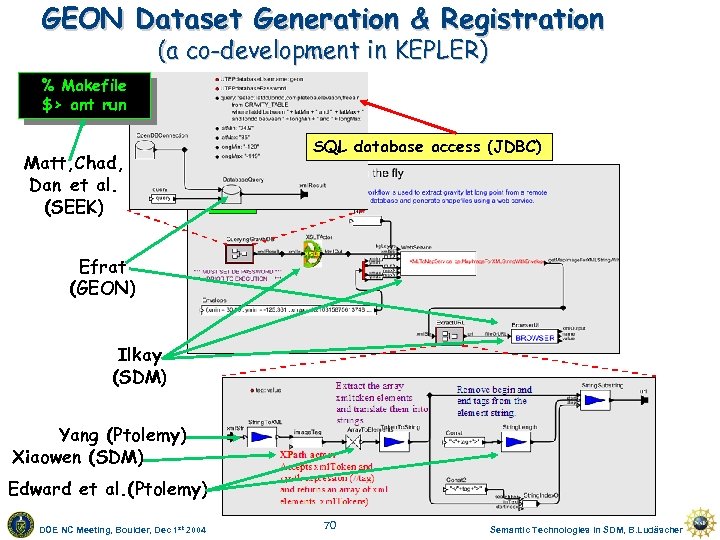 GEON Dataset Generation & Registration (a co-development in KEPLER) % Makefile $> ant run Matt, Chad, Dan et al. (SEEK) SQL database access (JDBC) Efrat (GEON) Ilkay (SDM) Yang (Ptolemy) Xiaowen (SDM) Edward et al. (Ptolemy) DOE NC Meeting, Boulder, Dec 1 st 2004 70 Semantic Technologies in SDM, B. Ludäscher
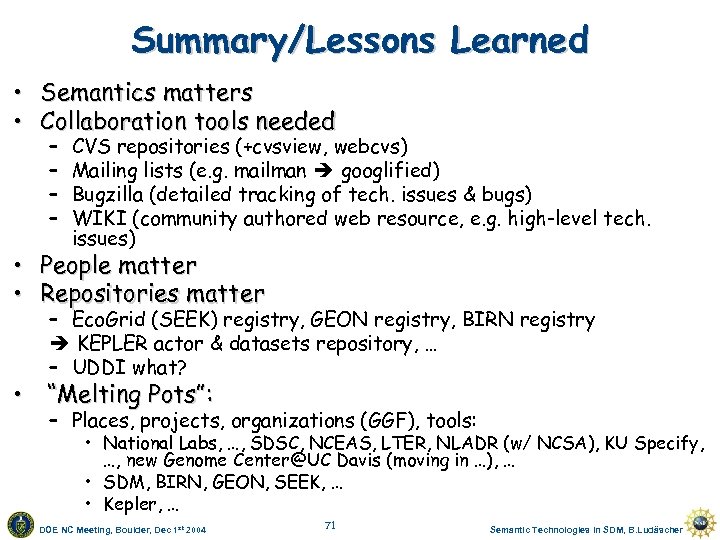 Summary/Lessons Learned • Semantics matters • Collaboration tools needed – – CVS repositories (+cvsview, webcvs) Mailing lists (e. g. mailman googlified) Bugzilla (detailed tracking of tech. issues & bugs) WIKI (community authored web resource, e. g. high-level tech. issues) • People matter • Repositories matter – Eco. Grid (SEEK) registry, GEON registry, BIRN registry KEPLER actor & datasets repository, … – UDDI what? • “Melting Pots”: – Places, projects, organizations (GGF), tools: • National Labs, …, SDSC, NCEAS, LTER, NLADR (w/ NCSA), KU Specify, …, new Genome Center@UC Davis (moving in …), … • SDM, BIRN, GEON, SEEK, … • Kepler, … DOE NC Meeting, Boulder, Dec 1 st 2004 71 Semantic Technologies in SDM, B. Ludäscher
 Q & A DOE NC Meeting, Boulder, Dec 1 st 2004 72 Semantic Technologies in SDM, B. Ludäscher
 Further Reading under review – available upon request from ludaesch@sdsc. edu DOE NC Meeting, Boulder, Dec 1 st 2004 73 Semantic Technologies in SDM, B. Ludäscher
 Related Publications • Semantic Data Registration and Integration • • • On Integrating Scientific Resources through Semantic Registration, S. Bowers, K. Lin, and B. Ludäscher, 16 th International Conference on Scientific and Statistical Database Management (SSDBM'04), 21 -23 June 2004, Santorini Island, Greece. A System for Semantic Integration of Geologic Maps via Ontologies, K. Lin and B. Ludäscher. In Semantic Web Technologies for Searching and Retrieving Scientific Data (SCISW), Sanibel Island, Florida, 2003. Towards a Generic Framework for Semantic Registration of Scientific Data , S. Bowers and B. Ludäscher. In Semantic Web Technologies for Searching and Retrieving Scientific Data (SCISW), Sanibel Island, Florida, 2003. The Role of XML in Mediated Data Integration Systems with Examples from Geological (Map) Data Interoperability, B. Brodaric, B. Ludäscher, and K. Lin. In Geological Society of America (GSA) Annual Meeting, volume 35(6), November 2003. Semantic Mediation Services in Geologic Data Integration: A Case Study from the GEON Grid, K. Lin, B. Ludäscher, B. Brodaric, D. Seber, C. Baru, and K. A. Sinha. In Geological Society of America (GSA) Annual Meeting, volume 35(6), November 2003. • Query Planning and Rewriting • • • Processing First-Order Queries under Limited Access Patterns, Alan Nash and B. Ludäscher, Proc. 23 rd ACM Symposium on Principles of Database Systems (PODS'04) Paris, France, June 2004. Processing Unions of Conjunctive Queries with Negation under Limited Access Patterns , Alan Nash and B. Ludäscher. , 9 th Intl. Conference on Extending Database Technology (EDBT'04) Heraklion, Crete, Greece, March 2004, LNCS 2992. Web Service Composition Through Declarative Queries: The Case of Conjunctive Queries with Union and Negation, B. Ludäscher and Alan Nash. Research abstract (poster), 20 th Intl. Conference on Data Engineering (ICDE'04) Boston, IEEE Computer Society, April 2004. DOE NC Meeting, Boulder, Dec 1 st 2004 74 Semantic Technologies in SDM, B. Ludäscher
 Related Publications • Scientific Workflows • • Kepler: An Extensible System for Design and Execution of Scientific Workflows , I. Altintas, C. Berkley, E. Jaeger, M. Jones, B. Ludäscher, S. Mock, 16 th International Conference on Scientific and Statistical Database Management (SSDBM'04), 21 -23 June 2004, Santorini Island, Greece. Kepler: Towards a Grid-Enabled System for Scientific Workflows, Ilkay Altintas, Chad Berkley, Efrat Jaeger, Matthew Jones, Bertram Ludäscher, Steve Mock, Workflow in Grid Systems (GGF 10), Berlin, March 9 th, 2004. An Ontology-Driven Framework for Data Transformation in Scientific Workflows , S. Bowers and B. Ludäscher, Intl. Workshop on Data Integration in the Life Sciences (DILS'04), March 25 -26, 2004 Leipzig, Germany, LNCS 2994. A Web Service Composition and Deployment Framework for Scientific Workflows, I. Altintas, E. Jaeger, K. Lin, B. Ludaescher, A. Memon, In the 2 nd Intl. Conference on Web Services (ICWS), San Diego, California, July 2004. DOE NC Meeting, Boulder, Dec 1 st 2004 75 Semantic Technologies in SDM, B. Ludäscher