 Скачать презентацию Semantic Management of Web Services Steffen Staab Prague
fb441e9b4d2c5286d6961fe98c63394b.ppt
- Количество слайдов: 50



Semantic Management of Web Services Steffen Staab Prague May 19, 2005 Steffen Staab ISWeb – Information Systems & Semantic Web
Hopes • Describe a goal – let the work be done by Semantic Web Services (previously „agents“, „PSMs“, …) • Projects like – EU: DIP, ASG, Ibrow, … – IBM India: see WWW 2005 – US: OWL-S Steffen Staab ISWeb – Information Systems & Semantic Web
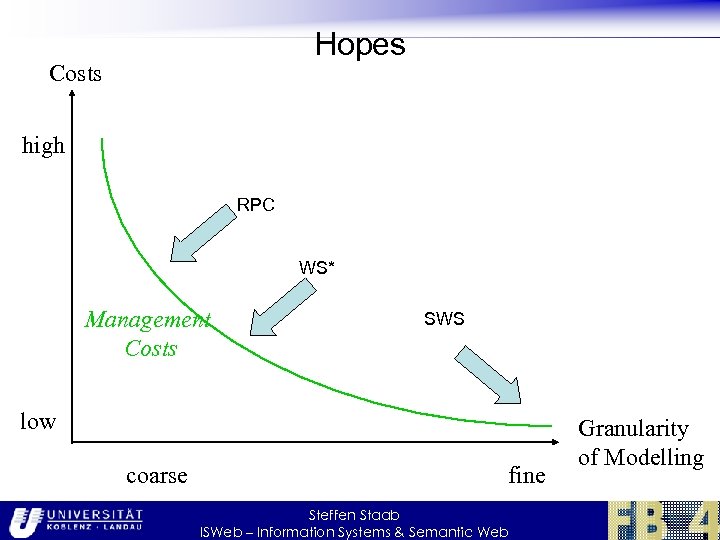
Hopes Costs high RPC WS* Management Costs SWS low coarse fine Steffen Staab ISWeb – Information Systems & Semantic Web Granularity of Modelling
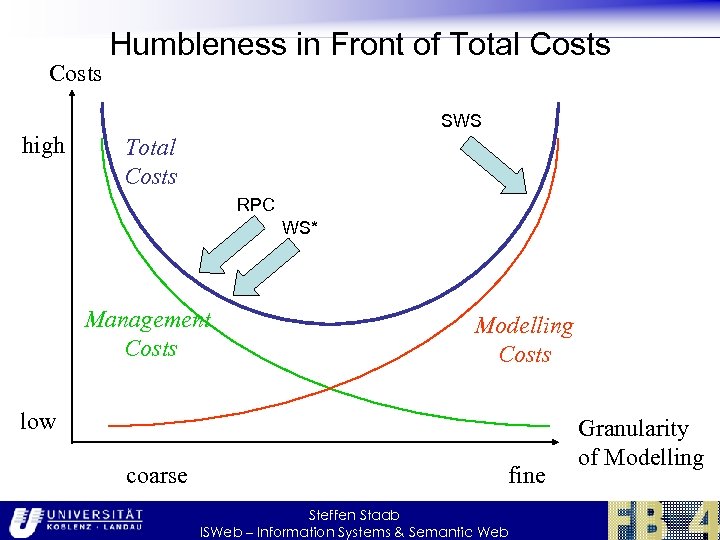
Costs Humbleness in Front of Total Costs SWS high Total Costs RPC WS* Management Costs Modelling Costs low coarse fine Steffen Staab ISWeb – Information Systems & Semantic Web Granularity of Modelling
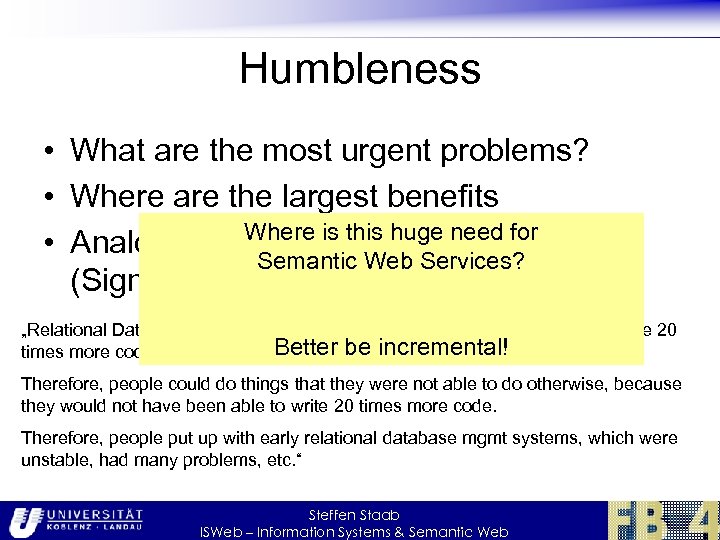
Humbleness • What are the most urgent problems? • Where are the largest benefits Where is this • Analogy/Pseudoquote huge need for from Mohan Semantic Web Services? (Sigmod Record, 2004): „Relational Databases were so successful, because people would have to write 20 Better be times more code if they would not use them. incremental! Therefore, people could do things that they were not able to do otherwise, because they would not have been able to write 20 times more code. Therefore, people put up with early relational database mgmt systems, which were unstable, had many problems, etc. “ Steffen Staab ISWeb – Information Systems & Semantic Web
Hope, Humbleness and Hope again… • Web Services • Middleware » They are a huge mess! » Though they have clear conceptual underpinnings, they are complex beasts! » Semantic Technologies can do something for them! » Let‘s backtrack how! Steffen Staab ISWeb – Information Systems & Semantic Web
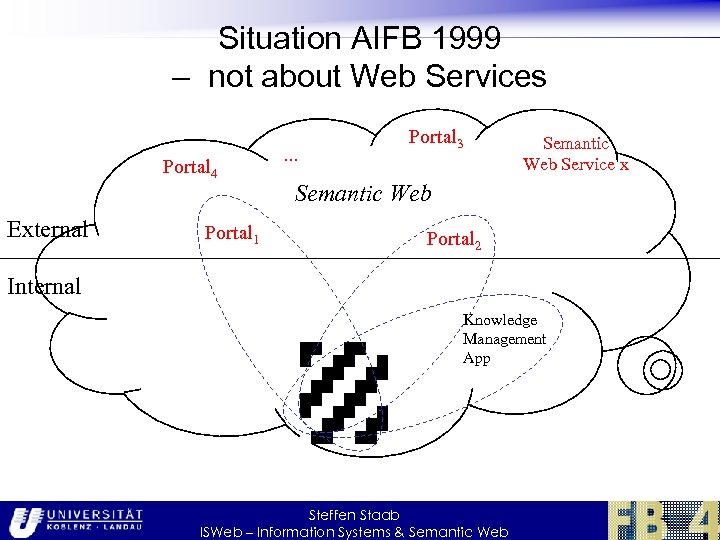
Situation AIFB 1999 – not about Web Services Portal 4 External Portal 1 . . . Portal 3 Semantic Web Service x Semantic Web Portal 2 Internal Knowledge Management App Steffen Staab ISWeb – Information Systems & Semantic Web
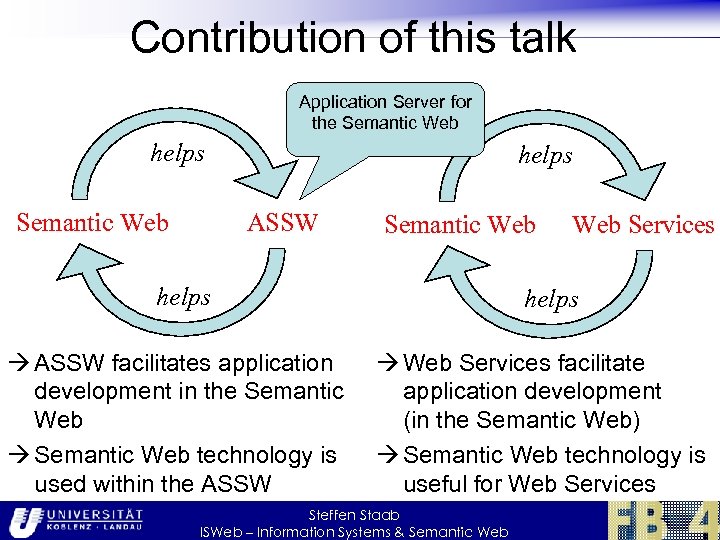
Contribution of this talk Application Server for the Semantic Web helps ASSW Semantic Web helps à ASSW facilitates application development in the Semantic Web à Semantic Web technology is used within the ASSW Web Services helps à Web Services facilitate application development (in the Semantic Web) à Semantic Web technology is useful for Web Services Steffen Staab ISWeb – Information Systems & Semantic Web
Agenda • Application Server – Semantic Web for Application Server • Problem • Ontology • Use Cases – Development Time – Run Time • • • Ontology Design Architecture Implementation Relationship to MDA Conclusion – App Server for Semantic Web • Semantic Management of Web Services Steffen Staab ISWeb – Information Systems & Semantic Web
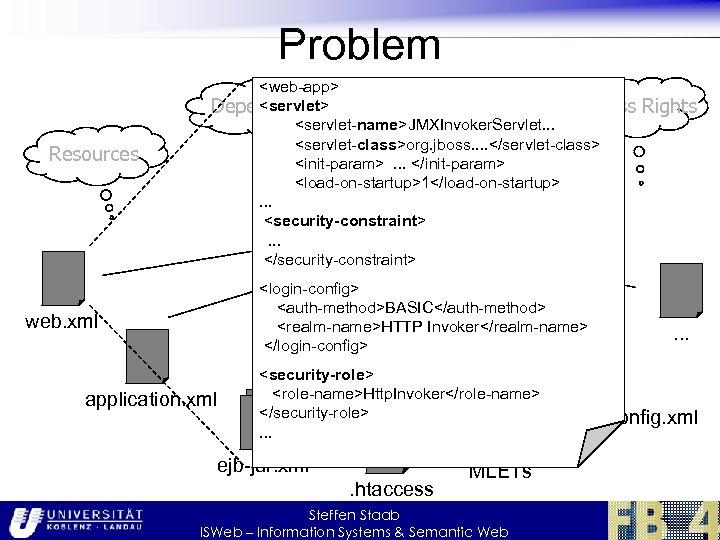
Problem Resources <web-app> <servlet> Dependencies Access <servlet-name>JMXInvoker. Servlet. . . <servlet-class>org. jboss. . </servlet-class> <init-param>. . . </init-param> Users <load-on-startup>1</load-on-startup>. . . <security-constraint>. . . </security-constraint> Complexity in Application Servers. . . Multitude of XML-DTDs Ontology <login-config> <auth-method>BASIC</auth-method> <realm-name>HTTP Invoker</realm-name> </login-config> web. xml application. xml <security-role> <role-name>Http. Invoker</role-name> </security-role>. . . ejb-jar. xml. htaccess MLETs Steffen Staab ISWeb – Information Systems & Semantic Web Rights . . . login-config. xml
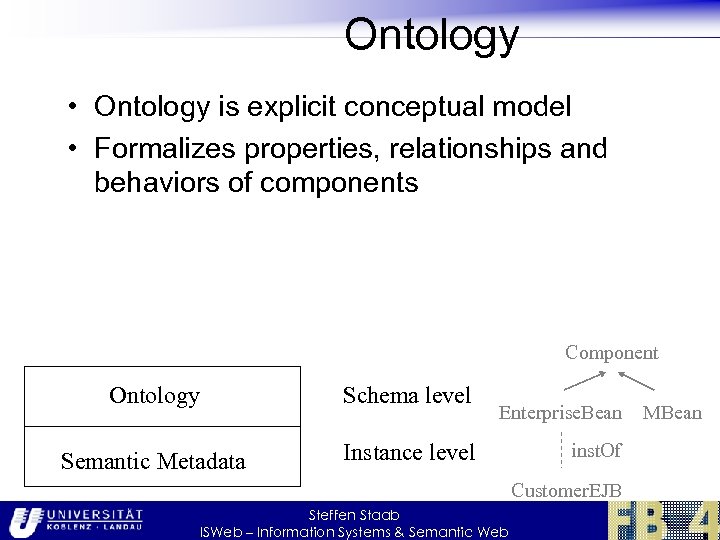
Ontology • Ontology is explicit conceptual model • Formalizes properties, relationships and behaviors of components • Aims at conceptualizing „shared“ understanding • Logics-based formal semantics Component • Axioms Ontology Schema level Enterprise. Bean MBean • Allows reasoning inst. Of Instance level Semantic Metadata • Allows conceptual querying Customer. EJB Steffen Staab ISWeb – Information Systems & Semantic Web
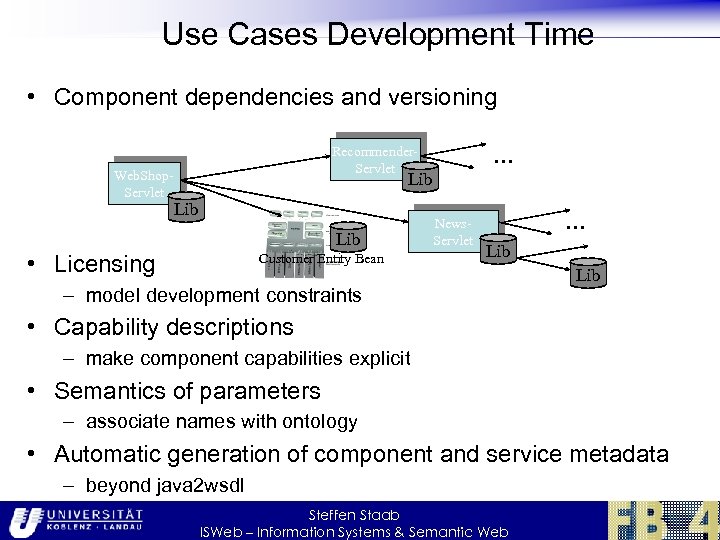
Use Cases Development Time • Component dependencies and versioning . . . Recommender. Servlet Web. Shop. Servlet Lib Lib • Licensing Customer Entity Bean News. Servlet . . . Lib – model development constraints Lib • Capability descriptions – make component capabilities explicit • Semantics of parameters – associate names with ontology • Automatic generation of component and service metadata – beyond java 2 wsdl Steffen Staab ISWeb – Information Systems & Semantic Web
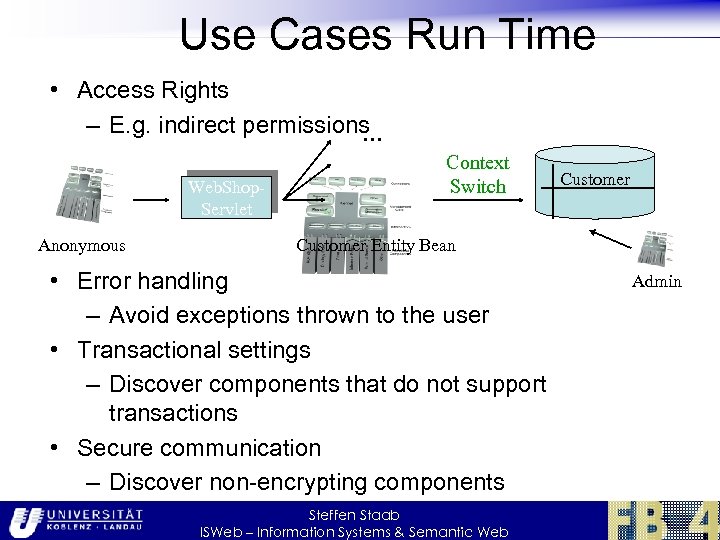
Use Cases Run Time • Access Rights – E. g. indirect permissions. . . Web. Shop. Servlet Anonymous Context Switch Customer Entity Bean • Error handling – Avoid exceptions thrown to the user • Transactional settings – Discover components that do not support transactions • Secure communication – Discover non-encrypting components Steffen Staab ISWeb – Information Systems & Semantic Web Admin
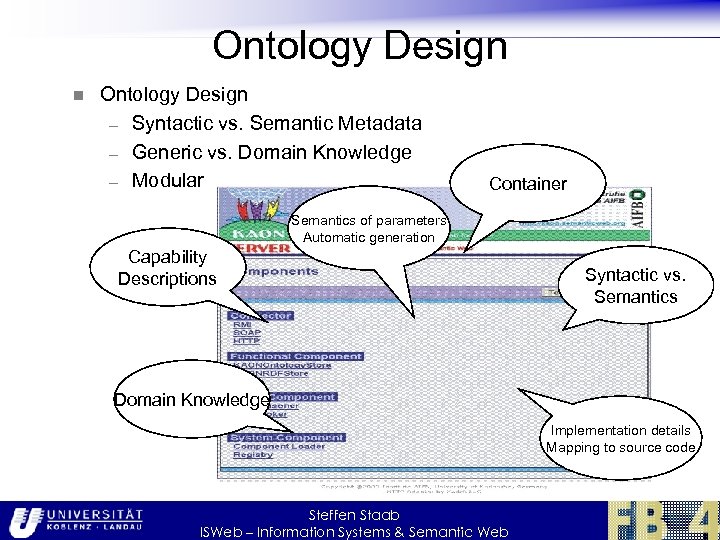
Ontology Design n Ontology Design – Syntactic vs. Semantic Metadata – Generic vs. Domain Knowledge – Modular Container Semantics of parameters Automatic generation Capability Descriptions Syntactic vs. Semantics Domain Knowledge Implementation details Mapping to source code Steffen Staab ISWeb – Information Systems & Semantic Web
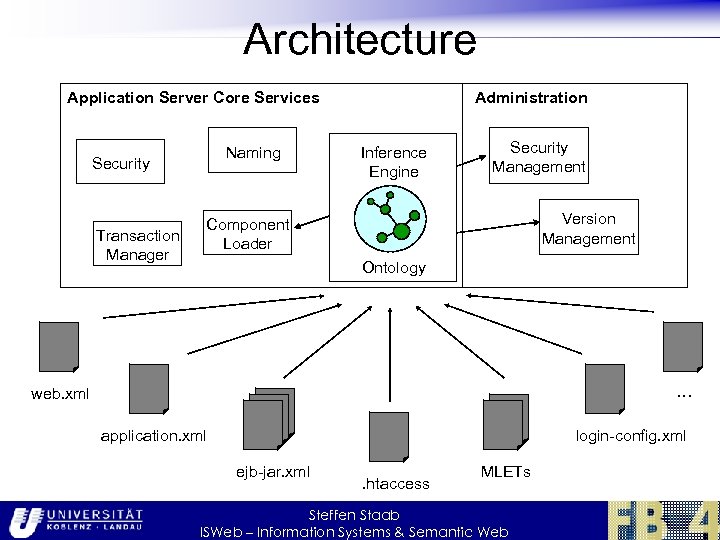
Architecture Application Server Core Services Naming Security Transaction Manager Administration Inference Engine Security Management Version Management Component Loader Ontology . . . web. xml application. xml login-config. xml ejb-jar. xml . htaccess MLETs Steffen Staab ISWeb – Information Systems & Semantic Web
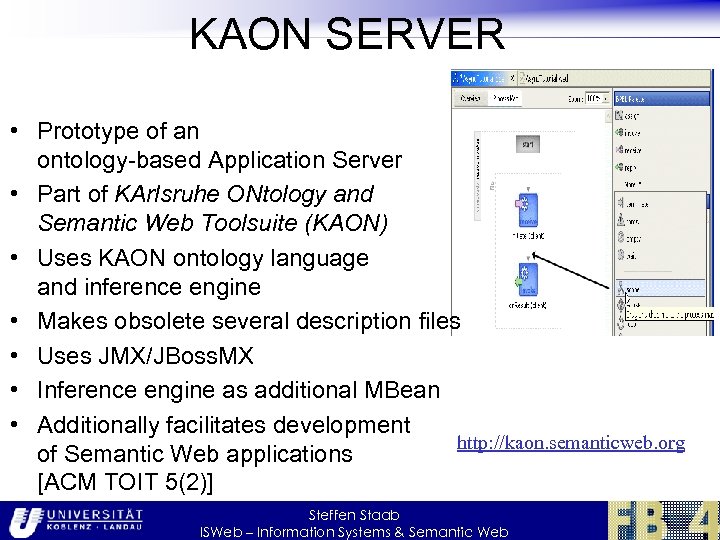
KAON SERVER • Prototype of an ontology-based Application Server • Part of KArlsruhe ONtology and Semantic Web Toolsuite (KAON) • Uses KAON ontology language and inference engine • Makes obsolete several description files • Uses JMX/JBoss. MX • Inference engine as additional MBean • Additionally facilitates development http: //kaon. semanticweb. org of Semantic Web applications [ACM TOIT 5(2)] Steffen Staab ISWeb – Information Systems & Semantic Web
Relationship to MDA • OMG‘s Model Driven Architecture • Separates conceptual from implementation concerns • Not applied for run time aspects so far • Lack of formal semantics • No reasoning capability Steffen Staab ISWeb – Information Systems & Semantic Web
Agenda • Application Server – Semantic Web for Application Server – App Server for Semantic Web • Semantic Management of Web Services Steffen Staab ISWeb – Information Systems & Semantic Web
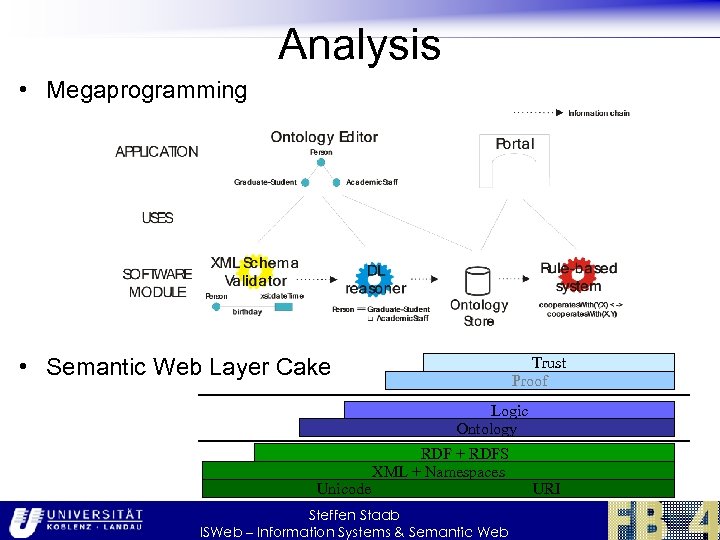
Analysis • Megaprogramming • Semantic Web Layer Cake Trust Proof Logic Ontology RDF + RDFS XML + Namespaces Unicode Steffen Staab ISWeb – Information Systems & Semantic Web URI
Requirements 1. Flexible handling of modules Extensibility, Dependencies, … 2. Static part of the Semantic Web Language Support, Ontology Mapping, … 3. Dynamic part of the Semantic Web Finding, Accessing, Modifying and Storing of ontologies Transactions and Rollbacks, Evolution and Versioning, Inferencing and Verification, … 4. Semantic enhancement of the server Component capability descriptions and discovery, Semantic API descriptions, Component classification, automatic generation of semantic web service descriptions, etc. 5. Common Application Server functionality Steffen Staab ISWeb – Information Systems & Semantic Web
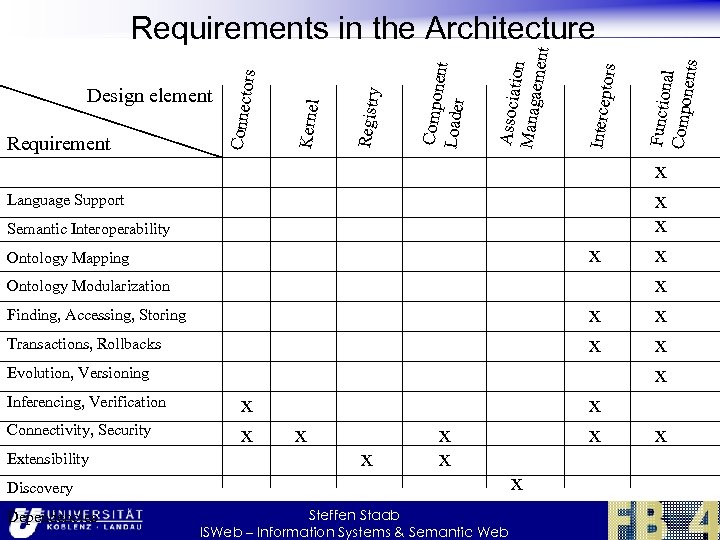
Language Support Semantic Interoperability x Ontology Mapping Ontology Modularization x x Finding, Accessing, Storing Transactions, Rollbacks Evolution, Versioning Inferencing, Verification Connectivity, Security Extensibility x x x Discovery Dependencies Steffen Staab ISWeb – Information Systems & Semantic Web x x x Function al Compon ents tors Intercep Associat ion Managa ement Compon ent Loader Registry Kernel Requirement Connect Design element ors Requirements in the Architecture x x x x x
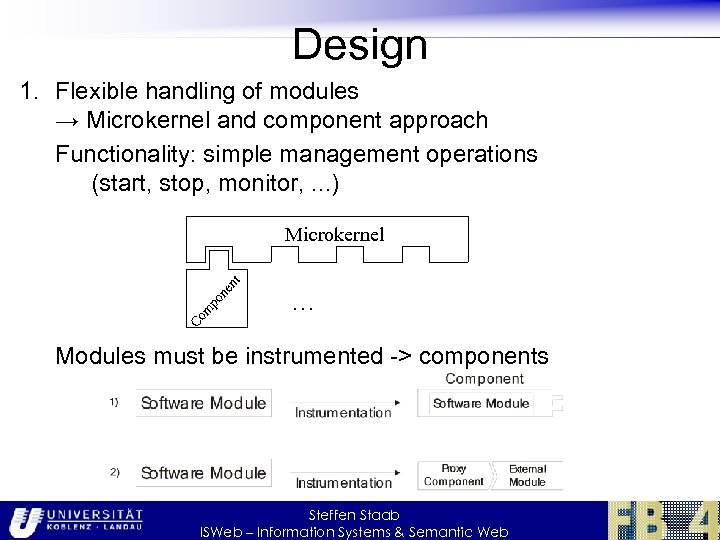
Design 1. Flexible handling of modules → Microkernel and component approach Functionality: simple management operations (start, stop, monitor, . . . ) Co m po ne nt Microkernel . . . Modules must be instrumented -> components Steffen Staab ISWeb – Information Systems & Semantic Web
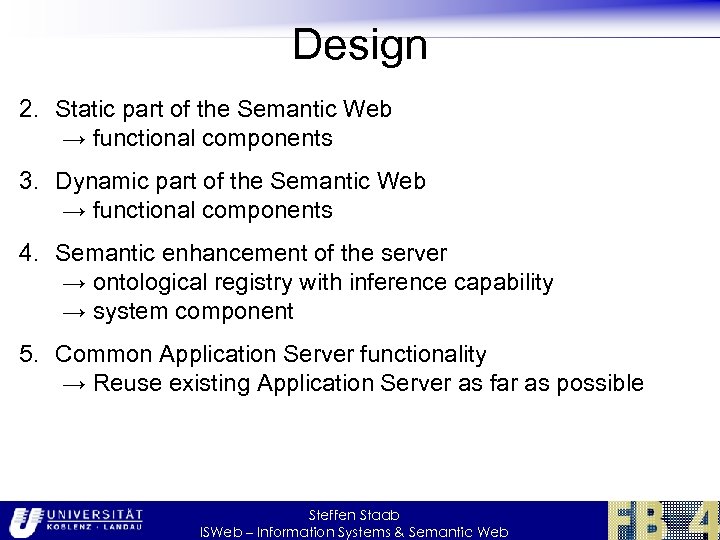
Design 2. Static part of the Semantic Web → functional components 3. Dynamic part of the Semantic Web → functional components 4. Semantic enhancement of the server → ontological registry with inference capability → system component 5. Common Application Server functionality → Reuse existing Application Server as far as possible Steffen Staab ISWeb – Information Systems & Semantic Web
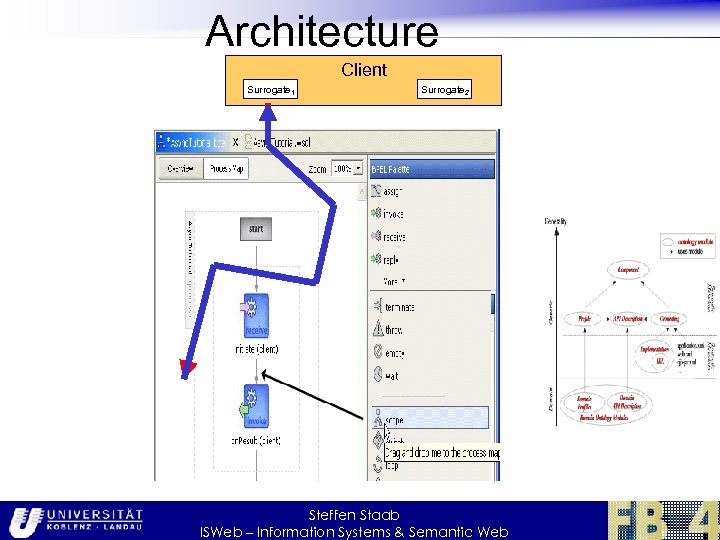
Architecture Client Surrogate 1 Surrogate 2 Steffen Staab ISWeb – Information Systems & Semantic Web
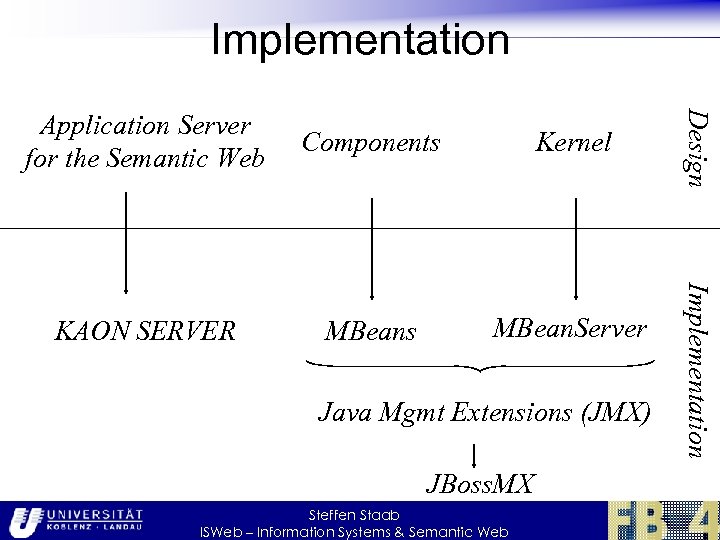
Implementation Kernel KAON SERVER MBeans MBean. Server Java Mgmt Extensions (JMX) JBoss. MX Steffen Staab ISWeb – Information Systems & Semantic Web Implementation Components Design Application Server for the Semantic Web
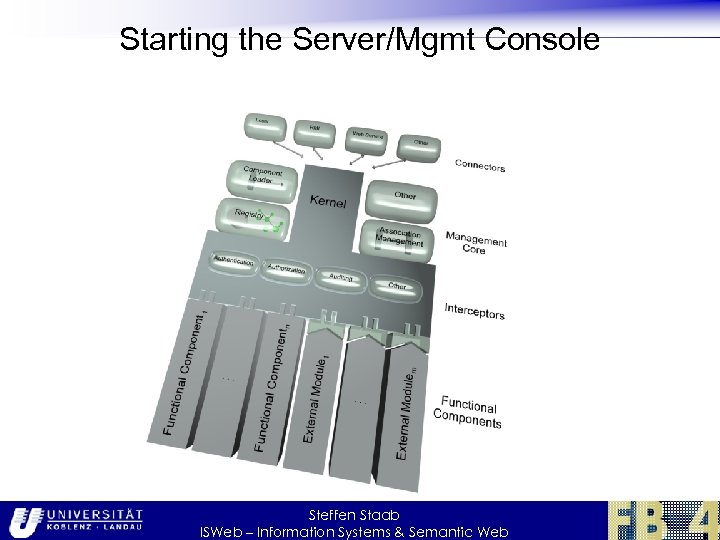
Starting the Server/Mgmt Console Steffen Staab ISWeb – Information Systems & Semantic Web
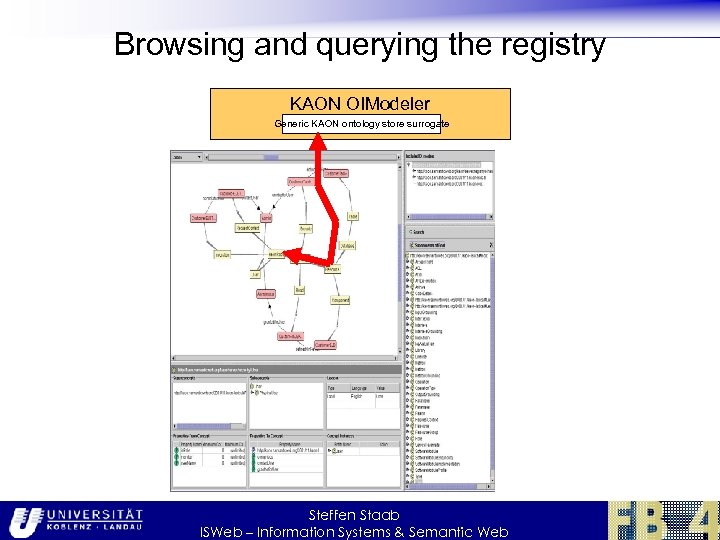
Browsing and querying the registry KAON OIModeler Generic KAON ontology store surrogate Steffen Staab ISWeb – Information Systems & Semantic Web
Browsing and querying the registry KAON OIModeller for browsing and querying the KAON SERVER‘s registry at run-time Steffen Staab ISWeb – Information Systems & Semantic Web
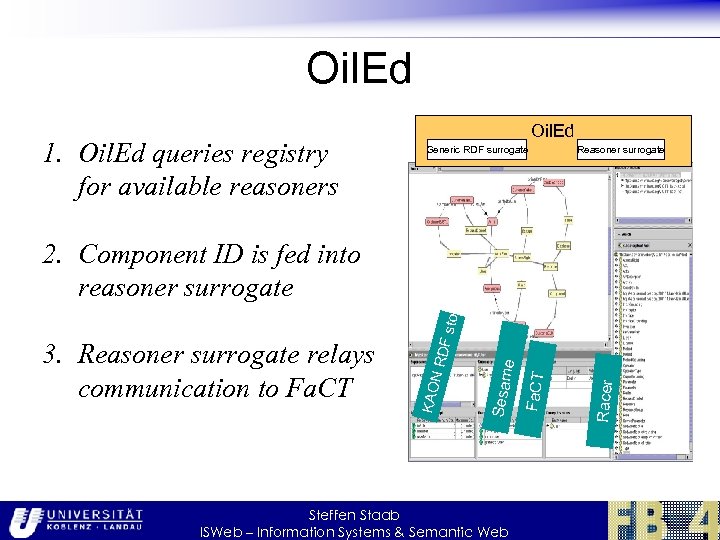
Oil. Ed 1. Oil. Ed queries registry for available reasoners Oil. Ed Generic RDF surrogate Reasoner surrogate Steffen Staab ISWeb – Information Systems & Semantic Web Racer Fa. CT e Sesam 3. Reasoner surrogate relays communication to Fa. CT KAO N RD F sto re 2. Component ID is fed into reasoner surrogate
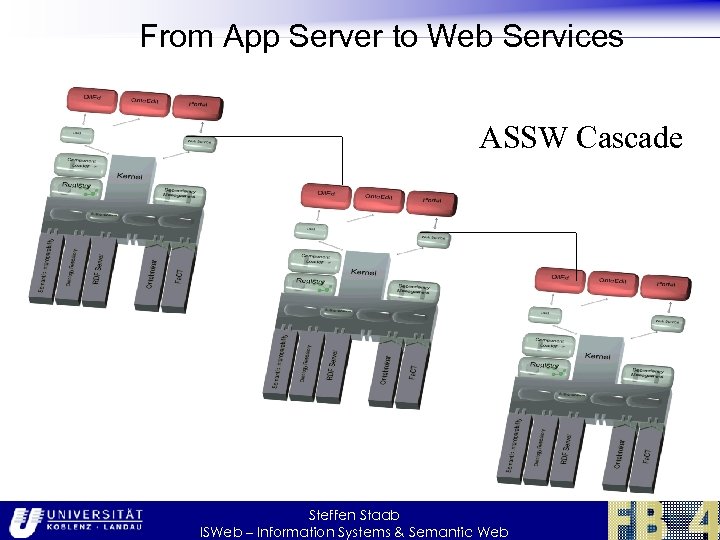
From App Server to Web Services ASSW Cascade Steffen Staab ISWeb – Information Systems & Semantic Web
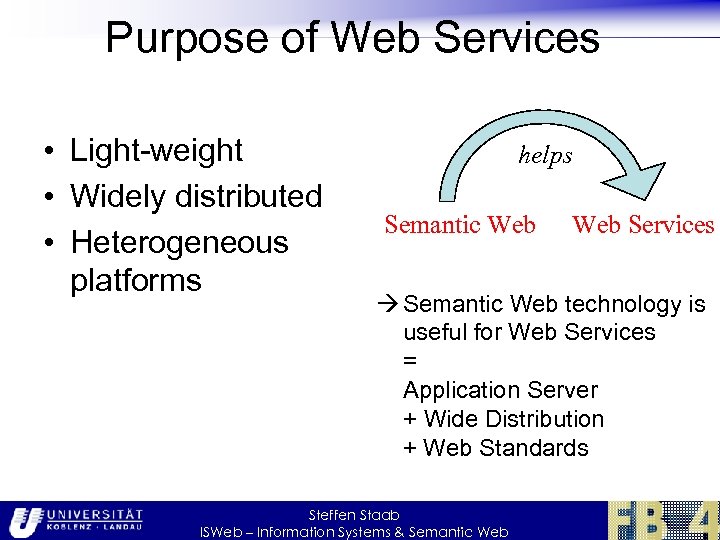
Purpose of Web Services • Light-weight • Widely distributed • Heterogeneous platforms helps Semantic Web Services à Semantic Web technology is useful for Web Services = Application Server + Wide Distribution + Web Standards Steffen Staab ISWeb – Information Systems & Semantic Web
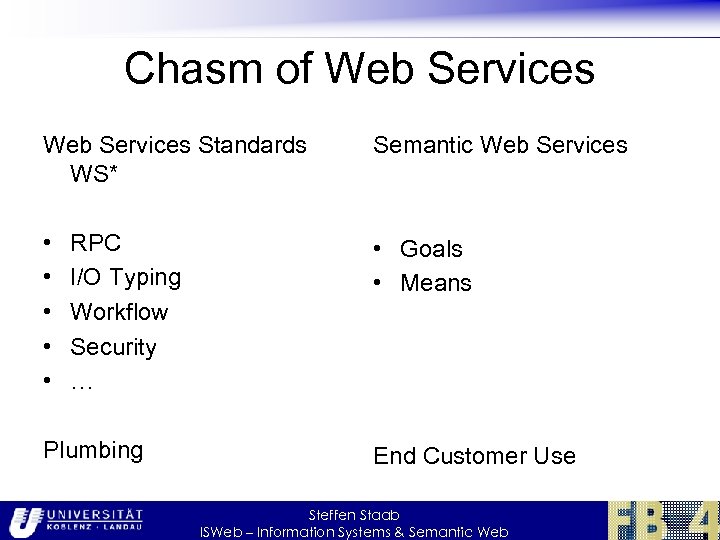
Chasm of Web Services Standards WS* Semantic Web Services • • • Goals • Means RPC I/O Typing Workflow Security … Plumbing End Customer Use Steffen Staab ISWeb – Information Systems & Semantic Web
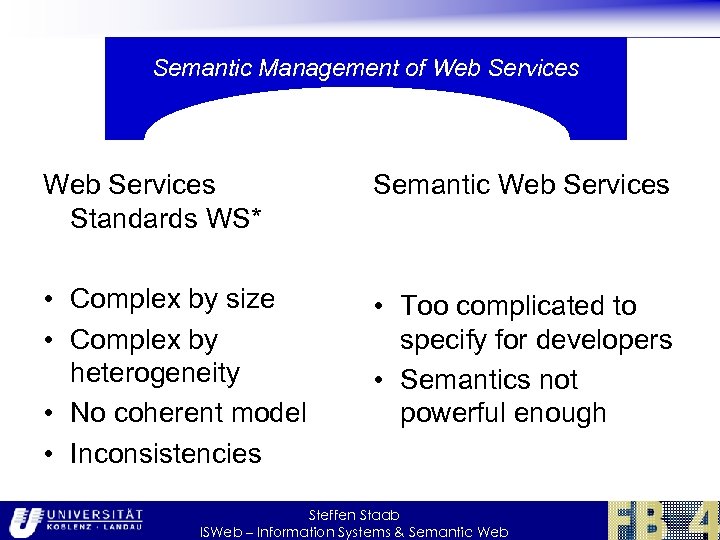
Semantic of Web Services Chasm. Management of Services Web Services Standards WS* Semantic Web Services • Complex by size • Complex by heterogeneity • No coherent model • Inconsistencies • Too complicated to specify for developers • Semantics not powerful enough Steffen Staab ISWeb – Information Systems & Semantic Web
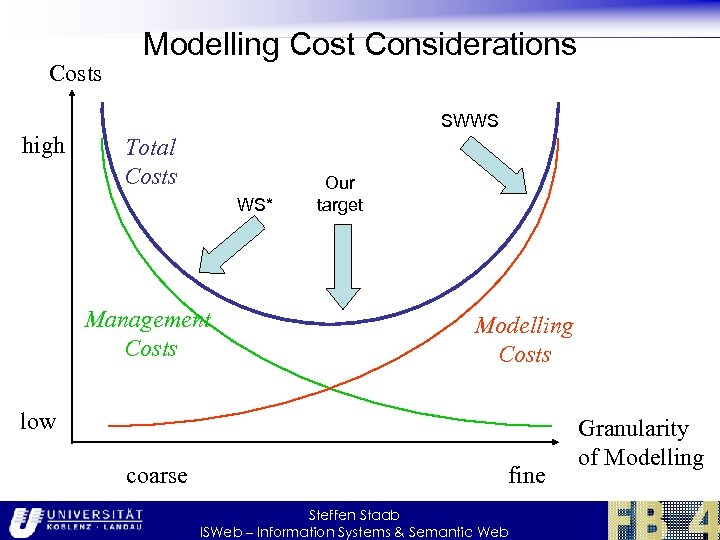
Costs Modelling Cost Considerations SWWS high Total Costs WS* Management Costs Our target Modelling Costs low coarse fine Steffen Staab ISWeb – Information Systems & Semantic Web Granularity of Modelling
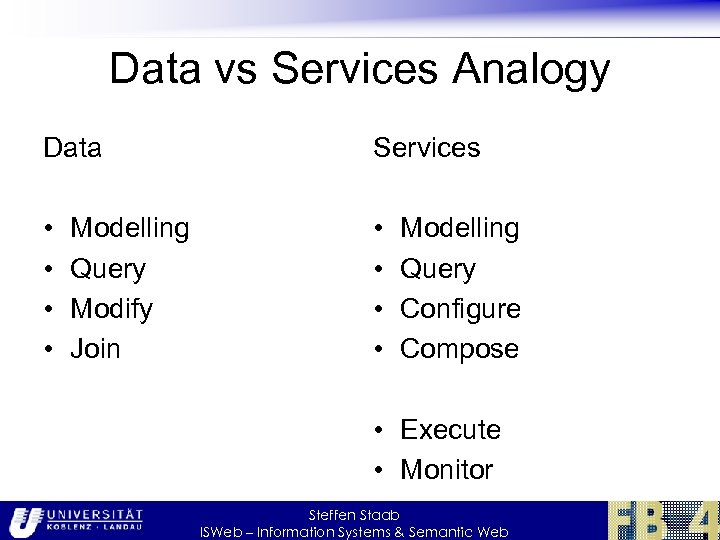
Data vs Services Analogy Data Services • • Modelling Query Modify Join Modelling Query Configure Compose • Execute • Monitor Steffen Staab ISWeb – Information Systems & Semantic Web
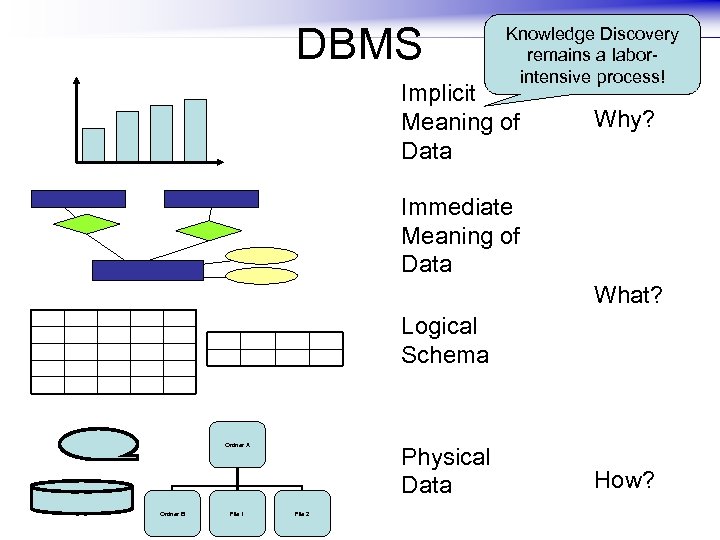
DBMS Knowledge Discovery remains a laborintensive process! Implicit Meaning of Data Why? Immediate Meaning of Data What? Logical Schema Ordner A Ordner B Physical Data Steffen Staab ISWeb – Information Systems & Semantic Web File 1 File 2 How?
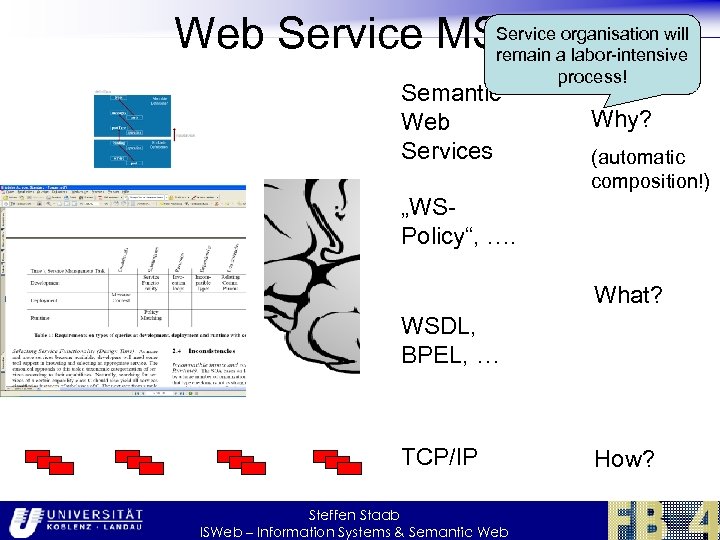
Web Service MSServiceaorganisation will remain labor-intensive Semantic Web Services process! Why? (automatic composition!) „WSPolicy“, …. What? WSDL, BPEL, … TCP/IP Steffen Staab ISWeb – Information Systems & Semantic Web How?
Conclusion from analogy Modelling and use of Web services by manipulation of individual files is an archaic practice – just like managing data by reading and writing individual files! Steffen Staab ISWeb – Information Systems & Semantic Web
WS Management Objectives • Separate „What? “ from „How? “ • Leave „Why? “ to the developer (at least for the moment) • Go beyond simple data manipulation into semantic management in order to capture the immediate meaning of Web services Steffen Staab ISWeb – Information Systems & Semantic Web
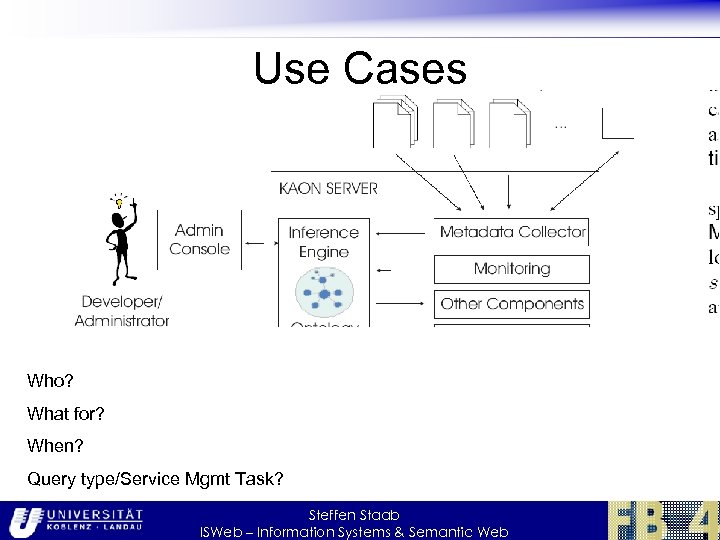
Use Cases Who? What for? When? Query type/Service Mgmt Task? Steffen Staab ISWeb – Information Systems & Semantic Web
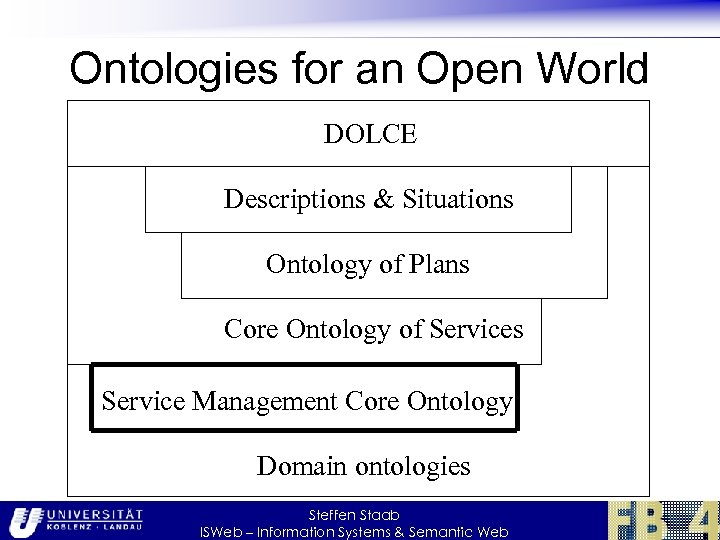
Ontologies for an Open World DOLCE Descriptions & Situations Ontology of Plans Core Ontology of Services Service Management Core Ontology Domain ontologies Steffen Staab ISWeb – Information Systems & Semantic Web
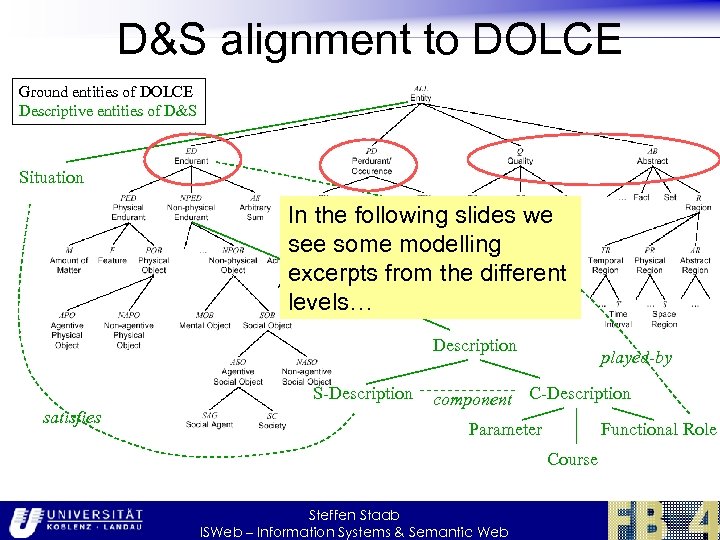
D&S alignment to DOLCE Ground entities of DOLCE Descriptive entities of D&S Situation In the following slides we see some modelling excerpts from the different levels… Description S-Description satisfies played-by component C-Description Parameter Functional Role Course Steffen Staab ISWeb – Information Systems & Semantic Web
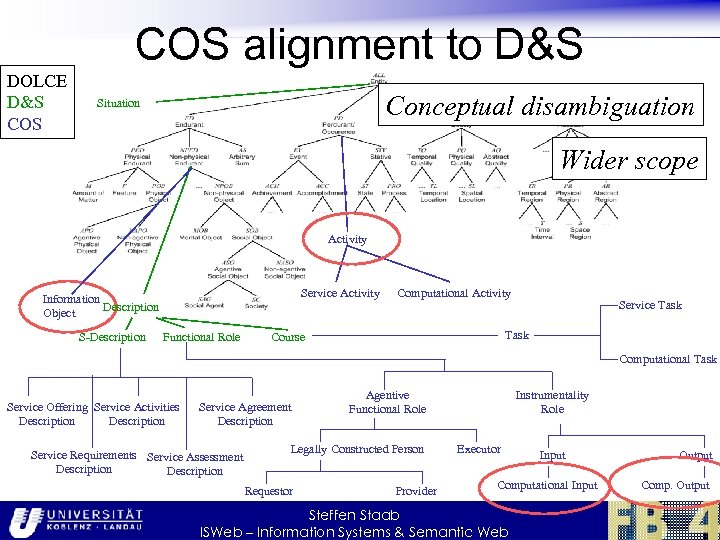
COS alignment to D&S DOLCE D&S COS Conceptual disambiguation Situation Wider scope Activity Service Activity Information Description Object S-Description Functional Role Computational Activity Service Task Course Computational Task Service Offering Service Activities Description Service Agreement Description Service Requirements Service Assessment Description Agentive Functional Role Legally Constructed Person Requestor Provider Instrumentality Role Executor Input Computational Input Steffen Staab ISWeb – Information Systems & Semantic Web Output Comp. Output
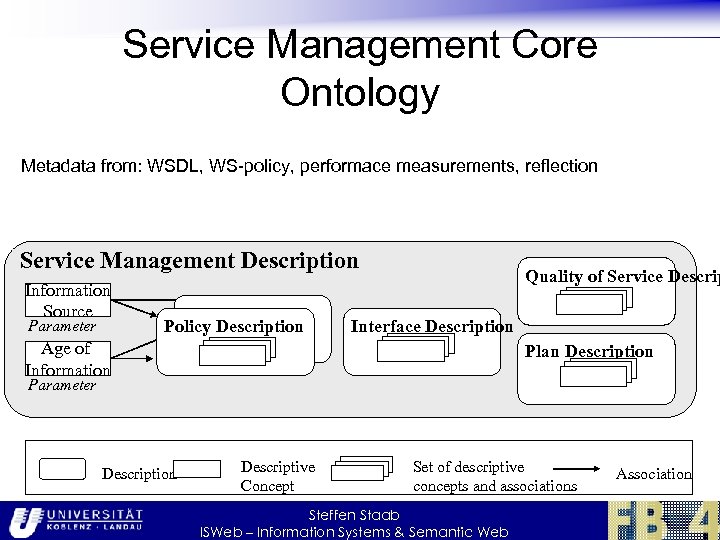
Service Management Core Ontology Metadata from: WSDL, WS-policy, performace measurements, reflection Service Management Description Information Source Parameter . . . Quality of Service Descrip . . . Policy Description Interface Description Age of Information Plan Description Parameter Description Descriptive Concept Set of descriptive concepts and associations Steffen Staab ISWeb – Information Systems & Semantic Web Association
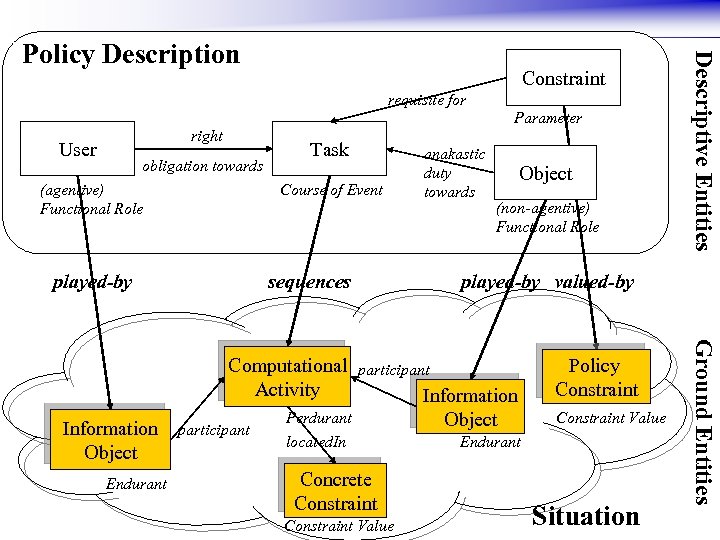
Constraint requisite for Parameter right User obligation towards (agentive) Functional Role Task Course of Event played-by sequences Endurant participant Object (non-agentive) Functional Role played-by valued-by participant Perdurant located. In Concrete Constraint Steffen Staab Information Object Policy Constraint Value Endurant Constraint Value ISWeb – Information Systems & Semantic Web Situation Ground Entities Computational Activity Information Object anakastic duty towards Descriptive Entities Policy Description
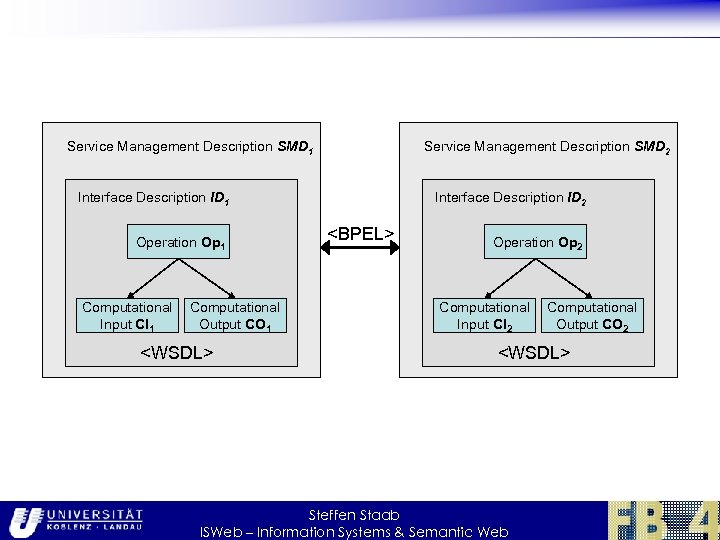
Service Management Description SMD 1 Service Management Description SMD 2 Interface Description ID 1 Operation Op 1 Computational Input CI 1 Computational Output CO 1 <WSDL> Interface Description ID 2 <BPEL> Operation Op 2 Computational Input CI 2 Computational Output CO 2 <WSDL> Steffen Staab ISWeb – Information Systems & Semantic Web
Integration in KAON Server Steffen Staab ISWeb – Information Systems & Semantic Web
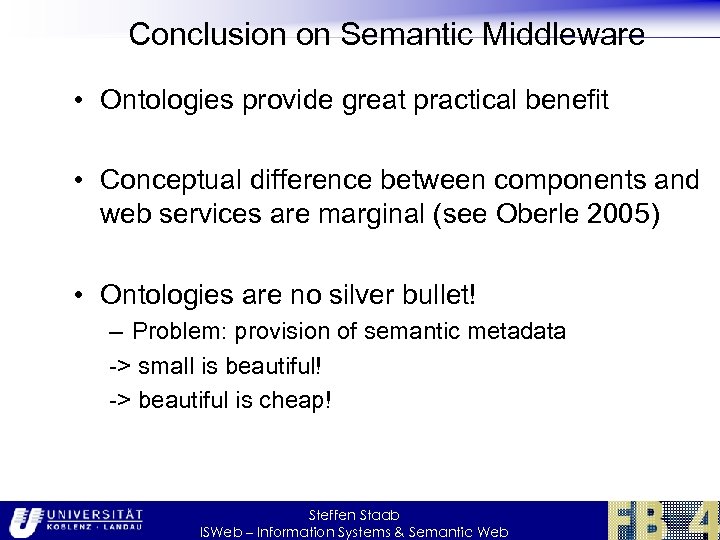
Conclusion on Semantic Middleware • Ontologies provide great practical benefit • Conceptual difference between components and web services are marginal (see Oberle 2005) • Ontologies are no silver bullet! – Problem: provision of semantic metadata -> small is beautiful! -> beautiful is cheap! Steffen Staab ISWeb – Information Systems & Semantic Web
Thank You! • D. Oberle, A. Eberhart, S. Staab, R. Volz. Developing and Managing Software Components in an ontology-based Application Server. In Proc. Middleware 2004, ACM/IFIP/USENIX International Middleware Conference, Toronto, October 18 -22, 2004, LNCS, Springer. • D. Oberle, S. Staab, R. Studer, R. Volz. Supporting Application Development in the Semantic Web. ACM Transactions on Internet Technology, 5(2), 2005. • D. Oberle, S. Lamparter, A. Eberhart, S. Staab. Semantic Management of Web Services. Tech Report (shorter version at Semantic Web Service Week, Innsbruck June 2006). • D. Oberle. Semantic Management of Middleware. Springer 2005/06 http: //isweb. uni-koblenz. de/ Steffen Staab ISWeb – Information Systems & Semantic Web
Web services constitute a middleware in order to model distributed applications and let them run on a set of heterogeneous platforms. Unfortunately, the many different Web service standards do not include a formal, let alone a common formal, model, which would allow to give an integrated, consistent view onto all of them. In this talk we sketch how ontologies may be used to integrate metadata about middleware in general and web services, in particular. Thus, we may answer about properties of web services in order to facilitate the life of the system developer and administrator for managing complex, distributed systems. Steffen Staab ISWeb – Information Systems & Semantic Web
Скачать презентацию Semantic Management of Web Services Steffen Staab Prague
fb441e9b4d2c5286d6961fe98c63394b.ppt